MICHAEL GILBERT – The Black Seraphim. Hodder & Stoughton, UK, hardcover, 1983. Harper & Row, US, hardcover. 1984. Penguin, US, paperback, 1985.
Michael Gilbert is one of the most versatile and prolific practitioners of the British mystery since the Golden Age. He has published over 300 short stories and over twenty mystery novels, of which The Black Seraphim is but the latest. He has published thrillers, novels of intrigue, police procedurals, and classic detective puzzles-and has shown himself to be competent or better at all of them.
The Black Seraphim qualifies as a classic mystery puzzle with modern flourishes. The amateur sleuth is no amateur but a professional pathologist, James Scotland, on an R-and-R visit to a British cathedral town. When the archdeacon is killed, Scotland’s rest turns into a stress-filled busman’s holiday.
The detection is handled along traditional lines. Gilbert, however, is interested in more than a puzzle. He enjoys examining the conflicts within the cathedral close, as well as the tensions between the secular community and their religious neighbors. With young Dr. Scotland as sleuth, there is an additional opportunity for an occasional debate over faith versus scientific inquiry.
The puzzle is worked out nicely, the characterization is excellent, and there is even a love story for them that likes ’em. Not one of Gilbert’s finest novels, The Black Seraphim is nonetheless very fine indeed.
Outstanding among Gilbert’s other non-series books are The Family Tomb (1969). The Body of a Girl (1972; Inspector Mercer’s only appearance in a novel, although he is featured in a number of short stories), and The Night of the Twelfth(1976).
Superintendent Vachell of the Chania Police [in Kenya] is brought in when Lady Baradale’s jewels turn up missing, then finds murder on his hands when the lady is found dead, near a pond full of hippos but shot between the eyes.
[A replica of a] small isolated English village taken to an extreme – one hundred miles from the nearest civilization. Most satisfying. The only whodunit (outside of Carr?) with footnotes to [point out] the clues – all fairly stated and still not much more.
— Reprinted from Mystery.File.3, February 1988.
The Inspector Vachell series —
Murder at Government House, 1937.
Murder on Safari, 1938.
The African Poison Murders, 1939.
FRANK GRUBER – The Laughing Fox. Johnny Fletcher & Sam Cragg #5. Farrar & Rinehart, hardcover, 1940. Serialized earlier (?) in Short Stories magazine, July 10 through August 25, 1940. Penguin, paperback, May 1944. Belmont-Tower, paperback, 1972.
Book salesmen Johnny Fletcher and Sam Cragg, on the scene at a midwestern cattle convention, are forced to act as detectives when a man is found murdered in their hotel room. The man was a fox breeder, with enemies among the other exhibitors, but he was killed as the consequence of a mystery involving a missing heir who disappeared twenty years before.
With a story meant primarily as fun, Gruber has too casual an attitude toward his plot, Fletcher and Cragg are happy scoundrels who mostly enjoy the scrapes they get into. But on page 49 [of the Penguin edition], Fletcher tells the police the whole story of how they found the body in their room, then on page 99, he is confronted with the story as if the previous episode had never happened.
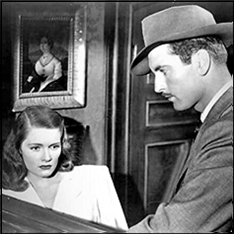
NOCTURNE. RKO Radio Pictures, 1946. George Raft, Lynn Bari, Virginia Huston, Joseph Pevney, Myrna Dell. Screenplay: Jonahan Latimer. Director: Edwin L. Marin.
When the death of womanizing songwriter is ruled a suicide by the coroner, a stubborn police lieutenant refuses to quit investigating the case. His primary suspect, however, is a woman he could easily fall in love with (even take home to his mother).
Raft is as stiff an actor in this movie as he ever was. Even his love scenes with Lyn Bari lack any kind of spark. The bit players are what make this movie at all worth seeing – the mystery is only so-so, with the murderer essentially confessing to make it easy.
Criminal confessions constitute some of the earliest hardboiled crime writing. This was back when people still believed in heaven and hell, and a forgiving God, who in exchange for a pure confession, might allow the soul of a repentant convict to traverse the pearly gates.
Jesse Strang abandoned his wife in Ohio, assumed the name Joe Orton, and ended up in Albany, New York, a guest at Cherry Hill mansion.
He’s at a bar, and there’s a wild girl there, pretty inviting. ‘Joe’ tells his buddy at the bar he wouldn’t mind playing hide the salami with the chick. And his buddy says he’s had her himself, and she’s there for the asking.
Her name is Elsie Whipple. That’s Mrs. Elsie Whipple to you.
And they flirt. She’s also a denizen of Cherry Hill mansion. They pass notes. Agreeing to burn after reading.
She wants to know his intentions. She says she loves him, she never thought love was possible, til now. She wants to run away with him, but she can’t, at least not until she gets her hands on $1200 to open a pub.
See, she had money. But old Mr. Whipple took it. She’d love to be a wife to Joe — but she wants them to do it right. Hence the need for money.
Maybe he’d kill Mr. Whipple for her. Do you love me enough to do that for me? He beats me. Please kill him — or else I’ll have to kill myself.
She gives him a taste of how good it can be, in the barn, in the spare bedroom. It’s pretty great.
Okay okay. He’ll do it. So they can be together.
And he does.
She immediately turns him in. And shows his letters to the cops.
And so, the hangman.
And the confession.
This sordid tale’s been around long before James M. Cain. Cain just honed down the prose and made it sing. Like Mrs. Whipple.
ANTHONY GILBERT – Mr. Crook Lifts the Mask. Arthur Crook #38. Random House, US, hardcover, 1970. Beagle, US, paperback, date?. Published earlier in the UK as Death Wears a Mask (Collins, UK, hardcover, 1970).
Lucy Beatrice Malleson’s mystery-writing career spanned almost fifty years and well over fifty novels. While she started her career as Anthony Gilbert with a polished and gentlemanly sleuth, Scott Egerton, Liberal M.P. and man about town, she is best known and loved for a very different kind of detective. In 1936 she introduced Arthur Crook. cockney lawyer, detective, and “The Criminal’s Hope.”
Of course, Crook’s clients are always innocent. And like Perry Mason, with whom he otherwise has very little in common, Crook always proves his client’s innocence by bringing the real murderer to justice.
In this late Gilbert title, Arthur Crook plays advocate and protector for a spunky spinster named May Forbes. On her nightly sojourn to “Broomstick Common” to feed the wild cats, she stumbles upon a man (in balaclava helmet and mask) about to bury a suspiciously large bundle. While fleeing this fearsome figure, May retreats into a noisy pub, and so into the life of Mr. Crook.
The bundle turns out to be the body of a young woman of loose morals and avaricious ambition. There are plenty of men who might have wanted the victim dead. One young fellow (not surprisingly, an out-of-towner) is arrested for the crime, but since May is sure of his innocence, Crook investigates.
The puzzle of Mr. Crook Lifts the Maskis perhaps a little too easy to guess. but the characters, especially May (or “Sugar,” as Crook calls her) and her man-hating. sharp-tongued friend, Mrs. Politi, are a delight. Arthur Crook. with his irrepressible optimism, his colorful slang. and his ancient yellow Rolls, “The Superb,” is a memorable sleuth. And Gilbert is skilled at creating tidy puzzles and eccentric characters.
THE FUGITIVE. “Tiger Left, Tiger Right.” 1964 October 20 (Season 2, episode 6). David Janssen (Dr. Richard Kimble), Leslie Nielsen, Carol Rossen. Created by Roy Huggins. Screenplay: William Link & Richard Levinson. Director: James Goldstone. (The entire series is available for viewing on the Internet Archive.)
By the time of this, the sixth episode of the second season, the story lines were well established. Dr. Kimball was on the run, having been convicted of a murder he did not commit, used a fake identity somewhere else every week, interacting with a new family or anyone giving him shelter for a time. (If he ever stayed in one place for more than week, I don’t know about it.)
He’s staying with the Cheyney family this week: mother, father, young boy, working as a gardener, when he is kidnapped and a ransom is asked. He has been mistaken for the father by another couple, desperate for both money and revenge. The man is disabled, and he blames the father of the family Kimball is working for.
This is quite a situation for the latter, as man on the tun. He is in the hands of a couple who will kill him as likely as not, once they realize their mistake, but if by happy chance he is rescued, the police will recognize him as a fugitive, and back to prison he will go.
It’s a good story with lots of drama and suspense, and it’s greatly enhanced by excellent acting by all of the players involved, especially David Janssen, young and handsome at the time, and as the doctor on the run, as cool as anyone could be in such a situation, as always.
And as I mentioned up above, with Dr. Kimball interacting with his two captors with coolly nervous aplomb until the end, upon which time he makes his escape in all the chaos of a most satisfying conclusion.
DONALD HAMILTON – The Infiltrators. Matt Helm #21. Gold Medal; paperback original; 1st printing, June 1984.
Matt Helm helps rehabilitate a lady attorney just released from prison and in the process discovers that not only is the lady’s story true, but that there are some very fancy worms in the government’s woodwork.
I liked the first half (the reclamation project) better than the second (the work Helm gets paid for). Too much padding, and too much coincidence (although you don’t realize the latter until some time later).
Back to the Wells, Part 4:
The War of the Worlds
by Matthew R. Bradley
As previously noted, I never owned the Berkley Highland edition of H.G. Wells’s The War of the Worlds (1898) with Paul Lehr’s cover art, having purchased my long-gone, oversized trade paperback—now identified, with the aid of my main man Gilbert Colon, as a 1969 Elephant Edition from Pendulum Press—at a grade-school book fair.
Since my 1986 Signet Classic edition has an afterword by SF legend Isaac Asimov, I don’t exactly feel short-changed. He notes, “Wells was well-grounded in the science of his day and he was always careful, in his science fiction tales, to draw upon actual science as much as he could,” e.g., American astronomer Percival Lowell’s book Mars (1894), which suggested intelligent Martians, based on the later-discredited observations of “canals” on its surface.
What Asimov calls “the very first tale of interplanetary warfare the world had ever seen, the first story of an invasion of Earth by alien beings” returns to the first person after The Invisible Man (1897). “No one would have believed in the last years of the nineteenth century that this world was being watched keenly and closely by intelligences greater than man’s… Yet across the gulf of space…intellects vast and cool and unsympathetic, regarded this earth with envious eyes, and slowly and surely drew their plans against us.” Writing early in the next century, the unnamed narrator joins an astronomer, Ogilvy, at an observatory in the Surrey village of Ottershaw, and sees a “jetting out of gas” from Mars.
After the first falling star is seen rushing over Winchester, Ogilvy—certain that a meteor has fallen on nearby Horsell Common—is surprised to find that “the Thing” is a cylinder with a 30-yard diameter, whose circular top begins to unscrew.
Mentally linking it with the flash on Mars, he fetches London journalist Henderson from Woking, yet upon their arrival, the signs of life have ceased; alerted by his newspaper boy to the presumed “dead men from Mars,” the narrator hastens there from his home in Maybury, finding it equally inert. Later, the pit surrounded by a crowd of hundreds, the end of the screw comes out, and what emerges is not the man-like occupant they expect, but a many-tentacled horror.
The pulsating, bear-sized “rounded bulk [rises] slowly and painfully…due to the greater gravitational energy of the earth”; it has “oily brown skin [that] glistened like wet leather [and two] immense eyes [with] extraordinary intensity [above a] V-shaped mouth…the lipless brim of which quivered and panted, and dropped saliva.” It is joined by another, and as the crowd scatters in horror, a shopman accidentally pushed into the pit vanishes while trying to climb out, shrieks, and is heard no more. A Deputation including Ogilvy, Henderson, and Stent, the Astronomer Royal, advances waving a white flag in an attempt to communicate, only to be incinerated by the Heat-Ray from a “black, domelike object.”
Returning home after his terrified flight, the narrator reassures his wife that the Martians’ limited mobility will confine them to the pit, yet inside it, a noise of hammering betokens the machines they are making ready, and another cylinder falls by the Byfleet Golf Links.
Soldiers arrive, and with the Heat-Ray coming too close for comfort, he takes his wife to her cousins in Leatherhead, renting a cart from the Spotted Dog’s landlord. As he departs in a violent thunderstorm, a third cylinder falls, while the lightning reveals a “monstrous tripod, higher than many houses, striding over the young pine trees, and smashing them aside…a walking engine of glittering metal…articulate ropes of steel dangling from it…”
Crashing the cart as a second appears, emitting puffs of green smoke from its joints and a deafening howl of “Aloo! Aloo!,” the narrator makes his way home on foot, stumbling on the landlord’s body en route. He offers refuge to a passing soldier, who relates their rout by the hooded tripods—also equipped with Heat-Rays—then himself sees Weybridge and Shepperton laid to waste: “Never before in the history of warfare had destruction been so indiscriminate and universal.” Fearing a “disastrous struggle” around London, he plans to take his wife out of the country from Leatherhead to Newhaven, detouring via Epsom to avoid the third cylinder, yet nearly loses his life in the Thames as the Heat-Ray boils it.
As cylinders fall daily and more artillery is arrayed, having felled one tripod, the narrator presses on toward London, paddling downriver in an abandoned boat, and while he lies dozing, exhausted, on the Middlesex side, he is joined by a curate fleeing Weybridge, his mind shaken by what he has seen.
Meanwhile—with news slow to travel—his brother, a medical student, is among the Londoners unaware of the gravity of the situation until the approach of the “boilers on stilts” and a poisonous Black Smoke that stifles the gunners. The end of organized opposition leads to “the great panic” and a mass exodus, with the narrator’s brother saving two ladies from a gang trying to steal their “little pony-chaise.”
On the Essex coast, the trio secures passage aboard an Ostend-bound paddle steamer, and after the vividly described chaos—with its torrent of real locales adding verisimilitude—“Book One: The Coming of the Martians” concludes as the torpedo ram H.M.S. Thunder Child destroys two tripods before being sunk.
“The Earth under the Martians” resumes the narrator’s attempt to reach Leatherhead, when he and the curate see a Martian picking up people and tossing them in a metallic carrier. A cylinder hits the house where they are foraging for food, burying them under the ruins with a sentinel tripod nearby, and from concealment therein, they have a unique opportunity to observe the enemy at close range.
During their days of imprisonment, the narrator sees a spidery “handling-machine” in the pit remove and assemble pieces of an apparatus from the cylinder. The Martians, which he believes communicate telepathically, are sexless and never sleep, have evolved largely into brain, and obviate digestion by injecting “fresh, living blood of other creatures…into their own veins,” hence the human-harvesting. “Micro-organisms, which cause so much disease and pain on earth, have either never appeared on Mars or Martian sanitary science eliminated them ages ago. A hundred diseases, all the fevers and contagions of human life, consumption, cancers, tumours and such…never entered the scheme of their life.”
Now insane, the curate resists rationing the food, loudly proclaims that God is punishing humanity, and forces the narrator to silence him with the butt of a meat chopper, too late to prevent alerting a Martian; as he hides in the coal cellar, a tentacle pulls the curate out to his death.
On the 15th day, he escapes, finding the unoccupied pit overrun by Mars’s red weed and containing aluminum bars refined from the clay. Raiding gardens for food, he feels like “an animal among the animals, under the Martian heel,” amid great swathes of destruction and the weed choking the Thames and the Wey, which finally “succumbed almost as quickly as it had spread…due, it is believed, to the action of certain bacteria…”
On Putney Hill, the narrator encounters the artilleryman he’d sheltered, who believes the Martians are learning to fly; if so, “It is all over with humanity,” destined to be bred for food, made pets, or trained to hunt one another.
He parts from “this strange undisciplined dreamer,” who envisions the ablest humans surviving underground in drains and tunnels, preserving their knowledge in books, ultimately capturing tripods to turn their Heat-Rays against the Martians. Traversing dead London, the narrator hears a wailing of “Ulla, ulla, ulla, ulla” from a stationary tripod, then stilled, and finds the wrecked handling-machine whence “a pack of starving mongrels [competes over] a piece of putrescent red meat…”
Other motionless tripods, with hungry birds pecking at “lank shreds of brown” hanging from their hoods, reveal that the Martians had succumbed to “the putrefactive and disease bacteria against which their systems were unprepared…slain, after all man’s devices had failed, by the humblest things that God, in his wisdom, had put upon this earth.”
As the joyful news spreads around the world and relief pours into London, the unwitting narrator is taken in, wandering and raving, by kindly people who inform him that Leatherhead has been destroyed. Yet soon after he returns home, his wife and cousin arrive to seek him, and he marvels “that I have counted her, and that she has counted me, among the dead.”
The War of the Worlds (1953) was one of four collaborations between producer George Pal and director Byron Haskin (1899-1994); The Naked Jungle(1954) was based on Carl Stephenson’s “Leiningen Versus the Ants” (Esquire, December 1938), which resembles Wells’s “The Empire of the Ants” (The Strand Magazine, December 1905). The woes of Conquest of Space (1955) are legendary, and their reunion on The Power (1968) fared no better. In the interim, Haskin directed From the Earth to the Moon (1958), shifting from Wells to Jules Verne, and Robinson Crusoe on Mars (1964), an update of Daniel Defoe’s classic, also contributing to the seminal SF series The Outer Limits in various capacities.
From 1922 to 1937, Haskin was primarily a cinematographer, with occasional directorial credits, and in the second phase of his career, through 1944, he worked mainly in special effects. Nominated for four consecutive Academy Awards in that category (1940-1943), after winning the 1939 technical achievement award for the development and application of the triple head background projector, he was thus ideal for the effects-heavy War of the Worlds. Ironically, it earned Gordon Jennings the special-effects Oscar that had eluded Haskin; Warwas also nominated for film editing (Everett Douglas) and sound recording (Loren L. Ryder), and received a 2004 “Retro Hugo” for the Best Dramatic Presentation.
For years, I lamented that, unlike in his Wells adaptation The Time Machine (1960), Pal had updated the story to the present with a script by Barré Lyndon, who wrote the twice-filmed stage play The Man in Half Moon Street (1939). He adapted the 1944 version of The Lodger and the Thriller episode “Yours Truly, Jack the Ripper” (4/11/61) from well-known works about the serial killer, and was one of the writers on the ill-fated Conquest. But I grew to see the wisdom of giving it an immediacy with a modern setting, following in the footsteps of Orson Welles, whose Mercury Theatreon the Air broadcast (10/30/38) sparked the furore re-enacted in the TV-movie The Night That Panicked America(1975).
In his Directors Guild of America Oral History interview with Joe Adamson, Haskin said, “The threat to humanity…was an antiquated machine looking like a water tank tottering around the country on creaky legs, blowing whiffs of smoke, frightening a cast directly out of Agatha Christie—the vicar and the butler and other rural characters….[But] we had to consider the atomic bomb and the impact of that technology…I thought surely we should modernize it, which meant a new story, with new characters. [So w]e ignored the people and the complications of the [Wells novel] and created a new story line with new characters and complications,” headed by physicist Dr. Clayton Forrester (Gene Barry).
Among the illustrious names who had been attached to the property, or expressed interest in adapting it, since Paramount had acquired it in the ’20s were Cecil B. DeMille, Sergei Eisenstein, Alfred Hitchcock, Alexander Korda, and Pal’s old Puppetoons colleague Ray Harryhausen, who even animated test footage of the Martian emerging from the cylinder.
The film opens on a literal high note, with Leith Stevens’s enthusiastic main-title theme, and multi-colored credits punctuated by flashes of lightning. Depictions of the planets by astronomical artist Chesley Bonestell—like Stevens a frequent Pal collaborator—underly a commentary by Sir Cedric Hardwicke, some of it taken almost verbatim from the novel.
By the marquee for a reissue of DeMille’s Samson and Delilah (1949), Sylvia Van Buren (Ann Robinson) and her pastor uncle, Dr. Matthew Collins (Lewis Martin), see the initial “meteor” fall near Linda Rosa, starting a blaze soon brought under control. As it cools, the lookout suggests that some Pacific Tech scientists fishing up at Pine Summit check it out, so Forrester remains while Pryor (Bob Cornthwaite) flies Bilderbeck (Sandro Giglio) back in Forrester’s plane. Sylvia, who teaches library science at USC, is familiar with his work and meets him at the crater, where Forrester detects radioactivity, prompting Sheriff Bogany (Walter Sande) to post some deputies, and infers that the meteor must be hollow.
Forrester is invited to stay with Collins while it cools further, but as he joins Sylvia for a square dance in the social hall, Wash Perry (Bill Phipps), Salvatore (Jack Kruschen), and Alonzo Hogue (Paul Birch) see the cylinder unscrew, immolated with their white flag by a cobra-like appendage that emerges. At the dance, the lights, phone, and watches all go dead; with his watch magnetized and a compass now pointing to the gully, Forrester has Bogany alert the military after they see the men’s ashes and another cylinder descending. Marine Colonel Ralph Heffner (Vernon Rich) surrounds the gully as Canada’s Professor McPherson (Edgar Barrier) confirms the reports of cylinders falling in European nations.
After much activity in the gully and the arrival of Major General Mann (Les Tremayne), with reports of mass destruction spreading worldwide, the Martian war machine arises, a manta-ray-shaped craft made of copper and designed by co-art director (with Hal Pereira) Albert Nozaki, supported by three invisible legs of energy.
Seeking to communicate with an advanced civilization he presumes is “nearer the Creator,” Collins approaches, a Bible held high, reciting Psalm 23, only to be mown down. During a fruitless attack, exploding shells reveal impenetrable electromagnetic domes; as Mann races to warn Washington of their meson-neutralizing energy beam, Heffner is killed leading a doomed holding action.
The military plane in which Forrester and Sylvia are fleeing crashes, so they take refuge in a deserted farmhouse, where she relates wandering off as a child, waiting in a church for “the one who loved me best,” Uncle Matthew, to find her. As in the novel, the house is hit by a falling cylinder and penetrated by a tentacle; Forrester chops off the tri-colored electronic eye it bears and scares away the diminutive, spindly Martian (Charles Gemora) that touches her shoulder. During “the rout of civilization [and] massacre of humanity,” with its torrents of refugees, Washington is the only “unassailed strategic point,” at which Mann is informed of the decision to use the atom bomb, to be monitored by Pacific Tech.
Forrester and Sylvia finally arrive with the eye and her scarf, soaked with Martian blood that Dr. Duprey (Ann Codee) says is extremely anemic. Bilderbeck attributes their light-sensitivity to Mars’s weaker sunlight, noting that “everything about them seems to be in threes”; Dr. James (Alex Frazer) connects the eye to a projector, so they see themselves from the Martians’ distorted viewpoint.
With all radio dead, reporter Paul Frees, later of The Time Machine, makes tape-recordings for the benefit of posterity, “if any,” and as the bomb is shrugged off, L.A. is evacuated, with Mann vowing to fight on with whatever the scientists can develop—but their instrument-filled truck is seized en route to the Rockies.
The impressive scenes of the exodus alternate the spectacles of streets choked with cars and people, literally heading for the hills, or empty and strewn with debris, while the mob separates Sylvia from the scientists. Forrester searches for her as the Martians decimate the city, with extremely detailed miniatures, and finally finds her, as he knew he would, in the Reverend Bethany’s (Russ Conway) church; suddenly, silence breaks out as a war machine crashes into the street, a sight that we learn is swiftly repeated around the world. Forrester watches its hatch open above the rubble and an arm bearing three digits—each tipped with what looks like a suction cup—slowly emerge, pulsate briefly, then lie limp.
Hardwicke explains, “The Martians had no resistance to the bacteria in our atmosphere to which we have long since become immune [so they] began to kill them”; his closing line, again almost verbatim from Wells, completes a religious motif.
Said Haskin, “I was as responsible as anybody for a lot of the major turns [from sometime atheist Wells]. The constant re-occurrence of the religious note came from having nobody solving our final dilemma but God. It became expedient to ring a few church bells to get some kind of ominous feel to the goddamn thing.” When Bilderbeck says, “the Martians can conquer the Earth in six days,” Sylvia points out, “The same number of days it took to create it.”
Although DeMille chose not to make the film himself, he heartily endorsed his friend Pal as producer, rendering every support possible; Pal and associate producer Frank Freeman, Jr.—another of his champions, and the son of Paramount head Y. Frank Freeman—have cameos as bums listening to a radio news broadcast. The grateful Pal also asked DeMille to narrate, but in declining, he suggested Hardwicke, a veteran of Wells’s Things to Come (1936) and an apt choice to read his fellow Englishman’s words. In an early, and perhaps wisely abandoned, plan, the last portion of the film was to have been shot in 3-D, with the audience donning their glasses as the cast did their protective goggles before the a-bomb.
In 1988, in dubious homage, Trace Beaulieu debuted as mad scientist Clayton Forrester on the perennial Mystery Science Theater 3000, while the two-season syndicated series The War of the Worlds premiered; Robinson returned as Sylvia in this continuation of the film, positing that the aliens—retconned as coming from Mor-Tax, not Mars—had been in suspended animation.
She and Barry also had cameos as the grandparents in Steven Spielberg’s big-budget 2005 remake with Tom Cruise, which restored elements such as the red weed, the harvesting of blood (to fertilize it), and an analog of the curate. Yet it seems safe to say that as the granddaddy of alien invasions, this War will go on forever.
Up next: The First Men in the Moon
Sources/works consulted:
Asimov, Isaac, afterword to The War of the Worlds, pp. 206-215.
Baxter, John, Science Fiction in the Cinema: 1895-1970 (The International Film Guide Series; New York: A.S. Barnes, 1970).
Brosnan, John, Future Tense: The Cinema of Science Fiction (New York: St. Martin’s, 1978).
Gunn, James, editor, The New Encyclopedia of Science Fiction (New York: Viking, 1988).
Hardy, Phil, editor, The Overlook Film Encyclopedia: Science Fiction (Woodstock, NY: Overlook, 1995).
Haskin, Byron, Byron Haskin: A Directors Guild of America Oral History, interviewed by Joe Adamson(Metuchen, NJ: Scarecrow, 1984).
Internet Movie Database (IMDb)
Internet Speculative Fiction Database (ISFDb)
Von Gunden, Kenneth, and Stuart H. Stock, Twenty All-Time Great Science Fiction Films(New York: Arlington House, 1982).
Warren, Bill, Keep Watching the Skies!: American Science Fiction Movies of the Fifties (2 volumes; Jefferson, NC: McFarland, 1982-6).
Wells, H.G., The War of the Worlds(New York: Signet Classic, 1986).
ROBERT A. HEINLEIN “All You Zombies –.” First published in The Magazine of Fantasy and Science Fiction, March 1959, after reportedly being rejected by Playboy after that magazine had requested a short work of adult fiction from the author. Collected in The Unpleasant Profession of Jonathan Hoag (Gnome Press, hardcover, 1959). Reprinted many time since, including The Arbor House Treasury of Modern Science Fiction, edited by Martin H. Greenberg & Robert Silverberg (Arbor House, 1980) and Time Troopers, edited by Hank Davis & Christopher Ruocchio (Baen Books, 2022).
A guy walks into a bar and eventually begins telling on the other side of the counter his life story. It’s a strange one. It turns out that he, so far, has had a very strange existence. He was born a girl but was stolen from his mother when he was born. He did have a child while still female…
And from there it gets complicated. I think I have explained everything as best I can without telling you everything, but between you and me and a handy time travel machine, there is only one major character in the story. Only one.
I loved this story when I first read it, I don’t remember where or when, was totally puzzled the second time. Third time, a couple of days ago, and I loved it again, the pieces all falling into place as smoothly as anyone could make it. If there were any flaws, but given the number of times it’s collected and reprinted, someone else would have found them by now.
The title? That’s one the first things that comes to our protagonist’s mind once he comes to grips with his life in the world. Where (or how) do the rest of us come in?
For the record, reading this yesterday and trying to keep the threads of the story straight, I was struck by how smooth a writer Robert Heinlein was when he was at his prime. He was one of the best.
Devoted to mystery and detective fiction — the books, the films, the authors, and those who read, watch, collect and make annotated lists of them. All uncredited posts are by me, Steve Lewis.