Uncategorized


MARY DURHAM, Mystery Writer:
A Bio-Bibliographical Essay by Jamie Sturgeon.


   If you look in Hubin, the indispensable Crime Fiction Bibliography, amongst the authors, you will see the name Mary Durham, for eleven murder mysteries she had published in the United Kingdom between 1945 (Hate Is My Livery) and 1952 (The Devil Was Sick). No biographical details are given in Hubin or in any of her books.
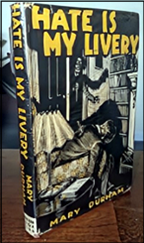
   Until now, nothing was known about the author, not even even whether Mary Durham was a pseudonym. Recently however I have discovered details about Mary Durham and her life, but before I reveal what I have unearthed, here is a summary of her books and publishing history.

   She had three different publishers: starting and ending with John Gifford (four books in total), with John Crowther (four books) and Skeffington (three books) issuing her other books. Her first book, Hate Is My Livery was published in June 1945 by John Gifford, with a Thriller Book Club edition as well. It is an excellent wartime mystery concerning the stabbing to death of an M.P. It has echoes of Freeman Wills Crofts and Christopher Bush in its alibi-busting solution — the detective is Inspector Randolph York who appears in three other titles, including the next Why Pick on Pickles?
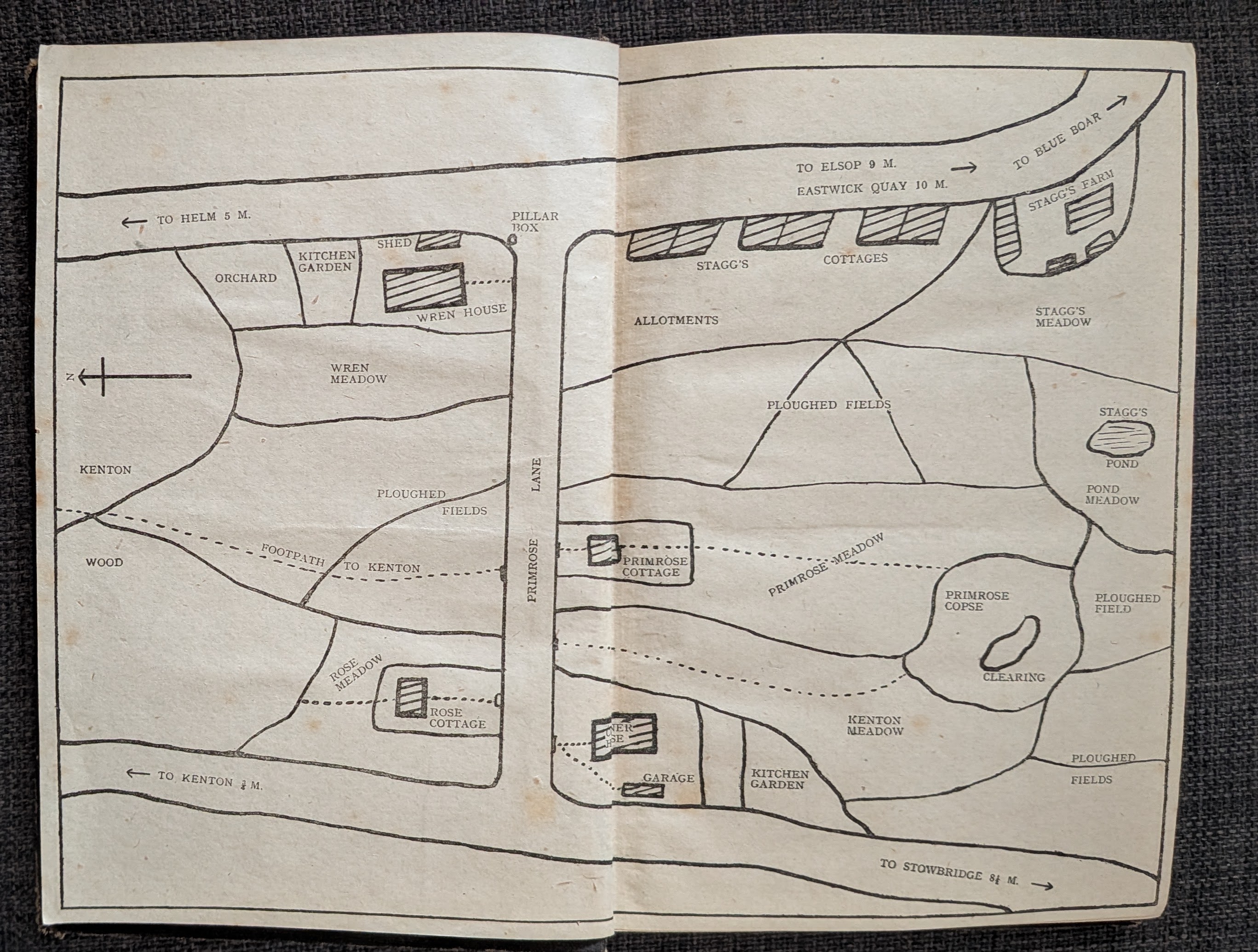
   This second novel is set in the autumn of 1939, during the early days of the Second World War, when Chamberlain assured everybody that it was better to be bored than bombed. All who knew Frederick Ponsonby Pickles asked why such a harmless little man should have been the victim of a brutal murder; found throttled to death in the entrance lobby of his country cottage. It presents a puzzle for Inspector York to solve, which he eventually does with the help of his young assistant, Detective-Sergeant Noel Hammond.  The book was published by the small firm of John Crowther as were the next three titles.
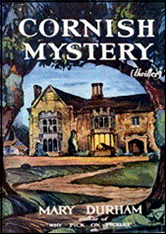
   Her third book is a stand-alone title, Cornish Mystery. The body of a woman artist is found deep in a stagnant pool, there are many suspects, but all have alibis. The murderer is cleverly hidden, a feature that reoccurs in her next book, Keeps Death His Court.

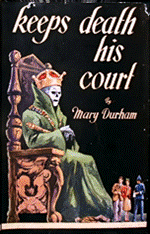
   Sir Philip Linwood, an English Baronet with a fearsome reputation, is found murdered during Christmas Eve in the grounds of his country estate in Yorkshire; another case for Inspector York to solve. It was reprinted in Italian in 2020 as a Christmas Mystery under the title Morte a Linwood Court.

   York investigates again in her fifth book, Crime Insoluble. It starts with an intriguing premise: two unnamed characters are discussing the vengeance murder of another person, the toss of a coin to decide which of them will commit the crime. I thought I had worked out ‘whodunnit’, but there’s a clever twist at the end and I was wrong.
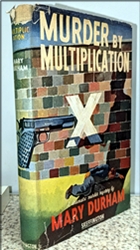
   Then come three books published by Skeffington. I suspect they may have been her first written books: Murder by Multiplication and Murder Hath Charms are both set in the 1930s. In Murder by Multiplication a collection of ill-assorted guests is assembled at a country house for a weekend party and the house becomes the scene of a diabolically ingenious murder.

   The book has a clever plot but has a very dull section in the middle where the narrator and one of the characters discuss where various people were at the time of the murder, the author uses lots of A’s & B’s X”s etc making it hard going to read. But it is redeemed by having a surprise murderer, found by the ‘suave but shrewd personality’ Inspector York.
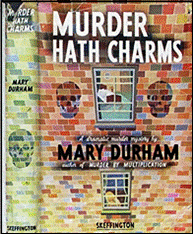
   In Murder Hath Charms it takes Inspector Hilton exactly six days to lay his hands upon the murderer of Henry Phillips, who is found strangled on an afternoon in August 1935 after an attack of sunstroke. It appears impossible for any of the suspects to have committed the murder, but the author pulls a rabbit out of a hat with at the last minute the detective working out who did it and how.

   Her third and last book for Skeffington Corpse Errant is her hardest book to find and I have never seen a copy. A contemporary newspaper review helpfully outlines the plot. It concerns a young woman who upon arrival at a new job as a secretary at Grover Court finds a dead body when it falls out of her bedroom cupboard. The body disappears and a series of amazing episodes ensue. Eventually Scotland Yard is called in, and Inspector Charles solves the mystery.
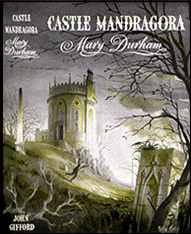
   Her original publisher, John Gifford, published her final three books. Castle Mandragora is set in the early 1930s and is a first-person narrative. It is a crime thriller, with elements of the supernatural throughout, set in the Suffolk Brecklands and complete with a diagram of the castle layout. The police appear only briefly, and the explanation of the crime comes in an epilogue written by a friend and former colleague of the narrator.
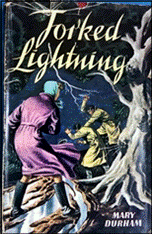
   Forked Lightning introduces a new detective, Inspector Christopher March who also appears in her final book. The blurb starts: ‘When the attractive young novelist, Jessica Munro, sets out from her cottage one night in a heavy thunderstorm to post an urgent letter, she plunges straight into the heart of a nightmare. A flash of forked lightning reveals a terrifying scene, and Jessica cannot escape the consequences of what she witnesses’.

   It seems there can be only one person who could have committed the murder that Jessica has seen but once again the author cleverly misdirects the reader and the actual culprit is not someone obvious.
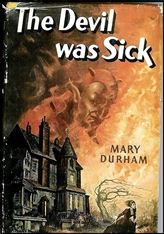
   Her last book, published in April 1952, was The Devil Was Sick; in a review in the author’s local newspaper, it says that the book ‘presents the Sorrell family of writers whose oscillating passions cause a sequence of events ending in catastrophe’. There are too many with a motive for committing the crime and the change in character of the person who is murdered seems a little farfetched. The ending is disappointing as well.

      Mary Durham Bibliography (from Hubin)

         All the following books are set in England:

Hate Is My Livery -– John Gifford 1945 – Insp. (Chief Insp.) Randolph York
Why Pick on Pickles? — John Crowther 1945 – Insp. (Chief Insp.) Randolph York
Cornish Mystery — John Crowther 1946
Keeps Death His Court — John Crowther 1946 – Insp. (Chief Insp.) Randolph York
Crime Insoluble — John Crowther 1947 – Insp. (Chief Insp.) Randolph York
Murder by Multiplication — Skeffington 1948 – Insp. (Chief Insp.) Randolph York
Murder Hath Charms — Skeffington 1948
Corpse Errant — Skeffington 1949
Castle Mandragora — John Gifford 1950
Forked Lightning — John Gifford 1951 – Insp. (Chief Insp.) Christopher March
The Devil Was Sick — John Gifford 1952 – Insp. (Chief Insp.) Christopher March

   So, who was Mary Durham? A few months ago, Mauro Boncompagni, a keen and very knowledgeable collector of crime fiction, told me he’d found for sale on eBay a letter from the author to a fan of her books, that gave her full address, which happened to be in Felixstowe, an East of England coastal town in the county of Suffolk. From this, it was a short step using the genealogical website Ancestry and the British Newspaper Archive to find details about her and her life.
   Born Mary Edith Emily Hervey on the 24 February 1891 in Shotley, a village near Ipswich in Suffolk. She was the second daughter of the Reverend John Frederick Arthur Hervey, a rector of Shotley for 56 years, and had three siblings. Her grandfather was Lord Arthur Charles Hervey, a Bishop of Bath & Wells. Her great grandfather was the 1st Marquess of Bristol, Frederick Hervey.

   Mary married Reverend John Francis Langton Durham in Felixstowe in September 1929. At the time he was an assistant priest at a church in London. He was an army chaplain from May 1939. She obtained a First Class Honours Degree (Bsc) in Economics from the London School of Economics in the same year. In the 1939 Register which was taken on 29 September, Mary Durham is listed as married and residing in Felixstowe with her mother and unmarried sister, but there is no mention of her husband John. There were no children from their marriage, and the couple separated, probably before the end of the Second World War.

   Of her three siblings only her sister Patience Gertrude Hervey produced an offspring, a daughter Josephine Griffin, born in December 1928. Josephine was an actress; her films included the Francis Durbridge thriller Portrait of Alison, The Man Who Never Was, and The Purple Plain. Under her married name Josephine Filmer-Sankey she co-wrote a history of the Bayeux Tapestry, published in 1966.

   A few months after Mary Durham’s second book was published, The Felixstowe Times newspaper reported in May 1946 in a brief piece entitled ‘Thriller With Local Setting’, that as well as writing thrillers she was a teacher of economics and had taken a flat in that town. It also reported that she had spent four years in Cornwall during the Second World War.

   Mary Edith Emily Durham died in hospital in Felixstowe on December 28, 1972, aged 81.

   If you want to try a new author who wrote in the Golden Age of Detection tradition Mary Durham is well worth seeking out. While some of her books are difficult to find, the Thriller Book Club editions of the last three John Gifford titles are easier, and cheaper! All her books will repay investment in them.
A 1001 MIDNIGHTS Review
by Marcia Muller


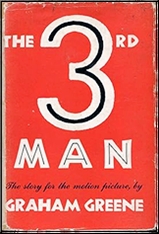
GRAHAM GREENE – The Third Man. Viking, US, hardcover, 1950.  Reprinted many times.

   Rollo Martins, a somewhat drunken writer of westerns, has come to Vienna at the request of his old school friend, Harry Lime. Lime has suggested he might write a piece on the postwar international refugee problem and pay his way to the divided city. But when Martins arrives, Lime is dead, having been run over by a car in front of his building, and Martins is barely in time for his funeral. There he meets Colonel Calloway of the British occupational police force; Calloway is interested in Lime, and in Martins’ association with him.

   Although he has little money, Martins manages to stay on in Vienna by cadging funds from a variety of people who seem extraordinarily concerned with his welfare. And soon questions about Harry Lime begin to plague him: Who was his friend, really? A harmless adult version of the boy Martins knew at school — a young rogue who played all the angles? Or a vicious racketeer, the worst Vienna has ever seen? Why did Lime really want Martins to come to Vienna? Was Lime’s death merely an accident. or was it very deliberately staged? And who was the third man at the scene when he died-the third man who disappeared shortly after?

   Martins becomes more and more convinced that Lime’s death was no accident, and he crosses the various zones of the war-tom city searching for the mysterious third man. Set against the backdrop of postwar Vienna, and told alternately from Colonel Calloway’s and Martins’ viewpoints, this is an intriguing and suspenseful novel that contains a number of surprises.

   The Third Man was the basis for a gem of a film of the same title, made in 1949, directed by Carol Reed, and featuring Joseph Cotten, Orson Welles, and Trevor Howard.

   Other equally absorbing thrillers by Greene include Orient Express (1933); This Gun for Hire (1936), made into a tense 1942 film starring Alan Ladd in his first major role; Brighton Rock (1956); The Quiet American (1956); Our Man in Havana (1958), the screen version of which showcases Alec Guinness in one of his best roles; and The Honorary Consul (1973).

———
   Reprinted with permission from 1001 Midnights, edited by Bill Pronzini & Marcia Muller and published by The Battered Silicon Dispatch Box, 2007.   Copyright © 1986, 2007 by the Pronzini-Muller Family Trust.

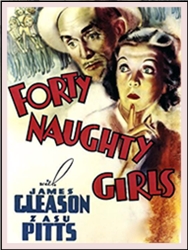
FORTY NAUGHTY GIRLS. RKO Radio Pictures, 1937. James Gleason (Inspector Oscar Piper), Zasu Pitts (Hildegarde Withers), Marjorie Lord, Joan Woodbury, Tom Kennedy. Based on story and/or characters created by Stuart Palmer. Director: Edward Cline.

   Nothing naughty about this movie at all. What this is instead is the last of the Hildegarde Withers movies, as she and Inspector Piper solve the murders committed backstage while a musical is going on. We see a lot of legs but nothing more.

   Zasu Pitts, the last of three actresses to play Miss Withers, cuts down on her usual flutter and settles for mere clumsiness instead, while Gleason acts like he’s auditioning for the Three Stooges, This does mark the first use of the nitrate test in the movies, though.

— Reprinted from Movie.File.2, April 1988.

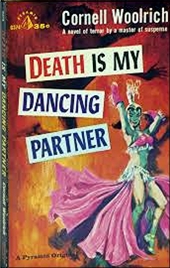
CORNELL WOOLRICH – Death Is My Dancing Partner. Pyramid G374, paperback original; 1st printing, 1959. Savage Bride / Death is My Dancing Partner / Doom Stone, Centipede Press, hardcover, 2025.

   Bandleader Maxwell Jones helps a dancer from an Oriental temple, then uses her erotic Dance of Death for fame and fortune, with coincidence and promotion adding to the legend as it builds. Her love for him is not returned; he does not even treat her as a person, a fact that does not seem believable, nor is her success in making him jealous.

   After 100 pages, their strange love affair has been established, but by this time, his fear of her dance causes their common fortunes to decline: they are now living in the depths of a poor Panamanian café. The terror and suspense that has been promised thus far are confined to the last chapter only, as the dancer tests the curse of the dance, as they find themselves locked together in their hotel room…

   To me, the story would have been better told as a shorter story, with the lengthy “love affair” eliminated. My rating below is almost only for the ending.

Rating: ***½

— July 1969.

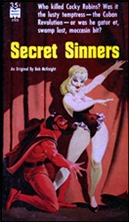
BOB McKNIGHT – Secret Sinners. Merit 355, paperback original; 1st printing, June 1960.

   Or, perhaps as an alternate title, The Case of Cocky Robin. No kidding. Attorney Arch Behan is hired by Cocky’s sister, to locate him after he turns up missing. Just as in The Bikini Bombshell (reviewed here), the story takes place in Florida, and involves gun-running to Castro’s rebels.

   And lots of naked, willing women. This is a story for red-blooded males, that is for sure. The swamp girl who wants Arch to help her make a baby is tops. One question: a Miami deputy think Cocky might have been “gator et.” What could he have meant?

— Reprinted from Mystery.File.5, May 1988.


PostScript: If you follow the link above to my review of The Bikini Bombshell , be sure to read on to the comments that follow.

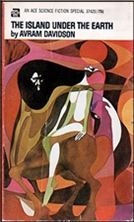
AVRAM DAVIDSON – The Island Under the Earth. Ace SF Special; paperback original. 1st printing, 1969. Cover art: Leo Dillon & Diane Dillon.

   Although published as an ACE SF Special, this is pure fantasy, living legend stuff, with centaurs, gnomes, harpies, and humans, all inhabiting some kind of counter-Earth, which may somehow justify the SF part of the label.

   I didn’t finish the book, I have to confess, quitting after page 120, at which point new characters were being introduced and with no detectable story having occurred so far. It’s a book I found to be very difficult for quick reading, at least for me. The style is quite strange but it’s also one that’s very much suitable. The world it takes place is one I don’t know and difficult to recognize, in spite of its familiarity.

Rating: *½

— July 1969.

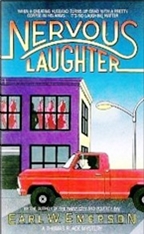
EARL W. EMERSON – Nervous Laughter. PI Thomas Black #3. Avon, paperback original; 1st printing, January 1986.

   PI Thomas Black is in danger of falling in love with his client in this case, a woman whose husband is accused of killing a young girl he was sleeping with, then shooting himself. The nervous laughter in the title is hers (see page 86).

   Emerson has s smooth, readable writing style that starts the book off well, but the story is all on the surface. Black takes a lot of physical abuse in this book, but as a substitute for twists and turns of the plot, it’s not really very satisfying.

— Reprinted from Mystery.File.5, May 1988.


The Thomas Black series —

1. The Rainy City (1985)
2. Poverty Bay (1985)
3. Nervous Laughter (1985)
4. Fat Tuesday (1987)
5. Deviant Behavior (1988)
6. Yellow Dog Party (1991)
7. The Portland Laugher (1994)
8. The Vanishing Smile (1995)
9. The Million-Dollar Tattoo (1996)
10. Deception Pass (1997)
11. Catfish Cafe (1998)
12. Cape Disappointment (2009)
13. Monica’s Sister (2013)
14. Two Miles of Darkness (2015)
15. Jackson Street (2018)

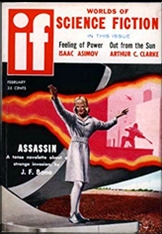
ARTHUR C. CLARKE “Out of the Sun.” First published in If, February 1958. Collected in The Other Side of the Sky (Harcourt, Brace & Co., hardcover, 1958). Reprinted in The Mammoth Book of Mindblowing SF, edited by Mike Ashley (among several other anthologies).

   This is the lead story in the latter book, and it’s a good one (both the story and the anthology). It’s told by a research scientist studying the sun from the ideal vantage point of the planet Mercury. Although he is not the only person on the station where he is working, none of the others make a physical appearance. He tells his own story, and in fact, I do not believe there is a word of dialogue to be found within it.

   The story begins in earnest when he spots a black spot moving across the surface of the sun before it is ejected off into space, aimed straight at the station where he is standing. I say “black spot” figuratively, as it (perhaps formed solely of invisible gas) cannot be seen by the naked eye – only by the instruments he is using. As he watches, he begins to wonder: could the object actually be alive? And if so, can it possibly survive, now well outside its home environment?

   The story is short, and I’ve already described the essence of the plot itself, except for the last few sentences — which are well worth waiting for. The author, Artur C. Clarke, was an excellent writer who was also a man with a mind based on scientific reasoning. In a few words he could produce a million mind-boggling ideas. Although perhaps not the best of his tales, and it may be just a minor one, but it’s also a story you may find yourself thinking about for a quite a while after you read it.

   I enjoyed this one.

Reviewed by Tony Baer:


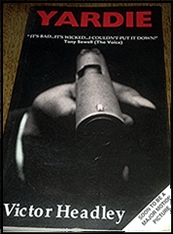
VICTOR HEADLEY – Yardie. The X Press, UK, hardcover, 1992. Pan Books, UK. paperback, 1993, 2018. Atlantic Monthly Press, US, hardcover, 1992.

   D. is a mid-level coke dealer in Kingston, Jamaica. His outfit sends him to London with a British passport and a couple bags of coke. He’s met by the London contacts at the airport and they head for a house to complete the deal.

   D.’s job is to hand over the coke, get the money, hang out for a bit, and fly home with the dough.

   But D.’s got bigger plans.

   At the London dealer’s home, D. asks to use the toilet, and escapes out the bathroom window (protected by a silver spoon), with half the goods in tow.

   D.’s got some buddies in the London slums (which are high living compared to the Kingston ghettos), including Donna, a woman he’d come to know biblically in his youth.

   D. is smart with his stake, and leverages it to become a kingpin in the London crack trade.

   The Jamaican drug lords have much less ruth than their non-Jamaican competitors, having been de-moralized by rabid conditions back home. They are quick to kill, and quick to a drug hued hegemony, to greater and greater wealth and power.

   And then an international syndicate moves in….

           ——

   It’s a good mob book, a 90’s Jamaican Little Caesar set in London with pitch perfect dialect, Caribbean vibes, and parties with a dub soundtrack. My only real complaint is an unfinished ending, feeling like the writer wanted to make sure he didn’t do anything too drastic, lest spoiling options on a sequel.

Codes and Ciphers
by Robert C. S. Adey.


   Originally published in The Mystery Lover’s Newsletter, 1969. Vol II No. 6, pp. 10/11:
   

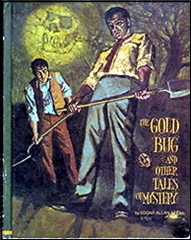
   Like so many other things, Mr. Edgar Allan Poe started it all, though this time the illustrious forerunner was not the much-cited “The Murders in the Rue Morgue”, but instead that equally fine quintessence of its form, “The Gold-Bug.” Published in 1843 and yet, today, still as readable as ever, it is the first detective story where the major detection was not that of a crime or of a criminal, but of a vital message contained in a cipher.

   And then in the highest tradition of the detective story, Sir Arthur Conan Doyle followed on from Poe, and produced his Sherlock Holmes masterpiece, “The Adventure of the Dancing Men”. This time the cipher concealed (amongst other things) a sinister warning to a victim rather than the clue to a lost treasure.

   However, both stories contain the same basic element, a secret message put before the reader in its clandestine form and then later, carefully, clearly and minutely translated into plain words by the ingenious inventor.

   And after Sir Arthur? Well, certainly not the deluge. Since those matchstick men danced their way off the last page of their story, few indeed have been the short story writers who have ventured cautiously into the demanding world of the code and the cipher. The rigorous and exacting nature of the work, however, has had its compensations (for the reader, at any rate), inasmuch as only the most painstaking and articulate of authors have managed to sell a convincing product on this market.

   If you happen across a good example of this kind of short story, then you can lay odds that it will be exclusively good and fashioned by a master-craftsman.

   The reason for this, on reflection, is self-evident. To succeed the story must contain the original cipher or coded message – it cannot be so simple that it is effortlessly construed by the reader and yet must not be so complicated that it defies any sort of comprehensible and communicable translation.

   The author must, therefore, not only be able to conceive a formula of secret writing, but must also be able to translate it for his reader in a clear and intelligible way. No great wonder, then, at the smallness of that illustrious band who have succeeded in doing all of these things within the confines of a short story.

   In fact, just who are the members of this select company? Poe and Sir Arthur we have already mentioned, but what of those who followed on? Careful examination of my library and an intensive brain-wracking session eventually brought forth — somewhat reluctantly — more names. The ingenious Melville Davisson Post, R. Austin Freeman (inevitably), that brilliant writer Dorothy L. Sayers, O. Henry and F.A.M. Webster. A list was drawn up and appears as follows:

      Author       Story       Book

(l) Edgar Allan Poe. The Gold-Bug, from Tales
(2) Sir Arthur Conan Doyle, The Adventure of the Dancing Men, from The Return of Sherlock Holmes
(3) R. Austin Freeman, The Moabite Cipher. from John Thorndyke’s Cases
(4) Melville Davisson Post, The Cuneiform Inscription, from The Bradmoor Murder
(5) Melville Davisson Post, The Great Cipher, from Monsieur Jonquelle
(6) O. Henry. Calloway’s Code, from Whirligigs
(7) F.A.M. Webster. The Secret of the Singular Cipher, from Old Ebbie Returns
(8) Dorothy L. Sayers, The Fascinating Problem of Uncle Meleager’s Will, from Lord Peter Views the Body
(9) Dorothy L. Sayers, An extract, from Unnatural Death

   (This last item, in fact, was not written as a short story; but part of chapters 26 and 29, in combination with the whole of chapter 28, form a separate story and probably the cleverest example of all.)

   Thus far I had a total of only nine short stories when every fibre in my orderly being was crying out for a nice symmetrical list of ten. I began to pound mercilessly through my list of likely authors again. Ellery Queen? Surely the master of· the cryptic clue would qualify for a place? But no, the nearest I could find were a couple of ineligible dying-message short stories, plus a number of novels (including “Face to Face,” “The Scarlet Letter” and “The Finishing Stroke”) which could in no way be distilled to the size of a short story. (Who would, want to distill Ellery Queen anyway?)

   Agatha Christie? Despite such promising titles as “N or M?” and “The A.B.C. Murders,” I could find no short story of hers to fit the bill. Then for a brief illusory moment, I thought I had it and dug out from an old Ellery Queen magazine “The Message on the Lawn” by T.S. Stribling. The title sounded just right, but on re-reading the story I found that it didn’t quite suit the occasion, Poggioli or no Poggioli.

   I had reached a point of desperation and was manfully steeling myself to the arduous task of battling my way through all my old favorites, Allen, Anderson, Bailey, Bennett, Bentley, Berkeley, etc., — right through to Zangwell, when suddenly a bombshell of an idea exploded in my vortex of a mind.

   Why should I do all the work, I asked myself, when there are dozens of readers out there, idling away their time, who could do it for me? Dozens of readers who, in combination, would have a much wider knowledge than I could possibly have and would be able, without difficulty, to supply that elusive tenth title (and perhaps disagree with the other nine)’ At one fell swoop I would be introducing a competitive element, gain an introduction to lots of interesting stories and, last but certainly not least, save myself a great deal of time and trouble. A positive masterstroke!

   And so, without apologies, this is what I am doing, leaving it to you, the perceptive and omnivorous reader. There are no prizes, other than perhaps the egotistical satisfaction of seeing your name in print. The editor, in being able to decide whether or not a suggestion shall be printed, is, ipso facto, the final arbiter. For my part I shall sit back in my easiest easy chair and await your comments with an appropriate air of self-satisfied detachment— and a good detective story.

   (Mr. Adey, 27, works as a civil servant in the Department of Health and Social Security, Birmingham, England. He reports that he likes his detective fiction literate and has a preference for the “set piece” mysteries of Queen, Millar, Carr, Christie, Brand, Berkeley, etc. His chief grouse is “with the so-called literary critics who dismiss a book simply because it is a detective story.”)

         ****************************************

   Some replies to the plea for readers’ help were printed in the next Vol. III, No. 1, October 1969, pp. 15/16, with the magazine now renamed as The Mystery Reader’s Newsletter.

      From Amnon Kabatchnik, Binghampton, N.Y.

   In order to help Adey relax into his easy chair let me add the following Code and Cipher stories to his list: THE PUZZLE LOCK by R. Austin Freeman from “The Puzzle Lock and Other Stories”; THE STOLEN CHRISTMAS BOX by Lillian de la Torre from “Dr. Sam Johnson, Detector”; THE WHITE ELEPHANT by Margery Allingharn from “Mr. Campion, Criminologist”; THE FOUR SUSPECTS by Agatha Christie from “The Tuesday Club Murders”. There must be more.

      From Joe Christopher, Stephenville, Texas

   In re: Adey’s “Codes and Ciphers”. Anthony Boucher has a very brief but tricky cipher in “The Numbers Man” (EQMM, June 1953). Another Boucher cipher (which I haven’t read) is “QL 696.C9” (EQMM, May 1943). An example of a cipher from John Dickson Carr is “The Adventure of the Wax Gamblers” in Carr and Adrian Conan Doyle’s THE EXPLOITS OF SHERLOCK HOLMES.

      From Michael Wahl, Los Angeles, Calif.

   For Robert C.S. Adey, I recommend the following stories:

Elsa Barker, The Key in Michael, from The C.I.D. of Dexter Drake (EQMM, May 1942)
R. Austin Freeman. The Puzzle Lock, from The Puzzle Lock
E.C. Bentley, The Ministering Angel, from an early EQMM [September 1943]
M.R. James. The Treasure of Abbot Thomas, from Ghost Stories of an Antiquary
Anthony Boucher, QL 696 .C9, from EQMM, May 1943
Agatha Christie. The Four Suspects, from The Tuesday Club Murders
Edgar Wallace, Code No. 2, from EQMM, Spring 1942
Harvey O’Higgins, The Blackmailers, from Detective Barney
Margery Allingham, The White Elephant. from Mr.·Campion, Criminologist
Alfred Noyes, Uncle Hyacinth, from Walking Shadows
Lillian de la Torre, The Stolen Christmas Box, from Dr. Sam Johnson, Detector

   The above stories are all available in Famous Stories of Code and Cipher, edited by Raymond T. Bond, published originally by Rinehart and now in print as a Collier paperback.

« Previous Page — Next Page »