Pulp Fiction


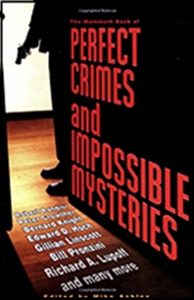
J. J. des ORMEAUX “The Poisoned Bowl.” Novelette. First published in Clues Detective Stories, April 1939. Reprinted in The Mammoth Book of Perfect Crimes and Impossible Mysteries, edited by Mike Ashley (Running Press, softcover, 2006), as by Forrest Rosaire.

   I used the term “Locked Room Mystery” up there in the heading, but that’s only in the loosest of terms. “Impossible Mystery” is far better: in “The Poisoned Bowl” a man falls dead of an instantly fatal poison with several people standing around him and no one giving him anything to eat or drink, including himself. How could it be done?

   It’s an interesting question, and J. J. des Ormeaux, a modestly prolific pulp writer whose real name was Forrest Rosaire, does his best to confuse the issue by a lot of hand-waving and other such means of distraction. Lots of coincidences, in other words, not to mention keeping relevant information from the reader. The final result is a veritable hodge-podge of a story, but … it all does make sense in the end, sort of.

   A question is, could a better writer (or editor) have taken this story, cleaned it up and made something more presentable out of it? Answer: There’s a germ of a good story at the base of it, so I’d like to think so, but in all honesty, without the hand-waving and the holding back of vital information from the reader, it would be awfully tough. Fun to read, especially if you love pulps, but all in all, no cigars for this one.


REVIEWED BY DAVID VINEYARD:


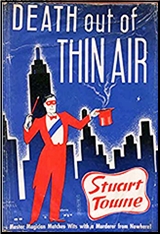
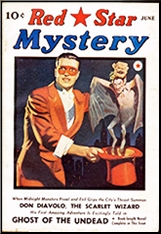
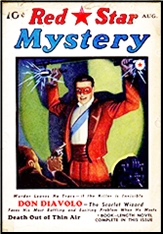
STUART TOWNE – Death Out of Thin Air.  Don Diavolo #1. Coward McCann, hardcover, 1941. First published as a pair of stories from Red Star Mystery magazine: “Ghost of the Undead” (June 1940) and “Death Out of Thin Air” (August 1940). Kindle edition: Mysterious Press, 2012.

   Don Diavolo, The Scarlet Wizard, looked out across the footlights at the applauding audience that filled the great Manhattan Music Hall. His dark eyes beneath the scarlet half-mask held an engaging, devilish twinkle and his lips bore a mysterious half smile. His lithe, athletic figure bowed formally from the waist and the spotlight that centered on him made the red of his faultlessly tailored evening clothes glow like flame.

   Fresh from the pages of the too short-lived Red Star Mystery, the scarlet-clad magician detective plunges into two full blooded pulp adventures combating clever villains and outwitting frustrated police Inspector Church in both the title piece “Death Out of Thin Air” and its companion “Ghost of the Undead.” Like his creator Clayton Rawson’s other sleuth, the Great Merlini, Don Diavolo, Nicolas Alexander Houdin, is a magician sleuth mystery man who specializes in solving Impossible Crimes, though of a more fantastic and melodramatic nature than his more literary companion.

   In “Undead” Don Diavolo finds himself pitted against “the living ghost of a medieval” murderer, none other than the original Bluebeard, Gilles de Rais, that has already struck terror in the heart of London:

   … the silent figure once more crossed the window-sill. Beyond it there was no support but empty air!

   It looked back once and the lamplight shone for a moment on its face. The face, if it could be called that, was black, and its features were unutterably grotesque and hideous. White pointed teeth gleamed between the bestial lips. The Thing had the face of a bat!

   And on the woman’s neck, on the blue vein that throbbed there faintly now, were two small red incisions….

   Now the hideous thing is in New York about to terrorize Manhattan and only Don Divallo stands between the grotesque killer, Count Draco, and his murderous plans after a beautiful woman forces her way into Diavolo’s dressing room at gunpoint and is murdered with two puncture wounds to the neck as a vampire bat invades the room behind her.

   â€œUndead” even features a pretty good dying message clue that would have pleased Ellery Queen.

   In “Thin Air” Don Divallo is faced with invisible killers who fade in bright light in front of the eyes of reliable witnesses, and comes to the aid of hard-nosed Inspector Church, his police ally/nemesis who, as usual, is more concerned Don Diavolo is up to no good than catching the real killer after he witnesses the murder of Sergeant Healey by an invisible killer in a locked room with no possible exit but the front door. The case also involves the infamous necklace of Marie Antoinette that started the French Revolution, and, as Diavolo, framed for the crime, tells Church, “… an Invisible Man, but he’s a different sort than you expect.”

   Despite his penchant for footnotes explaining the historical veracity of the tricks used in the story, it should be admitted going in that Stuart Towne is hardly as scrupulous as his more restrained Clayton Rawson persona, and Don Diavolo, as that red costume and opera cape suggest, is given to a deal more melodrama than the Great Merlini.

   I can’t see Merlini tooling around Manhattan in white tie and tails in a scarlet Packard.

   Along the way the Don Diavollo books often include a colorful cast of grifters, magicians, con-men, and other theatrical types, Diavolo’s assistant/valet Chan, several beautiful women assistants, his manager, trick designer, the theater owner, and favorite publicist as well as murderous bad guys and cunning plots which Diavolo solves with flair, if not quite as carefully staged as a Rawson, John Dickson Carr, or Hake Talbot impossible crime, but what the stories lack there they make up for in speed and pulp style energy.

   Hardly the only magician detectives in the mainstream or the pulps, Merlini and Diavolo are still standouts in a company that includes Walter Gibson’s Norgil, and though no magician, the impossible crimes of Edward D. Hoch’s Nick Velvet. Other sleuths who show a fair hand at misdirection would include the Shadow and Arsene Lupin both given to performance art as much as crime prevention. No few writers have even trotted Harry Houdini out as amateur sleuth, notably Daniel Stashower in a series of well done mysteries.

   There are two collections of Towne novellas from Mysterious Press available in E-book form, this, and Death From Nowhere, and both are worth the effort, bright and entertaining pulp adventures with a bit more going for them than just the speed and invention of the average pulp mystery. While far from perfect they move fast enough you may not pause to overthink things, and the mystery and detective angle is much better developed than the usual pulp hero mystery. Don Diavolo may not have had a long run on the pulp stage, but his act is worth catching.

POUL ANDERSON “Flight to Forever.” Novella. First published in Super Science Stories, November 1950 First reprinted in Year’s Best Science Fiction Novels: 1952, edited by Everett F. Bleiler & T. E. Dikty (Frederick Fell, hardcover, 1952), and The Mammoth Book of Vintage Science Fiction: Short Novels of the 1950s, edited by Isaac Asimov, Martin H. Greenberg, & Charles G. Waugh (Carroll & Graf, softcover, 1990), among others. Collected in Past Times (Tor, paperback, 1984) and Alight in the Void (Tor, paperback, 1991), among others.

   This is one of Poul Anderson’s earliest stories, written when he was only 24, and a better story of Gosh Wow time travel, I can think of none better. And I do not mean that disparagingly! This tale was written back when time-traveling machines could be constructed in a garage, or if not, then in a single scientist’s laboratory, with only a modicum of assistance. Such a scientist is Martin Saunders, and his machine has been working perfectly. Inanimate objects have been sent farther and farther into the future, and in case they have also returned.

   Until now. An object sent 100 into the future has not come back, and Saunders an assistant decide to take a trip there themselves and see if they can’t figure out what went wrong. Now you and I know that this might not be the wisest thing to do, but this was also in the age (1950) when scientists did not think things out too clearly ahead of time before jumping into either homemade spaceships or time machines as they should.

   The problem does not consist of getting there. It seems, however, that there is a limit of only 70 years in going backward in time. The solution: keep going ahead into the future until they reach such a time when scientists have figured out a way to overcome the difficulty in going backward in time. Ahead they go, each stage of the in larger and larger increments of time. Fifty tears, a hundred years, a thousand years, five thousand years. Empires come and go, as they discover, oftentimes with barbarians at the gates. Some people they find are friendly; others not. A million years, a million million years, and on to the end of time?

   Well, I will leave it to you to read this to see if Saunders ever finds his way home again, but wow, what a trip he makes!
   

T. T. FLYNN “Bushwhackers Die Hard.” Novelette. First published in Dime Western, January 1933. Collected in Prodigal of Death: A Western Quintet (Five Star, hardcover, 2001).

   T. T. Flynn was one of the more prolific pulp writers, with hundreds of stories in both the detective and western pulp magazines. He tried but never really made the switch over to mass market paperbacks when the pulps began to die out, as some of his contemporary authors did.

   The two featured players in “Bushwhackers Die Hard” are a couple of rambling cowpokes named Lonesome Lang and Tarnation Tucker, who seem to delight in poking their noses into other people’s business, however, rather than poking cows. Even though team-ups such as this were quite commonplace in the western pulps, this appears to be their only recorded adventure together.

   Which begins by finding a dead man beside his buggy, which they had watched fly off the side of a mountaintop road, Investigating, they discover it wasn’t the fall hat killed him. He’d been shot and killed instead while maneuvering his way down the treacherous road. Their services the are offered to the man’s beautiful daughter, unwillingly on her part, as she believes they are on the rancher working against her father.

   Ah, misunderstandings. How could western stories such as this ever have been written without them? Flynn had a smooth and flowing writing style, which serves him in good stead in this average to middling pulp yarn, that and a good sense of what life was like in the west in a time when automobiles were just beginning to appear in such tales.

FIRST YOU READ, THEN YOU WRITE
by Francis M. Nevins


   Let’s begin with the unfinished business from last month, in other words with the final four uncollected Cornell Woolrich stories from 1936. During that year the steadiest publisher of his tales was Detective Fiction Weekly but the second steadiest was Argosy with six contributions in twelve months, three of them never reprinted in hardcover or paperback collections.

   â€œGun for a Gringo” from the September 5 issue is the earliest of several Woolrich stories about various macho Americans in one or another banana republic. The local color obviously stems from his memories of growing up in Mexico, and more likely than not the adventurous protagonists are based however loosely on his father Genaro Hopley-Woolrich. In “Gun for a Gringo” the narrator-hero is Steve Willoughby, a former Chicago gangster now residing in the land of Costamala and bodyguarding the country’s dictator, one- armed Presidente Savinas.

   A band of scruffy revolutionaries approach Steve and offer mucho dinero if he’ll assassinate Savinas during an official banquet. Steve goes along in order to catch the conspirators red-handed but is caught playing double agent and railroaded into the state insane asylum. After enough time in the madhouse for Woolrich to take full advantage of the place’s noir potential, Willoughby escapes and, in a blaze of action, tears back to the capital trying to save El Presidente’s life.

   The story works well on a simple cliffhanger level except that Woolrich gives us no reason to care whether or not the one set of corrupt politicos is ousted by the other. As usual in these Gallant Yank Abroad sagas, the racism is thicker than the heat and stronger than the plot.

   â€œPublic Toothache Number One” from the November 7 issue is a semi-hardboiled comedy about a bill collector, obviously modeled on Jimmy Cagney, who makes a dunning call on a certain dentist just in time to be mistaken for that fellow by henchmen of the country’s most wanted criminal, who’s in hiding and suffering from a ferocious ulcerated tooth.    These gangsters are so stupid they let our hero fill their hideout with carbon monoxide fumes from an auto on the pretext that it’s a form of anesthesia. Enough said.

   Woolrich closed out his sales to Argosy that year with the kind of exotic adventure yarn with which the magazine was identified. “Holocaust” from the December 12 number takes place on the island of Santo Domingo during the French Revolution and deals with a bloody slave revolt.

   The female lead is 18-year old Aurelie Blanchard, daughter of a plantation owner, a girl who admires Voltaire and opposes the whipping of slaves and says of blacks, echoing Shylock’s words in The Merchant of Venice about Jews, “Do they not laugh as we do, weep as we do, bleed when cut, draw breath as we do?”

   In this story the answer is No. They are a savage tide, a horde of repulsive brutes in loincloths and Jacobin caps, screaming for victims to torture, shouting Robespierre slogans and war cries and voodoo chants all in the same breath, all except Aurelie’s faithful old nurse Marthe who saves her life.

   In the first and most vividly conjured-up sequences, Mon Repos is besieged. Aurelie’s mother kills herself, Aurelie herself is buried alive, and her fiancé Robert Lemaitre and the sadistic but cowardly plantation overseer Picard are taken prisoner and tortured until Aurelie turns the tables by rising from her open grave and masquerading as a zombie.

   She and the two Frenchmen boil the rebel leader in a vat of wax and escape into the jungle where more terror awaits them. It’s a long and ultra-lurid tale, worthy of appearance in Thrilling Mystery alongside “Baal’s Daughter” which we dissected last month, but nowhere near as vividly written as the noir classics Woolrich set on his home turf.
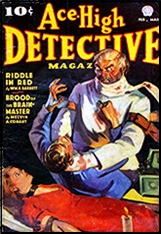
   One of the least popular of the Popular Publications pulps was Ace-High Detective, which lasted just seven issues, from August 1936 through February-March 1937. Its November 1936 number included “Evil Eye,” the earliest of several stories Woolrich was to write about the encounters of various plucky and mischievous young boys with death and terror, but this one unlike its successors is played almost entirely for comedy.

   Bronx plainclothesman Dan Kieran takes his 8-year-old son Danny to the Metropolitan Museum of Art to see a newly unearthed mummy with a priceless emerald eye. The orb is supposedly protected by an ancient curse that whoever tries to steal it will be blinded by the god Osiris. Danny slips away from his dad at closing time and is locked in the museum, as are two dimwits nicknamed Jojo and Donkey Mouth who plan to steal the eye during the night.

   Woolrich tells almost none of this story from the viewpoint of the boy as he would in later tales of this sort. Instead he concentrates first on making us laugh as we watch the thieves’ comic interplay (which may remind sufficiently aged readers of the scenes between Jackie Gleason and Art Carney on TV’s The Honeymoners) and the bungling efforts of Danny’s father and a helpful traffic cop to break into the museum and rescue the brat, and then on making us shudder as the gory curse is fulfilled. The setting shows that Woolrich intended “Evil Eye” to be included in his book of New York Landmarks stories- — a book that for unknown reasons never came into being.

***

   
   For the rest of this column let’s delve into a topic as far removed from Woolrich as possible, a trio of traditional detective novels from the Golden Age of that noble genre in England between World Wars. The authors I usually discuss when I’m on that subject are John Rhode and Christopher Bush, whom I’ve been reading intermittently since my teens. I don’t believe I’ve ever written a word about this month’s author. Isn’t it about time I did?
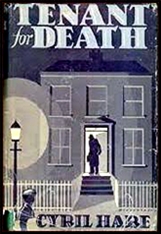
   Cyril Hare was the writing byline of Alfred Alexander Gordon Clark, who was born in the county of Surrey on 4 September 1900 and, in the interstices of a legal career, produced nine highly regarded novels and more than forty short stories. His earliest novel, Tenant for Death  (1937), written while he was still practicing law and before he migrated to the judicial side of the system, introduced Scotland Yard’s Inspector Mallett, a tall stout man with a taste for sumptuous lunches, not as memorable a protagonist as, say, Colin Dexter’s Inspector Morse who debuted almost forty years later but far more vivid than the all but characterless sleuths who were commonplace in British detective fiction of the Golden Age.

   Lionel Ballantine, a crooked financier on the brink of exposure and arrest, is found strangled to death with a Venetian blind cord in a house in Kensington, recently rented by a paunchy full-bearded man calling himself Colin James who seems to have vanished. The murder took place shortly after the release from prison of a banker who had been innocently caught up in Ballantine’s crimes and had sworn revenge in open court after his conviction but was still behind bars when the mysterious Mr. James made his first appearance.

   The banker however is hardly the sole suspect. Mallett also has to consider Ballantine’s equally corrupt secretary (who today would probably have a title like Executive Administrative Assistant), the bigamous husband of Ballantine’s mistress, a dotty nobleman who served on the crooked company’s board of directors, and several more. The traditional clues are few and far between — notably the riddles of why Ballantine was found wearing a sloppily tied green bow tie with an elegant gray suit and what happened to the umbrella with which he was last seen — but Mallett connects the dots with rare ingenuity and Hare succeeds in keeping us puzzled while playing fair all the way.

   Barzun and Taylor in A Catalogue of Crime  (2nd ed. 1989) called this book “a very engaging debut,” distinguished by “sound yet uncommon philosophizing….” Readers who aren’t interested in legal issues or jargon may rest assured that Tenant for Death  is free of both.

***


   Except for a brief colloquy in Chapter 1 on whether fishing rights are a covenant running with the land or an easement — terms which for attorneys will evoke fond or bitter memories of their Property course as first-year law students — legalisms are also absent in Hare’s second book.

   I’m sure there are other detective novels in which anglers and angling are central to the plot but I can’t recall any in which the pursuit of fish figures so prominently as in Death Is No Sportsman (1938). An elaborate map of a three-mile stretch of the river Didder and its surroundings, which most readers will have to consult again and again as various characters traipse through the area, portrays footpaths, a ford, a cart track, a bridge across the river, and assorted copses and trout pools, with stately Didford Manor at the map’s northern edge and the village of Didford Magna (which is dwarfed by its companion village Didford Parva) at its southern end.

   Each summer weekend the village’s only pub is taken over by four Londoners, the members of a fishing syndicate which owns the exclusive right to cast reels along this stretch of the river. All four have reasons to despise Sir Peter Packer, the wealthy owner of Didford Manor, who late one hot Saturday afternoon in June is found on a tiny piece of solid ground known as the Tump with a bullet through his eye that took most of his brains with it when it exited. Suspects besides the four fishermen include the young wife of the syndicate’s senior member, the even younger wife of odious Sir Peter, a young man from the village whose fiancée Sir Peter had (as we used to say) knocked up, and — perhaps — the rector’s unspeakable wife and the local doctor.

   Almost halfway through the novel Scotland Yard in the person of Inspector Mallett is called into the case, which is labyrinthine to the max and brim-full of fishing lore. Dare I venture to suggest that most if not all of the dramatis personae must be Anglicans?

   Whether Hare plays completely fair with the reader is uncertain. At the denouement Mallett offers several reconstructions of what happened, each positing a different killer, but it’s all a charade to pressure the real murderer into a confession without which, as Mallett freely admits to his local colleagues, there’s no real evidence against the culprit.

   The authors of A Catalogue of Crime couldn’t agree on a    verdict, with Wendell Hertig Taylor calling it the second best of the nine Hare novels while Jacques Barzun disliked it “because of the long windup and fumbling detection.” One can see his point: without real evidence how could Mallett reasonably identify the guilty party? But I remain uncertain about my own verdict. Who can decide when doctors disagree?

***

   
   In Hare’s third book, the last he completed before the outbreak of World War II, Mallett appears only in the early and final chapters, but for my money it’s the finest detective novel of the trio. Suicide Exceptted (1939) opens on the last evening of the Inspector’s holiday, which he’s spending in a stately Georgian house turned mediocre country hotel, 42 miles from London.
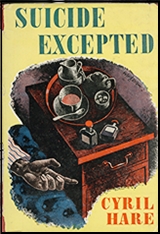
   That evening in the hotel lounge, after an indigestible meal, Mallett is approached by a fellow guest, a rather eccentric old bloke named Leonard Dickinson, who hints that he may take his own life before morning. As any whodunit devotee might have guessed, he’s found dead in his bed by the maid bringing him his breakfast. The physical evidence plus Mallett’s statement convinces the coroner’s jury that Dickinson deliberately took a fatal overdose of a sleeping potion called Medinal (which I gather Hare invented out of whole cloth), and a verdict of suicide is reached.

   Shortly thereafter it develops that less than a year before his death the old man had put most of his money into a life insurance policy on himself — a policy which offers a huge payout but becomes null and void if he should kill himself within a year of its inception. Faced with the prospect of destitution, Dickinson’s son Stephen and his daughter Mary, assisted by Mary’s fiancé Martin Johnson, set out to prove to the insurance company that the old gentleman was murdered by one of his fellow guests at the country hotel.

   A rum assortment of guests indeed! An antiquarian parson and his wife, a young couple spending an illicit night, a mystery man who stayed confined to his room, a Lincolnshire dowager and her mentally challenged son, a gas company executive rendezvousing with a blackmailer, and of course Mallett himself and the decedent.

   Most of the novel follows various combinations of the three amateur detectives, whose sleuthing soon establishes that an incredible number of the hotel’s guests that night had motives for killing the old man. Mallett comes back into the picture and exposes the murderer, whose identity is a stunning surprise (at least to me), although later I discovered that Hare had planted all sorts of subtle pointers to the truth which aren’t apparent except on a second reading.

   For some reason Barzun and Taylor weren’t impressed by this novel, calling it “one-third good, two-thirds fumbling.” Long after the end of the war, when it was first published in the U.S., Anthony Boucher in the New York Times Book Review (7 November 1954) found it “more conventional and less witty” than Hare’s postwar novels but “adroit in its manipulation of [the] three amateur detectives” and “distinguished by a plot-twist” worthy of Agatha Christie. With the last point I agree completely.

***

   
   Hare spent the WWII years first as a judge’s marshal (somebody who sits with and performs various chores for a judicial officer), then with the Department of Public Prosecutions and finally with the Ministry of Economic Warfare. Apparently he was kept quite busy, so much so that during the war he published only one novel, Tragedy at Law  (1942), which many consider his masterpiece.

   With the defeat of Hitler he resumed writing a book every few years. In 1950 he was appointed a County Court judge for his native Surrey, a position he held until he died, at the all too early age of 57, on 25 August 1958. Whether he chose the title himself or his publisher came up with it when he was no longer with us, it’s equally fitting that his last novel is called Untimely Death.
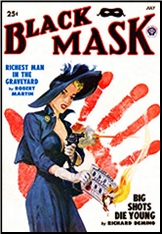
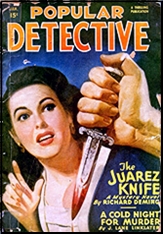
A 1001 MIDNIGHTS Review
by Bill Pronzini


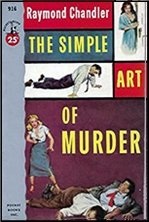
RAYMOND CHANDLER – The Simple Art of Murder. Houghton Mifflin, hardcover, 1950. Pocket #916, paperback, 1953. Reprinted many times since, in both hardcover and paperback.

   Eleven of the twelve stories in is collection are those that Chandler considered the best of his output for the pulps; the other story, “I’ll Be Waiting” was first published in the Saturday Evening Post (although Chandler admittedly felt uncomfortable and restricted writing for the slick-magazine medium). Also included here is Chandler’s famous and controversial essay on detective fiction, first published in the Atlantic Monthly, in which he lauds Hammett and the realistic school of crime writing, and takes a number of shots (some fair, some cheap) at such Golden Age luminaries as Christie, Sayers, and A. A. Milne.

   The stories here, as the dust jacket blurb says with typical publishers’ overstatement bur accurately nonetheless “hit you as hard as if [Chandler] were driving the last spike on the first continental railroad.” “Red Wind,” for instance, begins with one of the finest opening paragraphs in the history of the genre:

   There was a desert wind blowing that night. It was one of the hot dry Santa Anas that come down through the mountain passes and curl your hair and make your nerves jump and your skin itch. On nights like that every booze party ends in a fight. Meek little wives feel the edges of carving knives and study their husbands’ necks. Anything can happen. You can even get a full glass of beer at a cocktail lounge.

   In the original appearance of that story, the private-eye narrator was Johnny Dalmas; here he becomes Philip Marlowe. Similarly, the unnamed narrator in “Finger Man,“ Carmady in “Goldfish,” and Dalmas again in “Trouble 1s My Business” are also changed to Marlowe. Johnny Dalmas does get to keep his own name in “Smart-Aleck Kill,” no doubt because that novelette is told third-person.

   And the same is true of Carmady in “Guns at Cyrano’s.” The only other first person story in the collection, the lighter-toned and somewhat wacky “Pearls Are a Nuisance,” features a much more refined dick named Walter Gage whose antics in search of a string of forty-nine matched pink pearls provide chuckles as well as thrills. Also included arc the tough Black Mask novelettes “Nevada Gas” and “Spanish Blood,” “The King in Yellow” from Dime Detective and “‘Pick-Up on Noon Street” from Detective Fiction Weekly.

   All of these stories appear in several other collections, such the paperback originals Five Murderers (1944) and Finger Man and Other Stories (1946) and the Tower Books hardcover originals Red Wind (1946) and Spanish Blood (1946). Next to The Simple Art of Murder, the most interesting and important Chandler collection is Killer in the Rain (1964), which gathers the eight “cannibalized” stories that were used as the bases for The Big Sleep, Farewell. My Lovely, and The Lady in the Lake.

———
   Reprinted with permission from 1001 Midnights, edited by Bill Pronzini & Marcia Muller and published by The Battered Silicon Dispatch Box, 2007.   Copyright © 1986, 2007 by the Pronzini-Muller Family Trust.

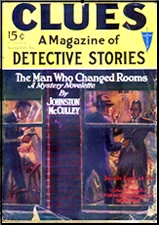
JOHNSTON McCULLEY “The Man Who Changed Rooms.” Novelette. Creighton Marpe #1. First published in Clues, February #2, 1929. Collected in The Johnston McCulley Megapack (Wildside Press, Kindle edition, March 2015).

   Johnston McCulley is known today, if at all, as the creator of the pulp western hero Zorro, and if it hadn’t been for Walt Disney, even such a dashing character as Zorro may be unknown to readers as some of the other series characters he came up with. Only the most dedicated collectors of old pulp magazines will remember these folks: Black Star, The Spider (the earlier version), The Mongoose, Thubway Tham, Green Ghost, The Thunderbolt, The Avenging Twins, and The Crimson Clown.

   He also wrote hundreds of standalone stories for the pulp magazines in all genres but primarily mysteries and westerns, along with several dozen hardcover novels. As for secret agent Creighton Marpe, I’ve listed this as his first story, but in fact, while there are possibilities in the character, it seems as though there never was another one.

   His task in “The Man Who Changed Rooms” is outwardly a simple one. He’s to take the train from New York City to Kansas City, pick up a top secret document, and bring it back to Manhattan. A job to be completed with code words and the utmost caution. The reason Creighton Marpe is called “the man who changed rooms” is that when he needs a room in a hotel, he books three, and when he buys tickets for a train, he buys at least two.

   Along the way he runs across various operatives for the other side, whom he invariably taunts in jaunty carefree fashion. Also along the way his path crosses that of a fellow agent on his side, Alla Stimney, a young woman he is rather fond of, a fact that causes them problems when both are being held captive by the aforementioned other side.

   There is no depth to the story, nor is the prose anything but rudimentary. but it’s told in such breakneck fashion, the non-sophisticated reader may not even notice. Of course you must realize that I’m paid to notice such things, but somehow or another, I enjoyed the story anyway. Stories taking place largely on trains often have that effect on me.

A 1001 MIDNIGHTS Review
by Bill Pronzini


RAYMOND CHANDLER – The Lady in the Lake. Alfred A. Knopf, hardcover, 1943. Pocket #389, paperback; 1st printing, September 1946.  Film: MGM, 1946, as Lady in the Lake (with Robert Montgomery as Philip Marlowe).

   Even though The Lady in the Lake is not Chandler’s best novel. it is this reviewer’s favorite. It too was “cannibalized” from three pulp novelettes: “Bay City Blues·” (Dime Detective, November 1937), “The Lady in the Lake” (Dime Detective, January 1939), “No Crime in the Mountains” (Detective Story, September 1941), but it is not as seamless as The Big Sleep or Farewell, My Lovely, nor as wholly credible. Nevertheless. there is an intangible quality about it, a kind of terrible and perfect inevitability that combines with such tangibles as Chandler’s usual fascinating assortment of characters and some unforgettable moments to make it extra satisfying.

   The novel opens with Marlowe hired by Derace Kjngsley, a foppish perfume company executive, to find his missing wife. Crystal (who he admits he hates and who may or may not have run off with one of his “friends,” Chris Lavery). Marlowe follows a tortuous and deadly trail that leads him from L.A. to the beach community of Bay City, to Little Fawn Lake high in the San Bernardino Mountains, to the towns of Puma Point and San Bernardino, and back to to L.A. and Bay City. And it involves him with a doctor named Almore, a tough cop named Degarmo, a half-crippled mountain caretaker, Bill Chess, whose wife is also missing, Kingsley’s secretary, Miss Adrienne Fromsett and the lady in the lake, among other victims.

   As the dust jacket or the original edition puts it, it is “a most extraordinary case, because … Marlowe understands that what is important is not a clue – not the neatly stacked dishes, not the strange telegram … but rather the character of [Crystal Kingsley]. When he began to find out what she was like, he took his initial steps into a world of evil, and only then did the idea of what she might have done and what might have been done to her take shape. So it was that not one crime but several were revealed, and a whole series of doors that hid cruel things were suddenly opened.

   “Again Chandler proves that he is one of the most brilliant craftsmen in the field, and that his Marlowe is one of the great detectives in fiction.”

   Amen.

   The Lady in the Lake was filmed in 1946. with Robert Montgomery (who also directed) as Marlowe. For its time, it was a radical experiment in film-making, in that it is entirely photographed as if through the eyes of Marlowe — a sort of cinematic version of the first-person narrator, with Montgomery himself never seen except in an occasional mirror reflection. The technique doesn’t quite work – it, not the story, becomes the focus of attention – but the film is an oddity worth seeing.

         ———
   Reprinted with permission from 1001 Midnights, edited by Bill Pronzini & Marcia Muller and published by The Battered Silicon Dispatch Box, 2007.   Copyright © 1986, 2007 by the Pronzini-Muller Family Trust.


FIRST YOU READ, THEN YOU WRITE
by Francis M. Nevins


   A few weeks ago I received an email from bookseller Lynn Munroe, asking me a question about the uncollected short stories of Cornell Woolrich. The result was that I got interested in how many uncollected stories there were and how many might be worth collecting. It will take more than one column to explore these questions but let’s start here.

***

   For the first two years in which Woolrich published crime-suspense stories, the number of uncollected tales is zero. Why? Because I brought together all three of the tales that first came out in 1934 and all ten of those that appeared in ‘35 in the collection DARKNESS AT DAWN (1985). Woolrich’s output grew exponentially in 1936: a total of 26 crime stories, earning him a total of $4,300, which was a respectable annual salary back then.

   Some of them—for example “The Night Reveals” (Story, April 1936), “Johnny on the Spot” (Detective Fiction Weekly, May 2, 1936), “The Night I Died” (from the same magazine’s August 8 issue) and “You Pays Your Nickel” (Argosy, August 22, 1936), which is usually reprinted as “Subway”—rank among his most powerful short stories. Others from that year—including, I fear, most of the dozen that remain uncollected—are pretty terrible.

   The year kicked off with one of the worst tales he ever perpetrated; perhaps the worst of his career. The mild success of the Popular Publications pulp chain with weird-menace magazines like Dime Mystery inspired rival entrepreneur Ned Pines of Thrilling Publications to launch a competing monthly called Thrilling Mystery, which debuted in October 1935 under editorial director Leo Margulies (1900-1975).

   During its 50 issues the magazine offered a parade of strange cults, diabolic rituals, gruesome murders, sadistic villains, slavering beasts and (of course) beautiful young women shivering in peril. Woolrich dipped his toes into these weird waters just once. Like the 1935 classic “Dark Melody of Madness” (better known as “Papa Benjamin”) and the 1937 classic “Graves for the Living,” “Baal’s Daughter” (Thrilling Mystery, January 1936) is about hapless innocents falling into the clutches of repulsive religions.

   But this version of the story is so sloppily and luridly written, so overloaded with stupid inconsistencies and grotesque twaddle, that to claw one’s way through its pages is an act of masochism. Narrator Bob Collins visits his psychiatrist friend Dr. Dessaw to ask for help in freeing his fiancée Gloria’s dotty aunt from a Westchester cult.

   As Woolrich Coincidence would have it, the head of the cult is Dessaw, who drugs Bob and spirits him to the religion’s headquarters mansion on the banks of the Hudson, where in rapid order our hero is stripped to his shorts, flogged by a tongueless black giant, menaced by a man-eating panther, tortured with boiling oil injected into his veins, forced to kneel before a woman calling herself the reincarnated goddess Ishtar, forced to help lure Gloria to the mansion for ritual sex with with the god Baal who of course is Dr. Dessaw, and so on and on long past our endurance.

   The narrative throbs with clunkers like “The fiend on the throne stood up and turned to me as I quivered there, ashen-faced” and “I was prone there, at the mercy of the he-devil and the she-devil….” How desperate must Woolrich have been to have cranked out this garbage?

***

   Of the dozen uncollected Woolrich stories from 1936, Detective Fiction Weekly was the original home of seven, including two that might well deserve collection. Not, though, the first pair we consider here. “Blood in Your Eye” from the March 21 issue is an insanely bad cop story set in an anonymous city on which Woolrich sticks the label Los Angeles.

   Mitchell, a rambunctious young homicide dick, is the only one who sees the truth when a murder victim is found in a rooming house with the image of his killer apparently imprinted on his eyes. Instead of sharing his insight, Mitchell throws down his badge in disgust at his colleagues’ willingness to believe medieval superstition and goes out to solve the crime lone-wolf style.

   The hunt takes him to two venues that Woolrich was to use over and over, a manicurist’s booth and a dance hall. For this one you have to accept that neither a roomful of cops nor the medical examiner can tell the difference between genuine and glass eyes, but the climax is violent and the central gimmick Guignol-gruesome.

   Just two weeks later, in the magazine’s April 4 issue, came “The Mystery of the Blue Spot,” which Woolrich submitted as “Death in Three-Quarter Time.” In a lifetime of reading whodunits I’ve never come across an alibi gimmick as wacko as this one. Homicide cop Dennis Small happens to be in the Curfew Club on the night when the specialty dancer Emilio is shot to death in his dressing room just a few minutes after he and his partner Lolita have finished performing a bizarre new number.

   All the evidence points to chorus line dancer Mary Jackson, for whom Emilio was about to dump Lolita. This tale too is never likely to be reprinted or collected so I might as well give away the solution: Lolita herself killed Emilio before the dance, then rigged herself in a crazy costume and went out into the spotlight and convinced a clubful of people that she was both herself and her partner! The story becomes interesting only in the final scenes when Woolrich makes us empathize with her for two crucial noir reasons: she had lost her love and she’s about to die.

   For the next uncollected story we jump into the summer months. “Nine Lives” from the June 20 number is set in the waterfront district around New York’s South Street. Demon newshawk Wheeler stumbles onto the story of an old bum who’s been treated by three sinister strangers to booze, food, clothes, and to an insurance policy on his life. The best scene finds Wheeler bound, gagged and left for dead at the bottom of an old-fashioned bathtub filling with water, but even in this serial-like incident there’s nothing terribly urgent.

   Later that summer, in the August 15 issue, came “Murder on My Mind,” the earliest appearance in Woolrich and perhaps the earliest in crime fiction of a plotline which was a staple of film noir classics like SO DARK THE NIGHT (1946, directed by Joseph H. Lewis) but ultimately goes back to the Greek tragedy OEDIPUS TYRANNUS.

   Marquis, the detective narrator, is assigned with his partner Beecher to the brutal murder of a harmless cigar-store clerk, but as the investigation goes forward, countless tiny details push Marquis and the reader closer and closer to becoming convinced that the murderer is Marquis himself.

   This tale has never been reprinted or collected as it first appeared but a heavily revised and less crudely written version was included as “Morning After Murder” in the paperback collection BLUEBEARD’S SEVENTH WIFE (Popular Library pb #473, 1952, as by William Irish).

   The trademark Woolrich combination of breathless urgency and plot flubs permeates the long story which he submitted as “Right in the Middle of New York,” but it’s so packed with action and tension that one barely notices that nothing in it makes sense, not even the published title, since no murder is committed at all in “Murder in the Middle of New York” from the September 26 issue.

   Tony Shugrue, a relatively honest protégé of mobster Chuck Morgan, is set up by his mentor with phony references and gets hired by wealthy Cole Harrison as chauffeur for his beautiful and spoiled daughter Evelyn. Unaware that he’s married, Evelyn makes several passes at her driver, and for a while we’re reminded of the romance between another flighty heiress and her chauffeur in Woolrich’s 1927 pre-crime novel CHILDREN OF THE RITZ.

   Finally Tony realizes that Morgan plans to kidnap Evelyn, hold her for ransom, kill her and leave him to take the fall. From this point on the story morphs into a wild roller-coaster ride crammed with thrills, anguish and suspense as Tony fights to save himself and his wife and Evelyn from the gang. Some of the dialogue creaks—“‘Rats!” he hissed viciously through his teeth. ‘Lower than rats, even!’”—and the crucial scene requires Tony literally not to recognize his wife at close quarters.

   But the irresistible Woolrich urgency sweeps away all nitpicking into the ash heap and suggests that this one of the uncollected dozen may deserve being revived.

   I feel the same way about “Afternoon of a Phony” from the November 14 issue—so much so that it was reprinted in Alfred Hitchcock’s Mystery Magazine (June 2012) at my recommendation and with a new introduction by me.

   The story is something of a departure for Woolrich, a charming, clever and bizarre whodunit where the detective role is played by a con man. Clip Rogers steps off the train at the Jersey seaside resort of Wildmore and is instantly mistaken by the brainless local cops for Griswold, the supersleuth from Trenton, whom they’d sent for to help solve the bludgeon murder of a woman in one of the town’s vacation hotels.

   What complicates the case beyond the local yokels’ power to unravel is that the woman’s eight-year-old son, who witnessed the crime in the middle of the night but is too young to understand its meaning, has identified as the murderer a man with a perfect alibi. Rogers exposes the real killer rather neatly, but the story becomes distinctively a Woolrich tale only afterward when, as in “The Mystery of the Blue Spot,” a criminal motivated by lost love takes center stage and, for a page or two, becomes a deeply sympathetic character. His comment that the impostor Rogers is more humane than any cop he’d ever met is evidence that when Woolrich drew genuine cops as brutal thugs he wasn’t doing it inadvertently.

   His final 1936 appearance in Detective Fiction Weekly was one of his weakest, but for anyone with a little knowledge of law, it’s a coffee-out-the-nose classic. The year’s last issue, dated December 26, included “The Two Deaths of Barney Slabaugh,” in which Woolrich dusted off his favorite James M. Cain plot twist, backdated it forty years, and threw in so much of the tinny insult humor and gangster stereotypes from the current James Cagney movies that the illusion we’re in the New York of the 1890s isn’t sustained for a microsecond.

   Manhattan racket boss Emerald Eddie Danberry is persuaded by his shyster lawyer Horace Lipscomb that the proper way to kill rival mobster Barney Slabaugh is to take the man prisoner, frame himself for Barney’s murder beforehand, and get himself acquitted in court. Then, Lipscomb explains—foreshadowing an infamous recent comment by Donald Trump?—even if Danberry were to murder him in full view of a thousand people he could never be prosecuted for it.

   Danberry asks for the name of this marvelous rule of law. Lipscomb replies: Why, it’s the Statute of Limitations! (Cue the coffee.) Fighting DA Barry McCoy, one of the city’s few uncorrupt officials, tries to snooker the plot, and fate works another Cain trick to help him out in this super-pulpy tale, which is full of police brutality, casual racism and enough Woolrich-style wisecracks to sink an aircraft carrier.

***

   So much for eight out of the dozen, and quite enough for one column. I’ll finish the tabulation next month. With perhaps a bonus thrown in to boot.

  ARTHUR LEO ZAGAT “Crawling Madness.” Novelette. First published in Terror Tales, March 1935. Reprinted in Zombies! Zombies! Zombies!, edited by Otto Penzler (Black Lizard, softcover, 2011) and in Famous Fantastic Mysteries, Fall 2016, edited by Matt Moring (Altus Press, softcover).

   Ann and Bob Travers are newlyweds who are heading for Bob’s new job located somewhere out west. He has a new formula for extracting gold from otherwise tapped out mines, and he’s anxious to try it and find out how well it works. Driving along in their car, they are sideswiped off the road by a truck filled with crazed, terrified miners speeding madly off in the opposite direction.

   Their car is wrecked, and Bob’s ankle is broken. What is she to do? Luckily the mine is only a short distance away. It can’t be totally deserted, can it? Well, no, not exactly. Nearing the mine, she is confronted on all side by creeping emaciated men, crawling on their stomachs closer and closer…

   Thus begins “Crawling Madness,” a story that once started, just doesn’t stop. A stranger who claims to be the foreman frightens off Ann’s attackers, but there is something about his Satanic visage that she just doesn’t trust. It’s then a cat and mouse game all the way, in shelter and out, in the mine and out, then trapped in one of the furthermost caverns, always with the threat of unspeakable horror from the monstrously disfigured creatures lurking just beyond the only small sources of light she has.

   The clammy shuddersome feel of the thing upon which Ann’s hand had fallen shocked her back to reason. To reason and the flooding horror of her search. She shoved up on extended arms, arching her back; she looked dazedly about her.

   Madness pulsed in her once more as she stared at which the crawlers had left — at tattered, gnawed flesh; at a torso from whose ribs meat hung in frayed strips; at a skull that had been scraped quite clean so that the grinning bone glowed brightly in the lunar rays. And everywhere on the pitiful remains that once had been human were the marks of teeth, of human teeth!

   This is the stuff of nightmares, no doubt about it, but of course it ends happily, with an explanation that actually works (I think), and most surprisingly at the very end, the equivalent of a PSA about the need for more safety regulations in mines all across the country.


« Previous PageNext Page »