Pulp Fiction


THE SERIES CHARACTERS FROM
DETECTIVE FICTION WEEKLY

by MONTE HERRIDGE


        #5. SECRET AGENT GEORGE DEVRITE, by Tom Curry.

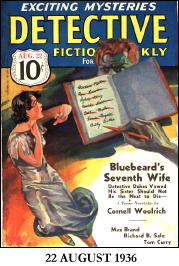
   The Secret Agent George Devrite stories by Tom Curry were a short series of seven stories published in Detective Fiction Weekly from 1936 to 1940.

   The series involves the exploits of an undercover policeman, or secret agent, of the New York Police. Inspector Hallihan was his superior in the department, but George Devrite was in essence the Secret Police Chief. He had an obscure office on the second floor of a dingy house “down the street from Headquarters, outwardly an importer of beaded goods but actually the main receiver of reports made by such agents as Devrite.” (The Green Fingers of Death)

TOM CURRY George Devrite

   These reports often consist of factual accounts of their actions and gives recommendations to Hallihan of what to do – people to investigate, arrest, or otherwise take action about. Devrite “received credit only in the secret records of the Police.” (The Donkey’s Head) He lived in a small apartment in the West Forties, and had no close friends, as his job did not allow such.

   As to entertainment, Devrite derived “his main amusement … in solving the puzzles presented by Hallihan.” (The Donkey’s Head) So Devrite could be described as a workaholic who lived for his job.

    Devrite usually visited the scene of the murders he investigated in order to gather information. As Devrite puts it when he closes in on some criminals, “with twenty thousand policemen on tap but Devrite dared not call one to assist him directly, since he was an undercoverman and could not expose himself to friend or foe.” (The Green Fingers of Death)

    Devrite’s orders at all times was to never expose himself. He did not make arrests or appear in court to give trial testimony. It was explained in the second story in the series (The Queen’s Taste), that “George Devrite was a valuable man – irreplaceable save by years of training; his natural competence and experience made him Hallihan’s star.” Part of Devrite’s training is in ju-jutsu, which he uses in a number of the stories, especially “The Dragon’s Tooth.”

    In the first story in the series, “The Green Fingers of Death,” one of Devrite’s fellow agents has been found murdered, and Hallihan gives the case that he was working on to Devrite to investigate. It involves a young bank clerk named Robert Evans, who is in some sort of trouble.

    Devrite does some investigating and finds that Evans owes a gambling debt to a German named Count von Hult. Hult wants something unknown in return for this debt, which turns out to be passing counterfeit money at his bank. Devrite tracks down the counterfeiters and his earlier report to Hallihan set the police on their track too.

    The second story in the series, “The Queen’s Taste” involves Devrite in investigating a murder case. The police haven’t been able to solve the case satisfactorily, so Inspector Hallihan puts George Devrite on the case. The police think they know who committed the murder, and Devrite winds up agreeing with them.
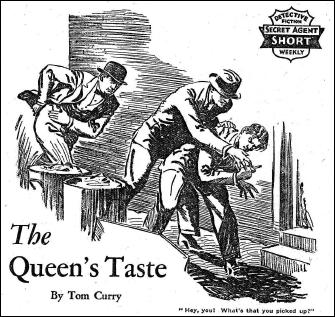
TOM CURRY George Devrite

    The culprit is a Cuban named Luis Ortez, a former triggerman turned dancer at the Peacock Cabaret. His dancing partner is the murdered man’s daughter, Adele Morris. Ortez is interested in Adele Morris, and part of Hallihan’s instructions to Devrite stressed that he was to see what he could do to stop this interest. Devrite runs into the usual danger in this case, barely escaping with his life after gunmen target him.

    “Powder on the Body” is the third story, and Devrite is assigned to investigate a series of murders after the police come up with a dead end. Each of the victims is well-off, each has talcum powder on his suit, and each has been robbed and shot at close range.
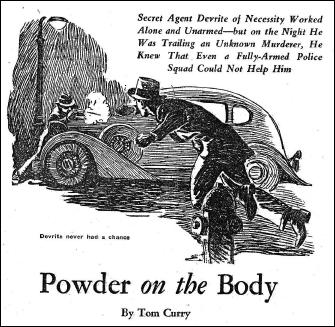
TOM CURRY George Devrite

    One more victim is killed while Devrite is investigating, making him more determined than ever to solve the case. The victims all went to a night club called the Blue Belle before they were killed, so Devrite starts there. As usual in this series, Devrite comes near death in his attempt to get to the bottom of the murders.

    In “The Dragon’s Tooth” Devrite investigates the murder of William Brennan of Brennan and Kanes, furriers. Also he was to track down the $250,000 worth of furs stolen at the same time. Devrite infiltrates the underworld to a slight degree in this one, and gains some information that sets him on the trail of the solution to the crimes.
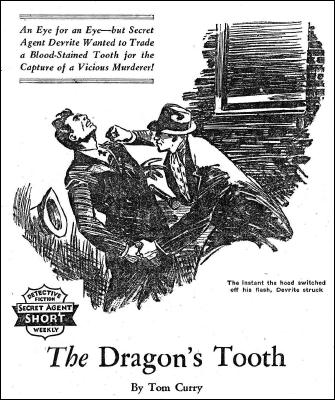
TOM CURRY George Devrite

    Not only does Devrite’s work clear up the murder, but it also breaks up a criminal gang of fur thieves and put a number of its members in jail.

    “The Visit of Death” involves Devrite in still another murder case, that of Daniel Moresby, rich recluse. The only clue to the murderer is a chunk of lead, which turned out to be a railroad freight car seal. So Devrite puts on some old clothes and goes to the hobo encampment near the railroad tracks, hoping to find further clues and some information. He finds more than he bargained for, as the murderer and a companion show up at the encampment.

    “The Donkey’s Head” finds George Devrite investigating another murder, that of Keith Mortimer, a fairly young rich man who lived an idle life. Other than a possible burglar, there are only two suspects in the case so it is a matter of tracking down clues on each suspect.

    Devrite has his life saved by one of the suspects, and becomes indebted to him for that to the point where he is temporarily unwilling to investigate further. However, his work ethic convinces him to continue the investigation. The title of the story refers to the murdered man’s broken Chinese vase, which is in a hundred pieces when Devrite and Hallihan see it. However, a small piece showing a donkey’s head is missing from the reconstructed vase and provides a clue to the murder.

    “Racket Kill” is the last story in the series, and was published over 2 ½ years after the previous story. Kenneth Harris, a Bronx garage owner, has been murdered racketeer style. Hallihan instructs Devrite to investigate. The only suspects are Harris’ partner, Jerry Sessler, and the local racketeers who peddle stolen auto parts to the garages. Devrite almost immediately gets into trouble with the racketeers, and has to talk fast to get out of it.

    This is an average series, with some very good stories, but mostly average or slightly above that. There is no element of humor in the stories, and the hardboiled nature of the stories denies any lightness to them. This series is better than other stand-alone stories about undercover police that was published in DFW.

      The Secret Agent George Devrite series by Tom Curry:

The Green Fingers of Death     August 22, 1936
The Queen’s Taste     August 29, 1936
Lion Face     September 5, 1936     [**]
Powder on the Body     November 14, 1936
The Dragon’s Tooth     November 21, 1936
The Visit of Death     December 19, 1936
The Donkey’s Head     January 2, 1937
Racket Kill     August 31, 1940

[**]   This story has been added later, thanks to Ron Smyth who discovered its existence and told us about it in the comments. Not only that, but it can be read online at http://www.unz.org. Follow the link to the website, next to the Detective Fiction Weekly page, then to the issue itself.
FIRST YOU READ, THEN YOU WRITE
by Francis M. Nevins


DASHIELL HAMMETT

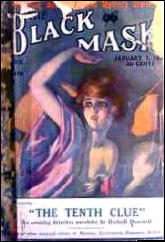
   If you own a copy of the Library of America’s Dashiell Hammett volume Crime Stories & Other Writings (2001) and also a copy of Ellery Queen’s Mystery Magazine for July 1945, then, whether you know it or not, you have two different versions of Hammett’s Continental Op story “The Tenth Clew” (Black Mask, January 1, 1924).

   The first difference between the two leaps out: the last word of the title is spelled “Clew” in both Black Mask and the Library of America collection but Fred Dannay changed it to the more common “Clue” when he reprinted the tale in EQMM.

DASHIELL HAMMETT

   To appreciate the final difference between the two requires a little knowledge about the story’s plot. Leopold Gantvoort, a 57-year-old widower whose net worth is around $1,500,000, is planning to marry a much younger woman, but he’s murdered before the marriage takes place and also before he’s signed a new will leaving half his fortune to her.

   The Op exposes her as a confidence woman and the murderer as her scam partner, who’s been posing as her brother. Here are the last few sentences as Hammett wrote them.

   [W]ith her assistance it was no trick at all to gather up the rest of the evidence we needed to hang him. And I don’t believe her enjoyment of her three-quarters of a million dollars is spoiled a bit by any qualms over what she did to Madden. She’s a very respectable woman now, and glad to be free of the con man.

   What’s wrong here? Since Gantvoort was killed before either changing his will or marrying the woman, there’s no way on earth she could have inherited half his estate! Fred Dannay obviously caught this flub, and spared Hammett some potential embarrassment by taking it upon himself to rewrite those lines.

DASHIELL HAMMETT

   With her assistance it was no trick at all to gather up the rest of the evidence we needed to hang the man who left too many clues.

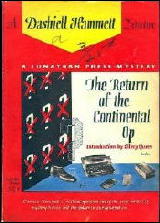
   Very shortly after this story appeared in EQMM, Fred included it in the digest-sized paperback original collection The Return of the Continental Op (Jonathan Press pb #J 17), which was published in the first week of July 1945, a month or two before Hammett came back to the U.S. from Army service in the Aleutian Islands during World War II.

DASHIELL HAMMETT

   If any reader of this column has a copy of that edition, which I don’t, I’d love to know whether the text of this story is Hammett’s original or Fred’s revision. (My hunch is the latter.)

   Settled back into civilian life, Hammett started teaching an evening course on mystery writing at the Jefferson School of Social Science, a Communist-affiliated institution on New York’s Sixth Avenue, and Fred joined him regularly as unofficial co-instructor.

   When Return was reprinted in ordinary paperback format (Dell pb #154, 1947), the last paragraph of the story was unaccountably back in its original form. Had Hammett objected to Fred’s bold attempt to spare him a few blushes?

***

   Erle Stanley Gardner’s pulp stories of the early 1930s, and his early novels as well, were hugely influenced by Hammett although in later years he resented having the fact pointed out.

ERLE STANLEY GARDNER

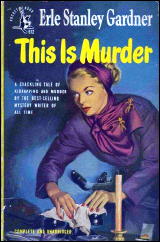
   In Chapter 20 of one of those early novels, the non-series whodunit This Is Murder (1935, as by Charles J. Kenny), a suspect has just been exposed as an ex-con. “Where was your first conviction?” he’s asked. “In Wisconsin.” “You served a term there?” “Yes, sir, at Waupum.”

   In fact the name of the town is Waupun, which locals unaccountably pronounce Wau-PAN. According to Wikipedia the place was supposed to have been named Waubun, which is a Native American word meaning dawn of day, but some state bureaucrat misspelled it and the mistake has never been corrected.

   The town’s chief industry is prisons — three of them! — but it’s also known for having more outdoor sculpture per capita than any other city in North America. The most famous such piece in Waupun is the “End of the Trail” sculpture: a young warrior on his horse contemplates the end of life as his people had known it.

   I saw it when I passed through the town years ago. The Library Bar on Waupun’s Main Street served the finest fries I’ve ever eaten. My buddy Joe Google tells me it’s no longer there. Drat!

***

BERNARD HERRMANN

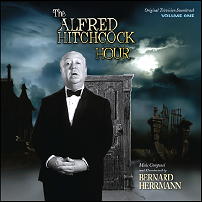
   I am finishing this column on June 27, two days short of what would have been the 100th birthday of my favorite American composer. The centenary of Bernard Herrmann (1911-1975), who’s best known for having scored films like Citizen Kane, Vertigo and Psycho, is being celebrated throughout the music world, and Varese Sarabande Records has just made a huge contribution to the festivities by releasing The Alfred Hitchcock Hour, Volume One.

   Herrmann wrote original scores for 17 Hitchcock Hour episodes during the program’s second and third seasons (1962-64), and this handsome two-CD set contains eight of them, more than two and a half hours of primo Herrmann never before available in audio form. Volume Two, let’s hope, will bring together the other nine — and soon. As I wrote in an earlier column, no one does ominous like Herrmann does ominous.

THE SERIES CHARACTERS FROM
DETECTIVE FICTION WEEKLY

by MONTE HERRIDGE


        #4. COLIN HAIG, by H. Bedford-Jones.

   The Colin Haig stories by H. Bedford-Jones made up a short-run series of six stories published consecutively from the October 7, 1933 issue through the November 11 issue. The stories are narrated by Martin Burke, who is the assistant in charge of Colin Haig’s laboratory in Los Angeles, “unequaled in the country.”

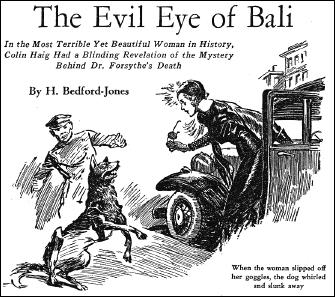
   The series relates the adventures of Colin Haig and his assistant against a priestess of Shiva named Madame Vanderdonk. She is supposedly the possessor of an evil eye, which can kill people and animals. This power is shown in the first story in the series, “The Evil Eye of Bali,” and Colin Haig cannot get anyone to believe him when he relates this fact. However, she has criminal agents who seem to do most of the actual killing by various means.

H. BEDFORD JONES Colin Haig

   I am missing the second story in the series, “The Desert of Death,” but “The Backward Swastika” is the third story, and involves more of the struggle against Madame Vanderdonk. Lieutenant Kelly of the missing persons detail of the local police makes an appearance at the beginning of the story, relating what they know about Madame Vanderdonk’s activities.

   It appears that she is targeting wealthy financiers, stealing their money and causing their deaths. The police have counted ten victims so far, and Kelly tells of a possible eleventh victim named Johansen. Kelly relates all of this information to Burke; Haig has been gone for three days looking for a trail to follow to Madame Vanderdonk based on photographic evidence acquired in the second story.

   Charles Hunter, one of Madame Vanderdonk’s murderous agents, appears for the first time in this story and uses a fake Haig letter to lure Burke into a trap, where he finds Johansen. He also meets Madame Vanderdonk, who talks to him. She attempts to manipulate him, but it doesn’t work, as Haig and Lieutenant Kelly arrive in time to rescue the two men. Madame Vanderdonk flees in her car.

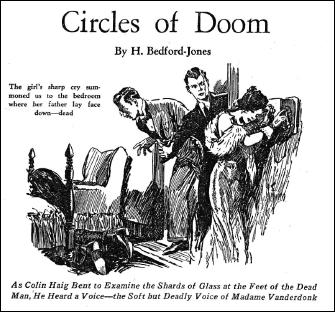
   In the fourth story, “Circles of Doom,” Burke receives a telephone call from a Professor Malvolio, whose real name is Van Steen. He is a professional hypnotist. Van Steen is asking for information about Madame Vanderdonk. He promises to come and see Colin Haig, but never arrives. He then calls Haig and asks him to come to see him.

H. BEDFORD JONES Colin Haig

   Haig arrives to find Van Steen dead by means of poison and Van Steen’s daughter present. Haig and his assistant, with the aid of the police (including Lieutenant Kelly), investigate the situation and discover much information, including a good deal about one of their nemesis’s agents, Charles Hunter (first seen in the third story).

   However, Hunter is dead from an accident by poisoning by the time they reach him. Another dead end for Haig, but he has an idea she has her headquarters is in the desert around Palm Springs, and plans to search for her.

   The fifth story, “Footsteps of Death,” opens with Lieutenant Kelly saying he can’t help them in their fight against Madame Vanderdonk outside the city limits of Los Angeles. His superiors don’t believe in the evil eye.

   Shortly thereafter, another attempt is made upon the lives of Colin Haig and Martin Burke. This impels them to immediately start the search for Madame Vanderdonk’s desert lair. After searching in the heat for quite a while, they stumble upon a dying man whose last words indicate he knows the woman for whom they are searching.

   They then search outward from that spot. Martin Burke finds woman’s hideout and is captured. He undergoes another session with Madame Vanderdonk as she attempts to win him over to her cause. He soon escapes, and finds Colin Haig nearby.

   Haig wants to go for help and return to attack the dwelling. Somehow, to me this sounds too simple to expect her to stay there and wait for him to return. On to the final part of the story.

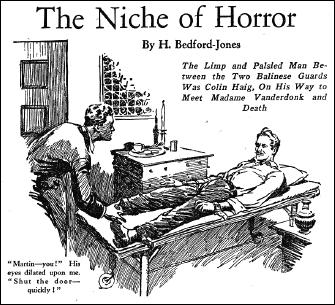
   In the sixth and last story in the series, “The Niche of Horror,” Colin Haig manages to get himself captured by Madame Vanderdonk. With this series, it was only a matter of time. He manages to escape the evil eye of the madame by sabotaging her base of operations and ending her reign of terror.

H. BEDFORD JONES Colin Haig

   This quick, short series of stories did not leave much time for readers to have to wait for each installment in the ongoing story. With the series preplanned and an ending provided, I don’t see why there wasn’t a sequel to it. That is, assuming the series was well received by the readers. It had plenty of action.

       The Colin Haig series by H. Bedford-Jones:

The Evil Eye of Bali     October 7, 1933
The Desert of Death     October 14, 1933
The Backward Swastika     October 21, 1933
Circles of Doom     October 28, 1933
Footsteps of Death     November 4, 1933
The Niche of Horror     November 11, 1933

WHO WAS ARTHUR MALLORY?
A 76-Year Old Pseudonym Revealed
by Victor A. Berch


   In a recent exchange of e-mails with my colleague, Allen J. Hubin, he queried me about the death date of the author known simply as Arthur Mallory.

   Mallory’s entry in Allen’s Crime Fiction IV appears as follows:

MALLORY, ARTHUR.   1881- ?

      The House of Carson (n.) Chelsea 1927
      Doctor Krook (n.) Chelsea 1929
      The Fiery Serpent (n.) Chelsea 1929
      Apperson’s Folly (n.) Chelsea 1930 [Dr. Kirke Montgomery; New York]
      The Black Valley Murders (n.) Chelsea 1930 [Dr. Kirke Montgomery; New York]
      Mysteries of Black Valley (n.) Chelsea 1930 [Dr. Kirke Montgomery; New York]

   The FictionMags Index adds a little more biographical information about Mallory, specifically that he was born on a ship in the Indian Ocean, along with a list of stories he wrote for Breezy Stories and Detective Story Magazine. No more than a dozen of these are listed, but the connection of Chelsea House and Detective Story is not surprising, since the former was the hardcover imprint of Street & Smith, which also published many pulp magazines, including DSM.

   However, I had no idea how much truth there was in that piece of biographical information from FictionMags, so I set out to discover what might be in the Ancestry.com genealogical database.

   There were some Arthur Mallorys, but none that fit the date of birth nor the description of the author. Searching further however, the name Arthur Mallory popped up in an obituary in the New York Times as the pseudonym of Ernest M. Poate, a mystery writer of some note.

   The obituary, which was dated Feb. 3, 1935, also provided the following information: Dr. Poate was born in Yokohama Japan and died in Southern Pines, North Carolina, Feb. 1, 1935, at the relatively young age of 50. He was a physician and an attorney as well as an author.

   Checking out entry for Poate in CFIV, I found the following:

POATE, ERNEST M.   1884-1935.

      The Trouble at Pinelands (n.) Chelsea 1922 [North Carolina]

ERNEST M. POATE

      Behind Locked Doors (n.) Chelsea 1923 [Dr. Thaddeus Bentiron; New York City, NY]
      Pledged to the Dead (n.) Chelsea 1925
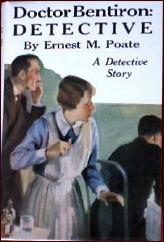
      Doctor Bentiron: Detective (co) Chelsea 1930 [New York City, NY]

ERNEST M. POATE

      Murder on the Brain (n.) Chelsea 1930 [New York City, NY]

   The first thing one notices is that Mallory and Poate had the same publisher, and digging a little further it can be discovered that the stories in the Dr. Bentiron collection were reprinted from Detective Story Magazine.

   The other major match between Mallory and Poate is that both used doctors as main characters in many of their books. This had to be more than coincidence. Just as the Times obituary had stated, and in spite of the discrepancy between the two dates of birth (and the location), the two men were one and the same.

   Poking around a bit more, I learned that his parents were Thomas Pratt Poate and Belle (Marsh) Poate, missionaries in Japan until the family immigrated to the US in 1892. His birth mother had died in 1896 and by 1900, his father had remarried. His World War I draft registration revealed that he was born October 10, 1884 and his full name was Ernest Marsh Poate.

   Anyone wishing to dig further into the family can examine the Poate family papers housed at Cornell University Library. The basic information on Dr. Poate will appear in the next Addendum to Crime Fiction IV.

— Copyright 2011 Victor A. Berch

VICTOR MAXWELL (RE)REVEALED
by Terry Sanford


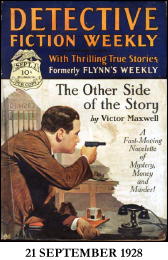
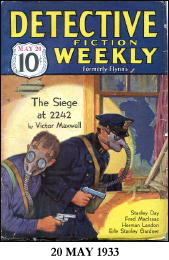
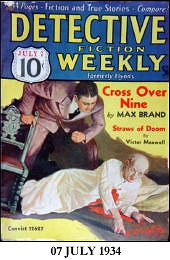
   When I began collecting pulp magazines over thirty years ago, I quickly zeroed in on Detective Fiction Weekly in all its various incarnations. I bought a lot of nice copies for fifteen dollars or less and I found a good number of stories that I enjoyed.

VICTOR MAXWELL

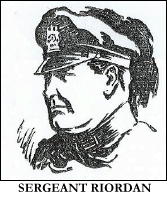
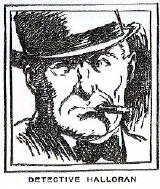
   I soon realized that I was a fan of Victor Maxwell’s Sgt. Riordan and Det. Halloran stories, a police procedural series that began in 1925. I found these stories were amazingly modern. There were no rubber hoses, beatings or hours spent in a darkened room with a bright light in the suspect’s face.

   Instead there were, just as there are today, instances where the interrogator lied to the suspect trying to extract a confession. The police were very concerned about their cases holding up in court and whether a smart defense attorney would shred them. (Riordan and Halloran are the two gents pictured here to the right and below, stalwart fellows both.)

VICTOR MAXWELL

   As I began to collect all the stories, I began to see that there was little information about the author. The stories appeared almost exclusively in Detective Fiction Weekly, hereinafter DFW, and that magazine did often run an “About the author” feature, but Victor Maxwell was never included. Sometime, somewhere I read that the Maxwell name was thought to be a pseudonym.

   About four years ago, I wrote an article for the Mystery*File website titled “Those Detective Fiction Weekly Mugs.” It was so titled because we added artist’s renderings of the various characters featured.

   I wrote this to share my enthusiasm for the hobby and one of my favorite pulps. There was no thought of a reward. A year later, Steve Lewis, our editor and chief was contacted by Don Wilde, who is the step-grandson of the man who wrote as Victor Maxwell. Mr Wilde had googled the pen name and discovered the article.

   Although he never met his grandfather he had some items that might be of interest. Steve kindly put the two of us together and we had a fine time sharing information. Within a few weeks, he sent me pictures, correspondence, three unpublished stories and two unpublished novel manuscripts and more. A treasure trove for a Victor Maxwell fan!

VICTOR MAXWELL

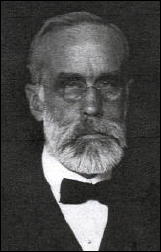
   The identity of the author was never a secret. It was mentioned in almost all of his obituaries. It was simply lost over time. Victor Maxwell was a newspaper reporter named Maxwell Vietor.

   Mr. Vietor was born on July 7, 1880 in New York City to Edward W. and Agnes C. (McCahey) Vietor. Edward Vietor was a medical doctor and within a few years, so was his wife. Edward was the founder of the Brooklyn Bird(watcher’s) Club, which exists today.

   In January of 1882, Dr. Edward Vietor was summoned to a local residence where 10 year-old Bessie Thayer had become gravely ill after eating some candy she bought at the neighborhood candy store. Although Dr. Vietor was the third physician to see the girl that day, his was the correct diagnosis: arsenic poisoning! The girl died in his presence.

   Dr. Vietor subsequently testified at a Coroner’s Inquest where it was resolved to turn the matter over to the police. There is no conclusion of the case that I’ve been able to find. Is it likely that this became a story that was mentioned from time to time in the Vietor household and fueled the imagination of young Maxwell? Perhaps.

   At some point prior to 1910, the Vietors divorced. Dr. Agnes Vietor and Maxwell moved to the Boston area.

VICTOR MAXWELL

   Maxwell graduated form Phillips Exeter Academy in 1898. He then attended MIT where the records show, “Maxwell Vietor ex.’02 has been granted a leave of absence for one year by the faculty, in order to take up practical railroad work with the Boston and Maine R.R.” Like many a college kid before him, Max soon realized that manual labor was not an ethnic gentleman.

   According to several of his obituaries, he then returned to New York and began his newspaper career, first with the Sun and then with New York City News, a news distribution service.

   Just prior to 1910, Max married Helena Haworth. The couple soon moved to Boston where Max continued as a reporter for The Boston Globe. By 1911, Max and Helena moved to the Vancouver, Washington and Portland, Oregon area.

   That year Max made a haphazard attempt to keep a diary. Some of the entries deal with personal matters, but many of the pages just bore the letters, “P.P.” Finally months into the diary, those initials are spelled out: “Purple Pulp.” This was a humorous reference to his newspaper writing as he hadn’t yet begun to write for the real pulps.

VICTOR MAXWELL

   Their only child, Alice was born on August 15, 1911. In 1915, tragedy struck the Vietor family. Helena’s car was discovered parked by a bridge spanning the Columbia river, but Helena was gone. The river flows into the Pacific ocean from that spot, which was used by many suicidal people over the years.

   There was no trace of her after that day. Max would never remarry.

   The January 20, 1916 issue of The Popular Magazine published the first Victor Maxwell short story, “The Little Girl Who Got Lost.” A second story appeared in August in that same pulp.

   The family knew that Max occasionally wrote for the pulps full-time and one of those times may have been in 1917 when eight stories appeared in The Popular in an eight-month period.

   Another minor mystery in Max’s life is evidenced by a letter found in his correspondence. The letter was from Ben W. Olcutt, Oregon’s governor and was dated April 5, 1920. The one-paragraph body reads:

    “I am in receipt of your report of April 3rd, which I have read with much interest. In this connection and in passing I wish to say a good word for the work you have accomplished for the state in the capacity of special agent and for your highly intelligent and understandable report made in that connection.” There is no further explanation of his duties or service to Oregon.

VICTOR MAXWELL

   Reporting must have lured him back as the pulp stories ended until his first appearance in DFW in 1925. That story would be the first of exactly one hundred appearances in the detective pulps, thanks, in part, to a novelette that was serialized over three successive issues of DFW.

   Max had found a home there. All but seven of his detective stories were published by DFW. What prompted the inquiry is lost to the ages, but in March of 1931, Max apparently wrote the editor of DFW asking if he thought the readers might be tiring of Riordan.

   At this point Max had sold them over fifty stories in a five-and-a-half years. Editor Howard V. Bloomfield wrote Max saying that he did not think anyone was tired of Riordan and strongly encouraging to either continue with the series or send in even more!

   In addition to the detective stories, Max wrote three non-fiction articles for DFW. There were a smattering of other stories published in The Popular, Railroad (&) Railroad Man’s Magazine, Short Stories and Street & Smith’s Complete Magazine.

   And that and reporting was his life, along with raising his daughter. About 1938, Max moved back to the Boston area where his mother resided. He would finish his newspaper career at the Worcester Telegram–The Evening Gazette.

VICTOR MAXWELL

   His hearing was going and he would be completely deaf before his death. He switched from reporting to editing copy and would communicate with his fellow employees via handwritten notes. His last pulp story was in the January, 1944 issue of New Detective Magazine.

   In 1950, increasingly worse back pain was plaguing Max. He went to the Mayo Clinic finally for help. Their diagnosis was inoperable cancer. From the clinic, he returned to the Pacific coast to be with his daughter. Just two weeks prior to his death, there was a heart-breaking exchange of letters between Max and his employer where he was told he was not eligible for a pension from them.

   He died at a Portland hospital of a heart attack on October 4, 1950, survived by his mother and daughter.

   The stories and the novels I have in manuscript form are not publishable as they are. But it is one hell of a collection and I want to thank Don Wilde for his generosity of time and spirit. And thanks to Steve Lewis for starting the ball rolling.

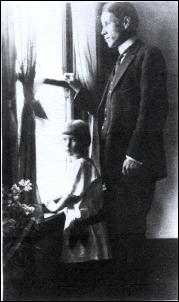
Note:   The uppermost photo of Maxwell Vietor with his daughter Alice may have been taken in 1918. The date of the lower photograph is unknown.

THE SERIES CHARACTERS FROM
DETECTIVE FICTION WEEKLY

by MONTE HERRIDGE


        #3. ARTY BEELE, by Ruth & Alexander Wilson.

   The Arty Beele stories by Ruth and Alexander Wilson were a short series of at least sixteen stories (some short stories and some novelette length) published in Detective Fiction Weekly from 1928 to 1932. There could be more.

   The character’s full name is Arthur Welliver Beele. The series involves the exploits of a hardboiled newspaper crime reporter in the Prohibition era. The stories are a bit hardboiled, too; an early example of this type of story.

   Beele is not afraid of gangsters and racketeers; he associated with them considerably and they gave him good stories. This doesn’t mean that all criminals liked him. Beele would without any compunction insult a known criminal and act unafraid of the consequences.

   Beele could often acquire information about goings on with the police and underworld. On one occasion “It had come to Arty Beele’s attention, by one of those devious routes that were at once the despair and the astonishment of his city editor…” (The Fragrant Alibi)

   In a number of the stories, John Ryan, captain of the homicide squad, leads the investigations and somewhat disapproves of Beele, but lets him ask many questions. Harrington, the Telegraph newspaper’s city editor, is a friend of his.

DETECTIVE FICTION WEEKLY Arty Beele

   The descriptions given of Beele are sketchy, but one statement about Beele is “a tall, untidy figure crowned with a disreputable Stetson…” (A Pain in the Neck) He also has a beaky, hawk nose. Beele does not let himself get involved with women, “he distrusted and detested women.” (Strike Three!)

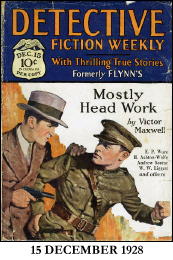
   In the first story in the series, “Killers Have Blue Eyes” (December 15, 1928) Beele tells Hymie Jacobs, a known gunman, that he is yellow. He also notes that killers always have blue eyes, and Jacobs doesn’t. The story is a simple one where Jacobs’ enemy, another gunman, is killed. Beele knows that Jacobs didn’t kill him, and suspects who did. But Beele convinces Jacobs to confess to the killing.

   â€œThe Silent Witness” details the aftermath of a killing of Brady, a gangland leader, supposedly by his girl friend Floss Jordan. But Arty Beele sees something that others don’t see, and believes she is innocent. He plays this up in his newspaper writings, and gets a lawyer friend of his to represent the accused woman. Part of the story is a relation of the court trial, and its results.

   â€œA Ride in the Park” does not involve a mystery, but does involve a murder. When gangster Tony Costello arrives back in town, Arty Beele expects that he will be killed by enemies. When a killing does take place at the train station, Beele jumps to the conclusion it was Costello and writes up an article about it.

   The piece was not complimentary to Costello, and he it turns out was not killed. Costello waylays Beele and takes him for a ride, intending to kill him. Beele manages to wreck to the car and kill Costello. A very close call for Arty Beele.

   â€œDeath in the Dark” is a longer story than many others in the series, being of novelette length. It is a better story, as it enables the author to spend more time on details and the characters. Beele is sent by Harrington, his editor, to the house of a rich man who has been mysteriously shot while a police patrolman was not too far away.

   The only witness is too drunk to tell anyone anything, and there seems to be no place that the murderer could have gone after the crime. The crime was a complicated scheme to provide an alibi for the murderer, and it takes Arty Beele to see through it. He had the cooperation of Captain Ryan here.

   â€œThis Way Out” doesn’t involve a mystery, although someone is murdered in it. One of Arty Beele’s gangster friends named Al Donner is in trouble with the law for a murder. Beele doesn’t believe he did it, although he knows that Donner did murder someone else a short time before. So Beele gets Donner a lawyer to defend him in court, and backs up Donner. Beele feels an obligation to Donner because Donner saved his life once. This is another novelette length story.

   â€œA Pain in the Neck” is a murder mystery where Arty Beele is involved with the police in solving the case of a fight manager who has been strangled. The obvious suspect is the manager’s boxer, but Beele sees clues the others have missed and points out the correct killer.

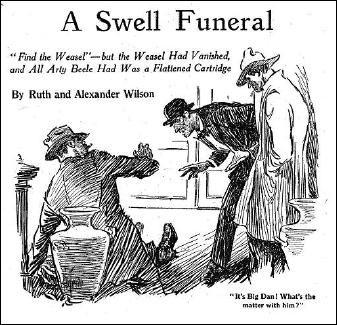
   â€œA Swell Funeral” involves the murder of a racketeer leader at his recently opened nightclub, the Club Seville. Arty Beele is a friend of the racketeer, Dan O’Malley, and happens to be in the club at the time that he was killed. Strangely, no one saw the shooting at the front door where O’Malley fell dead.

ARTY BEELE Ruth & Alexander Wilson

   Captain Ryan is soon on the scene, and Beele insists on being a part of the investigation. Various other men, some of them racketeers also, come under suspicion. As usual, Beele comes up with the solution, with the cooperation of the police.

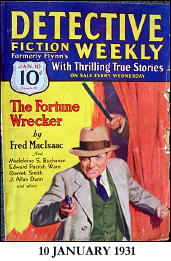
   â€œSpecial Delivery” is of novelette length, and is a story of gangsters and the newspaper. Scarron, the local liquor racketeer, has told Arty Beele that he will retire from bootlegging and move to a foreign country. However, a fellow newspaperman of Beele’s named Slim Stengel was shot supposedly by gangsters near Scarron’s home. Considering that Stengel idolized Arty Beele, Beele feels obligated to do something about the matter.

   â€œThe Murder of the Seven-Year Itch” involves another gangland killing. Al Toriano visits Arty Beele in the newspaper newsroom and gives him some stock certificates to cash in and dole out the money to a beneficiary. Toriano says that he will probably be killed by other gangsters shortly.

DETECTIVE FICTION WEEKLY Arty Beele

   When both Toriano and his beneficiary are found shot in suspicious circumstances – it looks like they killed each other – Beele stirs Captain Ryan to investigate the matter more thoroughly. Beele of course helps the investigation, and coincidentally comes across the two killers a short time later.

   â€œThe Picture of a Crime” involves Arty Beele in the murder investigation of a rich man in his mistresses’ apartment. In this story, Harrington, the Telegraph newspaper’s city editor, assigns the news coverage to him and a photographer.

   Once on the scene, Beele begins acting like one of the investigating police, asking questions of the suspects and others. There is no real mystery about the murderer, since there are only three suspects.

   â€œLive Bait” is different than other stories in the series. The story opens with Beele getting a tip-off from an underworld connection that he is going to be the target of a local crime lord, who means to kill him. Beele heads to Captain Ryan’s office to tell him the news, and together they come up with a plan to trap Orsini the crime lord. No mystery or murder to solve in this story.

   â€œStrike Three!” is a novelette length story that involves Arty Beele in the planned killing of one liquor gangster by another. One of the gangsters tips off Beele that he will kill an unnamed gangster, and Beele tries to figure out who the victim is to be. He winds up at the Club Chanticleer investigating.

   He is asked by Mike O’Mara (the intended victim), to sit in on a meeting between him and Repetti. “It was no new role for him to act as arbiter at a gangster conference.” When O’Mara and Repetti are both murdered, it is Beele who straightens out the confusion as to who killed whom.

   â€œDevil’s Brew” is something of a mystery combined with gangdom interactions. Beele is called in by two of the local liquor barons to help arbiter a problem between the three local liquor barons. Captain Ryan interferes with this work, and all of a sudden one of the barons is mysteriously shot and another disappears. Arty Beele investigates, and puts his life in danger in order to solve the problem.

   â€œThe Fragrant Alibi” is another story where Beele assists the police in the solution of a crime. No Captain Ryan here, though. Beele is in a nightclub when a gangland murder takes place, and is involved in the story before the killing takes place. As often is the case, a small clue points out the solution of the crime to Beele.

DETECTIVE FICTION WEEKLY Arty Beele

   â€œCheap at the Price” has Arty Beele investigating another gangland killing, and he is also under threat from the gangster suspected in a number of other killings. Another novelette length story.

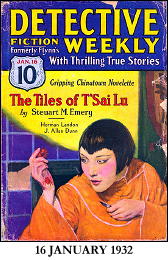
   â€œTwenty Grand” is the last story found in the series, and is a good one. There is no murder mystery here; the culprit is known from the beginning. Blacky Frey, a gangster, has killed two people with his .22 rifle. One of these was a policeman, for which he was tried and acquitted due to lack of evidence(the police couldn’t find the rifle). However, Arty Beele thinks up a scheme to have the police catch Frey red-handed with the rifle committing a crime.

   This is an average series, with some very good stories, but mostly average or slightly above that. The best stories are the novelette length ones, because they have more scope for description and action and complexity.

   There is no element of humor in the stories, and the hardboiled nature of the stories denies any lightness to them. This series about a crime reporter does not measure up to the later crime reporter series that Richard Sale wrote about Daffy Dill. Daffy Dill was a longer running series and much more popular than many other series in DFW.

      The Arty Beele series by Ruth & Alexander Wilson:

Killers Have Blue Eyes     December 15, 1928
The Silent Witness     April 13, 1929
A Ride in the Park     August 24, 1929
Death in the Dark     April 5, 1930
This Way Out     May 10, 1930
A Pain in the Neck     September 27, 1930
A Swell Funeral     October 18, 1930
Special Delivery     January 10, 1931
The Murder of the Seven-Year Itch     January 31, 1931
The Picture of a Crime     March 7, 1931
Live Bait     March 21, 1931
Strike Three!     May 2, 1931
Devil’s Brew     August 1, 1931
The Fragrant Alibi     August 22, 1931
Cheap at the Price     November 7, 1931
Twenty Grand     January 16, 1932

NOTE:   Thanks to Phil Stephensen-Payne for helping put together this checklist of story titles. The cover images also came from his Galactic Central website. Please visit!

REVIEWED BY JEFF MEYERSON:         

FRANK GRUBER – The French Key Mystery. Farrar & Rinehart, hardcover, 1940. Paperback reprints include: Avon Murder of the Month #4, 1942; Avon #91, 1946, both as The French Key Mystery. Jonathan Press J89, [1957], as Once Over Deadly. Belmont L92-592, 1964. Film: Republic, 1946 (story & screenplay by Frank Gruber).

   Frank Gruber was a mainstay of the pulps, grinding out over 600,000 words a year for many years. In 1940 he turned out this, his first detective novel, in a week, and it was a big success (a film was made with Albert Dekker and Mike Masurki).

   It is the first of fourteen books with quick-thinking, fast-talking Johnny Fletcher, the world’s greatest book salesman, and his brawny sidekick, Sam Cragg. Fletcher and Cragg are locked out of their hotel room for non-payment of the bill; when they climb in through the window of the next room they find a dead body in their bed clutching an extremely valuable gold coin in his hand.

   From then on it’s one fast moving complication after another, as Fletcher must clear himself of murder, find the real killer, and solve the mystery of the coin. Despite a few improbabilities of plot, French Key is pulp writing at its best, with a briskly moving plot, breezy dialogue, and lots of action.

   It also offers an interesting picture of New York in 1939, when a nickel could buy a hamburger at a greasy spoon, as well as a ride on a subway, and a suite at the Waldorf went for as little as twenty-five dollars a day.

— Reprinted from The MYSTERY FANcier, Vol. 1, No. 5, September 1977.

BILL PRONZINI – Blowback. Random House, hardcover, 1977. Paperback reprints: Dale Books, 1978; Foul Play Press, 1984.

   As you may already know, this is the one that begins with the nameless private detective as he waits for the report on his lungs to come through. It is a tumor, he knows that now, but is it malignant?

   He means to sweat it out alone over the weekend, but a call for help from a friend takes him a short way out of himself, up into the mountains, to mix a little fishing with business.

   There are six men at the camp, and one woman, which is just the right mixture to provoke a murderous amount of jealousy and hatred, but how do a stolen Oriental carpet and a lone peacock feather enter in to it?

   Pronzini enjoys doing a tough-edged version of classical detection, and he may surprise a few who haven’t been paying close attention; but he adds something more — a rare view of someone confronted with and facing his own mortality, analyzing his life, comparing it with those of the pulp heroes he emulates.

   The fact that he, and others, still read their adventures makes certain their kind of immortality, and while I can’t tell you what the doctor’s report says, even without a name to call his own, there is a private eye who now can be added to the list of those who may in time be forgotten by many — by not by all.

— Reprinted from The MYSTERY FANcier, Vol. 1, No. 5, September 1977 (very slightly revised).

Reviewed by DAVID L. VINEYARD:         

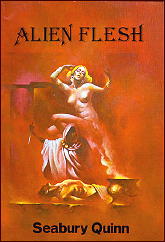
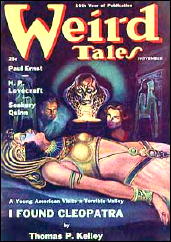
SEABURY QUINN – Alien Flesh. Oswald Train; hardcover, 1977. Introduction by E. Hoffman Price; illustrations by Stephen Fabian. Expanded from the short story “Lynne Foster Is Dead!”, Weird Tales, November 1938.

SEABURY QUINN Alien Flesh

   There is a type of book that can only be called a peculiar classic; not a work of great literature, and yet both memorable and remarkable. Inevitably such books are faintly redolent of the decadent, faintly touched with the strange; Huysman’s La Bas and Against the Grain are such books, so were the works of E. H. Visiak and William Beckford, so Mari Corelli’s The Sorrows of Satan, and James Branch Cabell’s Jurgen. Everything William Morris wrote falls under this umbrella and most of Lord Dunsany.

   And so does Seabury Quinn’s Alien Flesh.

   Seabury Quinn reigned supreme in the old pulp Weird Tales. The popularity of his tales of psychic sleuth Jules de Grandin and his Watson, Dr. Trowbridge, far surpassed the popularity of H. P. Lovecraft, Robert E. Howard, Robert Bloch or any of the other legendary names associated with the magazine. He even produced one genuine classic, the haunting Christmas story Roads (the legendary Arkham House edition illustrated by science fiction master Virgil Finlay is one of the most attractive books ever printed by a small press)..

   Alien Flesh is a novel, written after Weird Tales glory days, in 1950 not long before the series of strokes that ended Quinn’s fiction writing career. He lived until 1969, but no longer churned out tales of vampires, werewolves, cults, and covens, and only one book like Alien Flesh. Not that there could be more than one book like Alien Flesh.

    “For sweet God’s sake, who is she, Conover?”

    She came slowly toward them passed the rows of glassed-in mummy cases. She was not tall, but very slim, with the force maigruer of youth, and wore a daringly low-cut evening gown of midnight blue and a blonde knee length mink coat draped crosswise across her shoulders. Her eyes were amber and her honey colored hair was drawn back from a pronounced widow’s peak to be looped in a loose figure eight at the nape of her neck … she was like Clytie in a velvet gown, Titania in pearls and mink. If she had suddenly unfolded moth- wings and taken flight Arundel would not have been too much surprised.

SEABURY QUINN Alien Flesh

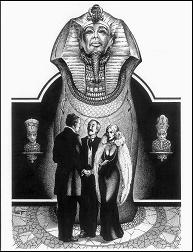
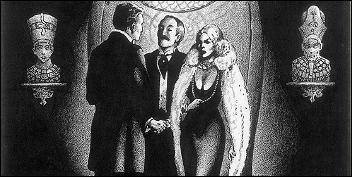
   Hugh Arundel, Egyptologist, attending a new Egyptian exhibit at a New York museum is introduced to the fabulous Madame Foulik Bey, Ismet.

   And something draws Arundel to her, something in her strange manner, and stranger eyes, something he can’t quite put a finger on.

   In short order his life revolves around her. She becomes the axis all aspect of his thoughts turn on. And at every turn a new mystery, her nature possessing, “as many facets as a diamond.”

   And yet despite her obvious feeling for him she holds him at bay.

   Finally he pushes her and she relents and tells him her story,

    “Tell me what you know about Lynne Foster, especially what you know about him now,” he heard her saying.

   Lynne Foster was a boyhood friend. They had gone to school together, dated together, both been fascinated with Egypt. Lynne Foster had disappeared in Cairo, possibly murdered.

    “…Can you supply the ending of the story?”

    “Here is the ending!” she knotted her small hands into fists and struck herself on the breast. Her head was thrown back, and her eyes were flushed with tears. “I am — or was — I don’t know which — Lynne Foster.”

SEABURY QUINN Alien Flesh

   And then she relates her — Lynne Foster’s — tale.

   I did warn you this was a peculiar classic.

   Lynne Foster in Egypt fell afoul of ancient sorcery, and in his western arrogance was punished. He was transformed, from the strong and tough minded young man to …

   I rose, walked slowly toward the mirror, and the girl walked towards me with a cadenced, sensuous swaying of slim hips and pointed breasts. Arm’s length from the looking glass I halted and put out my hand. The mirror girl’s slim hand came up to meet mine, but instead of warm flesh I encountered cool hard glass. I turned to look behind me.

   Besides me there was no one else in the room!

   As you might imagine this could go wrong very quickly, and it is a testament to the old pulp master’s skills that it does not. He finds a fine balance between horror, humor, whimsy, unabashed Arabian nights, the erotic — suggested but never spelled out — and sensuality — the book drips with that — as he spins out the tale of the fortunes of Lynne Foster, now Ismet a simple harem girl.

SEABURY QUINN Alien Flesh

   Again, I said this was a peculiar book and it is difficult to convey to any reader how well Quinn handles this difficult theme without slipping into either soft porn or outright comedy. The book recounts Ismet’s adventures, her first touches of romance in her new body, her battle with the mind of Lynne Foster and the emotions of the woman Ismet, and her rise to riches and power using Lynne Foster’s masculine mind and Ismet Foulik’s feminine charms.

   I’m not sure I buy the sweepingly romantic ending, but Quinn more than prepares you for it, and after all, Hollywood used to churn out this kind of fantasy with regularity — though usually in the form of Thorne Smith comedy such as Turnabout or I Married A Witch.

   Here it is deadly serious, but handled so deftly that the giggles that could easily turn to guffaws and destroy the entire mood are held at bay (at least while you are caught in Quinn’s spell, I can’t answer for later) and the reader manages to stay with Quinn thanks to his sheer story telling skills.

   Once he gets you on his side he keeps you there, and plays deftly with both the reader’s willingness to suspend disbelief and also the key to any storyteller’s success, the readers desire to see what happens next. Quinn knew how to spin a tale and keep the pages turning, and here those skills serve him well. This isn’t the sort of book that can survive much in the way of the reader stopping to meditate on the story.

SEABURY QUINN Alien Flesh

   When this was reissued in 1977 by Oswald Train it came with an appreciative forward by Quinn’s friend and former pulp master E. Hoffman Price, a beautiful color cover by illustrator Stephen Fabian, and a full accompaniment of full page black and white illustrations also by Fabian. It’s a lovely little book and a perfect tribute to this most peculiar of peculiar classics.

   I know many of you reading this description of the book, are going to say there is no way it could work in the form Quinn gives it, and no doubt it would not for many readers, but Alien Flesh, given half of a chance earns it’s place on that shelf of peculiar classics, and earns Quinn this much from me — I can’t think of another writer who could have pulled it off with half the charm, skill, and old fashioned pulp romanticizing.

   If nothing else you turn each page just to see if he avoids the obvious traps — which he always does — and you reach the end glad to give him his choice of endings thankful for the memorable trip.

    “… the past has lost all meaning — and all menace.”

   And one more peculiar classic finds its way onto the shelves.

THE SERIES CHARACTERS FROM
DETECTIVE FICTION WEEKLY

by MONTE HERRIDGE


        #2. HAPPY McGONIGLE, by Paul Allenby.

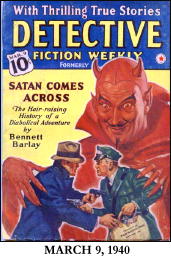
   The Happy McGonigle stories by Paul Allenby was a short series of at least eight stories published in Detective Fiction Weekly from 1940 through 1941. The stories are about the misadventures of petty criminal Happy McGonigle and his partner in crime, Blackie Roberts.

HAPPY McGONICLE Paul Allenby

   The stories are narrated in first person by Blackie Roberts, who tries to explain the problems of trying to plan and commit crimes with a person like Happy McGonigle. In the first story Roberts explains very briefly what McGonigle is like:

    “He is not a gent who is looking for trouble all the time. Oh, no! Happy is the simplest, dumbest boob that ever turned a dishonest penny. From the top of his mop-like blond hair to his 13-D feet, he is plain uncut, yokel.”     (“A Cockeyed Wiggley”)

   Roberts notes that he has trained Happy over a ten year period, and that Happy is handy with burglar tools and in fights, but often makes him sorry he knows him. Blackie explains that he is the brains of the duo, and Happy is the brawn. Trying to plan crimes with help like Happy is difficult. He has to be careful to explain the crime plans very carefully to Happy, who is often not paying close attention.

   Happy is happiest when he is involved with his latest hobby. He has been through many hobbies, and in the first story in the series, “A Cockeyed Wiggley,” his hobby is collecting matchbook covers. This hobby causes problems with their crime plan for this story, but somehow everything turns out all right, though they don’t make any money from their crime.

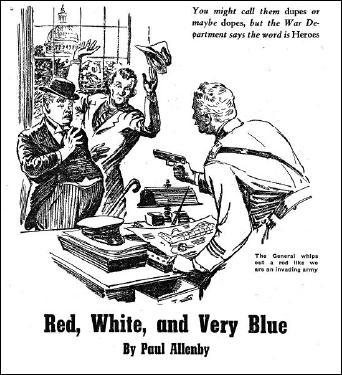
   The next story, “Red, White and Very Blue,” finds the two criminals on their way back from gambling on horse racing at Pimlico, stopping off in Washington, D.C. for some rest and relaxation. Happy turns into a typical tourist, going to see all the sites and spending a lot of money on fancy clothes.

HAPPY McGONICLE Paul Allenby

   They run into trouble when they encounter a group of spies. The spies con the two out of all of their money, and also con them into stealing airplane plans from a house. Fortunately for them, they realize what is going on and hand the plans back to the U.S. Government, and wind up making themselves look like heroes in the process.

   As shown in the story, Black Roberts can be just about as gullible and naïve as Happy McGonigle. So Blackie’s comments about his partner need to be taken with a grain or two of salt.

   In the story “In the Bag,” the two are planning a jewel robbery, but another of Happy’s hobbies interferes with the plans. Happy has started taking dancing lessons in order to be an “adagio” dancer.

   Blackie thinks this is ridiculous and tries to get Happy to work with him on the robbery. But Happy has promised to deliver a suitcase for the dance teacher. The title refers to the fact that three new identical leather suitcases become involved in the plot and the guys try to keep straight which contains what.

   When the newspaper reports that the dance studio staff has been arrested for drug smuggling, the bag situation gets more complicated.

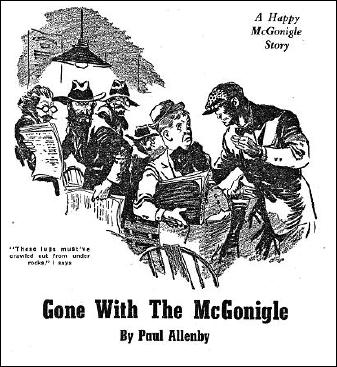
   In “Gone With the McGonigle,” Happy’s newest hobby is to become a writer. So he buys a lot of paper, a filing cabinet, a portable table, and a typewriter. After spending all of this money he thinks he is ready to become a writer.

   However, he finds being a writer is not all it is cracked up to be. Happy finally goes on a destructive rampage through his editor’s house, which he and Blackie are burglarizing.

HAPPY McGONICLE Paul Allenby

   In “McGonigle the Great,” Happy is struck with the wish to be a professional magician. He learns a number of magic tricks while he and Blackie are staying at a large hotel. Unfortunately, he makes so many mistakes that people laugh at his act.

   Even though the audiences enjoy the mistakes, Happy does not like being laughed at. Blackie notes that Happy is somewhat deficient in a sense of humor. While all of this is going on, Blackie Roberts and a newspaper reporter (who is teaching Happy magic tricks) are searching the hotel for an absconding bank teller who has stolen a hundred thousand dollars. The magic act plus the search make for a situation that is sure to get out of hand quickly.

   â€œMcGonigle Makes a Bid” finds the duo trying to take a vacation and behave in a law-abiding manner. They head off to the wilds in a car, but wind up stranded at a large house occupied by a crazy man. Unknown to them, the grounds are also the hiding place of three criminals who don’t like the interruption of Happy and Blackie.

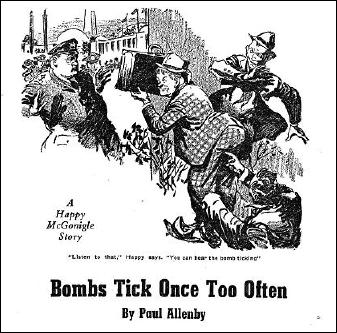
   In “Bombs Tick Once Too Often”, Happy and Blackie are visiting the World’s Fair and trying to enjoy themselves. However, Happy thinks that someone is trying to plant a bomb at the Fair. Their first move is to follow two suspicious acting characters (who are carrying a suitcase) around the Fair. Later, when Happy discovers a bag that is ticking and whirring, he is positive he has found a bomb. Altogether, a very stressful day for Blackie and Happy.

HAPPY McGONICLE Paul Allenby

   â€œThe Skeleton of Danny Force” is atypical of the other stories in the series. Happy McGonigle does not play the primary focus of the story. Blackie Roberts is more the focus of this story, as he and Happy go out to a rural town to help one of Happy’s friends in his dealings with the local Scrooge-like banker. A skeleton is dug up by a local, and this provides the means by which Blackie can counter the banker and get the better of him.

   The final story, “In Union There Is McGonigle,” The two guys get into union activity, primarily because they think they can make some money in it. Definitely not in it for the benefit of the workers of pretzel salters industry, which is their working area.

   As usual, they run into numerous complications in the process, and only Blackie’s planning gets them out of the situation and with a profit for a change. Also as usual, it was Happy’s doing that they got into union activity in the first place. He doesn’t appear to ever think through the consequences of his actions.

   As you no doubt can tell from the above story descriptions, this series is meant to be a light comedy series of stories. No seriousness invades the stories, and the cast bumbles their way along the story lines without any serious damage or landing in jail.

   The series is not really that funny, however, though it aims to be. It is okay as a mildly humorous look at two bumbling criminals.

   There were other humorous series in DFW in the past, including two (Fluffy McGoff , 1931-37, and Murray Magimple, 1935-37) by Milo Ray Phelps, who died in 1937. Not having read much of the various humorous series, I can’t say which ones are the best or succeed at being funny.

        The Happy McGonigle series by Paul Allenby:

A Cockeyed Wiggley     March 9, 1940
Red, White and Very Blue     March 30, 1940
* Grand Marshal McGonigle     June 1, 1940
In the Bag     June 15, 1940
Gone With the McGonigle     June 29, 1940
McGonigle the Great     August 3, 1940
McGonigle Makes a Bid     August 17, 1940
Bombs Tick Once Too Often     October 19, 1940
* Insurance for Sale     November 23, 1940
The Skeleton of Danny Force     January 18, 1941
In Union There Is McGonigle     April 26, 1941
* It’s All in the Angle     May 31, 1941

(*) These three were added after the list was first posted. Thanks to Phil Stephensen-Payne for pointing them out as likely possibilities in the comments, and for Walker Martin for confirming that they are indeed McGonigle stories.

Previously on this blog:   #1. Shamus Maguire by Stanley Day.

« Previous PageNext Page »