Pulp Fiction


A REVIEW BY WALKER MARTIN:         


JOHN LOCKE Best of Prison Stories

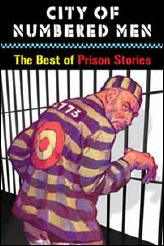
JOHN LOCKE, Editor – City of Numbered Men: The Best of Prison Stories.

Off-Trail Publications, trade paperback; 1st printing, January 2010.

   Back in the 1960’s and 1970’s it was actually possible to find and build up extensive collections of many rare pulp titles. Most readers and collectors were aware of only the SF pulps (and pulps which printed early SF like Argosy and All Story), and the hero pulps like The Shadow, Doc Savage, G-8, The Spider, etc.

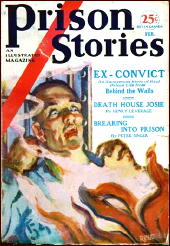
   There wasn’t a lot of competition for other pulps back then, and I managed to find many of the Harold Hersey magazines not many other collectors were looking for — magazines such as Ace-High, Cowboy Stories, Danger Trail, and of course one of the most fascinating titles, Prison Stories.

   Now of course it is very hard indeed to find such rare pulps as Danger Trail and Prison Stories. But we are fortunately living in the age of print on demand reprint collections. Now within a matter of weeks, it is possible to publish a collection of pulp stories with all sorts of interesting editorial comments in the form of original research articles.

   Another example of this trend is a new book which I have just received in the mail from John Locke, publisher of Off-Trail Publications, a pulp reprint line of books. The title is City of Numbered Man: The Best of Prison Stories. It is a very handsome large paperbound volume of 274 pages, priced at $20.00.

JOHN LOCKE Best of Prison Stories

   You may order it from amazon.com, Adventure House, or Mike Chomko Books. It also is available from John Locke directly using Paypal by contacting directly at offtrail@redshift. com.

   The book consists of 12 stories reprinted from Prison Stories, all dating from 1930 to 1931, including a long novelet “Big House Boomerang.” These stories alone would make the collection a must buy, but there also is a 15 page article about the history of the magazine entitled “Imprisoned Pulp,” by John Locke.

   John has also included a 34 page biography, “Harold Hersey: Tales of an Ink-Stained Wretch,” and in addition, we have 7 pages of notes on the authors, an index, and 20 pages of letters from ex-cons and lovers of prison fiction, reprinted from the crumbling pages of the magazine itself.

   I repeat, if you are a lover of pulp fiction, then this is a must have volume. John Locke has done around 20 of these reprint books and we need to show our support so that he will continue this worthy cause. This book gets my highest recommendation.

Reviewed by DAVID L. VINEYARD:         


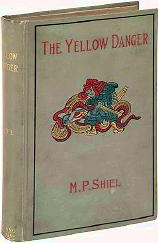
M. P. SHIEL – The Yellow Danger. Grant Richards, UK, hardcover, 1898. R. F. Fenno, US, hc, 1899. Reprinted many times.
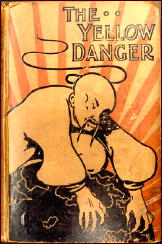
M. P. SHIEL

   Matthew Philips Shiel has to be one of the most eccentric writers of all time. Racist (despite the fact he was of mixed race himself), jingoist, and mystic, he is probably best known today for his Last Man on Earth novel The Purple Cloud and his stories about decadent sleuth, the neurasthenic Prince Zaleski, but for pulp fans he holds a special place — as the inventor of the “Yellow Peril” novel.

   Before Shiel the “Italian Peril’ had been the biggest trend in popular fiction. Guy Boothby’s Dr. Nikola had a long successful career plaguing a series of English heroes (Nikola deserves to be rediscovered, and all the books are available to read free on-line as well as others by the popular and talented Australian Boothby), and Italian villains with ties to ‘the Black Hand’ and other such secret societies had shown up in the adventures of Sherlock Holmes, Nick Carter, Sexton Blake, and books such as L. T. Meade’s and Robert Eustace’s The Brotherhood of the Seven Kings (also available free on-line and worth checking out, a clever and entertaining thriller from an earlier age).
M. P. SHIEL

   The Yellow Danger is a novel in the sub-genre of stories known as invasion or future war novels that began with The Battle of Dorking and reached its highpoint with H. G. Wells’s War of the Worlds. William LeQueux made a near cottage industry of these, and classics of the form include Erskine Childer’s prophetic Riddle of the Sands and Conan Doyle’s Danger! (which predicted submarine warfare in WW I).

   Modern examples include Vandenburg by Oliver Lange, I, Martha Adams by Pauline Glen Winslow, SGB by Len Deighton, and films such as Red Dawn and Invasion USA.

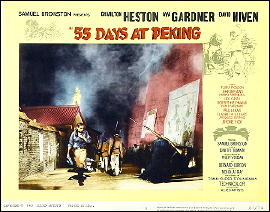
   I won’t go into the historical reasons for the rise of the “yellow peril” novel here. Suffice it to say that as much as anything the Boxer Rebellion, in which a fanatic secret society with backing from the Chinese government led to the siege of the embassies in Bejing (see Peter Fleming’s The Siege of Peking and the film 55 Days in Peking), and the subsequent military action by allied forces of the United States, Great Britain, Germany, and Japan among others, and the growing population of Chinese in Western cities and the sensationalist reporting of the era on the activities of the criminal “tongs” and the “yellow peril” only needed the right book to set the whole thing off.
M. P. SHIEL

   The Yellow Danger was that book.

   The novel opens as England faces a crisis in the East at the hands of the Germans, Russians, and French (Shiel was an equal opportunity jingoist), but it is at a simple garden party for a charity that we first meet the source of “the yellow danger” —

   “Just allow me to introduce my friend here — Miss Seward — Dr. Yen How.”

   In the light of the ’bus lamp Ada Seward saw a very small man dressed in European clothes, yet a man whom she at once took to be Chinese. With a wrinkled grin he put out his hand and shook hers.

   He was a man of remarkable visage. When his hat was off, one saw that he was nearly bald and that his expanse of brow was majestic. There was something brooding, meditative in the meaning of his long eyes; there was a brown, and dark, and specially dirty shade of yellow tan to his skin.

   He was not really a Chinaman, or rather he was that, and more. He was the son of a Japanese father by a Chinese woman. He combined these antagonistic races in one man. In Dr. Yen How was the East.
M. P. SHIEL

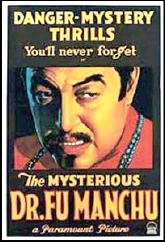
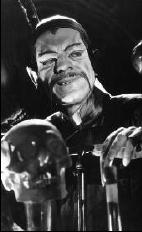
   That “expansive majestic brow ” must surely remind readers of Sax Rohmer’s Dr. Fu Manchu and his “brow like Shakespeare.” And Shiel makes no bones about the doctor’s motives for his evil machinations —

   Yen How was nothing if not heathen. He was that first of all.

   His intellect was like dry ice. Though often secretly engaged in making The Guess, on the whole he despised all religions — faiths of the West, the superstitions of the East, he despised them all alike. He was full of light, but without a hint of warmth; and so lacked religious emotion.

   It is not likely that ordinary ethical considerations would much influence the aims of such a man. He was like an avalanche, as cold and as resistless.

   What was Dr. Yen How’s aim? Simply told, it was to possess one white woman, ultimately, and after all. He had also the subsidiary aim of doing an ill turn to all the other white women, and men, in the world.

   To say the least the horse was out of the barn and bolting. You can’t accuse Shiel of beating around the bush. He jumps in with both feet. It’s not long before the evil Dr. Yen How has the world crumbling and the West trembling as the hordes of the East (ever since Genghis Khan Asian armies always seem to move in hordes).

   Luckily for us England has men like Shiel’s Nietzschean hero John Hardy to call on —

   There could be no doubt that John Hardy’s long-lashed, azure blue eyes possessed the faculty of seeing.
M. P. SHIEL

   As the crisis rises and the Asian hordes sweep across the west the consumptive but heroic Hardy rises in short time from unknown officer to Admiral of the fleet.

   Under the English banner the treacherous Russians, Germans, French and others rally, and Kaiser Bill himself leads an army under the Union Jack in a great land battle, but it is Hardy who must destroy Dr. Yen How and his hordes, and his choice of weapon is perhaps the most far seeing and startling of Shiel’s predictions.

    Hardy uses the young woman, Ada Seward, who Dr. Yen How desires, to get to the leader of the Asian invaders and infects the Dr. and the invading armies with plague — a bit of payback since the invading Mongols introduced the disease to Europe in the first place back in the days of Genghis Khan.
M. P. SHIEL

   To be fair, mass murder weighs heavily on Hardy in a chapter entitled “Hardy’s ‘Crime'” —

   He was no longer sane. His hand was thicker that itself with his brother’s blood. His final hour of darkness was hastening to meet his life. All his sky was an ink of clouds. Now again, he tarried, cowering, in Gethsemane.

   The Asian armies die by the millions, Dr. Yen How succumbs to his ‘unnatural desire’ for a white woman, and the triumphant Hardy, the beloved leader of the white race, dies of the consumption eating away at him, leaving the world in the safe hands of the Pax Britannica, all of Europe now under the firm hand of the Union Jack from the English Channel to the Russian Steppes.

   The Yellow Danger is relatively hard to find but you can download a facsimile in pdf format or read it on-line.

   It’s a remarkable book, not just for its distasteful jingoism and racism, but also because so many of the cliches and stereotypes of the sub genre are already present: the stalwart English hero; the inhumanly cold intelligence and yet base passions of the Asian villain; the fear of racial impurity; the swarming hordes of sub-human and alien forces; and the fear of the unknown.
M. P. SHIEL

   Nor is The Yellow Danger Shiel’s only contribution to the invasion novel and the paranoid fear of the foreign. Lord of the Sea is the story of an English Jew who conquers the seven seas and is ultimately destroyed by his desire for a pure English woman. Luckily the “Jewish Peril” didn’t quite catch on despite the nonsensical and wholly fictitious Protocols of Zion and rampant Anti-Semitism.

   No doubt about it, this can be unpleasant stuff, but it also has historical import both socially and to the genre as a whole.

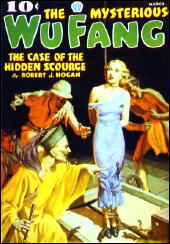
   It was Shiel who moved the world’s eyes East and spawned a long line of “Yellow Perils,” a genre that still lingers long past the heyday of the Fu Manchu’s, Dr. Wu Fang’s, the Shadow’s Shiwan Khan, and Dr. No’s of yesteryear. The list of Asian super villains is impressive and still growing.

   The genre is far from dead even today (although the “yellow peril” currently has been replaced by the “Islamic peril”). Clive Cussler has written at least two novels that fall in this category (Dragon and Flood Tide) and is hardly alone. One hundred and twelve years later popular fiction is still haunted by the “yellow peril” stereotype.
M. P. SHIEL

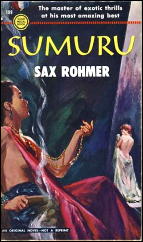
   A new Fu Manchu novel appeared in 2009 (The Terror of Fu Manchu from Black Coat Press). There’s even a distaff “yellow peril” with Sax Rohmer’s Sumuru and Andre Caroff’s Madame Atomos (also being reprinted by Black Coat Press), and books like Alexander Cordell’s The Deadly Eurasian and Richard Condon’s The Whisper of the Axe send up of the whole thing offering a new take on old cliches.

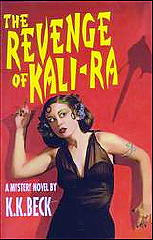
   Richard Jacoma’s The Yellow Peril is a good example of having it both ways, a “yellow peril” novel seen through modern eyes, and K. K. Beck’s The Revenge of Kali Ra (reviewed here ) sends the whole thing up as well as taking shots at Hollywood and Sax Rohmer.

   But be warned: If you are easily offended or bothered much by what is or is not politically correct, The Yellow Danger may be hard going.

   Shiel was a very unpleasant man by all accounts and eccentric as both a writer and a human being. Still, if you are interested in the history of the genre and the origin of many of its stereotypes and cliches this one is hard to ignore.
K. K. BECK Kali Ra

   In its wake march armies of shadowy geniuses hidden in the foggy street of Limehouse or Chinatown and gathering their forces in distant exotic lands.

   We may have outgrown some of Shiel’s more obvious prejudices, but it may be a wise thing to compare them to our own modern flaws and ask ourselves if we have really moved that all that far in the one hundred and twelve years since The Yellow Danger first saw print.

   There are writers today — Brad Thor and John Ringo come to mind — often found on the bestseller list, whose popular books are, in their own way, no less sensationalist, jingoistic, and intolerant as Shiel’s work.

   We are in no position to condemn without first examining our own failings.

Note:  The anthologies It’s Raining Corpses in Chinatown and It’s Raining More Corpses in Chinatown edited by Don Hutchinson (Starmont House) offer a good selection of “Yellow Peril” stories from the pulps plus a good history of the genre and bibliography of “Yellow Peril” fiction from writers like Frank Gruber, Steve Fisher, Richard Sale and others for those interested.

COMMENT [02-17-10]   From Jess Nevins, author of Fantastic Victoriana

   To be precise and in terms of the facts, Shiel didn’t invent the Yellow Peril novel. I believe that David has grossly overstated Shiel’s development of the trope. It was already commonly used by the time Shiel wrote his book.

   I wrote about this, at length, in Fantastic Victoriana, but, briefly:

   Numerically, the Italian Yellow Peril peaked with suspense fiction, in the 1870s. Anti-Asian sentiment rose from mid-century, and in both Britain and the US the 1880s were when it surged upwards, and not just in the U.S. It was Albert Robida, in France, who wrote “La Vorace Albion” (1884), with its various Asian villains.

   But in the US you’ve got Robert Woltor’s A Short and Truthful History of the Taking of Oregon and California by the Chinese in the Year A.D. 1899 (1882), you’ve got Emma Dawson’s “The Dramatic in My Destiny” (1880), Ellen Sargent’s “Wee Wi Peng” (1882), the various dime novel Yellow Peril villains (far outnumbering Italian villains), culminating in Kiang Ho (1892), enemy of Tom Edison, Jr.

   You’ve got Robert Chambers’ Yue Laou, in The Maker of Moons (1896), and you’ve got C.W. Doyle’s Quong Lung (short stories, 1897-1898).

   It was an established literary trope and even a cliche by the time Shiel got to it. It predated the Boxer Rebellion in non-fiction and fiction by, oh, about 40 years. Shiel *capitalized* on it, but he didn’t establish it. Yellow Papers were in the British story papers and American dime novels a full decade before Shiel.

RESPONSE [02-17-10]   David’s reply:

   I am not suggesting Shiel invented the idea of Asian villains in popular fiction. Certainly the influx of Asians on the Western Coast of the United States after the Civil War and the growth of Chinese sections of major cities in the West were major contributing factors in the growth of the field.

   This was complicated by the language and cultural barriers and the tendency of the Chinese and Japanese to stay in their own communities (not that they had much opportunity to move out of them if they had wanted to). Just as the Irish, Italians, and Jews all suffered similar demonization at various times as their communities grew in major cities.

   But The Yellow Danger is generally attributed by most critics (Don Hutchinson, Robert Sampson, Brian Aldiss, and others) as the book which put the “yellow peril” on the map of popular imagination. Historically Shiel’s book helped to move a vague prejudice from the background of popular culture to one of the most recognized stereotypes of 20th Century popular imagination.

   In any case no one can argue that Sax Rohmer and Fu Manchu “invented” the genre and yet no one can argue that the “yellow peril” would still be with us without the good doctor’s influence.

   First is not always important in popular fiction. Sherlock Holmes wasn’t the first detective, James Bond wasn’t the first post war secret agent, Fu Manchu wasn’t the first Asian super villain, the Virginian wasn’t the first western, Tarzan not the first feral man, John Carter not the first interplanetary traveler, and Zorro wasn’t the first masked caped hero with a secret identity — none the less their role is important and vital to the sub genres they represent. The Yellow Danger was neither new nor unique, but it was important in establishing a still existing sub-genre.

       LATER:

   I do regret loosely using “inventor” as if there had been no Asian villains before Shiel, but I do think Jess vastly underrates the importance of the Boxer Rebellion in the rise of the genre in the 20th century, and the importance of Shiel’s book — which is hardly unique to me, as I pointed out earlier.

   When I was researching Chinese secret societies and particularly the Boxers for Dr. John Y. Moon (former Foreign Minister of South Korea and head of the History Department of the University of Mexico in Mexico City), he brought the Shiel book to my attention as the “turning point” in the use of the “yellow peril” in fiction (ironically Dr. Moon was a Rohmer and Fu Manchu fan and introduced me to “yellow peril” fiction — though as he laughingly pointed out, Fu Manchu was Chinese, not Korean — and though he never missed a Wo Fat episode of Hawaii Five-O either). I grant his opinions and work influenced my article (and a life time interest in secret societies in general in fact and fiction).
    I received the following email notice from Barry Traylor yesterday. He’s one of the co-chairs for PulpFest 2010

PULPFEST 2010 William F. Nolan

    “Our guest of honor at PulpFest 2010 will be William F. Nolan, best known as the co-creator of Logan’s Run. The author of more than 80 books and 750 magazine and newspaper pieces, Mr. Nolan is best known in pulp circles for The Black Mask Boys, an anthology drawn from and history about Black Mask magazine, celebrating its 90th anniversary in 2010.

    “Additionally, he edited and compiled Max Brand: Western Giant, a bio-bibliography of one of the most prolific authors to emerge from the pulp industry, and one of the best biographies of Dashiell Hammett, a founder of the hardboiled detective story. Mr. Nolan was recently named one of the 2010 recipients of the Lifetime Achievement Award, presented annually by the Horror Writers Association.”

    PulpFest 2010 will be held at last year’s venue, the Ramada Plaza Hotel and Convention Center in Columbus, Ohio. The show will begin on Friday, July 30th, and run through Sunday, August 1st. Clicking the link in Barry’s first paragraph will take you directly to the PulpFest 2010 website, where additional information may be found, including a FAQ page and a registration form.

Reviewed by DAVID L. VINEYARD:         


MAX BRAND – Big Game. Warner Paperback Library, paperback original; 1st printing, March 1973. First published in Argosy as a six-part serial, beginning 9 May 1936.

MAX BRAND Big Game

   It’s hard to think of Max Brand, Frederick Schiller Faust, in terms of anything but superlatives and broken records.

   One of the great pulp writers, he went on to live in an Italian villa where he hosted guests like Scott and Zelda Fitzgerald, then became the highest paid screenwriter in Hollywood penning, among others, Errol Flynn’s last great swashbuckler, The Adventures of Don Juan. He died in World War II Italy as a war correspondent for Harpers Magazine during the battle of Santa Maria Infante.

   Though he is best known for his westerns, Max Brand penned a little of everything under a dizzying array of names, from science fiction, to historical novels, to the Dr. Kildare series, to spy stories, to hard boiled crime tales.

    Big Game falls in the latter category and involves Terry Radway, a one time big game hunter still bearing the scars of a too close encounter with a tiger, and down on his luck. Looking for adventure closer to home, Radway finds it right under his nose when he spies the pretty girl in a room across the street preparing to kill herself.

   At first Radway only watches in a somewhat detached manner, but pretty soon he can’t help himself and intervenes. Seems the girl, Nell, is in trouble with a Hollywood big shot named Hugo Bigi. Radway decides to take matters in is own hand and pays a visit to Bigi, and being who he is puts the game to the big shot in the only way he knows how:

MAX BRAND Big Game

    “When in the course of human events,” said Radway, “it becomes necessary for one man to hunt down another like a beast, a decent respect for the opinion of mankind should lead him to state the reason for his action. In this case, Bigi, you are the beast and I am the hunter.”

   But things aren’t that simple, and soon Radway also finds himself involved with civic minded reform committee lawyer John Battersby Wilson, who has begun a private crusade to shut down the rackets in New York.

   After saving Wilson from a car full of killers, Radway is enlisted in that crusade — which leads to the doorstep of banker Chandler Orme Gregor, and back to Bigi who ends up ironically enlisted in Radway’s crusade to smash the men behind the crime ring.

   With the help of a couple of hoods originally hired to follow him, and the beautiful Lady Nell, who isn’t all she seemed, Radway tackles the drug ring and begins to root out the men behind the rackets, including the biggest of them all, the big game, the secret face behind the rackets controlling the city.

   The prose is tough and lean in the appropriate manner:

    He shifted his aim even as he covered the target. In that lost instant, the Duster saw him. He had time to jerk his machine gun around in a new direction. he had time to gape his mouth wide open. Then Radway shot him through the hips, and leaped right in.

   There is nothing terribly original here. It’s a fairly standard tough story in the pulp vein, well enough written and competently plotted by one of the masters of the form.

MAX BRAND Night Flower

   It’s a tightly written book, slick and fast moving, the plot a fairly familiar one often used in that era (both in The Secret Six (MGM, 1931) and Leslie Charteris’s The Saint in New York, and Raoul Whitfield used the big game hunter angle in Killer’s Carnival written as Temple Field), but it’s well handled here, and it touches on the classical references common to Brand’s work (here Radway playing at Theseus negotiating a labyrinth of lies).

   Still, it’s prime Brand and well worth the time it takes to read. It may lack that word savagery that marks the best of Black Mask or Dime Detective, but it’s fast paced, fun, and a reminder of that special quality that made Max Brand one of the most successful writers of all time.

   Brand did somewhat better with The Night Flower (Macauley, 1936, as Walter C. Butler), another of his tough crime novels, but Big Game is well worth looking for. Even if you find you’re more than a few steps ahead of the hero and the writer in terms of the plot, it moves at an action-packed pace, and Brand keeps the big revelation hidden right down to the wire; in the true pulp tradition you can’t ask for much more than that.

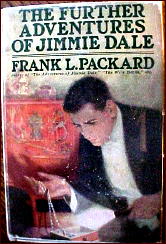
JIMMIE DALE, THE GRAY SEAL, by Frank L. Packard

An Overview by David L. Vineyard         


FRANK L. PACKARD Jimmie Dale

   Few characters as obscure as Canadian novelist Frank L. Packard’s gentleman cracksman, Jimmie Dale the Gray Seal, have had the impact and long term import of this one. Almost unknown today, Packard and his creation not only exerted a tremendous influence on the pulps he came from, but established many of the tropes of the modern superhero in comic books.

   From his secret lair, the Sanctuary, his multiple identities, and his calling card, a gray diamond paper seal, Jimmie Dale set the pattern for the mystery men and super heroes who will follow.

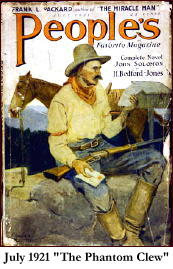
   Jimmie first appeared in the May 1914 issue of People’s Magazine. He is the son of a wealthy safe manufacturer and himself an expert at all sorts of locks and safes. He is also noted for his sense of fun and adventure — which explains in part why he takes on the nom de guerre of the Gray Seal and breaks into the most difficult of safes, stealing nothing and leaving behind a gray diamond paper seal, the mark of the Gray Seal.

FRANK L. PACKARD Jimmie Dale

   Normally he would probably have grown out of this stage, but a mysterious woman will change all that. It begins with a series of letters claiming to know all about the Gray Seal and threatening him with jail.

   Soon enough the letters change and the mysterious angel begins to direct the actions of the Gray Seal to correct miscarriages of justice.

   Of such things are great careers born.

   Jimmie sells his father’s company and sets himself up as an idle playboy with the aid of the faithful butler Jason and his tough chauffeur Benson.

   He creates the personae of Larry the Bat, a small time crook and informer, and Smarlinghue the drug addicted artist so he can penetrate the world of crime.

   The police and press offer rewards for the Gray Seal; the underworld wants him dead. Jimmie squeaks by on brains, luck, and no little skill. His mysterious female angel calls herself the Tocsin, the Alarm. Soon enough she is revealed to be Marie LaSalle and Jimmie, already half in love with her, falls the rest of the way.

FRANK L. PACKARD Jimmie Dale

   Not that there is much room for romance in the life of the Gray Seal.

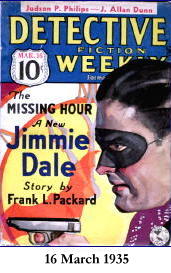
   Jimmie first appeared in 1914 and made his final appearance in Detective Fiction Weekly in 1935. His adventures are cleverly written melodrama penned by a writer who specialized in books about adventure with backgrounds in railroading, South Seas adventure, and the world of urban crime.

   Among his better known books, The White Moll, and The Miracle Man (the latter a famous film with Lon Chaney). His books were frequently brought to the silent screen and his long career successful and rewarding.

   But like many popular writers of his time — Harold McGrath comes to mind — he is largely forgotten today. Or would be, if not for Jimmie Dale, the Gray Seal.

   Jimmie isn’t entirely original. He borrows elements from Eugene Sue’s Prince Rodolfe, from the Count of Monte Cristo, from Rocambole, from the Scarlet Pimpernel, from Raffles, from O. Henry’s grifters and Jimmy Valentine, from Arsene Lupin and others, but in Jimmie all the tropes of the mystery man and the super hero come together for the first time.

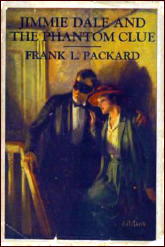
FRANK L. PACKARD Jimmie DaleThe Adventures of Jimmie Dale appeared in 1917. In 1919 The Further Adventures of Jimmie Dale came along. In 1922 the first novel, Jimmie Dale and the Phantom Clue came out in hardcover.

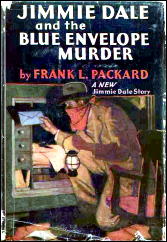
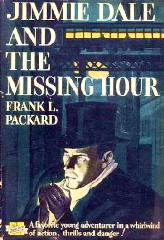
   Jimmie Dale and the Blue Envelope appeared in 1930 and finally in 1935, Jimmie Dale and the Missing Hour. But as Robert Sampson points out in Yesterday’s Faces, Volume I: Glory Figures, the saga is really one long book, remarkably concise and suspenseful with the tension of a ticking clock.

   Frank Packard died in 1942 while working on a new adventure of the Gray Seal.

FRANK L. PACKARD Jimmie Dale

   Much of our view of the mean streets and the urban ‘badlands’ comes from Packard’s books and their impact on others who followed in his footsteps. His tales are told in clean straight forward prose by a man of some culture and learning who understood the needs of storytelling and had something to say about salvation and redemption.

   Virtually every fictional crime fighter who follows is within his shadow. He is simply one of the genre’s most important archetypes, and the transition figure from the quaint pre-war crime as game to the tough guns blazing sagas of the pulps, films, and comics that follow.

   Jimmie may be a romantic and melodramatic figure, but he operates in the world of Hammett and Chandler. That said, Packard does not follow through on the social impact of crime in the same way as the hard-boiled school. He writes superficially about these subjects, but he writes well.

   And his adventures are still worth reading. There’s little a modern reader has to forgive and much to praise. It is no small thing to say that Jimmie Dale can still be read for pleasure, not merely nostalgia or his historical importance.

   The criminals lurk in the darkness, and the Gray Seal stands ready to strike, and in his wake every masked, caped, and spandex clad hero and mystery man stand ready to carry on his crusade. They are all in his debt, as are we.

FRANK L. PACKARD Jimmie Dale

   From Lamont Cranston to Bruce Wayne, from Richard Wentworth to Peter Parker, Jimmie Dale and the Gray Seal are where it all truly began, and more than worth revisiting to be surprised at just how much of the genre came fully formed from his adventures.

   Note: Norvel Page, who took over the Spider from R.T.M Scott (creator of Aurelius Smith aka Secret Service Smith), was a particular fan of the Gray Seal and used many of Packard’s ideas in the Spider’s saga.

   As Page greatly influenced both Michael Avallone and Mickey Spillane, so Jimmie Dale’s influence continues.

   While there are other figures of equal importance, some which came before him, Jimmie brings all the elements together for the first time and thus holds pride of place.

REVIEWED BY GEOFF BRADLEY:         


FREDRIC BROWN Night of the Jabberwock

FREDRIC BROWN – Night of the Jabberwock. E. P. Dutton, hardcover, 1950. Paperback editions include: Bantam #990, April 1952; Morrow-Quill, 1984. British edition: T. V. Boardman, hc, 1951.

Based on two pulp stories: “The Gibbering Night” (Detective Tales, July 1944) and “The Jabberwock Murders” (Thrilling Mystery, Summer 1944).

   After hearing several people tell me about this book, I just had to read it. I went up to the loft and searched but to no avail. Fortunately a couple of days later, when I was looking for something else, I stumbled across my copy.

FREDRIC BROWN Night of the Jabberwock

   Doc Stoeger, the narrator, is the proprietor/editor of a small town newspaper and a huge fan of the work of Lewis Carroll. After putting the paper to bed and getting home for the evening, he faces a night of catastrophic events, including a mysterious bank robbery, an escaped lunatic, a midnight gathering of the Vorpal Blades in a haunted house, and more.

   Most of them are unconnected, but after a murder for which he has been framed, Doc is fighting for his life and an explanation that will make sense of what has gone on.

   That the explanation makes as much sense as it does is a tribute to the plotting abilities of Fredric Brown, who has weaved a tangled web of intrigue. This madcap, humorous affair is a pleasurable romp with a satisfying ending, and I enjoyed the reading of it.

   Brown is an author that I am underexposed to, having previously only read Madball, which was only so-so, and The Fabulous Clipjoint, the first in the Ed and Am Hunter series, which I somehow didn’t take to.

Editorial Comment:   Happy Halloween, everyone!

A 1001 MIDNIGHTS Review
by Bill Pronzini:


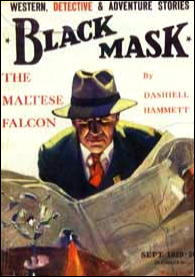
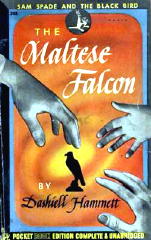
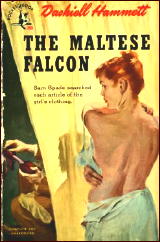
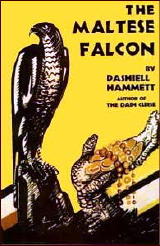
DASHIELL HAMMETT – The Maltese Falcon. Alfred A. Knopf, hardcover, 1929. Serialized in Black Mask magazine, September 1929 through January 1930. Reprinted many times, in both hardcover and soft, including Pocket #268, July 1944; 8th printing, October 1945, with dust jacket (both shown). Film: Warner Bros., 1931; also released as Dangerous Female. Also: Warner Bros., 1936, as Satan Met a Lady. Also: Warner Bros., 1941.

DASHIELL HAMMETT The Maltese Falcon

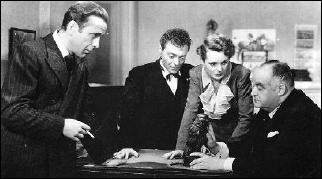
   The Maltese Falcon is the prototype hard-boiled private-eye novel, the finest ever written. It is also the most famous of all American detective stories, thanks in no small part to John Huston’s definitive 1941 screen version.

   Huston remained remarkably faithful to the novel, using most of Hammett’s original dialogue; and his casting was superb: Humphrey Bogart as Sam Spade; Mary Astor as Brigid 0’Shaughnessy; Sydney Greenstreet as Caspar Gutman; Peter Lorre as Joel Cairo; and Elisha Cook, Jr., as the little gunsel, Wilmer.

   (An interesting footnote is that Wamer Brothers originally wanted either Edward G. Robinson or George Raft for the lead role; it was only after both of those actors turned it down that Bogart — Huston’s choice from the first — was selected. The thought of either Robinson or Raft, fine actors though they were, portraying Spade is mind-boggling.)

   Sam Spade is likewise the quintessential tough detective. Other writers have altered his image, refined it; but the fact remains that without Spade, there would have been no Philip Marlowe, no Lew Archer, no uniquely American subgenre of detective fiction that has so captured the imaginations of millions that it has been elevated to the status of myth.

DASHIELL HAMMETT The Maltese Falcon

   Spade himself is a mythical figure, of course, owing in part to the fact that he is both enigmatic and misunderstood. Otherwise a Hammett admirer, Somerset Maugham called Spade “a nasty bit of goods … an unscrupulous rogue and heartless crook,” and said that “there is little to choose between him and the criminals he is dealing with.”

   Maugham missed the point completely. Spade is indeed a nasty bit of goods, an unscrupulous rogue and heartless crook — on the surface. That is his public persona, one he wears like a suit of old clothes or the gun he sometimes needs to carry.

   As he says to Brigid at the end of both novel and film, words identical in both: “Don’t be too sure I’m as crooked as I’m supposed to be. That kind of reputation might be good business — bringing in high-priced jobs and making it easier to deal with the enemy.”

DASHIELL HAMMETT The Maltese Falcon

   Spade is hardly a saint; but in his own way, and despite his affair with his partner’s wife, about which much has been made, he is an exceedingly moral man.

   Similarly, don’t be too sure The Maltese Falcon is everything it seems to be on the surface. It is hard-boiled, yes. Uncompromising, yes. Grim and brutal and even nasty in places, yes. But in its own way, it, too, is exceedingly moral.

   The plot of Falcon is familiar to nearly every detective story fan and film buff. Briefly, Spade is visited by a woman calling herself Miss Wonderly; she tells him her sister ran away from New York with a man named Floyd Thursby, that the three have a date that night, and that she wants Spade to rescue the sister.

   Enter Miles Archer, Spade’s partner, who says he’ll attend to the job himself. Which he does, but not very well: He gets himself shot to death in a back alley. Also shot that foggy San Francisco night is Floyd Thursby, in front of his hotel.

   Spade tracks down Miss Wonderly (in reality Brigid O’Shaughnessy); she tells him a different story and begs for his help, and he agrees.

DASHIELL HAMMETT The Maltese Falcon

   Enter Joel Cairo, who puts a gun on Spade in Spade’s office and first mentions “the black figure of a bird.”

   Enter Caspar Gutman, who eventually explains that the figure is “a glorious golden falcon encrusted from head to foot with the finest jewels,” a gift to Emperor Charles V from the Order of the Hospital of St. John of Jerusalem, crusaders who persuaded the emperor to give them the islands of Malta, Gozo, and Tripoli in 1530.

   While en route to Spain, the falcon was stolen by the pirate Barbarossa, and over the centuries it passed through various private hands, two of those hands being Gutman’ s — almost.

   He has spent seventeen years tracking down the black bird, almost got it in Paris, almost got it in Constantinople: wants it desperately. So do Joel Cairo and Brigid O’Shaughnessy, both of whom were confederates of Gutman’s at one time and both of whom have tried to double-cross him to get it for themselves.

DASHIELL HAMMETT The Maltese Falcon

   Another murder and more double-dealing lead to a grand finale in Spade’s flat with all the principals present — including the falcon, which has just arrived via the ship La Paloma from Hong Kong. Or has it? The confrontation between Spade and the murderer of Miles Archer remains one of the most powerful in all of crime fiction.

   The Maltese Falcon is hardly a perfect novel; such is a rara avis indeed, almost as rare as the Maltese falcon itself. Spade’s affair with Iva Archer is never satisfactorily resolved. The character of Rhea Gutman, Gutman’s daughter, seems superfluous. (John Houston thought so, too: He excised her completely from his screen version.)

   Bits and pieces don’t quite hang together or are fused by melodrama. But this is nitpicking, really. In all ways that matter, it is truly a classic work, summed up brilliantly by Houston in the last line of the film, when he had Bogart/Spade say that the Maltese falcon is “the stuff that dreams are made of.”

         ———
   Reprinted with permission from 1001 Midnights, edited by Bill Pronzini & Marcia Muller and published by The Battered Silicon Dispatch Box, 2007.   Copyright © 1986, 2007 by the Pronzini-Muller Family Trust.

A 1001 MIDNIGHTS Review
by Francis M. Nevins:


DASHIELL HAMMETT The Glass Key

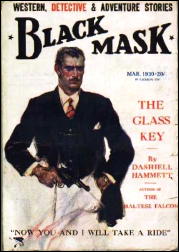
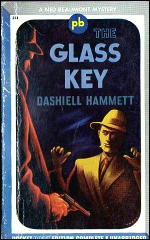
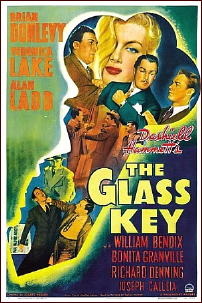
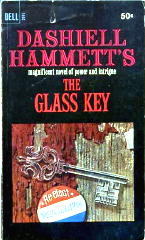
DASHIELL HAMMETT – The Glass Key. Alfred A. Knopf, hardcover, 1931. Serialized in Black Mask magazine: “The Glass Key” (March 1930). “The Cyclone Shot” (April 1930), “Dagger Point” (May 1930), “The Shattered Key” (June 1930). Reprinted many times, in both hardcover and paperback, including Pocket #211, pb, 1943 ; Dell 2915, pb, 1966. Film: Paramount, 1935, with George Raft. Also: Paramount, 1942, with Alan Ladd, Brian Donlevy, Veronica Lake.

   Hammett’s fourth novel is set in a nameless city modeled on Baltimore, where he grew up. Like Personville in Red Harvest, the city is controlled by crooked politicians in league with various mobster factions; but in The Glass Key Hammett gives us an insider’s view of the corruption and in fact creates a corrupt political henchman as his protagonist.

DASHIELL HAMMETT The Glass Key

   Ned Beaumont — tall, thin, a dandy and a compulsive gambler and tuberculosis victim like Hammett himself — is the best friend and most trusted adviser of Paul Madvig, the lower-class ethnic who controls the city.

   Against Beaumont’s advice, Madvig has made a deal for mutual political support with upper-crust Senator Henry, hoping that the payoff for him will include Henry’s lovely daughter, Janet, with whom he’s infatuated.

   Then Senator Henry’s son is murdered in circumstances that implicate Madvig. As Madvig’s enemies plot to speed the politically wounded leader’s fall from power, Beaumont sets out to clear his friend and patron, limit the damage to his machine, and keep the other side’s crooked candidates from defeating Madvig’s crooked candidates in the upcoming election.

   In the process he endures perhaps the most savage beating in crime fiction, and the equally painful experience of becoming involved himself with Janet Henry, his best friend’s woman.

DASHIELL HAMMETT The Glass Key

   The Glass Key is one of Hammett’ s most powerful novels but also one of crime literature’s most frustrating classics. Its third-person narrative voice, like that of The Maltese Falcon, is so objectively realistic and passionlessly impersonal that it seems to draw an impenetrable shield between characters and reader.

   As a result, generations of critics have debated all sorts of factual questions that writers less bold than Hammett would have answered unequivocally.

   Did Ned really intend to sell Madvig out to his rival Shad O’Rory, or is he playing double agent?

   For what earthly reasons did he permit Jeff, O’Rory’ s unforgettable moronic bone-crusher, to beat him almost to death? Is he really in love with Janet Henry or does he have a suppressed homosexual desire for Madvig?

   Reading the novel again and again only fuels these controversies, for Hammett refuses on principle to enter into any of his characters’ thoughts and feelings, and forces us to judge from what they say and do — from inherently misleading and uncertain data. No wonder there’s no consensus about The Glass Key!

DASHIELL HAMMETT The Glass Key

   Hammett himself, and such experts as Julian Symons and Frederic Dannay (Ellery Queen), thought it was his best novel; a number of academic literary critics rank it as his worst.

   Hammett’s vision was one of the darkest in the history of crime fiction. He saw the world as an incomprehensible place in which no one can ever really know another, and created the world of The Glass Key to match.

   Whatever the ultimate verdict on its literary status, it’s a compulsively readable, coolly sardonic portrait of an unredeemable nightworld and ambiguous relationships, and stands beside The Maltese Falcon as one of the earliest classics of noir crime fiction.

         ———
   Reprinted with permission from 1001 Midnights, edited by Bill Pronzini & Marcia Muller and published by The Battered Silicon Dispatch Box, 2007.   Copyright © 1986, 2007 by the Pronzini-Muller Family Trust.

A 1001 MIDNIGHTS Review
by Bill Pronzini:


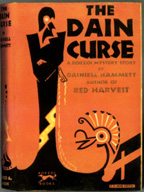
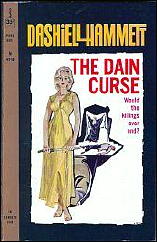
DASHIELL HAMMETT – The Dain Curse. Alfred A. Knopf, hardcover, 1928. Originally published as the following stories from Black Mask magazine: “Black Lives” (November 1928), “The Hollow Temple” (December 1928), “Black Honeymoon” (January 1929), “Black Riddle” (February 1929).   Reprinted many times since, in both hardcover and paperback, including Permabook M-4198, 1961 (shown). TV movie [4-episode mini-series]: 1978; with James Coburn as “Hamilton Nash”.

DASHIELL HAMMETT The Dain Curse

   The Dain Curse is one of two novel-length works featuring the Continental Op. It was originally written for Black Mask as four separate novelettes; taken together, the four interconnected “cases” comprise a kind of criminous family saga in which Hammett all but decimates the “Black Dains” of San Francisco.

   The novel begins with the Op, who has been hired by an insurance company to look into a diamond robbery at the home of Edgar Leggett (real name Dain), finding one of the missing stones:

    “It was a diamond all right, shining in the grass half a dozen feet from the blue brick wall.”

   Just a few of the more than thirty characters he subsequently encounters: Leggett/Dain, a scientist working at home on a process for coloring diamonds; his daughter, Gabrielle, who feels she has bad blood and is cursed and whose drug addiction is a focal point of the story line; the family’s mulatto maid, Minnie Hershey; Gabrielle’s doctor, Riese; her fiance, Eric Collinson (a puckish Hammett tribute to the pseudonym under which his first Black Mask stories were published); Joseph Haldorn and his wife, Aaronia, who run a religious cult called the Temple of the Holy Grail; writer Owen Fitzstephan; and a couple of other private detectives investigating Leggett/Dain’s shady past.

HAMMETT The Dain Curse

   The plot has numerous twists and turns, multiple climaxes, and plenty of atmospheric elements (the scenes enacted at the Temple of the Holy Grail, for instance).

   On the whole, however, it is overlong and decidedly melodramatic. As critic John Bartlow Martin wrote in Harper’s Magazine:

    “In this single Hammett novel the detective shot and stabbed one man to death, helped shoot another dead, was himself attacked with dagger, gun, chloroform and bomb, fought off a ghostly manifestation barehanded, wrestled with five women, cured a girl of narcotic addiction — and … was obliged to deal with one seduction, eight murders, a jewel burglary, and a family curse.”

   The Dain Curse is more cleanly plotted and credible than the first Op novel, Red Harvest (1927), in which more than thirty people die, including no fewer than a dozen of the main characters. But its flaws prove that it is the novelette, not the novel, to which the Continental Op was best suited and in which his finest cases are chronicled.

         ———
   Reprinted with permission from 1001 Midnights, edited by Bill Pronzini & Marcia Muller and published by The Battered Silicon Dispatch Box, 2007.   Copyright © 1986, 2007 by the Pronzini-Muller Family Trust.

A 1001 MIDNIGHTS Review
by Bill Pronzini:


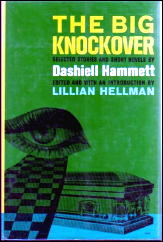
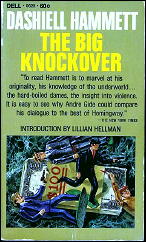
DASHIELL HAMMETT – The Big Knockover. Edited and with an Introduction by Lillian Hellman. Random House, 1966. Paperback reprint: Dell, 1967, in two volumes: The Big Knockover and The Continental Op: More Stories from The Big Knockover. Also: Vintage V829, 1972.

   Samuel Dashiell Hammett was the father of the American “hard-boiled” or realistic school of crime fiction.

DASHIELL HAMMETT The Big Knockover

   As Raymond Chandler says in his famous essay “The Simple Art of Murder,” Hammett “wrote at first (and almost to the end) for people with a sharp, aggressive attitude to life. They were not afraid of the seamy side of things; they lived there. Violence did not dismay them; it was right down their street. Hammett gave murder back to the kind of people that commit it for reasons, not just to provide a corpse; and with the means at hand, not hand-wrought dueling pistols, curare and tropical fish. He put these people down on paper as they were, and he made them talk and think in the language they customarily used for these purposes.”

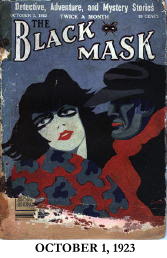
   Hammett’s first published short story, “The Road Home,” appeared in the December 1922 issue of the pioneering pulp magazine Black Mask under the pseudonym Peter Collinson. The first “Continental Op” story was “Arson Plus,” also published as by Collinson, in the October 1, 1923, issue; the October 15 number contained “Crooked Souls,” another Op novelette and Hammett’s first appearance in the magazine under his own name. (“Arson Plus” was not the first fully realized hard-boiled private-eye story; that distinction belongs to “Knights of the Open Palm,” by Carroll John Daly, which predated the Op’s debut by four months, appearing in the June 1, 1923, issue of Black Mask.)

DASHIELL HAMMETT The Big Knockover

   Two dozen Op stories followed over the ensuing eight years; the series ended with “Death and Company” in the November 1930 issue.

   The Op — fat, fortyish, and the Continental Detective Agency’s toughest and shrewdest investigator — was based on a man named James Wright, assistant superintendent of the Pinkerton Detective Agency in Baltimore, for whom Hammett had worked. And his methods, if not his cases, are based on real private-investigative procedures of the period.

   It was in these Op stories that Hammett honed his realistic style and plotting techniques, both of which would reach their zenith in The Maltese Falcon (1929).

DASHIELL HAMMETT The Big Knockover

   The Big Knockover contains thirteen of the best Op stories, among them such hard-boiled classics as “The Gutting of Couffignal,” about an attempted hoodlum takeover of an island in San Francisco Bay, during which corpses pile up in alarming numbers and a terrific atmosphere of menace and suspense is maintained throughout; “Dead Yellow Women,” which has a San Francisco Chinatown setting and colorfully if unfortunately perpetuates the myth that a rabbit warren of secret passageways exists beneath the streets of that district; “Fly Paper,” in which the Op undertakes “a wandering daughter job,” with startling results; “Corkscrew,” a case that takes the Op to the Arizona desert in an expert blend of the detective story and the western; and “$106,000 Blood Money,” a novella in which the Op sets out to find the gang that robbed the Seaman’s National Bank of several million dollars, and does battle with perhaps his most ruthless antagonist.

DASHIELL HAMMETT The Big Knockover

   Lillian Hellman’s introduction provides some interesting but manipulated and self-serving material on Hammett and his work.

   This is a cornerstone book for any library of American detective fiction, and an absolute must-read for anyone interested in the origins of the hard-boiled crime story.

   The Continental Op appears in several other collections, most of which were edited by Ellery Queen and published first in digest-size paperbacks by Jonathan Press and then in standard paperbacks by Dell; among these are The Continental Op (1945), The Return of the Continental Op (1945), Hammett Homicides (1946), Dead Yellow Women (1947), Nightmare Town (1948), The Creeping Siamese (1950), and Woman in the Dark (1951).

   The most recent volume of Op stories, The Continental Op, a companion volume to The Big Knockover but edited and introduced by Stephen Marcus instead of Hellman, appeared in 1974.

         ———
   Reprinted with permission from 1001 Midnights, edited by Bill Pronzini & Marcia Muller and published by The Battered Silicon Dispatch Box, 2007.   Copyright © 1986, 2007 by the Pronzini-Muller Family Trust.

Editorial Comment:  Coming over the four days, spread out at a rate of one a day, will be reviews by Bill Pronzini and Mike Nevins of The Dain Curse, The Glass Key, The Maltese Falcon, and The Thin Man, all taken from 1001 Midnights.

« Previous PageNext Page »