Pulp Fiction


A 1001 MIDNIGHTS Review
by Marcia Muller:


JOEL TOWNSLEY ROGERS – The Red Right Hand. First published in New Detective Magazine, March 1945. Reprinted many times, in both hardcover and soft. Shown: Pocket 385, pb, 1946; Dell D203, pb, Great Mystery Library #9, 1957.
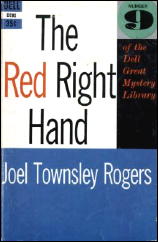
JOEL TOWNSLEY ROGERS Red Right Hand

   This classic suspense novel has the quality of a hallucination. From the opening paragraph, we are drawn into a strange world where eerie and seemingly impossible events are happening; and as we view them through the eyes of the narrator, Dr. Harry Riddle, we begin, as he does, to believe in their reality and to search desperately for some rational explanation for them.

   The story begins after most of the events have taken place, with Riddle trying desperately to puzzle them out as he sits in the study of Adam MacComereau, a professor emeritus of psychiatry at Harvard.

   The late Adam MacComereau, we learn. Murder has been done more than once. Various shadowy and frightening events are described, without their chronology or connections being given. There is a woman asleep on a nearby sofa toward whom Riddle feels protective, while also holding back fear of his own insanity. And as he sits there, thinking about the events that have passed, he begins to reconstruct what they really signify.
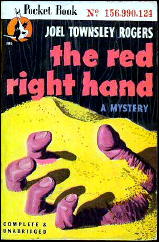
JOEL TOWNSLEY ROGERS Red Right Hand

   While driving from Vermont to New York City, Riddle had car trouble on a back road; when he finally got under way, he encountered the woman, Elinor Darrie, lost and fleeing through the underbrush. As Riddle tells us, “It was a simple enough incident.”

   Elinor and her fiance, Inis St. Erme, were driving to Vermont to be married. On the road they picked up a tramp-a little, twisted man whom Riddle comes to think of as Corkscrew — and when they stopped for a picnic, there was a fight between the tramp and St. Erme. Elinor heard a terrifying scream and fled. Riddle and Elinor investigated the spot and found a quantity of blood, but nothing else.

   As Riddle says, “It was such a damned ordinary and commonplace crime, on the face of it.” But other aspects surface — such as St. Erme’ s missing right hand; a mutilated blue hat that Riddle found on the road before he met with Elinor; the noise “like a great frog croaking in the weedy ditch” near where Riddle’s car broke down; and the ugly little man, Corkscrew — who is he and how has he gotten away after apparently doing murder?
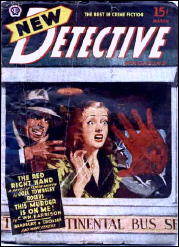
JOEL TOWNSLEY ROGERS Red Right Hand

   This is a dizzying and confusing novel, but pleasurably so. And when the action has been unraveled, its apparent solution explained, confusion is initiated again, and more action occurs. And when that has been unraveled, its solution stands alone, and the result is stunning indeed.

   In thinking over the wonderful experience of reading The Red Right Hand, the reader can only marvel at how the author constructed such a baffling and complex plot without leaving a thread untied. And — corollary to that — how he did so without driving himself as mad as his narrator fears he is becoming.

   Rogers, however, did remain sane and capable of writing other memorable novels: Lady with the Dice (1946) and The Stopped Clock (1958). In addition, he wrote reams of fiction for both the pulp and slick magazines, and a first (but less memorable) novel, Once in a Red Moon (1923).

         ———
   Reprinted with permission from 1001 Midnights, edited by Bill Pronzini & Marcia Muller and published by The Battered Silicon Dispatch Box, 2007.   Copyright © 1986, 2007 by the Pronzini-Muller Family Trust.

Editorial Comment. As you might recall, I’d intended to post the three Ruth Rendell reviews from 1001M this weekend, but as usual, the real world interfered. I’ll get those uploaded in the next couple of days, I hope, but in the meantime, I thought this alternative choice might be appropriate.

   Geoff Bradley’s review of this book, which you can find here, has generated more comments than usual — including my own admission that I’ve yet to read it. Perhaps the book falls into a category that might called Classic Novels That Everyone’s Heard About But Relatively Few Have Read.

   If the combination of Geoff’s and Marcia Muller’s reviews don’t tempt you into reading it, if you haven’t already — and I doubt that anyone could say more about the story than Marcia without revealing everything — than nothing will!

   As for me, I know when I’ve run out of excuses. I also know where my copy of the Pocket paperback is, and I’ll start reading it this week. You can take that statement to the bank and cash it. It’s as good as gold.
REVIEWED BY GEOFF BRADLEY:         


JOEL TOWNSLEY ROGERS Red Right Hand

JOEL TOWNSLEY ROGERS – The Red Right Hand. Simon & Schuster, hardcover, 1945.

First published in New Detective Magazine, March 1945. Reprinted many times, in both hardcover and soft. Shown: Pocket 385, pb, 1946; Dell D203, pb, Great Mystery Library #9, 1957.

    It’s been a while since I despaired of catching up with all the books I would want to read so I have piles of books by old favourites that I haven’t yet got around to, books that I have acquired over the years meaning to try, and new books whose descriptions seem tempting for one reason or another.

    This fell into the second category, an impossible crime story that comes highly recommended from some quarters including that indefatigable searcher of impossible crime themes, Bob Adey.

JOEL TOWNSLEY ROGERS Red Right Hand

    Indeed it was a visit from Bob, who persuaded my son to try the book, even finding a copy in a local second-hand book shop, that led to me finally getting around to it.

    I had heard that it was a difficult book to read, that the language was turgid and the action was slow-moving, but in fact I was soon into things and though the layout was rather unusual it never lost my interest.

    The story is told by Harry Riddle, a medical doctor, starting with him sitting at the desk of Adam MacComerou in the wilds of Connecticut recounting the story of what has happened in order to try make sense of it.

JOEL TOWNSLEY ROGERS Red Right Hand

    His recollections are not in chronological order as he muses over what he has been told: the story of Inis St. Erme, a rich young man, and Elinor Darrie, his bride to be, who are driving overnight to Vermont in order to be married, and how a tramp that they give a lift to kills St. Erme and drives off creating much mayhem before impossibly disappearing in the region of MacComerou’s house.

    Finally the story catches up to current time and Riddle’s writings finally allow him to explain what has happened.

    There would appear to be a few coincidences abounding, unless I’m missing something here, but the denouement is comprehensive and clears up the mysteries pretty well.

    An unusual style, but I thoroughly enjoyed the book and I’m glad I can now add it to my list (still being compiled) of books read.

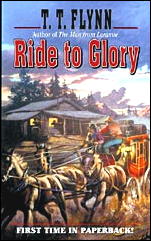
T. T. FLYNN – Ride to Glory: A Western Quartet. Five Star, hardcover; 1st edition; 2000. Reprint paperback: Leisure, March 2004.

T. T. FLYNN Ride to Glory

   I’ll list the titles of the four novelettes and short novels it contains, and that’s all you’ll need to have a perfect picture of what this book’s all about: “Ghost Guns for Gold”, “Half Interest in Hell”, “The Gun Wolf” and “Ride to Glory.”

   Action, that is, pure pistol-packing action. First appearing in the pages of old pulp fiction magazines such as Star Western (1935), Dime Western (1945 & 1949), and Western Story Magazine (1938), this marks the debut of these tales in hardcover.

   And whenever there’s room to breathe between the rounds of gunfire, there’s always a chance that romance will work its way into the story, one way or another. According to the creed of the day, or so it’s implied — if not outright stated — it’s the love of good women that gives men the courage to risk their necks against the crooked ranchers, conniving Mexican despots, and other assorted outlaws found inhabiting these pages, and by extension, the entire American west.

   If these stories succeed, it’s by sheer story-telling power, not by the grace or elegance of the writing. While T. T. Flynn was the contemporary of such western writers such as Max Brand and Zane Grey, it’s plain to see that he simply wasn’t in their league, at least not in terms of word-slinging ability.

   But if you can sit back, turn off your critical eye, and allow these yarns of yesteryear to simply take over, what you’ll be in for is four installments of the ride of your life — and I ask you: What could be better than that?

— Reprinted from Durn Tootin’ #2, July 2003       (slightly revised).


[UPDATE] 08-29-09.   I’ve recently had to drop out of a western fiction apa called Owlhoots — a pure lack of time — but in the ten or so issues I did for it, there are some articles and reviews I did that I’ll gradually be reprinting here on the Mystery*File blog.

   I regret to say that at the moment, I don’t have access to the book itself, and I seem to have made no record of it at the time. Right now, except for one story, I can’t tell you which one came from which magazine. When I come across the rest of the information, I’ll add it later:

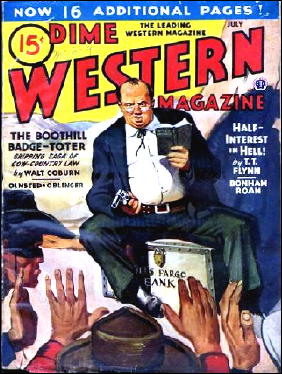
       Half-Interest in Hell, Dime Western Magazine, July 1945.

T. T. FLYNN Ride to Glory      


[UPDATE #2]   Later the same day. Walker Martin has come to my rescue. See comment #1.

Con Report: PulpFest 2009
by Walker Martin.

   Just back from PulpFest after a tiring 500 mile drive and discovered that Trenton, NJ had been hit by a big storm on Sunday which caused some damage to the airport which is near my house. Fortunately my pulp collection survived, but my wife’s car had to be towed to the repair shop.

   Upon arriving in Columbus on Thursday, I met fellow early birds for dinner and we all started to unload our pulps in the dealer’s room at 7:00 PM. This lasted until around 12:00 midnight and was a nice way to start the convention. We all missed the usual old Pulpcon rules of “no talking, no dealing, and no looking at other tables!”

   Friday the fun officially began and I noticed a vast improvement over the previous Pulpcons in Dayton. For example the attendance was over 350 which is more than Pulpcon ever had and I’ve been keeping track since 1972. This figure put PulpFest near the great level achieved by Windy City’s 400.

   During the three days the dealer’s room never looked empty and I saw several important and rare deals being made. For example I sold 17 bound volumes of Weird Tales, numbering 97 issues, mostly in the 1930’s, for only $1000. That’s like $10 an issue. Also sold from my table were many canceled checks from the Munsey and Popular Publication files.

   I bought my usual mound of pulps like Western Story, Dime Mystery, Dime Detective, Detective Story. There was a lot of original art for sale and I bought a framed, signed Edd Cartier drawing which illustrated a Harry Whittington story.

   I also obtained a Detective Fiction Weekly painting from 1931 and a strange bondage cover that was supposed to be used for Fred Cook’s 1960’s pulp fanzine, Bronze Shadows. I say “supposed” because the magazine died before the cover could be printed.

   Also sold from my table were such odd items as a Charles Russell bronze and a pulp painting cover from Fifteen Western Tales. Across the aisle I was witness to the five issues of Black Mask containing the “Maltese Falcon” serial being sold for $4,000.

   What made this deal so strange was the fact that the buyer wanted the issues not because they were from Black Mask or contained Hammett, but because he is an Erle Stanley Gardner fan.

   For those collectors who went broke buying pulp magazines, there were plenty of panels, slide shows, and auctions during the evening hours. The panels were all interesting and covered such pulpish topics as collecting pulps (I was so excited about being on this panel, that I almost tripped and fell on my face), Frederick C. Davis, Edmond Hamilton, The Shadow, and H. P. Lovecraft.

   The guest of honor was Otto Penzler, book dealer, editor, expert on mystery first editions. He was the perfect guest and appeared to be enjoying himself.

   However I was stunned by his announcement that his big book of Black Mask stories had been rescheduled for publication and would appear in late 2010, about a year beyond the date we were hoping for.

   Why? Because since vampires are so popular, they decided to publish a big book of vampire stories first. This of course was sad news for all pulp and mystery fans, but to offset the disappointment, Otto announced that he would also be editing a big book of adventure stories.

   In addition to thousands of pulps there were also quite a few reprints making their debut, such as new Edmund Hamilton collections and several new collections from Black Dog Books, including a stunning collection of Roger Torrey stories. Torrey died an early death but was quite prolific in the detective pulps. For some reason he has been unjustly forgotten and this is the first big collection of his work.

   Also being introduced was the new and enormous issue of Blood ‘n’ Thunder with a ground breaking article by Ed Hulse on Popular Magazine.

   After the panels and auction ended many of us gathered in the Hospitality room for snacks, soda and thank god, beer. More that one collector contributed to the free food and drink, and I’m not sure of their names but I believe Rusty Burke deserves my thanks for supplying the beer, and not just the usual watery American beers, but imported beers.

   I was glad to see such women collectors as Laurie Powers and Karen Cunningham. I caught a glimpse of Clare MacDonald from Australia but Curt Phillips quickly escorted her from my view.

   The Sunday morning Munsey breakfast was a rousing success with far more collectors being willing to rise up early on Sunday morning than I expected. The new Munsey award was a stunning image by David Saunders. I thought about stealing it but it was always under guard. I asked Mike Chomko if I could trade my Lamont award for the Munsey but he was not at all receptive to this reasonable request.

   The first winner of this award is Bill Thom, who administers the Coming Attractions website. This site is new every Friday evening and announces all sorts of pulp related news.

   I would like to thank the PulpFest committee for a great job on their very first attempt. Soon Mike Chomko, Jack Cullers, Barry Traylor, and Ed Hulse will be busy planning the 2010 convention. Fellow Pulp Collectors, this is an event that you must attend, so start making plans!

Editorial Comments: I echo everything that Walker has to say. By any standard you can think of, the convention was a resounding success. The dealers room was constantly busy with none of the lulls that has afflicted the past few PulpCons in recent years. I didn’t buy much myself, but there seems to have been lots of activity at and around Walker’s table.

   I’ve looked carefully, but I have not spotted myself in a short YouTube video of the event, but you can see Walter Albert’s brother Jim in the process of covering their table with a white cloth, probably just before one of our joint ventures out for food and/or local bookhunting.

   I won’t mention any of the names of the people I met there, some for the first time, even though I’ve known many of them for a long time. I spent most my time walking up and down the aisles, but not getting very far any time that I did. It was far too easy to find someone to stop and talk to for large chunks of time, and more than anything else, that’s what I did and why I go.

   For me the convention was compact, intense, and all too short. It was hard to believe it when Paul Herman and I got off the plane together and he dropped me off at home thirty minutes later. Many thanks for all of the effort put into this year’s event by the organizers of PulpFest 2009, and as Walker says, it’s time to start thinking about next year!

I’ll be leaving tomorrow morning for Columbus OH and this weekend’s 2009 PulpFest convention, the first under the new name and new management. They’ve done a tremendous amount of advertising and stirred up a lot of excitement about their show, more than there’s been in a long time. The fellows running the old PulpCon had done a good job over the years, but attendance had been dropping and they didn’t appear to be very receptive to new ideas.

PulpFest is primarily a venue for collectors of old pulp magazines to get together and talk about their recent acquisitions as well as those that got away, and of course to look for more. The center of the show is the dealers’ room, but in the evening are various panels and presentations, all in a very relaxed atmosphere. Many of the attendees have been coming for years, but anyone coming for the first time should feel welcome right away.

Some of you reading this I expect to see there, including several whose names should be familiar if you’ve been reading this blog for a while, such as Walter Albert, Walker Martin, Mike Nevins and Dan Stumpf. Stop by and introduce yourself if you’re there and I don’t see you first!

I’ll be back home on Sunday, but it may be a few days into August before the blog is very active again. Whenever I go away I pretty much stay off the computer, so no reports on the big bash until I get back. See you then!

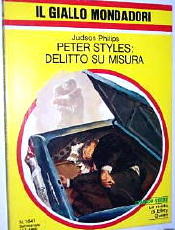
JUDSON PHILIPS – A Murder Arranged. Dodd Mead, hardcover, 1978. Reprint hardcover: Detective Book Club, 3-in-1 edition, November 1978. No US paperback edition. (Shown is the cover of an Italian softcover edition.)

JUDSON PHILIPS

   Journalist Peter Styles’ crusade against senseless violence leads him to an out-of-the-way New England village where he becomes the champion of a young man accused and convicted of murder. All the evidence seems to point directly to Tim Ryan, but the feeling of at least half the townspeople is that the state police wrapped up their case far too quickly.

   Obviously there’s more than a little resemblance here to a story that recently made Connecticut headlines, and the reader is swallowed up at once into the affairs of a small town. In spite of some fast deductions and the long arm of coincidence in the final chapters, Philips demonstrates once again that few authors are so non-stop reliable as he.

— From The MYSTERY FANcier, Vol. 3, No. 3, May-June 1979
            (very slightly revised).


[UPDATE] 06-29-09.  For an author as popular as Judson Philips (1903-1989) was, it never made sense to me that a good percentage of his books never came out in paperback. Including the books he wrote as Hugh Pentecost, his hardcover mystery fiction would have filled at least two long shelves at your local library.

   Philips began his career writing an even longer list of stories for the pulp magazines in the 1930s, and books continued to come from his typewriter very nearly up to the day he died. A list of his book-length fiction can be found online here.

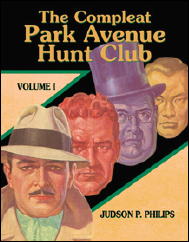
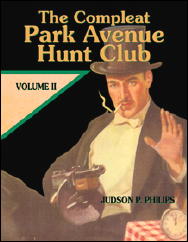
   If it weren’t for readers and collectors of pulp magazines, I imagine that Philips would have fallen long ago into that ever-growing limbo of mystery writers who sold tons of books in their day, but who are fast fading from memory today. (A list of his “Part Avenue Hunt Club” stories from Detective Fiction Weekly that have recently been reprinted in a two-volume set from Battered Silicon Dispatch Box can be found online here.)

JUDSON PHILIPS           JUDSON PHILIPS

Con Report: WINDY CITY PULP & PAPERBACK SHOW, 2009
by Walker Martin

   I just got back from Windy City. I went by Amtrak this year. Going from Trenton, NJ to Chicago only took an agonizing 28 hours with some delays and microwave food that I had trouble eating. Not to mention the claustophobia that kicked in when I closed the door to my sleeping car room.

   I traveled with long time pulp collector Digges La Touche and we spent the long train ride mainly reading. The last time I went to Windy City I drove for two days, but I can’t do that anymore since my eyesight is deteriorating. I’m a danger on the road for long trips or night time driving.

   I checked with Doug Ellis, and he said there were over 400 registered for the weekend and 128 tables. I spent all day each day in the dealer’s room roaming around looking through each table for pulps and artwork.

   I usually skipped lunch because I couldn’t tear myself away. However I did have breakfast and dinner each day with such great and out-of-control collectors like Nick Certo, Scott Hartshorn (Mr. Hollywood), Digges La Touche (The Human ATM Machine), Ed Hulse (the latest issue of his Blood n Thunder magazine debuted at this con and is over 100 pages!), Dave Scroggs (Pulp Librarian), Dave Kurzman, Kevin Cook, Steve Kennedy (pulp art dealer), and others too numerous to list. All these characters may not be well known to readers of this blog, but they all have enormous pulp collections.

   Bob Weinberg was there with his wife, and he has some great projects coming up. He and George Vanderburg of Battered Silicon Press are the new editors of Arkham House. I think this is great because Arkham has been a ghost of its former self the last few years. Others in attendance were Rodney Schroder, Paul Herman, Tony Tollin, Tom Roberts, Doug Ellis (thanks to you and John Gunnison for a great Convention), Rob Preston, Mike Chomko, Jack Cullers, John Locke, and others.

   I spent some time talking to Frank Robinson, who looks great, and he told me several stories about his experience on the Milk movie set. He evidently got a good salary for his 17 days on the set and will be in the DVD extras. Frank warned me before one auction, “Watch out for the paper.” At first I didn’t know what he meant but as the auction progressed, I realized some the great-looking pulps looked excellent on the outside but had browning paper inside.

   Speaking of the auction, both were well attended and packed with rabid bidders. The Friday auction was mainly material from the Frank Hamilton estate, such as artwork, Shadow and Doc Savage pulps.

   The Saturday auction was of more interest, with a complete run of Weird Tales being auctioned piece by piece, 1930-1954. All were from Ray Walsh’s collection. He had the 1920’s issues at his tables. Also auctioned were many issues of The Spider, Munsey correspondence and checks, and various pieces of artwork.

   The art exhibit was stunning, packed with work by Ward and Hubert Rogers. After seeing a room full of Rogers art, I upgraded my opinion of his work. The program book was edited by Tom Roberts and at 138 pages deserves to be in all our libraries. There were several articles on Hubert Rogers, Ward, and the Spicy pulps.

   What did I actually buy? Well I went with a few thousand dollars and came back with a couple hundred. I found some pulp wants like Dime Mystery, Western Story, Far West, Street and Smith’s Detective Story.

   I also came home with many pieces of art including an Arkham House dust jacket by Herb Arnold, The Watcher Out of Time, a Detective Fiction Weekly pulp cover from the mid 1930’s, a Two Fisted Tales cover by Severin, ten illustrations by Potter from a Arkham House anthology, a Cartier illustration, and several pieces of “Outsider” art by an unknown artist who evidently submitted the pieces to Castle of Frankenstein magazine but never got them back.

   There must be something bad I can say about this convention, but no, I can’t think of a single criticism. Well maybe I can gripe about not being able to see Ed Hulse’s film program, but that’s my fault becuse I can’t drag myself away from the dealer’s room and auction.

   So after four days and nights of pulps, pulps, and more pulps, I headed back to Chicago’s Union Station and caught the 7:00 pm Amtrak. Fortunately this time the food was cooked and not microwaved, plus they had a nice lounge and bar car where you could sit and watch the scenery. This time no claustophobia! I took a xanex, closed the door to the tiny room and got more sleep than I did at the pulp show.

   Next thing on the horizon is Pulpfest! All members of this group should support it either by attending or sending in a supporting membership. Since this is the first of the new pulp shows, it must have our support in order to survive and prosper. We don’t want to wake up one day and face a world with no dealers’ room! Mark these days on your calendars, July 31, August 1 and August 2, 2009. See you there!!

THE GOLDEN AGE OF BRITISH MYSTERY FICTION, PART IV
Reviews by Allen J. Hubin.


   Hal Pink’s obscurity in this country is total. None of his thirteen books from 1932 to 1941 was published here, and I think Pink escapes notice in every commentary on the genre known to man or beast.

   So at least I wasn’t over-expectant in approaching The Strelson Castle Mystery (Hutchinson, 1939), but it turned out to be a cheerful, fast and gratifying read. No detective story, this; it’s a thriller, with bad guys and good guys clearly identified at the outset.

   The good guys are a trio of bachelors, vacationing in Europe’s vest-pocket kingdom of Zovania. The bad guys are trying to grab control of a mysterious fortune, apparently hidden somewhere in Zovania’s titular castle, which has just been inherited by beautiful British opera star Coralie Mayne.

   The fun begins at the Zovanian border, and then it’s pell mell action all the way, in two batches – since the chief villain, vanquished once, brews another rotten scheme and surfaces again in his sewer.

***

   Burford Delannoy wrote a number of volumes of crime fiction around the turn of the century, some of which are collections of detective short stories and vanishingly scarce. Denzil’s Device (Everett, 1904) is one of his novels and, for all its antiquity and stylistic peculiarity, it surprised me with its effectiveness, especially in the portrayal of odious villainy.

   The peculiarity lies in a pronounced tendency toward subjectless sentences (the subject of the previous sentence applies but is left unstated); this is compensated for by a wryly humorous turn of phrase. And while the basic outcome is fairly well assured from the outset, some uncertainty and suspense about details develops.

   Denzil is wealthy and evil. He lusts after the daughter of a judge, but she rejects him for an actor. Denzil’s device is a scheme to acquire the girl (willingly or not) and revenge himself upon the actor. For his purposes he makes use of a murderous lowlife and an embittered mimic; for his downfall the careful attentions of Detective Doyle and colleagues must be praised.

***

   My only reading of the works of Annie Haynes involves The Blue Diamond (Lane, 1925), which I found effective — surprisingly effective, even, in creating complexity and mystification and in arousing my interest.

   We meet the wealthy and titled Hargreaves, whose estate lies near Lockford in Devonshire, and who own the titular gem. A beautiful young woman, afraid and bereft of her memory, is found one night on the estate. The Hargreaves allow the woman to make the manor her home until her memory returns, or until her family can be traced.

   She soon wins the hearts of most of the household, especially that of Sir Arthur, the impressionable male head of the line who is just reaching his majority. No trace of the woman’s earlier existence can be found; her memory does not return. She stays on, and Sir Arthur’s swoon deepens.

   Not everyone, however, finds her credible, and the disappearance without trace (apparently through locked doors) of a nurse brought in to aid her recovery casts a pall on the manor. And brings in the police…

***

   NOTE: Go here for the previous installment of this column.

[EDITORIAL UPDATE] 04-13-09. There are few authors so obscure that no one recognizes their name. In spite of the fact that not a single one of Hal Pink’s fourteen mysteries is offered for sale online right now — I just looked — Bill Pronzini had this to say when this set of reviews first appeared:

    “One minor point in re Hal Pink: It’s true that none of Pink’s novels was published here in book form, but he was published in the U.S. A handful of his short stories appeared in such magazines as Mystery (The Illustrated Detective Magazine) and Street & Smith Detective Story in the early 30s. Pretty good stories, too.”

    Steve again: There’s nothing like a comment like that to prompt a checklist. I’ve come up with three stories from US magazines, but if someone more knowledgeable than I knew more about the British pulps than I do, I would expect the list to be a whole lot longer.

         The Blond Raffles, Mystery, February 1934.
         Bat Island, Mystery, March 1934.
         The Fires of Moloch, Detective Story Magazine, September 1939.

   Some time later, I heard from Christine Craghill, a relative of Mr. Pink’s whom I corresponded with for a while. I’ve lost contact with her, so I haven’t asked, but I hope she doesn’t mind my reprinting some of the information she found out about him. I’ve left out a good deal, but this is the essential data:

    “Hal’s real name was Harry Leigh Pink (Leigh being his middle name, given in respect of his step grandfather Edmund Leigh) and he was born in 1906 on the Wirral Peninsular in Cheshire, England. He was the son of my grandfather’s brother Frederick Pink and his wife Ethel. So I was right with my first hunch about him, he was my father’s cousin and therefore my second cousin. […] He died in Bakersfield [California] in 1973.”

   In her first email to me, Christine thought that Hal Pink’s name was really Percy Pink, which is the information that’s given in Part 31 of the online Addenda to the Revised Crime Fiction IV, by Allen J. Hubin. This she corrected in a later email, having discovered that Hal and Percy were actually brothers.

   One last note: Hal Pink’s The Test Match Mystery (1941) is mentioned very briefly by Marv Lachman in an article he wrote called “A Yank Looks at Cricket and the Mystery Story.” Worth a look, I think, if you haven’t seen it before.

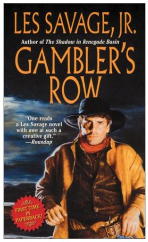
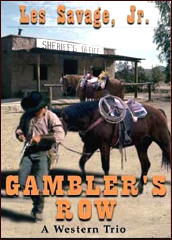
LES SAVAGE, JR. – Gambler’s Row.

Leisure, paperback reprint; 1st printing, February 2003. Hardcover edition: Five Star, February 2002.

LES SAVAGE JR Gambler's Row

   Yes, this is a western, and if you’re a mystery fan only, you can go right on to the next review, if you prefer. But over the past few years Five Star has been doing western fans a great big favor in publishing collections of vintage pulp stories like this one, and thanks to Leisure Books as well, many of them are now available in cheaper editions.

   There are three short novels in this one, all previously appearing in the badly flaking pages of Lariat Magazine, circa 1945-48. But where’s the crime connection, you ask? I’m glad you did, since I was coming to that. In “Gambler’s Row,” the title story, a wandering cowpoke named Drifter (well, yes) is hired by the female owner of the Silver Slipper to locate the sole witness to a murder.

   In “Brush Buster” the only crime is cattle rustling, but it does take some detective work on the part of small-scale rancher Nolan Moore to track them down (and win the hand of lush, full-bodied Ivory Lamar). And in “Valley of Secret Guns” one-armed bronc-buster Bob Tulare is suspected by a gang of rustlers and killers of being a private detective, working undercover to bring them to justice. There is, of course, a woman involved as well.

LES SAVAGE JR Gambler's Row

   As you can probably tell, Al Hubin isn’t likely to include this book in the latest edition of his Bibliography of Crime Fiction, nor would I if I were he, to tell you the truth, but like most westerns, it’s not all that far afield. The stories are melodramatic, especially the first one; humorous, especially the last one; romantic, all three of them; and, most importantly, authentic, again all three of them.

   If you read carefully enough, you can learn how to track someone on horseback without being spotted; how to retrieve cattle used to running wild in the mesquite and thick brush along the Mexican border; and how to break killer horses at five dollars a bust.

   There are cowboy terms in this book that I’ve never heard of, and I don’t think Savage made them up. From page 160: “Center-fire rig popping and snapping beneath him, Tulare unhitched his dally … he didn’t have to get too close with forty-five feet of maguey in his hand.”

   Savage also writes great fight scenes, a few that go on for pages. Not great literature, by any means, but for the market for which they were written, these stories are top of the line.

— March 2003

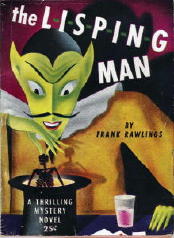
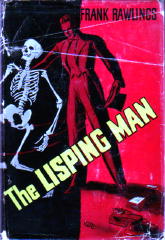
FRANK RAWLINGS – The Lisping Man.

FRANK RAWLINGS The Lisping Man

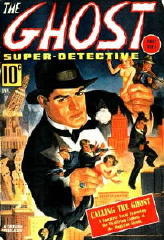
Atlas Mystery/Hercules Publishing Corp.; digest-sized paperback; first printing, 1944; abridged. Hardcover edition: Gateway Books, 1942. Based on the short novel “Calling the Ghost,” the first appearance of the Ghost/Green Ghost pulp hero character, magician-sleuth George Chance, in The Ghost, Super-Detective, January 1940, as by G. T. Fleming-Roberts.

   For a longer and much more comprehensive look at the complicated background behind this story, go to Monte Herridge’s excellent article “Chance Without a Ghost,” located here. Monte goes into a considerable amount of detail in pointing out all of the changes that were made by Fleming-Roberts between the pulp story and the digest paperback, with a hardcover appearance in between.

   The most significant of these alterations turned out to have been all of the pulp hero apparatus that was abandoned for the novel — no secret identity nor hidden hideaway nor so on — leaving George Chance as only a magician by profession and a crime-solving sleuth as a sideline, only one step up from being a hobby, you might say.

   Monte did not believe that the story was very good.

   I agree. In fact, I thought it was quite bad, if not awful, but with reservations. Working pretty much in the dark, I’m inclined to lay a good chunk of the blame on the second set of changes: on whoever the editorial staff was whose responsibility it was for trimming a standard-sized hardcover down to a fairly slim paperback. The latter is the only version I have, and as it was for Monte, that’s all that I can base my comments on.

   So how much was cut, or whether it was done crudely or with any amount of skill, I do not know. The fact is that when a book is cut and trimmed and comes out as, well, ineptly as this one, it’s difficult to give the full responsibility to the author for how the final version reads, especially as in this case, when it does not turn out well.

   [FOLLOWUP: It’s not exactly a footnote, but Bill Pronzini, a fellow pulp fiction aficionado, will have more to say about this when I’m finished with the rest of the review, which follows. Keep reading.]

FRANK RAWLINGS The Lisping Man

   I mentioned that crime-solving was an avocational passion for George Chance. A good example that I can use to demonstrate just exactly how obsessive and attracted Chance is to strange murder cases comes only one or two chapters into the book, as he leaves his new wife Merry on their wedding night to help Inspector Ames investigate the suicide of one Leonard Van Sickle, who apparently jumped (or was pushed) from a hotel room twenty floors above the pavement.

   What makes this a strange case is that Leonard Van Sickle had telephoned Chance only hours before, with no indication in the call that he was planning on ending his life. What is also strange is that he talked with a lisp. Hence the title. It also turns out (page 67) that the dead man had recently had all of his teeth extracted.

   Explains the dentist:

    “I wouldn’t have complied with the patient’s request to extract healthy teeth had it not been for the fact that I needed money badly,” Dr. Chambers confided. “I thought there was something suspicious about the whole setup. …”

   As you have probably suspected, there is something funny about it, all right, and you also would probably not be astonished to learn that there is a lot of fuss made about life insurance policies and who collects and who doesn’t.

   There is some intelligence behind the plot, but it is seemingly indifferently and/or non-skillfully told most of the way through, culminating in a “gather all of the suspects together” scene that does not depend on more than a modicum of a magician’s sleight-of-hand in any substantial manner, shape or form.

FRANK RAWLINGS The Lisping Man

   What it does rely even more upon is the answer to the question, “Whose hands will show up like phosphorus under an ultra-violet light?”

   It didn’t take a magician to think of this. I think that if a magician is a sleuth, he ought to do more with his prestidigitation and legerdemain than pull cigarettes out of the air or coins out of people’s ears. (I’m speaking figuratively here, as what is up George Chance’s sleeve at a crucial moment is, well, crucial.)

   There is a decent detective novel hidden in the depths of this one, perhaps. I just didn’t happen to read it, or I was too lazily intent at the time on reading the one that was there, not the one it could have been.

FOLLOWUP: After finishing my review above, and telling Bill Pronzini only the gist of what I’d said, I asked him about the differences between the hardcover and the paperback version of the novel. (I could think of no one else who might possibly have read both.) Here’s his reply:

    “The uncut hardcover edition of The Limping Man is marginally better than the abridged paper one, which eliminates a fair amount of descriptive material that fleshes out the story and some connective material whose absence makes for choppy reading. It’s still not a very good novel, though, particularly when compared to the pulp version — no doubt the reason Fleming-Roberts didn’t want his own name on it and why it didn’t find a better publisher than Leo Margulies’ Gateway.”

— April 2006

« Previous PageNext Page »