Pulp Fiction


         PulpFest press release copy:

   Edgar Award-winning writer, editor, and publisher Otto Penzler has been chosen to be the Guest of Honor at this year’s PulpFest, a convention for collectors and devotees of vintage pulp fiction, which will be held July 31 through August 2 at the Ramada Plaza Hotel and Convention Center in Columbus, Ohio.
PULPFEST 2009

   PulpFest not only attracts book dealers and collectors from all across the country but also hosts seminars on various aspects of pulp history and stages auctions of rare and desirable material including vintage hardcovers, paperbacks, and dime novels in addition to the fabled woodpulp magazines from which the convention takes its name.

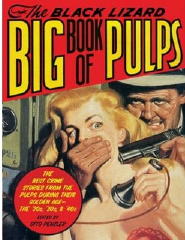
   Penzler, whose recent anthology The Black Lizard Big Book of Pulps has done more to renew interest in Golden Age pulp fiction than any mainstream publication in recent history, is a perfect Guest of Honor in that he is also a world-class collector of crime fiction, many of whose most notable authors—including Dashiell Hammett, Raymond Chandler, Cornell Woolrich, Erle Stanley Gardner, and John D. MacDonald—toiled in the pulp vineyards before achieving mainstream success with major publishers.

   Penzler will regale PulpFest attendees with stories of his adventures in the publishing business and as a lifelong collector. He is expected to give attendees a preview of his much anticipated Black Lizard Big Book of Black Mask Stories, an upcoming anthology collecting rare yarns from the prestigious pulp magazine that was home to Hammett, Chandler, and other giants of hard-boiled detective fiction.
PULPFEST 2009

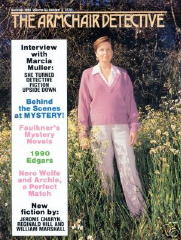
   Still the proprietor of The Mysterious Bookshop, a New York City landmark that celebrated its 30th anniversary last year, Otto Penzler published The Armchair Detective, an Edgar-winning quarterly journal devoted to the study of mystery and suspense fiction, for seventeen years. He was the founder of The Mysterious Press, now an imprint at Grand Central Publishing, and also launched the publishing firms of Otto Penzler Books and The Armchair Detective Library.

   He currently has imprints at Houghton Mifflin Harcourt in the United States and Quercus in the U.K. In 1977, he won an Edgar Award for the Encyclopedia of Mystery and Detection. The Mystery Writers of America gave him the prestigious Ellery Queen Award in 1994 for his exceptional contributions to the publishing field. He was also honored with MWA’s highest non-writing award, the Raven, in 2003.

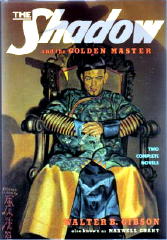
   Penzler first endeared himself to pulp-fiction fans in the late 1970s by publishing a two-volume collection of short stories featuring Norgil, a magician-detective created by Walter B. Gibson, who also wrote more than 280 novel-length adventures of pulpdom’s legendary crime fighter, The Shadow. In 1984, Penzler reprinted two of that character’s best-remembered adventures in The Shadow and the Golden Master.
PULPFEST 2009

   Subsequently his Mysterious Press issued trade-paperback anthologies of classic pulp detective stories by Carroll John Daly, Erle Stanley Gardner, Frederick Nebel, and Norbert Davis. First You Dream, Then You Die, a deluxe hardcover biography of veteran pulp scribe Cornell Woolrich published by The Mysterious Press in 1988, earned an Edgar for author Francis M. Nevins and became a standard reference work.

   In addition to having access to interviews and seminars featuring Penzler and other guests, PulpFest attendees can shop for vintage paper collectibles in the convention’s spacious Dealers’ Room, in which dozens of merchants will exhibit their wares. Tens of thousands of pulps will be available for purchase, along with various books and magazines of related interest. Publishers of facsimile pulp reprints will also be on hand to supply fans with inexpensive but high-quality alternatives to the original rough-paper periodicals.

   For additional information and downloadable registration forms, interested parties are encouraged to visit the convention’s web site, www.pulpfest.com, which will be updated regularly in the weeks and months to come.

— 30 —

Reviewed by MIKE GROST:

CAROLYN WELLS – Faulkner’s Folly.

George H. Doran Co., hardcover, 1917. Serialized in All-Story Weekly, September 8 to September 29, 1917.

CAROLYN WELLS

   Carolyn Wells’ Faulkner’s Folly (1917) is the first novel I have read by that author. It shows the frustrating mix of (artistic) virtue and vice that other commentators have discerned in her work.

   The book is startlingly close to the traditions of the Golden Age novel. But it was written before Christie, Carr, Queen, Van Dine and other intuitionist Golden Age writers had published a line. And this is hardly Wells’ first work; she had been publishing for over a decade, since 1906, when this novel appeared.

   The novel has an apparent medium who holds séances, etc., and whose “supernatural” gifts are ultimately explained naturally; this seems very anticipatory of both John Dickson Carr and Hake Talbot. Carr was in fact devoted to Wells’ works while growing up, and we know from both Ellery Queen and Carr biographer Douglas G. Greene that he was one of Wells’ biggest admirers. Many of Wells’ tales are impossible crime stories; she was apparently one of the first to expand this genre from the short story to the novel, following Gaston Leroux.

   Faulkner’s Folly also anticipates the Golden Age in other ways. It takes place in an upper class country house, and draws on a closed circle of suspects of relatives, guests and employees of the murdered man. There is an atmosphere of culture to the novel, too; the murdered man was a great painter, and one of his guests is the widow of the architect who built his mansion. The whole novel is very close in tone to S.S. Van Dine; in fact it is one of the closest approximations in feel to his work among the mystery authors who preceded him.

CAROLYN WELLS

   Wells would certainly be classified as an intuitionist. She started by publishing in All Story magazine, one of the early pulp magazines that also featured the work of Mary Roberts Rinehart. But her work could not be more different from Rinehart’s.

   There is no sign of an influence from Anna Katherine Green, or of scientific detection à la Arthur B. Reeve. Nor is there much suspense of any sort in Wells’ work. Instead, Wells’ book is squarely in the intuitionist tradition, and seems on the direct line to such later intuitionist writers of the Golden Age listed above.

   The best part of Wells’ book is the finale, when the murderer is revealed and the various mysteries are explained. It reminded me of the pleasure I have received from the finales of Christie, Carr and other Golden Agers, when all is revealed.

   Now for the down sides of Wells’ work. Her book is nowhere as good as a work of storytelling as the later authors we have mentioned. And her plot is nowhere as clever as these later authors, either. Bill Pronzini’s Gun in Cheek (1982), his affectionate but hilarious history of really bad crime fiction, points out other truly major flaws in Wells’ works.

   Her impossible crime plots tend to depend on secret passageways. This gimmick was later, during the Golden Age, regarded as a cheat; the locked room novels of Carr and others often contain solemn assurances from the author that no secret passageways were found in the buildings where the crimes occurred. To be fair, Wells showed some real ingenuity in the use of such secret panels and doors; but this gimmick is likely to annoy modern readers.

CAROLYN WELLS

   We can compare Wells’ novel with “Nick Carter, Detective” (1891), an early series detective tale. The story opens with a “locked house” crime. Nick Carter suspects secret passageways, and sure enough he eventually finds the house to be riddled with them.

   They are similar to the secret passageways Herman Landon used for his Gray Wolf stories in Detective Story in 1920. Detective Story was the first specialized mystery pulp magazine. So the impossible crime caused by secret passageways was a common coin of inexpensive mystery fiction.

   Carolyn Wells also used secret passages for her locked room tales in the 1910’s, although she tended to employ Occam’s razor on them. She would employ the minimum number of passages need to commit the crime, often just one. It would be strategically placed in the only spot that would allow the crime to be committed.

   There was a quality of ingenuity to her placement: it was not at all obvious that a secret passage anywhere would enable the crime to be possible; the revelation that a secret passage would make the crime possible would startle the reader at the end of the story. She achieves a genuine puzzle plot effect by this approach: where is the secret passageway, and how could any secret passage possibly enable this crime?

— Reprinted with permission from A Guide to Classic Mystery and Detection, by Michael E. Grost.

THE CURMUDGEON IN THE CORNER
by William R. Loeser


STUART TOWNE [CLAYTON RAWSON] – Death Out of Thin Air.

Coward McCann, hardcover, 1941. UK edition: Cassell & Co., hardcover, 1947. Both novelettes are included in The Magical Mysteries of Don Diavolo, by Clayton Rawson, aka Stuart Towne, Battered Silicon Dispatch Box Press, hc, 2005.

STUART TOWNE Death Out of Thin Air.

   Death out of Thin Air is, I believe, a scarce book. It actually contains two pulp novelettes, “Death from the Past” and “Death from the Unseen,” featuring Don Diavolo, a red-garbed version of the Great Merlini.

   Considering the stories’ source, it is not amazing that Diavolo’s entourage includes such elements as an oriental valet, a custom red automobile, beautiful blond twin assistants, and a townhouse next to his residence owned solely for the purpose of spying on and escaping from visitors.

   The first of the stories begins with a locked-room murder in Diavolo’s dressing room; the second gives us a variety of crimes carried out in such a way that the criminal must have been invisible. Similar crimes and further adventures and mysteries intervene before Diavolo exposes the perpetrators.

   These are not the best of Rawson’s works but contain full measure of the puzzlements fairly explained, though arising from unlikely and extravagant causes, which make all of his books so popular with a small group. What element is lacking in his books to account for their original small sales — it is hard to find a copy of any that was bought by an individual, not a library — and Rawson’s giving up writing them?

– From The MYSTERY FANcier, Vol. 3, No. 4, July-Aug 1979       (mildly revised).


      Contents:

   Death from the Past, published as “Ghost of the Undead,” Red Star Mystery, June 1940.

STUART TOWNE Death Out of Thin Air.

   Death from the Unseen, published as “Death Out of Thin Air,” Red Star Mystery, August 1940.

CHARLES G. BOOTH – Murder at High Tide.

Charles Booth, Murder at High Tide

William Morrow & Co., hardcover, 1930. UK edition: Hodder & Stoughton, 1930.

   This story of a domestic tyrant who’s found murdered in his library has a lot of what attracted me to mysteries in the first place.

   Even so, while fun to read, an honest appraisal would have to rank it only a notch or so above the Hardy Boys. And as in a vintage Charlie Chan movie, the dead man’s mansion is full of suspects at each other’s throats, with wild accusations and amazing discoveries coming at every moment.

   The hero is a young antiques dealer, in his own words, an ass with women. (No further comment.) The detective is Anatole Flique, a comically suave French policeman, although the murder does take place on an island just off the California coast. In his own words, he’s the cleverest on the Paris Surete. He’s also greatly given to twirling his mustaches and busily polishing the top of his head, all the while contemplating life’s little mysteries.

   There are tons of false evidence, most of it leading to dead ends, but I think that the killer, in spite of his or her alibi, should be spotted at once. The style is not John Dickson Carr’s, but it is his kind of story. If there’s no locked room, it’s only because then there wouldn’t have been quite so much fun with alibi-breaking, which in Murder at High Tide is the name of this particular game.

— Reprinted from The MYSTERY FANcier, Vol. 3, No. 4, July-Aug 1979 (slightly revised).


[UPDATE] 01-14-09.  One of the revisions I made was to add the name of the French detective who worked on this case. Obviously I had no idea that he appeared in more than one book, but he did. From the Revised Crime Fiction IV, by Allen J. Hubin, here’s his complete dossier:

FLIQUE, ANATOLE [Charles G. Booth]
       o Murder at High Tide (n.) Morrow 1930 [California]
       o The Cat and the Clock (n.) Doubleday 1935 [Los Angeles, CA]
       o Kings Die Hard (n.) Hammond 1949 [California; 1929]

   This last book never had a US edition. It came out in 1949, the same year that the author died. According to Wikipedia, Charles G. Booth was “a British-born writer who settled in America and wrote several classic Hollywood stories, including The General Died at Dawn (1936) and Sundown (1941). He won an Academy Award for Best Story for The House on 92nd Street in 1945. […] He also penned the source story for Paul Mazursky’s 1988 film Moon Over Parador.”

HARD BOILED OMNIBUS

   I’d never realized until now that Booth was originally from England. Besides the fiction he wrote in novel form, I know his name from many stories he wrote for Black Mask, the quintessential hard-boiled American detective pulp magazine.

   In fact, he has the unfortunate distinction of being one of the three authors whose stories were deleted from the paperback edition of The Hard-Boiled Omnibus (Simon & Schuster, 1946), edited by Joseph T. Shaw. This is a great reason why you should own the hardcover edition, not just the one reprinted by Pocket (1952).


   Hidden in a long string of comments about Walter Albert’s review of the Buck Jones movie Unknown Valley (1933) is a separate thread about Charles Starrett and the Durango Kid movies, which I expressed a great fondness for as a kid growing up in the late 1940s. This long comment by Ed I thought could use more exposure. My response? He certainly has me pegged.

— Steve
CHARLES STARRETT, by Ed Hulse

   Re: Charles Starrett. He holds the record for most starring Westerns made by one star at the same studio: 131, for Columbia Pictures, produced and released over a 17-year period. He played the Durango Kid in half of them, all but the first released between 1945 and 1952.

CHARLES STARRETT Outlaws of the Prairie

   Although the Durangos are very fondly remembered by aging Western fans who saw them in Saturday-matinee engagements, they’re generally cheap, shoddy productions with cookie-cutter plots and puerile comic relief.

   Starrett’s earlier Westerns — especially the 1937-40 pictures in which his regular leading lady was Iris Meredith (the subject of a recent M*F thread) and his sidekicks the Sons of the Pioneers — were his best.

   I met Starrett twice and spoke to him at length about his career. His favorite among those early Westerns was also mine: Outlaws of the Prairie (1938, based on a Harry F. Olmsted story originally published in Dime Western), which cast him as a deadly “fanner” who has spent his entire adult life looking for the renegade who killed his father and cut off his trigger fingers.

   Starrett was also very fond of a short-lived series — also based on pulp stories — casting him as Dr. Steven Monroe, aka The Medico, a frontier doctor who occasionally used his guns in defense of the law.

IT’S ABOUT CRIME
by Marvin Lachman

ROBERT KENNETH JONES – The Shudder Pulps: A History of the Weird Menace Magazines of the 1930s.

NAL Plume, trade paperback, 1978. Hardcover edition: FAX Collector’s Editions, West Linn OR, 1975. Reprint hardcover/softcover: Wildside Press, 2007.

THE SHUDDER PULPS

   In 1940, when I began reading everything I could lay my eyes on, there were countless pulps at my local newsstand. There was even, in the neighborhood in the South Bronx in which I grew up, a store that sold used pulps at three for a dime. Aware of the prices being asked for pulps now, I deeply regret not having invested-or at least kept those I had. Had I but known.

   Robert Kenneth Jones’ The Shudder Pulps is designed for those of us who, for literary and-or monetary reasons, are nostalgic for the pulpa era. It is not designed as a complete history, but rather as an informal survey of the horror-weird menace type of pulp that was so popular in the 1930’s.

   The stories of which Jones writes fell somewhere in between fantasy-science fiction on one hand and detective-mystery fiction on the other. While most of his discussion concerns magazines like Weird Tales, Horror Stories, and Terror Tales, some of the detective pulps like Dime Detective come in for attention as well. In an easy-going, anecdotal style, Jones describes the contents of some of the magazines, the publishing taboos, and gives us an idea of the economics of writing at the time.

   Though many of the pulp writers of the thirties are no longer alive, Jones interviewed several of those available, e.g., Baynard Kendrick and Wyatt Blassingame, and has captured their reminiscences for posterity.

   No book about the pulps would be complete without some discussion of the illustrations, especially the gory, funny, sexy covers. Jones has included more than seventy illustrations, mostly covers. Unfortunately, they are reduced in size and are in black and white, so that some of the original appeal of the covers is missing. Still, in words and pictures Robert Kenneth Jones has done an admirable job of recreating a time for which we rightly feel nostalgic.

– From The MYSTERY FANcier, Vol. 3, No. 4, July-Aug 1979.       

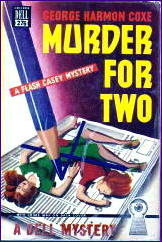
GEORGE HARMON COXE – Murder for Two.

Dell #276; mapback edition; no date stated, but circa 1949. Hardcover edition: Alfred A. Knopf, 1943.

GEORGE HARMON COXE Murder for Two

   Another Boston mystery, this one featuring “Flashgun” Casey, ace photographer for the Express, but one of another style and another era. While Death of a Harvard Freshman [reviewed earlier here] was wordy and cerebral, this novel by George Harmon Coxe is terse and prone to violent action. Casey is as good with his fists as with his wits.

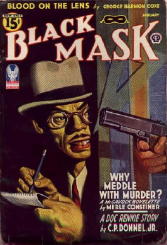
   As you might have known without my saying so, had I mentioned earlier that this novel was originally published as a Black Mask serial. Its original title in the pulps? “Blood on the Lens.” [A three-part serial, beginning January 1943.]

   And as far as titles go, Murder for Two is the more appropriate, even though it’s rather meager and bland in comparison. The first death is that of crusading columnist Rosiland Taylor. Apparently someone objected to a story she was working on. The second death is that of a former secretary who held some incriminating evidence against the target of that story.

GEORGE HARMON COXE Murder for Two

   The case is all so straightforward that it comes as quite a pleasant (though not unexpected) surprise to learn that Coxe has more of a mystery in mind than that, so if you pick this one up and give it a try, don’t take it too lightly as a work of detective fiction. Keep reading. (The question is more of how Coxe is going to pull off what he does, not whether.) The key here is that there is a very nifty alibi involved, one so nifty, as a matter of fact, that no one is even aware it is an alibi.

   Or in other words, there is a lot of action going on in this book, so take this as a warning. Coxe’s meticulous plotting can easily blindside you and catch you as flat-footed as I was. (A humbling admission to make, but there you are.)

   He also catches a rare male camaraderie between Casey and police lieutenant Logan of Homicide — one that can suddenly flare into mutual irritation and tired sarcasm but then, with common sense and good humor, just as quickly right itself back into place again.

— From Mystery.File 1, January 1987 (revised).


REVIEWED BY WALTER ALBERT:         


SATTERTHWAIT Dead Horse

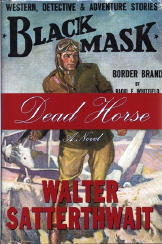
WALTER SATTERTHWAIT – Dead Horse. Denis McMillan Publications, hardcover, 2006.

   Sattherwait’s novel speculates on the private relationship of [pulp author] Raoul Whitfield and his socialite wife, Mrs. Emily Davies Vanderbilt Thayer Whitfield, who was found dead of a gunshot wound in 1935, a death that was never explained to anyone’s satisfaction.

   Satterthwait’s extensive research only serves to strengthen the plausibility of his depiction of the doomed marriage and ill-matched couple, and the terse, finely honed prose is a fitting tribute to a mystery writer of uncommon stylistic gifts.

      ___

   Bibliographic data: RAOUL WHITFIELD.   Expanded from Crime Fiction IV, by Allen J. Hubin. Criminous novels and collections only:

WHITFIELD, RAOUL (Falconia). 1896-1945; pseudonym: Temple Field.

      * Green Ice. Knopf, 1930; No Exit Press, UK, 1988. Hardcover reprint: Grosset & Dunlap, early 1930s. Reprinted in 3 Star Omnibus: Trent’s Last Case, Green Ice, The Middle Temple Murder, Knopf, 1936. Later hardcover reprint: Gregg Press, 1980. Also published as: The Green Ice Murders. Avon Murder Mystery Monthly #46, pb, 1947. Later paperback reprints: Avon PN373, 1971; Quill, 1986.

RAOUL WHITFIELD

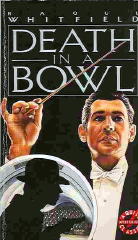
      * Death in a Bowl. Knopf, 1931; No Exit Press, UK, 1988. Paperback reprints: Avon PN337, 1970; Quill, 1986.

RAOUL WHITFIELD

      * The Virgin Kills. Knopf, 1932; No Exit Press, UK, 1988. Paperback reprint: Quill, 1986.
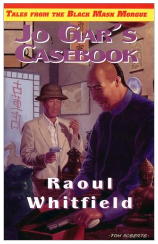
      * Jo Gar’s Casebook. Crippen & Landru, hc, 2002. Story collection. RD = Originally published as by Ramon Decolta:

RAOUL WHITFIELD

West of Guam [RD] Black Mask, Feb 1930
Death in the Pasig [RD] Black Mask, Mar 1930
Red Hemp [RD] Black Mask, Apr 1930
Signals of Storm [RD] Black Mask, Jun 1930
Enough Rope [RD] Black Mask, Jul 1930
The Caleso Murders [RD] Black Mask, Dec 1930
Silence House [RD] Black Mask, Jan 1931
Shooting Gallery [RD] Black Mask, Oct 1931
The Javanese Mask, [RD] Black Mask, Dec 1931
The Black Sampan [RD] Black Mask, Jun 1932
The Siamese Cat [RD] Black Mask, Apr 1932
The China Man [RD] Black Mask, Mar 1932
Climbing Death [RD] Black Mask, Jul 1932
The Magician Murder [RD] Black Mask, Nov 1932
The Man from Shanghai [RD] Black Mask, Apr 1933
The Amber Fan [RD] Black Mask, Jul 1933
The Mystery of the Fan-Backed Chair. Cosmopolitan, Feb 1935
The Great Black. Cosmopolitan, Aug 1937


FIELD, TEMPLE.
Pseudonym of Raoul F. Whitfield, 1896-1945.

      * Five. Farrar & Rinehart, 1931.
      * Killer’s Carnival. Farrar & Rinehart, 1932.

BILL PRONZINI on WILLIAM CAMPBELL GAULT:


WILLIAM CAMPBELL GAULT

   William Campbell Gault was a writer of the old school, a consummate professional throughout a distinguished career that spanned more than half a century. From 1936 to 1995 he published scores of novels, both mysteries and juvenile sports fiction and hundreds of short stories, and counted among his awards an Edgar from the Mystery Writers of America, and the Life Achievement Award from the, Private Eye Writers of America.

   Noted author and critic Anthony Boucher said of him: “(He is) a fresh voice — a writer who sounds like nobody else, who has ideas of his own ,and his own way of uttering them.” Another of his peers, Dorothy B. Hughes, stated that he “writes with passion, beauty, and with an ineffable sadness which has been previously been found only in Raymond Chandler.”

WILLIAM CAMPBELL GAULT

   He was in his mid-20s when he entered a story called “Inadequate” in a Milwaukee Journal-McClure Newspaper Syndicate short story contest. The judges found it to be anything but inadequate, awarding it the $50 first prize. Spurred on by this success, he wrote and placed several more stories with the McClure Syndicate, then in 1937 entered the wide-open pulp field with the sale of a drag-racing story, “Hell Driver’s Partnership,” to Ace Sports.

   Over the next fifteen years he was a prolific provider of mystery, detection, sports, both light and racy romance, and science fiction to such pulps as 10-Story Detective (where his first criminous story, “Crime Collection,” appeared in January of 1940), Detective Fiction Weekly, The Shadow, Clues, All-American Football, Strange Detective Mysteries, Adventure, Dime Mystery, Dime Detective, Doc Savage, Argosy, Detective Tales, Five Novels Monthly, and Thrilling Wonder and to such “slick” and specialty magazines as The Saturday Evening Post, Grit, and McClure’s.

WILLIAM CAMPBELL GAULT

   In the late forties he was featured on the covers of the king of the detective magazines, Black Mask, in whose pages he published nine stories, five of them featuring an offbeat, Duesenberg-driving private detective named Mortimer Jones.

   When the pulp markets collapsed in the early fifties, Gault turned his hand to book-length works. He published the first of his 33 novels for young readers, Thunder Road, in 1952, a work which stayed in print for more than three decades. Appearing that same year was his first mystery, Don’t Cry for Me, one of the seminal crime novels of its time.

   Prior to Don’t Cry for Me, the emphasis in mystery fiction was on its whodunit / whydunit aspects. Gault’s novel broke new ground in that its whodunit elements are subordinate to the personal lives of its major characters and to a razor-sharp depiction of the socioeconomic aspects of its era — an accepted and widely practiced approach utilized by many of today’s best writers in the field.

WILLIAM CAMPBELL GAULT

   His fellow crime novelist, Fredric Brown, said of the novel: “[It] is not only a beautiful chunk of story but, refreshingly, it’s about people instead of characters, people so real and vivid that you’ll think you know them personally. Even more important, this boy Gault can write, never badly and sometimes like an angel.”

   The Mystery Writers of America agreed, voting Don’t Cry for Me a Best First Novel Edgar. Gault’s subsequent mysteries are likewise novels of character and social commentary, whether featuring average individuals or professional detectives as protagonists.

   Many have unusual and/or sports backgrounds, in particular his non-series works. The Bloody Bokhara (1952) deals with the selling of valuable Oriental rugs and carpets in his native Milwaukee; Blood on the Boards (1953) has a little-theater setting in the Los Angeles area; The Canvas Coffin (1953) concerns the fight game and is narrated by a middleweight champion boxer; Fair Prey (1956, as by Will Duke) has a golfing background; Death Out of Focus (1959) is about Hollywood filmmakers and script writers, told from an insider’s point of the-view.

WILLIAM CAMPBELL GAULT

   An entirely different and powerful take on the Hollywood grist mill is the subject matter of his only mainstream novel, Man Alone, written in 1957 but not published until shortly before his death in 1995.

   The bulk of Gault’s 31 criminous novels — and many of his short stories showcase series detectives. One of the first was Mortimer Jones, in the pages of Black Mask; another pulp creation, Honolulu private eye Sandy McKane, debuted in Thrilling Detective in 1947.

   Italian P.I. Joe Puma, who operates out of Los Angeles, was created for the paperback original market in the fifties, first as the narrator of a pseudonymous novel, Shakedown (1953, as by Roney Scott), and then of several books published under Gault’s own name between 1958 and 1961, notably Night Lady and The Hundred-Dollar Girl.

WILLIAM CAMPBELL GAULT

   His last and most successful fictional detective was Brock “The Rock” Callahan, an ex-L.A. Rams lineman turned private eye, who first appeared in Ring Around Rosa in 1955. Callahan, along with his lady friend, interior decorator Jan Bonnet, did duty in six novels over the next eight years. In a rave review of Day of the Ram (1956), The New York Times called Callahan “surely one of the major private detectives created in American fiction since Chandler’s Phillip Marlowe.”

   After the publication of Dead Hero in 1963, Gault abandoned detective fiction to concentrate on the more lucrative juvenile market. It was nearly twenty years before he returned to the mystery field; and when he did return, it was exclusively with stories of an older, wiser, married (to Jan Bonnet), inheritance-wealthy, and semi-retired Brock Callahan.

WILLIAM CAMPBELL GAULT

   The new series of Callahan books began with The Bad Samaritan (1982); six others followed, culminating with Dead Pigeon in 1992. In The Cana Diversion (1982) Gault also brought back Joe Puma — dead. The novel’s central premise is Puma’s murder and Callahan’s search for the killer, a tour de force that earned a Private Eye Writers of America Shamus for Best Paperback Original.

   The hallmarks of Bill Gault’s fiction are finely tuned dialogue, wry humor, sharp social observation, a vivid evocation of both upper class and bottom-feeder lifestyles, and most importantly, the portrayal of people, in Fredric Brown’s words, so real and vivid that you’ll think you know them personally.

    — This essay first appeared as the introduction to The Marksman and Other Stories, by William Campbell Gault and edited by Bill Pronzini (Crippen & Landru, hardcover, March 2003). Reprinted with the permission of Bill Pronzini.

MAX BRAND – Gunman’s Goal.

Five Star, hardcover, Feb 2000. Leisure, paperback; 1st printing, Nov 2002. First appearance: Western Story Magazine, 14 July 1928.

MAX BRAND Gunman's Goal

   Max Brand is one of this country’s most famous western writers, and that’s exactly how this latest of his works is being marketed, but what it an action-packed crime novel that just happens to take place in the West. Reprinted from its serial form when it first appeared in the pulp Western Story Magazine in 1928, this is one of a series of adventures of James Giraldi, a dashing young adventurer to whom crime is a fine art, looking solely for the excitement, not ill-gotten gains.

   He’s hired in this novel by a girl (beautiful) to find her father (innocent) who has disappeared, fleeing from the law after being charged with murder. The girl’s Cousin Edgar (dastardly) has evil intentions toward the estate, and to that end he is making romantic overtures to her mother (fluttery and weak-minded).

   It reads much better than it sounds! The action is continuous, the dialogue often lyrical, and the tale truly epic in nature. This is the stuff that legends are made of, the American West of the imagination, not of reality, but to my way of thinking, every so often a strong dose of balladry and fables like this is just what the doctor ordered.

MAX BRAND Gunman's Goal

   [One note of caution, though: Going back to Brand’s original manuscript may be responsible for some glitches a good eagle-eyed editor should have caught. Giraldi’s horse gains a new name from one chapter to the next, and once in Giraldi’s hands, a saddlebag full of valuable papers suddenly seems to contain currency instead.]

— November 2002 (slightly revised)


[UPDATE] 11-23-08.   Put this in the “For What It’s Worth” category: A reviewer of this book on Amazon claims that it was published earlier as Three on the Trail and warns people not to buy it. I don’t believe the two books are the same. “Three on the Trail” was published as a six-part serial in Western Story Magazine beginning 12 May 1928; and as as you can see from the cover to the right, “Gunman’s Goal” was in the 14 July issue of the same year.

« Previous PageNext Page »