Pulp Fiction


WALKER MARTIN on Rereading Day Keene:            

   I’m glad you did your recent post on Ross Macdonald because this reminded me that it was important for me to reread some of his outstanding novels.

DAY KEENE Home Is the Sailor

   Speaking of rereading, I know you have run across novels like I have where you know that you have read the book a few years ago, or sometimes only a few months ago, but cannot recall anything at all about it.

   Usually this means there was nothing outstanding about the story, just a mediocre reading experience that you eventually forget. To prevent myself from rereading these type of bland novels, I put a note in the book or magazine listing the date, my comments and a grade.

   But yesterday I was reading a Day Keene novelet of about 15 pages in the June 1946 issue of Detective Tales, titled “If a Body Meets a Body.” I recognized every character and plot turn in the story but there was no note indicating that I had read it.

DAY KEENE Home Is the Sailor

   Needless to say, this was a mystery I had to solve because I never forget to rate and comment on a story. Digging through my Day Keene books I stumbled across a Hard Case Crime paperback titled, Home Is the Sailor.

   Mystery solved. I’d read the novel in October 2006 and now realize that the June 1946 novelet was expanded into the original 1952 Gold Medal novel. Both stories using the basic same plot but I had found the full length novel to be ok but nothing special.

   However, the novelet was outstanding at 15 pages. Just another example of how expanding a story sometimes is not a good idea. But I guess Keene got the usual couple thousand dollars advance for the full length expansion.

   Despite my opinion of the novel as being mediocre, I somehow managed to remember the plot two years later. Maybe there is hope for our memories after all!

DAY KEENE Home Is the Sailor

   By the way, the above might generate some discussion among your readers about rereading, memory, Day Keene, rating novels, etc. Feel free to post it to Mystery*File if you wish.

[EDITORIAL COMMENT]   For more on Day Keene, including a complete bibliography of both his novels and all of his known pulp fiction, check out this page on the main Mystery*File website, beginning with the Gold Medal column about Keene that Bill Crider did for M*F back when it was a print zine.

   As for rereading mystery novels, I do try, but I own so many of them, it’s tough to put reading one a second time before reading others for the first time. In cases like Ross Macdonald, Rex Stout, John Dickson Carr, Agatha Christie and Raymond Chandler, I do make exceptions!

   I’ve written reviews of almost everything I’ve read since the mid-1970s, although some of the early ones are only short notes to myself, like Walker’s, and you won’t ever see them posted on here on the blog. The primary reason I’ve done this, I think, so that I do remember the story lines. I’ve discovered that if I don’t write a review of a book or a movie, I forget almost everything about it.

   I admire people who can describe in detail either a book or a movie they’re read or seen many years before. Not me. If I don’t write a review right away, forget it. Or at least I do! They’re gone.

   This “lack of memory” property does help when rereading a detective novel, though. I almost never remember who did it. (Except for that Roger Ackroyd novel….)

— Steve

A 1001 MIDNIGHTS Review by Bill Pronzini:


HERMAN PETERSEN – Old Bones.

Duell, Sloan & Pearce, hardcover, 1943. Paperback reprint: Dell 127, 1947 [mapback edition].

   Herman Petersen was a prolific contributor to the aviation, adventure, and detective pulps of the Twenties and Thirties; one of his stories appears in the famous “Ku Klux Klan Number” of Black Mask (June 1, 1923). Between 1940 and 1943, he published four crime novels advertised by the publisher of three of them, Duell, Sloan & Pearce, as “quietly sinister mysteries with a rural background.”

HERMAN PETERSON Old Bones

   All four are set in an unnamed county in an unspecified part of the country (presumably upstate New York, Petersen’s home base). Three feature a team of more or less amateur sleuths: old Doc Miller, the county coroner; Paul Burns, the D.A.; and the narrator, Ben Wayne, a gentleman farmer. Miller does most of the sleuthing, Burns most of the worrying, and Wayne most of the leg work.

   Old Bones, the last and nominally best of the Doc Miller books, begins with the discovery — by Wayne’s wife, Marian — of a jumble of old bones wedged into the bottom of a standpipe at an abandoned gristmill.

   Before the authorities can remove them, someone else gets there first and tries unsuccessfully to hide them. Doc Miller’s eventual examination and investigation reveal that the bones are those of Nathaniel Wight, a black-sheep member of the district’s leading family; that he died of a crushed skull; and that he has evidently been dead for five years — ever since the night he was banished by old Aunt She, eldest and most imperious of the Wights, who believed he had seduced his cousin Amelia.

HERMAN PETERSON Old Bones

   It soon becomes apparent that someone in the Wight family, or someone close to it — perhaps more than one person — is willing to go to any lengths to keep the truth about Nate’s death from surfacing along with his bones.

   Much of the action takes place at or near the mill, and in the swamp that separates it from the Waynes’ farm, known as Dark House. In one harrowing episode, Wayne nearly drowns inside the standpipe; in another he is attacked in the mill loft and superficially stabbed.

   A second murder, the actions of a transient who has been bothering women in the area, a nightmarish stormy-night chase through the swamp on the trail of a kidnapped girl, and a tense and fiery conclusion are some of the other highlights.

   Old Bones drips atmosphere and understated menace. Its mystery is well constructed, with some legitimate detection on Doc Miller’s part; there is a nice sense of realism in the characters; and the touches of folksy humor are adroitly handled.

HERMAN PETERSON Murder RFD

   The novel does have its flaws: We are told almost nothing about the backgrounds and private lives of the protagonists, people we want to know better; the solution to the mystery comes a little too easily and quickly; and more could have been done with the final confrontation. But the pluses here far outweigh the minuses. This and Petersen’s other servings of fictional Americana are well worth tracking down.

   Doc Miller, Paul Bums, and the Waynes are also featured in Murder in the Making (1940) and Murder R.F.D. (1942). The D.A ‘s Daughter (1943) also has a rural setting and emphasizes comedy along with murder and mischief.

   Petersen’s only other mystery novel, “The House in the Wilderness,” was published serially in 1957 and did not see book publication.

         ———
   Reprinted with permission from 1001 Midnights, edited by Bill Pronzini & Marcia Muller and published by The Battered Silicon Dispatch Box, 2007.   Copyright © 1986, 2007 by the Pronzini-Muller Family Trust.

Con Report: PULP ADVENTURECON, Bordentown NJ
by Walker Martin

   I arrived at the Ramada Inn in Bordentown at about 8:00 am Saturday, November 1 and found dealers already bringing in dozens of boxes filled full of pulps, paperbacks, books, DVDs, and artwork. The official start of the show was 10:00 am but the action was already gearing up for a day of selling and buying. By the ten o’clock start all 50 or so tables were open for business.

   During the day I sold vintage paperbacks, pulps, DVDs, and cancelled checks made out to pulp authors. I had Dashiell Hammett’s first appearance in print priced at $2,000 but it did not sell. However I did sell his third or fourth appearance for $200.

   The above will give you an idea of items available at the show. I picked up a few pulps and books but my main acquisition was a pulp cover color preliminary for the first issue of Strange Stories. It’s amazing that this somehow survived; I bet the original cover art was destroyed or lost a long time ago.

   David Saunders was there with an advanced copy of the book on his father Norman Saunders. It looked stunning with hundreds of color reproductions of Saunders artwork.

   Bob Lewis was there with his friend Craig Poole, and Martin Grams came with hundreds of DVDs and copies of his immense new book on The Twilight Zone. I recommend this book highly; it seems to have everything in it that you would want to know about the TV series. David Kurzman was there with four tables crammed full of high quality condition pulps and first editions.

   Nick Certo has found the mother lode of Black Mask‘s and had many copies for sale. There probably will not be another large cache of these pulps available in our lifetime. John Gunnison had several tables of pulps.

   Cowboy Tony had an amazing number of magazines available. You name it, he had it: pulps, paperbacks, slicks, dime novels, men’s adventure magazines. The smell at his tables of musty, woody, pulp and slick paper, was overpowering. It was a heavenly smell.

   After the dealer’s room closed at 5:00 pm, about 15 of us met for an hour or so to talk about Pulpcon 2009 which is to be held in Columbus, Ohio July 31-August 2, 2009. Rich Harvey kindly provided the pizza and soda. All members of the new committee were present to discuss the Columbus Pulpcon and answer questions. Thank you Mike Chomko, Jack Cullers, Barry Traylor and Ed Hulse. All pulp collectors should visit the Pulpcon 2009 website which gives some details.

   These pulp shows are great for stirring up interest and usually result in visits with other collectors before the show and after the show. For instance, on Friday Steve Lewis and Paul Herman, visited me and we discussed pulp artwork and DVDs among other subjects. After the show was over, Scott Hartshorn and Nick Certo visited me and we watched film noir and horror movies until 2:00 am. I’ve been friends with all these collectors since the 1970’s when we met at Pulpcon or other conventions.

   So ended another day of great books and pulps, great friends, and plenty of fast food.

A 1001 MIDNIGHTS Review by Bill Pronzini:

   
MERLE CONSTINER – Hearse of a Different Color. Phoenix Press, hardcover, 1952. Previously serialized in Short Stories magazine as “Death on a Party Line”: July 10, July 25, August 10, Aug 25, 1946.

   In Gun in Cheek (1982), the undersigned reviewer’s humorous study of classically bad crime fiction, an entire chapter is devoted to the lending-library publisher, Phoenix Press. During the Thirties and Forties, Phoenix foisted upon an unsuspecting public some of the most godawful mysteries ever penned — scores of them, in fact.

MERLE CONSTINER Hearse of a Different Color.

   Not all Phoenix mysteries were horrendous, however; every now and then, whether by accident or otherwise, a pretty good one seems to have slipped out. Hearse of a Different Color falls into that rarefied category.

   Arkansas semanticist Paul Saxby comes to the backwoods town of Falksville, Tennessee, for two reasons: to study the picturesque colloquialisms of the area (?Git down and tie up, Brother Saxby; we’uns is shore hellacious proud to have you jubilating with us”), and because of a letter written to him by a local resident, Alicia Poynter, which hints at a “great and terrible crime being planned.”

   Shortly after Saxby’s arrival, at least part of that terrible crime is revealed: He finds Alicia dead of poison that mayor may not have been meant for her. Saxby’s investigation involves him with, among other colorful characters, a tough old lady named Cora Bob Wilkerson; the founder of the Caudry Burial Brotherhood; the owner of an abandoned sawmill (in the vicinity of which are all sorts of strange goings-on); and a dog with the magnificent moniker of Moonrise Blizzard the Second. More homicide — and the local sheriff, Masters ? plagues Saxby before he finally arrives at a well-clued solution.

MERLE CONSTINER Death on a Party Line

   You should not get the impression that this is a masterpiece, however; Hearse of Another Color has its flaws (one of them being the title), and in places the story shows its pulp origins (it was originally published as a serial in Short Stories in 1946).

   Still, the unusual background is well depicted (Constiner was a native of southern Ohio and traveled extensively in the Deep South), the plotting is competent, and the writing is above average. Come to think of it, considering the general run of Phoenix mysteries, maybe this is a masterpiece ? Phoenix’s, anyway.

         ———
   Reprinted with permission from 1001 Midnights, edited by Bill Pronzini & Marcia Muller and published by The Battered Silicon Dispatch Box, 2007.   Copyright ? 1986, 2007 by the Pronzini-Muller Family Trust.

[COMMENTS]   (1) A working bibliography for Merle Constiner by Peter Ruber can be found online at the Pulp Rack website.

(2) Covers for almost all of the Phoenix Press covers can be found online here, beginning with those published in 1936.

LEWIS B. PATTEN – Prodigal Gunfighter.

Berkley F1241; paperback original, 1966. Signet, 1976; Signet Double, 1979; Leisure Double, 1994.

LEWIS B. PATTEN

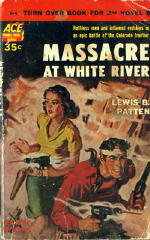
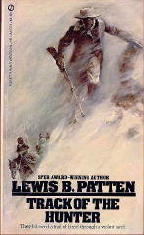
   Lewis B. Patten’s first book, Massacre at White River, came out from Ace in 1952, and his writing career continued right up until he died in 1981, when Track of the Hunter came out, also as a paperback original, this time from Signet.

   He was incredibly prolific. In a thirty-year span he produced something like 90 novels, including books as by Lewis Ford, Len Leighton (with Wayne D. Overholser) and Joseph Wayne (also in collaboration with Overholser).

   As one of the next generation of western writers, Patten’s all of novels came out very much in the post-pulp era but (as far as I know) also still all very much in the “code of the west” tradition. It’s certainly difficult to generalize on the basis of one book, and Prodigal Gunfighter is the only book of his that I’ve read in several years, and probably more than that.

   Not that Patten didn’t write for the pulps. Starting in 1950 he had a score or more shorter works that appeared in magazines like Mammoth Western, Thrilling Western, Frontier Stories and so on. His name is certainly more identified with novels, however, and in his heyday, he was cranking them out like almost nobody else.

   And he was published in hardcover as well. He may have begun in softcover only, but beginning with Guns at Gray Butte in 1963, more and more of books came out from Doubleday. Not all of them, but a high percentage of them, the easy explanation for this being that he probably wrote more books than Doubleday could publish.

   Take 1966 for example. He wrote No God in Saguaro and Death Waited at Rialto Creek for Doubleday; The Odds Against Circle L for Ace; and Prodigal Gunfighter for Berkley. Not that year, but in the same time period, he also wrote for Lancer and Signet, the latter eventually becoming his primary publisher in paperback, both for originals and reprints of the Doubleday novels.

LEWIS B. PATTEN

   If you want a slim and lean western to read, one that you will pick up and not put down until you’re done, then the 128 page Prodigal Gunfighter is the book for you. Taking place in the space of only a day in the small town of Cottonwood Springs, Patten certainly doesn’t leave the reader much time to breathe.

   The early morning finds the entire town down at the railroad station, waiting for the prodigal to return, in the person of the notorious home-grown gunfighter Slade Teplin. Included among them is a rather nervous deputy sheriff Johnny Yoder, who has been semi-courting Teplin’s wife, Molly, a school teacher who thought she could tame him, couldn’t, but who has not yet divorced him.

   Is he the reason for Slade’s return? Slade has had no contact with Molly since he left town. His father still lives in Cottonwood Springs, but there’s hardly any love lost between the two of them. Does he want revenge of some sort against the entire town? It is pure hatred? No one seems to know, and the sense of fear in the town is everywhere.

   And no one can do anything, including the law. In all but his first of many killings over the years, Slade has never drawn first. On page 91 Slade is briefly confronted by the sheriff:

    … Arch said finally, “So that makes it murder doesn’t it? It’s just like a rigged poker game where you know you’re going to win because you’ve stacked the cards.”

    “I always let the other guy draw first.”

    “Sure. Sure you do. You can afford to. Besides, it’s smart. It gives you immunity from prosecution. But you know, every time who it is that’s going to die. Like with Cal Reeder earlier today.”

LEWIS B. PATTEN

   Cal Reeder was a kid, the son of a wealthy local rancher, who thought he’d make a name for himself and failed. His father is part of the story, and so are the four drifters that Johnny notices having come quietly into town.

   Even at the short length the plot does not go exactly where it seems expected to do, and on pages 114-115 is one of the best choreographed fist-fights (not shoot-outs) I’ve read in quite a while, and it’s not even with Slade Teplin. He’s still on the loose, however – don’t worry about that – and with plans to cause even more havoc in Cottonwood Springs.

   To show you want I mean, though, here’s at least how the end of the fight reads:

    Johnny followed him over the desk-top and landed once more on top of him. The man was fighting with a silent desperation now, fighting for his life. Each blow he struck had a sodden, smacking sound both his fists and Johnny’s face were wet with blood. And he was tough. He was wiry and strong and no stranger to this kind of fight.

    But he lacked one thing, one thing that Johnny had – anger, righteous indignation and outraged fury. Johnny had those things in quantity. For every blow the stranger struck, Johnny retaliated with another, harder one.

    The man was weakening. They rolled against the glass-strewn floor to the window and back again. And at last Johnny felt the man go limp.

   After a few seconds taken to recover, Johnny knows he needs to make the man talk. From page 116:

    Johnny said softly, “You’re going to talk, you son-of-a-bitch, or I’m going to kick your head in. You understand what I said?”

LEWIS B. PATTEN

   He’s not bluffing. The west was a tough place to live, but Patten’s characters also seem to be tough enough themselves and equal to the challenge when they need to be. What’s more traditional than that?

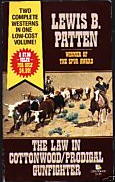
PostScript: Written later in Patten’s career is a book called The Law in Cottonwood (Doubleday, 1978). In paperback form from Signet and Leisure, it eventually appears packaged up in the same edition as Prodigal Gunfighter, two novels for the price of one. I don’t happen to have a copy readily at hand, so while I’m curious and it may not be very likely, I have no idea whether or not the later book has any of the same characters as this one.

— July 2005 (slightly revised)


[UPDATE] 09-06-08. First of all, my apologies for being unable to provide a cover image for the original Berkley edition of this book. I can’t get at my copy, and I can’t locate one anywhere else. There is only one copy for sale on abebooks at the moment, for example. Early Berkley paperbacks are often hard to find, more so than you might think, but their distribution through the 1960s was extremely erratic. (Believe it or not, I was looking for them then.)

   I posted this to fulfill a semi-promise I made in the previous post, in which Patten came up as an example of western noir writer. I didn’t write this review with that thought in mind, but at least from the quotes, I think you can gather that it’s a fairly tough-minded book. More than that I cannot tell you myself.

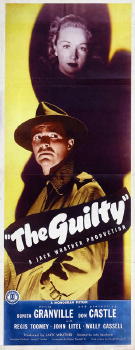
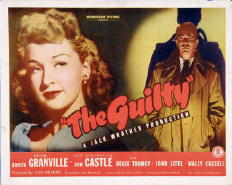
THE GUILTY. Monogram, 1947. Bonita Granville, Don Castle, Wally Cassell, Regis Toomey, John Litel. Screenplay: Robert Presnell Sr., based on a story by Cornell Woolrich. Producer: Jack Wrather. Director: John Reinhardt.

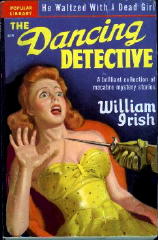
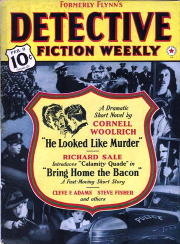
[WILLIAM IRISH – “Two Fellows in a Furnished Room.” Long novelette included in The Dancing Detective, Lippincott, hardcover, 1946; Popular Library 309, ppbk, January 1951. Originally published as “He Looked Like Murder,” as by Cornell Woolrich, Detective Fiction Weekly, 8 February 1941.]

WILLIAM IRISH The Dancing Detective.

   Some of the books on noir films like this movie quite a bit, but if I were writing one, the one I’d write wouldn’t be one of them. It’s a noir film all right – how could it not be, based as it is one of the originators of noir fiction, Cornell Woolrich?

   Poor production values, for one possibility, is the answer, and even more poorly conceived changes and/or additions to the story, both of which, in my opinion, occurred in the making of The Guilty.

   Woolrich’s story is long but compact, complete in itself, and full of his usual “things gone wrong in an everyday world” motif. One fellow of two sharing a room together asks the other to stay away for a couple of hours while his girl friend comes over. After Stewart Carr, the one who was asked to leave, returns – he’s also the one telling the story – the girl’s mother calls, asking where her daughter is.

CORNELL WOOLRICH.

   She’s disappeared, and when Carr’s roommate John Dixon begins to act more and more suspiciously, Carr tries to stay on his side, but he begins to find it more and more difficult to do so. This is the kind of mess you get into, suggests Woolrich in his role of author, when you start to hide things you needn’t, you panic, and all you end up doing is making the mess even worse.

   Fate, at nearly the last minute, steps in, however, before Dixon is picked up by the police and (more than likely) railroaded off to the death house. The friendship is over, of course, even though things worked out OK in the end.

   Woolrich’s stories are almost always a little over the top, some more than others, and this is one of them. It’s a little too short for a movie, even one only 71 minutes long, so of course some additional material has to be added.

THE GUILTY

   Some of what was done is understandable, or at least you can figure out why. I mentioned in the opening credits that Jack Wrather was the producer. In 1947, the same year that The Guilty was made, he and Bonita Granville, the star of the film, were married. And any story in which the only major female role is someone who dies in the first chapter is hardly a part for any leading lady to consider, married to the producer or not.

   Solution? Double the part by giving the girl who dies (Linda) a twin sister (Estelle) who’s as manipulative-of-men bad as the dead girl was good. More, to complicate matters – none of which appeared in the original story, of course – make Carr fall for the bad girl after she was dumped by the roommate for the good girl, who’s the one who died, with (as in the story) the roommate strongly suspected of doing the killing.

   I don’t recall ever seeing it, but in 1946, the year before The Guilty was made, Olivia De Havilland played a similar pair of good and bad twins in The Dark Mirror. Apparently one takes ideas wherever one can get them. Similar story lines probably occurred even before that, and probably several times over.

   In any case, it takes a while to sort things out – luckily the girls meet on the screen together only once, and after all, Linda leaves the film soon after anyway. What seemed awkward to me at the beginning, though, was the framing device of Carr coming to the bar around the corner from the room where all this happened, some six months later, waiting for a girl to show up – we don’t know who, of course, at the beginning.

THE GUILTY

   The purpose? To help extend the ending of the novelette to include a newly devised one. A twist, in other words, as to who the real killer was.

   And here’s where everything really does goes wrong. Retrofitting a new ending to a detective story – and that is exactly what this is – one in which the clues are already pointing to one person – simply can’t be done without a complete rewrite, in which case you may as well write a brand new screenplay and leave Woolrich’s tale out of it altogether. What’s done is done, but even so, Pfui is what I say to the new ending.

   One other thing. Jack Wrather is described as an oil millionaire, but he certainly didn’t sink any money into this movie. (In 1954 he bought the rights to The Lone Ranger, and later on Sergeant Preston and Lassie, eventually producing all three as television series.)

THE GUILTY

   But in 1947 the sets in The Guilty are bare bones to the max. Some observers suggest that this only heightens the noir mood of the film, emphasizing the bleakness of the characters’ fates.

   To some extent I can see what they’re saying, but when all you can see in the film are little more than solid but completely stagey sets, all I can say is another Pfui. (Regretfully. I do want to make that clear.)

   I guess I was wrong; there were two other things I meant to add a moment ago, not just one. Bonita Granville was only 24 when she made this movie, but she’d already had a long career behind her in making films. She was, of course, most well known for the four movies she made in her teens as Nancy Drew, girl detective.

   Girlishly buoyant and full of enthusiasm in the role, one she may have been perfect for, if she had not married Wrather, she may have had a even longer career playing “bad” girls in noir films such as The Guilty. I don’t believe this photo I found of her is necessarily related to her role in that movie, but if not, it’s close enough, and I think it will show you more what I mean than I can say in words.

   Unless one of the words is Huzzah!

   The time went by very quickly, as it always does. Paul Herman and I arrived in Dayton soon after 2 pm on Wednesday and he dropped me off at home yesterday around 5 pm. In between were many many hours of visiting with people I hadn’t seen since last year (except of course people I’d seen at the Windy City show only a few months before).

   No matter. Being able to talk at length with with people with the same nutty (um, specialized) interests as you do is always a pleasure. That and a special nod to Randy Cox and Walter & Jim Albert, whom whom Paul and I spent a lot of time outside the convention center (meals and bookhunting) as well as inside, it seemed all too soon before it was over and it was time to leave.

   Only the absence of my long-time friend Jim Goodrich, who was unexpectedly hospitalized the weekend before, took any luster off the proceedings. Get well soon, Jim!

   While the dealers room was full of pulp magazines, I managed an all time low in the purchasing any, and in fact it’s a number that’s impossible to surpass: none (after buying only one last year). The selection was fine, but as I perhaps explained earlier, my funds were low. Attendance was also low, but (in my opinion) not dangerously so, as the enthusiasm around the room seemed high.

   What I did obtain consisted largely of various reprints of pulp stories and novels in trade paperback. Print-on-demand is getting easier and easier to do all the time, and the results, more often than not, are very impressive.

   Without intending to slight other publishers whose efforts I intend to review and talk about later, as time goes on, here are two such examples:

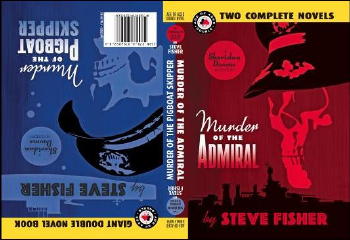
   From Age of Aces Press: A flip book with two early mystery novels by Steve Fisher: Murder of the Admiral (Macauley, 1936, as by Stephen Gould) and Murder of the Pigboat Skipper (Hillman-Curl, 1937). Both are cases for a chief detective for U.S. Naval Intelligence named Lieutenant Commander Sheridan Doome. (Follow the link for more information.)

STEVE FISHER

   Age of Aces Press specializes in air fiction stories that largely take place during World War I and soon thereafter, but I’m told that if there’s a military connection, they’d be interested in reprinting any kind of vintage detective or spy fiction as well. If you have any suggestions along these lines, I’d certainly be happy to pass them along to editor Bill Mann and art director Chris Kalb.

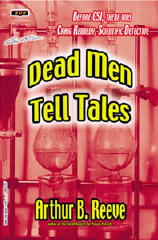
   From Black Dog Books: Dead Men Tell Tales, by Arthur B. Reeve, a collection of stories about Craig Kennedy, a scientific detective who was on the job long before either Patricia Cornwell or CSI came along.

CRAIG KENNEDY

   Much of Black Dog’s output consists of tales of high adventure, a la Talbot Mundy — whose body of work not so coincidentally they’ll be reprinting in total over the next few months, they being Tom Roberts and Gene Christie.

   Tom, by the way, and not so incidentally, was awarded this year’s Lamont award for his outstanding contributions to the hobby of pulp collecting. Another very popular choice!

   Guest of honor was SF writer Larry Niven, who never wrote for the pulps, since he began his career in the mid-1960s for the digest magazines, but whose work has always had (to me) the same sense of wonder the the SF in the pulp era had (and so seldom seems to have today). I had a short opportunity to talk to him, talking about mathematics, a field which we have in common, as well as his days writing for If, Galaxy and Worlds of Tomorrow. A fine gentleman.

   Back to pulps for a moment, if I may. Ed Kessell, a long time pulp fan and the one who put on the very first Pulpcon, back in 1972, died earlier this year. His sons brought a good portion of his collection to sell at their table and to put up for auction. Their table, before the doors were opened and sales could begin, was a sight to behold: stacks and stacks of rare and obscure pulps like Thrilling Adventure, All Star Detective, Clues, Dime Detective and many more. I wish I’d had a camera. They sold very quickly.

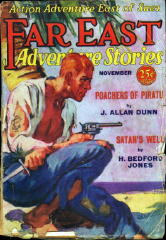
   The cream of the cream was reserved for the first night’s auction, however: a scattered run of Far East Adventure Stories which sold individually for quite remarkable prices, but not to me.

FAR EAST ADVENTURE

   Ah yes, the stuff dreams are made of.

AUSTIN J. SMALL – The Crimson Death.

Lead novel in the pulp magazine Detective Classics, March 1930.

   Austin J. Small is not a name well-known in mystery circles today, and all I knew about this story before I started reading it was the typically pulpish lead-in blurb: “Terror stalks at Gairlie” — with all that conjures up about ghosts, haunted castles and the like, but not — as a first impression — as being a “classic.”

AUSTIN J. SMALL

   But then the Gairlie Rubies are stolen, from a sealed room under observation at all times, and could it be? A locked room mystery that no one else knows about? Is Small going to play it straight? Can he be trusted to play fair with the reader?

   The investigation goes on, and doubts begin to creep back in. The Crimson Death strikes, and the first victim is a maid, slain in the library by an invisible killer that streaks her dress with red. Detectives from Scotland Yard are called in — but obviously they’re not at all familiar with anything close to resembling standard police procedural techniques. It’s not enough that the wrong questions are asked, but the answers they do get are often not revealed. Hopes fade fast.

   Am I revealing too much, considering the general non-availability of this particular work, to say that Small is more interested in writing science-fiction than an utterly fair detective story? Still, in spite of the frustrating nature of the incompetent investigation, and in spite of the dumb obstacles placed in the way of true love, there is a modicum of quaint naivete to go with the many pulp styled thrills and chills, thus making this sinister mystery not a complete failure.

   It comes close, though.

— From The MYSTERY FANcier, Vol. 3, No. 2, Mar-Apr 1979       (slightly revised).


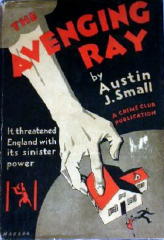
[UPDATE] 07-08-08. I’ve always assumed that this was the magazine version of one of Austin J. Small’s several crime and mystery novels published in hardcover, sometimes under the pen name of “Seamark,” but now that I have the means of checking into it more thoroughly, this is apparently not so.

   Which also means that in terms of an appropriate cover image, I’m stumped, for the first time in a long time. In its place, I have an inappropriate one, but it is one in my collection by the same author, and it appears to be the same kind of science-fictional overlap with the world of detective fiction. I’ve never read it, so I could be wrong, and don’t hold me to it.

   I no longer even have a copy of the magazine I read this story in. I must have traded it off for something I thought I’d rather have at the time. Little did I know then that I would need it now.

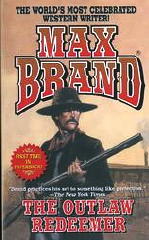
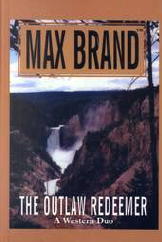
MAX BRAND – The Outlaw Redeemer.

Leisure; paperback reprint, March 2004. Hardcover edition: Five Star, 2000.

MAX BRAND The Outlaw Redeemer

   In one way or another, most traditional westerns have elements of crime fiction inherently built into their plot structure, and naturally I wouldn’t have brought it up if both of the short novels in the case at hand, The Outlaw Redeemer, did not abundantly qualify, but in different ways.

   In “The Last Irving,” which takes place in the more recent Old West – there is electricity in Irvington, and the characters drive proudly around in flivvers – the heir to the non-existent Irving fortune, a city yokel by the name of Archibald, returns from the East to revenge himself on the two crooks who conned his Uncle Ned out of his life’s savings. This a standard tall tale of a (perceived) dumb sap who (it is anticipated) comes out on top by the simple expedient of setting his two opponents one against the other.

   While there is more anticipation than there is follow-through, I can’t imagine anyone not finding the ending at least mildly satisfying.

   The title story, “The Outlaw Redeemer,” comes with some unexpected surprises, however, making it by far the more enjoyable one of the two.

   The opening is nothing more than Biblical in nature, with lots of “begat”s that trace the lineage of the tale’s two antagonists, the pure in heart John Tipton, who becomes a Texas Ranger whose constant quarry is the brutish and devilish criminally-minded Hubert Dunleven, nicknamed either Shorty or Bunch, “both of which were derived from his physical peculiarities.”

   Their efforts directed against each other are the stuff that legends are made of – can a western ever be called utterly charming? Dunleven is that rarest of beings, an outlaw with a silver tongue. Take for example, this speech he makes to the beautiful Nell – oh, yes, there is a girl, and of course she comes between them. But first, from page 118, after he has requested that she make breakfast for him, a request she cannot refuse:

MAX BRAND The Outlaw Redeemer

    “For instance,” he [Dunleven] explained, “there are your hands. Hands have an eloquence all their own. Your small brown ones, for example, have never before served a meal to a hungry man without enjoying their work. They have been gay and swift and tireless. They have carried dishes to every hungry table with a certain charming eagerness. And it has been a sad thing to sit here and to watch those hands working like slaves, heavily, joylessly, dragging themselves along.”

   Nell is not, however, emphasis not, your usual western heroine. As the two male protagonists of the tale, she also is flawed, and I confess – I admit it – I did not know, with several chapters remaining to go, which way the story was going to come out.

   That is it a happy ending, you may rest assured. You may be assured that you will not know in which way it will end happily, but it will.

— May 2004


PostScript:    Both of the these stories first appeared in the pulp magazine, Western Story. “The Last Irving” appeared as “Not the Fastest Horse,” as by John Frederick in the November 7, 1925, issue; and “The Outlaw Redeemer” appeared as “The Man He Couldn’t Get,” as by George Owen Baxter in the February 27, 1926, issue.

   In some substantial way, I like the original titles better.

REVIEWED BY WALTER ALBERT:         


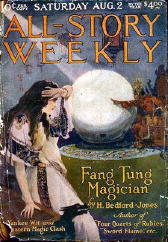
H. BEDFORD-JONES – Fang Tung, Magician. Detroit, MI: Beb Books, 2007.

BEDFORD JONES - Fang Tung

   This oriental thriller by a prolific and popular pulp writer was originally published in the All-Story Weekly issue for 2 August 1919. Brian Earl Brown, the entrepreneurial chap behind Beb Books, specializes in cheap reprints (the text, in stapled wraps) that he was selling at the table opposite mine at Pulpcon last year.

   This entertaining novelette, about a Chinese messianic magician who wants to chase all foreigners out of the country, in its often careless style betrays the pressure under which pulp writers worked, but the writer’s imagination carried this reader over the rough spots.

   Bedford-Jones was no Sax Rohmer, but he’s working somewhat in the same vein, and the combination of a charismatic villain, a pure and feisty heroine, and an adventuresome journalist is a winning one here. And the $5 price was just right for this minor adventure thriller.

« Previous PageNext Page »