Pulp Fiction


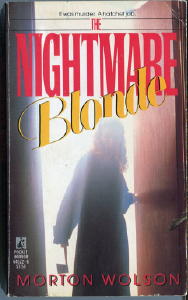
MORTON WOLSON – The Nightmare Blonde

Pocket, paperback original; 1st printing, April 1988.

   This book escaped a lot of notice when it came out, or at least that’s what I strongly suspect. Reading just the cover and the blurb at the top – “It was murder. A Hatchet Job.” – I think the average reader would have thought that this was just another horror novel of the blood and gore variety, both of which were very popular at the time. Nor would the name of the author have meant anything to anybody.

   But what if I told you that Morton Wolson was the real name of 1940s pulp writer Peter Paige, creator of the private detective Cash Wale? Or at least I think that Wale was a PI, but I may be wrong and someone will have to tell me.
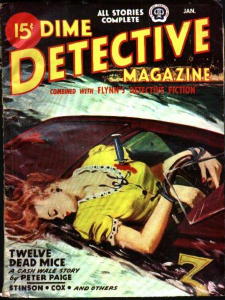
Paige: Pulp

   In any case, Peter Paige wrote a slew of detective stories for magazines like Black Mask, Detective Fiction Weekly and Dime Detective – mostly the latter, I believe – until disappearing from sight about the same time as most of the pulps died, in the early 1950s. Most of them were, by all accounts, fairly ordinary. Paige is a not a name which comes to many people’s mind when it comes to pulp detective fiction. Myself, I know the name, and I know Cash Wale, his primary series character, but as far as any single story is concerned, I can’t think of a single plot line, I have to say, and reluctantly so as I do.

   When I asked veteran researcher Victor Berch to see what he could come up with as far as either Paige or Wolson was concerned, he did his usual amazing sleight-of-hand and came up with a couple of interesting items. In the Los Angeles Times of January 7, 1946, there was a short item with the following headline: Writer, Held for Beating Wife, Says She Beat Him:

   Morton Wolson, 32, detective story writer under the name of Peter Paige, was in the San Pedro Jail yesterday facing a charge of wife beating… Mrs. Wolson [Ruth, age 23] charged that he husband struck her in the face during an argument… Wolson, in jail … denied the charges and declared that he was merely trying to defend himself.

   Accompanying the article, not much longer than the excerpt above, are separate photos of both Wolson and his wife, who is shown feeding their baby with a bottle. (The headline of the item that follows on the same page is: Jeanne Crain and Mother Reconciled.)

   Besides the work he did for the pulps as Peter Paige, Wolson had two stories published under his own name. The first one appeared in the January 1954 issue of EQMM, a tale entitled “The Attacker,” and a little bit later, “The Glass Room,” was published in the September 1957 issue.

   Wolson’s output may have been small under his own name, but “The Attacker” was good enough to be selected in David C. Cooke’s annual Best Detective Stories of the Year anthology for 1954, and more than that, to be picked up again by Allen J. Hubin’s Best of the Best Detective Stories: 25th Anniversary Collection in 1971. (Al did not remember this fact while he and I were corresponding a short while ago about Wolson, until I pointed it out to him.)

   There is one entry for Wolson on www.imdb.com. A story he wrote was the basis for “Prime Suspect,” an episode of Jane Wyman Presents the Fireside Theater, telecast on 27 February 1958. A gent named Steve Fisher did the adaptation, and an actress named Nita Talbot appeared in it, whom I thought was tremendously good-looking at the time; the leading role was played by William Bendix, whom hardly anybody thought was good-looking at any time. Where the story may have been published earlier remains unknown.

   The next time Victor came across Wolson’s name in a newspaper was in the New York Times for March 29, 1970, in an advertisement for a special “Manager’s” sale being held by Furniture-in-the-Raw, an outfit with five stores in the New York City area. I’ll quote the relevant detail:

   Our Queens store mgr. Morton Wolson says “If it doesn’t sell at these prices it can’t be sold.”

   Nothing more seems to have put Wolson in the news or in any sort of spotlight until the publication of The Nightmare Blonde in 1988, and then, as I alluded to earlier, the book seems to have come and gone without much notice. At the moment there seems to be two copies available on the Internet, one from Alibris in the $3.00 range, and one from England in the $30 range. It is dedicated to his wife Gaye, so it is clear that the earlier one did not last.

   But before getting to the main event, perhaps you’ve started to wonder. Wolson was born in 1913 (making his age as reported in the LA Times correct), and he died in 2003. You also may be beginning to wonder about this book he wrote in 1988, when he was 75, and whether it is any good or not.

   My answer, in a word, is “yes,” but if I may, I’d also have to say that it’s a qualified response, and I’ll get to that soon. Remember now that it was marketed as a horror novel, which in a strong but not overpowering sense it is, as the murder to be solved is that of a family of four, killed by someone with a very sharp axe.

   But what it really, really is, when you really get down to it, is a detective novel in a very traditional sense. It’s also a tough, middle-class sort of novel, and hard-boiled at about the same level as, for example, a Ross Macdonald novel, not to forget to mention that it’s quite definitely noirish in a way as well.
Wolson

   Let me explain that last sentence right away. Dan Warden, the leading character, is the former chief of police in Oregon City, a town somewhere along the Pacific Ocean where the story takes place, who had recently been fired for beating up a newspaper columnist’s nephew and being chewed out in print by that very same newspaper columnist. After coming out of a 24-hour drinking binge, about which he remembers nothing, he discovers that it is (no surprise here) the newspaper columnist who has been murdered, along with the three remaining members of his family.

   Which makes Dan Warden the number one suspect, no matter how close his friendship with the police commissioner is. At the same time as Warden is discovering how badly his life has been suddenly turned upside down and inside out, he makes a friend – saving her life, to be precise, as she (a blonde) tries jumping off the end of Fisherman’s Wharf, but miscalculating badly as she does so. Allow me to insert a long quote right about here, taken from pages 17 and 18:

   “I’m really all right,” she said. “The problem was not being able to talk it out. There was nobody I could really talk to. I had to keep it inside me. Like a nightmare that wouldn’t leave me alone. Do you know what I’m trying to say?”

   “Sure,” Dan said, his arm around her waist, urging her along. For the first time he realized that she had a slender, almost lithe, waist, and he felt a tug of sexual excitement, followed by a flush of shame that he should even note such a thing in this vulnerable woman. “I know,” he said. “It’s like you couldn’t get out of the mirror.”

   They were moving very slowly. She put her face against his chest and through the fabric said, “Do you know what it’s like to be two people? I mean two separate people — and one doesn’t know what the other is thinking or doing except in dreams now and then, and you don’t understand the dreams?”

   “I know all about it,” he told the droplets in her blond hair.

   Her eyes probed his.

   “Don’t joke with me, please!”

   “Scout’s honor,” he said, urging her toward Bayfront Street. “Me, I just had a twenty-four hour memory gap. And while I can remember staring at myself in a lot of bar mirrors, and awakening once on a strange back porch the other side of town, and seeing a sudden blinding flash of light, and walking several hundred miles through this rain, I have no idea where I left my hat or coat or parked my Chevy, or who I punched, or who punched and scratched me. I have not even the dimmest idea of even seeing the man I’m supposed to have either punched to death or killed with a hatchet.”

   Kay Mullins (that’s her name) has had psychological problems dealing with children in the past, and now two of them are dead, and the reason for emphasizing that she is a blonde, as I did a just a moment ago, is that several blonde hairs have been found at the scene of the murders.

   It takes Dan most of the rest of the book to investigate the crimes while trying to stay ahead of the new police chief, who still considers him to be his primary suspect, while keeping Kay stable and discovering just how many blondes just happened to be in and around the area of the victims’ home, including Kay herself.

   Part of the investigation includes visiting a camp of the local branch of the White Knights of America and at least three brothels of increasing degrees of sophistication, and some low spots as well. It’s a tough, rough story at times, and while it tends to start rambling a little, it still provides about four hours of pure entertainment, or at least it did for me, flawed only – here comes a qualifier – by the inescapable unlikelihood of one too many fairly uncommon events, all happening at the same time and in the same place.

   But while the laws of probabilities, still enforced in every state in the union, say that the juxtaposition of so many blondes in one focal point of chaos, could not and should not have happened, what Wolson does is not easy. He makes the book flow well enough, and smoothly enough, that you (the reader) don’t (and can’t) stop to think about it while you’re in the process of reading, and read it you will.

   As the identity of the killer becomes increasingly clear, and Wolson does a more than creditable job in disguising the solution to the murders for as long as he can – and even longer than he had a right to, truth be said – the chills begin as well, intellectually as well as (without trying to give anything away) deep down inside the reader’s bones somewhere.

   Nor is the book over even then. For noir fans everywhere, lift a glass to a pulp writer past. This one’s for you.

— written in September 2006

UPDATE: Victor Berch has come up with some more information on Wolson’s life. Why don’t I simply let him have the floor:
    “About the only thing I can add are some vital statistics: Morton Wolson was born the son of Joseph and Zina Wolson on June 9, 1913 in New York. He died January 4, 2003 in Laguna Hills, CA. Might have been living in Mission Viejo as that seems to be the latest phone record. At the time of his death, he was married to a woman named Gaye (last maiden name unknown). She was born February 1, 1927 and died Aug 30, 2005. It is highly possible that Morton was not his original name as he is listed in the 1920 US Census as Mortimer. He may have thought that was too sissified of a name and decided to call himself Morton, which is the name he used for Social Security purposes. Oh, his parents were immigrants from Russia. He also had a brother, Robert.”

         Bulwer-Lytton Fiction Contest

         2006 Results: Overall Winner

   Detective Bart Lasiter was in his office studying the light from his one small window falling on his super burrito when the door swung open to reveal a woman whose body said you’ve had your last burrito for a while, whose face said angels did exist, and whose eyes said she could make you dig your own grave and lick the shovel clean.

               Jim Guigli
                  Carmichael, CA

         —

   A retired mechanical designer for the Lawrence Berkeley Laboratory is the winner of the 24th running of the Bulwer-Lytton Fiction Contest. A resident of the Sacramento suburb of Carmichael, Guigli displayed appalling powers of invention by submitting sixty entries to the 2006 Contest, including one that has been “honored” in the Historical Fiction Category. “My motivation for entering the contest,” he confesses, “was to find a constructive outlet for my dementia.”

   An international literary parody contest, the competition honors the memory (if not the reputation) of Victorian novelist Edward George Earl Bulwer-Lytton (1803-1873). The goal of the contest is the essence of simplicity: entrants are challenged to submit bad opening sentences to imaginary novels. Although best known for “The Last Days of Pompeii” (1834), which has been made into a movie three times, originating the expression “the pen is mightier than the sword,” and phrases like “the great unwashed” and “pursuit of the almighty dollar,” Bulwer-Lytton opened his novel Paul Clifford (1830) with the immortal words that the “Peanuts” beagle Snoopy plagiarized for years, “It was a dark and stormy night.”

Hi Steve

Can you tell me whether your MR. CLACKWORTHY volume from Wildside contains any tales not collected in the two Chelsea House volumes of the 20’s? I have one of them but not the other.

Best wishes for 2007.

Doug Greene
>>>

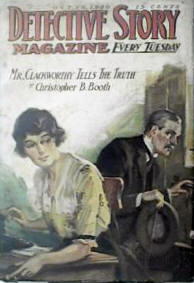
This may be more than the rest of the world wants to know, but after I wrote a review of the first Mr. Clackworthy collection, word got around, and I somehow became known as the expert on the character, who was created by Christopher B. Booth and who first appeared in a long series of stories for Detective Story Magazine. Little did anyone know that the stories in Mr. Clackworthy (Chelsea House, 1925) were all that I knew about the fellow, a gentleman con man who preyed on unscrupulous bankers, stockbrokers and other chiselers, thereby striking a certain chord in the hearts of thousands of readers in the Depression era. The stories were quite popular.

Mr. C

But the limited knowledge that I had certainly did not prevent me from being asked to provide the introduction to the recent Wildside collection of Clackworthy adventures — nor prevent me from accepting for that matter, either.

Which of course obliged me to not completely fake it. Even after the Wildside book was published, I continued to hunt around to find as much information as I could come up with. I have the first and third of the three volumes below, but not the second. The stories in the first of the two Chelsea House books are not identified by name. It’s what’s called a fix-up novel: a collection of stories combined into what is called a novel, but is, simply speaking, a collection of stories combined into a novel, some related to each other, others not.

I suspect, but do not know for sure, that the second Chelsea House collection is structured the same way. For the titles of the stories in both books, I am indebted to Gordon W. Huber’s Chelsea House: A Bibliography (June 2001), with the relevant data sent on to me by Don Davidson. For the first book, I matched the story lines with the titles that Gordon listed, his data coming directly from the Street and Smith files located at Syracuse University. (Street and Smith was the publisher of Detective Story Magazine, among tons of other pulp magazines and dime novels over the first half of the past century.)


THE MR. CLACKWORTHY STORY COLLECTIONS:

All of the stories below originally appeared in Detective Story Magazine. There has been no attempt to ascertain which Mr. Clackworthy stories have so far not been collected.

In the first collection, there is one more story than I can match up with a title. Two of the titles have been established by guesswork only, as indicated, and even so, all of the matching should be considered questionable.


MR. CLACKWORTHY
Chelsea House, hardcover, 1925.

Chapters 1-3. The Million Dollar Air Bag. March 9, 1920

Chapters 4-7. Blasted Reputations. March 23, 1920

Chapters 8-10. Painful Extraction. April 27, 1920

Chapters 11-13. The Comeback. May 11, 1920

Chapters 14-20?? Mr. Clackworthy Stakes a Friend. September 28, 1920

Chapters 21-24. Mr. Clackworthy Tells the Truth. October 19, 1920 (a)

Chapters 25-26. [unknown story title]

Chapters 27-28?? A Modern Lazarus. March 30, 1920

Chapters 29-32. Mr. Clackworthy Digs a Hole. July 16, 1921

(a) Contained in the Wildside collection below.


In the second collection, the following titles have been identified. They may not appear in this order in the book, which I have not seen.

MR. CLACKWORTHY, CON MAN
Chelsea House, hardcover, 1927.

Mr. Clackworthy Forgets His Tonic. January 14, 1922

When Mr. Clackworthy Needed a Bracer. January 21, 1922

Mr. Clackworthy and the Auto Rim. January 28, 1922

Mr. Clackworthy Sells a Gold Brick. March 25, 1922

Clackworthy Coddles a Contract. June 3, 1922

Mr. Clackworthy Pays His Income Tax. June 9, 1923

Mr. Clackworthy Takes a Dip in Rye. June 30, 1923

Mr. Clackworthy Tips a Teapot. April 19, 1924


In this latest collection, there seems to be only one overlap with either of the earlier ones.

THE ADVENTURES OF MR. CLACKWORTHY
Wildside Press. Hardcover & Trade Paperback, 2006.

Mr. Clackworthy Tells the Truth. October 19, 1920 (a)

Mr. Clackworthy Within the Law. August 13, 1921

Mr. Clackworthy’s Pipe Dream. March 11, 1922

Mr. Clackworthy Turns Chemist. December 17, 1921

Mr. Clackworthy Digs a Hole. July 16, 1921 (b)

Mr. Clackworthy Revives a Town. September 24, 1921

Mr. Clackworthy Sells Short. February 26, 1921 (b)

Mr. Clackworthy’s Pot of Gold. October 7, 1922.

(a) Appeared in the first Chelsea House collection. The story is also available online.

(b) The dates are in error as given on the copyright page. The ones given here are correct.

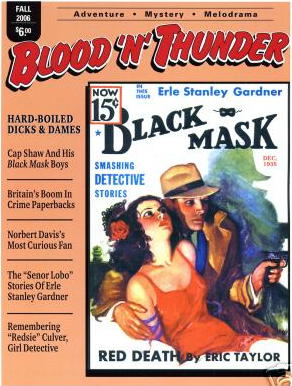
      Blood ‘n’ Thunder magazine is published more or less quarterly by Ed Hulse, and every issue seems to be better than the one before. This is a matter of perspective sometimes, and you may have to take into account that Ed’s coverage includes more than crime and mystery fiction, if that is all that is of interest to you. An overall statement found under the title on the first page reveals the magazine’s purpose a little more fully: Adventure. Mystery. Melodrama.

     Or maybe the title, Blood ‘n’ Thunder, says just about that as well, and wherever the above can be found, the pulps, the movies, chapter serials, old-time radio or the equivalent, Ed, his staff of several, and his crew of writers of many, will be there.

     But this issue is focused on the detective pulp magazines, and perhaps most on the best of them all, Black Mask.

bnt 16

     First up is Monte Herridge, writing about one of the many, many series characters who appeared in the pages of Detective Fiction Weekly: Senor Lobo, soldier of fortune. The author? If you are not well versed in matters pulpish, the answer may surprise you: Erle Stanley Gardner, best known of course as the creator of Perry Mason. Before Perry became an overnight success in the world of hardcover mystery fiction, Gardner produced tons of magazine stories about the adventures of men like Sidney Zoom, the Patent Leather Kid, Lester Leith and a host of others.

     Monte’s suggestion is that Leslie Charteris’s “The Saint” was a model for Senor Lobo, and I’d have to have read more of the latter’s exploits myself before I could agree. But if Monte has read them, and he says it’s so, then neither would I disagree, not one inch.

     I’d like to have seen a checklist of the Senor Lobo stories, which appeared between 1930 and 1934, but other than that, Monte’s flair for describing them makes the article second best only to reading the tales themselves.

     Ed Hulse himself contributes the next piece, one on the series of girl reporter Torchy Blane comedy-mysteries that turned out by Warner Brothers in the late 30s and early 1940s. Starring in most of them was the inimitable Gloria Farrell, and coincidentally enough, over the last week or so I’ve been watching many of them on a video tape that I made a while ago from Turner Classic Movies. They turn up every so often there, and when they do again, don’t miss them.

     What most people don’t realize, unless they — like you and I — well, I know about me, but I can’t be so sure about you — actually read the credits, is that Torchy Blane was based on a character from the pulps, and that the character from the pulps that she was based on was a man, a fellow named Kennedy, whose tales were told in Black Mask by one Frederick Nebel.

     Only the first of the Torchy Blane movies was taken from an actual pulp story, and that was the first one, Smart Blonde. My own opinion is that was the best one, containing more as it did actual crime detecting than it did humor, although the latter definitely was present. And humor became even more present as the series of movies went on.

     A double-starred feature is next for this issue, an interview of Joseph T. Shaw, editor of Black Mask in its heyday, taken from the pages of Writer’s Digest, October 1929. Shaw’s statement of what the magazine was looking for, and the ingredients that in his opinion made the magazine successful then, makes for fascinating reading today.

     Perhaps the most knowledgeable pulp historian around today, Will Murray is next, with an article on Grace Culver, a female sleuth whose stories are hard to find today, appearing as they did in the now highly collectible Shadow magazines, beginning in 1934 and continuing through 1937. Her exploits appeared under the byline of Roswell Brown, but Will’s research shows that the stories were really written by pulp author Jean Francis Webb. Another checklist might have been in order, but I’m only quibbling. A little.

     Whew. I’m only halfway through this issue. Next Alfred Jan contributes a companion piece to one written by Josef Hoffmann which appeared on the original M*F website a short while back. The subject of each is the connection between pulp writer Norbert Davis and famed philosopher Ludwig Wittgenstein. Alfred’s piece is more on Davis’s novels about Doan and Carstairs — the former a hard-boiled detective, the latter his Great Dane companion — than it is the pulps, but that certainly does not make it any less worth reading.

     Up next is Gary Lovisi, long-time publisher of Paperback Parade, who salutes the British gangster digests of the late 1940s and the 1950s. Authors such as Hank Janson, Roland Vane, Stephen Frances, and Darcy Glinto are prevalent in this piece, illustrated profusely by the covers of their books, which are probably as much the reason for their collectibility today as their contents. Unfortunately these covers are only in black and white. If they were in color, they would really knock your eye out. [For more on Darcy Glinto, aka Harold Kelly, and his long involved story and subsequent bibliography, do not miss John Fraser’s mammoth website devoted to the gentleman.]

     Closing up this issue, and perhaps saving the best for last, is a long article by the late E. R. Hagemann (reprinted from Clues magazine) about Cap Shaw, the aforementioned editor of Black Mask, and the process under which the stories for The Hard-Boiled Omnibus (Simon & Schuster, 1946) were chosen. It wasn’t easy. If you are a fan of hard-boiled fiction — and its authors — this is absolutely must reading.

     And so is the entire issue. Following the link at the top should be the easiest way to get a copy. I suggest you act quickly, though, as Ed sometimes runs out.

« Previous Page