Magazines


   A brief introduction from me seems to be in order. What follows below was originally a comment left by Keith Chapman (in his alter ego guise as Chap O’Keefe) following my recent review of Edgar Wallace’s The India-Rubber Men. I thought what he had to say informative and interesting enough for me to create a brand new post out of it. And so here it is.

— Steve


EDGAR WALLACE MYSTERY MAGAZINE

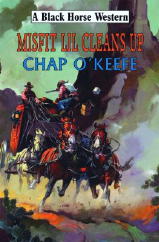
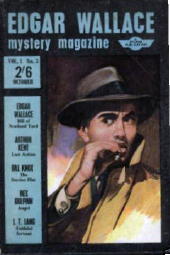
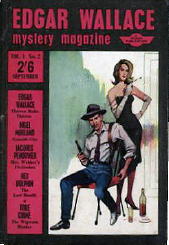
   A fascinating thread! As has been observed, Edgar Wallace was a very big name in thriller fiction in the 1920s and ’30s, but he was not, of course, part of the Golden Age of Detection, which makes comparisons with Christie — even Symons — in many ways inappropriate. Wallace was still a big name after the Second World War and right up to the 1960s, when I founded and edited the Edgar Wallace Mystery Magazine. At that time, his books and stories were already regarded as having a quaint flavor, which a daughter, Penelope Wallace, was largely responsible for trying to remove by supplying publishers with revised versions.

   Such revisions are, of course, an ultimately futile exercise and may even remove future points of appeal — something I realized even then though I was only 21 years of age. For the short time I ran the magazine, I concentrated on the “action” end of the mystery field, running the kind of stories Americans would have called “pulp fiction” and which I believe were written by authors who were worthy successors of Wallace himself. I also used full-color, vigorous pictorial covers that reflected this content.

EDGAR WALLACE MYSTERY MAGAZINE

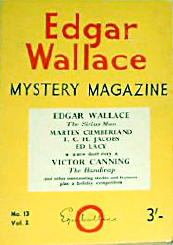
   Ultimately, the publishing company running the magazine — and employing me as the editor of it and a raft of digest-size “pocket libraries” — ran into financial difficulties and the Wallace family took over the magazine. I was replaced by a “more experienced” editor: elderly writer Nigel Morland who was said to be a family friend, and as a contributor to the magazine had previously flattered me with consistently favorable comment on my editorial work and policies.

   The illustrated covers were replaced by wholly typographical, two-color covers that at best were a poor imitation of Ellery Queen’s. The content changed, too, certainly abandoning what I considered the true Wallace tradition in preference for material that had more of a “whodunit,” intellectual slant.

   From the online FictionMags Index:

Edgar Wallace Mystery Magazine

Publishers
      Aug-1964 – Nov-1964: Micron Publications, Micron House, Gorringe Park Avenue, Mitcham
      Dec-1964 – Jun-1967: Edgar Wallace Magazines Ltd., 4 Bradmore Road, Oxford
      1969? – 1970?: Edgar Wallace Magazines Ltd., 50 Alexandra Road, London SW19

Editors
      Aug-1964 – Nov-1964: Keith Chapman
      Dec-1964 – Jun-1967: Nigel Morland
      1969? – 1970?: Leonard Holdsworth, Kurt Mueller & James Hughes

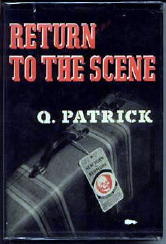
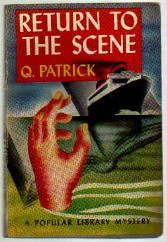
Q. PATRICK – Return to the Scene.

Books, Inc.; hardcover reprint, March 1944. First edition: Simon & Schuster/Inner Sanctum, 1941. Paperback reprint: Popular Library #47, ca. 1945. Serialized previously in The American Weekly as “The Green Diary.”

American Weekly

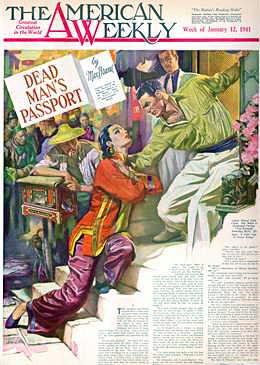
   I don’t know how long this website will stay up, but it presently contains loads and loads of the beautiful (if not exquisite) artwork that filled the covers of The American Weekly in its heyday. While the examples are all from 1918-1943, the magazine, a Sunday newspaper supplement for the Hearst chain, continued on through the years until the title changed to Pictorial Living in 1963, then folded for good in 1966. (Information obtained from Phil Stephensen-Payne’s magnificent Magazine Data File website.)

   Which is not relevant to anything more than the fact that this novel by Q. Patrick first appeared there, nothing more, but you really ought to see those covers.

   (I couldn’t resist. The one shown here is from 1941, the artist Joe Little, and as you see, one of the authors who had a story in that issue was Max Brand.)

   As for Q. Patrick, there is no way I am going to try to completely untangle the web of real names that lie behind that pen name and that of Patrick Quentin (and Jonathan Stagge). Suffice it to say that Return to the Scene was the result of the primary two collaborators who used that pseudonym, Richard Wilson Webb and Hugh Callingham Wheeler. On other Q. Patrick titles, Webb had as partners, at various times, Martha Mott Kelley and Mary Louise Aswell — pairwise, mind you, not in triple tandem.

   It is interesting to note that Mary Aswell’s two efforts with Webb took place in 1933 (S. S. Murder) and 1935 (The Grindle Nightmare), and her single solo effort did not appear until 1957 (Far to Go).

   As for Patrick Quentin (and Jonathan Stagge), we’ll leave any discussion of who they were (and when) for another time, but as well known as practitioners of the Golden Age variety of detection, none of the various aliases, nor their books, are very well known today.

   Nor of course is Quentin/Patrick alone in this category. The rise and fall in popularity of various authors over the years is a subject that is likely to come up often in these pages in the days to come. Why, for example, are Agatha Christie’s books so timeless, and Borders has nothing on the shelves by Ellery Queen or Erle Stanley Gardner, and only a handful of titles by Rex Stout? John D. MacDonald’s books may be in print, but only from Amazon. I’ve not seen them on any actual bookstore shelves, new, in quite a while.

   Not that answers are likely to be very forthcoming and/or definitive, but the question at least will be something that will turn up in one of these review/commentaries every once in a while.

   Case in point. Return to the Scene, by Q. Patrick. Is it a book very likely to be published today? Answer, possibly, but not by a major publisher. Maybe by a small independent publisher like the Rue Morgue Press, which specializes in reprinting classic (and obscure) mysteries from the Golden Age, of which Return to the Scene is obviously one — and if you have gotten this far into this (which eventually will turn into a review), you really should be supporting them, and if you aren’t, then shame on you — or one of those publishers that specializes in large print editions for libraries, under the obvious assumption that only older people who can’t see so well any more will have any interest in reading them any more.

Q. PATRICK Return to the Scene

   It starts out like a romance novel — this is now the review — with Kay Winyard rushing to back to Bermuda to stop her niece from marrying the man she once thought she was in love with, before she discovered what kind of man he was and walked out on him. And in her purse is her weapon, a diary. A very revealing diary written by the woman who did marry him, in spite of Kay’s warning, and who subsequently killed herself because of him.

   It very quickly becomes instead a murder mystery, however, and there is no surprise to learn who the victim is. The rich, the powerful Ivor Drake, who is soon also very dead. And with a huge house of possible suspects, all of whom (it is also quickly discovered) had reasons to wish him that way.

   The police investigate, and for one reason or another, no one tells them the truth. Alibis are created out of happenstance and convenience. Every one has their own package of facts that they do not wish to be known, and webs of intrigue and would-be (and only reluctantly admitted) love affairs make learning the complete truth next to impossible even for Kay, who is an insider, much less Major Clifford, the ultimate outsider.

   Here’s a long quote from pages 116-117. It begins with Terry talking to his sister, Elaine. Elaine is the girl whose marriage Kay came back to Bermuda to stop:

    “And I’ll go on telling that story to the police. You know I’ll do everything for you. But it can’t be this way between us. I’ve got to know what you were doing tonight.” He paused and then said in a tight, husky voice: “I can’t go on like this, wondering if you killed Ivor, not being sure.”

Q. PATRICK Return to the Scene

    “Killed Ivor!” Elaine have a sharp little laugh that was like a sob. “You and Kay! Why do you keep on saying that I killed him? Why would I have wanted to kill him? You don’t even know if he was murdered. It’s just Major Clifford, something crazy he said. It isn’t true. It’s all a terrible nightmare and we’re going to come out of it.”

    “It isn’t a nightmare, Elaine. It’s real. And there’s no hope for us unless we tell each other the truth.”

    “But what can I tell you when — when I don’t know anything?”

    Brother and sister were staring at each other with a cold, desperate intensity.

   Alliances are built, along with the stories the players tell the police, then collapse, and bit by bit the truth gets put together like a gigantic jigsaw puzzle. Delicious! There are clues aplenty, and the alibis so spontaneously constructed eventually cannot stand up under the pressure, and they begin to fall apart. Not one of the alibis, as it happens, is any good.

   The ending is disappointing, a little, but this (it seems to me) is what almost always happens. The explanation is so mundane, so unworthy, so why-didn’t-I-think-of that, but only, you realize, in comparison to the mystery itself.

   Another problem is that when the victim is so dastardly as this one is, one hates to see anyone found guilty of the crime, although of course someone must be, and in the end, all of the pieces fit together. (At least without a careful re-reading, all the way through, they do.)

   Not a classic, but in the Golden Age, even the non-classics came close.

— October 2005


PostScript: A preliminary checklist of titles in the Books, Inc., line of Midnite Mysteries, of which this book is one, can be found by following the link provided.

FIRST YOU READ, THEN YOU WRITE
by Francis M. Nevins

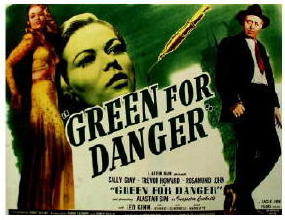
   The centenaries have come thick and fast lately: Woolrich in 2003, Fred Dannay and Manny Lee in ‘05, John Dickson Carr last year. Now we celebrate one of the great masters of English detective fiction, Christianna Brand. She was born Mary Christianna Milne in Malaya – on December 17th of, as if you hadn’t guessed, 1907 – began writing whodunits a couple of years after the start of World War II, and is best known as the author of Green for Danger (1944), a classic of fair-play detection set in a military hospital in Kent during the Blitz.

   I got to meet her when she was around 70 and quickly discovered that she was as perfect in the role of the dotty English lady as was Basil Rathbone playing Holmes. Who can ever forget the MWA dinner where she was asked to present one of the Edgar awards? “The nominees are: Emily Smith, James Quackenbush….Hahaha, Quackenbush, what a funny name!” The audience, except perhaps for poor Quackenbush, was left rolling in the aisles.

   On my first visit to England, to serve as an expert witness at a trial in the Old Bailey during the summer of 1979, Christianna and her husband Roland Lewis, one of England’s top ear-nose-and-throat surgeons, took me to dinner at Simpson’s in the Strand, the famous old eatery where one tips the server who carves your roast beef tableside. A few years later I edited Buffet for Unwelcome Guests (1983), the first collection of her short stories published in the U.S. On my next visit to England after the book came out I could hardly lift my suitcases, which were packed to bursting with copies for her. She died on March 11, 1988, and everyone who knew her still misses her.

Green

   The 1946 movie version of Green for Danger, starring Alastair Sim as the insufferable Inspector Cockrill and featuring superb English actors like Trevor Howard and Leo Genn, has long been considered one of the finest pure detective films ever made, but it’s been very hard to access over here until just a month or so ago when, in a miracle of perfect timing, it was released on DVD. If you love the classic whodunit but have never seen the film nor read the book, you have a double treat in store.

***

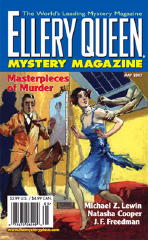
   The tale of fair-play detection has become a dying art, but each of two recent issues of Ellery Queen Mystery Magazine has featured at least one specimen worthy of the Golden Age. Jon L. Breen’s “The Missing Elevator Puzzle” (February 2007) is quite simply the finest short whodunit with an academic setting that I can recall reading, with a puzzle that might have fazed Ellery himself: Why was a visitor to the campus, just before being murdered, searching for the elevator in a building that had none?

EQMM

    “The Book Case” (May 2007) by Dale Andrews and Kurt Sercu not only has two authors like the Queen books themselves but returns to center stage their most famous detective, physically frail but mentally spry at age 100, as he tackles a murder with a dying message composed of copies of his own novels. Readers who aren’t well up on those novels are likely to get lost in this tale, but if you’re at home in the canon you’ll have a high old time trying to beat the centenarian sleuth to the solution.

***

   In most centenary celebrations the subject is dead, but there’s one coming up in just a few months where the honoree is still with us – and, so I’m told, doing well for a 99-year-old. He claims to have written a number of short whodunits published under a pseudonym in his student years but his real significance for us lies in his extensive writing about the genre over several decades and in his connection with the supreme master of pure suspense fiction.

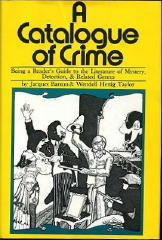
   I am referring of course to Jacques Barzun, distinguished professor at Columbia University, co-author of the massive Catalogue of Crime, and, in the early 1920s, Columbia classmate of Cornell Woolrich, who quit college in third year when his first novel sold.

CoC

   My first contact with Dr. Barzun was back in the late Sixties when I arranged to include one of his essays in my anthology The Mystery Writer’s Art (1970). In April 1970, while I was working on Nightwebs (1971), my first collection of Woolrich stories, he invited me to his Columbia office and we spent most of an afternoon talking about what the university was like almost half a century earlier when he and Woolrich were undergraduates together and sat next to each other for several courses.

   We corresponded off and on for several years. After translating from the French (a language I had never studied) an essay about Georges Simenon’s pre-Maigret crime novels, I presumed on my acquaintanceship with Barzun and asked him to look over my draft before I sent it in to The Armchair Detective. He made many small corrections, one of which I still vividly remember: I had rendered a line from an early Simenon as “Marc’s bottle was empty” which he changed to “The bottle of marc was empty,” pointing out to me that marc is a cheap French brandy. But on the whole he was hugely pleased with my translation, saying that he was “truly amazed” that I had done it without ever having taken a French course and that it was “certainly better than much advanced student work in a Romance Language Department.”

   In the early Eighties I became involved with Nacht Ohne Morgen (Night Without Morning), a documentary on Woolrich for German TV, and arranged for the director, Christian Bauer, to interview Barzun. They talked for almost an hour but only about a minute of footage found its way into the finished film. I obtained an audiotape of the entire interview and quoted from it extensively in my own Woolrich book First You Dream, Then You Die (1988). If Jacques Barzun had not been still alive and well and blessed with a vivid memory, we would know so much less about a key period in Woolrich’s life. For that gift to the genre and for countless others, merci beaucoup. May his hundredth birthday be a joyous one and not his last.

   Jamie Sturgeon recently sent me a couple of emails about some of the obscure authors who’ve been discussed here. I’ve been remiss in not posting them earlier, but here at last they are. The first one concerns the inquiry about Arthur J. Rees.

  Steve,

   I wonder if Arthur J. Rees emigrated to Australia to live with his two sisters and died there? His last book, The Single Clue, although set in England, was published only in Melbourne in 1940.

      Best Wishes,

         Jamie

   Jamie, I hadn’t noticed that, and thanks. I’ve added the information to the list of Rees’s books in that previous post. There’s also a lengthy gap between that book and his previous one, which came out in 1934. There’s probably an explanation, but at this late date, it would be awfully hard to find someone who’d know.

   Jamie’s second email refers to the post I did on Ramble House Books as soon as I learned that Fender Tucker was reprinting a couple of mysteries by British author Rupert Penny:

  Hi Steve,

   Noticed your mention of Rupert Penny. Did you know about his pseudonym Martin Tanner? See Al’s Addenda Part 5 on CrimeFictionIV.com. Penny is also mentioned in Geoff Bradley’s CADS Supplement Private Passions Guilty Pleasures, where Martin Edwards’ Private Passion/Hidden Gem are the books by Rupert Penny. Martin Edwards says that Penny (Thornett), after he gave up writing crime fiction, became a leading figure in the British Iris Society, editing its yearbook.

      Best Wishes,

         Jamie

   You can follow the link to find Jamie’s information on Penny as Martin Tanner, but to save you the click of the mouse, here it is below. I believe that the years of birth and death for Thornett are new also.

TANNER, MARTIN. Pseudonym of Ernest Basil Charles Thornett, 1909-1970. Other pseudonym: Rupert Penny, q.v.
      Cut and Run. Eyre, 1941 (correcting publisher and date)

   Perhaps it’s clear from the title and Jamie’s mention of it what Private Passions Guilty Pleasures consists of, but if you go here you will learn more, and if you are like me, you will learn enough to know that it’s a must have.

   In short, however, in celebration of the 50th issue of Geoff Bradley’s printed zine called CADS, 87 crime writers, critics, fans and CADS contributors responded to the topic of what authors and what mysteries they have secretly (perhaps) enjoyed the most. Their comments were then compiled and published in booklet form separate from CADS #50, but mailed along with it.

   I don’t know if Jamie intended for me to mention it or not, but he’s one of the contributors, along with Martin Edwards, Colin Dexter, Reginald Hill and Peter Lovesey, to name but a few.

   CADS is short, by the way, for Crime and Detective Stories.

      Blood ‘n’ Thunder magazine is published more or less quarterly by Ed Hulse, and every issue seems to be better than the one before. This is a matter of perspective sometimes, and you may have to take into account that Ed’s coverage includes more than crime and mystery fiction, if that is all that is of interest to you. An overall statement found under the title on the first page reveals the magazine’s purpose a little more fully: Adventure. Mystery. Melodrama.

     Or maybe the title, Blood ‘n’ Thunder, says just about that as well, and wherever the above can be found, the pulps, the movies, chapter serials, old-time radio or the equivalent, Ed, his staff of several, and his crew of writers of many, will be there.

     But this issue is focused on the detective pulp magazines, and perhaps most on the best of them all, Black Mask.

bnt 16

     First up is Monte Herridge, writing about one of the many, many series characters who appeared in the pages of Detective Fiction Weekly: Senor Lobo, soldier of fortune. The author? If you are not well versed in matters pulpish, the answer may surprise you: Erle Stanley Gardner, best known of course as the creator of Perry Mason. Before Perry became an overnight success in the world of hardcover mystery fiction, Gardner produced tons of magazine stories about the adventures of men like Sidney Zoom, the Patent Leather Kid, Lester Leith and a host of others.

     Monte’s suggestion is that Leslie Charteris’s “The Saint” was a model for Senor Lobo, and I’d have to have read more of the latter’s exploits myself before I could agree. But if Monte has read them, and he says it’s so, then neither would I disagree, not one inch.

     I’d like to have seen a checklist of the Senor Lobo stories, which appeared between 1930 and 1934, but other than that, Monte’s flair for describing them makes the article second best only to reading the tales themselves.

     Ed Hulse himself contributes the next piece, one on the series of girl reporter Torchy Blane comedy-mysteries that turned out by Warner Brothers in the late 30s and early 1940s. Starring in most of them was the inimitable Gloria Farrell, and coincidentally enough, over the last week or so I’ve been watching many of them on a video tape that I made a while ago from Turner Classic Movies. They turn up every so often there, and when they do again, don’t miss them.

     What most people don’t realize, unless they — like you and I — well, I know about me, but I can’t be so sure about you — actually read the credits, is that Torchy Blane was based on a character from the pulps, and that the character from the pulps that she was based on was a man, a fellow named Kennedy, whose tales were told in Black Mask by one Frederick Nebel.

     Only the first of the Torchy Blane movies was taken from an actual pulp story, and that was the first one, Smart Blonde. My own opinion is that was the best one, containing more as it did actual crime detecting than it did humor, although the latter definitely was present. And humor became even more present as the series of movies went on.

     A double-starred feature is next for this issue, an interview of Joseph T. Shaw, editor of Black Mask in its heyday, taken from the pages of Writer’s Digest, October 1929. Shaw’s statement of what the magazine was looking for, and the ingredients that in his opinion made the magazine successful then, makes for fascinating reading today.

     Perhaps the most knowledgeable pulp historian around today, Will Murray is next, with an article on Grace Culver, a female sleuth whose stories are hard to find today, appearing as they did in the now highly collectible Shadow magazines, beginning in 1934 and continuing through 1937. Her exploits appeared under the byline of Roswell Brown, but Will’s research shows that the stories were really written by pulp author Jean Francis Webb. Another checklist might have been in order, but I’m only quibbling. A little.

     Whew. I’m only halfway through this issue. Next Alfred Jan contributes a companion piece to one written by Josef Hoffmann which appeared on the original M*F website a short while back. The subject of each is the connection between pulp writer Norbert Davis and famed philosopher Ludwig Wittgenstein. Alfred’s piece is more on Davis’s novels about Doan and Carstairs — the former a hard-boiled detective, the latter his Great Dane companion — than it is the pulps, but that certainly does not make it any less worth reading.

     Up next is Gary Lovisi, long-time publisher of Paperback Parade, who salutes the British gangster digests of the late 1940s and the 1950s. Authors such as Hank Janson, Roland Vane, Stephen Frances, and Darcy Glinto are prevalent in this piece, illustrated profusely by the covers of their books, which are probably as much the reason for their collectibility today as their contents. Unfortunately these covers are only in black and white. If they were in color, they would really knock your eye out. [For more on Darcy Glinto, aka Harold Kelly, and his long involved story and subsequent bibliography, do not miss John Fraser’s mammoth website devoted to the gentleman.]

     Closing up this issue, and perhaps saving the best for last, is a long article by the late E. R. Hagemann (reprinted from Clues magazine) about Cap Shaw, the aforementioned editor of Black Mask, and the process under which the stories for The Hard-Boiled Omnibus (Simon & Schuster, 1946) were chosen. It wasn’t easy. If you are a fan of hard-boiled fiction — and its authors — this is absolutely must reading.

     And so is the entire issue. Following the link at the top should be the easiest way to get a copy. I suggest you act quickly, though, as Ed sometimes runs out.

« Previous Page