Bibliographies, Lists & Checklists


THE BACKWARD REVIEWER
William F. Deeck


BRANDON BIRD – Downbeat for a Dirge. Dodd Mead, hardcover, 1952. Detective Book Club, hardcover reprint, 3-in-1 edition. Also published as: Dead and Gone: Dell 857, paperback, 1955.

   While the sublettor of the apartment under Hampton Hume’s is with Hume and his wife, the woman rehearsing a song is murdered in a room below. During the wait for the police, the woman’s body is removed, presumably by the murderer, and an attempt is made to clean up the room.

   The murdered singer was a chanteuse, if there can be such a thing with a band playing Music Out of Dixie. A magazine illustrator and a former musician, Hume, who had appeared in two earlier novels, joins the band at police request when the band’s saxophonist disappears.

   If I relate my problems with the plot, it will give away essential information. So I’ll just say there were no more Hamp Hume mysteries after this one, no loss to the world of fiction.

— Reprinted from MYSTERY READERS JOURNAL, Vol. 6, No. 1, Spring 1990, “Musical Mysteries.”

      The Hampton Hume series –

Death in Four Colors. Dodd Mead, 1950.

Never Wake a Dead Man. Dodd Mead, 1950.
Downbeat for a Dirge. Dodd Mead, 1952.

Note:   A fourth book by Brandon Bird, Hawk Watch (Dodd Mead, 1954), not in the Hume series, was reviewed earlier on this blog by Walter Albert. You can read his comments here, along with considerable biographical information about the authors: George Bird Evans, (1906-1998) & Kay Harris Evans, (1906-2007). Some discussion of a fifth book they wrote, The Pink Carrera (Dodd Mead, 1960), as by Harris Evans, is also included in Walter’s post.
THOMAS B. DEWEY – Nude in Nevada. Dell 6508, paperback original; 1st printing, April 1965.

   I’ve read one or two of Dewey’s PI Pete Schofield novels, but I don’t remember it (or both) being as lackluster as this one is. It starts out poorly, as far as I was concerned, and never gets any better as it goes along. It does have some good moments, though, enough to keep me hoping, and I ended up finishing it. With another author, less known to me, I probably wouldn’t have.

   Pete Schofield is one of the few tough PI’s of the 50s and 60s era who happened to be married, and happily so. It did cut down on his womanizing, though that never seemed to stop him from looking. In any case, as the books begins, Pete and Jeannie are driving somewhere through the Nevadan desert when their car breaks down, miles from anywhere.

   Or so he thinks at first. Then he remembers that by pure chance an old friend, Strangler Martin, just happens to own a small garage and poor man’s resort a few miles back and off the road a way. He and Jeannie hoof it there, only to find Martin and his wife being held prisoner of a gang of foreigners whose language Pete doesn’t recognize. Perfect timing. What are the odds?

   The gang has killed the cook, so obviously they mean business. Also a prisoner is a young lady who is completely naked but covered with tattoos, and when Pete and Strangler Martin manage scare off the bad guys (this really puzzled me, how they managed to pull this off) the lady is happy to have them take a closer look.

   Then adding to the absolute weirdness of the evening, a horde of soldiers from a nearby army base stops by, and a party breaks out. A case might be made that this was meant to be a screwball mystery, but to me, it doesn’t make any more sense now when I’m telling you this than when I was reading it. As I said earlier, I was hoping Dewey could go somewhere with this wacky beginning, but other than morphing into a long and uninteresting story of international espionage, as far as I am concerned, he never did.

   Otherwise all ends well, but since this is last recorded adventure of the Schofields, I’m afraid we’ll never know where Jeannie wants to get a tattoo, or in fact if she ever did.

      The Pete Schofield series —

And Where She Stops. Popular Library, 1957.
Go to Sleep, Jeannie. Popular Library, 1959.
Too Hot for Hawaii. Popular Library 1960.

The Golden Hooligan. Dell, 1961.
Go, Honeylou. Dell, 1962.

The Girl with the Sweet Plump Knees. Dell, 1963.
The Girl in the Punchbowl. Dell, 1964.

Only on Tuesdays. Dell, 1964.
Nude in Nevada. Dell, 1965.

REVIEWED BY BARRY GARDNER:


  A. E. MAXWELL – The King of Nothing. Fiddler & Fiora #7. Villard, hardcover, 1992. Harper, paperback, 1994.

   The “A. E.” stands for Ann and Evan, who are the husband and wife who together write the Fiddler books, and have written several others besides. Their characters are no longer husband and wife, but lovers still. Fiddler is wealthy, by somewhat shady means detailed in the first book in the series; Fiora is wealthier, by virtue of being a financial wheeler-dealer and entrepreneur. You might, without stretching things too far, look at them as a West Coast McGee and Meyer with a little sex and a lot of money thrown in.

   Which is not to say that the Maxwells together are another John D. MacDonald, because they aren’t. They do combine to write very good prose, however, and I have thought highly of the series to date.

   In the latest episode, Fiddler is fishing with an old friend at his place on the coast of Washington. One day the friend makes Fiddler aware that he is to be the executor of his estate, and the recipient of an old Samurai sword, a souvenir of war experiences. The next day the friend is found dead, apparently the victim of a break-in and robbery. The local police do not inspire Fiddler with confidence. Concurrently, Fiora has been in Seattle negotiating with a Japanese conglomerate to sell her financial firm.

   Aha, Samurai sword, Japanese firm — can there be a connection? Well, maybe. Several gory deaths later you find out.

   This wasn’t my favorite of the series, and I’m really not sure why. The plot was a tad far-fetched in places, but most books of this type suffer from that. The writing was competent as usual, and Fiddler and Fiora continue to be engaging characters. At one time I was afraid they were headed toward some of Robert B. Parker’s Spenser-Susan kind of foolishness, but the Maxwells seem to have drawn back in time.

   Oh well, some you like more than others, some less. Still recommended, as are the first six in the series.

— Reprinted from Fireman, Fireman, Save My Books #3, September 1992.


      The Fiddler and Fiora series

1. Just Another Day in Paradise (1985)

2. The Frog and the Scorpion (1986)

3. Gatsby’s Vinyard (1987)

4. Just Enough Light to Kill (1988)
5. The Art of Survival (1989)
6. Money Burns (1991)
7. The King of Nothing (1992)
8. Murder Hurts (1993)

THE BACKWARD REVIEWER
William F. Deeck


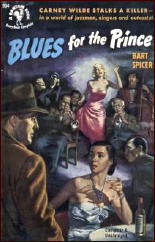
BART SPICER – Blues for the Prince. Dodd Mead, hardcover, 1950. Detective Book Club, hardcover reprint, 3-in-1 edition. Bantam #934, paperback, 1951.

   This is apparently the second case for private-eye Carney Wilde. When The Prince — Harold Morton Prince — jazz pianist, about sixth best in the country, and composer apparently without peer, is murdered, Wilde is called in to investigate the claim of The Prince’s accused murderer that he, not Prince, had composed most of the music Prince took credit for, particularly “Red Devil Blue,” and the folk operetta Sunset in Harlem.

   An admirer of The Prince and also a jazz enthusiast, Wilde takes a personal interest in the case since he doesn’t want The Prince’s reputation besmirched. Too much of an interest, it turns out, as he proves that the accused couldn’t have committed the murder.

   A good but not a particularly great case. Still, it has an interesting background. The Prince, his family, Wilde’s client, and other characters are black. Philadelphia in the late ’40s, as was true of most other places, was not a pleasant city if you were black. With music, though, there was no race barrier, nor apparently any race recognition.

— Reprinted from MYSTERY READERS JOURNAL, Vol. 6, No. 1, Spring 1990, “Musical Mysteries.”

       The Carney Wilde series —

The Dark Light. Dodd, 1949.
Blues for the Prince. Dodd, 1950.
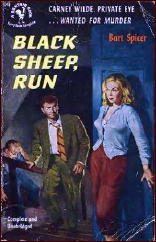
Black Sheep, Run. Dodd, 1951.

The Golden Door. Dodd, 1951.
The Long Green. Dodd, 1952.
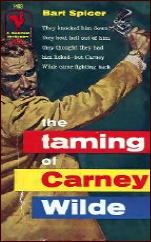
The Taming of Carney Wilde. Dodd, 1954.

Exit, Running. Dodd, 1959.

THE BACKWARD REVIEWER
William F. Deeck


WILLIAM GORE – There’s Death In The Churchyard. George G. Harrap, UK, hardcover,1934. No US publication.

   Pondersby Jonson becomes ill in the church at Sutton Eacham. When helped out of the church after the services by his host, Captain Stoyner, squire of the village, Jonson expires, but not before accusing his host of having murdered him.

   Stoyner and Jonson had had a fierce argument the night before; Stoyner possessed the poison used to commit the murder; Jonson, a financial ‘shark’ from the city, was trying to do down the good captain; Stoyner was the only one who could have administered the poison if what he says about the poison is true.

   It seems like an open-and-shut case. The villagers are all convinced that the squire did it, although their opinion is that the murder was certainly justifiable. Stoyner puts up no defence at the coroner’s hearing, his opinion being that if the jurors don’t want to believe a chap with his breeding, background, and record, so much the worse for them. They don’t justify his faith.

   During the trial itself, he will not allow himself to be defended by a barrister. If it costs £2000 for an obviously, or so he claims, innocent man to be found not guilty, then there really isn’t any justice.

   Luckily, this rather headstrong and proud man has a few believers and supporters. The vicar, married to Stoyner’s sister-in-law, finally spots, during one of his tedious sermons, how and why the murder was committed.

   This is a well-plotted, well-written, and amusing novel, with an unusually true-to-life private detective. It also has one of the few acceptable children in the genre, which makes it worth reading on that count alone.

— Reprinted from CADS 20, 1993. Email Geoff Bradley for subscription information.


          Bibliography:

WILLIAM GORE: pseudonym of Jan Gordon, 1882-1944.

   There’s Death in the Churchyard. Harrap, UK, 1934.
   Death in the Wheelbarrow. Harrap, UK, 1935; Mystery House, US, 1940 as by Jan Gordon. [Insp. Ernest Penk]
   Murder Most Artistic. Harrap, UK, 1937; published in the US by Doubleday, 1938. [Insp. Ernest Penk]

REVIEWED BY BARRY GARDNER:


JACK O’CONNELL – Box Nine. Lenore Thomas #1. Mysterious Press, hardcover, 1992; paperback, 1993.

   I started this with more anticipation than usual, and less certainty. It’s had a great deal of publicity, much more than a first novel usually gets, and though the reviews have been mostly favorable, still I really didn’t have a good sense of what to expect, other than something extremely hardboiled. And that, at least, I got.

   Lenore Thomas is a policewoman, an undercover narcotics agent. Her twin brother, Ike, is a postman. They live together in a duplex in a mythical city [Quinsigamond] somewhere (I assume) in Massachusetts. The book turns around the introduction of a new designer-drug with strange and ultimately lethal properties.

   Reviewers and would-be critics are lost without comparisons, and are prone to grab at unlikely ones when obvious and apt ones are not readily at hand. I’m going to avoid that trap, but possibly at the cost of leaving you as unsure of what Box Nine is all about as I was. There are, though, a few things I can tell you.

   The book presents a bleak, grim view of urban life, and of those urban denizens that it depicts. The story is told in the present tense and from shifting view-points; Lenore’s, Ike’s, a drug lord’s, another police woman’s, Ike’s supervisor at the Post Office, and they are all strange people. Lenore is arguably the strangest: a speed freak, heavy metal devotee, in love with her guns if she is in love with anything and overall one of the more different protagonists in recent memory. The prose serves the story well. The plot? Secondary, at best; what you have are people dancing in and out of a semi-apocalyptic vision.

   Do I recommend it? Lord, no. If you don’t like hardboiled fiction, you shouldn’t touch it with a pair of tongs. Even if you do, I have no idea whether you’d be glad you read it or not — and notice my avoidance of the terms “like” and “enjoy,” which seem inappropriate. Am I glad I did? No, I don’t believe I am. But it was different; I’ll give it that much.

— Reprinted from Fireman, Fireman, Save My Books #3, September 1992.


       The Quinsigamond series —

1. Box Nine (1992)
2. Wireless (1993)
3. The Skin Palace (1996)
4. Word Made Flesh (1998)

LIONEL BLACK – The Eve of the Wedding. Avon, paperback, 1st US printing, December 1981. First published in the UK by Collins, hardcover, 1980.

   This is the sixth of seven recorded cases solved by British newspaperwoman Kate Theobald, and the first of them that I’ve read. I’ve always thought that she and her barrister husband Henry were a Mr & Mrs detective duo, but Al Hubin lists only her as a series character, and not him in Crime Fiction IV. Inspector Bill Comfort is mentioned there as an occasional sleuthing partner, as he is for this one, but I’d say that that’s stretching it, as while the police are at hand, Comfort is offstage for most of the book.

   But Henry is a key character in this one, in a secondary role, true, but if it were me, I’d still say this is a married couple detective team. Dead is the brother of the groom during a party the night before he is to marry the daughter of the American half of a business partnership that split a generation or so ago.

   There are plenty of motives, not all of them all that savory. It seems that the dead man raped the bride-to-be during the party. He was also the one who stood in the way of the proposed re-merger of the two companies, US and UK. There is also a poltergeist at hand, making a nuisance of itself. Could it have thrown the dagger into the dead man’s neck. Henry thinks the idea is hogwash.

   There are several generations of family living in the huge mansion, and most of them do not get along, and I mean seriously. There is a completely dotty uncle and aunt, a pair of aged married servants who will do anything for their master, the patriarch of the family, but in one way or another, they were all cowed by the dead man, not a nice person at all.

   Black’s style is engagingly readable, but with a list of possible suspects like this, I’d have liked to have seen more actual detection. Having our detectives solve the case largely by overhearing and listening to secret conversations going on over the course of one long, long evening is not my idea of real detective work.

      The Kate Theobald series —

Swinging Murder. 1969.
Death Has Green Fingers. 1971.
Death by Hoax. 1974.

A Healthy Way to Die. 1976.
The Penny Murders. 1979.
The Eve of the Wedding. 1980.
The Rumanian Circle. 1981.

REVIEWED BY BARRY GARDNER:


MICHAEL ALLEGRETTO – Blood Relative. Jacob Lomax #4. Charles Scribner’s Sons, hardcover, 1992. No paperback edition.

   I had read a couple of the earlier Lomax books and hadn’t been tremendously impressed, but on the other hand liked them well enough to try another. I’m a little more impressed after reading the fourth.

   Jake Lomax is a Denver PI, an ex-cop whose wife was murdered five years ago; this destroyed his career as a policeman, and remains the central fact in his life. He is just back from an extended vacation in Mexico, and wondering what he’s doing with his life. He is hired by a lawyer for a man accused of murdering his wife, and who seems to be considered guilty by everyone even his children, and Lomax.

   Lomax is to find some helpful witnesses, and see if he can track down a possible lover of the murdered woman. As the stones are turned over the worms crawl out, and Lomax prods them to see which way they move. They move, as always, towards secrets and other crimes.

   This is a well-done standard private eye novel; if the concept of genre has any meaning this is probably the kind of book it applies to. Lomax walks the mean streets like he’s supposed to, and does the things a man’s gotta do when and where he’s gotta do ’em.

   Allegretto writes well if not exceptionally, and the plot is tight and more than normally realistic. I wouldn’t put him in the top rank of PI writers yet, but based on Blood Relative, I believe he’s moved up a notch. I look forward to the next one. Recommended.

— Reprinted from Fireman, Fireman, Save My Books #3, September 1992.


The Jacob Lomax series —

1. Death on the Rocks (1987)

2. Blood Stone (1988)

3. The Dead of Winter (1989)
4. Blood Relative (1992)
5. Grave Doubt (1995)

THE BACKWARD REVIEWER
William F. Deeck


ROBERT AVERY – Murder on the Downbeat. Arcadia House, hardcover, 1943. Death House #3, digest-sized paperback, 1944.

   Clarinetist Steve Sisson is widely respected for his great jazz playing, but he has lots of enemies. Early one morning in Fat-Ankles’s joint during a jam session, one of those enemies shoots Sisson in the head with the working part of an ice pick.

   The girlfriend of jazz columnist Malachy Bliss is arrested for file murder, she having had the opportunity and several good reasons for doing away with Sisson. Bliss, who is an even bigger toper than Jonathan Latimcr’s Bill Crane, begins his own investigation among musicians and the underworld.

   After Avery has constructed a quite good, but perchance not accurate, simile — “as pure as a seminarian’s dream” — his inventiveness is exhausted. A typical Arcadia product: interesting background, poorly executed novel.

— Reprinted from MYSTERY READERS JOURNAL, Vol. 6, No. 1, Spring 1990, “Musical Mysteries.”


Bibliographic Notes:   Robert Avery wrote three other mysteries, but all for the lending-library market. This seems to be Malachy Bliss’s only appearance, but two feature a sleuth named Joe Kelly, described by Bill elsewhere as a writer and amateur detective:

A Murder a Day! Mystery House, 1940. [Joe Kelly]
The Corpse in Company K. Swift, 1942. [Joe Kelly]
Murder on the Downbeat. Arcadia, 1943.
A Fast Man with a Dollar. Arcadia, 1947.

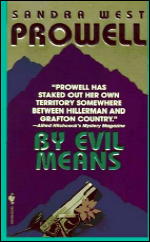
SANDRA WEST PROWELL – By Evil Means. Walker, hardcover, 1993. Bantam, paperback, April 1995.

   This is the first of three recorded adventures for perhaps the only fictional PI working out of Billings, Montana, a former FBI agent named Phoebe Siegel. The case seems simple enough, that of a woman who is afraid that there is something wrong at Whispering Pines, the psychiatric clinic on the outskirts of town where her daughter had recently sought help.

   Phoebe is about to turn her down, since (for many reasons) she always takes the month of March off. One of the reasons is that March is the month that her brother Ben, a cop in the local police force, committed suicide. She changes her mind, though, when the mother tells her there may have been an involvement between the girl and her brother Ben, even to the extent of a police complaint just before he died.

   Thus begins a long (over 350 pages) investigation into all kinds of secrets in her home town that Phoebe had never had an inkling of, many of them involving her family and friends, and she has many in both categories. The book is slow to start. It is not until page 130 or so, when Phoebe goes sneaks into Whispering Pines and convinces herself at last that Dr. Stroud is indeed up to no good, that the tale really starts to get into high gear.

   In some ways, this book reminded me of several of Marcia Muller’s Sharon McCone stories, in which the friends and family seem to be a secondary but essential sidebar to the mystery. But in Phoebe Siegel’s case, the role they both take on simply grows and grows, insidiously so. The ending is as harrowing as any that I’ve read in a PI novel in quite a long time.

   I wasn’t so sure for a while, but this one’s a keeper.

      The Phoebe Siegel series —

By Evil Means (1993)
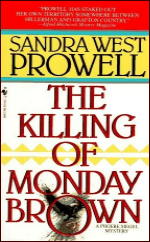
The Killing of Monday Brown (1994)

When Wallflowers Die (1996)
An Accepted Sorrow (unpublished)

   According to the Thrilling Detective website, By Evil Means was nominated for the Hammett Prize, and both that novel and The Killing of Monday Brown were nominated for a Shamus.

« Previous PageNext Page »