Bibliographies, Lists & Checklists


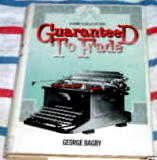
GEORGE BAGBY – Guaranteed to Fade.

GEORGE BAGBY Guaranteed to Fade

Doubleday Crime Club, hardcover, 1978. Hardcover reprint: Detective Book Club [3-in-1 edition], February 1979.

   The first time that George Bagby, himself a character in his own novels, told us about one of the mystery cases solved by his friend, Inspector Schmidt of the N.Y.P.D., was in 1935. This is his latest, the 44th in the series so far.

   As always, Schmitty complains a great deal about his aching feet, but he makes quick work of the murder of the many-times married Tommy Thomas, a prime example of how the rich find divorce so convenient a convention. To tell the truth, however, this one doesn’t take a lot of brain-power to figure out. The entertainment may be lighter than usual, but then again, I’m a confirmed addict.

— From The MYSTERY FANcier, Vol. 3, No. 4, July-Aug 1979.  This review also appeared earlier in the Hartford Courant.


[UPDATE] 12-31-08.   One thing that struck me when reading this review is that when I wrote them for the Courant, I generally had to keep them short, something I seem to have difficulty doing any more. Not that there’s anything wrong with that.

   The other thing that caught my attention was the very last word I used. George Bagby, in real life Aaron Marc Stein, aka Hampton Stone was one of my favorite writers, under all three names. I cringe at having to use the word “was,” since (once again) he’s an author I haven’t read in an awfully long time. Going through these old fanzines is bringing back lots of memories.

   In Mr. Bagby’s honor, and Inspector Schmidt’s as well, why not go for a long list of all of the latter’s adventures? Thanks to the Revised Crime Fiction IV, by Allen J. Hubin, here it is:

SCHMIDT, INSPECTOR [GEORGE BAGBY]

o Murder at the Piano (n.) Covici Friede 1935 [New York City, NY]
o Ring Around a Murder (n.) Covici Friede 1936 [New York]
o Murder Half Baked (n.) Covici Friede 1937 [New York City, NY]

GEORGE BAGBY

o Murder on the Nose (n.) Doubleday 1938 [New York City, NY]
o Bird Walking Weather (n.) Doubleday 1939 [New York City, NY]
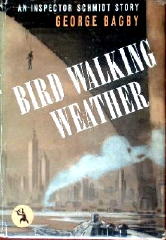
GEORGE BAGBY

o The Corpse with the Purple Thighs (n.) Doubleday 1939 [New Jersey; Academia]
o The Corpse Wore a Wig (n.) Doubleday 1940 [New York City, NY]
o Here Comes the Corpse (n.) Doubleday 1941 [New York City, NY]
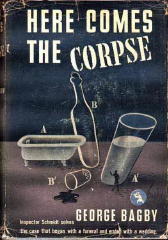
GEORGE BAGBY

o Red Is for Killing (n.) Doubleday 1941 [New York City, NY]
o Murder Calling �50� (n.) Doubleday 1942 [New York City, NY]
o Dead on Arrival (n.) Doubleday 1946 [New York City, NY]
o The Original Carcase (n.) Doubleday 1946 [New York City, NY]
o The Twin Killing (n.) Doubleday 1947 [New York City, NY]
o In Cold Blood (n.) Doubleday 1948 [New York City, NY]
o The Starting Gun (n.) Doubleday 1948 [New York City, NY]
o Coffin Corner (n.) Doubleday 1949 [New York City, NY]
o Drop Dead (n.) Doubleday 1949 [New York City, NY]
o Blood Will Tell (n.) Doubleday 1950 [New York City, NY]
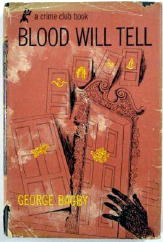
GEORGE BAGBY

o Death Ain�t Commercial (n.) Doubleday 1951 [New York City, NY]
o The Corpse with the Sticky Fingers (n.) Doubleday 1952 [New York City, NY]
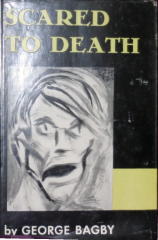
o Scared to Death (n.) Doubleday 1952 [New York City, NY]
GEORGE BAGBY

o Dead Drunk (n.) Doubleday 1953 [New York City, NY]
o Give the Little Corpse a Great Big Hand (n.) Doubleday 1953 [New York City, NY]
o The Body in the Basket (n.) Doubleday 1954 [Madrid]
o A Dirty Way to Die (n.) Doubleday 1955 [New York City, NY]
o Cop Killer (n.) Doubleday 1956 [New York City, NY]
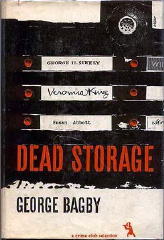
o Dead Storage (n.) Doubleday 1957 [New York City, NY]
GEORGE BAGBY

o Dead Wrong (n.) Doubleday 1957 [New York City, NY]
o The Three-Time Losers (n.) Doubleday 1958 [New York City, NY]
o The Real Gone Goose (n.) Doubleday 1959 [New York City, NY]
o Evil Genius (n.) Doubleday 1961 [New York City, NY]
o Murder�s Little Helper (n.) Doubleday 1963 [New York City, NY]
o Mysteriouser and Mysteriouser (n.) Doubleday 1965 [New York City, NY]
o Dirty Pool (n.) Doubleday 1966 [New York City, NY]
o Corpse Candle (n.) Doubleday 1967 [Maine]
o Another Day-Another Death (n.) Doubleday 1968 [New York City, NY]
o Honest Reliable Corpse (n.) Doubleday 1969 [New York City, NY]
o Killer Boy Was Here (n.) Doubleday 1970 [New York City, NY]
o My Dead Body (n.) Doubleday 1976 [New York]
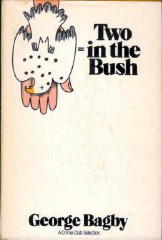
o Two in the Bush (n.) Doubleday 1976 [New York City, NY]
GEORGE BAGBY

o Innocent Bystander (n.) Doubleday 1977 [New York City, NY]
o The Tough Get Going (n.) Doubleday 1977 [New York City, NY]
o Better Dead (n.) Doubleday 1978 [New York City, NY]
o Guaranteed to Fade (n.) Doubleday 1978 [New York City, NY]
o I Could Have Died (n.) Doubleday 1979 [New York City, NY]
o Mugger�s Day (n.) Doubleday 1979 [New York City, NY]
o Country and Fatal (n.) Doubleday 1980 [New York City, NY]
o A Question of Quarry (n.) Doubleday 1981
o The Sitting Duck (n.) Doubleday 1981
o The Golden Creep (n.) Doubleday 1982 [New York City, NY]
o The Most Wanted (n.) Doubleday 1983 [New York City, NY]
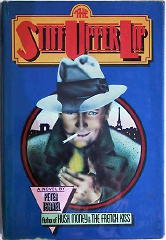
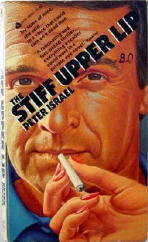
PETER ISRAEL – The Stiff Upper Lip.

Thomas Y. Crowell Co., hardcover, 1978. Paperback reprint: Avon, 1980.

PETER ISRAEL Stiff Upper Lip

   The private eye seems in essence to be almost wholly a uniquely American character. Even if B. F. Cage is originally from Los Angeles, by continuing to use the side streets and back alleys of Paris and Amsterdam as his stomping grounds, he stands out like a crime against nature.

   His client this time around is a black basketball player trying a comeback in France, but certain past and present indiscretions involving mobs of two different nationalities are threatening to catch up with him. The story is slight, involving no particular urgency, and it ends with an awfully silly version of a Chicago gang war.

   Too many transplants, and they fail to take. Valerie, Cage’s newly self-appointed assistant, is the only delicious morsel to be found anywhere in this stale and condescending affair.

– From The MYSTERY FANcier, Vol. 3, No. 4, July-Aug 1979.  This review also appeared earlier in the Hartford Courant.


[UPDATE] 12-30-08. As a wild shot in the dark, I’d say that fictional PI’s are a world-wide phenomenon today, which is a Good Thing. And in the years since 1979, I think that these foreign born PI’s have adapted and changed. They display much more of their own countries’ backgrounds and flavors, instead of relying so heavily on the US model. (A point worth considering in more detail, someday.)

PETER ISRAEL Stiff Upper Lip

   Just from reading through this review, I also think I might enjoy The Stiff Upper Lip more now than I did in 1979. Not having read it again in the almost 30 years since, all I can pass along to you is my judgment as it was back then.

   Over the years Peter Israel, the author, was also a high-ranking editor at Putnam. He eventually became the president, then chairman of the board of directors, serving in these capacities between 1978 and 1987.

   Of more specific interest to us, he also wrote five mystery novels, three with B. F. Cage and two with “eccentric, brilliant New York City legal detective Charles Camelot and his assistant, Phil Revere,” as they’re described on one bookseller’s website.

   Here’s a list of all five, as taken from the Revised Crime Fiction IV, by Allen J. Hubin:

      ISRAEL, PETER. Pseudonym of J. Leon Israel.

   Hush Money (n.) Crowell 1974 [B. F. Cage; Los Angeles, CA]
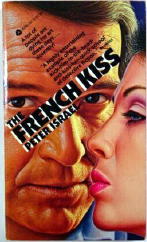
   The French Kiss (n.) Crowell 1976 [B. F. Cage; Paris]

PETER ISRAEL French Kiss

   The Stiff Upper Lip (n.) Crowell 1978 [B. F. Cage; Paris]
   I’ll Cry When I Kill You (n.) Mysterious Press 1988 [Charles Camelot; New York City, NY]
   If I Should Die Before I Die (n.) Mysterious Press 1989 [Charles Camelot; New York City, NY]

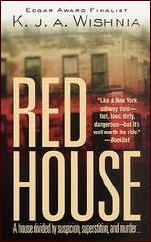
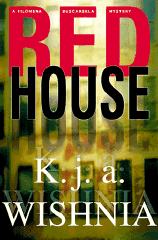
K. j. a. WISHNIA – Red House.

St. Martin’s; paperback reprint, December 2002. Hardcover edition: St. Martin’s, November 2001.

WISHNIA Red House

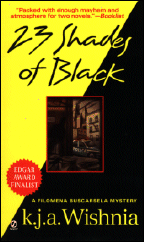
   This is the fourth in the series of mysteries solved by Ecuadorian ex-revolutionary and now fledgling private eye Filomena Buscarsela, single mom and philosopher slash social critic. Quoting from page 67: “And thus we see the dangers of post-Heideggerian rejection of history.”

   Since I haven’t read the previous three books, I don’t know exactly what career paths she may have been following up to now. She seems to have spent some time on the New York City police force — a police detective for only one day, as she puts it — but in this book, she’s a first year trainee at the PI firm of Davis and Brown, trying to work her way up to getting her own license.

   And rather than focusing on only one case, we get bits and pieces of a number of them — more of a private eye procedural, a la Joe Gores, street style, as Filomena tries to build up the Latino clientele for the firm.

   The mugging (murder?) of a local housing advocate is the main item on her agenda, however, with the plight of the illegal squatters in an abandoned tenement they refurbished themselves a close second.

   The pace is fast-moving, told in first person, present tense, and Filomena certainly knows her way around. The problem with the book is a subtle one, as I found it. According to the back cover, Wishnia (male) has a Ph.D. in comparative literature, and book reads as though it was written by someone having a Ph.D. in comparative literature.

WISHNIA Red House

   It does not read as though it was being told by a real-life Filomena Buscarsela, whose depth of knowledge seemingly knows no bounds, running the gamut from Heidegger (see above) to Marx (Groucho, waggle-waggle) to pulp novel covers (page 131) to nineteenth-century German chemist Friedrich Kekulé (page 226).

   I’m not saying that Filomena Buscarsela is not the person she says she is. What I’m saying is that K. j. a. Wishnia did not succeed in convincing me that she is. It’s his job, and so far (I’ve read only the one book) he hasn’t done it, at least not for me.

   The street scenes are fine, perhaps even more than fine. Otherwise? I’m skeptical, but I’ll leave myself open to opposing argument. (Even better, I’ll read the first three books.)

— December 2002 (revised)


[UPDATE] 12-29-08.   That’s another promise I haven’t kept, I’m sorry to say. Not yet, I haven’t, but I will. For the record, expanded upon from her entry in the Revised Crime Fiction IV, by Allen J. Hubin, here’s a list of all of Filomena’s appearances in book form:

   BUSCARSELA, FILOMENA

      23 Shades of Black. The Imaginary Press, trade pb, 1997. Signet, pb, Nov 1998; Point Blank, trade pb, 2004.    [Edgar Award finalist for Best First Novel.]

WISHNIA Red House

      Soft Money. Dutton, hc, 1999; Signet, pb, May 2000.
      The Glass Factory. Dutton, hc, 2000; Signet, pb, Mar 2001.
      Red House. St. Martin’s, hc, Nov 2001; St. Martin’s, pb, Dec 2002.
      Blood Lake. St. Martin’s, hc, Dec 2002.

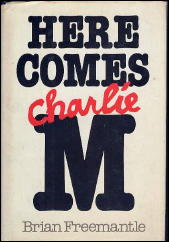
BRIAN FREEMANTLE Charlie MuffinBRIAN FREEMANTLE – Here Comes Charlie M. Doubleday, US, hardcover, 1978; ppbk reprint: Ballantine, 1980. Published in the U.K. as Clap Hands, Here Comes Charlie; Jonathan Cape, 1978; ppbk reprint: Arrow, 1987.
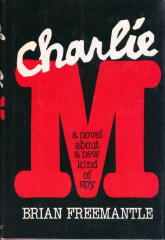
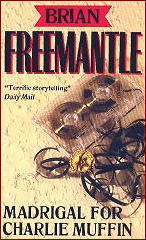
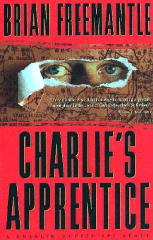
   Spies can easily outlive their usefulness. The new brooms of equally new administrations have moved in on both sides of the Atlantic, and Charlie Muffin, who proved to be so embarrassing a non-willing pawn in the preceding book in this series (a book called Charlie Muffin, or simply Charlie M. in the US) is the dirt that has to be swept out. Guilt-ridden and on the defensive as he is, however, it is his nature to fight back.

   And the nature of sequels being what it is, the keen edge of cutting commentary concerning the spy business is lost, or at least it takes a while for it to be sharpened up again. This time it seems almost too easy — the top minds of two huge intelligence organizations pose very little challenge to the intrepid Charlie M.

– From The MYSTERY FANcier, Vol. 3, No. 4, July-Aug 1979  (slightly revised).This review also appeared earlier in the Hartford Courant.


[UPDATE] 12-27-08. I had no idea at the time, but Charlie Muffin has turned out to be one of the most durable spy characters in hardcover spy fiction. He’s appeared in 14 books, listed below. Guys like Matt Helm, Joe Gall and Nick Carter have lasted longer in paperback, to be sure, and maybe you can think of others who might rival him in hardcover, but it’s quite a record.

   And one that’s passed below my own personal radar. Until coming across this review, I hadn’t thought of Charlie M. in ages, perhaps because so few of his adventures have come out in paperback. Expanded from the Revised Crime Fiction IV, by Allen J. Hubin, here’s the list:

   MUFFIN, CHARLIE

o Charlie Muffin. Cape 1977. [US: Charlie M.]

BRIAN FREEMANTLE Charlie Muffin

o Clap Hands, Here Comes Charlie. Cape 1978. [US: Here Comes Charlie M.]
o The Inscrutable Charlie Muffin. Cape 1979. [US: same]
o Charlie Muffin’s Uncle Sam. Cape 1980. [US: Charlie Muffin, U.S.A.]
o Madrigal for Charlie Muffin. Hutchinson 1981. [No US edition]

BRIAN FREEMANTLE Charlie Muffin

o Charlie Muffin and Russian Rose. Century 1985. [US? The Blind Run]
o Charlie Muffin San. Century 1987. [US: See Charlie Run]
o The Bearpit. Century 1988. [No US edition]
o The Runaround. Century 1988. [US: same]
o Comrade Charlie. Century 1989. [US: same]
o Charlie’s Apprentice. Century 1993. [US: same]

BRIAN FREEMANTLE Charlie Muffin

o Charlie’s Chance. Orion 1996. [US: Bomb Grade]
o Dead Men Living. Severn 2000. [US: same]
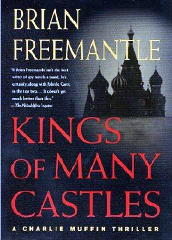
o Kings of Many Castles. Severn 2001. [US: same]

BRIAN FREEMANTLE Charlie Muffin

   As for author Brian Freemantle, he doesn’t seem to have stopped writing, unless it’s been very recently. He’s been averaging a book or two a year over the past 30 years, either under his own name or as by one of his four pseudonyms: Harry Asher, Jonathan Evans, John Maxwell or Jack Winchester. For a long list of all the books he’s written, along with a large assortment of covers, see the UK Fantastic Fiction website.

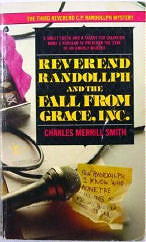
CHARLES MERRILL SMITH RandollphCHARLES MERRILL SMITH – Reverend Randollph and the Fall from Grace, Inc.
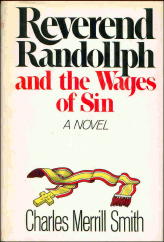
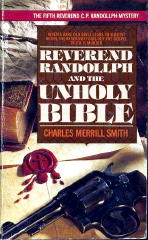
G. P. Putnam’s Sons, hardcover, 1978. Paperback reprint: Avon, 1982.

   This third mystery adventure of C. P. Randollph, a one-time pro quarterback now turned minister, continues to learn the ins and outs of his new profession, and in this case more specifically, how he finds that a clergyman’s responsibilities entail more than just his presence at Sunday morning services.

   In addition, there are often affairs of a political nature to contend with, both within the church and out. In this case, as an extreme example, being murdered are the close associates of a television evangelist who hopes to join Randollph’s denomination before announcing his bid for the U. S. Senate.

   Without a doubt, organized religion can always use such engagingly down-to-earth men of the cloth as Reverend Randollph. Reporting fairly on the mystery, however, I reluctantly have to admit that the motive for murder is an unlikely one.

– From The MYSTERY FANcier, Vol. 3, No. 4, July-Aug 1979  (slightly revised).This review also appeared earlier in the Hartford Courant.


[UPDATE] 12-24-08.  The Reverend Randollph books, concerned with everyday church life as they were, remain among my favorite mysteries in which clergymen do double-up duty as sleuths and detectives.

   Charles Merrill Smith wrote five of them before a relatively early death, with a sixth almost finished at the time of his passing. The book was completed by his son Terrance Lore Smith, also a mystery novelist. Phil Grosset, on his webpage for the character, says that Terrance intended to continue the Reverend Randollph stories on his own, but two years later he was killed himself in an automobile accident.

   From the Revised Crime Fiction IV, by Allen J. Hubin, here’s a list of all six Reverend Randollph mysteries:

SMITH, CHARLES MERRILL. 1918-1985.
      Reverend Randollph and the Wages of Sin. Putnam, 1974.

CHARLES MERRILL SMITH Randollph

      Reverend Randollph and the Avenging Angel. Putnam 1977.
      Reverend Randollph and the Fall from Grace, Inc. Putnam, 1978.
      Reverend Randollph and the Holy Terror. Putnam, 1980.
      Reverend Randollph and the Unholy Bible. Putnam, 1983.

CHARLES MERRILL SMITH Randollph

      Reverend Randollph and the Splendid Samaritan (completed by the author’s son, Terrance Lore Smith). Putnam, 1986.

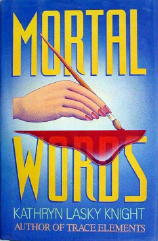
KATHRYN LASKY KNIGHT – Mortal Words.

Pocket, reprint paperback; 1st printing, July 1991. Hardcover edition: Summit Books, 1990.

   It’s a comfort then [after reading and reviewing Ben Sloane’s Hot Zone] to return to the real world, where deaths still occur, but when they do, they’re seriously mourned. The real world, unfortunately, is filled with violence, there’s no denying that, but it’s nice to be able to feel that you’re not the only one who feels that violence is the problem, and very seldom is it the solution.

KATHRYN LASKY KNIGHT

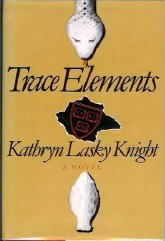
   On the top of the front cover, even before the title, is the heading: “Calista Jacobs is back!” Unfortunately, this is the first I knew about Trace Elements, which was Callista’s first mystery-adventure, along with her precocious son Charley, who is now 13, so I never knew she was away.

   Luckily (in a matter of speaking) enough references to the earlier book are made that I may not even have to go out looking for it. In terms of updating her life, in Mortal Words Calista is now a widow. She is also a world-famous illustrator of children’s books, and she and Charley live in that hotbed of liberalism, Cambridge, Mass.

   This is definitely not a book for readers of a more conservative persuasion. The book opens with Calista and her friends being harassed by a fervent right-wing fundamentalist at a librarian’s literary conference, and the plot grows to include born-again evangelists, evolutionary racists, and Nazi-inspired sperm banks. Moral cripples all, according to Ms. Knight, but nonetheless they embody a powerful anti-science movement, and quite the nasty combination indeed.

   Naturally Calista is opposed to all this with every fiber of her being, and equally naturally it makes her an obvious target. Murder also occurs, but with Charley’s computer-hacking abilities and general intellectual curiosity, along with Calista’s growing friendship with Archie Baldwin, noted archaeologist, the villains stand very little chance.

   As you may have gathered, here is a mystery that is bursting the seams of plain old (and old-fashioned) detective fiction, and in my opinion, it certainly wouldn’t hurt anybody to read it. As a detective story, though, I think it’s seriously flawed by the total lack of attention the Boston police force pay to the murder and to the invaders of Calista’s home.

   They are so severely excluded from the story, as a matter of fact, that you begin to wonder if they could possibly be in on the plot. I hope I’m not saying too much without a [WARNING: Plot Alert] that they are not, but it certainly makes the rest of the story a little harder to swallow.

   This same lack of concern on the part of Calista and Archie as to their safety, and that of Charley, is just as hard to accept. If murder and the invasion of one’s home isn’t warning enough that their opponents are serious, what is?

— Reprinted from Mystery*File 33, Sept 1991 (revised).


[UPDATE] 12-23-08.   The author wrote only four books in the series. As Kathryn Lasky, she’s been much prolific as a writer of children’s books, both fiction and non-fiction, for which she’s been given a list of awards as long as your arm. Expanded from her entry the Revised Crime Fiction IV, by Allen J. Hubin, here are her four mysteries, all with Calista Jacobs:

KNIGHT, KATHRYN LASKY. 1944- .
      Trace Elements. Norton, hc, 1986. Pocket, pb, 1987.

KATHRYN LASKY KNIGHT

      Mortal Words. Summit, 1990. Pocket, pb, 1991.
      Mumbo Jumbo. Summit 1991. Pocket, pb, 1992.
      Dark Swan. St. Martin’s, 1994. Worldwide, pb, 1996.

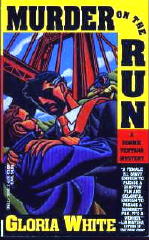
GLORIA WHITE – Murder on the Run.

Dell, paperback original. First printing, July 1991.

   According to page one, Ronnie Ventana is the half-Mexican daughter of a pair of jewel thieves. Somehow she is now a PI. According the short bio at the end of the book, this is Gloria White’s first novel.

GLORIA WHITE Ronnie Ventana

   Of these two statements, the first one is more than a little unusual, but it’s actually the second one that’s harder to believe. This is a very good book, and if I had any say in the matter (which I don’t, since I’m not involved in voting for any book for any award) I think it could easily be nominated for Best First Novel in anybody’s league.

   It begins like this. Ronnie is out running near Golden Gate Bridge one morning, when she spots two men struggling. One pushes the other into the water, and then she is pursued by the one who did the pushing. Luckily she gets away.

   Two problems follow right away: (1) the body is not discovered immediately, and (2) she recognizes the person who did the dumping as Pete August, a PI who once worked for the D.A.’s office, and who was also once on the police department — and in brief, a fair-headed, high profile boy with all his former connections still intact.

   Snubbed by the police, Ronnie keeps on the case. More deaths follow, and she manages to get a homicide detective named Philly Post interested. Ronnie is a lady who doesn’t give up, and the story has both ginger and snap.

   There is even an unexpected twist ahead. The only problem is the ending. It’s too predictable. A little too obvious. I saw it caning. One good twist deserves another, as the saying goes, and I didn’t get it.

   Don’t get me wrong, though. This book is as good as any of the other female PI novels I’ve read in recent months, and some of them were as good as some of the males of the species. (A number of them were even better.)

— Reprinted from Mystery*File 33, Sept 1991 (slightly revised).


[UPDATE] 12-20-08. This is the first review I’ve reprinted since I announced the new focus for this blog posted last weekend but revised earlier today. I was doing movie reviews back in 1991 as well as now, and the ones in this old issue of M*F will soon be showing up here also.

   As for Gloria White, her PI character Ronnie Ventana didn’t have as long a career as I was hoping when I wrote this review. In spite of a slew of award nominations, which I’m pleased to have anticipated, Dell dropped her books after only four outings. Luckily, and this doesn’t always happen, two more books in the series have come out in recent years, and in hardcover to boot.

   Expanded from her entry in the Revised Crime Fiction IV, by Allen J. Hubin, here’s a list of all of Gloria White’s mystery fiction:

WHITE, GLORIA.    Series character: PI Ronnie Ventana in all.
      * Murder on the Run. Dell, pbo, 1991. [Anthony Award finalist]
      * Money to Burn. Dell, pbo, 1993.
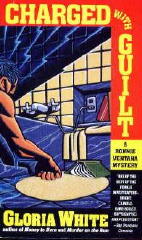
      * Charged with Guilt. Dell, pbo, 1995. [Edgar Award Finalist, Shamus Award Nominee, Anthony Award Finalist]

GLORIA WHITE Ronnie Ventana

      * Sunset and Santiago. Dell, pbo. 1997. [Edgar Award Finalist, Shamus Award Finalist]
      * Death Notes. Severn House, hc, April 2005.
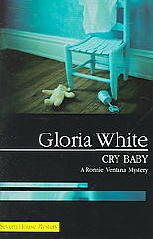
      * Cry Baby. Severn House, hc, June 2006; trade paperback, June 2007.

GLORIA WHITE Ronnie Ventana

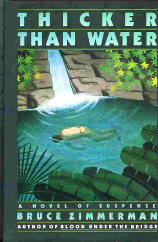
BRUCE ZIMMERMAN – Thicker Than Water.

Detective Book Club; reprint hardcover [3-in-1 edition]. First edition: HarperCollins, 1991. Paperback reprint: Harper, 1993.

BRUCE ZIMMERMAN

   In the five year period from 1989 to 1994, Bruce Zimmerman wrote four mystery thrillers featuring phobia therapist Quinn Parker, but since then he seems to have disappeared. Or at least I’ve found nothing more about him than what’s in Al Hubin’s Crime Fiction III, even using a quick search on the Internet. The four books and nothing more.    [See also the UPDATE below.]

   From the book at hand, the second in the series, Zimmerman seems to have been aiming at the moderately-boiled Travis McGee market. Treating phobia patients as a profession seems to be a good way of getting the San Francisco based Parker into all kinds of scrapes, but in this book, nothing is made of it.

   Parker gets involved this time when he gives a good buddy a hand after he inherits a half-million dollar estate in Jamaica and finds there are exceedingly dangerous strings attached.

   Zimmerman is very good at thumbnail dead-on descriptions of the people found in his books, and more than once I was brought suddenly to attention by a plot twist that was (to say the least) unexpected. But as a detective, Quinn Parker is — well, if inept is not quite the right word, then to say the least, he’s not very good at it. One additional death, if not two, can be attributed directly to Parker’s entirely unsavvy approach to the business at hand.

   Worse, he seems all but blithely unaware of it. He swallows hard, and it’s on to the next chapter. Nor is the ending particularly neat and tidy, with one explanation in particular producing (in my mind) many more questions than answer.

   From mind-boggling turns of plot to mind-blowing maladroitness, that’s the mix. Worth spending an evening’s reading time on, but not likely to be remembered strongly by more than a few of those who do.

— December 2002 (very slightly revised)


[UPDATE] 12-18-08. First of all, notice that I referred to Crime Fiction III in this review. The latest edition of Al Hubin’s book (but available only on CD) is the Revised Crime Fiction IV.

   Secondly, either the Internet contains more than it did six years ago, or I’m getting better at Google. Was Google around six years ago? Maybe not. Either way, I found out why there were four Quinn Parker mysteries (as stated in the review) and only four.

   Bruce Zimmerman, as it turns out, discovered Hollywood, or Hollywood discovered him. To his lasting great fortune, Zimmerman started writing for TV in 1998, and in 2000 he turned producer. Series to his credit in the latter capacity (thanks to IMDB) include The District, Judging Amy, Desperate Housewives, CSI: NY, and K-Ville. (I really liked that last series, a cop show taking place in New Orleans, but I think I was the only one. After last year’s writers’ strike, it never returned.)

   And thanks to the previously mentioned Crime Fiction IV, slightly expanded, here’s a list of the mystery novels that Bruce Zimmerman produced:

ZIMMERMAN, BRUCE. 1952- . Series character: Quinn Parker, in all four.
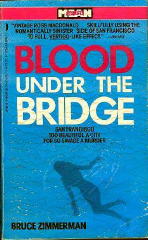
      Blood Under the Bridge. Harper, hc, 1989; St.Martin’s, pb, 1990.   [Nominated for an Edgar in the Best First Novel category.]

BRUCE ZIMMERMAN

      Thicker Than Water. Harper, hc, 1991; ppbk, 1993.
      Full-Bodied Red. Harper, hc, 1993; ppbk, 1994.
      Crimson Green. Harper, hc, 1994; ppbk, 1995.

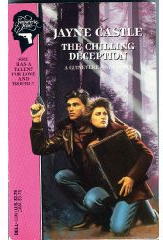
JAYNE CASTLE – The Chilling Deception.

Dell, paperback original. First printing, August 1986.

   Speaking of numbers of books sold, as I was in my preceding review of Richard S. Prather’s Over My Dear Body, Jayne Castle is no slouch in racking up sales, which were up to seven million in print at the time The Chilling Deception came out. (Ms. Castle is also known as Stephanie James and Jayne Ann Krentz, which also happens to be her real name.)

JAYNE CASTLE Chilling Deception

   That many of her books are romances without a hint of mystery to them makes no difference at all, especially to the IRS and other more mortal bean-counters.   [Jayne Krentz is also Amanda Quick, under which name many of her more mystery-oriented books have appeared, but she didn’t use that name until several years after this review first appeared.]

   Prompted, I assume, by the success of such TV series as Remington Steele and Moonlighting, in which the pseudo-romance between the leading characters is featured as prominently as the detective story itself, book publishers (never ones not to sense a dollar when a dollar is there) have decided to get in on the action. Hence, the second of the adventures of Guinevere Jones, exclusive secretarial assistant, and Zachariah Justis, sophisticated security specialist.

   They have a romance going — or more properly, perhaps, an affair — and in between trying to help their combined client in this book out from whatever trouble he is in — he won’t tell them — Guinevere is trying to pin Zach down as to what exactly their relationship is, and Zach, he’s simply trying to pin Guinevere down. In bed, that is.

   There is more explicit sex in this book than in Richard Prather’s, say, and nothing else could be more indicative as to how times have changed. Swooning is hardly enough for today’s readers — and I imagine I’m talking about the female half of the population, for I don’t believe many males will read this book.

   And if they do, they are likely to find the other scenes, those in which Guinevere and Zach talk (or, when they’re alone, think) about their relationship, something less than totally compelling. (I hope I’m not maligning men too much.)

   I have little idea how the aforementioned female half of the population will go for this book and this series, except to say that a track record of seven million books is quite a record to build on.

— From Mystery.File 1, January 1987 (greatly revised).


[UPDATE] 12-12-08. There were in all four books in the series. They all came out in 1986. Expanded from the Revised Crime Fiction IV, by Allen J. Hubin, here’s a complete list:

JONES, GUINEVERE
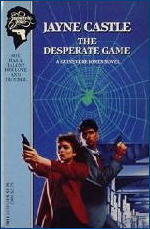
      o The Desperate Game (n.) Dell, pbo, June 1986.

JAYNE CASTLE Desperate Game

      o The Chilling Deception (n.) Dell, pbo, Aug 1986.
      o The Sinister Touch (n.) Dell, pbo, Oct 1986.
      o The Fatal Fortune (n.) Dell, pbo, Dec 1986.

JAYNE CASTLE Fatal Fortune

   She has her own page on the Thrilling Detective website, devoted to private eyes of all kinds, but other than that, I don’t know how successful the series was.

   Except for this. If you were to search for any of these four books on Amazon, which is where you will find the most accurate prices books are really going for, you will find only one for which the asking price is less than $22.50, and I’m willing to wager that that one book won’t last long at that price.

   Apparently none have been reprinted. If that’s so, one wonders why, as the market for Jayne Ann Krentz’s fiction seems to know no bounds. If her total was seven million books in print in 1986, one can only imagine what it is now.

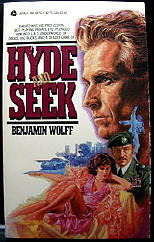
BENJAMIN WOLFF – Hyde and Seek.

Avon, paperback original; 1st printing, October 1984.

BENJAMIN WOLFF Hyde and Seek.

   A blurb from Tony Hillerman is on the back cover, and he makes the book sound promising, if not more so: “A great story, a skillful storyteller … action-suspense fans are going to love this one.”

   I hate to disagreed with Mr. Hillerman, but I do. I thought the story was murkily plotted, that Wolff is an unpolished story-teller, and that while I personally didn’t go wild over it, maybe the book did sell well in army post bookstores. Not that it’s in Donald Pendleton’s league, but when it comes down to it, whose are?

   From the publicity blurb on the front cover, I was also led to believe that this was a private eye yarn. As it turns out, though, the only real connection the protagonist of the story, John Byron Hyde, has with that profession is through a part-time job he has doing an insurance investigator’s books.

   He is also a part-time karate instructor, however, and a disillusioned post-traumatized Vietnam vet, and (after some thought) nobody I’d really rather care to know. (There goes the rooting interest.) When he’s asked by a girl (a knockout, of course) to help her find her brother, who’s mysteriously disappeared, he ends up in a sour-tasting melange of drug smuggling, South American politics, and the semi-benevolent order of The Good Helpers of our Lady The Mother of God.

   After something of a conclusion has taken place (at least everybody’s motivations are laid out in the open), the story is clearly continued into the next volume of Mr. Hyde’s adventures. I have a copy — it’s here somewhere– but if/when I find it, the question is, will I read it? You have two guesses, the same as I, and the second doesn’t count.

— From Mystery.File 1, January 1987 (revised).


[UPDATE] 12-11-08.   An uneasiness I have whenever I pull a review out of my archives that’s as negative as this one is that it turns out to have been written by someone I know, but writing under a pen name at the time. Not that I fear writing negative reviews (not all books can be as wonderful as the publicity guys make them sound), but generally speaking, I tend not to write reviews of books by authors I know.

   It turns out that Wolff was a pen name, and that there were only two of John Hyde’s adventures. My review had nothing to do with the latter. No more than 40 people may have seen this review when it first appeared; more than likely it was only a tenth of that.

   From the Revised Crime Fiction IV by Allen J. Hubin:

WOLFF, BENJAMIN. Pseudonym of Louis Chunovic; see also Charles Heath.
      Hyde and Seek (Avon, 1984, pb) [John Byron Hyde; Los Angeles, CA]
      Hyde in Deep Cover (Avon, 1985, pb) [John Byron Hyde; Bolivia]
      Nasty Boys (Berkley, 1991, pb) [Las Vegas, NV]

HEATH, CHARLES. Generally a pseudonym of Ron Renauld, but also note the book below:
      Operation Desert Sun: The Untold Story [by Louis Chunovic] (Dell, 1984, pb) [A-Team; Middle East]. Novelization of the “A-Team” TV series.

« Previous PageNext Page »