Bibliographies, Lists & Checklists


TALMAGE POWELL – Man-Killer.

Ace Double D-469; paperback original. First printing, 1960.

TALMAGE POWELL

   Speaking of “workmanlike prose,” as I was a little while ago — in the review of the other half of this Ace Double, as a matter of fact — I know Talmage Powell wrote a good deal for the pulps, so I’m not surprised to find anything he wrote totally readable — even, to coin a phrase, “hillbilly mystery fiction,” of which this might be a prime example (complete with moonshiners, deputy sheriffs and other dumb hicks).

   [The other half was Bob McKnight’s Running Scared, and you can find my comments here.]

   If a lack of tightly knit plotting may have been McKnight’s Achilles heel in the other half of the double volume, then a tendency toward melodramatic dialogue is Powell’s in his portion. Or maybe I’m not the one to judge. Perhaps old aristocratic ladies now on hard times actually speak the way they do in this book while contemplating their future — and the future of wayward sons who (in this book) insist on helping a poor hill girl accused of killing her husband days before her divorce becomes final.

   Or maybe the subject matter just naturally leads toward melodrama. More solidly plotted than McKnight’s book, Man-Killer nonetheless lacks the compulsive (not to say screwy) readability of Running Scared, which, on the whole, if you were to ask, I’ve decided is the better of the two.

— From Mystery.File 1, January 1987 (heavily revised).


[UPDATE] Later the same day.   I didn’t do it ahead of time, and maybe I should have, but in the first comment to this post, August West happened to mention Talmage Powell’s private eye character Ed Rivers. Having a few minutes on my hands, I followed up with a list of all five detective novels that he was in. Check it out.

BOB McKNIGHT – Running Scared.

Ace Double D-469; paperback original; 1st printing, 1960.

   I meant to say something about George Harmon Coxe’s “workmanlike” prose in my recent review of Murder for Two, but it could be said just about as well right here. [The phrase is a common one; Google just a moment ago produced about 3000 hits.] What I mean by the term is this: a style of writing that you just don’t notice.

   Nothing so fancy as to call attention to itself, although as a standard that’s hardly enough. It can’t be anything other than a subjective assessment, one that varies from person to person.

   Nonetheless, assuming that there is such a concept, I think that “workmanlike prose” was more common with writers whose background was working for the pulp magazines. Writers whose job it was to tell a story, to get on with it, before their readers got bored and went on to something else.
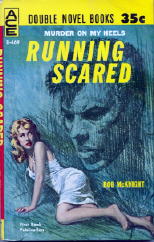
BOB McKNIGHT

   Coxe was such a writer. Frank Gruber was another. The most famous was probably Erle Stanley Gardner. None would get much of notice for their writing from a professor of literature, but because they were good writers, they captured the reader’s attention from page one onward.

   Although I don’t believe he ever wrote for the pulps. He came along a little too late for that. He was a paperback writer. He never had a book come out in hardcover, so in the overall scheme of things he’s on a far lower scale than either a Gardner or a Coxe, who both made it big. But a storyteller? Yes.

   The plot of Running Scared is that of your basic, everyday nitwit hero in a not quite everyday basic situation. He’s the kind of guy who has reasons for not calling the cops on page two — for if he had, there would be no story. He watches a murder take place, committed by someone driving his ex-wife’s car, and then he gets a call warning him that she has reported the car stolen. By him.

   He goes to her apartment (after being beaten up by two hoods on the way), befriends another girl there, hides her in a bathroom hamper when the cops come calling, and then finds her shot to death inside the hamper when the cops leave.

   I am not making this up. Actually, it reads very well. McKnight had the knack of making you believe nonsense like this all the while you realize that it is nonsense. Workmanlike prose, remember? One could easily picture an Alan Ladd or a Dick Powell in the leading role.

   But in the end, this is about all there is to say about the book. The pace is terrific, and I guarantee you that once stated, you will keep reading. Unfortunately, I cannot tell you that there is any overall depth to either the characters or the story. It’s too lightweight to be considered memorable, and the non-meticulous details of the plot are exactly that.

   What Running Scared is, though, is fun to read.

— From Mystery.File 1, January 1987 (heavily revised).



TALMAGE POWELL

[UPDATE] 12-09-08.   My comments on the other half of this Ace Double will be posted here shortly. For the record, it is Man-Killer, by Talmage Powell, an author who really did start out writing for the pulp magazines before shifting into a career, mystery-wise, of mostly paperback originals.

   As for Bob McKnight, here below is a complete list of his novel-length mystery fiction, as compiled in the Revised Crime Fiction IV, by Allen J. Hubin. Surprisingly enough to me, when I wrote this review I obviously didn’t recognize PI Nathan Hawk as being in this book and as being a series character. I thought so little of him, apparently, that I didn’t even mention his name. (I don’t think he was the main protagonist, but perhaps he was.)

   [INSERTED LATER.] I have located my copy of Ace Double D-469, and I was “right” and Al has erred in including Nathan Hawk as a Series Character in Running Scared. The primary protagonist is a guy named Harlan Jamieson and no PI’s are in the picture at all. I’ve so informed Al, and the deletion of Mr. Hawk from this book will be so mentioned in the next installment of the online Addenda. Also added will be the setting: St. Petersburg, Florida, so established by the mention of Al Lang Field early on in the story.

   And as long as I’ve brought him up, Nathan Hawk is included in Kevin Burton Smith’s website devoted to Private Eye fiction. He says, in part: “Tough guy eye NATHAN HAWK, transplanted northerner in Sun City, Florida, shot and slugged his way through ten novels published by ACE in the late fifties and early sixties. Detective Lieutenant Toby Duane lends a hand when he can, and dishes out plenty of friendly ‘damn yankee’ jibes along the way.”

   Running Scared is the only one of McKnight’s books I’ve ever read. Even though my judgment was qualified, I’m a sucker for books with wacky openings like this, even if the endings don’t pan out so well in comparison. Given an opportunity, I absolutely would read another.

McKNIGHT, BOB. 1906-1981. Mining engineer, pilot and horse-racing handicapper before semi-retiring to Florida.
      Downwind (n.) Ace Double D-217, 1957 [Santa Fe, NM]
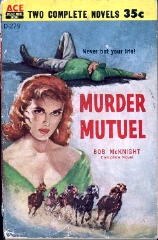
      Murder Mutuel (n.) Ace Double D-279, 1958 [Nathan Hawk; Florida]

BOB McKNIGHT

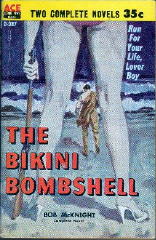
      The Bikini Bombshell (n.) Ace Double D-387, 1959 [Nathan Hawk; Florida]

BOB McKNIGHT

      Swamp Sanctuary (n.) Ace Double D-411, 1959 [Florida]
      Kiss the Babe Goodbye (n.) Ace Double D-447, 1960 [Nathan Hawk; Florida]
      Running Scared (n.) Ace Double D-469, 1960 [DELETE Nathan Hawk; ADD setting: Florida (St. Petersburg)]
      Secret Sinners (n.) Merit 35, 1960 [Nathan Hawk; Florida]
      A Slice of Death (n.) Ace Double D-419, 1960 [Florida]
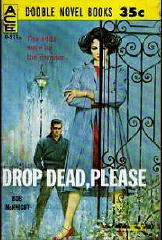
      Drop Dead, Please (n.) Ace Double D-511, 1961 [Florida]

BOB McKNIGHT

      The Flying Eye (n.) Ace Double F-102, 1961 [Florida]
      A Stone Around Her Neck (n.) Ace Double F-143, 1962 [Nathan Hawk; Florida]
      Homicide Handicap (n.) Ace Double F-229, 1963 [Nathan Hawk; Florida]
GRAHAM THOMAS – Malice Downstream.

Fawcett Books; paperback original; 1st printing, December 2002.

GRAHAM THOMAS

   Graham Thomas is a Canadian writer (British Columbia) who seems to have the British down pat, both the countryside and the countrymen. This is the fifth case for Detective-Chief Superintendent Erskine Powell, all paperback originals, and in the age of bloated mysteries running up to 400 pages or more, they’re lean and mean at a mere 200 plus.

   In Malice Downstream Powell is found recuperating from a previous injury at a small village called Houghton Bridge, known almost only for its superb chalk stream fishing, and home of the renown Mayfly Club. Taking his mind off his almost healed leg, and to a lesser extent his failing marriage, Powell also finds murder, with roots in the past. Totally out-of-bounds in taking a hand in investigating a case he shouldn’t be, he’s obviously the epitome of a busman on holiday.

   The detective work is solid if not flashy, with a villain rather obvious from first meeting, but if fly-fishing is an art you’re interested in, this is the book for you. And even if you’re not, if you can enjoy reading about the enthusiasm that someone else has for their near-obsessive hobbies, then this is also the book for you.

   Overall a male-oriented book, but still very cozy in nature. Snug and insightful, in a minor key sort of way.

— December 2002 (slightly revised)


[UPDATE] 12-09-08. Until I looked him up in the Revised Crime Fiction IV, by Allen J. Hubin, I did not know that Graham Thomas was a pen name, but it is so. I’m guessing, of course, but perhaps Kosakoski did not sound “British” enough to someone whose opinion mattered.

   Using his entry in CFIV as a basis, here below is a complete list of the Graham Thomas mysteries. Chief Supt. Erskine Powell is in all of them.

   Note: In the original version of this review, I stated that Malice Downstream was the sixth in the series. It does not appear to be so, nor was there ever a sixth.

THOMAS, GRAHAM. Pseudonym of Gordon Kosakoski, 1950- .
      Malice in the Highlands. Ivy, pbo, Jan 1998.

GRAHAM THOMAS

      Malice in Cornwall. Ivy, pbo, June 1998.
      Malice on the Moors. Ivy, pbo, Aug 1999.
      Malice in London. Ivy, pbo, April 2000.
      Malice Downstream. Fawcett, pbo, Dec 2002.

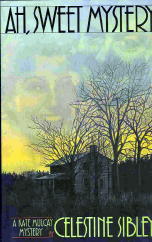
CELESTINE SIBLEY – Ah, Sweet Mystery

Detective Book Club; hardcover reprint [3-in-1 edition]. First Edition: HarperCollins, 1991; paperback reprint, 1992.

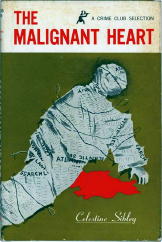
   It would take some investigating to be sure, but there may be record of sorts that was set with the publication of this book, Sibley’s second mystery novel. Atlanta newspaper reporter-columnist Kate Mulcay appeared in the first one, The Malignant Heart, which was published in 1958, and she’s in this one as well, only a mere 33 years later. (There may have been wider gaps between series appearances by a given character, but between the author’s first and second mystery, with the same character?)

CELESTINE SIBLEY

   Sibley, also a newspaper columnist, also from Atlanta, was 74 when she wrote this one, and she went on to write four more Mulcay books, the final one in 1997, two years before she died.

   Kate, now widowed in Ah, Sweet Mystery, is of an indeterminate age, but she’s still actively writing her columns and going along on a police raids. Hints of her life with her husband Benjy, a member of the Atlanta police force, suggest that he appeared in the first book, but Kate now lives on her own.

   Dead is Garney Wilcox, a cutthroat real estate developer intent on transformed quiet corners of Atlanta and environs into apartment complexes. Confessing to the crime is his stepmother, Miss Willie, whom Garney had recently persuaded to abandon her long-time home for the comforts of a rundown nursing manor.

   There are only a few mystery novels, I am sure, which incorporate the songs and mystique of Nelson Eddy and Jeannette MacDonald as part of the plot, but this is one of them. Also an underlying theme is the sense that pieces of traditional southern living and hospitality are disappearing, and that life in general in the South is changing. “Little enough country left,” Kate says on page 211. “I come this way if I have time.”

   The mystery itself is not nearly as strong as the nice homey feeling that Sibley creates, giving Kate guidance as she seeks out the roots of true southern culture. Puzzling to me was the dead man, who seems to have been electrocuted as part of his travails, rubbing up against a raw wire in a house where the electricity has been cut off. And while the culprits seem fairly obvious, the actions of the dead man’s wife are unfathomable, or at least unexplained.

   On the basis of a sample of size one, Sibley’s books, while sound as social statements and weak as detective novels, should still be more widely known than I think they are. (They’ve all come out as paperbacks, but I don’t think I’ve ever come across a used one.)

— December 2002 (slightly revised)


[UPDATE] 12-08-08. For the record, here’s a list of all of Celestine Sibley’s mystery fiction, thanks to the Revised Crime Fiction IV, by Allen J. Hubin. Kate Mulcay appears in all five:

SIBLEY, CELESTINE (1917-1999)
      * The Malignant Heart. Doubleday 1958.

CELESTINE SIBLEY

      * Ah, Sweet Mystery. Harper 1991.
      * Straight As an Arrow. Harper 1992.
      * Dire Happenings at Scratch Ankle. Harper 1993.
      * A Plague of Kinfolks. Harper 1995.
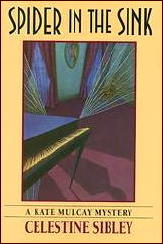
      * Spider in the Sink. Harper 1997.

CELESTINE SIBLEY

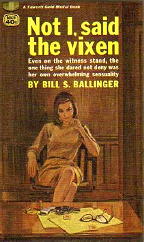
BILL S. BALLINGER – Not I, Said the Vixen

Gold Medal k1529; paperback original, 1965.

   Ballinger had a long career as a mystery writer as well as working for television and the movies, but for some strange reason, this is the first book of his I’ve read. So, whether this one is any way typical or non-typical of his fiction, I couldn’t tell you.

BILL S. BALLINGER Not I Said the Vixen

   His one-time protagonist in this largely courtroom affair is Cyrus March, perhaps the best defense attorney in the country. But unlike Perry Mason, say, March also has a drinking problem. And somewhat unlike Perry Mason, his client admits to pulling the trigger in the fatal shooting of a wealthy female socialite.

   Like so many of Perry Mason’s clients, Cyrus March’s is a beautiful woman, perhaps even narcissistic, and her story is that the victim was an unknown intruder in her apartment. March’s problems with the bottle began with the death of his wife, and unlike Perry Mason, he soon declares his love for person he’s defending.

   The dialogue is sometimes stilted, and the action often stagy, but every once in a while Ballinger mixes in a brilliant turn of phrase that makes you remember why you’d rather be reading instead of watching the tube. He also alternates chapters between first and third person, an unusual format that doesn’t quite click, even though you know why he’s using it.

   Lesbianism is a key ingredient of what makes the courtroom drama go — it’s seemingly kept at arm’s length at first, but the nuances become less and less subtle as the story works its way out.

   Rather a minor effort overall, but if you ever find a copy to read, I think it’ll keep you interested all the way through. It did me, and sometimes that’s all you need.

— December 2002


[UPDATE] 12-05-08.   Out of curiosity, I checked again to see if Cyrus March showed up in any of Ballinger’s other mystery fiction, but I’ve found nothing to suggest that he did. Ballinger did have a series character named Joaquin Hawks, who was in five paperback originals put out by Signet in the two year period 1965-66.

   As a Native American detective, tribal affiliation unknown, Hawks is mentioned in my list of N.A. sleuths on the primary M*F website, but I’ve not read any of his adventures. Another website says that he “is a case officer in the Central Intelligence Agency. His normal beat is Southeast Asia.”

   If you follow that last link, you’ll find a lot more information about him. For the record, here’s a list of all five of the Joaquin Hawks books, expanded from the Revised Crime Fiction IV, by Allen J. Hubin:

             HAWKS, JOAQUIN:
      The Spy in the Jungle (n.) Signet D2674, pbo, May 1965 [Viet Nam]
      The Chinese Mask (n.) Signet D2715, pbo, June 1965 [China]
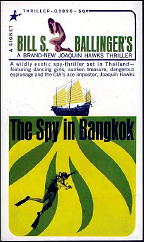
      The Spy in Bangkok (n.) Signet D2820, pbo, Dec 1965 [Thailand]

BALLINGER Spy in Java Sea

      The Spy at Angkor Wat (n.) Signet D2899, pbo, May 1966 [Cambodia]
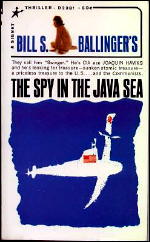
      The Spy in the Java Sea (n.) Signet D2981, pbo, Sept 1966 [Far East]

BALLINGER Spy in Java Sea

FREDRICK D. HUEBNER – The Joshua Sequence.

Fawcett Gold Medal; paperback original. First printing, November 1986.

   [Rather than make any changes, I’m going to leave this review pretty much as it was written, back in early January 1987. You’ll see why in a moment. Keep reading.]

   I guess I’m getting old. It’s not so much that I’ll be 45 years old tomorrow, because I really don’t think that’s what I’m feeling. It’s more that for the past few semesters I’ve gotten the feeling that for the students in my classes, the Vietnam War is something they’ve only read about, in history books, and not from newspapers.

   And here in The Joshua Sequence we have a mystery novel with the root causes based in the early 70s, with the various underground movements, the bombings, the thoughts (carried over from the 60s) that protests could change the world. The longer Seattle lawyer Matt Riordan searches for the killer of former student activist Stephen Turner, now a computer programmer, the more sure he becomes that the reason is connected with Turner’s days with the Weathermen and the Northwest Nine.

   Ancient history. Has it been 15 years ago, already? In the passage of time, most of Turner’s co-conspirators have gone establishment, in one form or another, depending on how you define the term, but there is a secret from those earlier days that one of them does not want revealed. And therein lies the mystery.

   Drugs, and a government cover-up, are also involved. Lacking sufficient muscle, Riordon has to call in a private eye friend from Montana. He also gets too closely involved with his client, the dead man’s sister. You can probably write the rest from here.

   Huebner is also a lawyer, so here in his first novel, he is writing largely what he knows, but every so often I thought his ear for dialogue was off. It may look good in print, but as opposed to the recently reviewed Death of a Harvard Freshman, I don’t think this is the way people really talk. There are an awful lot of typos, too.

   Or maybe I’m just getting cranky in my old age?

— From Mystery.File 1, January 1987 (slightly revised).


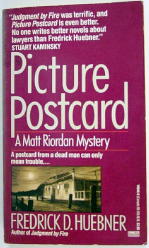
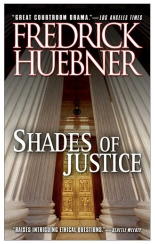
[UPDATE] 12-05-08.  No further personal comment is necessary from me, I don’t believe. My copy of the book is packed up and stored away where I can’t get to it, so I don’t have a cover image to show you. Next best thing, though: a cover shot of one of his other Matt Riordan books, then a scan of his most recent book. And why not a complete bibliography for him also, expanded from the Revised Crime Fiction IV, by Allen J. Hubin:

HUEBNER, FREDRICK D. 1955- .     MR = Matthew Riordan.
      * The Joshua Sequence. Gold Medal, pbo, 1986, MR
      * The Black Rose. Gold Medal, pbo, 1987. MR
      * Judgment by Fire. Gold Medal, pbo, 1988. MR
      * Picture Postcard. Columbine, hc, 1990; Gold Medal, ppbk, 1991. MR

FREDRICK HUEBNER

      * Methods of Execution. Simon & Schuster, hc, 1994; Gold Medal, ppbk, May 1995. MR
      * Shades of Justice. Simon & Schuster, hc, 2001; Signet, ppbk, Jan 2003.

FREDERICK HUEBNER

ED GORMAN – Will You Still Love Me Tomorrow?

Berkley; paperback reprint; December 2002. Hardcover edition: Carroll & Graf, January 2001.

ED GORMAN Sam McCain

   Not to make it too personal, but September 1959 was the month I started my senior year in high school, and that’s the very same autumn in which this nostalgic trip back to small-town America takes place. I was younger then than Gorman’s private eye protagonist, Sam McCain, but I remember drive-in movies, rock-and-roll, drugstore lunch counters, Gold Medal paperbacks, and Edd “Kookie” Byrnes.

   I also remember some of the darker sides of life in the late 50s: polio; segregation; Khrushchev’s threats; the remnants of McCarthyism. And it’s the Communist menace, or threat thereof, that forms the background for this latest of three mysteries Gorman has placed in Black River Falls, Iowa.

   The first death is that of a liberal former member of Truman’s administration, and the body count slowly but surely begins to climb from there. As good as the mystery is, even more enjoyable is Sam’s love life, which to put it mildly, is a mess, and I identified with every awkward moment of it.

   Along with an unerring sense of that not-so-long-ago period of American history, Gorman’s quiet but sarcastically obvious sense of humor is what makes this book worth looking for. Very enjoyable.

— November 2002 (slightly revised)


[UPDATE] 12-02-08. After a gap of three years — too long! — Sam McCain made his seventh appearance last year in Fools Rush In, which I haven’t read yet. I will have to do something about that.

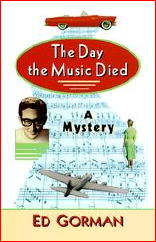
      The Day the Music Died. Carroll & Graf, Jan 1999; Berkley, pb, Apr 2000.

ED GORMAN Sam McCain

      Wake Up Little Susie. Carroll & Graf, Jan 2000; Berkley, pb, Feb 2001.
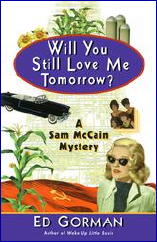
      Will You Still Love Me Tomorrow? Carroll & Graf, Jan 2001; Berkley, pb, Dec 2002.
      Save the Last Dance For Me. Carroll & Graf, Feb 2002; Worldwide, pb, July 2003.
      Everybody’s Somebody’s Fool. Carroll & Graf, Dec 2002; Worldwide, pb, June 2004.
      Breaking Up Is Hard To Do. Carroll & Graf, Feb 2004; Worldwide, 2005.
      Fools Rush In. Pegasus, Mar 2007; trade paperback, Mar 2009.

ED GORMAN Sam McCain

PAULA PAUL – An Improper Death.

PAULA PAUL

Berkley, paperback original; first printing, November 2002.

   The second mystery adventure of Dr. Alexandra Gladstone has much the same virtues and flaws as the first (Symptoms of Death, May 2002). The problems of being a female doctor in Victorian England are abundantly illustrated. Trying to do surgery on a male patient’s privates, for example, takes a good amount of strategic planning.

   And in general Ms. Paul does a more than credible job in re-creating the life and times of the lower classes; it was a hard life. Where she falters is in the mystery itself, that of the death of a former British admiral, found drowned on the beach near his home, clad only in women’s undergarments (hence the title).

   Constable Snow’s mysterious behavior which follows seems strained and forced, and so do several other incidents. Worse, though, is the killer’s behavior, totally unexplainable, making any attempt to follow the clues all but hopeless.

   So, definitely a mixed bag. Read this for the characters, not for the detective work.

— November 2002


[UPDATE] 12-02-08.   There were only three books in the Dr. Gladstone series:

      Symptoms of Death. Berkley, pbo, May 2002.

PAULA PAUL

      An Improper Death. Berkley, pbo, Nov 2002.
      Half a Mind to Murder. Berkley, pbo, Oct 2003.

   In a series coming before the Gladstone books were three adventures of Hillary Scarborough & Jane Ferguson, a mismatched pair of Southern belle decorators, all as by Paula Carter:

      Leading an Elegant Death. Berkley, pbo, Feb 1999.

PAULA PAUL

      Deathday Party. Berkley, pbo, Oct 1999.
      Red Wine Goes with Murder. Berkley, pbo, July 2000.

   Under her own name and as Catherine Monroe, Paula Paul has also written a number of other books, most of them historical fiction or romantic suspense.

REVIEWED BY WALTER ALBERT:         


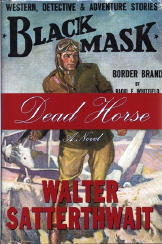
SATTERTHWAIT Dead Horse

WALTER SATTERTHWAIT – Dead Horse. Denis McMillan Publications, hardcover, 2006.

   Sattherwait’s novel speculates on the private relationship of [pulp author] Raoul Whitfield and his socialite wife, Mrs. Emily Davies Vanderbilt Thayer Whitfield, who was found dead of a gunshot wound in 1935, a death that was never explained to anyone’s satisfaction.

   Satterthwait’s extensive research only serves to strengthen the plausibility of his depiction of the doomed marriage and ill-matched couple, and the terse, finely honed prose is a fitting tribute to a mystery writer of uncommon stylistic gifts.

      ___

   Bibliographic data: RAOUL WHITFIELD.   Expanded from Crime Fiction IV, by Allen J. Hubin. Criminous novels and collections only:

WHITFIELD, RAOUL (Falconia). 1896-1945; pseudonym: Temple Field.

      * Green Ice. Knopf, 1930; No Exit Press, UK, 1988. Hardcover reprint: Grosset & Dunlap, early 1930s. Reprinted in 3 Star Omnibus: Trent’s Last Case, Green Ice, The Middle Temple Murder, Knopf, 1936. Later hardcover reprint: Gregg Press, 1980. Also published as: The Green Ice Murders. Avon Murder Mystery Monthly #46, pb, 1947. Later paperback reprints: Avon PN373, 1971; Quill, 1986.

RAOUL WHITFIELD

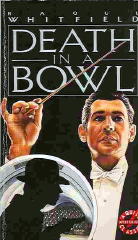
      * Death in a Bowl. Knopf, 1931; No Exit Press, UK, 1988. Paperback reprints: Avon PN337, 1970; Quill, 1986.

RAOUL WHITFIELD

      * The Virgin Kills. Knopf, 1932; No Exit Press, UK, 1988. Paperback reprint: Quill, 1986.
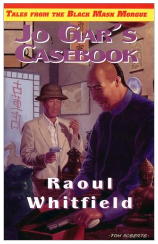
      * Jo Gar’s Casebook. Crippen & Landru, hc, 2002. Story collection. RD = Originally published as by Ramon Decolta:

RAOUL WHITFIELD

West of Guam [RD] Black Mask, Feb 1930
Death in the Pasig [RD] Black Mask, Mar 1930
Red Hemp [RD] Black Mask, Apr 1930
Signals of Storm [RD] Black Mask, Jun 1930
Enough Rope [RD] Black Mask, Jul 1930
The Caleso Murders [RD] Black Mask, Dec 1930
Silence House [RD] Black Mask, Jan 1931
Shooting Gallery [RD] Black Mask, Oct 1931
The Javanese Mask, [RD] Black Mask, Dec 1931
The Black Sampan [RD] Black Mask, Jun 1932
The Siamese Cat [RD] Black Mask, Apr 1932
The China Man [RD] Black Mask, Mar 1932
Climbing Death [RD] Black Mask, Jul 1932
The Magician Murder [RD] Black Mask, Nov 1932
The Man from Shanghai [RD] Black Mask, Apr 1933
The Amber Fan [RD] Black Mask, Jul 1933
The Mystery of the Fan-Backed Chair. Cosmopolitan, Feb 1935
The Great Black. Cosmopolitan, Aug 1937


FIELD, TEMPLE.
Pseudonym of Raoul F. Whitfield, 1896-1945.

      * Five. Farrar & Rinehart, 1931.
      * Killer’s Carnival. Farrar & Rinehart, 1932.

NICK O’DONOHUE – Wind Chill.

Paperjacks, paperback original, 1985.

   By rights, in a world that was absolutely perfect, this would have followed my review of L.A.Taylor’s Only Half a Hoax, as here is another book taking place in the twin cities area of Minneapolis-St. Paul. And if that weren’t connection enough, in 180 degree contrast (well, at least well over 60), this one takes place in the dead of winter, whereas what happened in that earlier book occurred instead in the balmy breezes (relatively speaking) of April.

   Ice fishing on a Minnesota lake on New Year’s Day is not my idea of a lark, nor that of private eye Nathan Phillips either. Especially when the first catch he and his fishing buddy, homicide lieutenant Jon Pederson, make that day is that of a waterlogged corpse which has been mutilated beyond recognition.

   And as a coincidence beyond belief, the body is somehow related to a case Pederson and the FBl have been working on, and now Phillips is involved too. As is the IRA, and a host of new clients for Phillips, attracted by the publicity, he guesses, but all of them, strangely, with Irish-sounding names.

   There is also a great deal of blackmail going around. You would not believe who is blackmailing who — and that is the problem with this book. I didn’t believe it. While O’Donohoe tries hard, he never did convince me. He has a nice easy style, for the most part, but every once in a while I found myself stopping short with a passage that simply stumped me for a moment.

   It is like listening to someone who is either afflicted with a faulty (or very selective) memory or (less seriously?) with an incurable habit of going off at wrong angles.

   Angles, at least, I wasn’t expecting. I don’t know if the problem was in the editing and the proofreading (or lack thereof), or if it was just me. Simply say that something failed to click — but when Phillips admits on page 194 that “I’d been stupid,” I could only nod my head, in complete agreement.

— From Mystery.File 1, January 1987 (slightly revised).


[UPDATE] 12-01-08.  Even with my review notes on the book, I don’t remember anything more about it than what I said back then, over 20 years ago. I may not have sounded very positive about it in my comments, but if I’m willing to give him another try, then I see no reason why you shouldn’t.

NICK O'DONOHOE

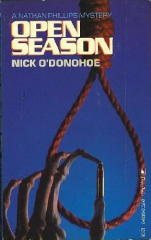
   I also don’t have a cover image to show you, since my own copy is buried away somewhere and essentially inaccessible. We’re therefore making do with the cover of another of Nathan Phillips’s adventures, as you’ll see here to the right:

   Besides the three of them in the same series (see below), O’Donohue has one other entry in Al Hubin’s Crime Fiction IV, an SF-fantasy novel with some criminous content. He also wrote a small handful of other fantasy paperbacks, but none of them cry out to be mentioned here.

O’DONOHOE, NICK   [i.e., Nicholas Benjamin O’Donohoe].   1952-  .

      * April Snow. Raven House, 1981. [Nathan Phillips]
      * Wind Chill. PaperJacks, 1985. [Nathan Phillips]
      * Open Season. PaperJacks, 1986. [Nathan Phillips]
      * Too Too Solid Flesh. TSR, 1989. [New York City, NY; Future]

« Previous PageNext Page »