Bibliographies, Lists & Checklists


JOHN PENN – A Deadly Sickness.

Bantam, reprint paperback; 1st printing, Nov 1986. Hardcover edition: Charles Scribner’s Sons, 1985. UK first edition: Collins Crime Club, hc, 1985.

JOHN PENN

   There is a type of British detective story I read and greatly enjoy, and I’d have to say that Agatha Christie represents it best.

   It’s an old-fashioned sort of story, one seldom taking place in London, but rather in one of the many villages England seems to be endlessly populated with. The police may take part, but the primary focus is often on other main characters, all of whom are more or less involved with the mystery, some more than others.

   And so, I have discovered John Penn. Everything I said above seems to apply. The first case Detective Superintendent Thorne and Sergeant Abbot worked on together seems to have been A Will to Kill, also recently published by Bantam. As in this one, a young girl is the key figure, and the same local doctor makes an appearance in each.

   In fact he is more of a main character in this one, as the police make only a late and mostly routine appearance in finally solving the death of the wealthy Sir Oliver Poston. The identity of the killer is unknown to the reader, of course, but what’s also a mystery, for a while, is what actually happened after his heir’s drunken accident on the occasion of his 40th birthday, preceding the death of his father. (Of the whole crowd, only the young girl mentioned above seems not to know.)

   As I am aware that most of you are completely capable of reading between the lines, I have probably said too much already. For that reason, I liked A Will to Kill more, but sometimes even when you know what’s going to happen, it’s fascinating to watch well-developed characters as they go through their paces.

— From Mystery.File 1, January 1987 (heavily revised).


[UPDATE] 11-24-08.  By some strange coincidence, when I used my computer to check the date just now, it also told me the time, which was exactly 11:24. I think this may be the day I should buy a whole stack of lottery tickets!

    When I wrote this review, over 20 years ago, I was rather down on British mystery and thriller fiction. How do I know? I deleted the first two paragraphs, neither of which do you see here, nor will you ever see them.

JOHN PENN

    I’ve changed my mind about British detective stories in the meantime. Maybe I’ve slowed down and I enjoy the pace of the older “humdrums” (of which category I do not consider the above to be an example) a lot more than I did when I was younger, but the glitz and glamour of present-day London and other larger cities, with all of their problems with the younger generation and immigrant populations, holds a lot of interest for me as well.

    I believe what remains of the review reads smoothly enough. Enough time has elapsed enough since I wrote it that I cannot tell you, however, whether the doctor figure that I mentioned was the same person, or if I meant to use him as a generic character.

    “John Penn,” and I did not know this when I wrote the review, was the joint pseudonym of Paula Harcourt and John H. Trotman. The latter did not write any mystery fiction of his own, but the former, who died in 1999, has a list of over 20 books to her individual credit in Al Hubin’s Crime Fiction IV, mostly of the espionage thriller variety, from what I can deduce from their titles.

    From CFIV then, here’s a list of all of John Penn’s work. Series characters: GT = Insp. (Supt.) George Thorne; DT = Chief Insp. (Supt.) Dick Tansey. (Most of the Tansey books have never been published in the US.)

* Notice of Death (n.) Collins 1982
* Deceitful Death (n.) Collins 1983
* A Will to Kill (n.) Collins 1983. GT
* Mortal Term (n.) Collins 1984. GT

JOHN PENN

* A Deadly Sickness (n.) Collins 1985. GT
* Barren Revenge (n.) Collins 1986. GT
* Unto the Grave (n.) Collins 1986. GT
* Accident Prone (n.) Collins 1987. GT
* Outrageous Exposures (n.) Collins 1988. DT

JOHN PENN

* A Feast of Death (n.) Collins 1989. DT
* A Killing to Hide (n.) Collins 1990. DT
* Death’s Long Shadow (n.) Collins 1991. DT
* A Knife Ill-Used (n.) Collins 1991. DT
* A Legacy of Death (n.) Collins 1992. DT
* A Haven of Danger (n.) Collins 1993. DT
* Widow’s End (n.) Collins 1993. DT
* The Guilty Party (n.) Collins 1994. DT
* So Many Steps to Death (n.) Collins 1995. DT
* Bridal Shroud (n.) Collins 1996. DT

JOHN PENN

* Sterner Stuff (n.) Collins 1997. DT

STEPHANIE BARRON – Jane and the Stillroom Maid: Being the Fifth Jane Austen Mystery.

Bantam, hardcover; August 2000. Reprint paperback, May 2001.

   Never having read any of Jane Austen’s works, or at least none that I can recall, I may not be the ideal person to be reviewing this book. On the other hand, speaking as a mystery fan, I thought the Jane Austen in this make-believe fiction does superbly well in her role as a full-fledged detective. By way of presentation, the book is related to us by her “editor” Stephanie Barron (a/k/a Francine Matthews), and I enjoyed it immensely.

STEPHANIE BARRON Jane Austen

   The year of the text is 1806, when it was entirely possible that Jane Austen could have been visiting Derbyshire, where she could have seen the house she used as an inspiration for Pemberley, the grand manor in the novel, as Barron says, “we now know as Pride and Prejudice.”

   And if she were in Derbyshire, is it not possible that she could have been once again (see the subtitle) involved in a murder there, this time of an apothecary maid in the most mysterious of circumstances?

   This is a well-plotted, well-told throwback to the Golden Age of detective fiction, in my humble opinion, with complication piled on complication. The maid has been shot in the forehead, but her body has been mutilated in a manner such as to cast blame on the demonic Masons the local folk fear so greatly. A sacrifice of some sort? More, and perhaps most puzzling, she is dressed in men’s clothing.

   Jane’s investigation — for definitely no timid wallflower is she — suggests that the maid’s death involves those well above her station. For many reasons, there are many who are not displeased that she is dead. Once again Lord Harold, the Gentleman Rogue in Jane’s life, is available to give her entrance to the world of the local gentry; if not for him, doors otherwise opened would have remained closed, and the case would never have been solved.

   Told in what satisfies me as being Jane Austen’s own words, with touches of delicate humor throughout, here’s a trip back in time I can’t recommend more. Charming and delectable; a complete pleasure.

— November 2002 (slightly revised)


   Bibliographic data:

      The JANE AUSTEN series —

1. Jane and the Unpleasantness at Scargrave Manor (1996)

STEPHANIE BARRON Jane Austen

2. Jane and the Man of the Cloth (1997)
3. Jane and the Wandering Eye (1998)
4. Jane and the Genius of the Place (1999)
5. Jane and the Stillroom Maid (2000)
6. Jane and the Prisoner of Wool House (2001)
7. Jane and the Ghosts of Netley (2003)
8. Jane and His Lordship’s Legacy (2005)
9. Jane and the Barque of Frailty (2006)

STEPHANIE BARRON Jane Austen

   Stephanie Barron’s most recent book, A Flaw in the Blood (Feb 2008), may be the first in a new historical series. In this one Irish barrister Patrick Fitzgerald, along with his ward Georgiana “Georgie” Armistead, initiates an enquiry into the death of Queen Victoria’s beloved Prince Albert.

DEBORAH DONNELLY – Died to Match.

Dell, paperback original; 1st printing, October 2002.

DEBORAH DONNELLY

   I missed the first one, of course, but I managed to catch up with Deborah Donnelly in this, her second mystery novel. The protagonist in both is Carnegie Kincaid, who’s a high-profile wedding planner in the city of Seattle. While she’s not number one, her clientele still consists of some of the wealthier big-names in town.

   In Died to Match an engagement masquerade party for two of the latter — wealthy big-names, that is — held at the Seattle Aquarium, results in one bridesmaid falling (or jumping or being pushed) into the ocean. Later on yet another one — a bridesmaid, that is — is found murdered in an exhibit with her head crushed in.

   There are a lot of characters to keep track of, which has the advantage of providing a host of possible suspects, but some of them seem to come and go without being fully introduced. Carnegie has a male friend, a newspaper reporter named Aaron, with whom she is having a touch-and-go almost romance. He seems to be the unthreatened jealous type. She thinks he smokes too much.

   The book itself is just over 300 pages long. About half of it is devoted to the various vicissitudes of the wedding planning business, Carnegie’s off-and-on affair with Aaron, and me just in general wondering why the wedding is going on as scheduled with someone (seemingly) stalking the bridesmaids like this.

   Donnelly does some fast talking and shuffling around to explain this (reference Aunt Enid, who may live not much longer) and lest I seem to be neglecting the other half of the book, she does a better-than-average job of providing all of the clues, false leads, and other required paraphernalia of an honest-to-goodness detective story.

   I doubt that I’m among the primary audience intended for this book, but in all honesty, Deborah Donnelly certainly delivers everything her readers are looking for, and maybe others, like me, who are satisfied as well.

— November 2002 (revised)


[UPDATE]  11-22-08. For whatever reason, the wedding planner ambiance, or the fact that the books were a rare breed these days, fully clued detective stories (or hopefully, a combination of both), the series seems to have caught on, at least for a while. There are six of them in all; you’ll find a complete list below. The bad news is that the last one came out nearly two years ago, and there’s not been another one since.

  Veiled Threats. Dell, pbo, Jan 2002. “In the first Wedding Planner Mystery, Carnegie ventures off her Seattle house-boat to deal with a handsome suitor, an annoying reporter, and a kidnapped bride.”

DEBORAH DONNELLY

  Died To Match. Dell, pbo, Oct 2002. “When a Halloween engagement party turns murderous, Carnegie finds herself costumed as a bridesmaid and stalked by a killer!”

  May the Best Man Die. Dell, pbo, Sept 2003. “In this Yuletide caper, Carnegie encounters a drowning at a bachelor party, a stripper in a Santa suit, and a murderous chase through a coffee roasting plant…”

  Death Takes a Honeymoon. Dell, pbo, Apr 2005. “Where there’s smoke, there’s murder, in this fiery tale of smoldering smokejumpers, hot-tempered actresses, and a super-heated Sun Valley summer.”

  You May Now Kill The Bride. Dell, pbo, Jan 2006. “On picturesque San Juan Island, love and lavender are in the air. But so are poisonous gossip, passionate jealousy…and murder.”

  Bride and Doom. Dell, pbo, Dec 2006. “When a baseball-themed engagement party is crashed by a corpse, Carnegie steps up to the plate to clear her pal of murder. Too bad her fiancé Aaron has suddenly come down with Relationship Deficit Disorder…”

DEBORAH DONNELLY

   Note: The short synopses above came from Deborah Donnelly’s website.

PHILIP ATLEE’S JOE GALL SERIES,
by George Kelley

JOE GALL

   Joe Gall is the Cadillac of hardass spies. Sure, Matt Helm can crush a foe’s kidneys with a crowbar, but would Helm allow himself to be turned into a heroin addict as Gall does in The Death Bird Contract (Fawcett, 1966), surely one of the best books James Atlee Phillips (who writes the Joe Gall series as “Philip Atlee”) ever wrote?

   I started the Joe Gall series early on with The Green Wound (Fawcett, 1963) and The Paper Pistol Contract (Fawcett, 1966). I was immediately impressed by the quality of the writing:

   The man seemed to be trying to walk up into the sky. One second he was strolling along the noon street in Laredo, distinguishable in the polyglot crowd only by his little white leather cap. Then he lunged forward and went gusting into an antic dance. Face contorted under the direct sunlight, he whirled and took two enormous sweeping steps, high and sideways. Racking away from the glittering store windows, he caromed into the parked car and jackknifed into the gutter. (The Green Wound, page 1)

JOE GALL

   We find out later that the man was carrying nearly half a kilo of uncut heroin in his butt, sealed in pliofilm and insertion surgically assisted. However, something went wrong: the bundle busted and a pound of pure heroin blasted into the tissues of the man’s body without warning. And the description of the event is graphic, yet at the same time poetic.

   The other trademark of the Joe Gall series is detailed references to local food, buildings, streets, and exotic customs. The reason is that James Atlee Phillips visited each of the sites of the novels in the series, many times writing the first draft on location to be sure to capture faithfully the local flavor. (Details of Phillips’ writing habits were related to me by a friend of his, Tom Van Zandt.)

   From Van Zandt’s information, Joe Gall is a projection of Phillips’ own fiery personality and style. Early in the series, Phillips has a minor character describe Joe Gall’s role that remains more or less consistant throughout the series:

JOE GALL

    “You are a greedy-guts, companero, like me. You want the best of everything; the best wines, the most attractive women, the clean overhead smash in tennis…. And you do these things well, almost with a Spanish style. But the flaw is always there. You are trying to sneak around the edges of your society, an anonymous man getting the best of it. Without making any obeisance to its smug gods of mass stupidity, automation, and regimentation…. You would appear to be, although you have not told me so, some kind of roving executioner in the holy name of Democracy. You think you can do this, as part-time work, and nurture your soul in an Ozark Mountain retreat. Not so, Josef. If you work in an abattoir, you get blood on you.” (The Silken Baroness, page 53)

   Joe Gall has class. He works only on a contract basis for large sums of money and spends most of his time in a fabulous mountain retreat in the Ozarks. He’s similar in style and flair to that legendary Western “consultant,” Paladin.

JOE GALL

   In terms of quality, I like the first four books in the series best. The Skeleton Coast Contract (Fawcett, 1968) features my favorite Joe Gall scene: Joe’s staked out on an anthill, and I assure you the description will make you itchy and wiggly for weeks. I have a certain amount of sentimental fondness for The Canadian Bomber Contract (Fawcett, 1971) because my home town is Niagara Falls, New York and I appreciate the fact that Phillips took the time to write an adventure taking place in my backyard and get it right.

   I recommend all the books in the Joe Gall series without reservation, but you have my preferences. The later books seemed to lack vitality and The Last Domino Contract (Fawcett, 1976) has Joe Gall calling it quits. Whether Phillips brings Gall out of retirement remains to be seen; however we have several top quality books to continue to enjoy while they remain in print.

– From The MYSTERY FANcier, Vol. 3, No. 2, Mar-Apr 1979       (very slightly revised).


      Bibliographic data: The JOE GALL books. [Expanded from Crime Fiction IV, by Allen J. Hubin.]

   Pagoda, as by James Atlee Phillips. Macmillan, hardcover, 1951. Bantam 1055, paperback, 1952. [Burma]. Joe Gall is an independent soldier of fortune.

JOE GALL

All later books are paperback originals:

   The Green Wound. Gold Medal k1321, July 1963 [New Orleans, LA] Joe Gall is now a semi-retired contract agent for the CIA. Reprinted as The Green Wound Contract, Gold Medal, 1967.
   The Silken Baroness. Gold Medal k1489, 1964 [Canary Islands] Reprinted as The Silken Baroness Contract, Gold Medal, 1966
   The Death Bird Contract. Gold Medal d1632, 1966 [Mexico]
   The Paper Pistol Contract. Gold Medal d1634, 1966 [Tahiti]

JOE GALL

   The Irish Beauty Contract. Gold Medal d1694, 1966 [Bolivia]
   The Star Ruby Contract. Gold Medal d1770, 1967 [Burma]
   The Rockabye Contract. Gold Medal d1901, 1968 [Caribbean]
   The Skeleton Coast Contract. Gold Medal D1977, 1968 [Africa]
   The Ill Wind Contract. Gold Medal R2087, 1969 [Indonesia]
   The Trembling Earth Contract. Gold Medal, 1969 [U.S. South]
   The Fer-de-Lance Contract. Gold Medal, Jan 1971 [Caribbean]
   The Canadian Bomber Contract. Gold Medal T2450, August 1971 [Montreal, Canada]
   The White Wolverine Contract. Gold Medal T2508, Dec 1971 [Vancouver, Canada]
   The Kiwi Contract. Gold Medal T2530, Feb 1972 [New Zealand]
   The Judah Lion Contract. Gold Medal T2608, Sept 1972 [Ethiopia]
   The Spice Route Contract. Gold Medal T2697, April 1973 [Middle East]
   The Shankill Road Contract. Gold Medal T2819, Sept 1973 [Ireland]

JOE GALL

   The Underground Cities Contract. Gold Medal M2925, Feb 1974 [Turkey]
   The Kowloon Contract. Gold Medal M3028, August 1974 [Hong Kong]
   The Black Venus Contract. Gold Medal M3187, Feb 1975 [South America]
   The Makassar Strait Contract. Gold Medal P3477, March 1976 [Indonesia]

JOE GALL

   The Last Domino Contract. Gold Medal 1-3587, 1976 [Korea]

Note: In a chart created by R. Jeff Banks accompanying the first appearance of this article, he points out that the background of the unnamed hero of The Deadly Mermaid by James Atlee Phillips (Dell 1st Edn #26, pb, 1954) is very similar to that of Joe Gall’s.

REVIEWED BY WALTER ALBERT:         


SUSAN KANDEL. Shamus in the Green Room, 2006.
      —, Christietown, 2007.

SUSAN KANDEL

   Cece Caruso, a biographer of mystery writers and an amateur sleuth, after cases involving research connected with her biographies of Erie Stanley Gardner and the writers of the Nancy Drew series, turns her attention to Dashiell Hammett and Agatha Christie.

   In Shamus, after her biography of Hammett has been published to some acclaim, she’s hired by the producer of a new film about Hammett to tutor the actor who will play the writer/detective.

   In my reviews of the two earlier books I noted that that Cece was often as much concerned about her clothes as her sleuthing, but that’s definitely not true this time. There’s an occasional sign of Cece’s clothes buying addiction, but the focus is definitely on the Hammett connection and the novel is all the stronger for it.

SUSAN KANDEL

   Christietown is something of a return to the clothes conscious Cece of the first two books, but she’s having some trouble finishing her biography of Christie, bogging down in the puzzling segment of Christie’s life that, in 1926, found her fleeing her marriage and the subject of a week-long manhunt that received extraordinary media coverage.

   Eventually, her breakthrough in understanding this facet of Christie’s life also leads to a breakthrough in her understanding of the murders connected with a real estate development, a Christietown that is attempting to recreate a village from Christie’s era in the Mojave desert.

   This is currently one of my favorite series and while there’s no teaser for a fifth novel, I’m hoping that’s not a sign that the series has ended.

   Bibliographic data:

      SUSAN KANDEL

I Dreamed I Married Perry Mason. William Morrow, hc, May 2004. Avon, pb, March 2005.

SUSAN KANDEL

Not a Girl Detective. Willliam Morrow, hc, May 2005. Avon, pb, March 2006.

Shamus in the Green Room. William Morrow, hc, May 2006. Avon, pb, May 2007.

Christietown. Harper, trade pb, May 2007. Avon, pb, June 2008.

      >>>

[UPDATE]   The chances that there will be more books in the series are awfully slim, or so it seems. You can find Susan Kandel’s website here, but only the four books are mentioned, and her calendar of events is all but empty after June of this year.   — Steve

[UPDATE #2]  11-18-08.  Good news, straight from Susan Kandel herself:

  Hi Steve,

   Thanks for the note — there is indeed a fifth Cece book, called Vertigo a Go Go, which will be out early next fall (2009), again from Harper. I took a year off to rest (!), but the series continues! I think the problem is I haven’t updated my website in years (literally), and I’m planning to get to that this fall so readers have a sense of what’s coming up for me.

All best

   Susan

LARRY KARP – The Midnight Special.

Worldwide; reprint paperback, August 2002. Hardcover edition: Write Way, March 2001.

LARRY KARP Midnight Special

   This is the third in a series of Dr. Thomas Purdue’s mystery adventures, and the first that I’ve read. He’s a medical doctor, but the criminal element in the stories doesn’t enter in from that end of things, as you might immediately suspect, but from his passion for the collecting and repairing of antique music boxes, which also seems to make cash registers start ringing in the minds of some rather nasty people. (It’s also a lot more interesting than hospital misbehavior, or at least it is to me.)

   His wife Sarah, as wives are generally supposed to be, is barely tolerant of both the collecting and the murder cases in which he seems to find himself involved. The rest of his circle of friends are either dealers, craftsmen or fellow collectors — all of whose idiosyncrasies are guaranteed to give mystery fans a nice warm, comfortable glow inside, as they identify more and more with their own personal obsessions as the book goes on.

   This particular case centers around a valuable, perhaps one-of-a-kind six-cylinder plerodienique-revolver box, circa 1875, and no, I had no idea what that might have been before I read this book. (But see the cover of the hardcover edition below.) Nor did I follow all of the details of the various machinations the thieves, con men and killers in this book went to in order to obtain it.

LARRY KARP Midnight Special

   What I found more interesting, I have to admit, were Dr. Purdue’s attempts to deal simultaneously with his friend Emma’s depression, resulting from a dehabilitating stroke, and the rehabilitation of his newly found assistant Jitters, whom he meets for the first time while the latter is attempting a daring skylight break-in at the doctor’s apartment.

   Purdue’s joyous approach to life is at once enjoyable, contagious and fun to read, which makes the dark clouds stand out in all the more as rolling in they come, inevitably, or so it seems. Not a prize-winner by any standard, I suppose, but all in all, nicely done.

— October 2002 (revised)


   Bibliographic data:   [mystery fiction only]

      The Music Box Mystery series:

The Music Box Murders. Write Way, 1999; Worldwide, 2000.
Scamming the Birdman. Write Way, 2000; Worldwide, 2001.
The Midnight Special. Write Way, 2001; Worldwide 2002.

      The Ragtime Mystery series:

The Ragtime Kid. Poisoned Pen Press, 2006; trade PB: 2008.

LARRY KARP Ragtime Kid

The King of Ragtime. Poisoned Pen Press, 2008.
Book 3, forthcoming.

   *** For a complete list of this week’s Forgotten Books, go here on Patti Abbott’s blog.

DENISE DANKS – Phreak.

Orion, UK, paperback reprint, 1999; reissued 2001. Hardcover edition: Gollancz, UK, 1998. No US edition.

DENISE DANKS

   Big cities in England in today’s mass computer and telecommunication age are no longer very much like what they were like in Agatha Christie’s day (to pick an obvious example) and hard-bitten investigative journalist Georgina Powers might well be the most complete antithesis of Miss Marple (to pick another) I think you can find.

   Miss Marple was a pretty sharp lady, and there were quite a few secrets in rural English villages that she was aware of, but in her wildest imagination, I just don’t think there’s any way she could have foreseen anything as hard on the senses as this.

   A world of neon lights, computer hackers and phone phreakers, booze and dope, dingy buildings and easy sex, that is; a London teeming with Asians, informants and other unsavory and often unkempt individuals operating “at the edge of the post-modern world.” Without much warning, it’s like stepping into the science-fictional world of a Philip K. Dick, except that his worlds were often only props, and this is real.

   The first death of that of a young Muslim phone hacker Georgina had been cultivating for a story. His T-shirt has her lipstick on it, making the police as interested in her as they are in finding the killer.

   Since this is fifth Mrs. Powers novel, it takes some time to catch up with all of her friends and acquaintances. Other than that, there’s no need to ask questions. It’s sit back and go along for the ride time, and perhaps take a shower afterward. This is Raymond Chandler territory, without a doubt. Chandler is far the better writer, but Ms. Danks’ streets are darker and meaner, and the edges, if possible, are even sharper.

   Not for everyone’s taste, but if you’re a fan, say, of the SFnal cyberpunk movement, here’s a mystery novel that’s very much in sync.

— September 2002


Bibliographic data:    [Expanded from Crime Fiction IV, by Allen J. Hubin.]

  DANKS, DENISE. Journalist and screenwriter living in London.

         Georgina Powers series:

   1. The Pizza House Crash. Futura, UK, paperback, 1989. Published in the US as User Deadly, St. Martin’s, hardcover, 1992.

DENISE DANKS

   2. Better Off Dead. Macdonald, UK, hc, 1991.
   3. Frame Grabber. Constable, UK, hc, 1992; St. Martin’s, US, hc, 1993.
   4. Wink a Hopeful Eye. Macmillan, UK, hc; St. Martin’s, US, hc, 1994.
   5. Phreak. Gollancz, UK, hc, 1998.
   6. Torso. Gollancz, UK, hc, 1999.

DENISE DANKS

   7. Baby Love. Gollancz, UK, hc, 2001.

   All of the books have been reprinted in the UK as Orion paperbacks.

[UPDATE] 11-12-08. Noting that the last book in the series came out in 2001, one wonders what has happened to Denise Danks’ career, and what she has been doing in the past seven years. If anyone can say, please let us know.

A REVIEW BY MARY REED:
   

NATALIE SUMNER LINCOLN – The Red Seal. D. Appleton & Co., hardcover, 1920. Hardcover reprint: A. L. Burt, n.d. Trade paperback reprint: Dodo Press, 2007.

NATALIE SUMNER LINCOLN

   Twins Helen and Barbara McIntyre arrive at court to give evidence against one John Smith, caught burgling the McIntyre mansion. Strange to relate, the sisters ask lawyer Philip Rochester, who happens to be present, to defend Smith, which task he undertakes.

   Smith is taken ill as he leaves the witness box and dies, whereupon he is discovered to be in disguise. He is James Turnbull, cashier of the Metropolis Trust Company, Helen’s fiance, and Rochester’s room mate. Incredibly, all three claim not to have recognised him. Turnbull’s angina pectoris is thought to have caused his death, but Helen insists on an autopsy.

   It transpires Turnbull was burgling the house because of a silly wager made with Barbara that he could not pull it off. Barbara asks her sweetheart Harry Kent, Rochester’s partner in a legal practice, to find out who murdered Turnbull, for she and her sister are convinced his death was the result of foul play.

   Soon the deceased Turnbull is suspected of forgery, Rochester goes missing, an eavesdropper lurks at a window, and a handkerchief is suspected as being the murder weapon. To further the busy plot, various characters play pass the red-sealed envelope, whose contents turn out to be the last thing most readers will expect.

NATALIE SUMNER LINCOLN

My verdict: While the initial pace is slow, it picks up after a few chapters. The solution is complicated, not to say outrageous, so don’t try reading The Red Seal if there is anything to distract you from noting every nuance.

   Cleverly worked red herrings mislead, and the explanation of the characters’ roles in the tragedy and subsequent events features what must be the largest number of culprits-named-and-then-it’s-someone-else’s-turn-to-be-accused many readers will have read — and all in a single chapter!

   Or to put it another way, the plot features twists galore. I suspect not many readers will guess whodunnit.

Etext: http://onlinebooks.library.upenn.edu/webbin/gutbook/lookup?num=1747

         Mary R

http://home.epix.net/~maywrite/


      Bibliographic data (taken from Crime Fiction IV, by Allen J. Hubin) —

LINCOLN, NATALIE SUMNER. 1881-1935.

* The Trevor Case (n.) Appleton 1912 [Washington, D.C.]
* The Lost Despatch (n.) Appleton 1913 [Washington, D.C.; 1865]
* The Man Inside (n.) Appleton 1914 [Washington, D.C.]
* C.O.D. (n.) Appleton 1915
* The Official Chaperone (n.) Appleton 1915 [Washington, D.C.]
* I Spy (n.) Appleton 1916 [Insp. Mitchell; Washington, D.C.]

NATALIE SUMNER LINCOLN

* The Nameless Man (n.) Appleton 1917 [Insp. Mitchell; Washington, D.C.]
* The Moving Finger (n.) Appleton 1918 [Insp. Mitchell; Virginia]
* The Three Strings (n.) Appleton 1918 [Insp. Mitchell; Washington, D.C.]
* The Red Seal (n.) Appleton 1920 [Detective Ferguson; Washington, D.C.]
* The Unseen Ear (n.) Appleton 1921 [Detective Ferguson; Washington, D.C.]
* The Cat’s Paw (n.) Appleton 1922 [Insp. Mitchell; Washington, D.C.]
* The Meredith Mystery (n.) Appleton 1923 [Insp. Mitchell; Virginia]
* The Thirteenth Letter (n.) Appleton 1924 [Maryland]
* The Missing Initial (n.) Appleton 1925 [Insp. Mitchell; Washington, D.C.]
* The Blue Car Mystery (n.) Appleton 1926 [Insp. Mitchell; Washington, D.C.]

NATALIE SUMNER LINCOLN

* The Dancing Silhouette (n.) Appleton 1927 [Insp. Mitchell; Washington, D.C.]
* P.P.C. (n.) Appleton 1927 [Insp. Mitchell; Washington, D.C.]
* The Secret of Mohawk Pond (n.) Appleton 1928 [Connecticut]
* The Fifth Latchkey (n.) Appleton 1929 [Maryland]

NATALIE SUMNER LINCOLN

* Marked “Cancelled” (n.) Appleton 1930 [Washington, D.C.]

NATALIE SUMNER LINCOLN

* 13 Thirteenth Street (n.) Appleton 1932 [Washington, D.C.]

MARILYN TRACY – Cowboy Under Cover.

Silhouette Intimate Moments #1162; c.2002; SIM edn, July 2002.

MARILYN TRACY Cowboy Under Cover

   I’m not going to go back and scour through all of the previous 1161 to check them all out, but I’ve recently discovered that quite a few of the SIM books are criminous in nature (like this one), although usually not out-and-out detective novels (like this one). SIM, if you didn’t know, is a line of books published by Harlequin, known primarily for their romances.

   This one takes place near the Carlsbad Caverns in New Mexico, where a young recently widowed woman, Jeannie McMunn, is trying to start a working ranch to house orphans and disadvantaged children. Opposing her is a villain straight from the lurid western pulps, El Patron. The US marshal working undercover for her as a ranch hand is Chance Salazar. She does not know his primary occupation, only that she seems to be depending more and more on him every day.

   Stock characters, in other words, but in a cozy setting that seems to blur the artificiality of the situation. The best characters are Jeannie’s two wards: the thorny young teen-aged girl named Dulce, multi-pierced and sullen, and José, an even younger Mexican boy, mute but cheerful. Being a romance novel, the growing sexual attraction between the two main protagonists is inevitable, and it eventually takes its natural course.

   The finale, though, is rather brutal and gory, in strong contrast to the warm, comfortable coziness of life on the ranch, but you don’t have to read too many novels like this to know that everything will turn out just about right.

— July 2002 (slightly revised)

[UPDATE] 11-04-08.  This book came out in 2002, too late to be included in Al Hubin’s Crime Fiction IV, which covers mystery fiction only through the year 2000. Here’s her current entry as given in the online Addenda:

TRACY, MARILYN. Pseudonym of Tracy LeCocq, ca.1954- , q.v. Under this pen name, the author of many series romances, some having criminous elements.
      Almost a Family. Silhouette, pb, 1997. [Eleven-year-old triplet boys scheme to get their choice of a father, a Texas Ranger, by inventing a murder.]
      Almost Perfect. Silhouette, pb, 1997. Setting: Texas. [A single mother’s bodyguard may be a murderer.]
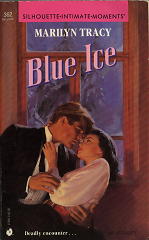
      Blue Ice. Silhouette, pb, 1990. Setting: Russia. [Art dealer Aleksandra Shashkevich’s most trusted friend is killed just as she is to purchase a collection of rare items from him.]

TRACY Blue Ice

      Code Name: Daddy. Silhouette, pb, 1996; Silhouette, UK, pb, 1997. [The aftermath of a hostage situation that ends with four dead.]

LeCOQ, TRACY (née HUBER). Ca.1954- . Pseudonym: Marilyn Tracy, q.v. Add maiden name. Lives in Roswell, NM. Under her married name and with her sister Holly Huber, the creator of the Santa Fe Tarot Deck. Their father, newspaper humor columnist Robert “Bob” E. Huber, was one of two hostages taken during a 1967 armed assault on the Rio Arriba County courthouse.

MAX MURRAY – The Right Honourable Corpse.

Farrar Straus & Young, US, hardcover, 1951, as The Right Honorable Corpse. Hardcover reprint: Unicorn Mystery Book Club, 4-in-1 edition, April 1951. US paperback reprint: Collier, 1965, as The Right Honorable Corpse. British hardcover: Michael Joseph, 1952. British paperback reprint: Penguin #1203, 1957.

MAX MURRAY

   Back when he was actively writing, which was up right up to his untimely death in 1956, Max Murray was never one of the big names in the field of mystery fiction. Even though he had a respectable string of detective novels in a ten year stretch between 1947 and 1957, he may not even have been in the second or third tier of big names, in spite of the fact that many of his books were reprinted in this country by Dell in paperback and either the Detective Book Club or the Unicorn Mystery Book Club in hardcover.

   The problem may have been that he never used a series detective. I’ve thought this of several mystery writers before, but I don’t believe I’ve ever quite come out and said it. I think it takes a steady focal point, a recurring detective character that the readers can feel comfortable with before they’ll take the author to heart as well.

   With obvious exceptions, of course. But authors like Andrew Garve and E. X. Ferrars, to take two rather disparate examples, were extremely prolific and presumably very popular in their day, are all but totally forgotten now. Ferrars did have a few recurring characters, but if you can name one without going and looking up her bibliography, you are the winner of today’s trivia contest, and truth be said, when Garve wrote as either Roger Bax or Paul Somers, he did have a couple of series characters. You’re this year’s trivia champion if you can name either.

   And I’m straying from the review of the book in hand, without making a very solid case for my conjecture, I’m afraid, but perhaps I’ll return to it some day.

   Here below is Murray’s entry in Crime Fiction IV, by Allen J. Hubin, along with a few facts about him, most of which I didn’t know, until I looked him up earlier today:

MURRAY, MAX(well). 1901-1956. Born in Australia; newspaper reporter in that country, the U.S., and England; scriptwriter and editor for BBC during WWII; married to author Maysie Greig.

      The Voice of the Corpse (Joseph, 1948, hc) [England] Farrar, 1947.

MAX MURRAY

      The King and the Corpse (Joseph, 1949, hc) [France] Farrar, 1948.
      The Queen and the Corpse (Farrar, 1949, hc) [Ship] See: No Duty on a Corpse (Joseph 1950).
      The Neat Little Corpse (Joseph, 1951, hc) [Jamaica] Farrar, 1950. Film: Paramount, 1953, as Jamaica Run (scw & dir: Lewis R. Foster).

MAX MURRAY

      The Right Honourable Corpse (Joseph, 1952, hc) [Australia] Farrar, 1951.
      The Doctor and the Corpse (Joseph, 1953, hc) [Singapore; Ship] Farrar, 1952.
      Good Luck to the Corpse (Joseph, 1953, hc) [France; Academia] Farrar, 1951.

MAX MURRAY

      The Sunshine Corpse (Joseph, 1954, hc) [Florida]
      Royal Bed for a Corpse (Joseph, 1955, hc) [England] Washburn, 1955.
      Breakfast with a Corpse (Joseph, 1956, hc) [Nice, France] U.S. title: A Corpse for Breakfast. Washburn, 1957.
      Twilight at Dawn (Joseph, 1957, hc) [Australia]
      Wait for the Corpse (Joseph, 1957, hc) [England] Washburn, 1957.

   All of his books were published in the UK, but when they were published in the US, strangely enough they were often published here first. And as befitting his background as a world news correspondent for the BBC, his books take place all over the world, with only two of them in Australia, where he was born. (And as it turns out, where he died, while back on a visit.)

MAX MURRAY

   The Right Honourable Corpse is one of the two, as it so happens, and from the description of (a) the closely knit circle of politicians, bureaucrats and diplomats in the small and isolated capital city of Canberra, and (b) life in the beautiful but desolate Australian out-of-doors, you’d think he’d lived there all his life. And, truth be guessed at, perhaps in his own mind, perhaps he did.

   Dead, but mourned only on the surface, is Rupert Flower, the powerful Minister for Internal Resources, poisoned to death during a piano concert going on in his home. Vain and vindictive — a dangerous combination — he was a man whose untimely passing was foreseen by many.

   Martin Gilbert, the pianist, turns out to be the central character, and I for one would have liked it immensely if he’d ever made a return appearance, which sad to say he did not. It turns out that he is a spy — a domestic one. He works undercover for the new Commonwealth Security Service, and it is not a job that he likes, and his extreme distaste only grows as the case goes on.

MAX MURRAY

   Bitter, sarcastic and outwardly enigmatic in tone and behavior, Martin discovers that friendship with the people he is observing does not go hand-in-hand with reporting those observations on to his superior, Sir David Reynolds. Nor is falling in love consistent with the role he is playing, another problem being that one of the possible suspects is also his best friend and in love with the same girl.

   The plot is quite largely secondary to the players, but it’s a good one. At the end, it’s also fairly clear why Martin Gilbert was never brought back for an encore. As a character himself, he gave all he was capable of in this one. I don’t think he had another murder case to be solved in him. He is used up, worn out, but never thrown away. No sir or ma’am. Tears seldom come to my eyes at the end of detective stories, but I’m not unwilling to say they did this time.

[UPDATE.] 10-28-08. Taken from a couple of emails sent by Jamie Sturgeon:

   Enjoyed your piece on Max Murray, a quick e-mail to point out correct title Wait for a Corpse. There’s a note on Crimefictioniv.com (Part 7) to say Twilight at Dawn was rewritten by his widow Maysie Greig (it says wife but should be widow) and published as Doctor Ted’s Clinic. It is possible that Twilight at Dawn is not criminous or only marginally at best.

   Also: In the entry for Maysie Greig in ADB (Australian Dictionary of Biography) Max Murray’s middle name is Alexander and year of birth as 1900. No separate entry for Max Murray.

« Previous PageNext Page »