Bibliographies, Lists & Checklists


RICHARD HALEY – Thoroughfare of Stones.

Headline, UK, paperback reprint, 1996. First hardcover edition: Headline, UK, 1995. No US edition.

   You may be more widely versed in British mystery writers who’ve never been published in the US than I am – and for whatever reason, there are a good many of them – but I have a feeling that Richard Haley may be as new a name to you as it was to me when I picked this book up to read.

   Here’s what the blurb inside the front cover says about the author:

    “Richard Haley was born and educated in Bradford, West Yorkshire, and has lived all his life in that area. He Began his working career in the wool trade, than undertook administration and personnel work for an international company producing man-made fibres, which gave him plenty of opportunity to travel.

    “Now retired, he lives with his wife in his native town, which inspired the background to this first John Goss novel, and he recently completed his second.”

   As for John Goss, he’s a private detective based in a town called Beckford, which confused me a little, as according to the Google map I have, Beckford and Bradford are quite a distance apart. No matter. Even though Thoroughfare of Stones has its flaws, it shows that Richard Haley should have started writing PI novels long before he did. (I grant you that living a life before taking up writing can often give you something to write about, and that may well be the case here. It should also be noted that Haley wrote three non-mystery novels before turning to PI fiction.)

   Before continuing further, though, here’s a list of all the John Goss novels, taken from Crime Fiction IV, by Allen J. Hubin:

      Thoroughfare of Stones (Headline, 1995)
      When Beggars Die (Headline, 1996)
      Written in Water (Hale, 1999)

RICHARD HALEY

      Fear of Violence (Hale, 2000)

   Haley has another PI character named Frank Crane, who so far has appeared in the following novels, not in CFIV, all having come out post-2000:

      The Murderer’s Son (Hale, 2006)
      Dead Dream Girl (Hale, 2007)
      Blood and Money (Hale, 2008)

RICHARD HALEY

   The only one of these I own is the one in hand, and let’s get to it, shall I? Goss is a PI more or less by default, having been turned down by the police force for health reasons. In Thoroughfare he’s hired by a wife who is wondering where her husband is wandering. He’s a a wealthy executive for large chemical firm’s local branch, and Goss has no problem asking (and getting) a thousand a week plus expenses.

   There is no other woman, though, as Goss soon discovers, but along the way I learned what the British idiom “getting his leg over” means. You can look it up. I won’t tell you. What he does learn is something worse in one sense, although Mrs. Rainger doesn’t seem to agree, but the local police force do. Or would if Goss would tell them, but he hesitates, and for a while all seems lost, as the “enemy” is quite capable of being as ruthless as any other gang of villains when cornered and at bay.

RICHARD HALEY

   I should also mention Fernande, a girl Goss meets and gets to know very well. She is almost-but-not-quite beautiful, sexy, flighty, mercurial, a liar, a consummate actress, and Goss simply can not resist her. In terms of the case he is working on, Fernande works in Rainger’s office, but otherwise she is not involved with any of his other activities. Nonetheless she is important both to Goss and (as they soon discover) to the predicament he puts them in …

   … the resolution to which takes up the last 150 pages of a novel containing just over 400 pages. I’ll wager that if you’re like me, they won’t take you much more than an hour to read, the pages will be turning so fast. This is a thriller novel, not a detective puzzle, make no mistake about it.

   Looking back once you’ve finished, you’ll realize that the opposition was just a little too efficient and deadly to make such foolish mistakes as they eventually did, but if they hadn’t – as we all well know – Goss and Fernande would never have survived past page 300.

   Lest you get me wrong, no PI novel containing more than 400 pages could be readable if the characters were not top notch and ably created, and in Thoroughfare of Stones, they are. It takes more than all-out action to make a believer out of me.

   When Ron Goulart came to Gary Lovisi’s paperback show this past Sunday, it was as a guest, and he had with him copies of Cheap Thrills and Good Girl Art available for sale and signing. See my previous post, and in particular Walker Martin’s comment in which he describes each of them more fully. He also praises them both very highly, a sentiment I wholeheartedly agree with.

   I asked Ron if he still had copies, and he says no, but they’re both easily available from Amazon and other Internet dealers as well as the publisher, hermespress.com.

RON GOULART Groucho Marx

   He does have copies of books in his “Groucho Marx, Detective” series, though, which he’ll gladly sell you for $20 each and pictorially autograph in his inimitable style (my words). You can email him if you’re interested, or just to say hello. (Click on the link.)

   None of the Groucho books ever came out in paperback, which is a criminal offense in itself. The only editions were hardcovers from St. Martin’s Press. Here’s a complete list. (You’ll have to ask him which ones he has.)

      Groucho Marx, Master Detective (1998)
      Elementary, My Dear Groucho (1999)
      Groucho Marx, Private Eye (1999)
      Groucho Marx and the Broadway Murders (2001)
      Groucho Marx, Secret Agent (2002)
      Groucho Marx, King of the Jungle (2005)

From my copy:

RON GOULART Groucho Marx

REVIEWED BY BOB SCHNEIDER:         


WILLIAM P. McGIVERN Night Extra

  WILLIAM P. McGIVERN – Night Extra.

Dodd Mead, hardcover, 1957. Paperback reprints: Pocket 1193, January 1958; Pyramid V3795, 1975; Berkley 11190, 1988.

   A big city reporter (which McGivern was at one time) investigates the murder of a woman whose body was found in the house of a reform mayoral candidate. It soon becomes clear that the entrenched political machine has engineered a frame-up and appears likely to succeed in destroying a feared political opponent.

   The novel is set in an unnamed East Coast city that suffers from pervasive corruption. Anyone who fights against the corruption places their job, if not their life, in jeopardy. Crusading reporter Sam Terrell spends much of the story trying to convince witnesses to come forward and tell what they know. He also must navigate through the city’s numerous layers of civic, political and bureaucratic corruption in order to find allies who might advance his investigation.

WILLIAM P. McGIVERN Night Extra

   One of the themes that McGivern explores is how ingrained and insidious corruption can become if left unchecked and unchallenged. Many of the enablers of corruption believe themselves to be good people and only realize their complicity after Terrell points it out to them.

   Will enough citizens stand up to the machine and do the right thing? Will Terrell succeed in his quest to save the reform-minded politician? Pick up a copy of this book from an Internet bookseller or at your local used bookstore. Sadly, few if any of this once respected mid-twentieth century crime writer’s books are in print today.

***

         Bibliographic data [Taken from Crime Fiction IV, by Allen J. Hubin] —

McGIVERN, WILLIAM P(eter). 1922-1982; pseudonym: Bill Peters.

But Death Runs Faster (n.) Dodd 1948

WILLIAM P. McGIVERN

Heaven Ran Last (n.) Dodd 1949
Very Cold for May (n.) Dodd 1950
Shield for Murder (n.) Dodd 1951
The Crooked Frame (n.) Dodd 1952
The Big Heat (n.) Dodd 1953
Margin of Terror (n.) Dodd 1953
Rogue Cop (n.) Dodd 1954

WILLIAM P. McGIVERN

The Darkest Hour (n.) Dodd 1955
The Seven File (n.) Dodd 1956
Night Extra (n.) Dodd 1957
Odds Against Tomorrow (n.) Dodd 1957
Savage Streets (n.) Dodd 1959
Seven Lies South (n.) Dodd 1960
Killer on the Turnpike (co) Pocket Books 1961
The Road to the Snail (n.) Dodd 1961
A Choice of Assassins (n.) Dodd 1963
The Caper of the Golden Bulls (n.) Dodd 1966
Lie Down, I Want to Talk to You (n.) Dodd 1967

WILLIAM P. McGIVERN

Caprifoil (n.) Dodd 1972
Reprisal (n.) Dodd 1973
Night of the Juggler (n.) Putnam 1975

WILLIAM P. McGIVERN

-The Seeing [with Maureen McGivern] (n.) Tower 1980
Summitt (n.) Arbor 1982
A Matter of Honor (n.) Arbor 1984

PETERS, BILL. Pseudonym of William P. McGivern.

Blondes Die Young (n.) Dodd 1952

GRIF STOCKLEY – Probable Cause.

Ivy, paperback reprint; 1st printing, December 1993. Hardcover edition: Simon & Schuster, October 1992.

Grif Stockley

   According to the information provided inside the back cover of Probable Cause, the second of his two recorded adventures, Grif Stockley was (in 1993) “an attorney for Central Arkansas Legal Services, which was funded by the federal government to provide representation to indigents in civil cases.”

   As an author, his series character is Gideon Page, a middle-aged attorney whose first case after striking out on his own is highly is highly charged with racial overtones. And undertones, too, for that matter. His client is a black psychologist who’s accused of killing a retarded girl he was administering electric shock therapy to with a cattle prod. Why is the case so difficult? The man was having an affair with the wealthy girl’s mother, who is white.

   Large portions of this novel are taken up with detective work, but for the most part what this is an intimate, inside look at how the justice system actually works, with lots of snapshot character studies of the people who either try to make it work, or (in some cases) try to make it work on their behalf.

   Page’s life with his precocious and sensitive high school daughter (Rosa, her mother, is dead) and his platonic love affair with Rainey, a social worker at a local state hospital, are essential parts of the story, more than background matter, although not part of the case itself.

   This is the legal equivalent of a multi-faceted and well-diversified police procedural, in other words, as Page divides his time among his other clients, colleagues and adversaries, told by someone who’s been there. One suspects with some amount of surety that some of Stockley’s own clients, colleagues and adversaries may find more than a little similarities between themselves and some of the people populating this book.

   There’s very little spelled out in black and white, pun intended, including the ending, nor as to what might happen next in Gideon Page’s life. I for one will be looking eagerly for more in the local used book stores. Unaccountably, this is the only one of his adventures that I own.

   Thanks to Crime Fiction IV, by Allen J. Hubin, here are the others:

STOCKLEY, GRIF. 1944- .
      Expert Testimony. Summit Books, 1991.

Grif Stockley

      Probable Cause. Simon & Schuster, 1992.
      Religious Conviction. Simon & Schuster, 1993.
      Illegal Motion. Simon & Schuster, 1995.
      Blind Justice. Simon & Schuster, 1997.

   And if you’re interested, here’s a link for more information on Grif Stockley himself.

NANCY PICKARD – No Body.

Pocket, paperback reprint; 1st printing, November 1987. Hardcover edition: Charles Scribner’s Sons, October 1986.

   I can sum up one impression of this book in one short sentence: More, I think, about funeral homes than I wanted to know.

   This was the third appearance of Jenny Cain, Nancy Pickard’s first series character, and the first to be published in hardcover, the previous two being paperback originals from Avon. For the record, here’s a list of all of Jenny’s full-length cases. (There are no short stories about her, as far as I’ve been able to discover.)

      Generous Death. Avon, pb, 1984.

NANCY PICKARD

      Say No to Murder. Avon, pb 1985. Winner of the first Anthony Award for Best Paperback Original Mystery.
      No Body. Scribner, 1986. Nominated for an Anthony.
      Marriage Is Murder. Scribner, 1987. Winner of the Macavity Award for Best Mystery Novel.
      Dead Crazy. Scribner, 1988. Nominated for both the Agatha and Anthony awards.
      Bum Steer. Pocket, 1990. Winner of the Agatha Award for Best Mystery Novel.
      I. O. U.  Pocket, 1991. Edgar Nominee for Best Mystery Novel, Agatha Winner for Best Mystery Novel, Macavity Winner for Best Mystery Novel.
      But I Wouldn’t Want to Die There. Pocket, 1993.
      Confession. Pocket, 1994.
      Twilight. Pocket, 1995. Nominated for an Agatha Award.

NANCY PICKARD

   I may have missed some of the nominations the books in the series have gathered, but even so, it’s an impressive list.

   The title of Twilight suggests that it may be the last in the series. Given that 13 years have gone by since it came out and Pickard has begun another series in the meantime (one featuring true-crime author Marie Lightfoot), Jenny may have packed up her sleuthing duties for good.

NANCY PICKARD No Body

   Jenny is the director of the Port Frederick Civic Foundation, which means that she knows all the important people in a small town. Also helping to explain why he has such success in getting involved (and solving) crimes of murder is the fact that she lives with Detective Geof Bushfield of the local police department. (I don’t believe it was ever stated in No Body, but Port Frederick is in Massachusetts. While reading it, I was under the slight assumption that it was in Maryland.)

   No Body is strong on humor, but other books in the series become gradually darker, or so I’ve been led to believe. Nonetheless, I think the Jenny Cain books fall in the forefront of the cozy, malice domestic movement in which amateur detectives, most of them women, have gradually taken over the non-thriller portion of the mystery publishing world today, filled as it is with quilters, herbalists, catsitters, wedding planners and so on.

   One of Jenny’s problems to solve at this book is that of 133 missing bodies in a 19th century and now closed cemetery. But while investigating the archives of the Harbor Lights Funeral Home, a more serious current crime is committed — the body of a dead man’s secret lover is found in his cover just before it’s put to earth.

NANCY PICKARD No Body

   Many of the secondary characters presumably appeared in the first two books in the series. They seem familiar enough to the author that she doesn’t feel the need to overly describe them or get them involved. For the most part they stay in the background, allowing a full focus to be placed on solving the murder. Good news, as I far as I am concerned.

   Geof is called out of town for most of the book, in fact, allowing Jenny nearly free rein in tackling the case, not always successfully, adding immensely to the comic effect. The ending is quite a spine-tingler — caused by Jenny’s not quite thinking things through — but the story becomes quite a page-turner at the conclusion, there’s no doubt about that at all.

[FOLLOW-UP.]  Who would I pick to play Jenny Cain in the movies? Maybe a younger Shirley MacLaine. As for Lew Riss, the disheveled dope-smoking local reporter with dreams of a Pulitizer (and a hopeful but unrequited yearning for Jenny), perhaps Richard Dreyfuss would do.

   In the process of cataloging my collection of western paperbacks, I’ve been putting together checklists of various authors to help let me know which ones I have and which ones I’m missing.

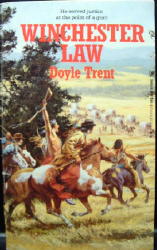
   I’ve done such lists for Gordon Shirreffs and Tom West, although neither one is online yet. I’ve just completed one for Doyle Trent, and I’ve just finished setting up the webpage for it. (I’ll add the other two later this month when I’m not quite so busy, and work on additional ones as time allows.)

   If you’d care to take a look, you can find Trent’s page here. It’s a work in progress. Additions and correction are most certainly welcome.

   Needless to say, I’ve added as many covers as I’ve had access to. (Even though I may have a book, it does not mean that it’s accessible.) Here are a couple of them:

DOYLE TRENT      DOYLE TRENT

J. R. RIPLEY – Lost in Austin

Worldwide, paperback reprint; 1st printing, April 2002. Hardcover edition: Longwind, May 2001.

RIPLEY Lost in Austin

   If you’re interested in the down-and-dirty behind-the-scenes aspects of the country music business, then this is the mystery for you. If not, if you’re more interested in a detective story, this second adventure of rhythm guitarist Tony Kozol will have you scratching your head, looking for more. Taken on by the Clint Cash band when a broken arm forces his predecessor to the sidelines, Tony soon finds himself once again in the starring role on a murder scene. (An earlier appearance was in Skulls of Sedona, also in paperback from Worldwide.)

   The dead man is a roadie, a member of Clint Cash’s crew, but the story really begins with a wild-eyed young Mexican trying to find his sister, and he claims the murder victim was the person who allowed her to go backstage. No one else, by the way, says they ever saw her.

   What with the non-stop partying going on — mostly booze — and the nonchalant after-hours sexual dalliances, even though Tony finds that the detective in charge is an old college buddy named Izzie Ibanez, it takes a while for any serious questions to be asked. (In a note I jotted down for myself, I can say with some certainty that this point in time occurred on page 184. There are 253 pages in all.)

   So, light and frothy is the order of the day, with a huge helping of inept police work on the side. (On something of a positive note, some of the more touristy attractions of the city of Austin are carefully pointed out.) It’s a readable combination, but all in all, for devout mystery fans, there’s little here to sink your teeth into.

— May 2002 (slightly revised)


[UPDATE] 10-01-08.   Since this review was written, I’ve discovered that J. R. Ripley is the pen name of pop rock musician Glenn Meganck. This is not surprising, since the music business was so authentically portrayed in Lost in Austin. A second series under the Ripley byline is totally different. It takes place in St. Barthelemy in the French West Indies, and features Charles Trenet, an inexperienced police officer newly transferred from the Gendarmerie Nationale.

       Bibliography:

   The TONY KOZOL mysteries:

Stiff in the Freezer. Beachfront, hc, 1998.
Skulls of Sedona. Beachfront, trade pb, 1999. Worldwide, pb, 2001
Lost in Austin. Longwind, hc, 2001. Worldwide, pb, 2002.
The Body from Ipanema. Longwind, hc, 2002. Worldwide, pb, 2003.
Bum Rap in Branson. Beachfront, hc, 2004.

RIPLEY Bum Rap in Branson


   The GENDARME CHARLES TRENET mysteries:

Murder in St. Barts. Beachfront, hc, 2003.
Death of a Cheat. Beachfront, hc, 2006.

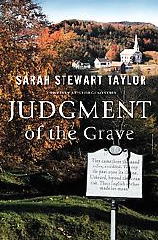
SARAH STEWART TAYLOR – Judgment of the Grave.

St. Martin’s; reprint paperback; 1st pr., Aug 2006. Hardcover edition: St. Martin’s; July 2005.

   It is impossible to keep up. When I go looking for whatever book to read next, I often pick one out at random, and invariably it’s the second or third in a series, almost never the first. (I used to teach college courses in probability, so I’m not complaining. I know exactly what the odds are, and they’re against me.)

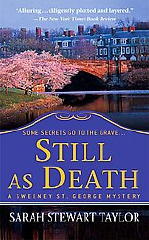
   Judgment of the Grave is the third of four of the recorded adventures of Harvard-based art historian, Sweeney St. George. It’s early in this review, instead of at the end, where I often do it, but here’s a list of all four. All came out first from St. Martin’s in hardcover, then in paperback:

      O’ Artful Death. 2003 / June 2004.

SARAH STEWART TAYLOR

      Mansions of the Dead. July 2004 / May 2005.
      Judgment of the Grave. July 2005 / Aug 2006.
      Still As Death. Sept 2006 / Oct 2007.

   And in spite of excellent reviews and good sales rankings on Amazon, these four appear to be all there’s going to be. Sarah Stewart Taylor’s website does not seem to have been updated since October 2007 and the last entry in her blog is dated May 2, 2007.

SARAH STEWART TAYLOR

   That’s a shame. In spite of some quibbles which I’ll get to shortly, I enjoyed Judgment of the Grave quite thoroughly. So well, in fact, that if I knew where my copy was, I’d read Still As Death next, just to find out what happens to Sweeney and her romantic difficulties in her followup adventure. And failing that, go back and read one or both of the first two (see above), just to learn how all of her romantic difficulties began in the first place.

   Quibbles: These very same Sweeney’s romantic difficulties — and all of the problems the other characters have in Judgment of the Grave. They’re a major part of the story, and they tend to overpower the detective story involved.

   But what they also help create is a dark, atmospheric tale filled with angst, anxiety and sorrow, beginning with the opening scene (after a short prologue) in which Sweeney meets a young 12-year-old boy with leukemia while she’s researching gravestones in a Concord MA cemetery.

   Cambridge police detective Tim Quinn, whom Sweeney has met before and seems to have a history with, meets her again as he follows up on a missing person’s report — a professor having a similar interest in gravestones and the history of the Revolutionary War has disappeared after taking part in a battle re-enactment up near Concord. Quinn’s wife committed suicide, we learn, and he’s forced to take his 10-month-old daughter along with him. Sweeney is a multi-tasker. She babysits and helps solve the mystery at the same time.

SARAH STEWART TAYLOR

   Meanwhile Sweeney’s almost-but-not-quite-affair with Ian has been put on hold while he’s home in England. Phone calls every night. I don’t quite understand where Toby fits in, but he somehow seems to have overnight privileges.

   Also often crowding the mystery aside are long expository pages on the War of Independence, how it was conducted, how not all of the colonists were fighting for freedom, and how much the British depended on spies.

   The latter may be the reason for the present day killings, or perhaps not, because all of the other character’s marriages are either broken or on the verge, and jealousy or revenge are also excellent reasons for murder. A veritable Peyton Place, without the same degree of notoriety or sensationalism.

   I suppose you already know, having gotten this far, whether or not you will ever read any of the books in the series, but nonetheless, with a bit of pruning down and firming up, and filmed in black-and-white, or with dark, shadowy indoor scenes contrasted with the bright colors of an autumn New England sky, Judgment to the Grave would be as noirish as they come. It’s not Los Angeles, but there are a lot of dark secrets in Massachusetts too.

[COMMENT.]  Later the same day. I’m embarrassed to point this out, but while searching for some more information about the author on Google, I discovered that I’d totally forgotten that Walter Albert reviewed this same book here on Mystery*File, and not too long ago.

   He liked it too.

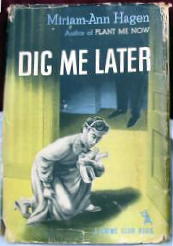
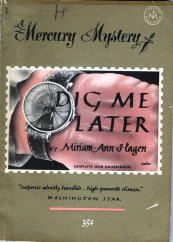
DIG ME LATER – Miriam-Ann Hagen.

Mercury Mystery 157; digest-sized paperback; no date stated, but generally accepted as being 1951. Hardcover edition: Doubleday/Crime Club; 1949. Hardcover reprint: Detective Book Club, 3-in-1 edition, August 1949.

MIRIAM-ANN HAGEN Dig Me Later

   I mean no offense to anyone named Hortense, or who knows anyone with the name Hortense, but it IS an old-fashioned name, I believe you have to admit, and a series of mysteries with a leading character named Hortense Clinton is going to be considered light-hearted from the outset, whether it is true or not.

   But true it is, or at the least, this second of three mysteries she was involved in certainly is. When a murder occurs across the hall to her in her Manhattan apartment, Hortense accidentally confronts the killer with her night clothes on, blemish cream on her face, chin strap on, and a band across her forehead.

   Of course squatting down on the floor as she was, all she could see before she was knocked unconscious was the killer’s pant legs and shoes. But if the killer was the dead man’s nephew making his getaway as she was putting her milk bottles out, why did he take the time to take her diamond watch?

   As it happens, the answer to that question is clear to any reader who’s been paying attention and has read Chapter One carefully, so anyone who reads detective stories for the detective work in them isn’t going to find much of any substance to mull over in this one.

   But the characters are what might keep you reading, as the did me, somewhat wacky and somewhat confusing, or confused themselves as to why so many of them end up with Hortense in a resort hotel in Nova Scotia where she flees when her notoriety in Manhattan proves to be too much for her.

   The killer is obvious enough in retrospect, but there are plenty of false trails to be followed and examined carefully before the final denouement. Most – but not all – the questions are answered, and Hortense Clinton survives to be involved in another murder another day. (See the bibliography below.)

   But before getting to that, I didn’t do any research on the author before beginning the book – I seldom do, as I prefer to let the book speak for the author, not his/her reputation or background. I almost never even read the blurbs on the jacket flaps or the back cover.

   So it took me a while to place Ms. Hagen’s style of writing, even though I have to admit that I should have known. It’s a style that feels itself necessary to explain the smallest detail, to spell out things so that the reader will fully understand, and yet is smooth enough, and clever enough to stay interesting. I am not denigrating it in any way. It’s a style of writing I most certainly and definitely admire.

MIRIAM-ANN HAGEN Dig Me Later

   I wish I could explain better what I mean, but here’s a sample, and maybe that will help. Picking a page and a selection at random from the first chapter, take this as an example. Hortense is being asked by the police to identify the nephew’s shoes:

    Although she wouldn’t raise her eyes above the feet she was asked to identify, she had a feeling that the simple monosyllable had been a blow to the young man and that he had stiffened under it. “Yes,” she repeated hastily, “like this man’s or like most men’s. You could go out in the street and within ten minutes bring in a hundred men, and I’d look at their feet and have to say yes, about that size.”

    “Sure, Miss Clinton,” said the detective. “Sure. We don’t expect you to say it was this man’s feet you saw. That would be asking too much. We just want you to tell us if it could have been this man’s feet, that the ones you saw weren’t so much bigger or smaller or anything that you’d know they couldn’t have been his or even that you’d think maybe they couldn’t be his.”

    They worked at it, trying to pin her down to some sort of statement, but Hortense refused to say more that what she could say with certainty, until finally, in a burst of frankness, they told her exactly what they wanted of her, and to that she had to give them the answer that satisfied them….

   Which was, to cut the story off short, that she wouldn’t later be able to testify in court that it couldn’t have been the man that the suspected of being the killer.

   I don’t know if that was enough of a sample for you to tell, and maybe you never heard of Aaron Marc Stein, also known as George Bagby and Hampton Stone, but the writing is identical. But if you have, then I’m sure you spotted the similarity, and probably even before I made the connection. And if you’ve been paying attention to this blog, as I should have been, or at least my only claim for ignorance was that I forgot, in one of Mike Nevins’s columns for M*F, he happened to have mentioned in passing that Miriam-Ann Hagen was Aaron Marc Stein’s sister.

   The title comes from a bit of jazzy jargon from the 1940s that I don’t think was used appropriately in the novel, but to expand the context a little, take a look at the three mystery novels that Miriam-Ann Hagen wrote, courtesy of Crime Fiction IV, by Allen J. Hubin:

HAGEN, MIRIAM-ANN (1903-1984)
       Plant Me Now (n.) Doubleday 1947 [Hortense Clinton; Train]
       Dig Me Later (n.) Doubleday 1949 [Hortense Clinton; Canada]
       Murder-But Natch (n.) Doubleday 1951 [Hortense Clinton; Ship]


[UPDATE] 09-28-08.  I asked Mike Nevins to read my comments and then to consider the possibility that Aaron Marc Stein might have written the Hortense Clinton books under his sister’s name. Here’s his reply. I’m sure he’s right, but the thought lingers on…

   Interesting review! Aaron and Miriam were exceptionally close siblings, and you’re absolutely right that she modeled her style and structure on his. He must have read those books before publication and may have edited them a bit, but I have no reason to think he ghosted them for her.

          Best,

             Mike

   If you check back, it was a year ago yesterday that I announced here on the blog that I’d uploaded an article by John Pugmire about one of his favorite subgenres of mystery fiction, Locked Room Mysteries. (Mine, too, of course.)

   It’s largely a list of such stories considered to be the best by a couple of noted panels of experts — I’ll leave the details to the article itself — along (and here is where I came in) with cover images of as many of them as John and I could come up with — or nearly 100 or so.

   Some time ago — and longer ago than I’d rather admit — John sent me images of five more covers, one an improvement over one that we’d used to fill a gap, plus four that are brand new. I’ve finally gotten around to doing what I do, and that’s get them online at last.

   The page is on the primary M*F website, and even if you’ve seen it before, I think it’s worth a look. Here’s the URL: https://mysteryfile.com/Locked_Rooms/Library.html, and here are a couple of the newly added covers:

Locked Room Mystery      Locked Room Mysteries

« Previous PageNext Page »