Bibliographies, Lists & Checklists


MARY FITT – Mizmaze.

Penguin, UK, reprint paperback: 1961. Hardcover editions: Michael Joseph, UK, 1959; British Book Centre, US, 1959.

   Perhaps it’s wrong-end-to in doing so, but I think I’ll begin this time by listing all of mysteries that Mary Fitt wrote, either under that name or her own, plus one other pen name. (I think you may be as surprised as I was at how long a list it turns out to be.)

   Courtesy, then, of Crime Fiction IV, by Allen J. Hubin:

FITT, MARY. Pseudonym of Kathleen Freeman, 1897-1959; other pseudonym: Stuart Mary Wick.

Murder Mars the Tour (n.) Nicholson 1936 [Austria]
Three Sisters Flew Home (n.) Nicholson 1936 [England]

Mary Fitt

Bulls Like Death (n.) Nicholson 1937 [Berlin]
The Three Hunting Horns (n.) Nicholson 1937 [France]
Expected Death (n.) Nicholson 1938 [Supt. Mallett; England]
Sky-Rocket (n.) Nicholson 1938 [Supt. Mallett; England]
Death at Dancing Stones (n.) Nicholson 1939 [Supt. Mallett; England]
Murder of a Mouse (n.) Nicholson 1939 [Supt. Mallett; England]
Death Starts a Rumor (n.) Nicholson 1940 [Supt. Mallett; England]
Death and Mary Dazill (n.) Joseph 1941 [Supt. Mallett; England] US title: Aftermath of Murder.
Death on Herons’ Mere (n.) Joseph 1941 [Supt. Mallett; England] US title: Death Finds a Target.
Requiem for Robert (n.) Joseph 1942 [Supt. Mallett; England]
Clues to Christabel (n.) Joseph 1944 [Supt. Mallett; England]
Mary Fitt

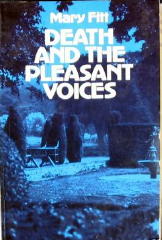
Death and the Pleasant Voices (n.) Joseph 1946 [Supt. Mallett; England]
Mary Fitt

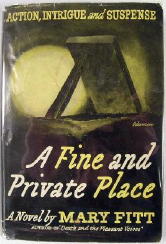
A Fine and Private Place (n.) Macdonald 1947 [Supt. Mallett; England]
Mary Fitt

Death and the Bright Day (n.) Macdonald 1948 [Supt. Mallett; England]
The Banquet Ceases (n.) Macdonald 1949 [Supt. Mallett; England]
Pity for Pamela (n.) Macdonald 1950 [England]
An Ill Wind (n.) Macdonald 1951 [Supt. Mallett; England]
Death and the Shortest Day (n.) Macdonald 1952 [Supt. Mallett; England]
The Night-Watchman’s Friend (n.) Macdonald 1953 [England]
Love from Elizabeth (n.) Macdonald 1954 [Supt. Mallett; England]
The Man Who Shot Birds and other tales of mystery and detection (co) Macdonald 1954 [Supt. Mallett; England]
Sweet Poison (n.) Macdonald 1956 [Supt. Mallett; England]
The Late Uncle Max (n.) Macdonald 1957 [Mediterranean Island]
Case for the Defence (n.) Macdonald 1958 [England]
Mizmaze (n.) Joseph 1959 [Supt. Mallett; England]
There Are More Ways of Killing… (n.) Joseph 1960 [England]

FREEMAN, KATHLEEN. 1897-1959. Pseudonyms: Mary Fitt & Stuart Mary Wick.

The Intruder, and other stories (co) Cape 1926
Gown and Shroud (n.) Macdonald 1947 [Academia; England]

WICK, STUART MARY. Pseudonym of Kathleen Freeman, 1897-1959; other pseudonym: Mary Fitt.

And Where’s Mr. Bellamy? (n.) Hutchinson 1948
-The Statue and the Lady (n.) Hodder 1950

   Kathleen Freeman herself was a British classical scholar who attended the University College of South Wales and Monmouthshire in Cardiff, where she was appointed Lecturer in Greek in 1919, but resigning from the University in 1946.

   As a writer of detective fiction, the author’s primary series character, Supt. Mallett, began his career in 1938, when the Golden Age of Detection was in full sway, and did not end until this book, Mizmaze, in 1959. Quite a career, 18 books in all, for a fictional character whom I’m sure none but the most devout aficionados remember. (The latter is a category which I unhappily confess does not include me, as this is the first book by Mary Fitt that I’ve ever read.)
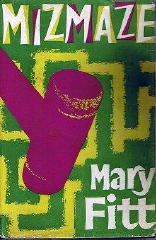
MARY FITT Mizmaze

   And in spite of some serious problems I found with the book, it will not be my last. Some of her mysteries were published in the US by Doubleday’s Crime Club imprint, for example, and while I have not read them, I do have them.

   But get to the book itself, shall I? It’s one of those old-fashioned detective stories in which the murder takes pace (or already has taken place) in Chapter One, and there’s nothing else in the book but the solving of the crime.

   Well, that and sorting through all of the relationships between the characters, some of which is relevant to the case and some of it not, but it’s all part and parcel of solving the crime, is it not?

   Dead is the patriarch of the Hatley family, found with fatal head injury in the center of the maze at his home, both called Mizmaze. The murder weapon: a croquet mallet. Surviving family: two daughters, one Alethea (Lethy), who never can be relied on to tell the truth, her father’s pride and joy, the other Angela, a devilish girl who her father seems to have intensely disliked. A dysfunctional family: yes, no doubts about it.

   Alethea’s former husband is also visiting upon the fatal weekend, along with his new wife, a former actress more than 30 years older than he. (The victim had much to do with the breakup of his daughter’s marriage.) Two others are possible suspects: a 6 foot 8 giant with pituitary problems, in love with Althea but Angela in love with him, plus his mother.

   More than you wanted to know, I suppose. Solving the case are Superintendent Mallet and his close friend, Dr. Fitzbrown, but truth be told, it is the latter who does the bulk of the questioning of the suspects.

   From the summary so far, I imagine that you already have a good grasp of the story line (and more importantly, whether or not this is a book for you.) And by the way, that the deadly blunt instrument was a mallet did not escape Fitzbrown’s attention, either. He comments on it immediately.
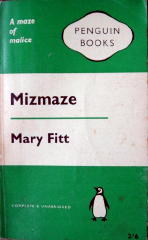
MARY FITT Mizmaze

   Problems, as previously alluded to: lapses in continuity in the telling. On page 23, Fitzbrown says that Hatley was followed by the killer into the maze. On page 24, he clearly states that someone with deadly intent was waiting for Hartley at or near the center of the maze.

   More. On page 132 Horick (the giant) comes downstairs from his sickbed to confront the rest of the entourage. On page 143 he comes down again as if for the first time, surprised to see them all there.

   There is also a previously never-mentioned spouse of one of the participants who shows up without notice at nearly the last moment, and a killer who suddenly turns into a madman (or woman) at the end, claiming responsibility and threatening to kill all of the others, the pair of sleuths included, only to fall victim himself (or herself) to a deus ex machina which is as amusing as it is fortuitous.

   And there’s the key right there, only I didn’t realize it until I was done, and indeed I did finish it, flaws and all, staying up 30 minutes past my planned bedtime to do so. I’m sure it wasn’t meant to be so, but if I were to be asked about an unintentional spoof of Golden Age detective stories, right now Mizmaze would be an example that I’d point to first.

   I suppose that may sound unkind. I don’t mean it to be, and so far I can’t explain my attraction to this book any better than I am. The characters are more than eccentric — you might even call them just plain looney — but they’re nonetheless real enough: devious, worried, clever, burdened down by life and love — or entirely human, in other words.

   Even Dr. Fitzbrown finds one of the women attractive enough to spend a short minute with her in a kiss, even though she’s still very much a suspect — and I wonder how that turns out. The book ends abruptly with the killer’s downfall, and this is the last appearance in print of either sleuth.

[COMMENT] 08-21-08. I have discovered that I am not the only mystery fan who has struggled with Mary Fitt and her detective fiction. On the John Dickson Carr forum, I have found a long post by Xavier Lechard in which he tries to come to grips with her books. The following except should demonstrate, and still be within the bounds of fair usage:

    “But did Fitt write Golden Age mysteries? As far as chronology is concerned, there isn’t a doubt about it. Stylistically, however, the matter is much more debatable. If we admit that Golden Age mysteries are about a crime and its resolution through logical reasoning by an amateur or professional detective, then we have a problem with Death and Mary Dazill which is almost devoid of any detection, as well as with Clues to Christabel which has no detective in the proper sense….”

   And may I recommend Xavier’s own blog to you? Entitled At the Villa Rose, it’s jam-packed full of serious commentary and replies on the state, status and structure of the Golden Age detective story.
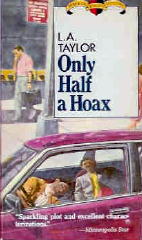
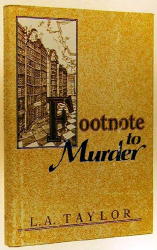
L. A. TAYLOR – Only Half a Hoax.

Walker; paperback reprint, 1986; hardcover edition, 1983.

   First of all, let me say it is about time [1987] Walker started reprinting some of their American detective fiction in paperback. In the past four or five years Walker seems to have come from nowhere to become of one of the leading publishers of hardcover mysteries, most of which seems to have been ignored by other paperback companies.

   (They have been reprinting their British mystery fiction in paper for several years now, but for the most part, I find myself too easily bored with the general run of “thriller” this entails.)

L. A. TAYLOR

   I also have to say that I’m glad they chose to include the Taylor books in their first batch of releases. (His/her second book, Deadly Objectives, is also now out.) I have to confess that I had the chance to pick this one earlier in hardcover, and I turned up my nose at the chance. I mean, after all, a detective whose hobby is chasing down reports of UFO’s in the Minneapolis area?

   No offense intended to Minneapolitans. I’m sure it must be a terrific place to live, in spite of the comments of J. J. Jamison (the aforementioned detective) sometimes to the contrary. But flying saucers and detective fiction seems such an incongruous combination, I couldn’t imagine myself reading such balderdash, much less enjoying it.

   But enjoy this book, I did. Even though J. J. (his full-time job a computer engineer) is pretty much a naive sort of neophyte at the detective business, the case he enters into is breezily told, and is easily recognized as a throwback to the wacky cases of homicide that were exceedingly popular back in the 1940s.

   And reflecting back on it now, the plot doesn’t really make a lot of sense. If you’re planning a murder, why should your first impulse be to set up an elaborate fake UFO in order to draw attention away from the act you’re about to do?

   When J. J. investigates and finds the body, he’s first suspected of complicity, then becomes the killer’s target. Chronologically: (1) his brakes are tampered with, (2) he is nearly run down while bike riding, (3) his house is set on fire, and (4) he is dumped in the tiger cage of the Minnesota Zoo. Maybe I missed one.

   The point of all this is to keep the reader’s mind off the fact that there really are very few suspects, and the clues are a little too obvious to withstand direct attention. It takes the last ten pages to wrap everything up is well, which is far too long for a mystery properly told. Even in the 40s, though it took time to make the illogical satisfactorily plausible.

   In spite of my earlier comments, Taylor does well at this sort of thing, and throws in a little bit of surprise to boot.

— From Mystery.File 1, January 1987 (slightly revised).


[UPDATE] 08-15-08. Several things are clear from this review, reading through it this evening for the first time myself in over eleven years. First of all, and most importantly, it is clear that I did not know whether or not L. A. Taylor was male or female. It is much easier to answer questions like this now, what with the Internet, and the handy assist of Al Hubin’s Revised Crime Fiction IV:

TAYLOR, L. A. [Laurie Aylama Taylor Sparer]. 1939-1996. Series character: JJ = J. J. Jamison

      Footnote to Murder. Walker 1983.   JJ

L. A. TAYLOR

      Only Half a Hoax. Walker 1983.   JJ
      Deadly Objectives. Walker 1984.   JJ
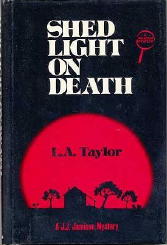
      Shed Light on Death. Walker 1985.   JJ

L. A. TAYLOR

      Love of Money. Walker.   1986
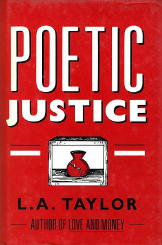
      Poetic Justice. Walker.   1988

L. A. TAYLOR

      A Murder Waiting to Happen. Walker 1989.   JJ   [set at a Minnesota SF convention]

   Besides the mysteries listed above, she also wrote Blossom of Erda, a science fiction novel; Cat’s Paw, a fantasy; and (possibly) Women’s Work a collection of both SF and fantasy. (I’ve not yet found confirmation that the latter was ever published.)

   It therefore now comes as no great surprise to find the SFnal elements that are so obviously present in Only Half a Hoax. As you’ve read, I found them semi- objectionable in 1986. I’d like to think I’d find them less so now.

   After her death Ms. Taylor’s husband had her final novel published: The Fathergod Experiment, described online as “a quirky, complex, interesting tale that combines court intrigue with mysteries both scientific and criminal, and a thoroughly satisfying story of an orphan rising from obscurity and oppression.”

   I’ve forwarded a more complete description to Al. It appears that the books ought to be included in CFIV, at least marginally. (Added later: He agrees. The book will appear in Part 29 of the online Addenda.)

   Also of note in the review, at least to me, was my mammoth snobbish putdown of British thriller fiction. You can blame my younger self for that, but not this present fellow who I am now.

ROGER L. SIMON – California Roll.

Warner, paperback reprint; 1st pr., June 1986. Hardcover edition: Villard, March 1985. Trade paperback: I Books, Jan 2001.

   I think what I will do is to quote private eye Moses Wine in his own words. The first three paragraphs of California Roll will do as much to set the stage as anything that I could say:

Roger L. Simon

   I never sold out before because nobody ever asked me. In all it took around twenty minutes. It would have taken around three, but the guy on the other end was so profusely apologetic, he wouldn’t give me a chance to say yes.

   Actually, if had any idea of my then depressed state, he might have known that all he had to do was whistle. I was in the midst of a pronounced mid-life crisis somewhere between Gail Sheehy’s Passages and the advice column of a minor metropolitan daily. I felt like a human cliché. Most of the time I would sit around in my room in my bathrobe, listening to Leadbelly albums and bemoaning my situation: three months shy of my fortieth birthday and still a private detective with nothing to show for it but a leaky two-bedroom cottage on Wonderland Drive and a battered Porsche with a sever transmission problem. My political ideals, when I could remember them, felt like the rehash of a twenty-year-old Marcuse paperback. My work, when I had some, was boring. And my body, however hard I fought against it, was beginning its slow, inexorable slide to oblivion.

   Beyond this, my kids were growing up and didn’t want much more to do with me than an occasional overpriced visit to a sushi bar, while my ex-wife, who had dropped out of law school to live with a movie producer with a chalet in Vail, still asked for alimony. And to top it all off, my own lovelife was in the doghouse since the glorious Louise went back to her nitwit stockbroker husband after three years because, after all, she had her security to think about. And all around me my sixties buddies were getting rich. “Fuck it, Moses,” they would say. “Reagan’s in the White House. If you can’t lick ’em, join ’em!”

   Moses was, as far as I have been able to determine, the first counter-cultural PI in the books, starting out as a pot-smoking California hippie detective in 1973 and having a whole career of life-altering adventures from that point on, but always the same person, always with new problems, or so his books have been described to me. (I’m relying here on some of the comments I found after a quick Google through the Internet, with (as usual) Kevin Burton Smith at thrillingdetective.com having the most concise but illuminating things to say.)

   Here’s the entire list of Moses Wine adventures. I’ve read only two of them, I’m sorry to say.

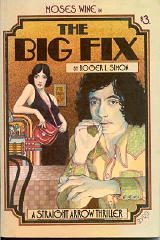
The Big Fix. Straight Arrow, trade pb, 1973.
   Andre Deutsch, hc, UK, 1974.
   Pocket, pb, March 1974.
   Pocket, pb, September 1978.
   Warner, pb, July 1984.
   I Books, trade pb, July 2000.

Roger L. Simon

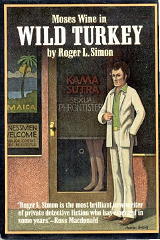
Wild Turkey. Straight Arrow, hc, 1974.
   Pocket, pb, February 1976.
   Warner, pb, September 1984.
   I Books, trade pb, July 2000.

Roger L. Simon

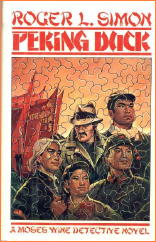
Peking Duck. Simon & Schuster, hc, June 1979.
   Detective Book Club, reprint hc, 3-in-1 volume, Sept-Oct 1979.
   Warner, pb, September 1987.
   I Books, trade pb, November 2000.

Roger L. Simon

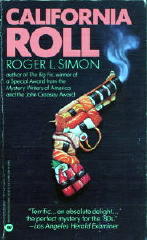
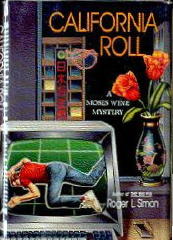
California Roll. Villard, hc, March 1985.
   Warner, pb, June 1986.
   I Books, trade pb, January 2001.

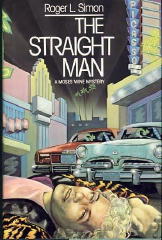
The Straight Man. Villard, hc, September 1986.
   Warner, pb, October 1987.
   I Books, trade pb, June 2001.

Roger L. Simon

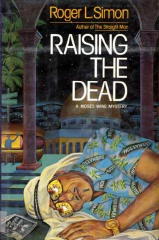
Raising the Dead. Villard, hc, July 1988.
   Warner, pb, August 1989.

Roger L. Simon

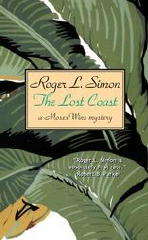
The Lost Coast. Harpercollins, hc, 1997.
   I Books, trade pb, March 2000.
   I Books, hc, May 2003.

Roger L. Simon

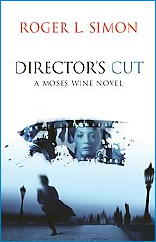
Director’s Cut. Atria, hc, June 2003.
   I Books, trade pb, December 2005. [Scheduled but possibly never published.]

Roger L. Simon

   Getting back to California Roll, however, and as you can probably imagine, the match-up of Moses Wine with corporate California — the computer business in its early stages — does not go well. There is a parallel theme, not thinly disguised, in the fact that Alex Wiznitsky (aka The Wiz), the head of Tulip (not Apple), newly worth $234,000,000 and who hires Moses to be the new head of security — he also finds that immense, immeasurable wealth is not what it is cracked up to be. He, the Wiz, would rather be, one feels, back in his garage tinkering around on his own.

   He, the Wiz, also says, on page 13, “They’re t-trying to take the company away from me, Moses.”

Roger L. Simon

   I don’t think the plot of the mystery adventure novel that follows makes a whole lot of sense, although it certainly follows the usual path of a private eye novel in practice, although with a sense that the latter is not entirely the sort of story Mr. Simon intended to tell.

   Characters come on stage to amuse and entertain us for a while, and then they are seemingly jettisoned when the story verves off in another direction — to Japan, say, for several chapters — and then back again to California.

   One excellent creation along these lines is Mr. Hodaka, a translator Moses hires in Japan who turns out also to be the writer of Japanese pulp detective stories and who eagerly finds the opportunity to be of assistance to Moses along those lines to be very exciting, along with his fellow members in the Maltese Falcon society. A girl named Laura Suzuki, on the other hand, whom Moses makes love to on page 62 (in brief but explicit detail), finds her role in the story (later on) much less to her liking.

   On page 170 is a sort of semi-capsule summary: “… it was a two-tiered game … being played out on one level by large corporate entities and nation-states and on another by human beings struggling desperately for survival in this sad vale of tears.”

   Which, if nothing else I’ve said so far, may give you an inkling of where either the book succeeds or fails. Or if it does not, here is another take on the book’s intentions — and ordinarily I perhaps should not do this, which is to quote the last two lines of the book (or that is to say, to quote a quote from Hagakure: The Book of the Samurai) — but if you were paying attention up above, there’s nothing in this that will surprise you, not an iota:

    “Human life lasts but an instant. One should spend it doing what one pleases. In this world fleeting as a dream, to live in misery doing only what one dislikes is foolishness!”

— May 2006

LINDA FRENCH – Coffee to Die For.

Avon, paperback original. First printing, December 1998.

   Linda French is the author’s maiden name, and this is second of three mystery novels she wrote under this byline. All of them take place in the northwestern corner of Washington state, with the leading character in each of them being Teodora “Teddy” Morelli, a history professor who lives in Bellingham. According to Google is about 85 miles north of Seattle, which is where most of Coffee to Die For takes place.

   Not so coincidentally, according to Amazon, Linda French is a history professor who lives in Bellingham, Washington.

   Based on her entry the Revised Crime Fiction IV, by Allen J. Hubin, here’s a list of her mystery fiction in book form:

FRENCH, LINDA. Pseudonym of Linda Mariz, 1948-
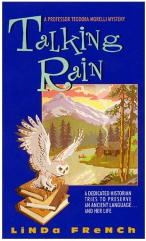
      * Talking Rain. Avon, pbo, April 1998.

LINDA FRENCH

      * Coffee to Die For. Avon, pbo, Dec 1998.
      * Steeped in Murder. Avon, pbo, Dec 1999.

   Under her married name, Ms. French also wrote the following pair of mysteries:

MARIZ, LINDA (Catherine French) 1948- . Pseudonym: Linda French.
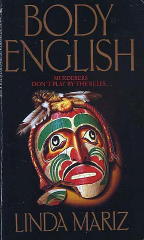
      * Body English. Bantam, pbo, Feb 1992.

LINDA FRENCH

      * Snake Dance. Bantam, pbo, Aug 1992.

   Anthropologist Laura Ireland, who’s also based in Washington state, is featured in both of these, although the second one takes place in Louisiana’s Cajun country. (She’s also a tall championship volleyball player, while Teddy Morelli is short, maybe five foot three.)

   Of the five, Coffee to Die For is the only one I’ve read, and while one should never say “never,” all things considered, I’m not likely to read another, or at least not right away.

   It’s not that it’s badly written, mind you, for it’s not. It’s not, shall we say, my cup of naturally flavored chocolate coffee. In fact, I suspected this from the very first paragraph, which I will quote:

LINDA FRENCH

    “From the balcony, Teddy Morelli dumped a forty-pound bale of fiberfill over the rail. She stared into the hopper, mesmerized as the compressed air of the stuffing machine ravaged the bale, plumping it to thirty times its former volume. A single block of fiberfill would fatten seventy-five of her sister Daisy’s exquisite woolen bunnies. But down on the floor of Bunny Business, Inc., her sister was not happy.”

   How cozier could you get than a mystery full of woolen bunnies?

   Dead, eventually, is Daisy’s philandering husband Leo, a scientist who (a) has recently developed the aforementioned naturally flavored chocolate coffee plant, and (b) has even more recently given himself a present in the form of a young, new (and beautiful) lab assistant by the name of Molly Thistle.

   When he’s found murdered in his laboratory office, no one sheds a tear. Teddy and Dolly assume that Molly did it, only to discover that she has an unbreakable alibi. It is not known whom the police suspect, unless it is Daisy, since they are visible on the scene for a maximum of seven pages out of 210 in all.

   Which means that the percentage of professional police participation is just over 3%. I’ve heard of low-carb diets, but this is far too low for me.

   The rest of the book is filled with Teddy’s extended family and circle of friends, along with some goons with whom Leo was partner’s with in some sort of cannabis deal, now gone bad. Among the circle of friends, by the way, is Teddy’s ex-husband Aurie Scholl, a knee surgeon who works with the Seahawks, who’s hoping they can get back together sometime.

   Four out of five reviewers on Amazon left positive comments, but keeping in mind that I’m not a member of the target audience for books like this, I need something more solid to chew on.

REVIEWED BY WALTER ALBERT:         


SARAH STEWART TAYLOR Judgment of the Grave

SARAH STEWART TAYLOR – Judgment of the Grave. St. Martin’s Press: hardcover, June 2005; paperback, August 2006.

   Sweeney St. George, temporarily relieved of her academic teaching duties, pursues her interest in funerary art (mainly gravestones) by relocating to Concord to do primary research on the bizarre headstones carved by a Revolutionary era stonecutter. She finds herself following the trail already opened up by another scholar who’s disappeared and is presumed to be dead.

   I prefer Sweeney in her academic setting, where she seems more at home, but the novel, if somewhat over ingenious in its plotting, is still a pleasing mix of scholarship and murder, both of them natural lures for the always inquisitive protagonist.

ANN WALDRON Unholy Death

ANN WALDRON – Unholy Death in Princeton. Berkley, paperback original, March 2005.

   A novel somewhat in the same vein as the one above. It features a protagonist (McLeod Dulaney) who’s a prizewinning journalist doing research for a biography on an abolitionist newspaperman at Princeton Seminary.

   In comparison with Taylor’s book, however, Waldron’s novel is cluttered with forgettable characters and really awful dialogue, further compromised by a meandering plot and an improbable climax.

BIBLIOGRAPHIC DATA:

   The Sweeney St. George mysteries:

O’ Artful Death. St. Martin’s, hc, 2003.
Mansions of the Dead. St. Martin’s, hc, July 2004.
Judgment of the Grave. St. Martin’s, hc, June 2005.
Still As Death. St. Martin’s, hc, Sept 2006.

   The McLeod Dulaney mysteries:

The Princeton Murders. Berkley,pb, Jan 2003.
Death of a Princeton President. Berkley, pb, Feb 2004.
Unholy Death in Princeton. Berkley, pb, Mar 2005.
A Rare Murder in Princeton. Berkley, pb, Apr 2006.
The Princeton Imposter. Berkley, pb, Jan 2007.

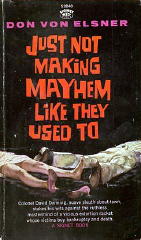
DON VON ELSNER – Just Not Making Mayhem Like They Used To.

Signet S2040; paperback original, December 1961.

   Have you ever read fifty pages into a book late into the evening, look up at the clock, see that it says that it’s one o’clock in the morning, and realize that the last 30 pages haven’t made much sense at all?

   I hate to say it of any book, but that’s what happened to me with this one. It’s not that I was tired, which is what I assumed the next morning, and maybe that’s what you’re thinking too, but no, that wasn’t it. I tried again, on and off, the whole week that followed. I struggled, I skimmed, and I skipped, and if you want to forgo reading the rest of this review for any of the reasons listed, you’d be right. I wouldn’t blame you in the least.

   This is the second recorded adventure of Colonel David Danning, lawyer, bridge player, and judo expert, among other accomplishments. If nothing else, the titles of his cases are designed to catch your attention. Expanded from the author’s entry in the Revised Crime Fiction IV, by Allen J. Hubin:

      Those Who Prey Together Slay Together. Signet D1943, June 1961.

DON VON ELSNER

      Just Not Making Mayhem Like They Used To. Signet S2020, Dec 1961.
      Don’t Just Stand There, Do Someone. Signet S2134, 1962
      You Can’t Do Business with Murder. Signet S2214, Dec 1962
      Who Says a Corpse Has to Be Dull. Signet G2407, 1963
      Pour a Swindle Through a Loophole. Belmont 92-604, Sept 1964
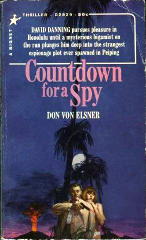
      Countdown for a Spy. Signet D2829, Jan 1966.

DON VON ELSNER

      A Bullet for Your Dreams. Lancer 73-709, 1968.

   Yes, I agree; the originality does tend to tail off toward the end. For the record, Von Elsner’s other mysteries feature Jake Winkman, a professional bridge player who helps out the CIA from time to time:

      How to Succeed at Murder Without Really Trying. Signet 1963. Reprinted as: The Jake of Diamonds. Award, 1967 (not a misprint)
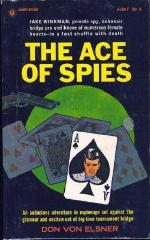
      The Ace of Spies. Award 1966

DON VON ELSNER

      The Jack of Hearts. Award 1968

   According to Contemporary Authors, Don Von Elser (1909-1997) was a Life Master of the American Contract Bridge League, which explains why his heroes happen to be expert players too.

   Danning is hired by an underwriters association in Mayhem to find out why so many small businessmen have been committing suicide recently at such an unnatural rate. Danning immediately suspects a gang of blackmailers at work, and he accepts the job. Five months later, he’s still working, with no results to speak of. On page 22: “A vague pattern began to take shape in Danning’s mind.”

DON VON ELSNER

   But then, at long last, the logjam breaks. Danning comes across the story of Homer Pettingill, the man whose misadventures were related to the reader in Chapters One and Two, and hold on to reins, honey, we’re off to the races, and the book doesn’t stop until page 142 and the case is closed.

   Assisting Danning are his adoring secretary Nell Sheridan, who has to prod him into taking cases to boost his disposition; Dr. Greta Nevin of UCLA, who possesses the longest and loveliest legs of any psychology professor in the world; his son Bob, whom he calls Duke, and vice versa, and who looks exactly like him; and a whole agency of private detectives at his continuous beck and call.

   As I type this, it’s beginning to dawn on me that I may have simply been in the wrong mood to read this book, but here’s what is it that goes wrong, as far as I’ve been able to decide, humorous approach prevailing or not.

   Danning’s case is built upon nothing but coincidence and guesswork. Two guys in a hotel chosen at random might be the pair of con men that they’re looking for – of all the gin joints in all the towns in all the world – and yes, they are the ones they’re looking for, a silly escapade with the married folks in the room next door notwithstanding.

   I’ve have thought they’d have investigated the mechanics of the crime and the actual way it was pulled off, but no, no questions are asked along those lines, save very obliquely. But after all of the fancy scheming to get the goods on the bad guys – I skimmed a lot here – it turns out in the recap and the explanations at the end, it all depends on guess what? The mechanics of the crime and the actual way it was pulled off.

   Which you’ve got to read to believe. I don’t, not even for a minute. There’s a good chance that you’ll disagree with me on any or all of this, but I have a hunch that you won’t.

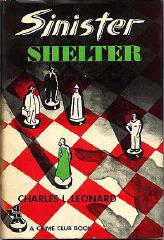
CHARLES L. LEONARD – Sinister Shelter.

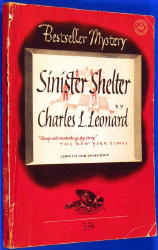
Unicorn Book Club; reprint edition. Originally published by Doubleday Crime Club, 1949. Digest paperback reprint: Bestseller Mystery B141. Pulp magazine reprint: Two Complete Detective Books, May 1950 (probably abridged).

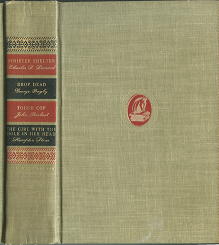
   One way you can read mystery and detective novels from the late 1940s and early 50s, if you can’t come across them in any other way, is to find them in hardcover book club editions, either from the three-in-one Detective Book Club, or the four-in-one volumes that came from the Unicorn Mystery Book Club.

UNICORN MYSTERY BOOK CLUB

   Of the two, the Unicorn Books were classier in appearance, and they look very handsome on the bookshelf. They didn’t last nearly as long as their competitors, however, including of course the Dollar Mystery Guild, which eventually came along. (And still is going strong today, although you can certainly forget the dollar part of their name.)

   In any case, without going further into their history (for now), I just bought about 20 of the Unicorn books on eBay, and over the next few weeks I’m planning on using them for reading material. Whether I skip around or read whole volumes at a time, I haven’t decided, but if it makes any difference, I think I’ll try reading this particular grouping all the way through. Stay tuned.

   In real life Charles L. Leonard, author of eleven private eye Paul Kilgerrin novels, of which this one, was M. V. Heberden, who also wrote two other series of PI novels under that name, one featuring Desmond Shannon (17 books), the other being Rick Vanner, who appeared in three.

   I’m not sure when the secret came out, but I imagine some eyebrows were raised when the initials M. V. were revealed to stand for Mary Violet. It’s been a while since I read any of them, but what little bibliographic information is about her books on the Internet suggests that they were tough, rugged and a little hard-boiled, reminiscent not at all of “shrinking violets.”

   While nominally a private eye, in this particular book Kilgerrin given an assignment by the government to help stop a flood of illegal immigrants from coming into the US after World War II. And from the list of titles he appeared in, he seems have been an undercover spy much more often than he worked out of an office where good-looking women who came in were apt to be his clients.

   Here’s a list of the Kilgerrin books. I think you’ll come to the same conclusion as I did. (All of the books were first published in hardcover by Doubleday Crime Club.)

Deadline for Destruction (1942)
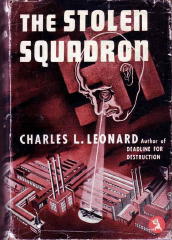
The Stolen Squadron (1942)

CHARLES L. LEONARD Stolen Squadron

The Fanatic of Fez (1943)
Secret of the Spa (1944)
Expert in Murder (1945)
Pursuit in Peru (1946)
Search for a Scientist (1947)
The Fourth Funeral (1948)
Sinister Shelter (1949)
Secrets for Sale (1950)
Treachery in Trieste (1951)

   Not that there aren’t good-looking women involved, at least in Sinister Shelter. While he is working undercover to get a line on the people smugglers, Kilgerrin befriends the members of a refugee family who are trying to make their way into the United States via Argentina.

CHARLES L. LEONARD Sinister Shelter

   Among them is a young widow and her young boy who are living with her husband’s parent, said husband having disappeared after being arrested by the Nazis some time before. Kilgerrin is kind and gentle with the family, especially with Irma, and if he is hard-boiled about some other things, with her he does not seem to be.

   The essence and general ambiance reminded me more of Hammett than it did Chandler, and for a long time, it was difficult to understand why. (I’ll return to this later.) Kilgerrin works with a firm goal in mind, but he has the capability of being able to improvise quickly, such as when the elderly father meets someone the family had known well back in Austria.

   Marie Louise, now Louise Ritter, is the other woman in the story, and while her strong, enigmatic presence shifts the story quickly into second gear, it will occur to more than one reader, I am sure, that while coincidences like this often happen in the real world, fiction is never quite that strange.

   In a way, there is a morality play going on. How does one comport oneself in the face of tyranny, the elderly father wonders on page 121, one man, acting alone, against evil? Kilgerrin himself tries to be understanding with Irma, but often finds himself frustrated when she cannot forget the past, when it stays with her and she cannot free herself from it.

CHARLES L. LEONARD Sinister Shelter

   The puzzle presented by the novel’s other lady of mystery gradually absorbs more and more of his attention. Kilgerrin has more in common with Louise Ritter, and he soon realizes it, making the question of how deeply she is involved with the smuggling gang all the more a matter of importance. (This could have been handled, unfortunately, somewhat more eptly.)

   They are two entirely different women, and to Kilgerrin each is a mystery in different ways. The scene in which he last sees Irma is when (for me) the Hammett-Chandler comparison suddenly snaps into focus.

   There is very little action, surprisingly enough, until the end. Character studies need some patience on the part of their readers, and that’s what, in large part, this story is comprised of. On the other hand, just to be sure that you know there is one, I’m going to quote the last few lines of the book, at which point in time the primary antagonist has been identified and is being discussed.

   I’ve tried to be very careful in setting this up properly. If I’ve done it correctly, this will demonstrate, more than anything else, that there’s more involved here than character studies.

    “… There are still gaps,” Morengo ended unhappily. “It is a pity […] is dead.”

    Kilgerrin shook his head. “When anyone with that much guts goes wrong, he or she has got to be killed,” he said.

— April 2005


[UPDATE] 07-04-08. Since I don’t imagine you can make them out in the small image shown, the other three books in the same Unicorn volume as this one are: Drop Dead, by George Bagby; Tough Cop, by John Roeburt; and The Girl with the Hole in Her Head, by Hampton Stone.

   In spite of the promise I made in the course of this review, I never did get around to reading any of these. On the other hand, the book is still here on the table next to the computer and keyboard where I’m typing away. That must mean something, mustn’t it?

   The other reason, of course, for retrieving this review from the archives, is the preceding post, the “mystery author” turning out to be Mary Heberden, aka M. V. Heberden, aka Charles L. Leonard. More on her shortly, I hope — what little is known about her so far.

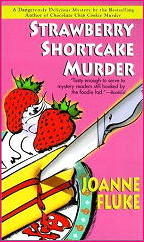
JOANNE FLUKE – Strawberry Shortcake Murder.

Kensington; paperback reprint, February 2002. Hardcover first edition: Kensington, March 2001.

   By sheer happenstance — a fluke of luck, you might say [*] — I discovered that Joanne Fluke has had quite a varied writing career. She seems to have started out writing horror novels, beginning in the early 1980s: books with titles like The Stepchild, Video Kill, and so on. Then as Jo Gibson she began writing young adult novels in much the same vein: Slay Bells, My Bloody Valentine and more.

JOANNE FLUKE

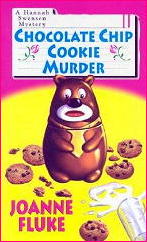
   As “Kathryn Kirkwood” in the late 1990s she began to branch out in an altogether different direction: regency romances. And two years ago she seems to found her forte with the first in her Hannah Swenson mystery series, The Chocolate Chip Cookie Murder.

   This is the second, with the third already out in hardcover, and if these books don’t at least make you hungry — recipes included — nothing will. Hannah runs a cookie shop in snowbound Lake Eden, Minnesota. Fluke makes it sound like a small town, and the way things are going, in a few more books, it will be even smaller. (Trend analysis at work.)

   When the local basketball coach is found murdered after his last-minute substitution as a judge for a TV cooking contest, Hannah and her non-lookalike sister go snooping after the killer, even though Hannah’s boy friend (a cop) and Andrea’s husband (also a cop) do their best to discourage them.

   A cozy sort of mystery novel, as comfortable as scarves and old shawls. Most of the appeal lies in the people, Hannah’s friends, relatives and neighbors, which constitutes 90% of the population of Lake Eden. The detective work is minor — there is an interval of time during which almost every reader will simply be screaming (non-verbally) for the obvious to dawn on Hannah and her sister.

   Even so, it’s a fun read, to coin a phrase, and I think Fluke has something good going for her.

— February 2002

[*]   I confess. Not luck at all. On page 181 of the paperback edition, the Lake Eden Regency Romance Club re-enacts a scene from one of Kathryn Kirkwood’s (unpublished?) regency romance novels. You can’t read this without at least cracking a smile.

[UPDATE] 07-02-08. I’m not very good at predicting track records of authors, but I was right this time. Just over six years later, there are now ten books and one novella in the series, and I don’t think Hannah Swenson will run out of recipes anything soon:

Chocolate Chip Cookie Murder (2000)

JOANNE FLUKE

Strawberry Shortcake Murder (2001)

Blueberry Muffin Murder (2002)

Lemon Meringue Pie Murder (2003)

Fudge Cupcake Murder (2004)

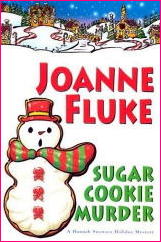
Sugar Cookie Murder (2004)

JOANNE FLUKE

Peach Cobbler Murder (2005)

Cherry Cheesecake Murder (2006)

Key Lime Pie Murder (2007)

Candy Cane Murder (2007) (a novella included in Candy Cane Murder;
   other authors: Laura Levine & Leslie Meier)

Carrot Cake Murder (2008)

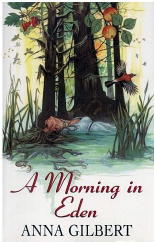
ANNA GILBERT – A Morning in Eden.

St. Martin’s; hardcover; First US Edition, Dec 2001. UK edition: Robert Hale, 2001. No paperback editions.

ANNA GILBERT A Morning in Eden

   A couple of quick reactions first. (a) No diehard private eye fan will ever read this slow-moving tale of adolescent romance in a remote village in England, just after the close of World War I. (b) Time and place are both important aspects of the story, and yet very little of the outside world intrudes — soldiers are coming home from the war, trying to fit into society again — but it’s all very incidental, hardly a major theme.

   After the death of one aunt, young Lorna Kent goes to live with another. In isolated Canterlow, she realizes that her infatuation with the local headmaster must be kept secret.

   She also discovers she is surrounded by swirls of other mysteries around her. Even more sinister secrets abound — most centering around the death (suicide or murder?) of another young girl not too long before.

   Ominous writing prevails, filled with constant portent, imbued with the sadness of nostalgia and the regrets of life that could have been. Decisions made that could not be undone.

   More than the mystery to be solved, the reader begins rather to wonder when Lorna will make her own right decision — glaringly obvious, if she were only to see.

— December 2001


ANNA GILBERT A Morning in Eden

[UPDATE] 06-21-08.    Anna Gilbert was the pen name of Marguerite Lazarus (1916-  ), making her 85 years old when this book appeared. (I have used “was” in the past tense only because I am fairly sure she is no longer writing; I have found no information to say that she has passed away.)

   [Unfortunately I was wrong when I wrote this last statement. Marguerite Lazarus died in 2004. See the first comment below for a link to a well-written and heartfelt tribute to her.]

   Here, using the Revised Crime Fiction IV, by Allen J. Hubin, as the primary source, is a complete list of her crime-related fiction (the dash (-) indicating only minor relevance to our field.)

   These are the British editions; most if not all have been published in the US, all but one by St. Martin’s. (This list does not include a few novels with no criminous component.)

# Images of Rose (n.) Hodder 1974 [England; 1883]
# The Look of Innocence (n.) Hodder 1975 [England; 1800s]
# A Family Likeness (n.) Hodder 1977 [England; 1800s]
# -Remembering Louise (n.) Hodder 1978
# The Leavetaking (n.) Hodder 1979 [England; 1880s]
# Flowers for Lilian (n.) Hodder 1980 [England; 1800s]
# Miss Bede Is Staying (n.) Piatkus 1982 [England; 1800s]
# The Long Shadow (n.) Piatkus 1983 [England; 1800s]
# A Walk in the Wood (n.) Piatkus 1989 [England; WWII]
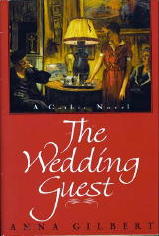
# The Wedding Guest (n.) Piatkus 1994 [England; 1920 ca.]

ANNA GILBERT The Wedding Guest

# -A Hint of Witchcraft (n.) Hale 2000 [England]
# A Morning in Eden (n.) Hale 2001 [England; post-WWI.]

   Quoting very briefly from Contemporary Authors:

   Marguerite Lazarus writes Victorian stories of mystery, deception, and intrigue. Her ability to create realistic Victorian settings and characters is the result of her interest in the literature, memoirs, letters, and biographies of the time. In Twentieth-Century Romance and Historical Writers, Elizabeth Gray wrote that Lazarus’ “work is stylish and elegant. She writes with fastidious care, making every word count… and she is past mistress at the art of heightening tension by placing a gentle finger on the reader’s nerves.”

   While doing some additional research on Peter Driscoll, the author of Pangolin, a spy thriller I reviewed here only a day or so ago, I discovered the sad news of his death, a fact not known to Al Hubin and the Revised Crime Fiction IV before now.

   The Wikipedia entry for Driscoll is not very large. It’s only one sentence long, followed by a list of the books he wrote:

    “Peter Driscoll (4 February 1942 – 30 October 2005) was a bestselling British author of international thrillers in the 1970s who first worked in South Africa then, in his later life, became Chief Radio News subeditor with Radio Telefís Éireann.”

   Taken from an interview with Mr Driscoll and appearing in his entry in Contemporary Authors, he had this to say about his early career:

    “I wrote my first story at age six, but was not certain I wanted to make a career of writing until I was fourteen. From then on I saw everything in my life as a preparation for that step, a conscious gathering of experiences that would one day be put to use. My first big breakthrough came when I sold the movie rights to my second novel, The Wilby Conspiracy. Since then, like most free-lancers, I’ve had ups and downs, with the ups predominating so far.”


   Here below is a checklist of all of Peter Driscoll’s crime fiction, expanded upon from the Revised Crime Fiction IV, by Allen J. Hubin:

DRISCOLL, PETER (John). 1942-2005.

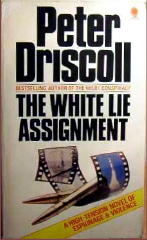
      * The White Lie Assignment (n.) Macdonald, UK. hc, 1971. Lippincott, US, 1975. [Albania] “Michael Mannis, a freelance photographer, knew how the Albanian Secret Police dealt with spies. So it took a great deal of money to tempt him into accepting a mission to cross the Albanian frontier and photograph the Chinese missile sites there. He certainly earned it hte hard way when he discovered that his contact was a fugitive double agent with Russian killers waiting for him at the end of the run.”

PETER DRISCOLL

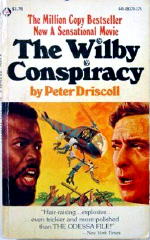
      * The Wilby Conspiracy (n.) Macdonald, UK, hc, 1973. Lippincott, US, hc, 1972. [South Africa] Film: Optimus, 1975 (scw: Rod Amateau, Harold Nebenzal; dir: Ralph Nelson; starring: Sidney Poitier, Michael Caine). “A white mining engineer plunged into an underground world of intrigue and violence. A beautiful, sensual woman whom he must trust. A black fugitive whom he must save. And hanging in the balance, the fate of a vast, vicious struggle between a clandestine revolutionary organization and a diabolically efficient secret police amid the ugly slums and breathtaking wilderness of present-day Africa.”

PETER DRISCOLL

      * In Connection with Kilshaw (n.) Macdonald, UK, hc, 1974. Lippincott, US, hc, 1974. [Ireland]

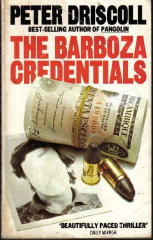
      * The Barboza Credentials (n.) Macdonald, UK, hc, 1976. Lippincott, US, hc, 1976. [Mozambique] “British-born Joe Hickey is charged with finding a mercenary killer in Africa’s dark heart. But time is running out for this ex-cop turned Rhodesian sanctions-buster, and the life he has to save – as the seconds tick relentlessly by – is his own.”

PETER DRISCOLL

      * Pangolin (n.) Macdonald, UK, hc, 1979. Lippincott, US, hc, 1979. [Hong Kong]

      * -Heritage (n.) Granada, UK, hc, 1982. Doubleday, US, hc, 1982. [Algeria; 1945-62]

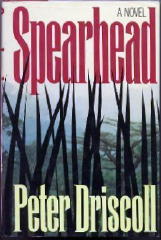
      * Spearhead (n.) Bantam, UK, hc, 1988. Little-Brown, US, hc, 1989. [South Africa] “The story of the terror and strife of a South Africa in deep racial conflict. Major Patrick Marriner, a retired British paratrooper and Falklands veteran, is recruited by the Black Nationalist leader Kumalo’s exiled comrades to do the seemingly impossible — free Kumalo before the National Intelligence Service can rid themselves of international humiliation.”

PETER DRISCOLL

       Secrets of State (n.) Bantam, UK, hc, 1991

       Spoils of War (n.) Bantam, UK, hc, 1994 [Kuwait]

« Previous PageNext Page »