Bibliographies, Lists & Checklists


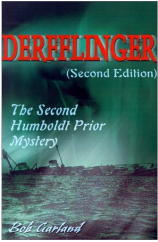
BOB GARLAND – Derfflinger

Manor Books 17181; paperback original. First printing, 1978. Trade paperback reprint: Writer’s Showcase Press, 2000.
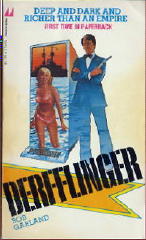
BOB GARLAND Derfflinger

   The Manor edition of this title is a very scarce book. As I type this, there is only one copy online on ABE. Manor books never did get distributed very widely, and when (or where) they did, the authors generally never had any “name appeal,” or not at least on the ones that were paperback originals. Usually an author wrote one or maybe two books for them and nobody else, and nobody ever heard from them (the authors) again.

   Which is why it surprised the something out of me to learn that Bob Garland, now a retired business executive, has written a total of four other book-length adventures of Humboldt Prior, computer manufacturing executive for Intercontinental Data Processing, of New York, NY. The order in which the adventures occur and in which the books were published is a little confusing, and I will try to elucidate as best I can.

   The only one published at the time it was written, I think, is the one at hand. As stated above, the book was reprinted as a trade paperback by Writer’s Showcase Press, in October 2000, and as such it is denoted as a Second Edition. (I do not know if the book has been revised for this edition, but there is the possibility, as there is a good chance Manor chopped it up and did a quick “make it fit” procedure on it, even before WordPerfect came along and made it easy.) It is interesting to note, however, that this 2000 edition is described as the “Second Humboldt Prior Mystery.”

   The other books in the series are the following, in order as published. All are trade paperbacks:

R.I.P. 37E: The Third Humboldt Prior Mystery Writer’s Showcase Press, October 2000.

Slaying the Red Slayer: The First Humboldt Prior Adventure. Writers Club Press; 2nd edition, April 2001. [If there was ever a First Edition, I do not know about it.]
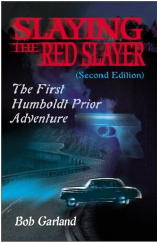
BOB GARLAND Derfflinger

The Elephant Mask: The Fourth Humboldt Prior Mystery. iUniverse, January 2004.

Tradedown: The Fifth Humboldt Prior Mystery. iUniverse, December 2005.

   The only one of these last four which I have is a copy of the third adventure, R.I.P. 37E. I have not read it, but from a quick peek inside, the story appears to have taken place in 1979, so there is the possibility that it was written back then, around that time, but it was never published until Garland retired from his day job.

   I’m really reaching now, but on Amazon.com, there is a short description of the last two books that tells us that Prior is “now … aging” (Elephant Mask) and is “now 60 years old” (Tradedown). Which really makes me feel old, but that’s not the point I’m trying to make. It could be that these last two books were written recently, and not earlier.

   But where Slaying the Red Slayer fits in as nominally the “first” book in the series, I do not know.
BOB GARLAND Derfflinger

   In any case, Derfflinger certainly reads like a debut appearance, as in it an amateurish but enthusiastic Humboldt Prior agrees to help the widow of a friend in England who had been doing some investigation on his own into a ship salvaging operation conducted at the end of World War II. He was killed in an auto accident, but as Humboldt takes over the investigation, he too becomes the target of some very narrow scrapes.

   The reason the book reads like the first in a series is that Humboldt seems to be awfully new and/or naive in matters which he seems to be in over his head about. Almost, I hasten to add, because he is quite competent at what he normally does, in a global business sense, and he doesn’t mind admitting it.

   With a billion dollar operation behind him (Intercontinental Data), Humboldt gets around fairly easily and comfortably – to Scotland and then to Germany before heading back to England – on the company’s private Jet Star, with various nefarious villains on his tail most of the way.

   Not only is Humboldt amateurish but enthusiastic, but so is the story. It’s enjoyable enough, but until the end, which contains a surprise or two, there’s no meat to the tale at all, nor does it quite connect on many levels. On the other hand, enthusiasm is sometimes all it takes, and even though this may surprise you, given my comments so far, I discovered when I was finished that I really wouldn’t mind reading any of the four follow-up adventures at all.

   And so perhaps I will.

POSTSCRIPT.   If you would like to know something more about the primary focus of the travail that Humboldt encounters, you could do no worse than to look the word Derfflinger up on Google, say. It’s just a suggestion.

— July 2006


[UPDATE] 06-12-08.   To no one’s surprise, I am assuming, including my own, I have not yet read or obtained any of the other books in the series. There is still only one copy of the Manor edition of Derfflinger offered on ABE, and in fact it may be the very same book. I also do not know any more about the publishing history of the Bob Garland’s work than is stated here.
      The first paragraph below is good news recently received from Bill Contento:

    The online edition of THE CRIME FIGHTERS, by W.O.G. Lofts and Derek Adley, has been updated, now listing fictional detectives “Abbott, Detective” through “Hyer, Henry ‘Hank’.”

   Say the authors Derek Adley (1927-1991) and Bill Lofts (1923-1997) in their introduction:

    “… What we do claim, however, is that the number of detective types listed here is many times greater than in any previous work on this subject. In fact, we have had to limit the number of inclusions owing to space considerations. We already have a thousand or so sleuths in hand, so if this compilation proves to be a success adequate material for a second one is available, and omissions here could then be rectified.

    “This is essentially a bibliography of the following fictional characters:

       * the private detective

       * the private eye

       * the official police investigator

       * the amateur sleuth

       * the adventurer type of detective, such as Bulldog Drummond and Norman Conquest, who were always on the side of law and order, as well as Robin Hood types like the Saint who were active on both sides

       * the secret service agent of the Tiger Standish type, who nearly always worked with the Special Branch at Scotland Yard (but not those of the James Bond type, who were purely engaged in spying and espionage and rarely worked in collaboration with the police).

    “Thus, in general, we cover the fighters of evil-doers, but of course not including the American super-hero of the Superman type. The closest we come to this type is The Shadow and Doc Savage, who, while having certain mystic powers, are nonetheless ordinary men.”


   The information was never published in the authors’ lifetime. Says Al Hubin as part of his editorial introduction, “The text appears to have been written mostly in the 1960s and so does not cover detectives introduced later.”

   The only version of The Crime Fighters still in existence is apparently the photocopy of the original manuscript in the hands of Al Hubin, who’s working with Bill, Steve Holland and others to put the data online.

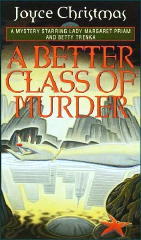
JOYCE CHRISTMAS – A Better Class of Murder.

Fawcett, paperback original; 1st printing, Dec 2000.

JOYCE CHRISTMAS

   Question. Did Hercule Poirot and Miss Marple ever appear in a story together? I don’t think so, but I might be wrong. I know that Perry Mason and the detective duo of Bertha Cool and Donald Lam never appeared in the same book. But think about it. Wouldn’t have either one been quite an event? Crossovers like this used to be rare in the comic book field, now it’s so common they do it all the time, even between DC and Marvel, two different publishers and direct competitors, if you will.

   But for mystery fiction, it’s not an everyday occurrence. (*) So to have the first appearance together of Joyce Christmas’s two main characters, Manhattan socialite Lady Margaret Priam (ten previous books) and retired office manager Betty Trenka (four earlier mysteries), well, when it first came out, her fans must have been grabbing the book right off the shelf.

   For me, though, this is the first of either series I’ve read, and it’s (in a word) disappointing. The two characters could not be from two more different worlds, but that’s not the problem. Poirot and Miss Marple are equally opposite in many ways, but just consider the puzzles they might have solved together — I think Agatha Christie could easily have come up with a couple of absolute knockouts. They would have been doozies.

JOYCE CHRISTMAS

   That’s not the case here. In fact, there’s very little case to be solved, and neither Lady Margaret or Miss Trenka get within 50 miles of the crime itself. Betty Trenka is asked by a neighboring suburbanite, a computer expert by trade, to do another job entirely, one that takes her into New York City, and thus into Lady Margaret’s social set, almost incidentally so. The connection turns out to be a dead woman whose body had been found earlier, back in (further) upstate Connecticut, involved somehow with a missing and essential computer disk.

   As crimes go, this is a rather mild one, and the solution is unravelled more or less perfunctorily, with no further ado or commotion. Lady Margaret has nothing to do but show Betty Trenka around the city, which the latter’s naiveté does make amusing, and perhaps even mildly interesting. All in all, though, what you should expect from this book is a lot more talk than there is action, of which there is none, neither physical nor mental.

— April 2001


COMMENT (*). 06-05-08. It wasn’t true then, and while it may be more true now, crossover appearances between mystery characters still happen only about .01 of 1% percent of the time. Of course in comic books it happens so often that it’s taken for granted, and it’s boring.

         JOYCE CHRISTMAS: A Checklist —

[Expanded upon from her entry in the Revised Crime Fiction IV, by Allen J. Hubin. All of her mysteries were published as paperback originals by Fawcett, or in the case of the earlier ones, Fawcett Gold Medal.]

   Lady Margaret Priam

1. Suddenly in Her Sorbet (1988)
2. Simply to Die for (1989)
3. A Fete Worse Than Death (1990)
4. A Stunning Way to Die (1991)
5. Friend or Faux (1991)
6. It’s Her Funeral (1992)
7. A Perfect Day for Dying (1993)
8. Mourning Gloria (1996)
9. Going Out in Style (1998)
10. Dying Well (2000)

   Betty Trenka

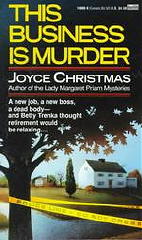
1. This Business Is Murder (1993)
2. Death at Face Value (1995)
3. Downsized to Death (1997)
4. Mood to Murder (1999)

   Lady Margaret Priam & Betty Trenka in tandem

1. A Better Class of Murder (2000)
2. Forged in Blood (2002)

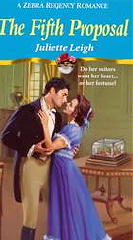
JULIETTE LEIGH – The Fifth Proposal.

Zebra, paperback original; 1st printing, July 1999.

   Detective mysteries come concealed in the strangest places. This one, for example, was published as a regency romance, and if you didn’t look closely when it first came out, you probably missed it.

J. LEIGH Fifth Proposal

   When Shelby Falcon is summoned to her dear grandfather’s home after learning that he’s gravely ill, she doesn’t know it, but she’s about to become an heiress. Or so he announces, with all the other family members circled around him. In his own mind, though, he has no intentions of dying yet.

   Someone intends to change those intentions, however, and a series of suspicious and potentially fatal accidents begins to happen to the old gentleman. Shelby suspects one of her four cousins, all debtors and heavily in need of money. Another possible perpetrator is the mysterious Gill, whom she’s never seen before, the old man’s new companion and bodyguard.

   As the story goes on, the four cousins in turn make proposals of marriage to Shelby — ah, you do know where this is going, don’t you?

   Well, it is a regency romance, after all. Frothy and light, with only the mystery of Colonel Falcon’s unknown assailant to give it a little added substance. The historical period is adequately evoked, at least within my limited experience in such things, but the dialogue (at times) seems a trifle forced to me, and (if this makes sense) artificially created to fit the time period.

   PS. It all ends well.

— February 2001


[UPDATE] 06-01-08. And in case you were wondering this as well, yes, the book above is in the Revised Crime Fiction IV, by Allen J. Hubin, and in fact, here’s the complete entry for the author, under two names. (Not all of her books were mysteries. Others were Regency Romances only, and are not listed below.)

LEIGH, JULIETTE. Pseudonym of Dawn Aldridge Poore, 1941- .

      The Fifth Proposal (Zebra, 1999, pb) [England; 1800s]
      Sherry’s Comet (Zebra, 1998, pb) [England; 1800s]

POORE, DAWN ALDRIDGE. 1941- . Pseudonym: Juliette Leigh. Series Character: Rozanne Sydney, in all.

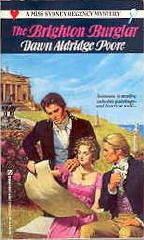
      The Brighton Burglar (Zebra, 1993, pb) [England; 1800s] “When it comes to unsolved crimes and unmatched hearts, Miss Roxanne Sydney is on the case! When Miss Sydney’s late father leaves her with a bed-ridden estate and three younger sisters to marry off, the unsinkable Roxanne decides to keep her family afloat by taking in boarders. But opening her home to strangers becomes a dangerous enterprise indeed when Roxanne finds herself embroiled in the current Brighton mystery: Someone is stealing valuable painting from the wealthy country estates…”

DAWN ALDRIDGE POORE The Brighton Burglar

      The Cairo Cats (New York & London: Zebra, 1994, pb) [London; 1800s]. “Miss Roxanne Sydney travels to London to attend a wedding, and when one of her two exotic cat statues–artifacts from her father’s Egyptian travels–is stolen, she has a mystery on her hands.”

      The Mummy’s Mirror (Zebra, 1995, pb) [Egypt; 1800s] “With her three sisters finally wed, Miss Roxanne Sydney is free to pursue her favorite pastime: a mystery! Accompanied by Miss Flora Rowe, her poor but proper traveling companion, Roxanne is off to uncover the grandest of all mysteries, the land of Egypt. […] …something decidedly odd is going on between the pyramids and the burning sands. And a missing mirror will soon turn the desert into perilous territory for a genteel detective in distress…and in danger of losing her heart!”

      The Secret Scroll (Zebra, 1993, pb) [England; 1800s] “When an invaluable ancient scroll vanishes on the eve of her sister’s wedding, Miss Roxanne Sydney looks among the visitors at the Sydney estate to find the culprit.”

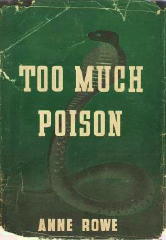
ANNE ROWE – Too Much Poison.

Detective Book Club; 3-in-1 edition; hardcover reprint, January 1945. Hardcover first edition: M. S. Mill, 1944.

   I love old mysteries. It’s like taking a small time capsule into the past, a past seldom written about in history books. The past that people actually lived in, everyday people, in all walks of life.

ANNE ROWE Too Much Poison

   Including the Manhattan social set. Strangely enough, the war is never mentioned in this wartime mystery, a cheery sort of world, yet with a hint of tragedy hiding behind the curtains. Mona Carstairs, the secretary-nurse to a doctor slowly establishing himself, has secretly been married to him for three years, supporting and nurturing him. And now, as he is on the verge of success, he has found a new lady friend, very young, petite and silvery blonde.

   That’s the story as it begins, and it probably has you yawning already. The mystery itself, two deaths by exotic cobra poison, is much more complicated. I won’t go into it in any more detail, but there are quite a few suspects, all in social circles that wouldn’t allow me in, but it’s quite a pleasure to read about them.

   Coming to Mona’s aid — as she gradually becomes Inspector Barry’s primary suspect — is Cliff Mallory, a son of one of Barry’s former colleagues on the force, as well as a cousin of Dr. Carstair’s new flame, a renown polo player, and now a knight in armor and an amateur detective to boot.

   Any resemblance to actual police procedure seems purely coincidental, although I would admit that standards may have differed then from what I see on NYPD Blue now. But the mystery is definitely taken seriously by Anne Rowe, with lots of clues and false trails scattered throughout, giving the fan of amateur detective fiction quite a bit to puzzle over.

[ Four stars (out of five). ]                 — January 2001.


[UPDATE.] 05-29-08.   I’m going to assume that not only is the book is forgotten, but so is the author. While this is the only book of Anne Rowe’s book that I’ve read, posting this review from over seven years ago makes me want to read more of them.

   To that end, if you’re also so inclined, here’s a complete list, thanks to Al Hubin and his Crime Fiction IV. Except for the one marked UK, listed are only the US editions and titles. (I have a feeling that some of these are going to be hard to find.)

ROWE, ANNE (Von Meibom) (1901?-1975?)

* The Turn of a Wheel (n.) Macaulay 1930
* -Men Are Strange Lovers (n.) King 1935
* Curiosity Killed a Cat (n.) Morrow 1941 [Insp. Josiah Pettengill; Maine]
* The Little Dog Barked (n.) Morrow 1942 [Insp. Josiah Pettengill; Maine; Theatre]
* Too Much Poison (n.) Mill 1944 [Insp. Barry; New York City, NY]
* Fatal Purchase (n.) Mill 1945 [Maine]
* The Painted Monster (n.) Gifford-UK 1945 [Insp. Josiah Pettengill]
* Up to the Hilt (n.) Mill 1945 [Insp. Barry; Connecticut]
* Deadly Intent (n.) Mill 1946 [Insp. Barry; New York City, NY]

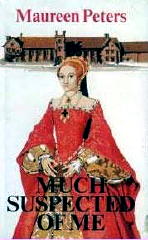
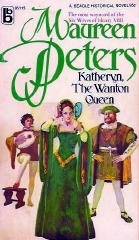
   When I received word of the death of Maureen Peters from John Herrington yesterday, I emailed my daughter Sarah immediately, as she’s the historical fiction expert in the family, and I thought she’d like to know. While Maureen Peters wrote a sizable number of books included in the Revised Crime Fiction IV, by Allen J. Hubin, under her own name she was known far more for her fiction about the past, most often re-creating the lives of women born to royalty.

Maureen Peters           Maureen Peters

   Here’s a portion of Sarah’s opening paragraphs about Maureen Peters on her blog, Reading the Past:

    “… She was born in Caernarvon, Wales, on March 3, 1935, and was married and divorced twice; she has two sons and two daughters. In addition to the novels written under her own name, which were historical fiction, she also wrote as Veronica Black, Catherine Darby, Belinda Grey, Elizabeth Law, Levanah Lloyd, Judith Rothman, and Sharon Whitby.

    “Her novels, which easily number over one hundred, fall into many categories: biographical fiction on royalty (written under her own name), Gothic romances, family sagas, Mills & Boon series titles, contemporary mysteries (her Sister Joan series was written as Veronica Black), and more.”

   There you have it. The secret is out. In the world of mystery fiction, Maureen Peters is far better well known as Veronica Black than she is as her own. For the rest of Sarah’s overview of her career, please follow the link above, and I hope you do.

Maureen Peters

   For more about Sister Joan, the contemporary nun who is the series character in many of the Veronica Black books, see this page on Philip Grosset’s website dedicated to clerical detectives:

   Said Maureen Peters about Sister Joan in an interview with her that you can find online:

    “I chose a nun because they have got a lot of time on their hands. I have friends who are real nuns and they give me information on their lives, but mine’s a bit more unconventional. Every time she goes to a convent, she finds a dead body — Cornwall is littered with them.”

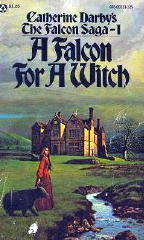
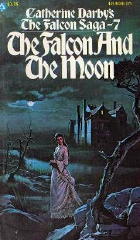
   As Catherine Darby, Maureen Peters wrote books that were sold as Gothics, such as the 12 books in the “Falcon Saga,” but were really what Sarah calls “dark family sagas.” Or more precisely, she describes their plot lines this way: “Themes of illicit passion, family rivalry, witchcraft, revenge, and even reincarnation permeated the novels…”

         BIBLIOGRAPHY. Crime Fiction only.
[Expanded and revised from her entries in CFIV; British editions only, except as noted.]

PETERS, MAUREEN (1935-2008). Pseudonyms: Veronica Black, Catherine Darby, Elizabeth Law & Judith Rothman.

Valentine (Hale, 2000, hc) SC: Tansy Clark. [London; Victorian]
Verity (Hale, 2002, hc) SC: Tansy Clark. [London; 1870s]
Vashti (Hale, 2006, hc) SC: Tansy Clark. [London; 1870s]

BLACK, VERONICA

Dangerous Inheritance (n.) Hale 1969 [England]
Portrait of Sarah (n.) Hale 1969 [England]
The Wayward Madonna (n.) Hale 1970 [England]
A Footfall in the Mist (n.) Hale 1971 [England]
Master of Malcarew (n.) Hale 1971 [England]
The Enchanted Grotto (n.) Hale 1972 [England]
Fair Kilmeny (n.) Hale 1972 [England]
Moonflete (n.) Hale 1972 [England]
Minstrel’s Leap (n.) Hale 1973 [England]
The House That Hated People (n.) Hale 1974 [England]
Spin Me a Shadow (n.) Hale 1974 [England]
Echo of Margaret (n.) Hale 1978 [England]
Greengirl (n.) Hale 1979 [England]
Pilgrim of Desire (n.) Hale 1979 [England]
Flame in the Snow (n.) Hale 1980 [England]
-Lover Dark, Lady Fair (n.) Hale 1983 [England]
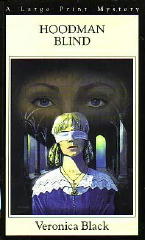
Hoodman Blind (n.) Hale 1984

Maureen Peters

Last Seen Wearing (n.) Hale 1990 [England]
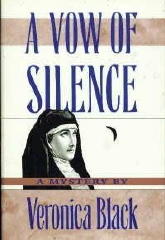
A Vow of Silence (n.) Hale 1990 [Sister Joan; England]

Maureen Peters

Vow of Chastity (n.) Hale 1991 [Sister Joan; England]
My Name Is Polly Winter (n.) Hale 1992 [England]
A Vow of Obedience (n.) Hale 1993 [Sister Joan; England]
A Vow of Sanctity (n.) Hale 1993 [Sister Joan; Scotland]
A Vow of Devotion (n.) Hale 1994 [Sister Joan; England]
A Vow of Penance (n.) Hale 1994 [Sister Joan; England]
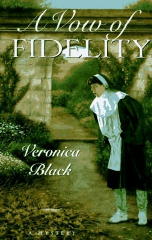
A Vow of Fidelity (n.) Hale 1995 [Sister Joan; England]

Maureen Peters

A Vow of Adoration (n.) Hale 1996 [Sister Joan; England]
Vow of Poverty (n.) Hale 1996 [Sister Joan; England]
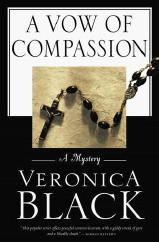
A Vow of Compassion (n.) Hale 1997 [Sister Joan; England]
Vow of Evil (n.) Hale 2004 [Sister Joan; England]

DARBY, CATHERINE [All were published first in the US as paperback originals.]

-A Falcon for a Witch (n.) Popular Library 1975 [Falcon Saga #1; England; 1910 ca.]

Maureen Peters

-The King’s Falcon (n.) Popular Library 1975 [Falcon Saga #2; England; 1644]
-Fortune for a Falcon (n.) Popular Library 1975 [Falcon Saga #3; England]
-Season of the Falcon (n.) Popular Library 1976 [Falcon Saga #4; England; 1774]
-Falcon Royal (n.) Popular Library 1976 [Falcon Saga #5; England]
-The Falcon Tree (n.) Popular Library 1976 [Falcon Saga #6; England; 1841]
-The Falcon and the Moon (n.) Popular Library 1976 [Falcon Saga #7; England; 1886]

Maureen Peters

-Falcon Rising (n.) Popular Library 1976 [Falcon Saga #8; England; 1818]
-Falcon Sunset (n.) Popular Library 1976 [Falcon Saga #9; England; 1916]
Whisper Down the Moon (n.) Popular Library 1977 [Moon Chalice Quest #1; England]

Maureen Peters

Frost on the Moon (n.) Popular Library 1977 [Moon Chalice Quest #2; England]
The Flaunting Moon (n.) Popular Library 1977 [Moon Chalice Quest #3; England; 1644]
Sing Me a Moon (n.) Popular Library 1977 [Moon Chalice Quest #4; England]
Cobweb Across the Moon (n.) Popular Library 1978 [Moon Chalice Quest #5; England]
Moon in Pisces (n.) Popular Library 1978 [Moon Chalice Quest #6; England; 1800s]
-Seed of the Falcon (n.) Popular Library 1978 [Falcon Saga #10; England]
-Falcon’s Claw (n.) Popular Library 1978 [Falcon Saga #11; England; 1399]
-Falcon to the Lure (n.) Popular Library 1978 [Falcon Saga #12; England]

LAW, ELIZABETH

The Sealed Knot (n.) Walker 1989 [Scotland; 1811]

ROTHMAN, JUDITH

With Murder in Mind (n.) Hale 1975


   For a complete listing of all of Maureen Peters’ fiction, see the Fantastic Fiction webpage for her.

   At the end of my previous post on Zekial Marko, better known to paperback collectors and mystery fans as John Trinian, I hinted at a small piece of information that turned up in his online obituary.

   Namely, that Marko had a brother named Kenn Davis. The double N immediately caught my eye. Could this be the same Kenn Davis, the mystery writer? Turns out that he is, and I hadn’t known it before. It was also news to Al Hubin, author of Crime Fiction IV, but after doing some investigating on my own, if it was a secret, it hasn’t been very well kept. People on various blogs and Yahoo groups have pointed it out on several occasions in the past.

   So it’s not exactly breaking news, but it’s still reason enough to talk about Kenn Davis’s books. Expanded slightly from his entry in CFIV:

  DAVIS, KENN. 1932- . Series character: CB = PI Carver Bascombe. All books are paperback originals.

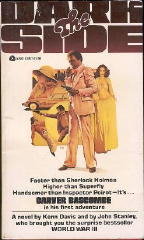
      The Dark Side [with John Stanley]. Avon 30957, pb, December 1976. [CB]
      The Forza Trap. Avon 44552, pb, June 1979 [CB]
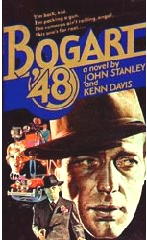
      Bogart ’48 [with John Stanley]. Dell 10853, pb, February 1980

KENN DAVIS

      Dead to Rights. Avon 78295, pb, August 1981
      Words Can Kill. Gold Medal 12667, pb, May 1984 [CB]
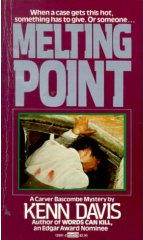
      Melting Point. Gold Medal 12901, pb, May 1986. [CB]

KENN DAVIS

      Nijinsky Is Dead. Gold Medal 13096, pb, 1987 [CB]
      As October Dies. Gold Medal 13097, pb, 1987 [CB]
      Acts of Homicide. Gold Medal 13351, pb, 1989 [CB]
      Blood of Poets. Gold Medal 13352, pb, 1990 [CB]

   In spite of the number of books, I have a feeling that both Kenn Davis and Carver Bascombe are fairly well forgotten today. Even though I believe I have all but one or two of the books, they’re boxed away where I can’t get at them. (You’ve heard that before.) So far I’ve been able to come up with only a few cover images, which you will see both above and below.

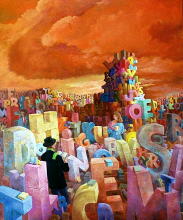
   But did you know, as I certainly didn’t — and I’ll get back to Carver Bascombe shortly — that Kenn Davis is also a well-known California-based artist, and has been for over 50 years? Taken from a website illustrating some of his work, one of which is shown here:

KENN DAVIS

    “KENN DAVIS has devoted his 53 year painting career to the interpretation of life in his own time. Associated with the North Beach Scene in the 1950s, he has continued to work with his chosen SURREALISTIC concepts, frequently in a satirical vein. In exhibitions throughout his home state of California, as well as in New York, Chicago, Boston, Houston and in Museums shows in San Francisco and Dallas, Davis has demonstrated his fascination with imagination. His work is often disconcerting and deliberately so. ‘There is enough art that lulls us into feeling right with the world, but to be stimulated by the artist brings us to another level of appreciation.’”

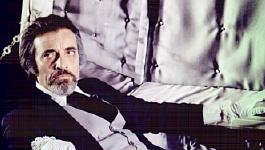
   Kenn Davis and John Stanley also co-wrote the screenplay for the comedy-horror film Nightmare in Blood, the storyline described on IMDB as: “Attendees at a horror-film convention in San Francisco keep disappearing. It turns out that the guest of honor is a real vampire…” Kenn Davis was the producer, and John Stanley directed. More on the making of the movie here, written by John Stanley himself. (No, that is not him in the coffin below.)

KENN DAVIS

   As for Carver Bascombe, from the second of the two websites linked to in the above paragraph, Stanley says:

    “One other thing we shared in common was an interest in science-fiction and horror. We also liked mysteries and in early 1970 had begun working on a private-eye screenplay, The Dark Side of the Hunt.

    “It was Kenn’s idea to write a story about a black San Francisco detective named Carver Bascombe. (This was before anyone had ever heard of John Shaft or Richard Roundtree.) We had even found a San Francisco-based stage actor, John Cochran, to play the Bascombe role.

    “And then came a big mistake: American-International offered to buy the script from us, but because we had promised John Cochran that the three of us would make the film come hell or high water, we turned it down. (Primarily because they wanted the script without us attached as would-be film wreckers.) We should have taken the offer but we were young and idealistic–and very idiotic.

    “(Dark Side of the Hunt didn’t completely die. A few years later it would be novelized by Kenn as The Dark Side –- my name was on it but I really didn’t write it –- and published by Avon. Kenn would go on to write an entire series about Carver and his San Francisco adventures.)

KENN DAVIS

   As it happened, The Dark Side was nominated for an Edgar in 1976 as Best Paperback Original. (Note that by the time the book was published, the movie Shaft had already appeared, in 1971, based on Ernest Tidyman’s 1970 novel) From the cover of The Dark Side:

    “Faster than Sherlock Holmes, Higher than Superfly, Handsomer than Inspector Poirot — It’s CARVER BASCOMBE, in his first adventure.”

   Kevin Burton Smith in the online January Magazine has this to say about the series:

    “For those who want a P.I. with good taste, you can hardly do better than Carver Bascombe, originally created by Kenn Davis and John Stanley in The Dark Side (1975), but continued for the next seven books by Davis alone, the series concluding with 1990’s Blood of Poets.

    “Bascombe’s a young Vietnam vet with a military police background, who’s now an ambitious, art-loving private eye and part-time student working his way through law school in San Francisco. Bascombe’s passion comes in handy, because his cases invariably involve the arts somehow, be it opera, drama, literature, art photography, ballet, painting or poetry.

    “The first few novels in this series were uneven, but by the fourth one, the Shamus-nominated Melting Point (1986), Davis had really hit his stride, with Bascombe sweating out a long, hot summer waiting to hear if he’s passed the bar, while at the same time he hunts down a missing sculptor.”

   Of special note, the link above leads to a long article by Kevin about black PI’s, a complete overview from a historical perspective. It’s well worth your reading.

[UPDATE] 01-18-10. I have bad news to report. Kenn Davis died six days ago at the age of 77. For a wonderful tribute to him as an author, check out Jeff’s piece about him on The Rap Sheet. I am pleased to say that Mr. Davis saw this post I did on him (see Comment #7). I am not pleased to say that in spite of all good intentions, an interview I kept meaning to do with him never happened. I wish it had.

   It was Juri Nummelin who on his blog was one of the first to post the news of Zekial Marko’s passing. A brief obituary can be found in its entirety on the Writers Guild of America website.

   Here’s a shortened version:

John Trinian

    “Veteran writer and long-time Writers Guild of America, West (WGAW) member Zekial Marko died on Friday, May 9, of complications related to emphysema in Centralia, Washington.

    “Born in 1933 and a WGAW member since 1964, Marko maintained a lengthy career writing for both small and silver screens. His television credits include episodes of The Rockford Files, Kolchak: The Night Stalker, and Toma, while his screen credits include the 1964 film Once a Thief, based on his novel.

    “Marko is survived by his wife, Sue, his two daughters, Belle and Zefra, his son, Zoyan, and his brother, Kenn Davis.”

   Marko’s list of TV credits would in itself qualify his death be mentioned on this blog. What the obituary does not say, however, but what has been known to fans of his work for some time, is that he was also “John Trinian,” author of a small eclectic set of mystery and crime paperbacks written back in the 1960s.

John Trinian

   It turns out that Al Hubin already knew this – the name behind the names is included in Crime Fiction IV, as you can easily check. What’s not there, but will appear in the next installment of the online Addenda — and right here, right now, of course — is any biographical information about Markos, including the year he was born (1933) and the fact that his name at birth was Marvin Leroy Schmoker. The latter Juri learned from a relative of Marko’s who contacted him after he died, perhaps because Juri had written about John Trinian on his blog and elsewhere.

   Based on and expanded from his entry in CFIV, here’s the list of all of Trinian’s paperback mystery fiction:

      A Game of Flesh. Bedside Book BB106, 1959; Lancer/Domino 72-678, 1963; Macfadden 75-360, 1970. “An explosive novel of a wanton gigolo and the love-starved women he shamed!”

      The Big Grab. Pyramid G548, 1960; Manor 95230, 1973. Reprinted earlier as Any Number Can Win. Pyramid F-925, 1963. “Their take would be a cool quarter of a million-or a hot slug in the gut.” Film: Cipra, 1963, as Melodie en Sous-Sol (Basement Melody). Released in Britain as The Big Grab; released in the U.S. as Any Number Can Win. Stars: Jean Gabin, Alain Delon.

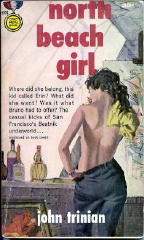
      North Beach Girl. Gold Medal s1000, 1960. Reprinted as Strange Lovers. Macfadden 60-301, 1967. [A novel set in the San Francisco beat world of the Fifties.]

John Trinian

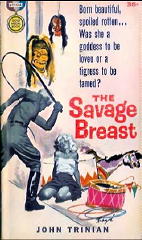
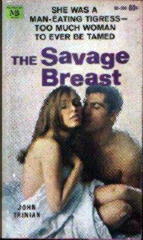
      The Savage Breast. Gold Medal s1104, 1961; Macfadden 60-330, 1968. “Born beautiful, spoiled rotten..was she a goddess to be loved or a tigress to be tamed?”

John Trinian      John Trinian

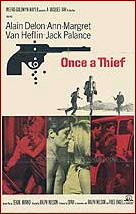
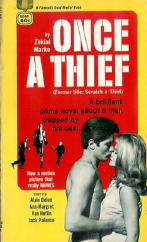
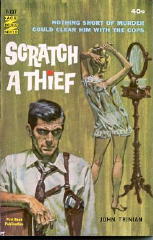
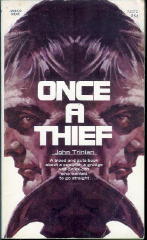
      Scratch a Thief. Ace Double F-107, 1961. Also published as: Once a Thief. Gold Medal k1569, 1965, as by Zekial Marko; and under the latter title as by John Trinian: Manor 95272, 1973. “A blood and guts book about a cop with a grudge and an ex-con who wanted to go straight…” Film: MGM, 1965, as Once a Thief; in French: Les Tueuers de San Francisco. (scw: Zekial Marko; dir: Ralph Nelson). Stars: Alain Delon, Ann-Margret. [Go here for a short clip from the film.]

John Trinian      John Trinian

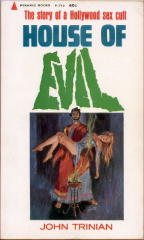
      House of Evil. Pyramid F-712, 1962. [?? Macfadden-Bartell, 1970] “The story of a Hollywood sex cult.”

John Trinian

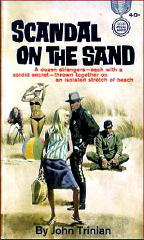
      Scandal on the Sand. Gold Medal k1449, 1964. Macfadden-Bartell 75-338, 1970.

John Trinian

   Reviews or commentary on Trinian’s work are few and hard to come by, but on Ed Gorman’s blog he had this to say, not too long ago:

    “A few weeks ago I reviewed a 1964 Gold Medal novel called Scandal on The Sand by John Trinian. Really fine pb. The structure was masterful and the social observation surprisingly rich. And the plot cooked. This guy knew how to tell a story. And the writing was equal to the other aspects of the tale. Deft turns of phrase; conscious rhythms in the sentences; interesting, even entertaining word choices.”

   What better things could one writer say about another? A fitting way to end this short tribute, I hope you’ll agree.

[UPDATE.] Later the same day. Keen eyes on your part may have noticed the same thing I did. It is true, it is he, and this small bit of information is what a followup post, coming up soon, will be all about.

REGINALD DAVIS – The Crowing Hen.

Doubleday Crime Club, hardcover, 1936. UK edition: Gordon Bles, hc, 1936.

REGINALD DAvIS The Crowing Hen

   The first thing you notice about Davis’s writing is his nicely wry sense of humor, you know, the kind that sort of sneaks up on you. Consider, for example, the superstitious reaction of the villagers of Hayes Coombe to the crowing of hens – wholesale slaughter in the feathered world! – and what one of a pair of real estate agents fears that this will do for the price of poultry….

   Precipitating this crisis is the impending sale of the mansion Danes Priory, said by some to be haunted, to a young couple about to be married. Warnings like footprints of blood and a dead Buff Orpington – or was it a Speckled Wyandotte? – are ignored, and mysterious death strikes, not once, but twice.

   Complicating matters is a fortune in unfenced stolen diamonds, but what Davis is more concerned with is his mystery-horror show that in no way is as intellectually gripping as a solid detective puzzle would have been. With facts as fragile as these, and a story that seems always to be heading off in the wrong direction, atmosphere just isn’t enough.

   The early promise of a reading treat in store is not kept. This was Davis’s first mystery novel. He wrote only one other.   [D]

– From The MYSTERY FANcier, Vol. 3, No. 2, Mar-Apr 1979.


[UPDATE] 05-20-08.  I knew this day was coming, and to tell you the truth, I’ve been putting it off for quite a while now. I wrote this review nearly 30 years ago, and I have the strongest feeling that if I were to read this book again, I’d have a strong quarrel with myself on the merits of this book.

   To me now, and from what little I remember of this book, it sounds exactly like something I’d love to read, little emphasis on the detective end of things or not. If only I could locate my copy, I’d let you know for sure.

   But since I haven’t – located my copy, that is – I’ve decided to let my younger self have his say, with only this one small hint to suggest that I may have been wrong.

   There’s one thing that I was definitely wrong on, and that’s how many mysteries Reginald Davis wrote. It must be that reference books back in 1979 hadn’t caught up with one of them, since in Crime Fiction IV now, here’s what Al Hubin lists for him:

  DAVIS, REGINALD

      * The Crowing Hen. Bles, UK, hc, 1936. Doubleday Crime Club, US, hc, 1936.
      * Nine Days’ Panic. Bles, UK, hc, 1937. Doubleday Crime Club, US, hc, 1938.

REGINALD DAvIS Nine Days Panic

      * Twelve Midnight Street. Bles, UK, hc, 1938.

   The latter is a scarce book. I found no copies offered for sale on the Internet when I searched just now.

   There’s no biographical information about Davis I can tell you about, neither from CFIV nor the Crime Club jackets, so says Bill Pronzini about the latter. It was he who provided both of the covers you see here in this post.

   Here’s Bill’s opinion on The Crowing Hen, cobbled together from a couple of emails as we were discussing the book. (This is just his end of the conversation, you understand.)

   “I read Hen a few years ago and liked it a lot; all sorts of wild, wonderful, and horrific happenings rather neatly wrapped up, I thought. […]

   “I wasn’t sure I liked The Crowing Hen at first, either. Farfetched to the point of absurdity in places. But the macabre atmospherics kept me reading, and I thought Davis did an admirable job of explaining the various weird happenings.”

   So there you have it. Two opinions, one of which the author is only partially standing behind. If you’ve read the book, why not add yours? I’d love to hear from you.

   A visit to the Book Barn in Niantic, one of Connecticut’s few surviving bookshops, netted me well over 100 mysteries yesterday, including a few recent hardcovers in nice shape. Of the paperbacks, so far I’ve found two (indicated with an *) from which I’ve gleaned information that Al Hubin did not have in the Revised Crime Fiction IV. He does now. These entries will appear in Part 28 of the online Addenda.

   Need I add that any additional information is always welcome? It is, and I just did.

ALLAN, STELLA. British author of six mystery novels included in the Revised Crime Fiction IV. Many of her books seem to focus on unhappy marriages and/or bad love affairs. See below.
      Arrow in the Dark. Collins, UK, hc, 1982.
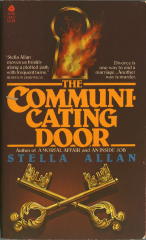
      * The Communicating Door. Love Stories, UK, 1986. Avon, US, pb, 1981. Add setting: London. “Divorce is one way to end a marriage… Another way is murder.”

STELLA ALLAN Communicating Door

      A Dead Giveaway. Collins, UK, hc, 1980. St. Martin’s, US, hc, 1981. Setting: England; theatre. [A successful playwright visits the country retreat of her wealthy ex-lover on the behalf of her new lover and finds herself embroiled in kidnaping, and murder.]
      An Inside Job. Collins, UK, hc, 1978. Scribner, US, hc, 1978. Setting: London. Scribner, 1978. “It was a plan so perfect they could get away with murder..He would do anything to get rich, and she would do anything to keep him.”
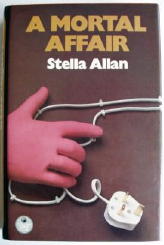
      A Mortal Affair. Collins, UK, hc, 1979. Scribner, US, hc, 1979. [The lover of a woman married to a doctor is exposed as a criminal.]

STELLA ALLAN Mortal Affair

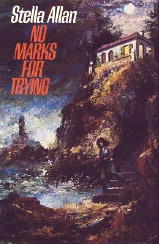
      No Marks for Trying. Macdonald & Janes, UK, hc, 1975. Avon, US, pb, 1981. Setting: Spain. [A married couple’s vacation in Spain turns into a nightmare of murder and intrigue when they meet a man with whom the wife once had an affair.]

STELLA ALLAN No Marks


KRAUSE, KATHALYN. Author of several works of romantic fiction, two of them included in the Revised Crime Fiction IV. See below.
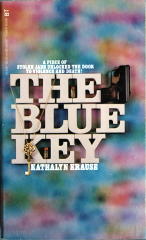
      * The Blue Key. Belmont, pb, 1980. Add setting: Los Angeles CA. “A piece of stone jade unlocked the door to violence and death.”
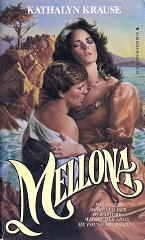
      Mellona. Belmont, pb, 1979. Make setting more specific: California, 1901. [A young woman, new to a close-knit coastal resort community, resembles a woman who disappeared 30 before.]

KRAUSE The Blue Key       KRAUSE The Mellona

« Previous PageNext Page »