Bibliographies, Lists & Checklists


   I’m still on vacation mode, but as I promised I might, I’m posting a short piece on a book that I just discovered that I have but didn’t know anything about until just now. And I can’t wait until September to tell you about it.

   It’s a private eye novel, one by John P. Browner, who is in Crime Fiction IV, by Allen J. Hubin, but about whom he also knows nothing more. The complete entry for the author reads like this:

      BROWNER, JOHN P.
         * -Who Killed the Snowman? (n.) Pocket Books 1979
         * Death of a Punk (n.) Pocket Books 1980 [New York City, NY]

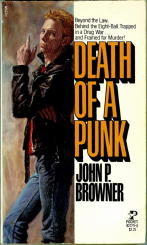
Death of a Punk

   It’s the second book of the pair which I’ve just discovered that I own. I found it in a box in my garage that I opened this afternoon to see what was in it (the box, that is). At the moment there’s not a single copy of Who Killed the Snowman? up for sale on the Internet, and Google brings up not a single mention of it, so I have no idea what it’s about. There is one copy of Death of a Punk on Amazon.com with an asking price of $75.00, but unless you’re more resourceful than I am, all of the other copies you’ll find there or anywhere else will set you back $300 or more. And, yes, you read that right.

   A word to the early bird. If the $75 one is gone by the time you read this, you weren’t early enough.

   The blurb on the front cover reads as follows: “Beyond the Law, Behind the Eight-Ball, Trapped in a Drug War … and Framed for Murder!”

   From the back cover:

ZZZ. Private Work for a Fee.
Complete Discretion Assured.
Leonard Hornblower (212) 699-1848.


   Lenny Hornblower. That’s me. $100-a-day plus expenses. Cash up front. Remember, this isn’t a licensed operation. I’ll trace anything, even runaways. For them it’s extra: $150 per, plus.

   So when a Mrs. Perlont (“Call me Lisa.”) asked me to find her Blinky, it was just another penny-ante job .. until I started nosing around the East Village puck rock scene and ran into a hot snowstorm: a cocaine heist, a hijacking ring and a know-nothing kid who knew too much to live.

   With friends like his, enemies were superfluous. Blinky was a punk rocker with a one-way ticket to Disaster Street. Trouble was, he wanted to take me along for the ride. And so did his stepmom who was willing to reveal everything but what I needed if I was ever going to find the one responsible for the …

DEATH OF A PUNK.


   About the “ZZZ.” That’s the first word in the ad that Hornblower puts in the Village Voice every week. Rather than having it show up at the top of the list in the classified section, he makes sure that it appears at the bottom.

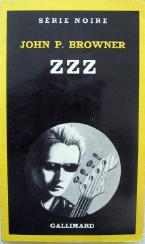
   There is a French version of this book, or at least I assume that it’s the same book, my French having disappeared on me about the same time I passed my last French exam, which would have been in 1964 or 1965. Here’s the bibliographic information from Amazon’s French website, along with a cover scan:

Browner - ZZZ

   Description du livre: Gallimard, 1981. État : Bon état. NRF 248p. N̊1824, première édition. N̊ de réf. du libraire 1928.

   Just as the word “noir” means many things to many people, it is not easy to define exactly was is meant by a “cozy” mystery. It’s usually a matter of saying “I can’t define it, but I certainly know one when I see one.” But pointing out examples is always good; also worth doing is a list of the common characteristics that cozies almost always seem to have.

   Danna Beckett does a super job of both on her Cozy Mystery website, which she’s just told me about and which I recommend to you highly. You’ll find a long detailed alphabetical list of authors there, from Jeff Abbott and Alina Adams (*) to Cornell Woolrich and Eric Wright, as well as a smaller section of TV and movie cozies.

   (*) Skipping over Pearl Abraham (not a mystery writer) and Peter Abrahams (not a cozy writer), but there are very good reasons why they’re included. Why make a list of mystery writers and not include your favorites? It works for me.

   I’m always on the lookout for previously unknown and/or unidentified private eyes, the fictional variety. Kevin Burton Smith keeps a pretty good list on his Thrilling Detective website, but he doesn’t have them all. I’ve helped in adding a few, and I thought I had another one when I came across the books of Bernard Bannerman, who chronicled the adventures of one Dave Woolf, a London-based PI about whom I’ll tell you more in a minute.

   It turns out, however, that Kevin has heard of Dave Woolf. He’s listed as a PI on his website, but only by name. There’s no page there for him, yet.

   Here’s what Bannerman’s entry looks like in Crime Fiction IV, by Allen J. Hubin:

   BANNERMAN, BERNARD; pseudonym of Andrew Arden (1948- )

      * Controlling Interest (n.) Sphere 1989 [Dave Woolf; London]
      * The Last Wednesday (n.) Sphere 1989 [Dave Woolf; London]
      * The Judge’s Song (n.) Sphere 1991 [Dave Woolf; London]
      * Orbach’s Judgment (n.) Sphere 1991 [Dave Woolf; London]

   Under his own name, Andrew Arden has one mystery novel to his credit:

   ARDEN, ANDREW (1948- ); see pseudonym Bernard Bannerman

      * The Motive Not the Deed (n.) Talmy Franklin 1975 [London]

   I don’t know anything about this book, but from the Internet, I have learned more about the author himself. Taken from his website:

   Andrew Arden Q.C. has established himself as one of the leading authors on housing and local government law, editing or authoring several leading and authoritative texts in this area. In addition to materials written for practitioners, he has also written several texts designed as a more general introduction to these areas of law.

   Fiction — the novels which appeared under his own name:

      * The Motive Not The Deed, 1974
      * No Certain Roof, 1984 [Landlord of working-class family wants to turn their house into flats.]
      * The Object Man, 1987
      * The Programme, 2001 [A law firm gets mixed up with a quasi-religious cult.]

   If you may have gotten the feeling that legal matters have something to do with the cases that Dave Woolf works on, you’d be right. I hasten to add that I’ve not read any of them yet, but I’ve recently put together a complete set of his adventures, as told by Bernard Bannerman.

   Each of the first two books mentions the other as a selling point, so perhaps they came out at the same time. But one has a lower publisher’s number than the other, so I’ll go with that one as the first of the two. (The same is true for the second pair of books.)

   Quoting from the back cover of each of the books:

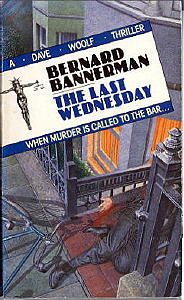
THE LAST WEDNESDAY. Sphere 0382, pbo, 1989.

The Last Wednesday

   No one falls out as viciously, as painfully or as messily as lawyers. Jack Nicholas, left-wing barrister, was supposed to have died in an accident. Drunk, said the coroner. Murdered, said his mother. Enter Dave Woolf, ex-solicitor, boozer and down-at-heel private eye.

   Even before Woolf starts asking questions, he finds that he is investigating not one death, but the wholesale despatch of Jack Nicolas’ erstwhile colleagues. There is very little for Woolf to go on – as he treks through the glitz and sleaze of London, through France and Norway in search of an elusive German – other than the apparent coincidence that all the deaths had occurred on the last Wednesday of every month.

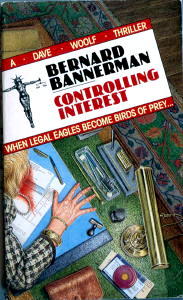
CONTROLLING INTEREST. Sphere 0383, pbo, 1989.

Controlling Interest

   “The body of a woman solicitor was discovered by staff arriving yesterday morning at the Holborn offices of the prestigious London solicitors, Mather’s. Katrina Parkhurst, 32, has been shot. Police are investigating.”

   A murder on the premises is bad news for a law firm. It discourages clients. It also discourages recruits which is damaging to a firm like Mather’s with a reputation, a lot of clients, but very few partners. But, as Dave Woolf, one-time lawyer, part-time boozer and (almost) full-time private eye realizes, a thorough professional would prefer a murder to a leak any day of the week. Dead men can’t leak information on gambling debts, treachery, the darker side of freemasonry, and a dodgy business dating back forty years …

THE JUDGE’S SONG. Sphere 0520, pbo, 1991.

The Judge's Song

   It was, as Dave Woolf said, “the sort of thing that doesn’t happen in England.” High-count corruption, gangsters, fire-bombs and a bit of murder on the side – all of it against the backdrop of a family drama raging through London, the West Country and the South of France.

   It’s not the sort of thing that solicitors ought to be investigating. But Woolf is not ordinary solicitor. Back in the legal fold after a spell as a private eye, he’s roped into a spot of detection for the usual reason – an irresistible fee. Sustained by hefty slugs of Southern Comfort, Camels and his new Aussie sidekick, he’s ready to haul a few skeletons out of family cupboards. The trouble is, they’re still alive …

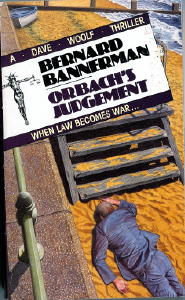
ORBACH’S JUDGEMENT. Sphere 0521, pbo, 1991.

Orbach's Judgement

   Dave Woolf, solicitor and private eye, has had respectability thrust upon him. He’s also been saddled with the most sensational case of his career.

   High Court Judge Sir Russell Orbach is a pillar of the establishment and a doting guardian to the orphaned Frankie. In public, that is. In private, according to Frankie’s famous half-sister, he’s a murderer. What’s more, she’s going to say so n her forthcoming autobiography. Would Woolf, asked the petrified publisher, check up on this bizarre accusation?

   It’s just up Woolf’s street; he specialises in investigating the misconduct of members of the legal profession. It’s sometimes like biting the hand that feeds you; but when that hand is adept at bullying, blackmail and bundling bodies into the ocean, it’s Woolf who’s in danger of being bitten … and badly.

Comments: First of all, I do like that last line. Secondly, as I mentioned earlier, I’ve not read these, but I have skimmed through them. Not well enough, I admit, to identify Woolf’s new Aussie sidekick in The Judge’s Song, but enough to know that these are books that are not likely ever to be published in the US, a country whose inhabitants have no idea what a solicitor is, nor how he or she is different from a barrister.

   My impression is, and I could be wrong, is that these books are like the rough-and-tumble adventures of Jonathan Gash’s Lovejoy capers, only with a backdrop of courtroom drama and stodgy legal wrangling rather than the much more dodgy antiques business. More reliable input would be welcome.

   Following up on the entry posted earlier here on Olive Harper, a lady who specialized in novelizing mystery plays around the beginning of last century, Victor Berch has made some revisions, corrections and additions to the previous list of books she wrote. None of these changes are major, but all of them are essential.

Trunk

   Many of these novelizations are, of course, included in Al Hubin’s Crime Fiction IV, but the true origins of these stories were not known for most of them when CFIV came out. This new entry for Olive Harper will show up shortly in the ongoing Addenda to the Revised Crime Fiction IV.

   The changes have been made in the previous blog entry, which you can see by following the link above. Victor also sent along another ten or twelve more cover images, some of which you see here, but there are simply too many of them for small blog entries like this one. So what I’ve done is to create a new separate page on the original Mystery*File website page, one that’s large enough to hold them all, along with the newly revisions.

Desperate Chance

   Take a look now, if you would, at www.mysteryfile.com/Harper/Compleat.html. It’s as complete now as we can get it. So far.

[UPDATE] 06-28-07. This didn’t take long, did it? Victor’s found two more cover images, and I’ve just uploaded them both to The Compleat OLIVE HARPER webpage. (See the link in the last paragraph above.)

   The Hillman-Curl cover scans found at Bill Deeck’s Murder at 3 Cents a Day website are complete now from 1936 to 1939, which marked the end of their “Clue Club” line. I uploaded the covers for 1939 over the weekend, but I haven’t had a chance to let you know till now. (It’s been a busy week, and it promises to get even busier.)

   Included in this last batch are a Bulldog Drummond title by Gerald Fairlie, one by pulp writer Steve Fisher, and two by Barry Perowne, one of them a Raffles adventure. Coming next: perhaps Arcadia House (1939-1967) or Mystery House (1940-1959), but one of the smaller companies like Gateway (1939-1942) may sneak in ahead of both of the two larger ones.

Lion #60

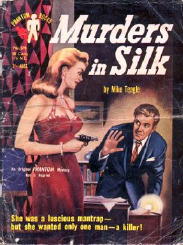
   There’s not much that’s known about a mystery writer named Mike Teagle. He wrote a pair of detective novels published by Hillman-Curl in the late 1930s, but after the second was published, he seems to have vanished completely. There’s not a single source that has any biographical data about him. The two books appear to be the only legacy he’s left behind.

   We can make some preliminary judgments and surmises, though. Since “Mike Teagle” is a character in his first book, the odds are that the name’s a pseudonym — possibly but not very likely to be the author’s too. Bill Pronzini says, “Judging from the political story, theme, and characters in Death over San Silvestro, I would guess that he was a newspaperman with leftist leanings, probably based in New York City or environs. His knowledge of NYC and Long Island is evident in the background descriptions in Murders in Silk.”

   Bill goes on to say: “Both novels are ultra-hardboiled. I prefer Silk, but that’s because I’m not a political animal. Silk is flawed, but it has well-drawn characters, good dialogue, an abundance (probably an overabundance) of violent action, and moves at a breakneck pace.”


Death Over San Silvestro
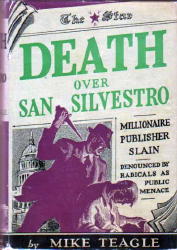
. Hillman-Curl, hardcover, 1936. Two printings known.

Murder San Silvestro - Teagle

Leading character: Mike Teagle, bodyguard.

Setting: New York City

Jacket Blurb:
Every American is a suspect in the strange murders which rock the country as the people of he United States approach their most crucial presidential election.

   In the midst of this fog of death and hidden conflict moves the figure of Horace J. Breasted, sometimes sinister, always powerful, driving ruthlessly toward his secret goal. A strange man, Horace J. Breasted – a multi-millionaire publisher of newspapers and magazines, friend of presidents and foreign dictators, paramour of beautiful women, owner of vast fields and factories and mines. A man hated by millions, feared by millions, envied by millions – doomed to die at the hands of an assassin.

   Caught up with Breasted in this whirlwind of mystery and danger are the President of the United States and his Republican opponent, gangsters and society matrons, show girls and senators, a general with a secret, and a girl with a cause. Caught up with them, flung about in the madness of speeded-up America at the crisis, are all the others, too – millionaires and starving men, Communists and Fascists, Democrats, Republicans and Socialists.

   How many of these are involved in the mysterious murders that shock America? Which of these know the forces that are at work behind the scenes to gain power over the American people for their own secret purposes? And which of these will be the next to die?

Review excerpts: “The book is probably the nearest thing to Marxist mystery-mongering the circulating library patrons have had to date.” – Carlton Brown, New Republic

    “The story is well told, but it leaves a bad taste in the mouth.”– Isaac Anderson, New York Times

    “Tough ’n terrible.”– Saturday Review of Literature

       [Taken from the front flap of Murders in Silk:]

    “Makes The Thin Man seem like a juvenile.” – Alvin C. Hammer

    “Most audacious mystery novel of the year.” – Toledo News Bee

    “The most exciting fiction story you have read since the ban was lifted on Nick Carter.” – Springfield Union


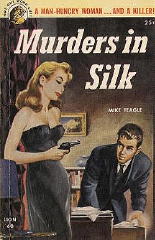
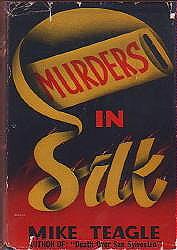
Murders in Silk. Hillman-Curl, hardcover, 1938. Mystery Novel of the Month, no number [#1], digest paperback, no date. Lion #60, paperback, 1951. John Long, UK, hc, 1939. Phantom Books #598, Australia, digest pb, 1954.

Murders in Silk - Teagle

Leading characters: Tiberius Bixby and Zeb Bixby.

Setting: New York City and Long Island

Jacket Blurb:
The troubles of Tiberius Bixby began when the man with the purple tie got his throat cut in the women’s washroom on a Long Island Railroad train. And mixed up in the bloody jigsaw jumble were:

   The girl in the red calot who strangely hid her knowledge of a dead man and thought murder didn’t constitute a social introduction;

   The blonde Paula, who celebrated because her father was mysteriously burned to death;

   Nicky Pet and the woman dentist; a Ghurka knife and the cryptic cry of a dead man’s wife – all tangled in a fog of alcohol and murder.

   What have all these to do with silk?

   The answer was found by eccentric old Pa Bixby, who, at seventy, was still able to appreciate a well-filled stocking as he mixed his whiskey with philosophy.

Review excerpts: “The story is fast, slick, exciting and altogether an outstanding example of the tough trend; it also contains additional features in the way of character and real amusement. If you must have a ten-minute egg, read Murders in Silk.” – Will Cuppy, Books

    “Good-natured cynicism, a clever plot well told, and a seventy-year-old chronic alcoholic make this book a feature of the mystery season. Three murders … and a wholly surprising denouement are some of the other factors that entitle this story to high praise.”– Boston Transcript.

Phantom Books - Teagle

   I don’t know about you, but whenever I come home from a book-hunting expedition and start going through my finds and come across an author I’ve never heard of before, I immediately go to Al Hubin’s Crime Fiction IV to see what other mystery fiction he might have done.

   Case in point. George Adams, whose entry in CFIV looks like this:

   ADAMS, GEORGE (1936- )
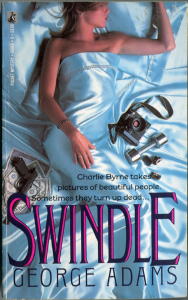
       * Swindle (Pocket Books, 1989, pb) [Charlie Byrne; New York City, NY]
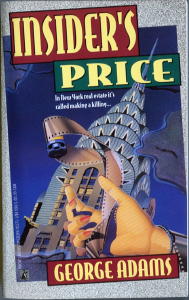
       * Insider’s Price (Pocket Books, 1993, pb) [Charlie Byrne; New York City, NY]

   The book I bought while on the road was his first one, Swindle, and thanks to the Internet, it wasn’t too difficult to find his other one. Nor was it too expensive. I don’t think the demand is very high, but let’s see if I can’t do something about that. Maybe I’ll succeed, and maybe I won’t, but it’s worth a try.

Swindle. Pocket, paperback original; 1st printing, February 1989.

Swindle, George Adams

From the back cover:

         THE CAMERA NEVER LIES …

   Charlie is a high-fashion photographer, part-time bicycle racer and a full-time lover. Manhattan is his playground. But when his sexy stylist loses $50,000 to a phony investment scheme. Charlie makes his first mistake. With the help of an out-of-work actor and a very busy hustler he sets out to scam the scammer – and get the money back. Instead, he finds a money-mad netherworld of insider trading, wiseguys, murder and sex, and there’s no telling the good guys from the bad … A gorgeous woman and a Wall Street wizard are the heavy hitters in a ruthless game to separate New York’s most beautiful people from their money. Charlie Byrne has wandered right into the middle of a nightmare that could only happen in New York – and getting out will be as simple as staying alive.

About the author:

   Like his hero, Charlie Byrne, George Adams is a well-known New York advertising photographer who can be found racing his bike in Central Park on Sundays. Unlike Charlie, he almost always finishes the New York Times crossword puzzle. Adams’ work appears on the front cover of this book.

Review excerpt: [Chicago Sun-Times] “A page turner with lots of twists and turns, flesh-and-blood characterizations, and swift and rhythmic prose. It’s hard to believe Swindle is a first novel.”

Insider’s Price. Pocket, paperback original; 1st printing, September 1993.

Insider's Price

From the back cover:

         THE ART OF THE STEAL

   High-fashion photographer Charlie Byrne heads from his humble midtown digs to the Upper East Side when old acquaintance JoJo Cyzeski – now Josephine – hires him to shoot a priceless Aubusson tapestry. The tapestry, and the fabulous co-op, belong to Marc Ransom, megabucks New York real estate developer and legendary ladykiller. But a darker side to the glittering world develops when the shoot is short-circuiited by a blackout and an apparent suicide in the adjoining courtyard. That’s when Charlie meets the gorgeous sister of the dead woman, who leads him into the gilded precincts of real estate royalty, where doing business can be murder….

   From a terrifying Times Square fleabag hotel to a penthouse bought with drop-dead deals, from the homeless woman camped in his doorway to the bevy of beauties in Ransom’s collection, Charlie follows clues to the suspect suicide and lands on the bottom line of the New York real estate game – where monopoly is played for keeps.

From inside the front cover:

       IF THE STAIRWELL WAS A GOOD PLACE TO GET MUGGED, THE ELEVATOR WAS EVEN BETTER …

   I leaned on the button continuously. “Come on,” I pleaded.

   A woman’s scream pierced the ambient sound of TV’s and ghetto blasters. “He’s an old man, leave him alone!” Smack! Then a baby was bawling.

   Tito and I swapped looks. We bolted down the corridor. A spindly black girl, a bawling child on her hip, sobbed into her hand. Four goons were working someone over.

   Tito leveled the Nikon to his eye and fired. They froze like statues. The flash etched them on my retina. One was Angel. The bandaged one was James. The other two were strangers. An old man was lying on the floor.

   “Yo, James, lookee ’ere.” Angel grinned, his vision clearing.

   One of them flicked open a switchblade. The four of them advanced.

   Tito and I began backpedaling. I sighted my camera and let them have a blast of strobe. The flashes took forty seconds to recharge, an eternity. We’d shot our load …

   “Get ’em,” Angel barked …

   Although I’m not sure what the first book was which “novelized” a movie, I know that it’s not a recent innovation, and in fact the idea is even older than that. Even before movies came along, around the turn of last century, what audiences took a good deal of pleasure in watching were plays in live performance, many of them mysteries, and would you believe, these plays were often novelized.

   This is hardly a formal article on the subject. It’s too early for that. Very little has been written about the novelizations of plays, and it’s obvious a much longer piece is needed to say everything there is to say. From what Victor Berch has told me, though, at the end of the 19th century and into the first part of the next, there were three or four publishing houses that specialized in such works of fiction, and there may have been more. The most prolific of these was the J. S. Ogilvie Publishing Company, of New York. Street & Smith did some, Victor says, and I. & M. Ottenheimer of Philadelphia did some as well.

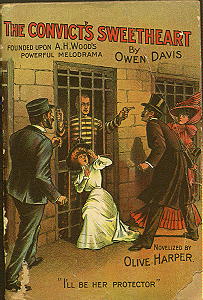
   One of the authors who specialized herself in turning plays into novels, usually in softcover form, was the pseudonymous Olive Harper, whose entry in Crime Fiction IV, by Allen J. Hubin, Victor has recently revised and which you’ll see below.

   This information will also show up soon in an upcoming Addenda to the Revised CFIV. Victor has sent me cover images for four of this books, and perhaps – just maybe – the titles themselves will be enough to start you off in a new direction for your mystery collecting activities.

   Warning: The books below are not easily found. While not expensive, generally under $20 each, only a handful of the titles below could be found by taking a quick look on www.abebooks.com. A few of the author’s non-mystery novelizations and translations show up also, but at the present time, only four of them are mysteries (not, as I recall, the same four that are shown below).

HARPER, OLIVE, pseud. of HELEN BURRELL GIBSON D’APERY, 1842-1915
Bertha, the Sewing Machine Girl (Ogilvie, 1906, pb) Novelization of play in 4 acts by Theodore Kremer [New York City]. Silent film: Fox Film Corp., 1926 (scw: Gertrude Orr; dir.: Irving Cummings)

The Burglar and the Lady (Ogilvie, 1912, pb) Novelization of play in 4 acts by [Arthur] Langdon McCormick. Silent film: Sun Photoplay, 1915 (scw: [Arthur] Langdon McCormick; dir.:Herbert Blache).

*Caught in Mid-Ocean (Ogilvie, 1911, pb) Novelization of play in 4 acts by Arthur J[ohn] Lamb. [London, ship]

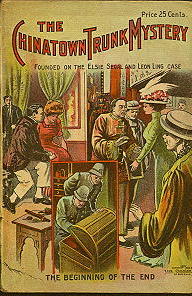
*The Chinatown Trunk Mystery (Ogilvie, 1909, pb) Novelization of play in 4 acts by Owen Davis. [New York City]

The Convict’s Sweetheart (Ogilvie, 1909, pb) Novelization of play in 4 acts by Owen Davis [Colorado]

The Convict's Sweetheart

The Creole Slave’s Revenge (Ogilvie, 1908, pb) Novelization of play in 4 acts by Walter Lawrence, pseud. of Owen Davis [Louisiana]

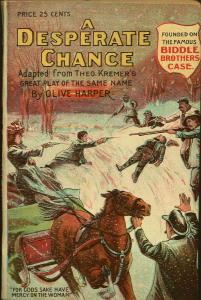
*The Desperate Chance (Ogilvie, 1903, pb) Novelization of play in 4 acts by Theodore Kremer

Fighting Bill, Sheriff of Silver Creek (Ogilvie, 1907, pb) Novelization of play in 4 acts [California]

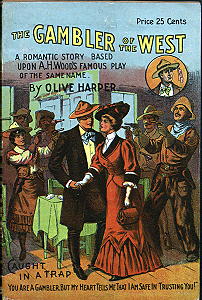
The Gambler of the West (Ogilvie, 1906, pb) Novelization of play in 4 acts by Owen Davis

Gambler of the West

It’s Never Too Late to Mend (Ogilvie, 1907, pb) Novelization of the 4-act play It’s Never Too Late to Mend; or, The Wanderer’s Return by Owen Davis [New York City]

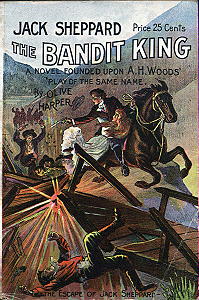
Jack Sheppard, the Bandit King; or, From the Cradle to the Grave (Ogilvie, 1908, pb) Novelization of play in 4 acts by Owen Davis [California]

Jack Sheppard

King of the Bigamists (Ogilvie, 1909, pb) Novelization of play in 4 acts by Theodore Kremer

The Millionaire and the Policeman’s Wife (Ogilvie, 1908, pb) Novelization of play in 4 acts by Owen Davis [New York City]

* A Millionaire’s Revenge (Ogilvie, 1906, pb) Novelization of play in 4 acts by [James] Hal[leck]
Reid [New York City]

On Trial for His Life (Ogilvie, 1908, pb) Novelization of play in 4 acts by Owen Davis [West]

The Opium Smugglers of Frisco; or, The Crime of a Beautiful Opium Fiend (Ogilvie, 1908, pb) Novelization of play in 4 acts by Owen Davis [San Francisco]

The Queen of the Outlaw’s Camp (Ogilvie, 1909, pb) Novelization of play in 4 acts by Edward M. Simonds [Colorado]

The Queen of the Secret Seven (Ogilvie, 1909, pb) Novelization of play in 4 acts by Ike Swift, pseudonym of Owen Davis [New York City]

The River Pirates (Ogilvie, 1909, pb) Novelization of play in 4 acts by Walter Lawrence, pseud. of Owen Davis. [New York City]

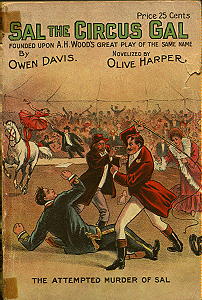
Sal, the Circus Gal (Ogilvie, 1909, pb) Novelization of play in 4 acts by Owen Davis [Chicago]

Sal, the Circus Gal

The Shadow Behind the Throne (Ogilvie, 1908, pb) Novelization of play in 5 acts by Alicia Ramsay and Rudolph de Cordova

The Shoemaker (Ogilvie, 1907, pb) Novelization of play in 4 acts by [James] Hal[leck] Reid [New York City, Wyoming]

A Slave of the Mill (Ogilvie, 1905, pb) Novelization of play in 4 acts by [James] Hal[leck] Reid and Harry Gordon

Tony, the Bootblack (Ogilvie, 1907, pb) Novelization of the 4 act play Tony the Bootblack; or, Tracking the Black Hand Band by Owen Davis [New York City, Italy]

Wanted by the Police (Ogilvie, 1909, pb) Novelization of play in 4 acts by [Arthur ] Langdon McCormick [New York City]

      * Based on true crimes.

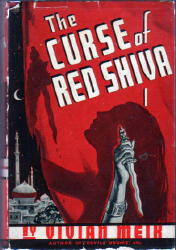
   Vivian (Bernard) Meek came to my attention when one of his books, The Curse of Red Shiva, appeared in the Hillman-Curl line of mysteries, covers of which I’ve been gradually uploading to the Murder at 3 Cents a Day website.

   Mr. Meek was born in 1894 and, as recently discovered by Victor Berch, died in California in 1955. Some short biographical notes online describe him as being an author, engineer and a war correspondent. In the course of these occupations he was also a dedicated world traveler, spending much time in India and the surrounding territory. In addition to his suspense and horror fiction, for which he is probably best known today, he wrote The People of the Leaves (Philip Allan, UK, 1931; Henry Holt, 1931), an anthropological study of an obscure tribe called the Juang located in Orissa, a sizable state along the east coast of the Indian subcontinent.

***

UPDATE: While waiting for me to complete my commentary on the books themselves, Victor came up with the following additional information on the author:

   Here is some info I picked up from various documents I found, the most informative being the information Meik supplied on his flight to the US for permanent residency here. According to the California Death Index, Meik was born June 21, 1894 and died December 22, 1955. Another database gives his birth date as July 21, 1894, however.

   Supposedly born in Calcutta, India, on the flight information, Meik claims he was born at sea on a British vessel. From another document, his father was a Lorenzo Meik and his mother was Alice Gertrude Thomas Meik. Another document lists his wife’s name as Bernadette Marie Desparadze. Going back to the flight document, the following further information is supplied:

   His flight left Frankfort, Germany June 21, 1947 and arrived in NY on June 22, 1947. His passport was issued June 14, 1947, a week before his 53rd birthday.

      Height: 6 feet
      Complexion: Swarthy
      Last permanent residence: 41 Denman Drive, London
      Occupation: Journalist
      Intention: Permanent residency in US. He was going to stay with an uncle, Francis T. Meik of Salt Lake City, Utah
      Age: 52

   There was no indication that his wife ever joined him. One outstanding feature that he had when he arrived in the US was that he was missing his left eye.

***

   I’m back. I have not located a usable cover scan for this first book, a collection of horror fiction, but the contents are listed in Crime Fiction IV, by Allen J. Hubin, who indicates that some of the stories are also crime-related. Note the slight correction in the title: the apostrophe is correctly after the “s”.

Devils’ Drums (Philip Allan, UK, 1933; Midnight House, US, in preparation, Douglas A. Anderson, editor)

* • An Acre in Hell • ss
* • Devils’ Drums • ss
* • The Doll of Death • nv
* • Domira’s Drum • ss
* • The Honeymoon in Hate • ss
* • L’Amitie Reste • ss
* • The Man Who Sold His Shadow • ss
* • Ra • ss
* • White Man’s Law • ss
* • White Zombie • ss

The volume edited by Doug Anderson will contain three additional stories:

* • Chimoro
* • I Leave It to You
* • The Two Old Women
***

   A second book, also published by Philip Allan in that publisher’s “Creeps series,” is a novel rather than a short story collection; it is nonetheless considered to be a sequel to the preceding one:
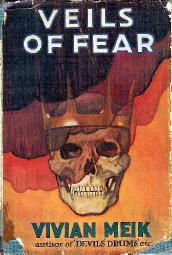
Veils of Fear (Philip Allan, 1934)

Veils of Fear

   The book is not presently included in CFIV, but Bill Pronzini says that in addition to featuring a reporter named Neil Martyn, “There are some homicides and suspense elements but they seem to be pretty much connected to the occult horror theme. Settings range from Port Said to the Far East.”

   On this basis, Al Hubin has indicated that the book will appear in an upcoming Addenda installment to the Revised Crime Fiction IV, but with a dash to indicate that it is only marginally criminous.

   Doug Anderson has more to say about the two books: “While Neil Martyn is the main point of view character, the [returning] series characters in Veils of Fear are Geoffrey Aylett and Padre Jan Vaneken. Both appear, along with others (Peter Verrey; one Vereker, no first name given; and Doctor Strang) in Devils’ Drums (and two – Vereker and Strang – are mentioned in the short story ‘The Two Old Women’.”

***

   The final work of fiction from the pen of Vivian Meik is also the only one which to this date has been published in the US, also a novel:

The Curse of the Red Shiva. (Philip Allan, 1936; Hillman-Curl, 1938.)

Curse of Red Shiva

Jacket blurb: Taken from the Hillman-Curl edition.

    “You will gasp for mercy for your children as I have cried for mine, and only the striking blade will be the answer. Behold! By Red Shiva I curse you!” A knife gleamed in her hand as it flashed downward and buried itself in her heart.

    More than a century and a half since those words were uttered by a beautiful Indian slave to Peter Trenton, adventurer …

    But now, after five generations, Sir Peter Trenton was found under Westminster Bridge, brutally murdered, a gold mohur tied around his neck.

    Sir Derek Balliol had guessed the significance of the series of murders – but he was killed before he could speak! Only Verrey was left … and against him were pitted the cunning powers behind the newly-awakened race consciousness of the East.

Review excepts: [Isaac Anderson, New York Times] “This is just the book for those who like tall tales of Oriental intrigue and of menaces to the supremacy of the white race.”

   [Saturday Review of Literature]. “Blood and thunder yarn of slinking Eurasians, renegade whites, stranglings, etc., with reasonably good detective trimmings.”

   [Bill Pronzini, earlier on the Mystery*File blog]. “A Sax Rohmerish adventure mystery with a screwball plot.”

***

Short fiction: [This list, which includes reprint appearances, is probably not complete. Doug Anderson promises that his edition of Devils’ Drums will include a more extensive bibliography as well as additional details of the author’s life, including where and when he lost one eye.]

    * • Chimoro. To be included in the expanded Devils’ Drums. From Doug Anderson: “This is an extract from a chapter of one of his autobiographical volumes, Zambezi Interlude (1932). It reads exactly like one of his stories.”

    * • The Doll of Death. From Devils’ Drums. Reprinted in The Sixth Pan Book of Horror Stories, Herbert van Thal, editor; Pan, pb, 1965. Televised on Night Gallery, NBC, Sunday, May 20, 1973.

    * • A Honeymoon in Hate. From Devils’ Drums. Reprinted in A Wave of Fear, Hugh Lamb, editor; W. H. Allen, 1973; Taplinger, US, hc, 1974.
      — Mikalongwa, Angoniland. English refugees Blair Taylor and Martin Kemp are bitter rivals for the love of the beautiful Estelle. When she decides to marry Taylor, Kemp turns to black magic and drives him to madness and suicide. Estelle avenges her beloved by marrying his murderer, having first infected herself with the blood of a leper. On their wedding night she performs a macabre striptease …

    * • I Leave It to You. From ?? Included in Another Corner Seat Omnibus, Anonymous, editor; Grafton Publications, March 1945. To be included in the expanded Devils’ Drums.

    * • The Two Old Women. From Monsters, A Collection of Uneasy Tales, Charles Birkin, editor. Philip Allan, 1934. Reprinted in The Fourth Pan Book of Horror Stories, Herbert van Thal, editor; Pan, pb, 1963. To be included in the expanded Devils’ Drums.
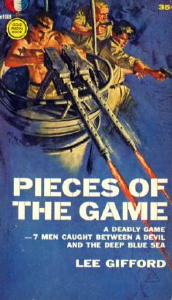
   It isn’t very difficult to create a “compleat” entry for a mystery writer when the writer has only one mystery novel to his credit, as is the case for Lee Gifford, which is quite possible a pseudonym. But as you can imagine — think about it for a bit — it’s not easy doing a Google search for anyone with a name like this. Screening out all of the unwanted entries produced nothing of interest. I also could not locate any other book, fiction or non-fiction, that I could ascribe to the name.

   The reason I suspect that Gifford is a pen name is that the single book in question is not copyright in the name of the author, but by Fawcett Publications, long time publisher of the well-known (and widely collectible) line of Gold Medal paperbacks. Any further information about the writer would be welcome.

    His entry in Crime Fiction IV, by Allen J. Hubin, slightly expanded:

         GIFFORD, LEE
            * Pieces of the Game. Gold Medal s1008, pbo, June 1960. Setting: Far East; WWII.

Pieces of the Game

   From the back cover:

    “Shortly before the U.S. and Filipino forces surrendered to the Japanese on May 6, 1942, they dumped a king’s ransom estimated at $8,000,000 in solver in the deep water south of Corregidor … A group of U.S. divers, captured on the fall of Corregidor, were forced to assist in its recovery by the Japanese…” — U.S. Naval Institute Proceedings, March 1958.

    Trapped between the calculated greed of a Japanese colonel and fear of the the savage fate with awaited them if they tried to escape, seven American POWs dove for the silver. And, in this novel, one of them lived to return, long after the war…

   From the front cover:

   A deadly game — 7 men caught between a devil and the deep blue sea

    From inside the front cover:

         CHECK MATE

    “There were several of us who knew where the silver was hidden.”

    Yamata’s smile faded. “Your selection of past tense is correct. There were several. You are the only one left, Mr. Sheridan.”

    I rose to my feet. My fists clenched. “Violence, Mr. Sheridan?” Yamata taunted. “Good! It is the last refuge of the intellectually defeated. His smile widened. “However, before engaging in precipitate action, I would suggest you meet an old friend.”

    When she appeared, I froze in disbelief. Slim, regally erect, she was even more beautiful than my vivid memories. She was wearing a red kimono. Luxuriant black hair fell in soft waves, framing her composed face. Only her eyes were different — the sparkle was gone, replaces by blue-porcelain emptiness.

    I swiveled my head as the Colonel spoke up. “You see, Mr. Sheridan — I have your Queen.”

« Previous PageNext Page »