Bibliographies, Lists & Checklists


    To supplement Bill Deeck’s reference work about lending-library mysteries, Murder at 3c a Day, I’ve just uploaded scans of the covers of those that Hillman-Curl published in 1938, 24 of them in all. Authors with more than one book from H-C that year were J. S. Fletcher, Norman Forrest [Nigel Morland], Paul Haggard, E. R. Punshon and Edmund Snell.

    I asked Bill Pronzini, who’s been supplying me with the covers to upload, if he could recommend any of the titles from 1938. Are there any unknown gems in the lot? His reply:

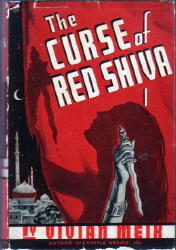
    “The Haggards aren’t bad, particularly Death Talks Shop. Slangy, eccentric, and super fast-paced, reminiscent (to me anyway) of Theodore Roscoe’s two novels for Dodge. Roger Torrey’s 42 Days for Murder is a pretty good pulpish private eye novel. The two John Donavans [one from 1937] are decent fair-play deductive mysteries. The [Vivian] Meik is a Sax Rohmerish adventure mystery with a screwball plot. I haven’t read a lot of the others.”

Curse of Red Shiva

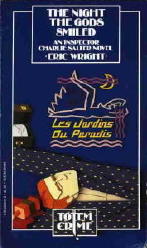
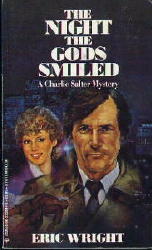
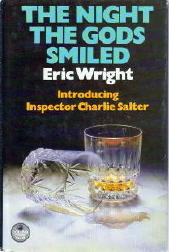
ERIC WRIGHT – The Night the Gods Smiled. Signet 13409; paperback reprint, February 1985. Hardcover edition: Charles Scribner’s Sons, September 1983. Canadian hardcover: Collins, 1983. Canadian paperbacks: Totem (two editions), 1984, 1988.
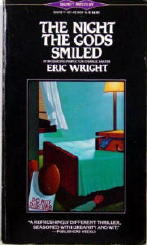
Night Gods Smiled

   Sub-titled “Introducing Inspector Charlie Salter,” this is the first of ten mysteries solved by Eric Wright’s most well-known series character between 1983 and 1993. An eleventh (and presumably last) case for Salter, a Toronto police detective, appeared in 2002. After first appearing in hardcover, all eleven of them were later published in paperback. When the series was dropped by Signet, the rest were picked up by Canada’s own Worldwide Mysteries (also known as Harlequin).

   Wright eventually added a second series character in Mel Pickett, a cop who first played a second fiddle to Salter in A Sensitive Case (1990) and then who tackled one on his own in Buried in Stone (Scribner, 1996), followed by Death of a Hired Man in 2001.

   The first of two adventures of Lucy Trimble Brenner also appeared in 1996. Ms. Brenner is a librarian who inherits a Toronto private detective agency and decides to make the big career move. (I have never seen either of the two books, and I think I had better do something about it.)

   In the year 2000 a fourth series character came along, a part-time community college English teacher named Joe Barley, who also works part-time as a private eye. He has two books under his belt so far, the second coming out in 2003. The latter may end up being Eric Wright’s final mystery, as he was born in 1929, making him now 77 years old, and perhaps he is no longer writing. Or he may yet surprise us. Perhaps there is yet another in the works.

   Eric Wright himself was (and more than likely, in this order) professor, chair of the English department, then Dean of Arts at Ryerson Institute of Technology in Toronto, from where he is now retired. And if his first book (and also more than likely) several of his others deal with academia, one should hardly be surprised. I know I am not, and in fact after reading The Night the Gods Smiled, I highly approve.

   The victim, in fact, was a professor of English at a small college in Toronto, but he was found dead in his hotel room while attending an academic conference in Montreal. The dead man’s occupation, however, gives Charlie the opportunity to interview many of his colleagues, none of whom seem to have liked the man very much, some less than others, and in the process, Charlie learns a lot about academic squabbles indeed.
Night Gods Smiled

   There was a glass with lipstick on it in the dead man’s room. Had he picked up a streetwalker? He had also bragged of good fortune earlier in the day (hence the title). I should back up. Charlie is on the outs with the current administration of the Toronto police force. He works under the category of General Duties, and homicide is by no means his regular assignment. But the investigating officer in Montreal is French, and the roots of the crime may lie in English-speaking Toronto, hence Charlie is assigned liaison duty.

   In the background is Charlie’s home life. While they are happily married, there is a class and/or cultural divide between Charlie and his wife (and children) and especially his wife’s family, who are considerably wealthier than Charlie, who gets by on a policeman’s pay, but usually no better than that. That Charlie is (platonically) attracted to the free-spirited Molly, one of the dead man’s students (and so was the professor) is part of who he is and who he is learning himself to be. She is a charmer.

   Here’s a short quote taken from a conversation Charlie has with one of the dead man’s colleagues at the Faculty Club, taken from page 59:

    “The thing you’ve got to understand, Inspector,” Usher said, causing Salter to hope the others would take him for an inspector of drains, “is that we all have a field. What we specialize in. My field is Lawrence. D.H. I come from Nottingham — did you realize I’m English? — and my grandfather knew Lawrence, or said he did, like most of the old codgers in Nottingham.” Usher broke off again for a sustained maniacal laugh at the lies Nottingham codgers told about Lawrence.

   The paragraph is longer, but I’ve changed my mind and decided to cut it off here, omitting the rest of it. The part that I cut has Usher explaining how courses are set up and who gets to teach what course and the like, all of which is necessary for Charlie to feel himself in the dead man’s shoes, and I hope you get the idea well enough from this greatly truncated version.

   The following quote shows Wright’s ability to describe something entirely ordinary and everyday, but when you look at it more closely, is not. From page 113:
Night Gods Smiled

   The office of the Dean of Women was open, and Salter pushed the door back and walked in. A secretary looked up from her typewriter, and he introduced himself. She was the drabbest girl he has seen in some time; she looked as though she were hired for her plainness by the original sex-fearing governors of the residence. Her glasses, steel-rimmed, round, and tiny, were balanced on the end of her nose; her thick blonde hair was cut in a straight line, parallel with the bottoms of her ears; she wore a brown smock that looked like a shroud. Salter was appalled and piteous. “Is Miss Homer in?” he asked. “She’s expecting me.”

   The girl stood up, took her glasses off, and smiled, transforming herself like the heroine of a musical comedy. She had beautiful teeth, and the shroud, when she was upright, clothed a perfect figure. It’s a style, thought Salter. They do it deliberately.

   I have a number of other quotes jotted down to provide to you, but I will resist and behave myself. I also see that I wrote myself a note about the mystery and its solution: “somewhat frazzled at the end but OK.” It’s been a while since I’ve read the book — I’ve had to put off writing this review for several weeks, I’m sorry to say — but I skimmed through the ending again, and I was right. It’s the characters that I remember the most about this book — characters who are described as individuals and (even better) who are allowed to think and behave like human beings that we either know or see around us every day.

   The book won a couple of major awards (see below) and if my opinion matters at all, at this late date, I think the author deserved them.

— August 2006

***

BIBLIOGRAPHY    [With a couple of exceptions, these are the US editions only. Some books may have appeared earlier in a Canadian or British edition.]

         Charlie Salter:

The Night the Gods Smiled. Scribner, hc, September 1983. (John Creasey Memorial Award, Arthur Ellis Award)
      Signet 13409, pb, February 1985.

Night Gods Smiled

Smoke Detector. Scribner, hc, December1984.
      Signet 14123, pb, February 1986.

Death in the Old Country. Scribner, hc, August 1985. (Arthur Ellis Award)
      Signet 14450, pb, 1986.
      Signet 14450, 2nd pr., July 1991.

The Man Who Changed His Name. Scribner, hc, August 1986.
      Signet 14930, pb, August 1987.

A Body Surrounded by Water. Scribner, hc, December 1987.
      Signet 16385, pb, September 1989.

A Question of Murder. Scribner, hc, October 1988.
      Worldwide 26039, pb, 1989/90?

A Sensitive Case. Scribner, hc, 1990. [Note: Mel Pickett also appears.]
      Worldwide 26083, pb, Oct 1991.

Final Cut. Scribner, hc, May 1991.
      Worldwide 26107, pb, Oct 1992.

A Fine Italian Hand. Scribner, hc, 1992.
      Worldwide 26143, pb, 1994.

Death by Degrees. Scribner, hc, 1993.
      Worldwide 26169, pb, 1995.

The Last Hand. St. Martin’s, hc, February 2002 [in which Salter, having reaching the mandatory retirement age of 60, does exactly that]
      Worldwide 26569, pb, 2006.

         Mel Pickett:

A Sensitive Case. Scribner, hc, 1990. [Note: A Charlie Salter case in which Pickett also appears.]
      Worldwide 26083, pb, Oct 1991.

Buried in Stone. Scribner, hc, March 1996.
      Scribner, trade pb, January 2001.

Death of a Hired Man
. St. Martin’s, hc, March 2001.
      Worldwide 26521, pb, 2005.

         Lucy Trimble Brenner:

Death of a Sunday Writer
. Foul Play Press, hc, 1996.

Death on the Rocks. St. Martin’s, hc, June 1999.
      St. Martin’s, trade pb, June 1999.

          Joe Barley:

The Kidnapping of Rosie Dawn. Perseverance Press, hc, 2000. (Barry Award)
      Perseverance Press, trade pb, October 2000.

The Hemingway Caper. Castle Street Mysteries (Canada), trade pb, April 2003. No US publication.

          Collection:

Killing Climate: The Collected Mystery Stories Eric Wright. Crippen & Landru, trade pb, August 2003. Collection of 16 stories, one original. A limited hc edition also appeared.

“Licensed Guide.” Criminal Shorts, ed. Eric Wright & Howard Engel, Macmillan Canada, 1992
“The Boatman.” [“Start with a Tree”]. Paper Guitar, ed. Karen Muhallen, 1995
“One of a Kind.” Secret Tales of the Arctic Trails, ed. David Skene-Melvin, Simon & Pierre, 1997
“Twins.” A Suit of Diamonds, ed. Anon., Collins, 1990
“Two in the Bush.” Christmas Stalkings, ed. Charlotte MacLeod, Mysterious Press, 1991
“The Duke.” 2nd Culprit, ed. Liza Cody & Michael Z. Lewin, Chatto & Windus, 1993
“Kaput.” Mistletoe Mysteries, ed. Charlotte MacLeod, Mysterious Press, 1989
“Caves of Ice.” EQMM, March 2002
“Hephaestus.” Cold Blood II, ed. Peter Sellers, Mosaic, 1989
“Bedbugs.” Das Magazin, April 26 1996
“Duty Free.” Cold Blood V, ed. Peter Sellers, Mosaic, 1994
“Jackpot.” [“Looking for an Honest Man”]. Cold Blood, ed. Peter Sellers, Mosaic, 1987
“The Cure.” Fingerprints, ed. Beverley Beetham-Endersby, Toronto: Irwin, 1984
“The Lady from Prague.” Cold Blood IV, ed. Peter Sellers, Mosaic, 1992
“An Irish Jig.” The Globe and Mail, December 22, 2001
“The Lady of Shalott.” [Insp. Charlie Salter]. Original.

Lodgings for the Night. Crippen & Landru, August 2003. Separate pamphlet accompanying the limited edition of A Killing Climate: The Collected Mystery Stories by Eric Wright, Crippen & Landru, 2003.

   EDITOR: Criminal Shorts: Mysteries by Canadian Crime Writers, ed. Eric Wright & Howard Engel, Macmillan Canada, hc, 1992.

   SOURCES:

      Allen J. Hubin, Crime Fiction IV.
      William J. Contento, Mystery Short Fiction: 1990-2004.
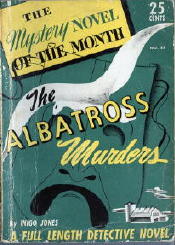
    As far as my comments about the pseudonymous Inigo Jones are concerned, nothing more has been learned other than was stated in my review of his/her second mystery novel, The Albatross Murders.

   Of course, and by now it surely goes without saying, if anything more is learned, odds are you will read about it here first; or if not, I hope it will be no more than second-hand news.

   In the meantime, Bill Pronzini has sent along cover scans for both of the Inigo Jones books, which I’ve combined with the information on the titles to be found in Crime Fiction IV, by Allen J. Hubin, and Murder at 3c a Day, by William F. Deeck, and have come up with the following complete crime fiction bibliography for:

INIGO JONES.  Pseudonym.

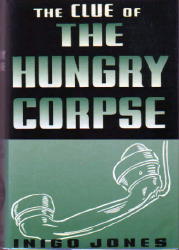
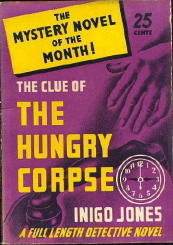
   * The Clue of the Hungry Corpse (n.) Arcadia House, hc, 1939.   Mystery Novel of the Month #11, digest pb, 1940.   Leading characters: Lt. Blanding and Det. Barry Linden, New York Police Department.   Setting: New York City.

The Clue of the Hungry Corpse

Dust jacket blurb: At 10:07 p.m. Hayden Snell, an eccentric millionaire fond of precious stones almost to the point of madness, is found dead in his overheated study, a Japanese dagger thrust hilt-deep in his heart. Temperature of the room makes it impossible to determine exact time of death, but his telephone receiver was removed at exactly 9:15 p.m.

   Involved in this crime and the complicated network of mystery and adventure that follows are: Katherine Fox, grand-niece of the deceased, the only suspect who cannot provide a satisfactory alibi; Arthur Leader, natural son who hates the entire Snell family; Evander Snell, middle-aged son who mortally fears his sister Miriam; Joseph Rogato, shady private investigator, who tries to have himself arrested for the crime; Weisswasser, Rogato’s mouthpiece and partner in crime; Cokey Flo, Arthur’s mother, who has information implicating Evander Snell in an earlier crime; Monk Saunders, her husband, who holds a powerful threat over Rogato.

   A satisfying detective story particularly recommended to those who appreciate good writing and a complicated puzzle.

Hungry Corpse

Review excerpts: [Will Cuppy, Books.] The author’s writing manner, except for a few backslidings into fancy prose, struck us as a cut above the standardized brittle style now employed by most of the ribald school, and his criminous lingo is inspired. Try the pseudonymous Mr. Jones for amusing wickedness.

[Kay Irwin, New York Times.] There is a little of everything in this story; it is a hodge-podge of excitements, inexpertly handled.
   The unanswerable question is why the architect of such a gingerbread structure chooses to sign himself “Inigo Jones.”

[Saturday Review of Literature.] Couple of clever tricks explained at end, but characters are overdrawn and plot pretty phoney. Not so much.

***

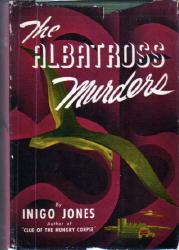
    * The Albatross Murders (n.) Mystery House, hc, 1941.  The Mystery Novel of the Month #33; digest pb, 1941.   Leading character: Inspector Sebastian Booth.  Setting: New England; Theatre.

The Albatross Murders

Dust jacket blurb: During ten months of the year Shrewsbury was — on the surface — a quiet little New England town; for two months it was something else again.

   For then the summer theatre brought its freight if small-time Broadway talent and amateur aspirants. Their jealousies and conflicts met in a fateful dovetail with conflicts and motives buried deep in Shrewsbury’s past. And so murder struck.

   One died in the sight of five hundred, another died alone. Meanwhile the promise of death murmured everywhere.

   With a fleck of paint off a three-hundred year-old chimney and the aid of twentieth-century science; with the bones of a praying Indian and a bird that flew by night; with an antique silver smelling-salts bottle and a scandal that had its roots in another age and clime — with the aid of these and other things Inspector Sebastian Booth at length solved this dark puzzle of fate’s irony and bloody vengeance.

Review excerpt: [New York Times.]   …Finally Booth comes up with a theory that accounts for everything. The only trouble is that there is very little evidence to support it. It is not a very satisfactory ending, but it is the best that Inigo Jones has to offer.

The Albatross Murders

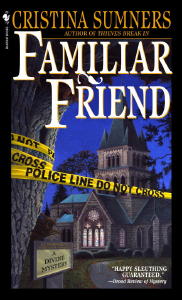
CRISTINA SUMNERS – Familiar Friend

Bantam; paperback original. First printing: August 2006.

   Familiar Friend is the third in a series of mystery adventures in which the two leading characters have an exceeding complicated relationship, which I will get to in a moment. First of all, however, here are the books:

      Crooked Heart. Bantam, hc, October 2002; reprint pb, September 2003.

      Thieves Break In. Bantam, pbo, October 2004.

      Familiar Friend. Bantam, pbo, August 2006.

   There is a long story behind the writing of these books and why it took so long for them to find a publisher. The author hints at it in the Acknowledgments to this one, but then she goes on to say that the story would bore us. As if. But – if I have read this introduction correctly – this, the third book, was the first one written, or at least plotted, and that was back in the 1970s when she was taking courses at Princeton, which is the town upon which her fictitious town of Harton, New Jersey, is modeled.

   Harton being the home of the Reverend Kathryn Koerney and police chief Tom Holder, who are tacitly in love with each other, but neither of whom dares to admit it, even to themselves. Tom Holder is married, but to a wife he does not love, nor does she love him. Kathryn Koerney is all but committed to another man, a rich Englishman named Kit Mallowan. (From what I’ve gathered, Kathryn is equally wealthy, if not wealthier, but I can’t tell you any of the details, this being the only book of the three that I’ve read. I also gather that she met Kit in England, where Book Two took place.)

Familiar Friend

   The setting in Book Three is purely academic, at least in the beginning, given that the body of the chairman of the local university’s Spanish department being found on the driveway leading into St. Margaret’s, a parish church. The man was universally disliked by his colleagues, it is soon revealed, making sure that there are many, many suspects for Holder to interview in the initial stages of the investigation that quickly ensues.

   Curiously enough, however, even though all of these professors, wives, students and the staff, crew and a group of the usual university hangers-on are strongly depicted, with considerable time and energy put into making them distinct individuals (all with motives), and with all of this elaborate background already built and ready to wear, the author seems to forget about (most of) them and concentrates instead on the not-so-minor issue of mysterious disappearance of Holder’s wife, causing the local D.A. to…, and Father Mark to…, and then Kit to…

   I can say no more, but it is a lot of fun. You will have to read it for yourself. Sometimes the leading characters behave like teenagers in their rather complicated dance they perform in establishing their relationships to each other, but it’s all done in such a nicely charming fashion, that I am sure that all but the most surly curmudgeon would not be pleased and object to it.

   The puzzle of the mystery is classically done as well, what with time tables and the shrewdest of plans concocts by the villain(s) involved. The last line has nothing to do with the mystery (as opposed to the Ellery Queen novel I covered not so long ago), but if you care anything at all about the characters, it will make absolutely certain that you will not miss where the next episodic installment of their amusing romance (but not to them) will take them next.

— September 2006


[UPDATE] 05-30-07.  Unfortunately, given the pattern of appearances of books in this series, it looks as though there will still be over a year’s wait.

   The following pair of posts came from the FictionMags Yahoo group. Thanks to Bill Contento and Mike Ashley for allowing me to reprint them here. First, a short introduction from Bill:


   Mike Ashley recently asked me for a list of mystery anthology publishers. As part of the process in generating that list, counts of the authors and stories in 2,244 anthologies were also produced.

   This was based on the latest edition of the Mystery Short Fiction Miscellany CD (available from Locus Press), excluding stories reprinted in single-author collections, round-robin novels, and magazines.

                Bill C.

    Authors with 40 or more stories that have appeared in mystery anthologies:

40 Collins, Max Allan
40 Crider, Bill
41 Fish, Robert L.
41 Highsmith, Patricia
42 Sayers, Dorothy L.
43 Allingham, Margery
43 Bankier, William
43 Barnard, Robert
43 Chesterton, G. K.
43 Ellin, Stanley
43 Oates, Joyce Carol
44 Asimov, Isaac
44 Blochman, Lawrence G.
44 Brown, Fredric
46 Boucher, Anthony
46 Gilford, C. B.
46 Howard, Clark
46 MacDonald, John D.
47 Breen, Jon L.
48 Estleman, Loren D.
48 Wallace, Edgar
48 Westlake, Donald E.
49 Simenon, Georges
51 Charteris, Leslie
52 Stout, Rex
53 Holding, James
54 Deming, Richard
57 Bloch, Robert
58 Gorman, Ed
58 Symons, Julian
62 Treat, Lawrence
63 Lovesey, Peter
66 Keating, H. R. F.
67 Rendell, Ruth
69 Pentecost, Hugh
81 Block, Lawrence
81 Doyle, Arthur Conan
87 Woolrich, Cornell
88 Ritchie, Jack
89 Slesar, Henry
102 Lutz, John
103 Pronzini, Bill
115 Christie, Agatha
119 Queen, Ellery
131 Gilbert, Michael
273 Hoch, Edward D.

   Stories that have appeared in mystery anthologies 10 or more times:

10 Block, Lawrence “By the Dawn’s Early Light” nv 1984 {Playboy}
10 Buck, Pearl S. “Ransom” nv 1938 {Cosmopolitan}
10 Carr, John Dickson “Guest in the House” ss 1940 {The Strand}
10 Chesterton, G. K. “Queer Feet” nv 1910 {The Storyteller}
10 Christie, Agatha “Witness for the Prosecution [ “Traitor’s Hands”] nv 1925 {Flynn’s}
10 Crawford, F. Marion “Upper Berth” nv 1886 *The Broken Shaft: Unwin’s Christmas Annual*, ed. Sir Henry Norman, London: Fisher Unwin
10 Dickens, Charles “Signalman” ss 1866 {All the Year Round}
10 Dickson, Carter “Clue in the Snow” ss 1940 {The Strand}
10 Doyle, Arthur Conan “Adventure of the Bruce-Partington Plans” nv 1908 {The Strand}
10 Ellin, Stanley “Question My Son Asked” ss 1962 {EQMM}
10 Gilbert, Michael “Amateur in Violence” ss 1949 {John Bull}
10 Gilbert, Michael “Mr. Portway’s Practice” ss 1957 {Lilliput}
10 Hardy, Thomas “Three Strangers” nv 1883 {Longman’s}
10 Harte, Bret “Stolen Cigar-Case” ss 1900 {Pearson’s Magazine}
10 Hemingway, Ernest “Killers” ss 1927 {Scribner’s}
10 Howard, Clark “Horn Man” ss 1980 {EQMM}
10 Rawson, Clayton “From Another World” nv 1948 {EQMM}
10 Rendell, Ruth “New Girl Friend” ss 1983 {EQMM}
10 Saki “Sredni Vashtar” ss 1910 {The Westminster Gazette}
10 Steinbeck, John “Murder” ss 1934 {North American Review}
10 Wells, H. G.“Cone” ss 1895 {Unicorn}
11 Barnes, Linda J. “Lucky Penny” ss 1985 *The New Black Mask No.3*, ed. Matthew J. Bruccoli & Richard Layman, HBJ
11 Bentley, E. C. “Inoffensive Captain” ss 1914 {Metropolitan Magazine}
11 Bentley, E. C. “Sweet Shot” ss 1937 {The Strand}
11 Bloch, Robert “Yours Truly, Jack the Ripper” ss 1943 {Weird Tales}
11 Chesterton, G. K.“Oracle of the Dog” nv 1923 {Nash’s Magazine}
11 Cole, G. D. H. & Margaret “In a Telephone Cabinet” nv 1923
11 Collier, John “Back for Christmas” ss 1939 {New Yorker}
11 James, P. D. “Victim” nv 1973 , ed. Virginia Whitaker, London: Macmillan
11 Kipling, Rudyard “Return of Imray” [ “The Recrudescence of Imray”] ss 1891 *Life’s Handicap*, Macmillan
11 McCloy, Helen “Chinoiserie” nv 1946 {EQMM}
11 Macdonald, Ross “Guilt-Edged Blonde” [as by John Ross Macdonald] ss 1954 {Manhunt}
11 Macdonald, Ross “Midnight Blue” nv 1960 {Ed McBain’s Mystery Book}
11 Marsh, Ngaio “I Can Find My Way Out” ss 1946 {EQMM}
11 Pentecost, Hugh “Day the Children Vanished” nv 1958 {This Week}
11 Poe, Edgar Allan “Black Cat” ss 1843 {Philadelphia United States Saturday Post}
11 Poe, Edgar Allan “Mystery of Marie Roget” nv 1842 {Snowden’s Lady’s Companion}
11 Queen, Ellery “Adventure of the President’s Half Disme” nv 1947 {EQMM}
11 Queen, Ellery “As Simple as ABC” nv 1951 {EQMM}
11 Stoker, Bram “Squaw” ss 1893 {Holly Leaves}
11 Westlake, Donald E. “Never Shake a Family Tree” ss 1961 {AHMM}
12 Armstrong, Charlotte “Enemy” nv 1951 {EQMM}
12 Charteris, Leslie “Arrow of God” nv 1949 {EQMM}
12 Crofts, Freeman Wills “Mystery of the Sleeping-Car Express” nv 1921 {The Premier Magazine}
12 Doyle, Arthur Conan “Silver Blaze” nv 1892 {The Strand}
12 Gores, Joe “Goodbye, Pops” ss 1969 {EQMM}
12 Jacobs, W. W. “Interruption” ss 1925 {The Strand}
12 Jacobs, W. W. “Monkey’s Paw” ss 1902 {Harper’s Monthly}
12 Quentin, Patrick “Puzzle for Poppy” ss 1946 {EQMM}
12 Rice, Craig “His Heart Could Break” nv 1943 {EQMM}
12 Sayers, Dorothy L. “Inspiration of Mr. Budd” ss 1926 {Pearson’s Magazine}
12 Vickers, Roy “Rubber Trumpet” ss 1934 {Pearson’s Magazine}
13 Dahl, Roald “Lamb to the Slaughter” ss 1953 {Harper’s}
13 Dickens, Charles “Hunted Down” nv 1859 {New York Ledger}
13 Doyle, Arthur Conan “Adventure of the Blue Carbuncle” ss 1892 {The Strand}
13 Forester, C. S. “Turn of the Tide” ss 1934 {The Story-Teller}
13 Knox, Ronald A. “Solved by Inspection” ss 1925
13 Patrick, Q. “Love Comes to Miss Lucy” ss 1947 {EQMM}
13 Stevenson, Robert Louis “Markheim” ss 1886 *The Broken Shaft: Unwin’s Christmas Annual*, ed. Sir Henry Norman, London: Fisher Unwin
13 Wynne, Anthony “Cyprian Bees” ss 1926 {Flynn’s Detective Fiction}
14 Bramah, Ernest “Tragedy at Brookbend Cottage” nv 1913 {News of the World}
14 Chesterton, G. K. “Hammer of God” ss 1910 {The Storyteller}
14 Collins, Wilkie “Terribly Strange Bed” ss 1852 {Household Words}
14 Doyle, Arthur Conan “Scandal in Bohemia” ss 1891 {The Strand}
14 Eustace, Robert & Jepson, Edgar “Tea-Leaf” nv 1925 {The Strand}
14 Glaspell, Susan Keating “Jury of Her Peers” nv 1917 {Every Week}
14 Huxley, Aldous “Gioconda Smile” nv 1921 {The English Review}
14 James, P. D. “Great-Aunt Allie’s Flypapers” nv 1969
14 Poe, Edgar Allan “Cask of Amontillado” ss 1846 {Godey’s Lady’s Book}
15 MacDonald, John D. “Homesick Buick” ss 1950 {EQMM}
15 Post, Melville Davisson “Doomdorf Mystery” ss 1914 {The Saturday Evening Post}
15 Queen, Ellery “Adventure of Abraham Lincoln’s Clue” [ “Abraham Lincoln’s Clue”] ss 1965 {MD}
15 Sayers, Dorothy L. “Adventurous Exploit of the Cave of Ali Baba” nv 1928 *Lord Peter Views the Body*, London: Gollancz
15 Sayers, Dorothy L. “Man Who Knew How” ss 1932 {Harper’s Bazaar}
16 Christie, Agatha “Accident” ss 1929 {The Daily Express}
16 Millar, Margaret “Couple Next Door” ss 1954 {EQMM}
16 Sayers, Dorothy L. “Suspicion” ss 1933 {Mystery League}
16 Wallace, Edgar “Treasure Hunt” ss 1924 {The Grand Magazine}
17 Barr, Robert “Absent-Minded Coterie” nv 1905 {The Saturday Evening Post}
17 Carr, John Dickson “Gentleman from Paris” nv 1950 {EQMM}
17 Kemelman, Harry “Nine Mile Walk” ss 1947 {EQMM}
18 Ellin, Stanley “Specialty of the House” nv 1948 {EQMM}
19 Chesterton, G. K. “Invisible Man” ss 1911 {Cassell’s}
19 Poe, Edgar Allan “Gold-Bug” nv 1843 {Philadelphia Dollar Newspaper}
20 Collins, Wilkie “Biter Bit” [ “Who Is the Thief?”] nv 1858 {Atlantic Monthly}
20 Dickens, Charles “To Be Taken with a Grain of Salt” [ “Trial for Murder”] ss 1865 {All the Year Round}
21 Gardner, Erle Stanley “Case of the Irate Witness” ss 1953 {Colliers}
21 Twain, Mark “Stolen White Elephant” nv 1882 *The Stolen White Elephant*, Webster
22 Doyle, Arthur Conan “Adventure of the Speckled Band” nv 1892 {The Strand}
22 Doyle, Arthur Conan “Red-Headed League” nv 1891 {The Strand}
22 Dunsany, Lord “Two Bottles of Relish” ss 1932 {Time & Tide}
25 Burke, Thomas “Hands of Mr. Ottermole” nv 1929 {The Story-Teller}
26 Berkeley, Anthony “Avenging Chance” ss 1929 {Pearson’s Magazine}
26 Poe, Edgar Allan “Murders in the Rue Morgue” nv 1841 {Graham’s Lady’s and Gentleman’s Magazine}
27 Futrelle, Jacques “Problem of Cell 13” nv 1905 {Boston American}
53 Poe, Edgar Allan “Purloined Letter” nv 1844 *The Gift: A Christmas and New Year’s Present for 1845*, 1844


   Mike’s reply:


  Bill,

   Thanks for generating those two lists.

   Hats off to Ed Hoch for topping the list as most anthologised — but then as the most prolific still active writer of short stories, maybe he ought to be up the top there somewhere. Still, it shows his work is sufficiently memorable, though clearly no single story stands out as he’s not in the second list.

   Conversely, Poe, Futrelle and Berkeley top the second list but don’t appear in the first. So we have a distinction here between writers who produce few major short stories but clearly a handful that hit the bullseye and those who produce many worthy stories but no individual one that stands out.

   Once we get to Ellery Queen and Agatha Christie, though, they hit both lists and evidently these are writers who can produce both quantity and quality.

   I think the first story that surprises me in the second list is Gardner’s “The Case of the Irate Witness”. It’s certainly not one that would have come instantly to mind and though I’m sure I’ve read it, I can’t bring it to mind at all! Intriguing to see Harry Kemelman’s “Nine Mile Walk” up there, too.

   I previously put forward the argument that many of those that will top the list will be because their work is out of copyright, but though this may be a factor in why Poe and Futrelle top list 2, it certainly doesn’t apply to most of the stories and clearly not the authors in list 1. I’m rather glad about that. Quality shines through rather than being able to use a story on the cheap.

               Mike A.

   Ian Covell has continued his attempts to track down some of the more obscure appearances of author Charles Runyon in print, adding to the bibliography established for him a few weeks ago on this blog. With the assistance of Victor Berch and Charles himself, a number of additional stories have been located and/or confirmed.

   These additions won’t be added to the blog version, however. I’ve set up a permanent webpage for the bibliography on the main M*F website, and this will be the “official” version, as complete as it is at the moment, and as it will be whenever any additional corrections are found.

   First, as relayed from Victor Berch to Ian and on to me:

      Ian:

   Here is the bibliographic data on one of Runyon’s items you were looking for: “The Appointment” Knight Magazine, vol. 7 no. 11, March 1970.

         Best,

            Victor

   This information was then sent on to Charles, who replied:

  Dear Ian,

   Your last e-mail stimulated me to look again through my files and lo! this hunter of the East turned up a copy of Knight, Volume 7, number 11, with my story called “The Appointment.” It is not crime fiction, nor is it strictly raunch, but simply a revealing story of a meeting between man and woman.

   Also, in that same mother lode, I unearthed a copy of Man’s World, April 1964, which contains a book-length feature called “The Naked Bums” – printed by Gold Medal as The Death Cycle. It must be seen to be believed, that a serious attempt at writing a suspense novel should be treated with such cavalier lack of taste. Yech! as Alfred E Neuman is fond of saying.

   Continuing now, I also found the Adam 1965 Yearbook containing the novelette called: “Never Kiss a Killer,” which stands up well alongside my suspense novels. And finally, Adam, Vol. 13, No 6, in almost mint condition, containing the short story “There Must Be More Than This.” Barry Malzberg liked it so well he wrote me a letter about it, which I still have somewhere in my files. That’s about it for now; I just wanted to say thanks for your help, and don’t stop looking, because there’s more stuff out there somewhere.

Chas.

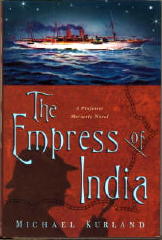
MICHAEL KURLAND – The Empress of India

St. Martin’s Minotaur; hardcover. First Edition: February 2006.

Empress of India

   On and off over the period of nearly 30 years, Kurland has been chronicling the adventures of Sherlock Holmes’ most notorious nemesis, James Moriarty. In the process his primary intents seems to have been to clean some of the tarnish off the good (or not so good) professor’s reputation.

   Not that Holmes was entirely mistaken about him, but could it just possibly be that Moriarty was NOT responsible for all of the crimes Holmes suspected him of committing?

   Take this latest case, for example. When a fortune in gold is known to be on its way to the Bank of England from India, and Moriarty is known to be on the way to Calcutta, what other reason could he have other than the most obvious one? Wrong. Admittedly he has nefarious intent, but the gold is not why he is there.

   While Holmes himself has mysteriously disappeared, swept away in a London sewer, Thuggees seem to have re-emerged as an evil force in India, and Dr. Pin Dok Low and his gang of unsavory associates really do have gold on their minds.

   While Kurland is not terribly convincing when writing in the mode of Doyle, when he is left to tell his own rollicking story, what a glorious romp of a tale it is! His quick breezy style, interspersed with small jabs of wry humor, makes this particular caper move along in fine smile-provoking fashion.

   That there is also a locked room mystery to be solved is only the frosting on the cake.

— March 2006


FOLLOWUP: Rather than expand upon my (of necessity) shorter than usual review, which first appeared in the Historical Novels Review, I’ve decided to take a look instead at the complete list of Michael Kurland’s mystery and detective fiction, as much (as always) for my own benefit as yours, as many of these books I’d never been fully aware of until now.

   I’ll be working in somewhat chronological order, but also grouping the novels by theme and series character, with some comments or two scattered between. Not included are Kurland’s science fiction and fantasy novels with no criminous connection, but perhaps The Unicorn Girl (Pyramid, pbo, 1974) deserves a mention, as it partially takes place in the same alternative universe as Lord Darcy, about whom, keep reading.

         +++++

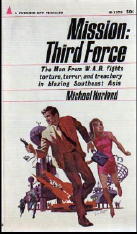
Mission: Third Force. Pyramid R-1578, pbo, 1967.
Mission: Tank War. Pyramid X-1876, pbo, 1968.
Mission: Police Action. Pyramid, pbo, 1969. [Scarce. No copies on ABE. It is quite possible that the book was never published.]     [UPDATE: This is correct. According to Mr. Kurland, the book became A Plague of Spies instead.]

Third Force

   I have a copy of the second of these, but as usual, I don’t have it at hand and available for inspection. Here is a description taken from an online listing, however, one that will give you the essence of what kind of spy thrillers all three books are likely to be:

    “Are you a little country with BIG trouble? WAR, Inc. will – develop your weapons – train your troops – plan your strategy – and even fight your wars! Peter Carthage of WAR, Inc. races to Asia on a crash-priority mission – find a way to stop a guerrilla army terrorizing a tiny, independent kingdom. But there’s a joker in the contract – a hidden party to the conflict – and Carthage and his WAR, Inc. team are in the fight of their lives against the mysterious, deadly Third Force.”

   It is not known if Peter Carthage, the “Man from WAR” is in either of the other two books or not. If he is, he is a series character not (yet) known to Al Hubin.     [UPDATE: Peter Carthage is indeed in all three books, the third being the one below.]

A Plague of Spies. Pyramid X2098, pbo, 1969. [Finalist for Edgar award.]

   Described by one bookseller as a “sexy spy thriller.”

         +++++

The Professor Moriarty / Sherlock Holmes novels:

The Infernal Device. Signet J8492, pbo, January 1979. [Finalist for an Edgar and nominated for an American Book Award.]

Death by Gaslight. Signet AE1915, pbo, December 1982.

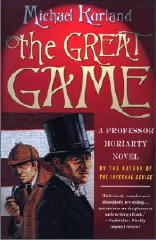
The Great Game. St. Martin’s, hc, August 2001.
      St. Martin’s, trade pb, February 2003.

The Great Game

Publisher’s info on the latter:

    “In March 1891, an unknown caller arrives at Moriarty’s door on a matter of great urgency. But before Moriarty can be summoned to speak with him, he is shot by a crossbow bolt loosed by unseen hands. While a lesser man might be daunted, Moriarty is merely intrigued and begins to investigate. What Moriarty discovers is that a cabal is attempting to use assassination to destablize the rule of the crowned heads of Europe. But he also senses that there is more than this operating — a conspiracy within a conspiracy — and detects the workings of a mind possibly more clever than his own. Using his agents around the world, Moriarty must outwit his most clever opponent ever while the fate of the world hangs in the balance.”

The Infernal Device and Others. St. Martin’s, trade pb, August 2001.

Publisher’s info on the contents:

   The Infernal Device – A dangerous adversary seeking to topple the British monarchy places Moriarty in mortal jeopardy, forcing him to collaborate with his nemesis Sherlock Holmes.

   Death by Gaslight – A serial killer is stalking the cream of England’s aristocracy, baffling both the police and Sherlock Holmes and leaving the powers in charge to play one last desperate card: Professor Moriarty.

   “The Paradol Paradox” – The first new Moriarty story in almost twenty years, it has never before appeared in print.

The Empress of India. St. Martin’s, hc, February 2006.

          +++++

The Last President, with S. W. Barton. William Morrow, hc, 1980.
      Critics Choice Paperbacks/Lorevan Publishing, pb, June 1988.

          +++++

Psi Hunt. Berkley 04664, pbo, September 1980.
Star Griffin. Doubleday, hc, March 1987.

   Science-fiction crime novels both, taking place in the future as constituted at the time of their writing.

          +++++

Ten Little Wizards. Ace 80057, pbo, March 1988.

MICHAEL KURLAND Study in Sorcery

A Study in Sorcery. Ace 79092, pbo, May 1989.

MICHAEL KURLAND Study in Sorcery

   The detective of record in both of these novels is Lord Darcy, a character created by SF author Randall Garrett. Darcy is a private security expert and chief investigator for Richard, Duke of Normandy, in an alternate world from ours in which magic takes the role of science. Garrett wrote one novel and several short stories about Lord Darcy, and after Garrett’s death, Kurland wrote the final two adventures.

         +++++

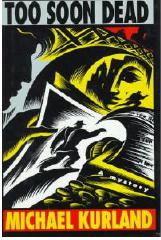
Too Soon Dead. St. Martin’s Press, hc, March 1997.
The Girls in the High-Heeled Shoes. St. Martin’s Press, hc, August 1998
       St. Martin’s Press, trade pb, August 2001.

   A traditional mystery series set in New York City in 1935, featuring New York World columnist Alexander Brass.

Too Soon Dead

         +++++

   And I’d certainly be remiss if I failed to include the Holmes-related anthologies edited by Kurland:

My Sherlock Holmes: Untold Stories of the Great Detective. St. Martin’s Press, hc, February 2003. Stories about Holmes but told by characters from the canon other than Dr. Watson.
      St. Martin’s Minotaur, trade pb, November 2004.

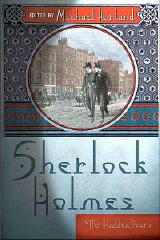
The Hidden Years

Sherlock Holmes: The Hidden Years. St. Martin’s Minotaur, hc, November 2004. An anthology of original stories taking place while Holmes was believed dead after Reichenbach Falls.
      St. Martin’s Griffin, trade pb, January 2006.

  Steve,

   Thanks for a great tribute to Desmond Cory on your blog. It’s greatly appreciated by the Cory fan club members. I contacted some of them who run the [Desmond Cory] website you mention, asking if there are any aspects of his life left out.

   Well, although not really dramatic, below are some points not mentioned that you might want to consider:

      CHILDREN’S NOVELS:

   Cory wrote a number of novels for children. I am aware of at least:

1958. Ann & Peter in Southern Spain (The Kennedys Abroad). Paperback: Frederick Muller Ltd., London, using pen-name Theo Callas.

1960. Jones On The Belgrade Express: An Adventure Story For Boys. Hardcover & jacket: Frederick Muller Ltd., London; First Edition. The adventures of Jones in Macedonia; an irrepressible schoolboy. Used Desmond Cory pen-name.

      SHORT STORIES:

   Cory wrote quite a few short stories too. Below is a sample:

1975. “The Crime of Prince Milo.” Appeared in Winter’s Crimes 7; Macmillan: London; edited by Hardinge.

1976. “Story of Stumblebum, the Wizard.” Appeared in Winter’s Crimes 8; Macmillan: London; humorous detective story featuring the inane wizard, StumbleBum.

1980. “Song of Fariq.” Appeared in The Mystery Guild Anthology, edited by John Waite; Constable: London

1992. “Switchblade.” Appeared in Midwinter Mysteries #2; Little Brown & Co: London; Short story featuring Professor Dobie.

      RADIO PLAYS:

1956. “The Secret Metal,” by Norman Edwards — freely adapted from Desmond Cory’s The Phoenix Sings (1956).

1959, Oct 31. “Shaken Leaf.” BBC Radio Play produced by R.D. Smith — adapted by Daphne Laney from the novel by Desmond Cory

1960, March 26 9.15 pm. “Pilgrim at the Gate.” BBC Radio Play adapted by Norman Edwards

Unconfirmed date. “The Phoenix Sings.” BBC Radio Play

1961. “Orbit One,” based on novel High Requiem.

      CINEMA:

1958. The Mark of the Phoenix. Directed by Maclean Rogers, 1958, written by Norman Hudis; based on Cory’s novel The Phoenix Sings.

1972. England Made Me. Screenplay of Graham Green’s novel.

      ACADEMIC BOOKS & ARTICLES:

   Probably one of Cory’s best kept secrets was that he was a university professor of English. His academic works varied a great deal. Below is an inkling of his work here:

1977. “Language and Behaviour.” Article Incorporated Linguist

1980. “Modes of Comedy.” Hardcover (no jacket); Volturna Press

1981. “Antonio Machado and the Cycle of Life.” Article Bulletin Hispanic Studies

1981. “English Literature and its Backgrounds.” Paperback (thick edition) Routledge

1983. “Eliot’s ‘mythical method’ and the poetic image.” Article Comparative Literature Studies

1983. “Hemingway and the Pardoner’s Tale.” Article American Literature

   My thanks again for the blog entry.

                     — Best wishes, Jan

    Ian Covell, from a post he made to the FictionMags Yahoo group:

   Thanks for alerting me that so much had been cleared up (though I can tell you the bibliography still has a couple of errors).

   I am “pleased” to find that the many books I thought were missing (there was a note [F&SF July 1974] that Runyon had written “over 30 published novels in 14 years of writing”) turn out to be much less (just over 20), and indeed, I have half of them.. definitely the SF, though not the Ellery Queen’s or the adult stuff.. The Black Moth is one of the finest, darkest thrillers I have ever read… and Color Him Dead is an unpredictable, excellent work. Soulmate is definitely adult horror. .

   The corrections and additions pointed out by Ian in the remainder of his post have already been incorporated into the bibliography. They include:

INCARNATE, the paperback from Manor, was published in 1977. (Previously “no date.”)

KISS THE GIRLS AND MAKE THEM DIE. Correct spelling of Runyan to Runyon.

I, WEAPON. The hardcover was published in July 1974, not 1971, which necessitated a change in the chronological order in the SF section. The paperback from Popular Library appeared in December 1977.

   Short Stories:

“In Case of Danger” F&SF, December 1975 — the actual title is longer and funnier, “In Case of Danger, Prsp the Ntxivbw”

      and add the following:

“Happiness Squad” – Fantastic, March 1967
“The Youth Addicts” – Worlds of IF, May 1967

   Charles also had a letter appear in F&SF, September 1975. [This does not appear in the bibliography, but it is certainly worth a mention here.]

   Ian also cited one British paperback reprint of one of Charles’ books, but since this means that other UK editions are omitted, I’ve decided not to include it for now, based on an “all or none” philosophy.

   Also from Ian: “I have a penned note of something called Hang Up from Gold Medal, circa 1969, but it really is just penciled in, not confirmed; may be an early title of No Place to Hide or even Power Kill.”

   And from Allen J. Hubin: “I’ve got the three Mark West titles listed in Addenda #14, each with a dash.” The dash, of course, indicating marginal crime content; the Addenda referring to the Revised Crime Fiction IV.

          —

   Thanks to Ian Covell in a followup email, and a judicious search of the Internet, I now have equal-sized cover scans for all of Charles Runyon’s novels. (One is a third printing, but other than that, it’s complete.)

   I’ve also cleaned up a couple of glitches that I created this morning. See the bibliography as it appears now on the primary Mystery*File website.

[UPDATE] 05-04-07. An email from Charles Runyon:

  Dear Ian, et al:

   Thanks for the kind words and the help in researching my past. You dug up some interesting material, not the least of which was that enigmatic Hang-Up which was supposedly published by Gold Medal in 1969. According to my wife’s Little Black Book, that was my original title for No Place to Hide.

   I sold a story entitled “The Day it All Hung Out” to Escapade Magazine in October 69. An amusing little tour de force, which I remember reading when it came out. I haven’t yet been able to find any copies of it in my files, but I’m keeping my eyes open.

   I sold a few other stories to the men’s magazines, such as Adam Yearbook, “There Must be More than This” and Knight, “The Appointment” but “The Day…” was the best according to my memory — not excluding “The Naked Bums,” which was the title Men put on their serialization of The Death Cycle. (If you’re looking for the Ultimate in Egregious Reprints, that’s gotta be IT.)

   I think the discrepancy in the number of books published arose from the fact that I counted foreign language editions at the beginning. Or maybe I was just exaggerating.

   Regards to you, Ian, and everybody else, Chas.

   I heard today from Charles Runyon, who’s been battling the flu. Going through his records, he’s come up with the following changes to his bibliography, posted here a couple of days ago.

    ● “Rum and Chaser” was the title put on one of my stories by Scott Meredith (or somebody working there at the time; perhaps Terry Carr) but that didn’t go down with the editor of Manhunt, who replaced it with my original title, “The Last Kill.” At least I think that was my original title; I used to have the magazine (Manhunt, April 1961) but I don’t seem able to find it now. Probably best to just leave out “Rum and Chaser” entirely.

   The book entitled Something Wicked (Lancer, pb, 1973) is included in Crime Fiction IV, by Allen J. Hubin, but tracking down a copy has proven to be a very difficult task. Both Victor Berch and I had come to the conclusion that it has never been published. The next comment from Charles confirmed my growing suspicion:

    ● Something Wicked was apparently the title put on Dorian-7 by the inheritors (if that is the right word) of the Lancer properties. At the time I was trying to switch from Scott Meredith to Richard Curtis and there was considerable confusion. Richard reported making several visits to the SM agency to winnow out all my stuff, but I do not recall getting paid for anything entitled Something Wicked. Maybe I did; my wife can’t find her financial records for that era so perhaps we could just sweep that little paradox under the carpet of the past. (Does this mean The Curse is actually working? Chills and premonitions.)

    So that it may be read more easily, I’ve moved the article entitled “The Curse of Dorian-7 to the primary Mystery*File website.

    ● A Killer is a Lonely Man was my title for To Kill a Dead Man (Major, 1976). [The former title sometimes appears as an unpublished book written by Charles.] It would be more appropriate in my case to retitle it To Revive a Dead Man because I’m about ready to make a major effort to resurrect my corpse which has been mouldering away (according to the report in SF Encyclopedia) since 1987.

    All of these changes are now in place. Thanks again to Charles Runyon and Ed Gorman for helping put together all of the pieces on this project, as they have. And to Charles, it’s great to have you back!

« Previous PageNext Page »