TV mysteries


REVIEWED BY MICHAEL SHONK:


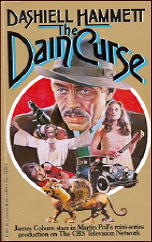
THE DAIN CURSE. CBS – Martin Poll Productions. Based upon the novel by Dashiell Hammett; developed for television by Robert W. Lenski. Producer: Martin Poll. Director: E.W. Swackhamer. Cast: James Coburn as Hamilton Nash, Nancy Addison as Gabrielle Leggett, Bernice Straight as Alice, Jean Simmons as Aaronia, Jason Miller as Owen, Hector Elizondo as Sheriff Feeney and Brent Spiner as Tom Fink.

THE DAIN CURSE

PART ONE – MAY 22, 1978 – MONDAY AT 9-11 PM (Eastern)

PART TWO – MAY 23, 1978 – TUESDAY AT 9-11 PM

PART THREE – MAY 24, 1978 – WEDNESDAY AT 9-11 PM

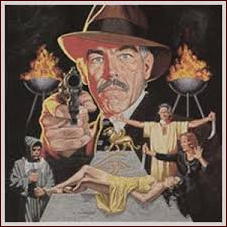
   THE DAIN CURSE features three stories – a simple diamond robbery that reveals a complex mystery involving drugs, child abuse, blackmail and various murders; a con using a religious cult that ends with death; and a middle aged PI who must overcome his attraction to a young innocent girl and save her from the evil around her.

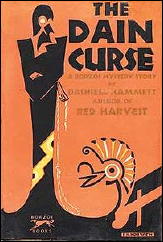
   THE DAIN CURSE originally appeared as four separate Continental Op stories in Black Mask magazine. Hammett would rework the four stories (“Black Lives” November 1928, “The Hollow Temple” December 1928, “Black Honeymoon” January 1929 and “Black Riddle” February 1929) into a three-part novel (Knopf, 1929). While it was a critical and commercial success when first published, time has not been kind to one of Hammett’s weakest work. The book suffers from its clumsy structure, its padded overly complicated story and a weak ending.

THE DAIN CURSE

   The TV adaptation by Robert W. Lenski would win him an Edgar award and an Emmy nomination (losing to HOLOCAUST writer Gerald Green). Surprisingly, there was no writer credit on screen, instead Lenski received a developed for television credit. Perhaps this was because he stayed loyal to the book and its structure. But changes were made, some were wise, others not.

   Characters such as Minnie the maid’s boyfriend and many red herrings were wisely dropped. The end of each part was changed. Hammett ended each part with the dramatic closure of that part’s case. Lenski knew each TV episode would need a cliffhanger ending to bring back the viewer for the next night. For example, he followed the book closely, but ended Part One with something that happened in Part Two – The Temple, drugged Gabrielle confessing to murder.

   Many of the changes were minor such as changing the Continental Detective Agency to Dickerson National Detective agency and moving the action from the California coast to the East coast and “The City” (New York).

   Lenski should have used even more of Hammett’s original dialogue than he did. His original dialogue tended toward pulp clichés, such as a place smelling of death or things being too quiet.

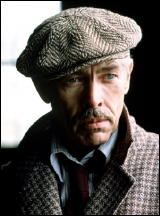
   The most notable change was replacing Hammett’s Continental Op with PI Hamilton Nash played by James Coburn. The well-dressed Ham owed more to the crime-fighting image of Dashiell Hammett than to the Continental Op. While Coburn would have been a terrible choice to play the Op, he was perfect as the thin, handsome, more energetic PI Hamilton Nash.

   Hammett’s Continental Op appeared in 36 short stories (four would make up Hammett’s first novel RED HARVEST, and four became THE DAIN CURSE). The Op was the visual opposite of TV PI Hamilton Nash. He was a short, overweight (180 lbs), ugly, middle-aged man. He had no life outside of his work. Hammett never even gave him a name. It was this image that made the relationship between the Op and the young victim Gabrielle so important to the tone of the book. It added to the creepiness of the all ready odd mystery as the Op got deeper into Gabrielle’s life, resisting and denying his growing attraction to her and her growing dependence on him, a favorite older Uncle who was fighting inside his desires for the young innocent girl.

   Hamilton Nash had a past he hid from others. To keep his noisy boss satisfied (you would think the boss of a detective agency would know the past of his employees) Ham claimed he had an ex-wife who had run off with the milkman because he was never at home. Coburn with his leading man looks and thin athletic body did not seem as wrong for young but adult looking Nancy Addison as the Continental Op did for the virginal Gabrielle.

   But Coburn’s Hamilton Nash did share the cynical soul of the Op, as well as the Op’s obsessive personality, his deductive talents, and his fatalistic acceptance of injustice. According to Nash, criminals had invented justice. Nash had no problem leaving a case the client thought solved, even when he knew better.

THE DAIN CURSE

   Nancy Addison had the difficult role of the freaky Gabrielle. Her scenes with Coburn brought to life Hammett’s Gabrielle’s feelings for the older PI who was always there to save her. To her Nash was a protector not a potential lover.

   The rest of the cast, especially Jason Miller and Jean Simmons, captured Hammett’s characters well in their performances. Early in the book, Mrs. Alice Leggett was described as being serene and the only sane soul in the Leggett’s household. This played a role in the story. Bernice Straight performance failed to capture that aspect of Alice, but her performance did get her an Emmy nomination for single performance by a supporting actress in a comedy or drama series (she lost to HOLOCAUST Blanche Baker).

   E.W. Swackhamer’s direction was worthy of the Emmy nomination he received (he lost to HOLOCAUST director Marvin J. Chomsky). He kept the characters moving to give a sense of energy and tension to the slow paced twisty story. In Part One’s denouement scene, several people filled the lab of the dead man. Nash refused to believe the letter left by the man was a suicide note. Swackhamer had Nash restlessly moving around the room while the rest stay still. As Nash declares the man was murdered, he moves out of the shot (but not out of the room) leaving the camera focused on the reactions of the rest of the people there.

THE DAIN CURSE

   Production values for THE DAIN CURSE were average at best, but never let down the story. Music by Charles Gross reminded us the time was 1928, and added a nice noir sound when needed.

   Following the success of the mini-series ROOTS, CBS had high expectations for THE DAIN CURSE. The ratings for the first night were a moderate success with a 37 share. But the ratings for the second and third night fell with each episode receiving a 30 share, OK but not the blockbuster numbers hoped for by CBS.

   THE DAIN CURSE aired during the May sweeps, an important ratings period for the networks and its local stations. ABC, CBS, and NBC were going all out to attract viewers. Viewers not hooked by Part One of THE DAIN CURSE had other options, including one in syndication.

   THE BASTARD (aka THE KENT FAMILY CHRONICLES) from Operation Prime Time (OPT) scrambled the regularly scheduled programs for that week. OPT was a group of independent TV stations who had united to finance programs from major studios. Produced by MCA/Universal, THE BASTARD was a four-hour mini-series scheduled to air over two nights. It proved a major challenge to THE DAIN CURSE when the two series aired against each other in many markets. Another problem for CBS and the other networks was THE BASTARD aired not only on 25 independent TV stations but also on network stations preempting network programs. THE BASTARD appeared on 14 ABC, 27 CBS and 25 NBC stations.

   I would like to read THE DAIN CURSE in its original Black Mask format, but the original four stories reportedly have never been republished. The book was a disappointment. It was padded and told three weak stories instead of one strong one. The TV mini-series was never able to overcome the problems of the novel and added some of its own, most notably the effect casting played on the romantic spine of the story.

      Sources:

Broadcasting Magazine – May 15, 1978, May 29, 1978, and June 5, 1978.

The Dashiell Hammett website by Mike Humbert:

http://www.mikehumbert.com/Dashiell_Hammett_05_The_Dain_Curse.html

Editorial Comment:   The first two videos consist only of clips from the show. I do not know if the bottom one is the complete mini-series or not, as I have not watched it to the end. I am suspicious about it, as it is only three hours long.

Also Note:   Curt Evans reviewed the novel version of The Dain Curse earlier on this blog. Follow this link.

A TV Review by MIKE TOONEY:


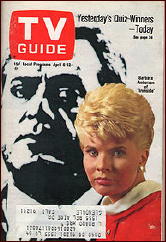
“Puzzlelock.” From Ironside: Season 2, Episode 23 (52nd of 196 installments). First aired: 13 March 1969. Regular cast: Raymond Burr (Ironside), Don Galloway (Det. Sgt. Ed Brown), Barbara Anderson (Officer Eve Whitfield), and Don Mitchell (Mark Sanger). Guest cast: Simon Oakland (Mel Grayson), Dennis Cooney (Paul Dekes), Ned Glass (Benjie), Jocelyn Brando (Etta Gibbs), Gene Lyons (Commissioner Dennis Randall), Dabbs Greer (Thomas Gibbs), Alvin Hammer (Mush Shelby), Jennifer Gan (Chickie), Barry Cahill (Sgt. Miller). Writer: B. W. Sandefur. Director: Allen Reisner.

   It was a dark and stormy night when Mel Grayson murdered his wife. Sure, they’d had their disagreements, but for Mel it was time to leave their relationship — or more precisely, it was time for the wealthy woman to depart this vale of tears and leave all her worldly goods behind for him to enjoy.

   It’s no secret that he kills her. The first act shows how Mel meticulously executes his plan, cleverly establishing his alibis (yes, more than one) with sticky tape and by being punctual with a dinner date (which will prove his ultimate undoing, for his dining companion is an old friend from Mel’s time with the police department, none other than Ironside himself).

   No, this isn’t a whodunnit type mystery; it plays more like a highly compressed Columbo episode, in which the murderer’s cover story is slowly but surely worn away to nothing.

   Mel does deserve some credit for ingenuity, though. He uses the sticky tape to convince the servants that his wife is still alive before — and even after — he leaves the house for dinner, although she’s been dead for some time. (Watch the episode here.)

   He drags his wife’s body from the bed, but only after having changed her clothes to a nightgown, over to the French doors, pockets all of her expensive jewelry, leaves the house in the rain storm, furtively doubles back to their second story bedroom, and breaks the glass, with rain pouring over her prostrate form, making it look as if a burglar did it.

   So far, so good (for Mel, anyway) — but as the show progresses, we learn that he seems to have made two rookie mistakes. When he murdered his wife, Mel strangled her with her necklace, but most of the time women don’t wear heavy, expensive jewelry to bed; and then there’s that dry spot under the body. If a burglar had broken the window panes and killed her in the struggle, the floor beneath her should have been covered with glass fragments and rain water, which it isn’t.

   But were these really mistakes, or did Mel incorporate them into an even more ingenious plan to make a burglar coming from the outside look like a murderer coming from the inside? And is it more than just a coincidence that dwelling with the unhappy couple is the ideal patsy, someone who is always broke and always arguing with Mel’s wife, someone who can’t alibi himself on the night of the murder? All Mel has to do is feign sympathy for the poor sap while pointing Ironside & Co. in his direction.

   It looks as if Mel has pulled off the perfect murder — and so he has . . . almost.

REVIEWED BY MICHAEL SHONK:


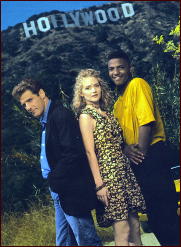
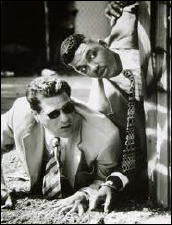
SOUTH OF SUNSET. 1993. CBS/Paramount/Stan Rogow Productions and Byrum Power & Light. Created and executive produced by John Byrum and Stan Rogow. Cast: Glenn Frey as Cody McMahon, Aries Spears as Ziggy Duane, and Maria Pitillo as Gina Weston. “Call On Me” performed by Glenn Frey (written by Glenn Frey and Jack Tempchin).

SOUTH OF SUNSET Glenn Frey

   SOUTH OF SUNSET was meant to be TV’s answer to popular action buddy movies such as 48 HRS. Poor acting, bad writing and the inability to duplicate what made the action buddy genre popular doomed this series to a quick death.

   According to an article in the Los Angeles Times (November 13, 1993), SOUTH OF SUNSET was the fourth series in TV history to be cancelled after one episode (the first three were YOU’RE IN THE PICTURE (1961), TURN ON (1969), and MELBA (1986)). The article also stated the show’s rating (6.1 and a 9 share) was “thought to be the lowest rating ever for a network prime-time series premiere …”

   Granted, October 27, 1993 on Wednesday at 9 to 10pm (Eastern), SOUTH OF SUNSET faced some strong competition from ABC’s HOME IMPROVEMENT (24.4) and GRACE UNDER FIRE (18.7), Fox’s MELROSE PLACE (9.3) and NBC’s NOW WITH TOM BROKAW & KATIE COURIC (11.5).

   But as the Times article noted there were other reasons for not airing a second episode, mainly due to CBS’s lack of confidence in the show and the risk of staying with it during the November sweeps (important rating period that affected the local stations as well as networks).

SOUTH OF SUNSET Glenn Frey

   An interview with Glenn Frey for the Chicago Tribune (October, 26, 1993) revealed some of the problems the series faced. Glenn Frey was not the first actor hired, Aries Spears as the comedic assistant was. Frey is best known for his work with popular rock band “Eagles” but had done some acting on TV (WISEGUY). However that was not how he got the job. The producers had been testing other actors with Spears for four months when a Paramount executive saw Glenn Frey sing on the Super Bowl pregame show and asked Frey to try out for the part.

   But the teaming of Frey and Spears didn’t work. It is obvious Frey never felt comfortable in the role of Cody. Frey lacked the acting talent and confidence to make the complaining loser Cody a strong appealing character (as opposed to what James Garner did with Jim Rockford).

   Cody ran the Beverly Hills Detective Agency located in the area south of Sunset boulevard in the low-income part of Beverly Hills (yes, there really is a poor section in Beverly Hills). The agency employed two people, Gina Weston and Ziggy Duane.

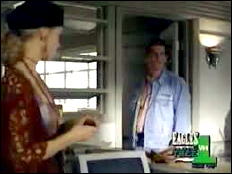
   Maria Pitillo did what she could with the clichéd character of Gina, receptionist/assistant who was trying to find work as an actress while keeping in touch with her worried Mother in Kansas.

SOUTH OF SUNSET Glenn Frey

   Aries Spears as Ziggy tried too hard to be Eddie Murphy. It didn’t help Spears the scripts forced his character to bounce between mature young man and immature idiot with a blink of a scene.

   If the acting was bad, the writing was even worse. The scripts seemed to have little interest in the plots or action, instead the viewer was forced to suffer through pointless scenes featuring long-winded speeches and boring banter. The characters and stories lacked originality or appeal.

   Production values were weak and often inconsistent. The gimmick of the Beverly Hills agency being in the poor part of Beverly Hills was ruined by Cody’s large office that grew larger every week (at one point it included a new pool table).

   Cody often complained of a lack of money, but in addition to his large office, Cody had a home (where he held parties and had a pet duck), had an expensive wardrobe, and a bright yellow Pontiac GTO (for those endless scenes where Cody and Ziggy exchange banal dialogue). Better direction could have helped establish settings such as Cody’s home and made the car rides more visual interesting.

   The series lone bright spot was an Emmy nomination for Opening Titles (Ed Sullivan and Jeff Boortz). It lost to THE X-FILES.


EPISODE INDEX

While CBS aired only one episode of the reported seven, VH1, during a salute to the “Eagles,” aired four more. At the moment, those five episodes are available to watch on YouTube. It is uncertain if the final two episodes, “Remember Me” and “Chalk Line” were ever filmed.


“Satyricon” (October 27, 1993) Teleplay by John Byrum Story by John Byrum and Stan Rogow Directed by Andy Tennant GUEST CAST: Wendy Benson, Season Hubley, and Richard Schiff *** Cody is working on a cheating spouse case when he is hired to find who is threatening a young tennis star, and then he is hired to find a gang leader who jumped bail.

https://www.youtube.com/watch?v=KzaXnFGxbyk


“Dream Girl” (VH1) Written by Paul Brown Directed by Felix Enriquez Alcala GUEST CAST: Mark Blankfield, John A. Fitzpatrick and John Diehl *** A friend of Cody’s mom, Lou the toilet King of Queens is in Los Angeles and hires the agency to find a girl he has seen only in his dreams. Meanwhile Gina is hired to spend three months in the Caribbean making a movie, but overprotective Cody senses something is wrong.

https://www.youtube.com/watch?v=yrPxRkI59cU


“Custody” (VH1) Written by John Byrum Directed by Oz Scott GUEST CAST: Judith Hoag, Robert Torti, Julia Nickson and John Diehl *** A young mother hires Cody to get her nine year old daughter back from her ex-husband who had kidnapped her. Dad and his biker friends object when Cody grabs the kid back. Cody then discovers the kid is not eager to go back to either parent. Meanwhile, Gina goes undercover on a case of a cheating husband.

https://www.youtube.com/watch?v=SCz7X1bEb8Q


“Family Affair” (VH1) Written by Terry Curtis Fox Directed by Bruce Seth Green GUEST CAST: Carroll Baker, Amber Benson, Jeff McCarthy and John Verea *** A teen-aged girl had received postcards on her birthday for years from a man claiming to be her real father. This year he sends her an expensive jewel so she hires Cody to find the man. Meanwhile, Gina’s Mom visits.

https://www.youtube.com/watch?v=lYBbslI0uKo


“Newspaper Boy” (VH1) Written by Reggie Rock Bythewood Directed by Michael Schultz GUEST CAST: Jessie Ferguson, Wendy Davis, William Allen Young and John Verea *** Parents of a young black teen come to Cody for help after their son is gunned down by a cop. Meanwhile, Ziggy’s love life goes bad.

https://www.youtube.com/watch?v=TwODCYQQw6I


   No amount of time could have overcome the series problems in front and behind the camera. SOUTH OF SUNSET deserved its quick death.

REVIEWED BY MICHAEL SHONK:


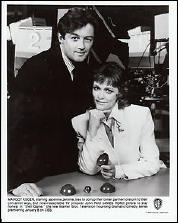
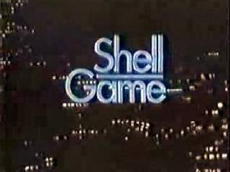
SHELL GAME. CBS, 1987; Warner Brothers Television. Created by Carla Jean Wagner. Cast: Margot Kidder as Dinah aka Jennie Jerome, James Read as Reilly aka John Reid, Marg Helgenberger as Natalie Thayer, Chip Zien as Bert Luna, Rod McCary as Bill Bauer, and (added after pilot) Fred McCarren as Vince Vanneman. Theme by Michel Colombier.

SHELL GAME Margot Kidder

Pilot: 60 minutes. Executive Producer: Michael Rappaport. Produced by Lou Antonio. Coordinating Producer was John Ziffren.

Weekly Series: 60 minutes. A Lou-Step Production & Hey Keed Production in association with Warner Brothers Television. Executive Producers: Nick Thiel and Paul Picard. Supervising Producer: Alex Beaton. Produced by John Wirth

   A link to the opening credits can be found here.

   There were two con artists, husband Reilly and wife Dinah. Reilly decided to go straight but Dinah refused. He left her and they were divorced.

   The show opens with Dinah on the run from a mark and his minions who want her dead. The chase takes her to Santa Ana California where she discovers her ex-husband had settled down and gone straight. Reilly was now John Reid (The Lone Ranger), producer of “Solutions,” a TV consumer action show for KJME-TV. Dinah, now Jennie Jerome (Winston Churchill’s mom), ditches the bad guys and becomes the new associate producer of “Solutions” before John can stop it. Of course, no one knows the truth about John aka Reilly, former conman and husband. Jennie wants John to return to their former life together, but he refuses.

SHELL GAME Margot Kidder

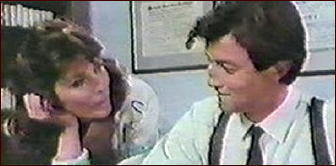
   Margot Kidder (SUPERMAN) as adventure loving Jennie/Dinah and James Read (REMINGTON STEELE) as John/Reilly were wonderful together, and the show, never aiming higher than mindless entertainment, took off whenever the two pulled a con so the TV show “Solutions,” could expose the bad guys.

   Sadly, the series wasn’t satisfied to stop there. There was the supporting cast: stereotypical station manager Vince, the idiot self-centered co-host Bill and the yes-man Bert, all adding annoyingly pointless comedy relief.

   Then there was “Solutions” co-host Natalie who was the rich beautiful daughter of the station’s owner, and John Reid’s current lover. Marg Helgenberger gave Natalie a likable naïve vulnerability that often made us feel sorry for her and her fate as the losing side of the romantic triangle. Worse, the chemistry so strong between Read and Kidder did not exist between Read and Helgenberger.

SHELL GAME Margot Kidder

   Believability is always a problem with shows such as SHELL GAME, especially one as poorly produced as this one. The mysteries, if there were any, were weak. The scripts were filled with action that made no sense. The interior sets were cheap looking. The soundtrack lacked a constant sound to give the series its own audio identity. Nothing in this series worked except when Kidder and Read as Jennie and John were running a con to catch the bad guys.

   But even if SHELL GAME had been HART TO HART with con artists, the series was doomed airing opposite NBC’s top rated THE COSBY SHOW and FAMILY TIES.

         EPISODE INDEX:

“Pilot” (January 8, 1987) Written by Carla Jean Wagner Directed by Lou Antonio. GUEST CAST: William Trayler, Jim Antonio, and Castulo Guerra *** This sixty minute pilot offers some screwball fun as on the run con artist “Jennie” helps her gone straight ex-husband and ex-partner save a potato chip Heiress.

Ratings: SHELL GAME – 9.7 versus ABC’s OUR WORLD – 6.8 and NBC’s COSBY SHOW – 36.6 and FAMILY TIES – 36.4

“Norman’s Parking Ticket” (January 15, 1987) Written by Gerald Sanoff Directed by Harry Harris GUEST CAST: Walter Olkewicz, Jordan Charney and Richard Minchenberg *** A man comes to “Solutions” for help to fight a parking ticket unaware the ticket will tie his car to a murder scene. Meanwhile, Jennie is being nice to Natalie so she can crash a high-stakes poker game to raise money to pay for a wedding anniversary gift to Reilly.

Ratings:: SHELL GAME – 8.9 versus ABC’s OUR WORLD – 6.9 and NBC’s COSBY SHOW – 38.6 and FAMILY TIES – 36.6

“Old Team” (1/22/87) Teleplay by Nick Thiel Story by Kerry Ehrin Directed by Paul Krasny GUEST CAST: Gene Barry, Brynn Thayer and Robert Hanley. *** “Solutions” is following Santa Ana’s police Bunco squad during an average day when offered a chance to join in on a bust. John realizes Jennie’s father is behind the con about to be busted, and that Dad had gotten Jennie to join in the con.

Ratings:: SHELL GAME – 9.3 versus ABC’s OUR WORLD -7.7 and NBC’s COSBY SHOW – 41.3 and FAMILY TIES -39.2

“The Upstairs Gardener” (1/29/87) Written by John Wirth Directed by Chris Leitch GUEST CAST: Michael MacRae, Vincent Schiavelli, Benicio Del Toro and Mary Woronov. *** A thieving husband kills his rich wife and frames her lover, the young gardener. “Solutions” is doing a story on the jail when they meet the young man’s mother who convinces them to prove her son innocent.

Ratings: SHELL GAME – 9.8 versus ABC’s OUR WORLD – 6.8 and NBC’s COSBY SHOW – 36.1 and FAMILY TIES – 36

“Pai Gow” (2/8/87) Teleplay by John Wells Story by Michael Fink Directed by Harry Mastrogeorge. GUEST CAST: James Pax, Clyde Kusatsu and Dustin Nguven *** A man comes to “Solutions” to help him prove he was not driving drunk when he hit and killed a man. The story takes us deep into Santa Ana’s Chinatown run by the evil “Tiger” who uses his gambling den to pass counterfeit money.

Ratings:: SHELL GAME – 8.8 versus ABC’s OUR WORLD – 7.2 and NBC’s COSBY SHOW – 37.6 and FAMILY TIES – 36.4

“Dead Wrong” (2/12/87) Written by John Wirth and John Wells. Directed by Chris Leitch. GUEST CAST: Michael Greene, George Dickerson, and Ora Rubens. *** A beautiful woman claiming to be a man’s wife cons Bert and Bill to do a report about the man committing arson. The police arrest the man, and the real wife decides to sue the station.

Ratings:: SHELL GAME – 8 versus ABC’s OUR WORLD – 6.8 and NBC’s COSBY SHOW – 36.1 and FAMILY TIES – 36.

   For three weeks starting June 3rd, long after it was cancelled, an episode of SHELL GAME was rerun in MAGNUM PI place on Wednesday at 9pm where each week it finished last up against reruns of ABC’s MACGYVER and NBC’S sitcoms FACTS OF LIFE, NIGHT COURT and NOTHING IN COMMON.

   SHELL GAME was a typical fun-dumb romantic comedy mystery with all the substance of cotton candy. While Read and Kidder were on the con the series had a screwball charm, but it wasn’t enough to overcome the many flaws of the series, let alone its suicidal timeslot.

A TV Review by MIKE TOONEY:


IRONSIDE Raymond Burr

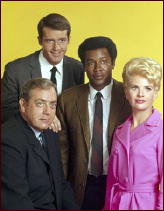
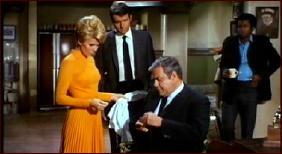
“The Monster of Comus Towers.” From the Ironside TV series. Season 1, Episode 10 (of 196 total). First telecast: 16 November 1967. Regular cast: Raymond Burr (Ironside), Don Galloway (Det. Sgt. Ed Brown), Barbara Anderson (Officer Eve Whitfield), and Don Mitchell (Mark Sanger). Guest cast: Warren Stevens, David Hartman, Joan Huntington, Michael Forest, Donald Buka, Kevin Hagen, Evi Marandi, Renzo Cesana, Harper Flaherty. Teleplay: A. J. Russell and Stanford Whitmore. Story: A. J. Russell. Director: Don Weis (58 Ironside episodes to his credit).

   Most long-running crime dramas seem to find it impossible to produce genuine whodunnits on a regular basis (it does require thinking a lot), so the majority of them work on the Encyclopedia Brown level of complexity.

   This particular episode, however, is something of an exception to the general rule.

IRONSIDE Raymond Burr

   A collection of one-of-a-kind art masterpieces valued at $20 million is being displayed on an upper floor of Comus Towers, headquarters of a computer firm. With alarms still sounding, security guards rush to the art exhibit only to find another guard with a knife sticking out of him and the head of security lying on the floor nearby, unconscious and wounded.

   The 6-foot-long, 40-pound centerpiece of a triptych has apparently been spirited out of the high-rise through a smashed plate glass window by someone who can either fly in gale force winds or shinny up the side of a tall building while wearing tennis shoes.

IRONSIDE Raymond Burr

   When Ironside & Co. are called in, the chief has no shortage of suspects, some more obvious than others: the wealthy owner of Comus Towers, the self-assured head of security (no one is above suspicion to Ironside), the bespectacled art insurance expert, the cool female employee of the firm, the two-timing ex-con she’s having an affair with, the Italian sponsor of the art exhibit who’s hard up for money, and his abnormally nervous young wife.

   The sponsor, however, soon eliminates himself from the suspect list by literally dropping dead from cyanide poisoning, leaving Ironside with two murders to solve.

   In Golden Age detective fiction style, the chief gets proactive, gathers all the remaining suspects together, and sets a trap according to the old adage of divide and conquer.

   You can watch “The Monster of Comus Towers” along with lots of annoying commercials on Hulu here.

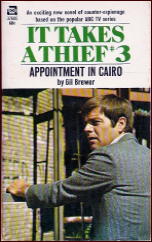
GIL BREWER – It Takes a Thief #3: Appointment in Cairo. Ace 37600, paperback original, 1970.

IT TAKES A THIEF Gil Brewer

   There are a couple of ways I could have begun this review. One, of course, is to start by talking about the TV series this novel is based on. The problem with that is that I’ve never seen an episode of the show, not when it was on (9 January 1968 – 24 March 1970) nor now, even though I bought the complete series when it came out on DVD a couple of years ago, nor even when it’s been shown on the Cozi channel, though if I ever flipped over there when it was on, I’m sure I would. Watch it, that is.

   I’m not sure why that is, but the fault, if fault there is, is mine, I’m sure. I’ve always found the delivery of Robert Wagner, the star of the show, to be both overly glib and overly flat, both at the same time, if that were possible. I realize that I am in the minority on this, since Wagner has always been a very popular TV star, even to the present day, including occasional recurring appearances on NCIS as agent Tony DiNozzo’s father.

IT TAKES A THIEF Gil Brewer

   The premise of this older series is that Wagner, playing Alexander Mundy a suave cat burglar (in the obvious Cary Grant mode), is forced to work for the US government in places all over the world where his particular field of expertise would come in useful. What he gets in return is his release from prison, not a very original concept now, but maybe it was at the time. Supervising Mundy (and holding his past over his head) on most of these adventures is Noah Bain, played by Malachi Throne.

   The other way I could have approached this review is by pointing out that this particular book was the last work of crime fiction to appear under famed Gold Medal paperback writer Gil Brewer’s own name. The sad decline of Brewer’s career over the years is chronicled here on the main Mystery*File website by Bill Pronzini, along with an exhaustive list of his (Brewer’s) entire written output.

IT TAKES A THIEF Gil Brewer

   But that this book came at the end of Brewer’s career rather than at the beginning does not mean that it is anything but a solid, professional effort. Inept it is most definitely not. Given the restrictions of working within the confines of the TV series, though, I found Appointment in Cairo to be, for the most part, as flat as Robert Wagner’s speech patterns, picking up in excitement a notch or two by story’s end, which includes the same little kind of twistette that tons of TV crime and mystery shows have ended with over the years.

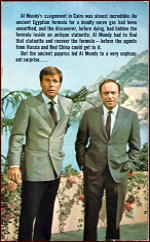
   The story itself, one which I do not believe was adapted from any one of the individual episodes of the series, has to do with “an ancient Egyptian formula for a deadly nerve gas” (quoting from the back cover), and if Mundy doesn’t do something about it, the whole world is in deadly peril.

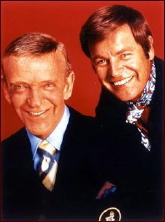
   As a postscript to myself, I had forgotten until now that Mundy’s father Alistair appeared several times in the third and final season of the series. He shows up in this novel as well, but in the book he is not nearly as interesting as he was on TV, given that there he was played by none other than Fred Astaire.

REVIEWED BY MICHAEL SHONK:


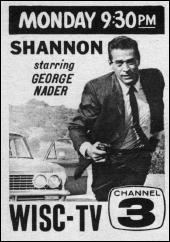
SHANNON. Syndicated, 1961-62. Columbia Pictures–Screen Gems Productions. Cast: George Nader as Joe Shannon, Regis Toomey as Bill Cochran. Music by Arthur Morton. Created by John Hawkins. Executive Producer: Robert Sparks. Producer: Jerry Briskin. Directed by Fred Jackman.

SHANNON George Nader

   Joe Shannon worked as an insurance investigator for Transport Bonding & Surety Company. TB&S main office was in Denver Colorado with a branch office in Los Angeles. While TB&S was owned and run by Bill Cochran, he did have to answer to stockholders. Shannon worked out of the Denver office and received his assignments directly from Bill.

   What set Shannon apart from your average syndicated PI was his car, a 1961 Buick Special with enough gadgets to please James Bond (though Bond would have be disappointed by the lack of lethal weapons/gadgets). The car’s most used features were a telephone that allowed Shannon to give exposition to his boss Bill who was at another location, and a microphone and tape recorder that popped out of the dashboard. There was also a camera mounted near the driver’s outside rear view mirror, and a film camera that with a touch of a button mechanically rose from the front middle seat.

   Shannon’s toys did not stop at just the car. He also carried a small tape recorder with him to preserve anything important a suspect or witness might tell him.

   Shannon was the typical first run TV Film syndicated half hour series. It suffered from poor production values, weak acting especially from the guest cast, scripts and direction flawed by a lack of production time and budget. There was no time to develop the characters to where we cared about them, and no time to develop any mystery or drama. But Shannon did have something that could have made it memorable, the car.

   This was the early 60s, a PI’s car was as important as a cowboy’s horse. Joe Shannon’s car was special and all the characters should have reacted to it with amazement and curiosity. Yet everyone behaved around the gadget filled car with indifference as if every one had a car with a tape recorder that pops out of the dashboard. Due to a lack of time in these thirty-minute dramas I expect the hero to be one dimensional, but if your series has a gimmick like Shannon’s car you need to highlight it, not virtually ignore it.


      EPISODE INDEX —

(Of the four episodes I have seen, there were no on screen episode titles. The titles used here came from IMdb.com and TVTango.com. The two sites had the same titles but listed the episodes in different order.)

“Zendee Report.” Written by John Hawkins. Guest Cast: Kathie Browne, Jan Arvan, and Joseph Rome. *** Zendee Truck company was having problems with hijackers. Shannon follows one trucker on a delivery run, but he was unable to stop two men from killing the driver. Shannon searched for an answer to the trucker’s little girl who asked, “Mister Shannon…Why did my daddy get shot?”

“Lady on the Rocks.” Written by Paul Schneider. Guest Cast: Leonard Stone, George Murdock and Walter Kinsella. *** Every one but Shannon believed the Captain wreaked his own ship so he could collect on the insurance.

“Professional Widower.” Teleplay by Todhunter Ballard. Story by Seymour Friedman Guest Cast: Walter Brooke, Elsie Baker and Henry Hunter. *** A con man marries lonely old ladies then kills them makes a mistake when he uses a teapot insured by TB&S as a murder weapon on his latest victim.

“Deadly Homecoming.” Written by Joseph Vogel and Lou Lantz. Guest Cast: James Griffith, Brenda Scott and Stephen Roberts. *** A truck covered by TB&S strikes a pedestrian, leading Shannon to play matchmaker for a great jazz musician just out of prison and his young daughter who refuses to see him.

   In 1961 first run syndication was dying. June 2, 1961 Screen Gems announced the availability of Shannon for the fall. In Broadcasting, June 5, 1961, a spokesperson for the company claimed it had more first-run programs “waiting in the wings,” when and if there was a market.

   However, Screen Gems had found more success with the networks than first run syndication. At this time Screen Gems was a major TV producer for network television. In Broadcasting (August 13, 1962) an article focused on what it called TV’s major studios, six studios that produced 40% of prime-time entertainment programs (Screen Gems, Revue, Warner Brothers, 20th Century Fox, MGM, and Four Star Television). Screen Gems had nine series on the networks primetime schedules for the fall 1962 season.

   Shannon was an average half hour TV Film syndicated series. Perhaps the other episodes (of the thirty-six total episodes) were better. Perhaps those written by Gene Roddenberry (Star Trek) were magical. Perhaps those episodes paid the proper attention to the real star and attraction of the series, the 1961 Buick Special with all the gadgets inside. But based on what I watched, I doubt it.

SUMMER TV SCHEDULE, 2013:
SCRIPTED ORIGINAL MYSTERY SERIES
by Michael Shonk


Below are this summer’s original scripted mystery series with a link to its home page or press release. Any additions are welcomed. Times subject to change.

        JUNE

Sunday 2nd:

THE KILLING – AMC – 9PM

http://www.amctv.com/shows/the-killing

VENTURE BROTHERS –CARTOON NETWORK (Adult Swim) 12 Midnight

http://video.adultswim.com/the-venture-bros

Tuesday, June 4th:

MAIGRET – MHz Worldview International

http://www.mhznetworks.org/series/maigret

Thursday 6th:

BURN NOTICE – USA – 9PM


http://www.usanetwork.com/series/burnnotice

GRACELAND – USA – 10PM


http://www.usanetwork.com/series/graceland

Friday 7th:

CONTINUUM – SYFY – 10PM

http://www.syfy.com/continuum

Saturday 8th:

SINBAD – SYFY – 9PM


http://www.syfy.com/sinbad

Sunday, June 9th:

IRENE HUSS – MHz Worldview International

http://www.mhznetwork.org/series/irene-huss

Monday 10th:

MAJOR CRIMES – TNT – 9PM


http://www.tntdrama.com/series/majorcrimes

KING AND MAXWELL – TNT – 10PM


http://www.tntdrama.com/series/king-and-maxwell

Tuesday 11th:

TWISTED – ABC FAMILY – 9PM

http://beta.abcfamily.go.com/shows/twisted

Friday 14th:

MAGIC CITY – STARZ


http://www.starz.com/originals/magic-city

NTSF: SD: SUV – CARTOON NETWORK (Adult Swim) 12 Midnight

http://video.adultswim.com/ntsfsdsuv/

Saturday 15th:

ZERO HOUR – ABC – 8PM


http://beta.abc.go.com/shows/zero-hour

Sunday 16th:

INSPECTOR LEWIS – PBS – 9PM


http://www.pbs.org/wgbh/masterpiece/programs/inspector-lewis

Saturday 22nd:

666 PARK AVENUE – ABC – 9PM

http://beta.abc.go.com/shows/666-park-avenue

Sunday 23rd:

WHODUNNIT – ABC – 9PM – (GAME)

http://beta.abc.go.com/shows/whodunnit

CROSSING LINES – NBC – 9PM

http://www.nbc.com/crossing-lines

COPPER – BBC AMERICA – 10PM

http://www.bbcamerica.com/copper

Tuesday 25th:

RIZZOLI & ISLES – TNT – 9PM

http://www.tntdrama.com/series/rizzoli-and-isles

PERCEPTION – TNT – 10PM

http://www.tntdrama.com/series/perception

Friday 28th:

CULT – CW – 8PM (two episodes a night)


http://www.cwtv.com/shows/cult

Saturday 29th:

DO NO HARM – NBC – 10PM

http://www.nbc.com/do-no-harm

Sunday 30th:

DEXTER – SHOWTIME – 9PM

http://www.sho.com/sho/dexter/home

RAY DONOVAN – SHOWTIME – 10PM


http://www.sho.com/sho/ray-donovan/home


       JULY

Monday 1st:

SIBERIA – NBC – 10PM

http://www.thefutoncritic.com/showatch/siberia

(Press release on right side)

NOTE: this is currently not on NBC.com list of shows. It may have been pulled.

Sunday 7th:

ENDEAVOUR – PBS – 9PM

http://www.pbs.org/wgbh/masterpiece/programs/endeavour

Wednesday 10th:

THE BRIDGE – FX – 10PM

http://www.fxnetworks.com/thebridge

Thursday 11th:

ORANGE IS THE NEW BLACK – NETFLIX

http://www.thefutoncritic.com/showatch/orange-is-the-new-black

(Press release on right side)

Tuesday 16th:

COVERT AFFAIRS – USA – 9PM


http://www.usanetwork.com/series/covertaffairs

SUITS – USA – 10PM

http://www.usanetwork.com/series/suits

Friday 19th:

BRAQUE – HULU

http://www.hulu.com/braquo

Saturday 20th:

CEDAR COVE – HALLMARK – 8PM


http://www.hallmarkchannel.com/cedarcove

Sunday 28th:

UNFORGETTABLE – CBS – 9PM

http://www.cbs.com/shows/unforgettable

       AUGUST

Saturday 3rd:

HELL ON WHEELS – AMC – 9PM

http://www.amctv.com/shows/hell-on-wheels

Wednesday 7th:

BROADCHURCH – BBC AMERICA – 10PM

http://www.bbcamerica.com/broadchurch

Sunday 11th:

BREAKING BAD – AMC – 9PM

http://www.amctv.com/shows/breaking-bad

LOW WINTER SUN – AMC – 10PM

http://www.amctv.com/shows/low-winter-sun

Monday 12th:

QUICK DRAW – HULU

http://www.hulu.com/quick-draw

Sunday 25:

SILK – PBS – 9PM

http://www.thefutoncritic.com/showatch/silk

(Press release on right side)

       SUMMER (DATE TBA)

STRIKE BACK – CINEMAX

http://www.cinemax.com/strike-back

REVIEWED BY MICHAEL SHONK:


THE MANHUNTER. CBS, 1974-75. QM Productions; developed by Sam H. Rolfe. Cast: Ken Howard as Dave Barrett, Robert Hogan as Sheriff Paul Tate, Ford Rainey as James “Pa” Barrett, Claudia Bryar as Mary “Ma” Barrett and Hilary Thompson as Lizabeth “Sis” Barrett.

   THE MANHUNTER was Quinn Martin’s second attempt at doing a series about a PI in 1930s Depression. His first was NBC’s BANYON [reviewed here ] set in Los Angeles that ran from 1971-73.

THE MANHUNTER Kenneth Howard

   Developed by Sam H. Rolfe (HAVE GUN WILL TRAVEL, DELPHI BUREAU), THE MANHUNTER featured ex-Marine Dave Barrett returning from fighting in China to find the Depression had changed his hometown of Cleary Idaho and the fortunes of his family’s farm.

   Dave was a man of few words, a man experienced in action. After stopping one infamous group of bank robbing gangsters, he decided to keep the family farm financially safe with the money he would collect tracking down wanted criminals. With the superfluous help of friend Sheriff Paul Tate, Dave showed rural America could handle those city gangsters. At least that was the way it started.

   The characters were drenched in Americana folklore from the good hardworking locals to his family with Pa, Ma, and little sister. This GUNSMOKE meets THE UNTOUCHABLES told in the Quinn Martin style of straight forward action had one major flaw.

   In the book Quinn Martin, Producer by Jonathan Etter (McFarland, 2008), Ken Howard discussed the series THE MANHUNTER.

   â€œI was playing a role that I wasn’t suited to,” explained Howard, “If you were to pick somebody to play the Manhunter, it would be Clint Eastwood. Kind of a stony-faced man of few words, which is not my own measure of what I had done as an actor up to that point. I tried to be that as best I could.”

   Quinn Martin and the writers began to change the character of Dave Barrett. Howard remembered Quinn Martin comparing him to more like Jimmy Stewart, more verbal and laconic:

   â€œLater in the year, they brought in this guy, this funny, hard-nosed guy, and he started changing it around. The Manhunter became more verbal, and this guy had me wearing kind of a three-piece, tweed suit… This writer was making me more of an FBI type, not a country guy.”

   I have seen the TV Movie pilot and three episodes. All four episodes had a different producer, not a sign of behind the scenes stability, but if Ken Howard’s point of view is correct, Quinn Martin was the showrunner.

EPISODE INDEX —

THE MANHUNTER Kenneth Howard

“The Pilot.” (February 26, 1974) Written by Sam H. Rolfe. Directed by Walter Grauman. Produced by Adrian Samish. GUEST CAST: Gary Lockwood, Stefanie Powers and Tim O’Connor *** It is 1934 and ex-Marine Dave Barrett returns home to find things have changed. Due to the Depression, the Barrett’s farm is in financial trouble. Dave is at the local bank when its robbed by a gang made infamous by an opportunistic reporter. Things go wrong and Dave’s ex-girl friend (wife of Sheriff Tate) and Dave’s loyal dog are killed. Dave goes after the bad guys and girl and discovers reward money might be an answer to keeping the family’s farm.

   The pilot had moments when writer Rolfe’s wit lifted the TV Movie above the standard action TV Movie but the story was burdened with clichéd characters and predictable twists.

“Death On the Run.” (October 2, 1974) Written by Robert W. Lenski. Directed by Leslie H. Martinson. Produced by Sam H. Rolfe. GUEST CAST: Harry Guardino, Bo Hopkins and William Schallert. *** Gangsters take a wounded member to the local hospital. On the run for multi-murders and other crimes, the gangsters take everyone in the hospital hostage just as Dave and the Barrett family arrive with a seriously injured Pa. One of the gangsters recognizes Dave as the famous Manhunter.

   This episode featured the original version of Dave Barrett. The episode was standard TV action drama that was mindless, if not also, mildly entertaining.

“Flight To Nowhere.” (December 18, 1974) Written by Robert I. Holt. Directed by Lawrence Dobkins. Produced by Arthur Weingarten. GUEST CAST: Christine Belford, Tom Skeritt and Norman Alden *** PI Dave Barrett is hired by an insurance company to investigate a jewel robbery in a small town near Los Angeles.

   This was a generic TV PI episode more suited for BANYON than THE MANHUNTER. Why send a PI from Idaho to solve a simple jewel robbery in Southern California? The mystery is obvious. The action keeps things moving, but leaves no time for the romance between Belford’s character and Dave to be more than a kiss at the end.

“To Kill A Tiger.” (February 26, 1975) Teleplay by S.S. Schweitzer. Story by Mort Fine. Directed by Bernard McEveety. Produced by Mort Fine. GUEST CAST: Kevin McCarthy, Robert Loggia and JoAnn Harris *** The Governor hires Dave to uncover a conspiracy to assassinate him.

   Ken Howard is looking more Ivy League than Idaho farmer. The original premise of rural hero versus Chicago type gangsters has been replaced with just another Quinn Martin style action TV PI. The one thing that was not changed was the gunfire, chases, and fistfights.

THE MANHUNTER Kenneth Howard

   In Broadcasting (September 16, 1974) excerpts from various reviews of the first episode were printed.

   John J. O’Connor of the New York Times wrote, “It’s still action adventure, but it works better than most. The production is good, the period details are attractive, and [Ken] Howard and other cast regulars are pleasantly effective. As escapist fluff, it could settle into the plausible category.”

   Kay Gardella of the New York Daily News wrote, “This is a good, weekly bread-and-butter series.”

   Dick Adler of the Los Angeles Times had a different view. “There might have been the germ of a workable idea in THE MANHUNTER … but the same Quinn Martin trash-compacter which has already turned CANNON and BARNABY JONES into interchangeable hours of mindless motion seems to have been at work here…”

   THE MANHUNTER lasted only one season, but ratings, while not Top 30 worthy, were not bad. The show aired on CBS, starting September 11, 1974 on Wednesday night at 10 to 11pm, opposite ABC’s GET CHRISTIE LOVE and NBC’s PETROCELLI. After two weeks, THE MANHUNTER average rating share was 36.5 compared to GET CHRISTIE LOVE 29.5 share and PETROCELLI’S 28 share. (Broadcasting September 30, 1974). But that would change.

   In April 1975, CBS cancelled THE MANHUNTER. Broadcasting (April 14, 1975) reported the series had an average of a 33 share from September through December, but in January the audience began to turn to NBC’s PETROCELLI. THE MANHUNTER also lost on average five shares from its lead-in CANNON.

   Timing doomed THE MANHUNTER from any possibility of a second chance. Public opinion was in one of its anti-violence moods. For the next season, the FCC had ordered the networks to adopt the “Family Hour,” where between 8 and 9pm only family entertainment could air. In Broadcasting (May 5, 1975), CBS President Robert Wood admitted that for the upcoming season, when offered a choice he’d pick a tame melodrama or variety show rather than an action series.

   Despite its early potential, THE MANHUNTER could never overcome the changes in premise and character nor the growing anti-violence public. The series was watchable but so ordinary and flawed that when gone few noticed or cared.

REVIEWED BY MICHAEL SHONK:


KING OF DIAMONDS. Syndicated, 1961-1962; Ziv/United Artists. Cast: Broderick Crawford as John King and Ray Hamilton as Casey.

KING OF DIAMONDS Broderick Crawford

   John King was the chief investigator for the Continental Diamond Industries. With Casey, his young handsome assistant, King led the fight against the evil IDB, the Illicit Diamond Buyers (well, at least the criminals were honest about it). Or as King explained, “… from the minute the diamonds come out of the clay until they go on somebody’s finger we protect them. The we is me.”

   King of Diamonds was a typical Ziv first run TV Film syndication series with the creative talent working against the limitations of low budgets and too short a production schedule. The series fortunately didn’t take itself too seriously which gives it a charm and makes it still fun to watch.

   The pace of the half hour episodes were fast enough for us to enjoy the story without noticing or caring about the plot holes. The writing featured dialog that was equally quick:

   â€œHe’s not big enough for this one.”

   â€œHe grew.”

KING OF DIAMONDS Broderick Crawford

   The episodes began with the narrator (probably Highway Patrol narrator Art Gilmore) setting up the story such as in “The Wizard of Ice”:

   â€œâ€¦ A world of diamonds. The world of Johnny King. Margie Howard wanted a share of that world, a two million dollar share, enough to play three men like a guitar. Men who heard the words but not the music. To Johnny King the melody was loud and clear.”

   Broderick Crawford was the perfect Johnny King, tough guy detective, a man obsessed with the recovery of stolen diamonds. Murder, justice, those were the police’s problems all Johnny King wanted was the diamonds back. Crawford biggest acting challenge was trying to be convincing as a ladies man with beautiful women from his past still helpless against his charms.

   It is hard to take the show seriously when King wore a trench coat and fedora in nearly every scene including at least once when he was sitting behind his office desk. Check out that outfit in this trailer for the series:

   Ray Hamilton was forgettable in the stock character role of King’s young assistant. The guest cast was above average especially (in the episodes I have seen) Lola Albright, John Anderson and Gerald Mohr.

   Directors such as Irving Lerner were able to overcome a lack of time and money and occasionally shoot some quality scenes such as a car chase in a high-rise parking lot involving three people in “The Wizard of Ice.”


EPISODE INDEX
. (I have watched three episodes each with incomplete credits. Titles from IMdb.com.)

“The Wizard of Ice.” Written and produced by John Robinson. Directed by Irving Lerner. GUEST CAST: Lola Albright, Telly Savalas, John Anderson, John Marley, and Richard Kiel. *** A hijacking of two million in diamonds gets complicated by a woman.

“Commando Tactics.” Written by Steve Fisher. Directed by John Rich. GUEST CAST: Gerald Mohr *** King’s fun loving WWII commando buddy has decided to try the adventurous fun life of a diamond thief.

“Backlash.” Written by Edward J. Lasko. Directed by Skip Homeier. GUEST CAST: James Coburn and Nancy Kulp. *** War hero and respected citizen in a small town in Maine has his past come back to haunt him as a former army buddy arrives wanting to sell the diamonds they had stolen from the Nazis during the War.

KING OF DIAMONDS Broderick Crawford

   King of Diamonds was an entertaining show despite its flaws or in part because of them, but it was the story behind the scenes I found more interesting.

   It is well known Broderick Crawford had a problem with alcohol (too many DWIs cost him his driver’s license and they had to adapt filming Highway Patrol). There is an interesting story about why Crawford agreed to do King of Diamonds in Rick Jason’s (The Case of the Dangerous Robin) autobiography Scrapbooks of My Mind. (Thanks to Wikipedia for citing its sources.)

   â€œAfter four years of the pressure of two shows [of Highway Patrol] a week, Brod got fed up, said he couldn’t take it anymore, so he quit and went to Spain to make movies. The studio held up payment of his ten percent gross. A year or so later he came back to the States.

   â€œHe’d dried out, hadn’t had a drink in almost nine months, and he wanted his money from Highway Patrol. Ziv cut a deal with him: if he’d do a pilot for a new series called King of Diamonds and sign on for the series, they’d release about two million dollars they were holding and he would only have to do one show a week if the pilot sold. He signed.”

   Despite being in over 185 markets including the top five markets in the country, King of Diamonds lasted just one season. TV was changing at the time. In the words of Broadcasting (9/18/61), “Production of programs for first-run syndication has virtually collapsed.”

KING OF DIAMONDS Broderick Crawford

   Production costs were rising. The trade magazine reported the cost of an average first-run syndicated TV Film series had risen to $40,000 to $50,000 per episodes. With a star such as Broderick Crawford (who was also credited as associate producer) King of Diamonds’ costs were most likely even higher.

   Meanwhile the market had been taken over by off-network reruns that were cheaper, had proven popular with the viewers, and could be aired on a daily basis.

   In the fall of 1961, King of Diamonds competed against twenty-one newly available off-network reruns series including Peter Gunn, Wanted: Dead or Alive, Hong Kong, Bat Masterson, Wyatt Earp, The Lone Ranger and Yancy Derringer.

   Another problem facing first-run TV Film syndication was the increase in the networks’ involvement in the programs they aired. Even the weakest network, ABC had increased the amount of programs they scheduled and their series quality. Also, the hour-long format was beginning to take up more and more time of the prime-time schedule.

   TV’s most successful first-run TV Film syndication company, Ziv Television would soon disappear as United Artists Television would completely take over the company (dropping the name Ziv from Ziv/United Artists television) in 1962 when Frederick Ziv sold the last part of the company he still owned and left Hollywood to teach at the University of Cincinnati.

   It is hard to mourn the passing of Ziv Television with its bottom of the barrel production values, but it was responsible for a few shows such as King of Diamonds that might not have been the best television ever made, still have enough charm to entertain.

KING OF DIAMONDS Broderick Crawford

« Previous PageNext Page »