Mystery movies


REVIEWED BY DAVID VINEYARD:

THE LIMEHOUSE GOLEM. Lionsgate, UK, 2016. Bill Nighy, Olivia Cooke, Douglas Booth, Sam Reid, Maria Valverde, Daniel Mays, Eddie Marsan Screenplay by Jane Goldman based on the novel Dan Leno and the Limehouse Golem by Peter Ackroyd Directed by Juan Carlos Medina.

   I haven’t read the novel by Peter Ackroyd this film was based on, but based on Mr. Ackroyd’s previous work (Hawksmoor) I have to assume something went terribly wrong in the translation from book to screen. The year is 1880, and the Limehouse section of London has been rocked by a series of bizarre unrelated murders by a killer who designates himself as the Limehouse Golem, after murdering a rabbi who was studying the Golem of legend when he was struck down.

   Inspector Kildare of Scotland Yard is assigned to the case with Constable Flood (Daniel Mays) and a quote by the Golem from Thomas de Quincey’s book Murder as a Fine Art leads them to the British Library, where the book is found defaced by the Golem with his own notes leading to four suspects who had access to the reading room before the murder — Dan Leno (Douglas Booth), a musical comic and social commentator who performs in drag; John Cree {Sam Reid), a journalist and failed playwright who was recently poisoned and whose wife, former music hall star Lizzie (Olivia Cooke) Leno’s protegee, is on trial for his murder; Karl Marx; and, Victorian novelist George Gissing, the latter two providing brief and pointless cameos and filler as each suspect gets a scene as the supposed killer (I suspect Ackroyd used them to show the political and social unrest and injustice of the era in the novel since that was what both men were known for, but here they serve only as unconvincing red herrings and in Gissing’s case a visit to a Limehouse Opium den).

   Kildare soon becomes convinced that Cree is the killer, and that he can save Cree’s wife from the gallows if he can obtain a handwriting sample from the dead man and win sympathy for her as the wife who poisoned the Golem, but Cree destroyed all his own papers before his death and Lizzie Is curiously unwilling to be helped. A sample of Cree’s handwriting is the McGuffin the plot turns on, and source of one of the plots major twists (which is spelled out so obviously that I cannot imagine they expected anyone not to notice).

   Before going any further I should mention most of the cast is outstanding, especially Olivia Cooke and Douglas Booth in the most demanding and theatrical roles. I wish I could say the same of Bill Nighy, an actor whose work I have greatly enjoyed elsewhere, but to call this performance one note would assume he ever achieves an actual tonal quality as Kildare. Even rushing to prevent an execution he can’t muster much.

   Poor man obviously read the screenplay.

   Some effort is made at providing a fair play solution, with red herrings presented, misdirection staged, and only a few plot contrivances to string the viewer along (with handwriting samples vital to their case the investigators drag their heels collecting the easiest of those needed because it would eliminate an attractive suspect thus making it all the easier for the viewer to figure out who did it — as if anyone didn’t early on).

   And there lies one of the film’s problems. While scrupulously providing red herrings and misdirection the script has also been showing us the killer’s motive, nature, and personality so clearly that when the big twist comes it is no twist at all — you will have figured it out long before the detectives do, and killed the big reveal that is supposed to be the major plot element. Frankly I am having trouble even writing the review without giving the game away.

   I’ll grant that the big twist might have fooled audiences even twenty years ago, and certainly in the Victorian period the story is set in, but in 2019 most of us have matured enough to think the once unthinkable, and once you even entertain the idea of the killer’s real identity everything that has gone before makes sense. Worse, if, like me, you caught on fairly early, then everything that happens simply convinces you more to the point you want to yell at Nighy’s character because it is so obvious.

   Not really where you want to be in a mystery.

   There are a few other minor problems from a historical standpoint. The Golem murders are headline grabbing news, yet handed to Kildare who has never investigated a homicide. We know enough about the Yard to know that passing difficult cases off on incompetents wasn’t how things worked. There was great social unrest in London in this period, riots, crime, and terrorism, and the Yard would have moved swiftly as they did eight years later with the Ripper to reassure the city. Abberline, who investigated the Ripper may have been a drunk, but he was a drunk with a reputation for solving crimes.

   Novelist or no, there is a point you have to nod to reality. In addition both Kildare and Flood are gay, and fairly openly so. I am not arguing there were no gay inspectors or constables, but this was a period when the Yard was raiding male brothels (at one point embarrassing the Royal family and government by capturing an heir to the crown in one) and persecuting gays and I would have to see some historical evidence that gay men were openly tolerated in the Metropolitan Police in this period. The idea of the barely closeted Kildare and the fairly open Flood (at least they are in the film) being tolerated in that environment much less assigned a sensitive case is unlikely, and if the book makes a believable argument for why or how, the film doesn’t bother. And there lies another problem, since I suspect a lot of dotted i’s and crossed t’s in Ackroyd’s book got left on the cutting room floor in lieu of sensationalism and melodrama.

   Many of my problems with the film are likely dealt with in the novel in light of Ackroyd’s known literary skills.

   It’s just one of several things in the film that work against the important suspension of disbelief needed in any film and especially in one with a historical setting. I’m far from a stickler about these things, but when they interfere with story logic they do bother me, and I know Ackroyd, an expert on this era and a fine novelist and biographer, knows better leading me to suspect the screenwriter and director just didn’t bother.

   The film is handsomely produced, and there is a certain underlying intelligence and literacy. There is brief nudity and quite a bit of gore as well as some disturbing scenes but nothing too gratuitous. The glimpse of musical hall life in Victorian London and the few bits of performances and plays are the best of the film, and you share young Lizzie’s euphoria on stage with her, so much so I wish they had dumped the murder mystery and made a film about the Victorian music halls instead.

   I suspect if you see it, you will feel the same.

DANCING WITH CRIME. Coronet Films Ltd./Paramount, UK, 1947. Richard Attenborough, Barry K. Barnes, Sheila Sim, Garry Marsh, John Warwick, Judy Kelly, Barry Jones. Director: John Paddy Carstairs.

   Richard Attenborough, he of Jurassic Park fame, was very young when he made this film, only 24, but if you’re fond of crime movies taking place against a backdrop of a postwar British dance palace, he’s not the only reason to watch this film.

   To tell you the truth, I’m not sure how man other movies there were taking place against a backdrop of a postwar British dance palace, crime film or not, but it only adds to the semi-noirish aspect of the movie. When a war buddy tries to persuade a young taxi driver named Ted Peters (Attenborough) that there’s easy money to be made in some obviously criminal activity he’s part of, Peters turns him down, only to later find his friend dead in the back of his cab.

   The aforementioned dance palace seems to be the headquarters of the gang, and while Peters goes straight to the police, he decides to do some investigating on his own. Not only that, but his girl friend agrees to go undercover as a hostess at the club. Kind of a lark on both their parts, as neither of them seems to be all that broken up at the death of the friend.

   But lark or not, it’s still very much an engaging sort of story, in which Attenborough gets to show off his athletic prowess as well as his acting ability. At least twice he gets away from hoodlums holding guns directly on him. It’s also good to see a movie in which the villains are entirely bad. Not a streak of goodness in any of them.


REVIEWED BY DAN STUMPF:         


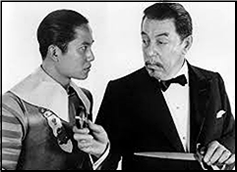
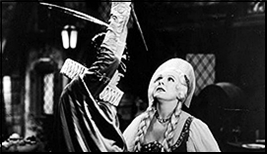
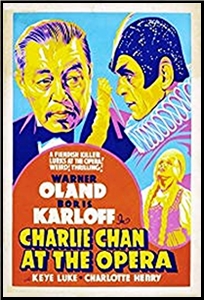
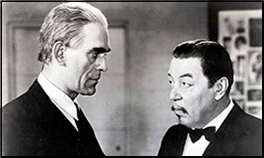
CHARLIE CHAN AT THE OPERA. Fox, 1936. Warner Oland, Boris Karloff, Keye Luke, William Demarest, Charlotte Henry, Thomas Beck, Margaret Irving, Gregory Gaye, Nedda Harrigan, Frank Conroy and Guy Usher. Written by Scott Darling, Charles Belden and Bess Meredyth, based on the character created by Earl Derr Biggers. Directed by H. Bruce Humberstone. Libretto by Oscar Levant.

   Above the title, the screen reads, “WARNER OLAND vs BORIS KARLOFFF” which is not exactly true of the ensuing film, but I remember it did pump considerable excitement into the monster-movie fan I was at 14, watching Charlie Chan at the Opera after school.

   In the wisdom of my advancing years I can appreciate CCatO for the anomaly it is. Or was. In 1936 Horror movies were banned in Britain and began to disappear from American screens, not to return till Son of Frankenstein in 1939. In the interim, Karloff made only a handful of films, and in 1938 would find himself feebly competing with Oland in Monogram’s “Mr. Wong” series – “Warner Oland vs Boris Karloff” indeed!

   But let’s get back to Charlie Chan at the Opera. It’s basically a Chan film trimmed out with some Horror Movie clichés — it even opens on a dark & stormy night!—and as such it shows off the strengths and weaknesses of Fox’s durable Chan series: strong production values and a capable supporting cast vs Oland’s tedious delivery, cardboard characters, and improbable story-line.

   Karloff opens the film in bravura style as an escaped maniac on some sort of vendetta that leads him back to the Opera where he once starred, with murders ensuing. But since this is a Chan film, he can’t actually be the killer — a bitter disappointment to a young horror fan of my acquaintance.

   Instead, we get the usual suspects: Margaret Irving, Geregory Gaye and Nedda Harrigan are rather good as the Nasty Diva, Philandering Baritone, and his Jealous Wife, but Charlotte Henry and Thomas Beck merely take up space as the perfunctory young lovers — there’s a momentary eyebrow-raiser when a bit of careless writing pegs Ms Henry’s age as about 11, but this isn’t that kind of movie; it’s the kind of movie where William Demarest plays the obligatory Dumb Cop on a single shrill note that gets tiresome very quickly.

   Against this mediocrity, Karloff and his back story (Years ago his “widow,” now the Nasty Diva, locked him in his dressing room during a theater fire.) emerge with a full-blooded theatricality I still find highly enjoyable. When Karloff comes on as Mephisto, glowering and demonic, belting out his ersatz villainy at the top of his lungs, CCatO achieves an intensity that seems fittingly poetic. And it’s fun to watch, too.

   I should add that this may be due in large measure to Oscar Levant’s mini-opera, with Karloff’s big scene reprised to haunting effect as he is lured back out onstage in an empty theater by the orchestra playing his big number. Levant was obviously having fun with this (I could swear I heard Karloff singing “Coloratura! ColoraTURRRAHHH!”) but it makes a perfect showcase for the actor, the character, and a scene that, like many old horror films, is strikingly operatic.
   

DEVIL IN A BLUE DRESS. TriStar Pictures, 1995. Denzel Washington (Easy Rawlins), Tom Sizemore, Jennifer Beals, Don Cheadle (Mouse), Maury Chaykin, Terry Kinney, Mel Winkler. Based on the book by Walter Mosley (also Associate Producer). Screenplay & director: Carl Franklin.

   When a young black man named Easy Rawlins, an unemployed aircraft worker who owns his own home in 1948 Los Angeles, is offered a job to find Daphne Monet, a white woman who is known to hang out in the juke joints in the city, he jumps at the chance. It turns out that Daphne is/was the girl friend of the man who has just dropped out of the current race for mayor, and when the girl who helps Easy track her down is murdered, it’s Easy whom the cops will pin her death on, unless he can do something about it.

   I’ve read some of the Easy Rawlins books, but not this one, which was the first. I have read that Denzell Washington was not Walter Mosley’s first choice to play Easy Rawlins, but this is not the first time I think an author was wrong as to whom would be best play his own character. Of course, I think Washington can play almost any character and make it work, and to me, he certainly does here.

   I loved the way director Carl Franklin recreated sections of late 1940s L.A. so perfectly, not to mention the lives led by the people who lived there, including their relationship with the police force, deeply infested with racism if not out and out malice. The era may also have been Raymond Chandler territory, but this movie takes us into locales that Chandler never was or could have been.

   As for Easy’s homicidal friend and sidekick Mouse (Don Cheadle), the way he is introduced could have been seriously improved upon. He came on the scene way too quickly (and conveniently) for me.

   In general critics seemed to have liked the movie, but it did not do well at the box office, and chances at a followup film seem awfully slim. I can think of a couple of reasons for this. First of all, it’s a complicated story, and by the two-thirds mark, it’s easy not to remember who all of the characters are. Secondly and honestly, I don’t think that audiences even as recently as 1995 were ready to see a movie in which one of the driving components was racism in 1948 L.A.


REVIEWED BY DAVID VINEYARD:


LESLIE CHARTERIS – The Saint in New York. The Saint #15. Hodder & Stoughton, UK, hardcover, 1935. Doubleday, US, hardcover, 1935. Avon #44, US, paperback, 1944. Reprinted many times, in both hardcover and paperback. Note: A shorter version appeared in the The American Magazine, September 1934.

THE SAINT IN NEW YORK. RKO, 1938. Louis Hayward, Kay Sutton, Jonathan Hale, Sig Ruman, Jack Carson, Paul Guilfoyle, Frederick Burton, Ben Weldon, Paul Fix, Leon Belasco. Screenplay: Charles Kaufman & Mortimer Offner, based on the novel by Leslie Charteris. Directed by Ben Holmes.

   Inspector John Fernack of the New York Police Department is fed up with the rampant crime plaguing the city when he vents to the Commissioner.

   â€œThere’s times when I wish I knew a guy like this Saint was here in New York—doing things like it says in that dossier,” he said. “There’s times when for two cents I’d resign from the Force and do ’em myself. I’d sleep better nights if I knew there was things like that going on in this city.”

   And as Fernack is going to learn sometimes you should be careful what you wish for.

   The Saint in New York is not my favorite Saint novel, but I will be the first to admit it is likely Charteris’s best novel, and it was certainly the best film adaptation of the character and his work despite his own dislike of the film.

   Not surprisingly Simon Templar’s arrival in New York also ushers in a considerably tougher, even hard-boiled version of the Saint, who had been around almost a decade when the novel was published in 1934. Indeed, the book itself was heavily censored in its early magazine and newspaper serialization, close to emasculated, because the full thing is a wild ride full of bursts of gunfire and violence, breathless escapes from impossible traps, cold blooded killings, the kidnapping of an innocent child, and the kind of retribution the Saint is famous for. There is also a beautiful and sexy femme fatale who is not only a match for the Saint, but possibly even wilder than the adventurer himself.

   The plot is that old favorite about the citizens committee that decides to clean up the city by extra legal means, in this case persuading one of its members, one Valcross, to find and hire Simon Templar to eliminate six of the big time racketeers terrorizing New York. Simon takes the job and arrives in New York with typical Saintly verve notifying his victims they are on his list.

   â€œIt goes back to some grand times—of which you’ve heard,” he said quietly. “The Saint was a law of his own in those days, and that little drawing stood for battle and sudden death and all manner of mayhem. Some of us lived for it—worked for it — fought for it; one of us died for it…There was a time when any man who received a note like I sent to Irboll, with that signature, knew that there was nothing more he could do. And since we’re out on this picnic, I’d like things to be the same—even if it’s only for a little while.”

   Not too long after he polished off Irboll the Saint is captured and taken to the lair of yet another of his victims, and it is there he finds the kidnapped little girl and first meets the beautiful and enigmatic Fay Edwards, who is connected in some mysterious way with all the men on his list.

   Escaping and rescuing the little girl with typical Saintly elan the Saint finds himself entranced by Fay Edwards even as he moves on his next victim.

   Eventually he meets Fay and he discovers that behind the six men he has been sent to kill is the Big Fella, the mastermind who with Fay’s help recruited the six criminals and who meticulously planned all their crimes, He also learns the big payoff is due soon when the Big Fella plans to split the profits — to a much smaller group than originally planned thanks to the Saint.

   I’m not going to pretend this one takes much effort for any mystery reader to figure out. Even in 1934 the villain should have been pretty obvious, which is why Charteris, who must have been well aware of this, never lets the action falter, never give the reader a chance to catch his breath, and piles incident upon incident in one of the most sustained action novels of its type ever penned.

   His trembling hands went up as if to shield himself from the stare of those devilish blue eyes.

   â€œDeath,” said the Saint, in a voice of terrible softness. “Death is my racket.”

   The Saint gets his man, the femme fatale meets the fate of most her kind, and the Saint and Inpector Fernack develop a much different relationship than the one he has back home with Inspector Teal.

   You know how it is, prophets in their own land.

   Charteris was working at Paramount when RKO bought the rights to his novel and the Saint came to the screen for the first time. Despite Charteris’s caveats, Louis Hayward is far and away the most Saintly of film Saints, hard edged but smooth, dangerous, suave, funny, and closer to the actual character in the books than any actor before or since. The scenes between he and Kay Sutton are not only well written, they are damn sexy considering when the film was made.

   There is a first rate cast with Jonathan Hale as Fernack, Kay Sutton as Fay, and a who’s who of bad guys that include Sig Ruman, Jack Carson, Paul Guilfoyle (as a semi comic team of killers Red and Heimie), Paul Fix, and Ben Weldon. The screenplay is fairly close to the book, certainly capturing the tone of the books better than any since, and the action is well staged.

   Granted it looks a little cheap here and there, and it could all be done a bit smoother, but it is the genuine Saint we are seeing in action, not the rather bored George Sanders or the dull Hugh Sinclair, and not the late much more sedate version television gave us (true to the later stories and novels in the series, there being almost as many versions of Simon Templar as there are of Ellery Queen).

   Whatever it’s flaws, you can imagine Hayward in white tie and tails singing to a Bobby beneath a street light or leaping through a window guns blazing — which he does at least twice in this film. Unlike later Saint’s he even makes use of his knife though he doesn’t seem to have named them.

   Some of the Sanders films are fun, and Hayward made an interesting if not entirely successful return to Sainthood in The Saint’s Girl Friday twenty years later. There is at least one French adaptation of a Saint novel done without Charteris’s permission (The Dance of Death (1960) with Felix Marten and based on “Palm Springs”) and available with the hero’s name changed.

   And of course there was the much loved Roger Moore series, a second series with Ian Ogilvy, a failed pilot, a series of made for television films with Simon Dutton, the Val Kilmer film, and a 2013 pilot with Adam Raynor (available on Netflix). That doesn’t include comics, comic strips, and the radio series that starred Vincent Price and later Brian Aherne as the Saint, but this is far and away the closest to Leslie Charteris’s vision of the character, making it ironic that he disliked it and Hayward so much, but I suppose when his ideals were Cary Grant and Rex Harrison anyone would be a letdown.

   Whoever plays the role next, I’m willing to bet it will be with less than half the verve and style Hayward brings to the part in his American debut as a leading man. For one time, and one time only, he was the Saint, the real one, not the rather wan imitation we have gotten since, and that is something Saint fans have every right to treasure.


REVIEWED BY WALTER ALBERT:


WHILE THE PATIENT SLEPT. Warner Brothers, 1935. Aline MacMahon (Sarah Keate), Guy Kibbee (Lance O’Leary), Lyle Talbot, Patricia Ellis, Allen Jenkins, Robert Barrat. Based on the novel by MIgnon G. Eberhart. Director: Ray Enright.

   Nurse Sarah Keate is brought to a gloomy mansion on a stormy nighth to care for a comatose patient while the family gathers vulture-like for the death-bed wait. A murder, accusation, Guy Kibbee as the amiable detective, and a confusing and not very convincing plot.

   Of interest for the pairing of MacMagon and Kibbee on what was probably an attempt to match the chemistry of the successful RKO Edna May Oliver/James Gleason pairing as Hildegarde Withers and Inspector Oscar Piper. MacMahon isn’t given much to do and aside from some arch exchanges between her and Kibbee, the movie doesn’t generate much chemistry.

   They were also probably trying to continue the more successful pairing of the two stars in Big-Hearted Hobart and Babbitt, both released in 1934. I saw these two films, or parts of them, recently. They’re light-weight romantic comedy-dramas worth watching for the expert acting of the cast. And Babbitt is as far from Sinclair Lewis as you can get.)

— Reprinted from Walter’s Place #106, March 1995.


REVIEWED BY DAVID VINEYARD:         


MENACE. Paramount, 1934. Gladys Michael, Paul Cavanaugh, Berton Churchill, Henrietta Crossman, John Lodge, Raymond Milland, Halliwell Hobbes, Robert Allen, Forester Harvey, Arletta Duncan Screenplay Chandler Sprague, Anthony Veilliers based on the novel R.I.P by Philip MacDonald (Collins, UK, 1933; published in the US as Menace, Doubleday, 1933). Directed by Ralph Murphy.

RYNOX. Ideal, 1932. Stuart Rome, John Londgren, Dorothy Boyd. Screenplay (mostly uncredited) J. Jefferson Farejohn, John Jerome, Philip MacDonald (his novel, Collins, UK, 1930; published in the US as The Rynox Murder Mystery , Doubleday, 1931), and Michael Powell, the latter also director.

   These two adaptations of novels by Philip MacDonald were virtually unknown to me until they showed up on YouTube, and certainly neither of them is in a class with his better known film adaptations such as X Vs Rex, Patrol, The List of Adrian Messenger (which ironically has a screenplay by Anthony Veilliers who co-wrote this one), 23 Paces to Baker Street, or even the earlier version of that book under its British title The Nursemaid Who Disappeared.

    Menace is the somewhat better of the two, working at least as a suspense film to some extent if not as much as a mystery, and moving with some vigor. Gladys Michael, Paul Cavanaugh, and Berton Churchill are wealthy friends in Africa just before the monsoons. Bored, they convince dam supervisor Ray (billed as Raymond) Milland to leave his post to play bridge with them. When the storms break early, Milland tries to fly back through the storm only to arrive in time to see the dam collapse and his mother and sister below killed, as well as hundreds of others.

   In a fit of remorse he flies his plane into the ground taking his own life.

   Back in England his brother Timothy, who is mentally disturbed, swears vengeance on the three he blames for his brother’s death, is put in a mental asylum, escapes, and one year later they are in Malibu in Michael’s beach side villa when he finally catches up with them.

   Soon to be trapped in the villa with them are a new butler (Halliwell Hobbes) hired from an agency, and who proves to be a crack shot when Cavanaugh tests him; Michael’s younger sister, who she raised when their parents died and her fiance (Arletta Duncan and Robert Allen); Cavanaugh’s driver (Forester Harvey); and a nosy eccentric old lady neighbor (Henrietta Crossman) who shows up on their doorstep with her son’s friend in tow (John Lodge).

   Not long after the lights go out, and the phone goes dead and all the autos are sabotaged. Not long after that Churchill is killed by a knife thrown by Timothy. Then Cavanaugh barely survives an attack.

   Now they are waiting for Timothy to strike and unsure who he is, if he is one of them at all. All we know is we have seen the butler attack Michael’s sister and tie her up and gag her.

   Not much real mystery here about who the killer is, even with a bit of misdirection, and there is one decent clue planted early on that does explain one surprise; plus two suspects complain of headaches– which we know Timothy suffers from — as half decent red herrings.

   What is notable here is not the film itself, which is at best a minor success, but just how stiff and unreal everyone else in the film seems after Ray Milland’s few scenes at the start. His perfect ease on screen, even delivering what isn’t much more than ‘tennis anyone’ dialogue, compared to everyone else in the film is striking. The film actually never recovers from his early death because there is no one in the film even remotely as attractive or natural on screen.

   It is about as clear a demonstration of the power of a natural screen presence as you will ever see. It’s as if everyone else is in a different film.

   Rynox, based on the The Rynox Mystery, basically has one thing going for it. It happens to be one of the earliest films directed by Michael Powell, who as one half of the Archers (with Emric Pressberger) would create such films as 49th Parallel, Black Narcissus, A Matter of Life and Death, I Know Where I’m Going, The Life and Death of Colonel Blimp, and more.

   Tycoon and founder of Rynox, F. X, Benedik (Rome) is threatened by the theatrical and larger than life Boswell Marsh. When Benedik is murdered, son Tony Benedik (Longdren, and the closest thing to Anthony Gethryn in the film — ironically Longdren is also television’s first Sherlock Holmes) takes over the business and the investigation.

   Unfortunately the very nature of film means the big reveal that made the novel a success is so obvious even the most naive film goer must have found it crystal clear. The script tries hard — little surprise with that lineup — and Powell shows a few directorial flourishes, but when the chief surprise in any mystery is telegraphed as this one is by bad acting and worse makeup, there isn’t much anyone can do to save it.

   This might have worked better is they had actually filmed the book as a detective story instead of trying to getting into character and showing the viewer far too much. I’ll only say that something similar worked much better when John Huston tried his hand at a MacDonald novel.

   Both films are mostly of interest to MacDonald fans or film historians, the former for an early star turn by Ray Milland and the latter as a footnote in the career of Michael Powell. I won’t warn anyone off them, because both have their moments, but take them for what they are, primitive variations on more familiar formulas.

   Menace at least has the advantage of moving fast and one or two touches of suspense and actual mystery, Rynox — well, it’s an early film by a great director.

MARLOWE. MGM, 1969. James Garner James Garner (Philip Marlowe), Gayle Hunnicutt, Carroll O’Connor, Rita Moreno, Sharon Farrell (Orfamay Quest), Kenneth Tobey, Bruce Lee. Screenplay by Stirling Silliphant, based on the novel The Little Sister by Raymond Chandler. Director: Paul Bogart.

   From beginning to end, the movie follows the book almost as closely as it could be done, starting with PI Philip Marlowe being hired by a young girl from Kansas to find her brother Orrin, who has come to L.A. to find work. But even though the story’s the same, and (so I’m told) some of the dialogue is the same, something’s missing. This is not the story Raymond Chandler wrote. Not the way I visualized it. It’s difficult to put into words, but if you watch the trailer below, I think you’ll see what I mean. (Hint: Bruce Lee.)

   What the movie is, to my way of thinking, more than anything else, is James Garner starring in an extended episode of The Rockford Files. It’s his story on the screen, not Chandler’s.

   The story does get darker and a lot more noirish as it nears the end, which is slightly different from the book, as I recall, but not so much as it makes any difference. Not that any of these observations make the movie bad, I hasten to add, and if you’re a Garner fan, I think you very well may love this movie. If you’re a Chandler fan, perhaps not as much.


REVIEWED BY DAN STUMPF:         


THE CAT AND THE CANARY. Grenadier, 1978. Honor Blackman, Michael Callan, Edward Fox, Wendy Hiller, Olivia Hussey, Betrix Lehmann, Carol Lynley, Daniel Massey, Peter McEnery, AND Wilfrid Hyde-White. Produced by Richard Gordon. Written & directed by Radley Metzger.

   Apparently you can’t go wrong with this title. The original 1927 film is a classic of silent era style and wit; the 1938 version offers a great cast and a star-making turn by Bob Hope; and this version, made by soft-core maven Meztger, has wit, color, and a cast of mostly one-shots and has-beens, shining in the kind of parts they weren’t used to getting.

   TIME OUT: Let me emphasize that the cast is only MOSTLY moth-eaten. Actually, many of them distinguished themselves on the stage, some went on to do interesting work in and out of the movies, and lovable old Wilfrid Hyde-White was always in a world of his own. But the fact is that when this movie was made, there wasn’t enough Hollywood star power between them to light up an “EXIT” sign.

   Yet they are consistently excellent here. Honor Blackman does a perfect Queen Bitch, paired up with Olivia Hussey as her submissive partner. Daniel Massey and Peter McEnery play vigorously off each other as bickering relatives. As the Doctor from the local Insane Asylum, Edward Fox acts nasty enough to make one suspect that the sobriquet “head shrinker” might be literal in his case, while Wendy Hiller and Beatrix Lehmann skulk about in the background as Shady Lawyer and Sinister Housekeeper.

   All of whom are gracefully counterbalanced by Carol Lynley and Michael Callan as the Young Lovers of the piece: She a frightened but sensible heiress; he a hack song-writer, ruefully aware of his insignificance in the scheme of things, but ready to roll the dice with a hostile universe.

   And then there’s Wilfrid Hyde-White as dead Uncle Cyrus, whose presence in the story is a clever ploy, handed off to an actor who carries it charmingly.

   I can attribute the presence of all this talent to Producer/Old-Movie-Buff Richard Gordon, but credit for their classy playing in well-written parts must go to writer-director Radley Metzger, whose stylish porno movies and erotic films of the 60s and 70s are reflected in the elegance of this, his only PG-rated effort. And some day I’d like to hear how he got the job.

   Just in case anyone still wonders what The Cat and the Canary is all about, it has to do with greedy relatives gathered for the reading of the last will & testament of their rich uncle Cyrus. And what happens when they find only one of them will inherit. And what happens when they find out that the putative heiress may be “disqualified.” And what happens when a Homicidal Maniac escapes from a nearby Madhouse. And one damn thing after another.

   That’s what the story’s about. The film is about style, pace, polish and wit, and how they can burnish an old gem like this into a real delight.


THE ROOKIE COP. RKO Radio Pictures, 1939. Tim Holt, Virginia Weidler, Janet Shaw, Frank M. Thomas, Ralf Harolde, Muriel Evans, Ace the Wonder Dog. Director: David Howard.

   Tim Holt, who came up for discussion as a B-western movie star following my review of Sagebrush Law a while back, was only 20 years old when he made this film, and as a rookie cop Clem Maitland, he’s really perfect for the part, since he’s young and eager and as wet behind the ears as they come.

   Although he’s billed first, this film is really built as a showcase for all the clever things Maitland’s dog Ace can do, which I didn’t find all that interesting, but back in 1939, audiences may have enjoyed his tricks a whole lot more. As for me, I was more impressed with the performance of even younger Virginia Weidler, 12 at the time playing a 9-year-old tomboy named Nicey who wants to become a cop herself, when she grows up — and she can hardly wait.

   It’s too bad that with all the screen time Nicey gets, they really didn’t have a lot for her to do. Part of the story has to do with Clem convincing the police chief that dogs can be of great help to a police force, but even though the police chief is the father of his girl friend, he stubbornly can’t see it Clem’s way.

   The other half of the story is nabbing a gang of crooks, which is a whole lot easier than convincing a stubborn police chief to see the light. The end result is competently done, but it’s certainly nothing special.


« Previous PageNext Page »