Authors


   You probably won’t recognize Rod MacLeish, nephew of poet Archibald MacLeish and noted NPR commentator who died in 2006, as having written a novel that was nominated for an Edgar by the Mystery Writers of America, but as it happens, he did.

   Here’s his complete entry in Crime Fiction IV, by Allen J. Hubin, only slightly expanded:

   MacLEISH, RODERICK (1926-2006 )
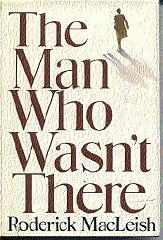
      * The Man Who Wasn’t There (n.) Random House, hc, 1976; Fawcett Crest, pb, 1977 [Washington, D.C.]
      * Carnaby Rex (n.) Weidenfeld, UK, 1976; See: The Man Who Wasn’t There (Random House,1976)
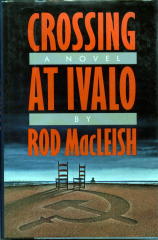
      * Crossing at Ivalo (n.) Little Brown, hc, 1990, as by Rod MacLeish. Zebra, pb, 1992.

Ivalo

   In case you may be wondering, it was the latter that caught the eye of the MWA. One online seller describes it thusly: “The principal architect of the Soviet ‘Star Wars’ system is kidnapped and his abductors offer him for sale to the Soviets and Americans. The Russians don’t want anyone to have him and the Americans want to learn all that he knows.”

   His earlier book having crime-related components, The Man Who Wasn’t There, is cryptically described by one seller thusly: “Millionaire film star, claiming to be his twin, reads of his death.” A second synopsis provided by another seller, probably from the back of the book itself, says: “From the quiet elegance of Georgetown to Hollywood and Paris, this novel moves inexorably toward the innermost recesses of a man’s mind. The suspense builds to a terrifying pitch in a climactic scene – a scene no reader will soon forget.”

Man Who Wasn't There

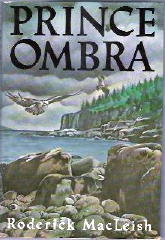
   Another book, this one with no criminous overtones, is A Time of Fear (Viking Press, 1958), the “story of a small town in the way of development.” Yet another, a science fiction fantasy thriller, is Prince Ombra (Congdon & Weed, hc, 1982; Tor, pb, 1983) in which the title character, “Prince Ombra is the lord of every mortal nightmare. He has appeared in the world a thousand times, and the rememberers have given him a thousand names – Goliath, the murderous Philistine; Mordred, enemy of Camelot. The heroes of legend have offered their lives in confrontation with the evil one. Among them have been David and Arthur, king of the Celts.”

Prince Ombra

   Or in other words, a book about a boy with magic powers in modern-day New England. During his journalist days, Mr. MacLeish also wrote a non-fiction book, The Sun Stood Still, about the 1967 Arab-Israeli war.

   According to an National Public Radio [NPR] tribute to one of their long-time contributors:

   MacLeish worked as a news director for WBZ radio in Boston in the early 1950s and later moved to London, where he was assigned the job of establishing a foreign news department for Westinghouse Broadcasting Co. He also worked for CBS News in Washington in the early 1970s, doing political commentary, and was a commentator and news analyst for NPR [during the early days of Morning Edition.]

   When he wasn’t covering foreign conflicts, he traveled the country writing social and political commentaries, including producing a program focused on race relations, A Month in the Country, with Bernard Shaw.

   MacLeish was also […] the broadcast voice of the Philadelphia Orchestra, and […] his documentary on the Hermitage in St. Petersburg was nominated for an Emmy.

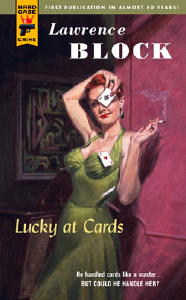
LAWRENCE BLOCK – Lucky at Cards

Hard Case Crime; paperback reprint, Feb 2007. First published as The Sex Shuffle, by Sheldon Lord; Beacon B757x, paperback original, 1964.

   Here’s a crackerjack of a crime novel published in 1964 that has been a loosely kept secret, not even appearing in Allen J. Hubin’s Crime Fiction IV until now, which is when the folks at Hard Case Crime have essentially let the entire world know about it. Everyone, that is, but a small handful of diehard collectors who delve into and devour what are called the “sleaze” books in the trade, Beacon being one of the better and more well known providers of the same.

Lucky at Cards

   Not that the “sex scenes” in Beacon’s output are anything near torrid, given today’s standards, and The Sex Shuffle, if anything, is tamer than most. On the other hand, if you believe the quality of the writing in the Beacon books is anything like that of The Sex Shuffle, you’d be fairly well mistaken. They were written quickly for the most part, mostly by men who had one eye on the market and other on their landlord, whenever the rent was due — sometimes with hidden talent but far more often, what you read was what you got.

   Nor do I think searching out Sheldon Lord’s books in general would necessarily be a worthwhile pursuit, unless you are one of those aforementioned diehard collectors, or this book persuades you to become one. An article in Books Are Everything, which I have not seen, is reported to have stated that Block was “the first user of the Sheldon Lord pseudonym, followed by Hal Dresner, followed by Milo Perichitch.” There are also claims that say that Donald Westlake was one of the writers behind Sheldon Lord, but since this statement seems to have been questioned immediately by others, you’d better not rely very much on my saying so.

   In any case, what you have here, whatever its lineage may have been, is a near perfect low-level novel of crime and lust and greed and comeuppance and all of the other noir-related themes you can think of, written so smoothly that its 220 pages can be read in an hour, without once coming up for air.

   Story: a professional cardshark is stuck in a two-bit town while recuperating from his last scrape with — not the law — but with real gamblers in a real game and of course there was a woman at the root of it. Quoting from page 19:

   … At two in the morning a little man with hollow eyes had seen me dealing seconds. “A goddamned number two man,” he yelled. “A stinking mechanic.”

   They hadn’t even asked for an explanation. They took back their twenty-three hundred plus the five hundred I started with. They hauled me out behind the store and propped me up against the wall. One of them put on a pair of black leather gloves. He worked me over, putting most of his punches in the gut. The one that broke my teeth was a mistake — I slipped and fell into it, and the guy belted me in the mouth by accident …

   Thus beginning the book with this pair of introductory lines:

   If it hadn’t been for the dentist, I would headed on out of town. The guy had a two-room office in the old medical building on the main drag, and I saw him on Monday and Wednesday and Friday of the first week I spent in town.

   The town isn’t mentioned, or if it is, I missed it, and even so I’d rather think of it as one of those typical small Midwestern towns of the sixties that was still living in the fifties at the time, with small town businesses and small town businessmen and small town wives…

   Except for one of them. From page 27, and an even longer quote this time. The dentist has invited Bill Maynard to a friendly small town poker game:

   I was busy losing a hand when I heard footsteps on the stairs and glanced up. I saw the legs first — long and slender, and a skirt ending at the knees. I folded my cards and had a look at the rest.

   She wasn’t quite beautiful. The body was perfect, with hooker’s hips and queen-sized breasts and a belly that had just the right amount of bulge to it. The hair was the color of a chestnut when you pick the husk from it. She had the hair bound up in a French roll. It was stylish as hell, but you started imagining how this female was with her hair down and spread out over a white pillow.

   The face was heart-shaped, with a pointed chin and wide-spaced eyes. Green eyes. There were little tension lines in the corners of those eyes, and there were matching lines around her mouth. Her mouth was a little too full and her nose was a little too long, and that’s why I say she wasn’t beautiful, exactly. But perfection always puts me off. There’s something dry and sterile about an utterly beautiful woman. This one didn’t put me off at all. She kept me staring hard at her.

   This is one of those moments when the clock simply stops ticking, in other words. Her name is Joyce, and it turns out that she has a sharp eye out for a man who’s (too) good at cards. One thing leads to another, as things like this happen to do, and the husband is in the way. Bill Maynard has a plan, an outrageous plan, and even when you read it for the first time, it sounds outrageous but you go along with it, simply because Bill Maynard knows his plan will work.

   It doesn’t involve murder, not quite, or maybe it does, in a way, and of course it doesn’t work. Not at least, the way that Bill Maynard thinks it will. Did I mention that there is also a “good girl” in this story, a grade school teacher named Barbara who thinks that maybe she wants a bad man? Bill thinks she deserves a house and kids, and says good-bye. She’s not in the plan.

   What is the plan, how is it supposed to work, why doesn’t it work, and what it is with women who are attracted to bad men? Read the book, and you will learn.

   It does go a little over the top — a small misstep once or twice somewhere near the end — but all in all, it is the truth: about bad men (and bad women, for that matter) and life in small towns and a small chunk of our past, all in an hour’s reading. I kid you not.

— February 2007

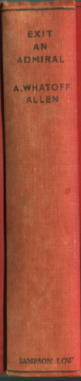
A. WHATOFF ALLEN – Exit an Admiral

Sampson Low; hardcover. No date stated, but given as 1938 in Crime Fiction IV, by Allen J. Hubin.

   And the above seems to be the sum total knowledge of Mr. Allen and his single work of detective fiction, unless you include an Internet obituary of one David Whatoff Allen, BA, 22 May 1997; commoner 1936-39. Aged 79. Perhaps a relative?     [See also the FOLLOWUP below.]

   In terms of other general information about the family, in this country (US) there was (presumably) a family of Whatoffs in Oklahoma, five members of which died between 1987 and 1993. [From Social Security records.] In the UK there is a Whatoff Lodge Farm in (I belive) Leicestershire where camping sites are available.
Exit an Admiral

    Using Google, even though it’s an uncommon name, there are other references to Whatoff to be found, so perhaps if one wanted, the author could be traced, given a little more persistence, ingenuity and luck.

    And you may need the same (persistence, ingenuity and luck) if you were to try to find a copy of this book. I obtained mine on eBay, a winning bid taken purely as a shot in the dark, as I had no idea what kind of crime fiction the book might turn out to be. There are no copies available on the Internet, for example, at the present time. (Right now my book searching website of choice is addall.com. The results on bookfinder.com are organized better, but since ABE took them over, they seem to miss a lot of books that addall finds.)

    But I digress. As a detective novel, Exit an Admiral leaves a certain amount to be desired, but it is also crammed full of clues, derring-do, more clues (a house full of them), mistaken identities, false trails, even more evidence and other clues, and I tell you up front, this was an extreme pleasure to read. (Not to mention the sinister satisfaction that one sometimes feels when one knows one is reading a book that no one else has in over 50 years perhaps — or am I deluding myself with this? — nor perhaps no one else will in another 50 years.)

    I do tell you this. If you do see a copy for sale anywhere, make sure you grab it up immediately. If I can’t persuade you to read it, and I am about to do my best, you can consider this: that I will have persuaded someone else that they desperately want to read it, and they will pay almost anything for the opportunity.

    In Chapter I we meet Ivor Duke, young barrister and a well-known amateur sleuth of the type that England was filled with in 1938. His assistant (major domo), a former boxer named Pug Jordan, is with him in a car, and the story of how they met is told.

    In Chapter II Duke stops along the highway, rather deserted, to come to the aid of young woman standing next to a car with a decidedly flat tyre. She resists his assistance, he allows her to resist, but persists long enough to see a man in the back seat who looks decidedly dead. She holds a revolver on him, and that is when the lights go out, as someone has snuck up on him from behind. (Pug remains asleep in Duke’s car throughout the incident.)

   Next day. In Chapter III Duke is visited by Inspector Jenner at home and is told about the mysterious murder of a retired admiral in his home, the same night and in the (totally coincidentally) same area as Duke’s own strange encounter. Not the same dead man, however, much to Duke’s surprise.

    But two bodies in the same evening and in the same vicinity? Are the cases connected? Apparently not, but we (the reader) know better, and in spite of some doubts along the way, so does Duke.

    Here’s a quote from the beginning of Chapter III, however, describing Duke on the morning after, and before the visit from Inspector Jenner:

   Thinking things over as calmly as possible while tenderly fingering the back of his head, Ivor Duke, lolling back on his pillows, with a newspaper propped against his knees and a cigarette between his lips, came to the conclusion that the implement which had laid him out a few hours ago had been a spanner. Various implements had at various times in the course of his career struck him on roughly the same spot, and he was qualified by experience to state quite definitively that it had not been a length of iron piping or a sandbag. The fact that he had not been led by his physical sensations at the moment of the impact to jump to the obvious conclusion that he had been struck by a ten-ton steel girder was, he felt, a remarkable tribute to the calm, unbiased working of a balanced legal mind. A mind much less free from prejudice might have ignored the strong evidence in support of the spanner theory supplied by the presence of a motor car on the scene, and overlooked the improbability of ten-ton steel girders lying about a deserted country road at two o’clock in the morning.

   Here’s where you and I may go our separate ways, if I were to tell you that this is my kind of writing and it happens not to be yours. And at least in the early going, the author is making it abundantly clear what sort of approach he plans to take with the story.

   What the paragraph above also makes clear is that this is not Duke’s first brush with strange events occurring at two o’clock in the morning, which is reinforced with some suitably appropriate banter soon thereafter with Jenner about how, when Scotland Yard is baffled, they come along to see Ivor Duke.

    Now this was in 1938, and in 1938, whether true in real life or not, amateur assistants to Scotland Yard in detective fiction were allowed to examine the premises where the dead man’s body was found, picking up clues and other evidence, sometimes revealing what they find to the reader, and sometimes not, carelessly forgetting to do so until such time when a careful exposition is more likely to impress the reader with their various reasonings and conclusions.

   One can easily forgive Mr. Allen for merely going along with the trend. Here’s a quote from page 101 which will describe what Ivor Duke soon finds himself up to his waist in, immediately after interviewing an elderly gent named Huggett, whose horse and buggy were nearly run off the road on the same night as the murder, but by another car altogether:

    “The trouble with this case, Jenner,” said Duke, “seems to be that we’ve got too many of everything — too many potential murderers, too many shots, too many cars. And if the bloke I saw in the car was dead, there’s a regular glut of corpses. Huggett, I’m afraid, has only made things more difficult for us.”

   There is also a host of strange and mysterious coincidences that are, I confess, exceeding frustrating, coincidences being the primary means of support for many a weaker detective fiction writer, but do not despair, all is explained, as well as the even stranger behavior of the dead man’s daughter on page 112.

    While this is a thoroughly solid detective story, once one gets over some of the shakier parts, it ends in a sudden burst of activity found in only the best thrillers of the day, followed by the revelations suggested above in which all is marvelously and beautifully explained.

    One is also left with the hope of another detective thriller from the pen or typewriter of A. Whatoff Allen, but for whatever reason, alas, such a one was not to be.

— September 2006


FOLLOWUP. I did hear from one fellow twice by email in one evening who told me he was a relative of the author and passed along some interesting pieces of information about him. I’ve not heard back from this fellow, though, and posting this review of Exit an Admiral here on the blog is serving as a reminder to me that perhaps I should try getting in touch again. More, when I learn more, as always.
   Two authors who have passed away not too long ago seem to have escaped notice in the world of mystery fiction, but not to the larger universe we also live in. Both have only one book included in Crime Fiction IV, by Allen J. Hubin, who recently came across the deaths of each.

   First is Pat Maloney, Sr., whose entry in CFIV previously looked like this:

      MALONEY, PAT, Sr. (c1926- ); Texas trial lawyer from San Antonio.

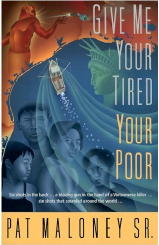
         * Give Me Your Tired, Your Poor (Presidio, 1998, hc) [Texas]

Give Me Your Poor

   Saying that Mr. Maloney was a trial lawyer is perhaps the understatement of the year, so far. Extracted from his obituary which appeared in the Washington Post for September 21, 2005, is the following:

   Pat Maloney Sr., 81, a flamboyant trial lawyer whose numerous multimillion-dollar verdicts landed him in years past on the Forbes magazine list of the nation’s top moneymaking lawyers, died September 11 [2005] of pulmonary fibrosis at his home in San Antonio.

   Combative and controversial in a personal-injury and product-liability career that spanned more than a half-century, Mr. Maloney won more than a hundred cases where the verdict topped $1 million. He was known as the king of torts.

   […] Mr. Maloney often said that his most memorable case was a 1979 capital murder trial involving two young Vietnamese brothers who worked as crab fishermen on the Texas Gulf Coast. They were charged with killing a longtime crabber who had terrorized them as part of an orchestrated effort to drive the newly arrived Vietnamese immigrants out of the coastal area. […] He represented the brothers pro bono.

   Even though he was not a criminal lawyer and his clients had shot the victim six times in the back […], he managed to get an acquittal for the two young men.

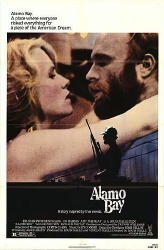
   The French director Louis Malle made a movie about the trial, Alamo Bay (1985), and Mr. Maloney wrote a vanity novel about it, Give Me Your Tired, Your Poor (1999). The main character is a colorful San Antonio lawyer named Frank Hogan.

Alamo Bay

   To complete his updated entry in CFIV, Mr. Maloney was born August 9, 1924.

***

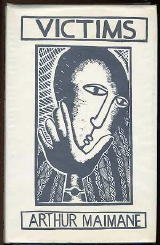
   Another author whose death has been recently noted is Arthur Maimane. His entry in CFIV consists of just one title as well:

      MAIMANE, ARTHUR (1932- ); A black South African.

         * Victims (Allison, 1976, hc) [South Africa; 1950s]

   One title, but the overall scheme of things, an important one. Born October 12, 1932, his full name was John Arthur Mogale Maimane. He died in London, June 28, 2005. Taken from his obituary in The Independent (London) is a short description of his early working career:

   South African political exiles in Britain in the early 1970s, after the government of Hendrik Verwoerd had smashed the internal liberation movements in the post-Sharpeville state of emergency, were cheered to see the name of Arthur Maimane on television screens as an ITN [the British Independent Television News] staffer. Here was a journalist who had made it in world media, from small beginnings in the newsroom at Drum magazine, which had opened up a new world of journalism in South Africa in the 1950s. Maimane worked also for Drum’s sister daily, Golden City Post, and had somehow remained a ‘free spirit’ too, having moved in 1958 to Kwame Nkrumah’s Ghana.

   This was an escape from the colour bar and oppression at home, but also from the attentions of the township gangsters who had murdered his fellow Drum news editor and role model, Henry Nxumalo, in 1957. Maimane’s crime reports and his Hadley-Chasesque short stories, under the name ‘Arthur Mogale’, had not gone down well in the Johannesburg underworld.

   […] He returned to the ‘new South Africa’, first for a year with the liberal, fringe Weekly Mail in May 1990, during which he was again ‘the first black journalist,’ this time to report on the dismantling of apartheid legislation. From 1994 to 1997 he served as managing editor of the Johannesburg Star, and also became a columnist on the Sunday Independent.

   His book Victims, winner of the English Academy of South Africa’s Pringle Award for Creative Writing in 1978, was banned in South Africa at the time of its publication but finally appeared there under the title Hate No More, Kwela Books, 2000.

Victims

   An online description of the book says of it:

   “Set in Johannesburg in the fifties, the central incident is the rape of a young white woman by a black man and the crumbling of her comfortable white suburbia life as she gives birth to the child. The young man avoids arrest but is unable to shake off the implications of this rape – an angry and desperate gesture against the indignities imposed on him by apartheid – as fate draws him back to the victim of his crime and to confront himself and his place in a racist and violent society. Maimane has written a vivid hard edged account of the harsh realities of township life under apartheid, introducing us to Sophiatown in all its vibrancy, violence and its colourful characters and to a South Africa filled with contradictions and frustrations.”

   Another, more detailed obituary appears online here, this one from The Guardian.

   Not much is known about Randall Parrish, author of The Case and the Girl. A brief Wikipedia entry calls him an American author of dime novels, and nothing more. Following Mary’s review, you’ll find a partial bibliography that I’ve quickly put together.

   And if after reading the review you’re prompted to look for a copy of the book itself, as I think you very well may, you’ll be glad to know that the book is online, or in print in POD format, since you aren’t going to find a copy of the Knopf edition anywhere for less than $250. In fact, there was only one that I could find, and that’s the asking price.          – Steve


RANDALL PARRISH – The Case and the Girl

Alfred A. Knopf, hardcover, 1922. A. L. Burt, hc reprint, n.d. Paul (UK), hc, 1923.

   Captain Matthew West has just been honourably discharged after twice being wounded during World War I. Feeling restless and not yet ready to return to civilian work, while browsing the newspaper at his club he decides to answer a personal ad running thus

   “Wanted: Young man of education and daring for service involving some personal peril. Good pay, and unusual reward if successful. May have to leave city. Purpose disclosed only in personal interview.”

   Instructed to bring his evening clothes — and a good job he has them! — he is soon off to a rendezvous with orphaned heiress Natalie Coolidge. She does not explain what task she requires him to undertake but Captain West agrees to help her even so, and is whirled off to the family mansion, where he is astonished to be introduced to the house party as her fiance. One of the guests is Natalie’s uncle and guardian Percival Coolidge. The two men dislike each other on sight – in fact, Uncle Percy accuses West of being a fortune hunter, the cad.

   Next morning the gallant captain has a private chat with Natalie and learns someone is impersonating her. However, nobody believes her because the responsible party looks so like her she fools even Natalie’s friends, not to mention the servants and bank clerks who know her well.

   Is Natalie telling the truth, mistaken, or demented? Despite doubts at times, West agrees to try to solve the mystery. There are a couple of odd happenings, statements made don’t quite check out, and then a death occurs and West is plunged into an adventure with enough twists and turns to make a scriptwriter swoon. The detective work is partly deductive and partly wearing out shoe leather and when it comes to action, West usually wipes the floor with his opponents, yet in a manner showing he is not a super hero.

   My verdict: Apart from the occasionally annoying fact that Captain West is a bit slow on the uptake at times, this was a rollicking read and keeps the interest to the end. I particularly admired a sequence in which West and Natalie are trapped in…but no, I will not ruin the suspense, although I will say it gave me the creeping heeby jeebies.

      Etext: http://www.gutenberg.org

              Mary R

http://home.epix.net/~maywrite/


RANDALL PARRISH (1858-1923) – A Partial Bibliography

● Crime Fiction  (Thanks to Crime Fiction IV, by Allen J. Hubin.)

* Gordon Craig, Soldier of Fortune (n.) McClurg 1912 [Alabama]
* -The Air Pilot (n.) McClurg 1913 [Air]
* -“Contraband” (n.) McClurg 1916 [Ship]
* The Strange Case of Cavendish (n.) Doran 1918 [Colorado]
* -Comrades of Peril (n.) McClurg 1919
* The Mystery of the Silver Dagger (n.) Doran 1920
* The Case and the Girl (n.) Knopf 1922 [Chicago, IL]
* Gift of the Desert (n.) McClurg 1922

● Titles available online, including non-mystery fiction:

* Beth Norvell: A Romance of the West

Beth

* Bob Hampton of Placer
* The Case and the Girl
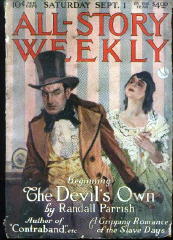
* The Devil’s Own: A Romance of the Black Hawk War
* Gordon Craig: Soldier of Fortune
* Keith of the Border
* Love under Fire
* Molly McDonald: A Tale of the Old Frontier
* My Lady of Doubt
* My Lady of the North
* Prisoners of Chance: The Story of What Befell Geoffrey Benteen, Borderman, through His Love for a Lady of France
* The Strange Case of Cavendish
* When Wilderness Was King: A Tale of the Illinois Country

Wilderness

* Wolves of the Sea: Being a Tale of the Colonies from the Manuscript of One Geoffry Carlyle, Seaman, Narrating Certain Strange Adventures Which Befell Him Aboard the Pirate Craft “Namur”

● Shorter fiction:   (Thanks to The FictionMags Index.)

* A Moment’s Madness (sl) The All-Story Aug, Sep, Oct, Nov 1911
* The Devil’s Own (sl) All-Story Weekly Sep 1, Sep 8, Sep 15, Sep 22, Oct 6 1917
* The Strange Case of Cavendish (sl) All-Story Weekly Apr 20, Apr 27 1918
* The Pathway of Adventure (sl) Railroad Man’s Magazine Nov 9, Nov 16, Nov 23 1918
* Comrades of Peril (sl) All-Story Weekly Oct 4 1919
* Wolves of the Sea (sl) Chicago Ledger Feb 25 1922

Devil's Own

● Three of his novels and stories have been adapted into film:   (Thanks to IMBD.)

Bob Hampton of Placer (1921) (novel)
Keith of the Border (1918) (novel)
The Shielding Shadow (1916) (story)

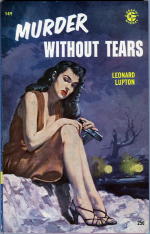
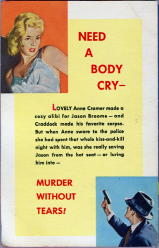
   In Crime Fiction IV, by Allen J. Hubin, there is presently no biographical information of any kind for Leonard Lupton, an author known perhaps only to collectors of Graphic paperbacks in the 1950s. I’m referring here to books produced by the Graphic Publishing Company of 240 W. 40th Street, New York, NY, but admittedly the covers could often be graphic, too.

Murder Without Tears

   But more about the books (and their covers) in a minute. A couple of recent emails between Al Hubin and Victor Berch have done much to remove some of the anonymity in which Mr. Lupton has been residing all these years.

   Al wrote to Victor first, saying,

    “[My records] have shown him as born ca. 1907. Peoplefinders.com has me wondering if possibly he was (William) Leonard Lupton, living in Newburgh, NY, who was probably married to Mary Lupton (a byline Leonard Lupton also wrote under). Social security death benefits has a William L. Lupton of that city, born 5/27/1907, died 4/26/2000. Also a Mary Lupton of that city, born 12/5/1906, died 6/22/1997. Can you track any confirming/contradicting information?”

   Victor’s reply, in part:

    “I’d say that you are right. I spotted the same as you concerning the Social Security Death notices on the Luptons of Newburgh.

    “[Also] the books Doomsday Ghost, Summer Camp Nurse, and Perilous Kisses are authored by Mary Lupton, which the Copyright Office says is a pseudonym of W. L. Lupton. I found a book of poetry called Poetry at the Angel, edited by Kenneth H. Baldwin, Mary Jane Lupton, Susan Moore and William L. Lupton. It’s possible that Mary Jane Lupton was the daughter of William L. Lupton, since the Copyright Office gives a 1938, birth date for her. Hope that helps.”

   There being a complete consensus at this time that the Leonard Lupton found in Social Security records being Leonard Lupton, the author, it’s about time for a list of the books he authored. Adapted from, and updating his entry in CFIV are the following:

LUPTON, (WILLIAM) LEONARD (1907-2000); see pseudonyms Mary Lupton & Chester Warwick

   * Murder Without Tears (Graphic 149, 1957, pb) [New York] Hard-boiled mystery. “Lovely Anne Cramer made a cozy alibi for Jason Broome — and Craddock made his favorite corpse. But when Anne swore to the police she had spent that whole kiss-and-kill night with him, was she really saving Jason from the hot seat — or luring him into murder without tears!”

Lupton: Back Cover

   * -The Night of the Owl (Lenox Hill, 1971, hc) Gothic Romance. Mrs. Moreland’s lively daughter could not keep from wishing to go to the pseudo-Swiss chalet known as Alpenstock, reputed to be haunted…

LUPTON, MARY; pseudonym of Leonard Lupton; other pseudonym Chester Warwick

* –Dangerous Kisses (Avalon, 1983, hc)

* –The Doomsday Ghost (Avalon, 1984, hc) [Alabama] [A tutor comes to an Alabama estate nicknamed Doomsday Plantation and faces both anger and love.]

Doomsday Ghost

* –Fantasy at Midnight (Avalon, 1982, hc)

* –Fear to Love (Avalon, 1983, hc) [A woman takes time off from her journalism job to visit her ill grandfather and finds herself falling for a potentially dangerous man.]

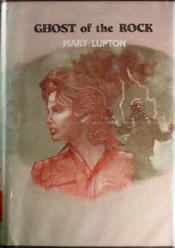
* Ghost of the Rock (Avalon, 1986, hc)

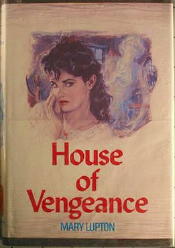
* House of Vengeance (Avalon, 1984, hc) [A woman inherits a reportedly haunted house and, when she arrives, she can’t understand why someone would want to harm her.]

House of Vengeance

* –Night Glow (Avalon, 1982, hc)

* Perilous Kisses [Avalon, 1986] [Included in the online Addenda #9 to the Revised CFIV.]

      [NON-MYSTERY]

* Summer Camp Nurse [Avalon, 1985] Nurse romance novel.

WARWICK, CHESTER; pseudonym of Leonard Lupton; other pseudonym Mary Lupton

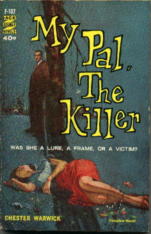
* My Pal, the Killer (Ace F-107, 1961, pb) [New York]

Warwick: My Pal

Other fiction as LEONARD LUPTON:

* River Man (Dial Press, hc, 1930) Novel. Story of Hudson River shanty-boat and its owner.
* Empire West (Lennox Hill, hc, 1972)
* Canyon Killer (Lennox Hill, 1973; Manor, pb, n.d.)

   The latter two books, while not seen, are almost assuredly westerns.

   One last search on the Internet led to the following discovery. From The FictionMags Index is the following (partial) list of pulp magazine stories written by Leonard Lupton, almost all of them tales of valor on the sports fields and arenas.

   Mr. Lupton, if the author were the same man, and we are 99% sure that he is, would have been 20 when he started writing, and 35 when the last story appeared. That was in 1942, just in time to serve (as a guess) in World War II.

LUPTON, LEONARD

* He Could Take It (ss) The Popular Stories Nov 19 1927
* He Just Dropped In (ss) The Popular Magazine Sep 7 1928
* The Shakes (ss) The Popular Magazine Nov 20 1928
* Captain of the Night Boat (ss) The Popular Magazine Feb 20 1929
* Mrs. Murphy’s Chowder (ss) The Popular Magazine Mar 7 1929
* A Minute with— (ms) The Popular Magazine Jul 20 1929
* The Beautiful Ballyhoo (ss) The Popular Magazine Aug 20 1929
* River Life (pm) The Popular Magazine Sep #2 1930
* Mr. Rooney Horns In (ss) Street & Smith’s Sport Story Magazine Sep 25 1932
* Steel Grappler (ss) Street & Smith’s Sport Story Magazine May 25 1933
* One Hundred Per Cent Maloney (ss) Street & Smith’s Sport Story Magazine Aug 10 1933
* The Great Gootch (ss) Street & Smith’s Sport Story Magazine Dec 10 1933
* Goal Posts on Thunder Mountain (ss) Street & Smith’s Sport Story Magazine Mar 10 1934
* The Fence-Buster (ss) Street & Smith’s Sport Story Magazine Sep 10 1934
* The Carny Kid (ss) Street & Smith’s Sport Story Magazine Oct 25 1934
* Big Top Touchdown (ss) Street & Smith’s Sport Story Magazine Jan 25 1935
* Write It on Ice (ss) The All-America Sports Magazine Feb 1935
* Road Test (ss) Street & Smith’s Sport Story Magazine Jun 10 1935
* The Wrestling Tramp (nv) Street & Smith’s Sport Story Magazine Jun 25 1935
* Publicity’s Pal (ss) Street & Smith’s Sport Story Magazine Nov #1 1935
* Sucker Trap (ss) Street & Smith’s Sport Story Magazine Dec #1 1935
* Tough on Tenors (ss) Street & Smith’s Sport Story Magazine Jan #2 1936
* No Help Wanted (ss) Street & Smith’s Sport Story Magazine May #1 1936
* Only One Champ (ss) Street & Smith’s Sport Story Magazine Nov #1 1936
* The Champion Chump (ss) Street & Smith’s Sport Story Magazine Dec #2 1936
* P.S. – He Got the Gob (ss) The All-America Sports Magazine Feb 1937
* North to the Ski Trails (ss) The All-America Sports Magazine Mar 1937
* Get Brannigan (ss) Street & Smith’s Sport Story Magazine Apr #1 1937
* Pan Rassler (nv) Street & Smith’s Sport Story Magazine Apr #2 1937
* False Alarm (ss) Street & Smith’s Sport Story Magazine Oct #1 1937
* The Wrestling Dummy (nv) Street & Smith’s Sport Story Magazine Sep #1 1938
* When Geek Meets Geek (ss) Street & Smith’s Sport Story Magazine Sep #2 1938
* Fall Guy (ss) Street & Smith’s Sport Story Magazine Nov #2 1938
* Circuit Clown (ss) Thrilling Sports Jan 1939
* Telemark Tension (ss) Street & Smith’s Sport Story Magazine Mar #1 1939
* Mud Show Mangler (nv) Street & Smith’s Sport Story Magazine May #1 1939
* Health for Sale (ss) Street & Smith’s Sport Story Magazine Sep #1 1939
* Take ’em to the Cleaners (ss) Street & Smith’s Sport Story Magazine Jan 1940
* Suicide Saucer (ss) Popular Sports Magazine Fall 1940
* Jumpin’ Jiminy (ss) Street & Smith’s Sport Story Magazine Feb 1941
* Kangaroo Kid (ss) Street & Smith’s Sport Story Magazine Mar 1941
* Money in Midgets (ss) Thrilling Sports Jan 1942

SARAH ANDREWS – Dead Dry

St. Martin’s, paperback reprint; 1st printing, September 2006. Hardcover: St. Martin’s Press, November 2005.

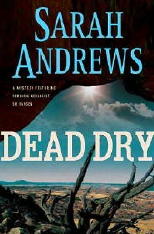
   Em Hansen, the detective of record in Dead Dry, is the new forensic geologist for the state of Utah, and while she’s had nine previous adventures on record, this is the first case of murder that’s come her way since taking the new position. I’d tell you more about some of her earlier cases, but as it happens, as I so often have to admit, this is the first one of the ten that I’ve happened to read.

    For the record, expanded from her entry in Crime Fiction IV, by Allen J. Hubin, here are the previous nine (plus this one, her tenth, along with the one that’s in the works) in chronological order, beginning with her earliest:

   Tensleep. Otto Penzler Books, hc, June 1994 [Wyoming]
      Signet, pb, December 1995
   A Fall in Denver. Scribner, hc, December 1995. [Colorado]
      Signet, pb, December 1996
   Mother Nature. St. Martin’s, hc, June 1997 [California]
      St. Martin’s; pb, July 1998
   Only Flesh and Bones. St. Martin’s, hc, May 1998 [Wyoming]
      St. Martin’s; ; pb, August 1999
   Bone Hunter. St. Martin’s, hc, September 1999 [Utah]
      St. Martin’s; pb, September 2000
   An Eye for Gold. St. Martin’s, hc, September 2000 [Nevada]
      St. Martin’s; pb, Decmber 2001
   Fault Line. St. Martin’s, hc, January 2002 [Utah]
      St. Martin’s; pb, January 2003
   Killer Dust. St. Martin’s, hc, February 2003 [Florida]
      St. Martin’s; pb, March 2004
   Earth Colors. St. Martin’s, hc, March 2004 [Pennsylvania]
      St. Martin’s; pb, December 2004
   Dead Dry. St. Martin’s, hc, November 2005 [Utah]
      St. Martin’s; pb, September 2006
   In Cold Pursuit. St. Martin’s, hc, Spring 2007 [Antarctica]

   For a photo of the author is the controls of her plane while researching her latest book, go to her website. You’ll also find a biography of the author there. Short version: “A geologist who writes mystery novels about a geologist.” For the long version, I’ll suggest you simply check out her website. It’s definitely worth a visit.

   While researching the publication dates of the books above, mostly on Amazon, I happened to glimpse some of the reviews, and unfortunately, some of them matched my opinion almost completely. Long discourses on matters geological, many of them, too little plot.

Dead Dry

    In Dead Dry, for example, we (the reader) are given mini-lectures (some not so mini-) on the lack of water in Colorado, along with water resources (and ecology) in general. Not that I’m complaining, mind you, because it’s important, but when it becomes noticeable, as it does here, then maybe (just maybe) it’s overdone, at least in a (mere?) mystery novel.

   Which, in the case at hand, involves the death of an old colleague of Em’s, an eccentric geological consultant named Afton McWain, buried in a suspicious quarry wall collapse. Was he the victim of a horrific accident, or is this a case of murder? It is the latter, and the connection with the above-mentioned water resources in Colorado (or lack thereof) has a great deal to do with it.

   Besides working all over the western part of the US (see the settings as listed above), Em also seems to have a romantic interest in every book. Whether new ones or not, I do not know, but Fritz (in this one) seems to be rather new, while Ray seems to have been part of her past for some time longer, and it appears that he will stay there.

   Now you may have noticed that I have left the detective work involved until after discussing the romantic aspects of the book, mostly because, well, I found the detective work of a rather, um, perfunctory nature. Something invariably seemed lacking. On more than one occasion, I found myself commenting to myself – I almost always write notes to myself while I’m reading – that Em simply wasn’t asking the right questions, if she was asking questions at all.

    But she’s a character whose lively, animated outlook on life is definitely worth following – a series wouldn’t last as long as this has if that weren’t true – and it all turns out well in the end. In fact, there is no doubt in my mind that the book is considerably better than the one that I see (looking back) that I have described so far. But (still looking back) I don’t see anything I’ve said that I would change, so I won’t.

— September 2006

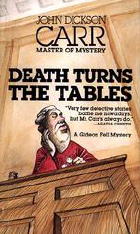
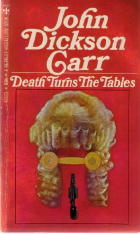
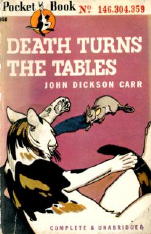
JOHN DICKSON CARR – Death Turns the Tables

International Polygonics 330-22; paperback reprint, April 1985. Hardcover editions: Harper & Brothers, 1941. Grosset & Dunlap; n.d; Collier, n.d. British title: The Seat of the Scornful, Hamish Hamilton, 1942. Other US reprint appearances: Two Complete Detective Books, pulp magazine, Fall 1942. Philadelphia Inquirer Sunday supplement, December 5, 1943. Hardcover reprint: Books, Inc., 1946. Paperback reprints: Pocket 350, 1945; Berkley G281, Nov 1959; Berkley F929, 1964; Berkley 1573, 1968.

IPL

   When it was originally published, the book was sealed after page 193. If the reader were to have read the book to this point and still wished to do so, he could return the book to the bookseller with the seal unbroken and receive a full refund. Since I read the IPL reprint, which has only 156 pages (of small print) in total, I can’t tell you what point in the book that might have been.

   [Small pause.] I’ve just checked, and the Harper edition had 256 pages, so the “Challenge to the Reader” seems to have come awfully early. In terms of the relative difficulty in solving the crime before Dr. Gideon Fell does, well, good luck on that. I don’t think that anyone is going figure out all of the details on how, when, where and why the crime is committed, no one, not anyone.

   Carr was an absolute master of making his detective fiction so complicated that of course it could never happen in the real world, but once you are in place in his world, it all makes sense, in a fashion and only after the fact. In the early 1940s he was still in peak form, there’s no doubt about it. And here’s a word of advice, if you think that you’re going to give it a shot – figure it out ahead of time, that is – everything that you see (through the detective’s eyes) is going to be important, no matter how trivial it may be. Everything that anyone does is at least 99% going to come back and be important later, I kid you not.

   And even so – even so, I say – there were aspects of this work of Mr. Carr, the genius craftsman that he was, that I did figure out ahead of time, but only (I think) because he got there first and they’re clichés of the field now, worn out by overuse by lesser hands.

   What’s the story about, you may well ask. I think what I will do this time is to quote the blurb on the back cover. I think it sums things up exceedingly well:

DR. FELL
AND
THE EMINENT
JURIST

   Mr. Justice Ireton was a pillar of moral rectitude. Unemotional, he sat godlike upon his bench, and mercilessly handed down the strictest sentences the law allowed.

   But then the judge’s future son-in-law was found dead, and although there were plenty of other suspects, even Dr. Fell had to ask:

    “Did Mr. Justice Ireton commit murder?”

Berkley

   And here’s a rather lengthy quote, but relevant, I think. Fell and Ireton are playing chess early on in the book (page 17 of the IPL edition):

    “Well,” mused Dr. Fell, smoothing his mustache, “that seems to be that. So you couldn’t, for instance, imagine yourself committing a crime?”

The judge reflected.

    “Under certain circumstances, I might. Though I doubt it. But if I did –”

    “Yes?”

    “I should weigh the chances. If they were strongly in my favor, I might take the risk. If they were not in my favor, I should not take it. But one thing I should not do. I should not go off half-cocked, and then whine that I wasn’t guilty and that ‘circumstantial evidence’ was against me. Unfortunately, that’s what they all do – the lot of them.”

    “Forgive my curiosity,” said Dr. Fell politely. “But did you ever try an innocent man?”

   The answer that Judge Ireton gives is, unfortunately, on the next page, but I submit that it will not necessarily be the answer that you may be suspecting.

   The chess game at the beginning is important. It is quite obvious – I believe that it is safe to mention this – that once the dead man is found, Judge Ireton is hiding something. But is he the killer? That is where the real chess match begins.

Pocket Book

   As always, when you pick up a John Dickson Carr to read, be prepared to be confounded, and it will, I guarantee you, happen once again in Death Turns the Tables. I’m not quite so pleased with the ending, though, as I believe that Dr. Fell concedes on one crucial point far too quickly. That, along with the fact that – and I apologize for not mentioning this before – there is no “locked room,” one of Carr’s best-known specialties, makes this book rate not so highly as it might otherwise have done.

— February 2007

   Uploaded this afternoon was Part 14 of Allen J. Hubin’s Addenda to the Revised Crime Fiction IV. Most of the data in this installment continues to consist of identifying authors who have entries in the online Contemporary Authors, not previously so noted.

   But longer expanded entries are included for a few authors, such as Charles E. Blaney, who specialized in novelizing popular plays at the beginning of last century; and Carola Dunn, who’s currently doing well with her series of Daisy Dalrymple mysteries, but she began her career by writing Regency romances. Many of these early novels had enough criminous elements that they should be included, and given given Carola’s guidance, all of them are.

   Recent posts on the M*F blog have resulted in smaller but still significant changes or additions for many other authors, such as Desmond Cory and Charles Runyon. Birth and death dates are continually being discovered, as well as many other facts about mystery writers, both active and not. They’re all included.

Posted today on DorothyL:

Date: Tue, 8 May 2007 20:19:03 -0400
From: “William G. Tapply”
Subject: sad news

I am sorry to have to report that my dear friend Philip R. Craig died
today after a short illness. Phil wrote the Martha’s Vineyard series
of mysteries featuring J. W. Jackson, and he and I collaborated on
three novels with J.W. and my Brady Coyne, the third of which, Third
Strike, will be out next November.

Bill Tapply


   A short autobiography of Mr. Craig can be found at www.philiprcraig.com. It will be for his books that he will be remembered by his readers, however. And from his books it was easy to understand what kind of person the author was. In their own way, in some imprecise fashion, of course, they are also the core of his biography.

   Like clockwork, every year from 1989 to the present except one, another excursion to Martha’s Vineyard and another case for former Boston cop J. W. “Jeff” Jackson and his wife Zee (nee Madieras), whom he married early in the series.

   After falling in love with the island, Jackson settled down to a life of fishing and occasional private investigation, often bringing him and Zee into considerable personal danger.

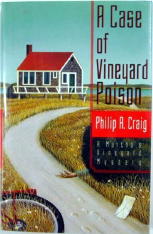
Vineyard Poison

   Here’s an excerpt taken from A Case of Vineyard Poison:

   It all started with a bluefish blitz at Metcalf’s Hole on South Beach. It was early summer and the bluefish were everywhere. After hitting the yard sales, Zee and I had taken a lunch out to Pocha Pond, on a beautiful, sunny Saturday morning. I had unfolded the old bedspread I use for a beach blanket, and while Zee lay on it in the lee of the tall rushes that grow there and read, I waded out for some chowder quahogs. For some reason, Pocha Pond doesn’t seem to have any small quahogs, only big ones. How they make the jump from teeny seed to chowder size with no intervening steps is a mystery to me, although the Great Quahog God probably understands it perfectly. After I had my small basket full, I waded back to shore, and ogled Zee, who looked splendid in her wee bikini.

    “Nice bod,” I said.

   Zee lifted her eyes. “By next month, you’ll be a married man, so you’re going to have to learn to stop drooling over single women.”

    “Next month is July. This is still June, and you’re still single, so don’t rush me.”

    “Come here,” she said. “I want to explain something to you.”

   I went to her.

    “Lean down.”

   I leaned down. She tossed her book, and pulled me down on top of her.

    “Help, help,” I whispered. “I’m being assaulted.”

    I was wet and cool, and she was warm and dry. Pretty soon we were both warm and wet.

    “There,” said Zee. “Let that be a lesson to you.”


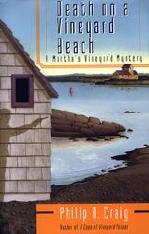
Vineyard Beach

   Another excerpt, this one taken from Death on a Vineyard Beach:

   Zee and I got married at noon on July 13, a date artfully chosen by me in the hope that since it was my birthday, one of the four dates I usually remembered — the Others being New Year’s Day, Christmas, and the Fourth of July — I had a fighting chance of recollecting my anniversary in the future.

   It was a beautiful Martha’s Vineyard day, with a warm sun in a cloudless sky, and a gentle north wind to keep things comfortable for all of us who had abandoned our summer shorts and had dressed up for the occasion. There were people with regular cameras and video cameras moving around shooting pictures. Apparently we were going to get the whole thing on record.


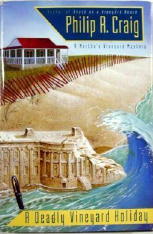
Vineyard Holiday

   In this excerpt from A Deadly Vineyard Holiday, J. W. has just met a young girl on the beach:

   There was an odd combination of sophistication and innocence about the girl, and, being just about old enough to be her father, I tried to imagine what it would be like to watch other people fish and not know how to do it myself. But I had been fishing as long as I could remember, thanks to my own father, who had gotten a rod into my hands before I could read.

    “You want to give it a try?” I asked.

   Her eyes widened. “Yes!”

   I got my spare rod off the roof rack and put a Ballistic Missile on the leader.

    “This is a good casting plug,” I said. “And the bluefish love it.”

   We went down to the water, and I showed her how to throw the bail on her reel, to hook the line on her trigger finger, to take the rod straight back, and to bring it straight forward, releasing the line at about a 45-degree angle to the horizon.

   Then I made a couple of casts, showing her how it was done, and gave her the rod.

    “Don’t try to cast too far, at first. Just concentrate on throwing straight out. And don’t worry about making mistakes. Everybody makes them.”

    “Okay.” She threw the bail, hooked the line with her finger, and took the rod back. Her first cast went into the surf right at her feet.


   The Books. Adapted from Crime Fiction IV, by Allen J. Hubin, and from Mr. Craig’s own website:

CRAIG, PHILIP R. (1933- 2007)

* Gate of Ivory, Gate of Horn (n.) Doubleday 1969 [Sweden]
* A Beautiful Place to Die (n.) Scribner 1989 [J. W. Jackson; Martha’s Vineyard]
* The Woman Who Walked Into the Sea (n.) Scribner 1991 [J. W. Jackson; Martha’s Vineyard]
* The Double-Minded Men (n.) Scribner 1992 [J. W. Jackson; Martha’s Vineyard]
* Cliff Hanger (n.) Scribner 1993 [J. W. Jackson; Martha’s Vineyard]
* Off Season (n.) Scribner 1994 [J. W. Jackson; Martha’s Vineyard]
* A Case of Vineyard Poison (n.) Simon 1995 [J. W. Jackson; Martha’s Vineyard]
* Death on a Vineyard Beach (n.) Scribner 1996 [J. W. Jackson; Martha’s Vineyard]
* A Deadly Vineyard Holiday (n.) Scribner 1997 [J. W. Jackson; Martha’s Vineyard]
* A Shoot on Martha’s Vineyard (n.) Scribner 1998 [J. W. Jackson; Martha’s Vineyard]
* A Fatal Vineyard Season (n.) Scribner 1999 [J. W. Jackson; Martha’s Vineyard]
* Vineyard Blues (n.) Scribner 2000 [J. W. Jackson; Martha’s Vineyard]
* Vineyard Shadows (n.) Scriber 2001 [J. W. Jackson; Martha’s Vineyard]
* Vineyard Enigma (n.) Scribner 2002 [J. W. Jackson; Martha’s Vineyard]
* A Vineyard Killing (n.) Scribner 2003 [J. W. Jackson; Martha’s Vineyard]
* Murder at a Vineyard Mansion (n.) Scribner 2004 [J. W. Jackson; Martha’s Vineyard]
* Vineyard Prey (n.) Scribner 2005 [J. W. Jackson; Martha’s Vineyard]
* Death in Vineyard Sand (n.) Scribner 2006 [J. W. Jackson; Martha’s Vineyard]

* Death in Vineyard Waters (n.) Avon 2003; originally published as The Woman Who Walked Into the Sea (Scribner, 1991).
* Vineyard Deceit (n.) Avon, 2004; originally published as The Double-Minded Men (Scribner, 1992)
* Vineyard Fear (n.) Avon, 2004; originally published as Cliff Hanger (Scribner, 1993)

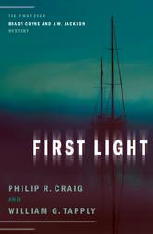
First Light

… with WILLIAM G. TAPPLY

* First Light (n.) Scribner, 2001 [J. W. Jackson & Brady Coyne; Martha’s Vineyard]
* Second Sight (n.) Scribner 2005 [J. W. Jackson & Brady Coyne; Martha’s Vineyard]
* Third Strike (n.) Scribner 2007 [J. W. Jackson & Brady Coyne]

   Brady Coyne is a Boston attorney who has had numerous cases to solve on his own. Both the authors and their characters, as it turns out, are old fishing buddies, and it came as no surprise when readers found them respectively writing and solving murders together.

   Plus:

Delish: The J.W. Jackson Recipes, co-written with Shirley Prada Craig (Vineyard Stories, 2006)

[UPDATE] Later the same day. A lengthy personal tribute by Bill Tapply to his friend and collaborator, Philip R. Craig, is online here.

« Previous PageNext Page »