Authors


FIRST YOU READ, THEN YOU WRITE
by Francis M. Nevins

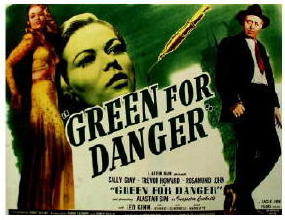
   The centenaries have come thick and fast lately: Woolrich in 2003, Fred Dannay and Manny Lee in ‘05, John Dickson Carr last year. Now we celebrate one of the great masters of English detective fiction, Christianna Brand. She was born Mary Christianna Milne in Malaya – on December 17th of, as if you hadn’t guessed, 1907 – began writing whodunits a couple of years after the start of World War II, and is best known as the author of Green for Danger (1944), a classic of fair-play detection set in a military hospital in Kent during the Blitz.

   I got to meet her when she was around 70 and quickly discovered that she was as perfect in the role of the dotty English lady as was Basil Rathbone playing Holmes. Who can ever forget the MWA dinner where she was asked to present one of the Edgar awards? “The nominees are: Emily Smith, James Quackenbush….Hahaha, Quackenbush, what a funny name!” The audience, except perhaps for poor Quackenbush, was left rolling in the aisles.

   On my first visit to England, to serve as an expert witness at a trial in the Old Bailey during the summer of 1979, Christianna and her husband Roland Lewis, one of England’s top ear-nose-and-throat surgeons, took me to dinner at Simpson’s in the Strand, the famous old eatery where one tips the server who carves your roast beef tableside. A few years later I edited Buffet for Unwelcome Guests (1983), the first collection of her short stories published in the U.S. On my next visit to England after the book came out I could hardly lift my suitcases, which were packed to bursting with copies for her. She died on March 11, 1988, and everyone who knew her still misses her.
Green

   The 1946 movie version of Green for Danger, starring Alastair Sim as the insufferable Inspector Cockrill and featuring superb English actors like Trevor Howard and Leo Genn, has long been considered one of the finest pure detective films ever made, but it’s been very hard to access over here until just a month or so ago when, in a miracle of perfect timing, it was released on DVD. If you love the classic whodunit but have never seen the film nor read the book, you have a double treat in store.

***

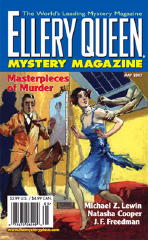
   The tale of fair-play detection has become a dying art, but each of two recent issues of Ellery Queen Mystery Magazine has featured at least one specimen worthy of the Golden Age. Jon L. Breen’s “The Missing Elevator Puzzle” (February 2007) is quite simply the finest short whodunit with an academic setting that I can recall reading, with a puzzle that might have fazed Ellery himself: Why was a visitor to the campus, just before being murdered, searching for the elevator in a building that had none?
EQMM

    “The Book Case” (May 2007) by Dale Andrews and Kurt Sercu not only has two authors like the Queen books themselves but returns to center stage their most famous detective, physically frail but mentally spry at age 100, as he tackles a murder with a dying message composed of copies of his own novels. Readers who aren’t well up on those novels are likely to get lost in this tale, but if you’re at home in the canon you’ll have a high old time trying to beat the centenarian sleuth to the solution.

***

   In most centenary celebrations the subject is dead, but there’s one coming up in just a few months where the honoree is still with us – and, so I’m told, doing well for a 99-year-old. He claims to have written a number of short whodunits published under a pseudonym in his student years but his real significance for us lies in his extensive writing about the genre over several decades and in his connection with the supreme master of pure suspense fiction.

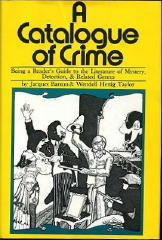
   I am referring of course to Jacques Barzun, distinguished professor at Columbia University, co-author of the massive Catalogue of Crime, and, in the early 1920s, Columbia classmate of Cornell Woolrich, who quit college in third year when his first novel sold.
CoC

   My first contact with Dr. Barzun was back in the late Sixties when I arranged to include one of his essays in my anthology The Mystery Writer’s Art (1970). In April 1970, while I was working on Nightwebs (1971), my first collection of Woolrich stories, he invited me to his Columbia office and we spent most of an afternoon talking about what the university was like almost half a century earlier when he and Woolrich were undergraduates together and sat next to each other for several courses.

   We corresponded off and on for several years. After translating from the French (a language I had never studied) an essay about Georges Simenon’s pre-Maigret crime novels, I presumed on my acquaintanceship with Barzun and asked him to look over my draft before I sent it in to The Armchair Detective. He made many small corrections, one of which I still vividly remember: I had rendered a line from an early Simenon as “Marc’s bottle was empty” which he changed to “The bottle of marc was empty,” pointing out to me that marc is a cheap French brandy. But on the whole he was hugely pleased with my translation, saying that he was “truly amazed” that I had done it without ever having taken a French course and that it was “certainly better than much advanced student work in a Romance Language Department.”

   In the early Eighties I became involved with Nacht Ohne Morgen (Night Without Morning), a documentary on Woolrich for German TV, and arranged for the director, Christian Bauer, to interview Barzun. They talked for almost an hour but only about a minute of footage found its way into the finished film. I obtained an audiotape of the entire interview and quoted from it extensively in my own Woolrich book First You Dream, Then You Die (1988). If Jacques Barzun had not been still alive and well and blessed with a vivid memory, we would know so much less about a key period in Woolrich’s life. For that gift to the genre and for countless others, merci beaucoup. May his hundredth birthday be a joyous one and not his last.
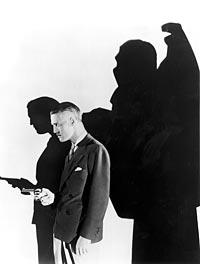
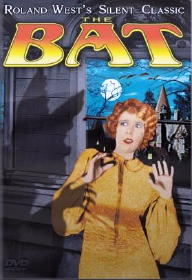
THE BAT, by Mary Roberts Rinehart


   Mary Roberts Rinehart’s character called “The Bat” appeared in many formats over the years. Not only did “The Bat” make a lasting impression and appear in many venues, but Bob Kane, creator of the second most famous comic book character, the Batman, has been quoted as saying that the inspiration for his hero came from “actor Douglas Fairbanks’ movie portrayal of Zorro, and author Mary Rinehart’s mysterious villain ‘The Bat.’”

The Bat

   This post has been put together from a variety of sources, the first being Michael Grost’s Classic Mystery and Detection website, from which is gleaned the following information about the early career of mystery author Mary Roberts Rinehart:

      The Early Novels 1904-1908

   The career of Mary Roberts Rinehart (1876-1957) can be broken up into a series of phases. The first was her pulp period (1904-1908), where she wrote her first three mystery novels and a mountain of very short stories. These stories have never been collected in book form, and are inaccessible today. The first two novels are classics, however, and are probably her best works in the novel form.

   The Man in Lower Ten (1906) and The Circular Staircase (1907) are the earliest works by any American author to be still in print as works of entertainment, not as “classics” or “literature.” These novels, which combine mystery and adventure, show Rinehart’s tremendously vivid powers as a storyteller.

   From the same page, but skipping over a few sections:

      The Bat

The Bat is a stage adaptation of Rinehart’s The Circular Staircase, written in collaboration with Avery Hopwood, the writer of popular Broadway comedies with whom Rinehart had collaborated before. The Bat introduced some new plot complexities into the original novel, especially a master criminal known as “The Bat.” It also includes plot elements reminiscent of her first Saturday Evening Post story, “The Borrowed House” (1909). The Bat shows Rinehart at the height of her powers, and in fact is her greatest work. A work of great formal complexity, The Bat is one of the few mystery stage plays to have the dense plotting of a Golden Age detective novel. Moreover, the formal properties of the stage medium are completely interwoven with the mystery plot, to form intricate, beautiful patterns of plot and staging of dazzling complexity.

   According to the online Broadway database, The Bat ran for 867 performances between August 23, 1920 and September 1922.

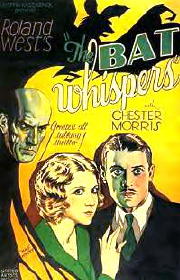
   Film director Roland West next made two versions of the play, a silent film The Bat (1926), and a sound film The Bat Whispers (1930).

   Following the links will lead you to the IMDB pages for each.

Silent

   His discussion is far too lengthy to repeat here, but Mike Grost goes into considerable detail in discussing director Roland West’s cinematic techniques in both of these movies, plus a number of his other films. If you’re interested in the early days of movie making, Mike’s website once again is well worth the visit.

   Returning to the play itself, Mike continues by saying:

   Rinehart and Hopwood’s play can be found in the anthology Famous Plays of Crime and Detection (1946), edited by Van H. Cartmell and Bennett Cerf, along with other outstanding plays of its era. (This book also contains good plays by Roi Cooper Megrue, Elmer Rice, George M. Cohan, and John Willard.) In 1926, a novelization of The Bat appeared, apparently written by poet Stephen Vincent Benét with little input from Rinehart. This novel version usually appears in paperback under Rinehart’s name, without any mention of Hopwood or Benét. I read this novelized version first, and confess I prefer it to the script of the play itself.

   It should also be noted that the play itself was later published by French, in a 1932 softcover edition.

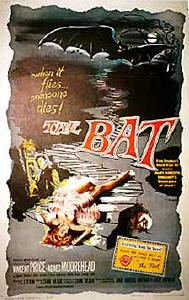
   In 1959 The Bat was once again made into a film, this one starring Vincent Price and Agnes Morehead. Of this version, one viewer says: “I found this to be an inventive and disingenuous endeavor full of red-herrings and wrong turns. Figure this one out for yourself. Puzzle the clues, weed out the characters set here as distractions, look past the deliberate contrivances and solve the mystery on your own.”

Poster

   By total coincidence, the way coincidences happen, as I was in the process of tracking down the details of all these various incarnations of the character, author Mary Reed sent me the following review of The Bat, the novel based on the play. I think it’s great when a plan comes together like this.

      Review of THE BAT: The Novel, by Mary Reed

   Everyone in the city, from millionaires to the shady citizens of the underworld, goes in fear of The Bat, a cold-blooded loner whose crimes range from jewel theft to murder and whose calling card is a drawing or some other form of expression of bathood.

   We meet wealthy, elderly, and independent spinster Miss Cornelia Van Gorder, scion of a noble family and the last of the line. An adventurous spirit, at 65 and comfortably situated, she still longs for a bit of an adventure. It maddens her to think of the sensational experiences she is missing as she contemplates that “…out in the world people were murdering and robbing each other, floating over Niagara Falls in barrels, rescuing children from burning houses, taming tigers, going to Africa to hunt gorillas, doing all sorts of exciting things!” Why, she’d love to have a stab at catching The Bat!

   Her wish is granted when she takes a house in the country for the summer and discovers it is located some twenty miles from an area where The Bat had committed three crimes. She is soon in the thick of mysterious events, including anonymous threatening letters, lights failing, a face at the window, and Lizzie Allen, her personal maid for decades, convinced she saw a strange man on the stairs. Most of the servants decamp, leaving Miss Van Gorder to manage with just a butler and Lizzie.

   More characters appear: Miss Van Gorder’s niece Dale Ogden, Brooks, the new gardener, local medical man Dr Wells, Detective Anderson, and Richard Fleming, nephew of Courtleigh Fleming, deceased owner of the house and once president of a bank which has just failed. There is talk Mr Bailey, its cashier, has stolen over a million dollars. A man is shot and an unknown party is deduced to be hiding somewhere on the rambling premises. More than one person in the house is concealing facts, and the rising storm outside underlines the increasing fear and tension within.

   Who is trying to scare Miss Van Gorder away and why? What if anything did Lizzie see on the staircase? Are any of the strange goings-on connected with the missing money? Who fired the shot? There is much flitting in and out of the doors and windows of a living room lit most of the time only by candle and firelight before everything is cleared up.

   The Bat is an excellent example of an old dark house mystery, with enough obfuscation to keep the reader guessing, although one or two surprises are less well concealed. The menacing atmosphere events create in the house is conveyed and sustained well. I found it a light, diverting read which held the interest without taxing the attention too much. The Bat is an excellent cold-night-outside read, and indeed, although I know whodunit, I would not mind seeing the play!

The Bat

   Etext at http://www.gutenberg.org/dirs/etext00/thbat10.txt

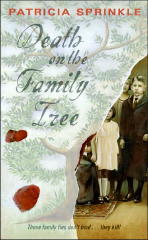
PATRICIA SPRINKLE – Death on a Family Tree

Avon, paperback original; 1st printing, January 2007.

   Here’s an author who’s been writing mysteries for quite a while, and (this may come as no surprise) this is the first one of hers that I’ve read. From the author’s website and a few other sources, including Crime Fiction IV, by Allen J. Hubin, I’ve come up with what I believe is a list of the books she’s done. Note that in some cases her byline is Patricia Houck Sprinkle.

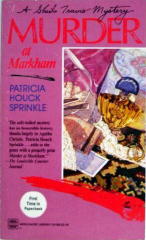
Sheila Travis Series: In Murder at Markham Sheila has been recently widowed and is working for a diplomatic training center in Chicago. Assisting her in solving crimes is her Aunt Mary, who hails from Atlanta, where Sheila frequently goes back to visit. In the third book in the series, Sheila moves back there permanently.

Markham

     Murder at Markham. St. Martin’s, hc, October 1988. Worldwide, pb, October 1992. Silver Dagger Mysteries, trade pb, revised, December 2001.
     Murder in the Charleston Manner. St. Martin’s, hc, May 1990. Worldwide, pb, April 1993. Silver Dagger Mysteries, trade pb, August 2003.
     Murder on Peachtree Street. St. Martin’s, hc, April 1991. Worldwide, pb, October 1993.
     Somebody’s Dead in Snellville. St. Martin’s, hc, August 1992. Worldwide, pb, July 1994.
     Death of a Dunwoody Matron. Doubleday, hc, April 1993. Bantam, pb, August 1994. Bella Rosa Books, trade pb, December 2005.
   A Mystery Bred in Buckham. Bantam, pbo, October 1994. Bella Rosa Books, trade pb, January 2007.
     Deadly Secrets on the St. Johns. Bantam, pbo, August 1995. [Note: This book is extremely scarce. There are only five copies offered for sale on Amazon, for example, with the lowest price being $44.50 for a copy in “good” condition.]

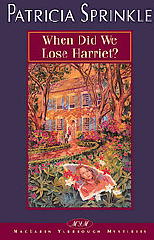
MacLaren Yarbrough Series: In the first book in the series, MacLaren is a wife of Judge Joe Riddley Yarbrough, a magistrate for the state of Georgia. In the second book, after her husband is shot, and two other people are murdered, MacLaren not only solves the crimes, but she takes over his position on the bench as well. After the first two novels were published by a Christian press, the rest of the series were published as mass-market paperback originals.

Harriet

When Did We Lose Harriet? Zondervan, pbo, November 1997.
But Why Shoot the Magistrate? Zondervan, pbo, September 1998.
Who Invited the Dead Man? Signet, pbo, July 2002.
Who Left That Body in the Rain? Signet, pbo, December 2002.
Who Let That Killer in the House? Signet, pbo, October 2003.
When Will the Dead Lady Sing? Signet, pb, June 2004.
Who Killed the Queen of Clubs? Signet, pbo, March 2005.
Did You Declare the Corpse? Signet, pbo, February 2006.
Guess Who’s Coming to Die? Signet, pbo, February 2007.

The Family Tree Series:

Death on the Family Tree. Avon, pbo, Jan 2007.
Sins of the Fathers. Coming in October 2007.

   From Ms. Sprinkle’s website she says about her work in progress: “Now I am deep in the tenth, and probably last, MacLaren Yarbrough mystery, What Are You Wearing To Die?” Which strongly suggests, of course, that she’s in the midst of shifting gears. Future mystery adventures will be concentrating Katharine Murray, a middle-aged Atlanta housewife who’s well-off and somewhat pampered, and whose first brush with crime in any form Death on the Family Tree is.

   The book begins on her 46th birthday, which she’s spending alone and which, unbeknownst to her, is her last day in her old comfortable life. Her children have moved out, and her husband Tom is out of town. Opening a box left to her by her recently departed Aunt Lucy, she finds two unusual items in among the junk: an ugly bronze necklace dating from the mid-1800s from Halstatt, Austria, and a diary, written in German and dating from a far more recent 1937.

   As she begins some genealogical researching she soon discovers relatives that she never knew she had, that there are secrets in her family she had never been told about, and that the diary means something to someone who will stop at nothing to possess it. You may have guessed that about the latter.

Family

   Also re-entering her life is a former boy friend, one she’d unceremoniously dumped before she married Tom, who is blissfully unaware that his absence in this crucially important time is his wife’s life is as serious as it is. Make that totally oblivious. (Speaking from a man’s point of view, he is a blithering idiot, and if he doesn’t watch out, he will deserve what he will most certainly get in the next book in the series.)

   Forgive me. I had to get that out of my system. It takes a while for all of Katharine’s family, her friends, and her friends’ families straightened out in the reader’s mind, and there surely are a lot of them, family, friends and relatives, that is. Katharine herself is prone to talking too much to all of them about her finds, and almost everyone else she meets. This was a tendency that this reader found almost intolerable, especially when all of this excessive talking leads to her being chased by cars, break-ins at her home, and eventually worse: several murders.

   It is soon clear (or it was to this reader) who is responsible for all of this nefarious activity, but Katharine, who even toward the end of the book still has not learned much about this Brand New World she is in, walks straight into the hands of the enemy, as if without a thought in her head.

   I don’t usually start yelling at characters in the mystery fiction I am reading, but I did this time. Perhaps that means that I cared? Perhaps so.

— January 2007

   Jamie Sturgeon recently sent me a couple of emails about some of the obscure authors who’ve been discussed here. I’ve been remiss in not posting them earlier, but here at last they are. The first one concerns the inquiry about Arthur J. Rees.

  Steve,

   I wonder if Arthur J. Rees emigrated to Australia to live with his two sisters and died there? His last book, The Single Clue, although set in England, was published only in Melbourne in 1940.

      Best Wishes,

         Jamie

   Jamie, I hadn’t noticed that, and thanks. I’ve added the information to the list of Rees’s books in that previous post. There’s also a lengthy gap between that book and his previous one, which came out in 1934. There’s probably an explanation, but at this late date, it would be awfully hard to find someone who’d know.

   Jamie’s second email refers to the post I did on Ramble House Books as soon as I learned that Fender Tucker was reprinting a couple of mysteries by British author Rupert Penny:

  Hi Steve,

   Noticed your mention of Rupert Penny. Did you know about his pseudonym Martin Tanner? See Al’s Addenda Part 5 on CrimeFictionIV.com. Penny is also mentioned in Geoff Bradley’s CADS Supplement Private Passions Guilty Pleasures, where Martin Edwards’ Private Passion/Hidden Gem are the books by Rupert Penny. Martin Edwards says that Penny (Thornett), after he gave up writing crime fiction, became a leading figure in the British Iris Society, editing its yearbook.

      Best Wishes,

         Jamie

   You can follow the link to find Jamie’s information on Penny as Martin Tanner, but to save you the click of the mouse, here it is below. I believe that the years of birth and death for Thornett are new also.

TANNER, MARTIN. Pseudonym of Ernest Basil Charles Thornett, 1909-1970. Other pseudonym: Rupert Penny, q.v.
      Cut and Run. Eyre, 1941 (correcting publisher and date)

   Perhaps it’s clear from the title and Jamie’s mention of it what Private Passions Guilty Pleasures consists of, but if you go here you will learn more, and if you are like me, you will learn enough to know that it’s a must have.

   In short, however, in celebration of the 50th issue of Geoff Bradley’s printed zine called CADS, 87 crime writers, critics, fans and CADS contributors responded to the topic of what authors and what mysteries they have secretly (perhaps) enjoyed the most. Their comments were then compiled and published in booklet form separate from CADS #50, but mailed along with it.

   I don’t know if Jamie intended for me to mention it or not, but he’s one of the contributors, along with Martin Edwards, Colin Dexter, Reginald Hill and Peter Lovesey, to name but a few.

   CADS is short, by the way, for Crime and Detective Stories.

WILLIAM MAGNAY – The Hunt Ball Mystery.

Ward Lock, UK, hc, 1918. Brentano’s, US, hc, 1918. Other later printings exist, including Aldine Mystery Novels #22, UK, 1927. Etext at the Gutenberg Project.

   Give me a novel opening with a fellow arriving for a social gathering at a country house, and I’m as happy as the proverbial clam.

   The Hunt Ball Mystery begins in just this fashion, and right away we are in crisis mode. Hugh Gifford discovers he is without evening clothes due to a mistake made by the guard unloading luggage. Gifford and his friend Harry Kelson are going to a Hunt Ball to be held that evening at Wynford Place.

   The station master arranges for Gifford’s traps to be transferred to a down train at the next stop, although Gifford won’t get them until about ten. However, this still leaves time for him to attend the ball.

   The two men share a fly to the Golden Lion Hotel with a stranger who mentions he is also staying there and will be going to the ball. Gifford sniffily decides the man is not of their class, a conclusion based largely on the other’s looks and manner. The man is Clement Henshaw, brother of Gervase, whom Gifford knows by repute as a fellow legal eagle.

   Gifford insists Kelson goes on to the ball ahead of him, and Kelson and Henshaw depart. While waiting for his missing luggage, Gifford decides to stroll over to Wynford Place to take a look at its exterior. He returns two hours later, obviously having had a shock. Even so, he dons his now retrieved evening clothes and tootles off to the jamboree, where he makes the acquaintance of Dick Morriston, owner of Wynford Place, and Dick’s sister Edith.

   Not long before four next morning the hotel landlord pops in to ask if the Hunt Ball is over as Henshaw has not returned. After encouraging the landlord to lock the doors against his missing guest, Kelson pours himself a drink and suddenly notices blood on his shirt cuff.

   Then the missing Henshaw is found dead in a locked room with the key on the inside and an 80 feet drop from its window. The general consensus is Henshaw committed suicide. Gervase Henshaw, the dead man’s brother, disagrees, and so does the doctor who gives evidence at the inquest.

   At this point the mystery gallops off in full cry after the fox of whodunnit, how, and why. Revelations follow concerning what upset Gifford on his nocturnal walkabout, whence came the blood on Kelson’s cuff, the solution to the locked room matter, and so on.

   My verdict: I have long been a fan of the Country House Mystery and so was disposed to like The Hunt Ball. Alas, this particular visit to a rural estate was not too successful. The locked room solution is pedestrian and most readers will guess it. I found the characters unsympathetic and the police presented as inept, not least in overlooking a couple of clues — including one of a particularly glaring nature. Then too the introduction of an important witness was without previous hints of this person’s existence.

   It may be this novel was intended as a spoof of the Country House Mystery, but all in all, I found The Hunt Ball Mystery something of a disappointment.


   From Crime Fiction IV, by Allen J. Hubin, a chronological listing of Sir William Magnay’s other mystery fiction:

MAGNAY, [Sir] WILLIAM, 2nd baronet (1855-1917)

* The Fall of a Star (n.) Macmillan 1897.
* The Heiress of the Season (n.) Smith, Elder 1899. Appleton, US, 1899.
* The Pride of Life (n.) Smith, Elder 1899.
* The Man-Trap (n.) Smith, Elder 1900.
* The Red Chancellor (n.) Ward 1901. Brentano’s, US, 1901.
* The Man of the Hour (n.) Ward 1902.
* Count Zarka (n.) Ward 1903.
* -Fauconberg (n.) Ward 1905.
* -A Prince of Lovers (n.) Ward 1905.
* The Duke’s Dilemma (n.) Long 1906.
* The Master Spirit (n.) Ward 1906. Little, US, 1906.
* -The Amazing Duke (n.) Unwin 1907.
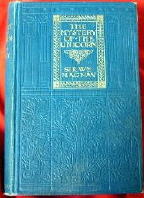
* The Mystery of the Unicorn (n.) Ward 1907. Street & Smith, US, 1910.

Unicorn

* The Pitfall (n.) Ward 1908.
* The Red Stain (n.) Ward 1908.
* A Poached Peerage (n.) Ward 1909.
* The Powers of Mischief (n.) Ward 1909.
* The Long Hand (n.) Paul 1912.
* Paul Burdon (n.) Paul 1912.
* Rogues in Arcady (n.) Ward 1912.
* The Fruit of Indiscretion (n.) Paul 1913.
* The Players (n.) Hodder 1913.
* The Price of Delusion (n.) Paul 1914.
* The Black Lake (n.) Paul 1915.
* The Cloak of Darkness (n.) Ward 1915.
* The Hunt Ball Mystery (n.) Ward 1918.
* The Flamards Mystery (n.) Pemberton 1942.
* The Eleventh Hour (n.) Odhams n.d.

   From John Herrington, as a followup to a previous blog entry describing the unsolved puzzle over who Golden Age mystery writer A. Fielding really was —


Hi Steve,

   Here are my latest notes on Fielding/Feilding in case someone can add anything.

   Further to my questioning of A. Fielding being the pen name of Lady Dorothy Feilding, I have a little more information — but also more questions.

   Working on the belief that her American publisher was correct in saying the author’s real name was Dorothy Feilding and had lived in Sheffield Terrace, Kensington, I retraced my steps and found that the statement was correct.

   Initially I checked the London telephone directories for the 1930s and — a Mrs A. Feilding was listed at 2 Sheffield Terrace from 1932 to 1936. A phone call to the Local Studies Library at Kensington, a check of the electoral roll for the period and there she was — Dorothy Feilding. No sign of Mr A. though. (Sadly, my previous enquiry had only seen the 1937/1938 rolls checked when she was no longer there).

    The phone books showed that she had moved to Islington for 1937, but by 1939 she had ‘disappeared’ from the listing.

   Unfortunately that is the sum of my search so far. A Dorothy Feilding (Mrs A.) was living in London circa 1932-1938 but so far no trace of her either side of that time. Also, there is no trace of Mr A. yet. Was she a widow, separated, was her husband away from home at the time? No idea. (Lady Dorothy’s husband was Charles Joseph, and anyway, his surname was Moore).

   There was an Albert Feilding born in Yorkshire in 1869, but cannot find another male A. Feilding from then to end of century. Possible the husband was not born in England or Wales, I wonder?

   There is also no trace of her in the probate registry up to the 1960s, but then she may died without making a will. I have yet to make a quarter by quarter search for her and her husband in the deaths registers.

   Not a great deal to say, but I think this at least removes Lady Dorothy from the scene.

   I have one other goodie which might be worth throwing out for comment.

   As you may now, the major English novelist C. P. Snow’s first book was a murder mystery, Death under Sail.

   Recently I was checking Author and Writers Who’s Who 1934 and came across the entry for a Kathryn Barber — who is in Crime Fiction IV for a couple of novels as Kay Lynn. But, to my surprise, her list of publications also include Death under Sail (in collaboration)!!

   Did a quick Google, but could find no mention of anyone but C. P. Snow in connection with the book..

   Wonder if anyone can throw any light on this?

Regards

   John


   From Crime Fiction IV:

SNOW, C(harles) P(ercy) [Baron Snow] (1905-1980)

* Death Under Sail (n.) Heinemann 1932 [Ship]
* -Strangers and Brothers (n.) Faber 1940 [Lewis Eliot; England; 1929-30]
* The Sleep of Reason (n.) Macmillan 1968 [Lewis Eliot; England; 1963-4]
* A Coat of Varnish (n.) Macmillan 1979 [London]

LYNN, KAY

* Laughing Mountains (n.) Hutchinson 1934
* Dark Shadows (n.) Hutchinson 1935


   By profession a dedicated newspaperman and sportswriter, Charles Einstein also dabbled in writing mystery and crime fiction. He died last week, and a more fitting and heartfelt tribute to him could not be found anywhere than this one by crime writer Wallace Stroby, who was also his editor at The Newark Star-Ledger for several years, not to mention a very close friend.

   You should read the entire piece yourself, of course, and I hope you will, but to illustrate what kind of interesting family Mr. Einstein came from, here are couple of paragraphs I’ve taken the liberty of excerpting from it:

   “His father was Harry Einstein, a radio, vaudeville and film comedian who billed himself as ‘Parkyakarkus’ and was a regular on Eddie Cantor’s NBC broadcast (he also became posthumously famous for suffering a fatal heart attack at a Friar’s Club roast in 1958, when tablemate Milton Berle’s cries of ‘Is there a doctor in the house?’ were misconstrued as shtick).

   “Charlie had two half-brothers as well, from his father’s second marriage – Albert Einstein and Bob Einstein. Albert, of course, eventually became writer/director/comedian Albert Brooks, and Bob went on to cable fame as ‘Super Dave Osborn’ and is now a regular on HBO’s Curb Your Enthusiasm.”

   As a sportswriter, Charles Einstein was, among other honors, a lifetime member of the Baseball Writers Association of America. His works include four Fireside Books of Baseball, The New Baseball Reader, and (with Willie Mays) Born to Play Ball and My Life In and Out of Baseball.

Spur

   As a mystery writer, his resume, while significant, is not nearly as extensive. Here’s a slightly expanded version of Mr. Einstein’s entry in Crime Fiction IV, by Allen J. Hubin:

EINSTEIN, CHARLES (1926-2007)

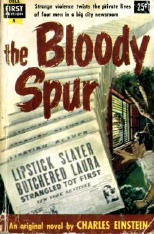
# The Bloody Spur (n.) Dell First Edition #5, pbo, 1953; reprinted as While the City Sleeps (Dell D86, 1956)
# Wiretap! (n.) Dell First Edition #76, pbo, 1955
# -The Last Laugh (n.) Dell First Edition A121, pbo, 1956
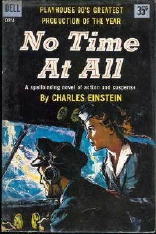
# No Time at All (n.) Simon & Schuster, hc, 1957. Dell, pb, 1958.
# The Naked City (co) Dell First Editon A180, pbo, 1959. Stories based on TV scripts by Stirling Silliphant.

• “And a Merry Christmas to the Force on Patrol”
• “Lady Bug, Lady Bug…”
• Line of Duty
• Meridian
• Nickel Ride
• The Other Face of Goodness
• Susquehanna 7-8367
• The Violent Circle

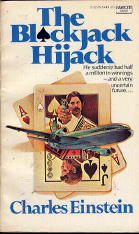
# The Blackjack Hijack (n) Random House, 1976. Fawcett Crest, pb, no date.

   I called his resume “significant,” and here are some details to back up that statement. First the movies, then the books the films were based on:

      THE MOVIES:

   The Bloody Spur was made into the RKO movie While the City Sleeps, 1956, directed by Fritz Lang. A top-notch film noir / social criticism film about the role of the media (newspapers vs. TV) while a serial killer is on the loose, it sounds as though it should be on DVD but for some reason, it does not seem to be. The movie stars Dana Andrews, George Sanders, Ida Lupino, Vincent Price, Rhonda Fleming, Howard Duff, Thomas Mitchell and Sally Forrest.

City

   No Time at All was filmed as an episode on Playhouse 90 in 1958. [See the cover of the paperback edition.] Available on video, an online description calls it: “A sort-of Airport of its time, this production tells of a stricken airliner that must make its way through the heaviest air traffic in the world without lights and radio. Among the cast members are William Lundigan, Jane Greer, Betsy Palmer, Keenan Wynn, Charles Bronson, Jack Haley, Buster Keaton, Chico Marx and Sylvia Sidney.”

No Time

   The Blackjack Hijack was the basis for the TV movie Nowhere to Run, 1978, starring David Janssen, Stefanie Powers and Allen Garfield. Synopsis of the movie, paraphrased from IMDB: “To get out of his marriage with Marian, world-weary Harry plans to fake his death and assume a new identity. His wife gets suspicious and hires a private eye, but when Harry discovers this, he hires the PI to work for him instead.”

      THE BOOKS:

   The Bloody Spur. “‘Help me for gods sake.’ Later the doctors would use these words to decipher the riddle of a perverted killer. Right now, the lipstick scrawl signaled the start of New York’s greatest manhunt.
   “And in the city room of the fabulous Kyne News empire, four big-time newsmen went into action. All four knew that an exclusive beat on the killings would mean the top job at Kyne – and they were all hungry for the job. Hungry enough to buck the police, sell out their mistresses, and commit blackmail. Four decent men – corrupted by the blood spur of ambition.”

   Wiretap! “Men with a golden ear. In the city of Aimerly they were the cops, the city prosecutor, the rackets boss. Their electronic spies recorded the intimacies of boudoir and office – intimacies later priced, and paid for.in cash or blood. Then a judge who knew where all the bodies were buried got himself murdered. And Sam Murray, State Crime Commission, walked into a maze of tapped phones, secret cameras, hidden mikes. Various people tried to sidetrack Sam, with the help of two ladies who were specialists at their work. But when Sam kept pushing, they gave him a choice – rot in jail, or send the last honest man in town to do it for him.”

   The Last Laugh. “Sam Prior was an off-stage straight man for Carl Anda and Jay-Jay Bailey, whom readers should be careful not to confuse with real-life entertainers, living or dead. And he was a straight man for his wife Rachel, whom he should have left where he found her, singing with her hips at a Borscht Circuit hotel. He tells his own story in his own words, warm and wry and funny. He’s a nice guy, and in the dog-eat-dog world of professional comics, they eat nice guys for breakfast.”

Hijack

   The Blackjack Hijack. About the author, taken from the dust jacket flap: “In a career that has included years as a wire-service newsman and feature writer in New York and Chicago, and as columnist and editor for two San Francisco dailies, Charles Einstein also has authored several hundred other works — books, screenplays, short stories, magazine articles. The Blackjack Hijack is his ninth novel and, he notes, the first in which he appears as a character in his own book, playing the part of an expert on the game of blackjack. Here art imitates life: in 1968 author Einstein published another book – now in its fourth printing and hailed by ranking computer programmers and other mathematicians as the best and simplest in the field — called How to Win at Blackjack. Both born in New England in the late 1920’s, the author and his wife first met as undergraduates at the University of Chicago, and with their four children, now all in their twenties, migrated subsequently from New York to Arizona to California.”

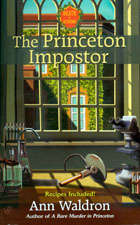
ANN WALDRON – The Princeton Imposter

Berkley, paperback original. First printing, January 2007

   This is the fifth mystery novel from Ann Waldron’s pen, all of them in her McLeod Dulaney series. According to her website, she’s also the author of a number of well-regarded biographies and a number of children’s books, both fiction and non.

   Like her fictional character – who’s female, by the way, which I’d better add in case you’re seeing her name for the first time and you’re not sure – Ann Waldron has been a journalist and writer her entire working career. For the record, here’s the list of all five of her mysteries, each of them taking place in and around Princeton University:

The Princeton Murders. Berkley, pbo; January 2003.
Death of a Princeton President. Berkley, pbo; February 2004.
Unholy Death in Princeton. Berkley, pbo; March 2005.
A Rare Murder in Princeton. Berkley, pbo; April 2006.
The Princeton Imposter. Berkley, pbo; January 2007.

   I imagine you see the pattern here as well as I do. Whenever McLeod Dulaney is on campus, that’s the semester you should be heading abroad or taking a sabbatical. McLeod herself is not a full-time faculty member; she’s an award-winning journalist and a visiting professor from Florida who teaches one course in journalism a year at Princeton University. Not so coincidentally, that is precisely where the author herself began working more than 30 years ago.

Imposter

   Which is why the love of the school and campus – the students, the staff and the professors, the legend and the lore – is as much of a key ingredient of the story as it is. The “imposter” in the title is Greg Pierre, one of McLeod’s better students, an older student who managed to gain admission to the university under an assumed name and falsified credentials. It seems that he’d previously been arrested in Wyoming – on false charges he says – and in order to come to New Jersey, he had to break parole.

   And soon after his arrest the fellow who turned him in is found murdered, a grad student in the chemistry department who (as it turns out) was highly unliked for a number of reasons, which makes for a long list of suspects. But when McLeod’s good friend in the police department, Lt. Nick Perry, seems to settle in on Pierre as the most likely of them – no surprise there – she thinks otherwise, and she sets out to prove it.

   Waldron writes in short, crisp, no-nonsense sentences, and McLeod Dulaney, in a number of ways her fictional alter ego, perhaps, conducts her investigation in very much the same style. Investigative journalists, by the nature of their profession, soon acquire the knack of asking questions in a way that people answering them sometimes reveal more than they intended, or if not, they quickly find another line of work. McLeod doesn’t need to worry on that account.

   On the other hand, while she does a whole lot of detecting, she does not do a whole lot of deducting. (One does not necessarily imply the other.) First she decides that this student is the guilty party, then that professor, and as a result, she always seems to be one step behind – she doesn’t ever seem to catch up. Which of course leads to the ending. In my book, it comes as a letdown, leaving the reader (me) feel caught standing on the wrong foot at the wrong time, or should that be the right time? It also feels cluttered — more for dramatic effect, I thought, than for any other reason.

   Overall, then? Here’s a book that’s well worth reading for anyone who’s fond of mysteries which either take place in academic locales or rank well above average in the writing department, or both. You can take my other caveat for whatever it might be worth.

— January 2007

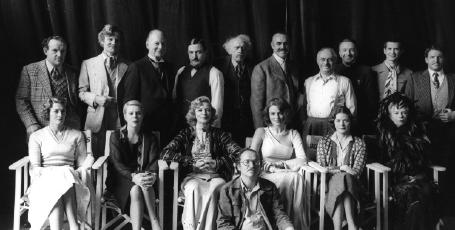
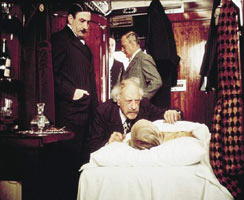
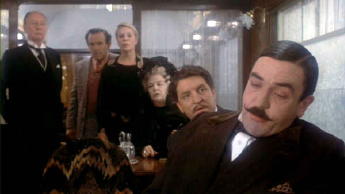
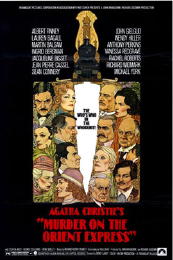
MURDER ON THE ORIENT EXPRESS. Paramount, 1974. Albert Finney, Lauren Bacall, Martin Balsam, Ingrid Bergman, Jacqueline Bisset, Jean-Pierre Cassel, Sean Connery, John Gielgud, Wendy Hiller, Anthony Perkins, Denis Quilley, Vanessa Redgrave, Rachel Roberts, Richard Widmark, Michael York, George Coulouris. Directed by Sidney Lumet.

Group

   They don’t make movies with all-star casts like this anymore, and maybe for a couple of good reasons. First of all, I don’t think you can convince me that in this modern, contemporary era of movie-making there are enough stars with the on-screen magnitude to match the ones you see above to make a film like this today.

   And secondly — and here’s a point in favor of the small-scale modern day casting — having too many stars can sometimes detract from the story and divert the audience’s attention away from it.

   Your eye sees the star, in other words, and you don’t see the character. The actors play roles rather than disappearing into parts. It probably can’t be helped in extravaganzas like this, but — and this is a rather subtle “but” — in thinking it over afterward, in terms of this grand, elaborate production of one of Agatha Christie’s masterpieces of deductive detective fiction, it may have even helped.

Still

   I’m sorry if I’m being cryptic here, but if you’ve seen the movie, it’s possible that you very well know what I mean.

   Before going on, and perhaps I shouldn’t admit it, but last night was the first time I’ve seen the film. I don’t know how I missed it when it first came out, or if I did, I’ve forgotten it completely, and I hardly believe I could have done that.

   So in what follows, you’re getting my opinion as it’s just been formed, with a “mature” eye, and not by the eye of a 30-something. (Notice that I put “mature” in quotes, keeping in mind that being old enough to collect Social Security does not necessarily imply mature.)

   Albert Finney as Poirot. Other than the later BBC productions with David Suchet, and I regret to say that I have seen only one of them, I think too many actors play Poirot as a comic character, what with his large assortment of eccentric mannerisms and sometimes faulty English.

   In the opening minutes of Orient Express, I could feel myself cringing at the anticipation of yet another performance played for laughs, but when Poirot gets down the business of solving the murder of a notorious crime figure traveling incognito on the train heading from Istanbul to England, he is exactly that. Down to business.

   The final scene, confronting the group of passengers who are the only suspects on the snowbound Express, takes at least 20 minutes of intense revelation, going over the clues and the deductions the Belgian detective made from them.

   I should have timed how long the scene actually takes. I know that I’ve read somewhere that filming the scene, in the restricted confines of the dining car, took several days. I can believe it.

Still2

   Luckily the flashback scenes, with the crime being reconstructed, piece by piece, break up the sequence of talking heads in a rhythm that slowly builds and builds upon itself.

   Even so, the lack of action that this approach entails means that there’s hardly action enough to suit modern day audiences, or am I only being cynical again?

   Finney is probably the only actor to play a detective concerned with clues and not the third-degree in back rooms to have been nominated for an Oscar, but on second thought, without going to check on it, there’s a finite chance that I’m wrong about that.

   But as for his performance, as regarded by others, according to IMDB: “An 84-year-old Agatha Christie attended the movie premiere in November of 1974. It was the only film adaptation in her lifetime that she was completely satisfied with. In particular, she felt that Albert Finney’s performance came closest to her idea of Poirot. She died fourteen months later, on January 12, 1976.”

   If she was pleased, then how I dare say anything otherwise? I can’t, and I don’t. As for the rest of the cast, while I enjoyed Lauren Bacall’s role as the the outspoken (and never stopping) American tourist more, it was Ingrid Bergman who actually won an Oscar, for her much briefer part as a semi-demented Swedish missionary lady. A good performance, even a very good one, but I have a feeling it may have been a slow year for the Academy.

   Should I say something about the plot, more than I have so far? Perhaps not, but this is a tour de force of some magnitude, based as it was on the kidnapping and murder of the Lindbergh baby. The book was first published in England in 1934, and as Murder in the Calais Coach in the US later the same year.

Poster

   Before the movie was shown on Turner Classic Movies, which is where I taped it from, the host, Robert Osbourne, pointed out that it took 40 years before the movie could pass the Movie Code. If you know the story, you will know why, and once again, that is all I am able to say about that.

   In terms of the detective work — well, let me tell you a story. Back when I was young, and maybe even younger than that, I decided that the next Agatha Christie novel I read, by golly I was going to take detailed notes and actually solve the murder myself. Well I did, and I didn’t.

   I was so upset at how the crime was committed and who did it that I literally threw the book across the room. Carefully, of course.

   The movie was extremely successful. Albert Finney was asked, but he turned down the opportunity to play Poirot again. Peter Ustinov, chosen in his place, played the part in Death on the Nile (1978), Evil Under the Sun (1982), and Appointment with Death (1988).

   He also appeared in three made-for-TV films: Thirteen at Dinner (1985), Dead Man’s Folly (1986), and Murder in Three Acts (1986). From what I remember — I haven’t seen any of these films in a while — I mostly regretted Ustinov in the role. Albert Finney, I think I could have gotten used to, now that I’ve had some time to think it over, and even more so as time goes on.

[UPDATE] 03-11-07. Looking back on my comments above, I regret not saying more about the opening terminal scene with the passengers boarding the train in the Istanbul station. Beautifully photographed, highly choreographed, and true to the period, it is nearly worth the price of admission in itself.

   Before I say anything more about it, though, I’m going to have to go back and watch it again. It was far too “visual” the first time, but for me, opening scenes often are. I find myself trying to make sure I’m not missing anything of the story while, at the same time, I’m struggling to take in everything there is to see. Delightful!

[A little bit later.] It was too hard to resist. I’ve just ordered the DVD from Amazon, the version with director Sidney Lumet’s commentary on “The Making of the Movie,” and who should know more how the movie was made than he?

   There’s good news tonight!

   Taken from publisher Fender Tucker’s latest email newsletter, Ramble House Rambler #52, along with the other upcoming mystery fiction he’s promising to go to press with soon, I was doubly delighted this evening to see the following:

   Two books by Wade Wright, author of the Paul Cameron series. ECHO OF FEAR and DEATH AT NOSTALGIA STREET. The author, who lives in South Africa, is working with Ramble House to bring back all of his mystery novels.

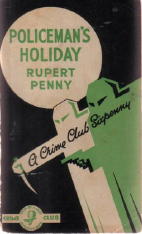
   Two novels from Rupert Penny, whose mysteries are filled with puzzles, time-charts, maps, railway schedules, etc. Thanks to friends in high places — Petaluma CA and Rockville MD — I was able to obtain copies of two hard-to-find titles: POLICEMAN’S HOLIDAY and POLICEMAN’S EVIDENCE. I’m working on them now.

   Delighted first of all because, as you may recall, John “Wade” Wright was interviewed here not too long ago. These will be the first US editions of any of his novels. It’s been a long wait, but it shouldn’t be too much longer. And if more are coming, as Fender seems to suggest, then all the better.

   As for Rupert Penny, he’s an author that I’ve always assumed to be a huge insiders’ secret. He wrote eight extremely scarce works of solid detective fiction between 1936 and 1941, and I’m lucky enough to have seven of them. I bought them back when they were still hard to find, but when you did, they were still relatively inexpensive. I don’t believe that I paid more than ten dollars for any one of them, but 30 to 35 years ago, ten dollars was a huge pile of change.

Holiday

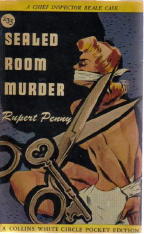
   Only two of the books are available on ABE at the moment. There is one copy of Sealed Room Murder, a Canadian paperback in VG condition for $145, and six copies of Policeman’s Holiday, all in paperback also, with asking prices ranging from $65 (a very worn reading copy) to $165. I haven’t checked the other online listing sites, but right now, not a single hardcover first edition is being offered on ABE.

   The Ramble House editions will be the first time that any of Rupert Penny’s will be available in the US. To whet your appetite, here’s a synopsis of Sealed-Room Murder. If your reading tastes are anything like mine, this will be hard to resist. (Unfortunately it’s not one of the book currently on Fender’s schedule, but I think it will get your mind thinking in the right direction.)

RUPERT PENNY excels all his previous form with this highly successful murder mystery. Unlike most “sealed-room ” stories, the problem is perfectly clear-cut and extremely simple in its elements. Where other mysteries try to baffle the reader by their complexity, this one will baffle by its simplicity. The story of Harriet Steele and the family that was forced upon her, is good reading even when considered as a straight novel, the situation is very real, very familiar and always lively and amusing in spite of the undertone of grimness. The thoroughly ingenious and exciting crime is put before the reader with scrupulous fairness so that he has every possible chance of leaping to the solution that will prove completely satisfying.

Sealed

   From Allen J. Hubin’s Crime Fiction IV, to whet your taste buds even more, assuming perhaps that the first two sell well, and that Fender can locate copies of the rest of them to reprint:

PENNY, RUPERT; pseudonym of Ernest Basil Charles Thornett. Series Character in all titles: Insp. (Chief Insp.) Edward (Ted) Beale.

* The Talkative Policeman (n.) Collins 1936
* Policeman in Armour (n.) Collins 1937
* Policeman’s Holiday (n.) Collins 1937
* The Lucky Policeman (n.) Collins 1938
* Policeman’s Evidence (n.) Collins 1938
* She Had to Have Gas (n.) Collins 1939
* Sweet Poison (n.) Collins 1940
* Sealed-Room Murder (n.) Collins 1941

« Previous PageNext Page »