Authors


A REVIEW BY DOUG GREENE:
   

R. T. CAMPBELL John Stubbs

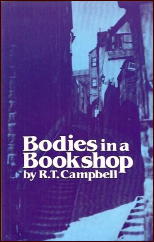
R. T. CAMPBELL (Ruthven Todd) – Bodies in a Bookshop. John Westhouse, UK, hardcover, 1946. Dover, US, softcover, 1984.

   For bibliophiles, Bodies in a Bookshop is pure enjoyment. The first chapter is full of love for books, and later chapters have insights into book- and print-selling and collecting. The story is well-structured, often amusing, and fairly clued.

   What is most interesting to me, however, is the amateur detective, Professor John Stubbs. He is an imitation of Carr’s Sir Henry Merrivale, with a bit of Dr. Gideon Fell thrown in. Stubbs is called “the old man”; he drinks copious quantities of beer; he resembles “a caricature of G. K. Chesterton trying to look like Buddha”; and, like Fell, he has a “mop of gray hair” which falls over his forehead. When he is concentrating he “frowns at the point of his cigar.” If Stubbs’ appearance combines Merrivale and Fell, his speech and attitude are pure H. M.:

    “Look’ee here, son.”

    “I got the simple mind I have.”

    “The shockin’ cussedness of luck.”

    “Oi,” the old man sounded and looked furious, “What d’ye mean by goin’ round arrestin’ people wi’out consultin’ me?”

    “Look here,” he roared indignantly, “me, I got the scientific mind… Ye thunderin’ well know ye’re wrong.”

    “What do I get? ” He looked round at us with an expression that he was the worst treated man in the world. “Do I get any thanks? No! All they say is that I’ve tried all the possible answers and I’ve found the right one. They say I got luck. I say I got brains. Bah!”

   Even the “large and bland” Chief Inspector is a Carrian character. None of this works quite as well as Carr at his best, but I am busily trying to locate more adventures of Professor Stubbs.

— Reprinted from The Poisoned Pen, Vol. 6, No. 2, Winter 1984/85.

      The Prof. John Stubbs series —

Unholy Dying. Westhouse, 1945.
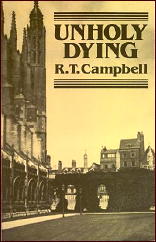
R. T. CAMPBELL John Stubbs

Adventure with a Goat. Westhouse, 1946.
Bodies in a Bookshop. Westhouse, 1946.
The Death Cap. Westhouse, 1946.
Death for Madame. Westhouse, 1946.
Swing Low, Swing Death. Westhouse, 1946.
Take Thee a Sharp Knife. Westhouse, 1946.

   Only the first and third of these have been published in the US, both in paperback by Dover Books. Campbell also wrote one non-Stubbs mystery: Apollo Wore a Wig (Westhouse, 1946). Other than the two reprinted in the US, Campbell’s detective fiction appears to be nearly impossible to obtain.
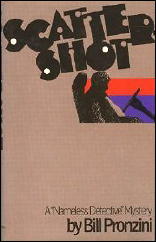
BILL PRONZINI – Scattershot. St. Martin’s Press, hardcover, 1982; $10.95. PaperJacks, paperback reprint, 1987.

BILL PRONZINI Scattershot

   Business, as they say, is booming. For Bill Pronzini’s pulp-collecting detective, for one, and for readers of private-eye fiction, for hundreds, if not thousands of others.

   Doomsayers to the contrary, the PI story is alive and — would you believe? — thriving. I’ve got a stack of PI novels here you wouldn’t believe how high, and if I weren’t awfully careful about it, I could read nothing but. Not that I would. I’d be burned out within a month if I did. I need a Leslie Ford every now and then, just to keep a proper perspective on things.

   But back to “Nameless,” as he has more or less officially been dubbed. All of a sudden he has more cases than he needs, especially just as his love life with Kerry (the lady he hit it off with so well in Hoodwink) is turning sour.

   Strangely enough, so do each of the three cases recorded in this book. Each becomes an impossible crime: a locked-room murder, a man who vanishes out of a constantly watched car, a wedding present that disappears out of a constantly guarded room.

   Terrific stuff , but 100 percent guaranteed to produce ulcers for the detective who is supposed to solve them or else. Lose his license? Nah, it couldn’t be … could it ? Life’s never this rotten. Is it?

   People not in the know constantly confuse PI fiction with hard-boiled fiction. There is an overlap, but nothing could really be much further from the truth. “Nameless” tries — he’s a man, and he has a macho image to maintain, whether consciously or not — but in many ways, in spite of all his rough edges, he’s also too soft and vulnerable. And likeable. He’d be hell to live with, but Kerry will come back. Won’t she?

   Hey, Bill! How long will we have to wait for the next one?

Rating: A minus.

— Reprinted from The MYSTERY FANcier,
       Vol. 7, No. 3, May-June 1983 (slightly revised).


[UPDATE]   If I have my chronology straight, the next book in the series was Dragonfire, which came out later the same year. I won’t tell you how the romance with Kerry came out, though. If you’re a fan of the series, you already know.

   I missed out on Patti Abbott’s multi-blog salute to Bill Pronzini on the occasion of his 70th birthday a couple of weeks ago. I had this review in mind to be included, but … time got away from me.

   Scattershot was the 8th book in the Nameless series, and now there are 30 more, or 38 in all, not including short stories, novelettes, and novellas. Best wishes for many more birthdays, Bill, and for many more books in the series.

REVIEWED BY MICHAEL SHONK:


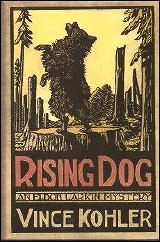
VINCE KOHLER – Rising Dog. St. Martin’s Press, hardcover, 1992. No paperback edition.

   Unlike most of today’s comedy mystery writers, Vince Kohler (1948-2002) understood the key to quality comedic mystery fiction is a good mystery with comedic elements, not how funny the jokes are. The few of us who have read his work still miss his talent for writing solid mysteries with eccentric characters, black humor, and a sense of the rainy coast of Oregon so real you’ll need a raincoat.

VINCE KOHLER Rising Dog

   Vince Kohler wrote four books, Rainy North Woods (1990), Rising Dog (1992), Banjo Boy (1994), and Raven’s Widow (1997). All four featured journalist Eldon Larkin who worked as reporter/photographer for the South Coast Sun, the local newspaper for small town Port Jerome, Oregon. Educated, he reads French classic literature in the original language, but proving how useful his education is, Eldon is a loser when it comes to the important things in life — women, cars, and career. He left Berkeley California and an ex-wife behind, and now dreams of the big story that will get him a job with a big city newspaper.

   The books can be read in any order and all of equal high quality. So I grabbed one off my shelf and was pleased to see Rising Dog.

   Rising Dog features a complex mystery centered on the murder of radical environmentalist John Henspeter, who is trying to stop a land developer from cutting down some trees to put up a condo. But while the mystery will hold your interest, it is the fast pace action, humor, and non-stop weirdness that will keep you entertained from beginning to end.

   Eldon responds to a phone call from Jasper, former drunken tugboat captain turned preacher, who claims to have raised his dog from the dead. Eldon meets with Jasper, the resurrected doggie and the members of Jasper’s church.

   On the way to where the miracle occurred, the group comes across some construction workers dealing with protester Henspeter. Things escalate, and as Eldon takes pictures, the church members and construction workers break out into a fight. It all stops with the arrival of a beautiful, topless mystery woman in her thirties on horseback (we will learn later her name is Enola Gay). All fall silent in awe. As quickly as she appears, she disappears back into the woods. Peace has been restored, until the dog arrives with a human foot. Its page 15 of 274 and the fun has barely begun.

   Kohler had a gift for ratcheting up the tension then easing off with a slight touch of the absurd. Near the end of the book, Eldon and Enola Gay finds themselves caught between gunfire from two sides:

   There were three shots from the trench. (Killer) was popping away with the Mauser. Eldon and Enola Gay flattened themselves as (killer) and the AK-47 gunner traded shots. Pop-blap, went the AK-47. The Mauser snapped in reply. Pop-blap. Pop-blap. Snap, snap. They’re both terrible marksmen, Eldon thought.

   Anyone who features odd characters is usually compared to Elmore Leonard, but Kohler’s books are better. Kohler’s pace and his ability to balance mystery, action, and humor avoids the dull sections I find in many of Leonard’s books.

   Kohler’s descriptions of locations are among the best in all fiction. He avoids the faults of the popular Weird Florida comedic mystery authors such as Carl Hiaasen, Christopher Moore, Tim Dorsey, etc. While too often the Florida locations out-weird the characters and events, Kohler’s locations play the straight man in his story, something real to anchor the story so the humor never cost the mystery its believability.

   Sadly, all four of his books are out of print and have yet to be rescued by e-books. There is little information on the Internet about Kohler besides his books for sale and two columns by his friend Bob Hicks.

      http://www.artscatter.com/general/sunday-scatter-it-was-a-dark-and-stormy-night-in-the-rainy-north-woods

      http://www.artscatter.com/general/going-native-on-the-oregon-coast-a-hair-raising-tale

   From Rising Dog, “Vince Kohler is a staff writer for the Oregonian in Portland. Kohler has traveled widely and in the course of his career, has filed stories from South America, Europe, the Soviet Union, and China. He is married, has three cats, and considers himself a permanent resident of the Pacific Northwest…”

   My favorite form of fiction is mystery lite, stories the opposite of film noir. Where film noir is soaked in self-pity and doom, mystery lite finds life too absurd to be taken seriously. Writers such as Norbert Davis, Ross Thomas, Gregory Mcdonald, Nat and Ivan Lyons, and Donald Westlake fill their books with the dark tragedies of life then make fun of them. Vince Kohler was one of the best at it. I miss him.

NOTE:   For a list of all of this week’s other “Forgotten Friday” books, check out Patti Abbott’s blog here.

      From mystery researcher John Herrington comes the following inquiry:

Hi Steve,

   I have been looking at this author of one title Headlines (1932) listed in Hubin’s Crime Fiction IV (as by Janette Cooper), and it has turned up an interesting story.

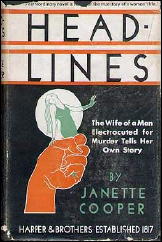
JANETTE COOPER Headlines

   She was born Rosalea (possibly Rosa or some variant spelling) Mary McCready in Pennsylvania in early 1894. She married Henry Colin Campbell, born 1864, in 1914 in Illinois. Is on 1920 census in Illinois with Henry, and two daughter Dorothy, aged 4, and Virginia, aged 2.

   But in 1930 her husband was executed as the “Cranford torch murderer,” and Rosalea seems to disappear from the records.

   There are a couple of things which do not help to clarify what happened to her.

   The Library of Congress copyright of Headlines is given to a Rhoda Cameron of Stamford, Connecticut. Although this lady appears in directories from 1930s, 1940s etc., sometimes with an Horace Cameron, she does not appear on 1930 or 1940 census. She may be the Rhoda Cameron born 3 April 1894 who died in Connecticut in 1978, who is Rhoda M Cameron in her Connecticut state death registration.

   The reports on Campbell’s trial state that he was a bigamist and had married several times without divorcing the previous wife. He is on 1910 census living with Emma Campbell and three children. In the trial report Emma Bullock Campbell says she was never divorced after Campbell left her, apparently to marry Rosalea! And while married to Rosalea, he had married his victim Mildred Mowery.

   I have no idea what Roselea’s status was after the trial and execution. Was any evidence found to say her marriage was definitely bigamous? Whatever, I cannot find her on 1930 census. Even a search for the children failed to find them. Did she change her name to escape the media hunt?

   And what is the connection between Rosalea and the mysterious Rhoda Cameron in the copyright entry. Are they possibly the same person?

   I would appreciate if you can do a bit on this, to see if anyone out there knows anything about Rosalea and what happened to her.

         Regards

               John

Editorial Comment: The description of the book as given on the cover says: “The wife of a man electrocuted for murder tells her own story.”

THE ARMCHAIR REVIEWER
Allen J. Hubin


LYDIA ADAMSON

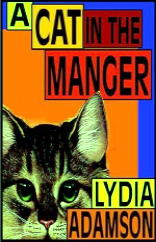
LYDIA ADAMSON – A Cat in the Manger. Signet, paperback original, 1990.

   A Cat in the Manger is the first in a series about sometime NYC actress and moretimes catsitter Alice Nestleton by the pseudonymous Lydia Adamson. This is a fanciful tale requiring hyperextension of disbelief, with a heroine of little appeal and an ending without the impact it could have had.

   Alice goes to Long Island to cat-sit for Harry and Jo Starobin, as she had done frequently before. This time, however, someone has hung Harry on the back of a door. Another corpse quickly turns up, just as motiveless a killing as the first.

   The police think robbery, but the Starobins were penniless — except for the $381,000 discovered in Harry’s safety-deposit box. And where has Ginger Mauch, who worked for the Starobins, gone off to, and why?

— Reprinted from The MYSTERY FANcier,
       Vol. 13, No. 1, Winter 1991.


[UPDATE.]   It is now known that Lydia Adamson is the pen name of mystery writer Frank King, who besides 21 books in his/her Alice Nestleton series (see below), also wrote 12 books in a series starring Dr. Deirdre Quinn Nightingale, veterinarian, and three books about birdwatcher and ex-librarian Lucy Wayles, not to mention five works of crime fiction under his own name.

       The Alice Nestleton series

1. A Cat in the Manger (1990)
2. A Cat of a Different Color (1991)

LYDIA ADAMSON

3. A Cat in Wolf’s Clothing (1991)
4. A Cat in the Wings (1992)
5. A Cat by Any Other Name (1992)
6. A Cat with a Fiddle (1993)

LYDIA ADAMSON

7. A Cat in a Glass House (1993)
8. A Cat with No Regrets (1994)
9. A Cat on the Cutting Edge (1994)
10. A Cat in Fine Style (1995)
11. A Cat on a Winning Streak (1995)
12. A Cat Under the Mistletoe (1996)
13. A Cat in a Chorus Line (1996)

LYDIA ADAMSON

14. A Cat on a Beach Blanket (1997)
15. A Cat on Jingle Bell Rock (1997)
16. A Cat on Stage Left (1998)
17. A Cat of One’s Own (1999)
18. A Cat With the Blues (2000)
19. A Cat With No Clue (2001)
20. A Cat Named Brat (2002)
21. A Cat on the Bus (2002)

   Author Audrey Boyers is included in the Revised Crime Fiction IV, by Allen J. Hubin, for one book under this name, Murder by Proxy (Doubleday Crime Club, 1945), which was actually a collaboration with Bettina Boyers. Some information about the latter has recently come to light: included in Part 37 of the online Addenda to the Revised CFIV, Bettina Boyers was the “pseudonym of Betti Rosa Tagger, 1891-1960. She was also known as Bettina Bruckner, and died the widow of Theodor Tagger, whose pseudonym was Ferdinand Bruckner. Born in Rosnow, Poland; died in New York City.”

   Bettina Boyers has one other entry of her own in CFIV, a solo novel entitled The White Mazurka (Doubleday, 1946), also a Crime Club novel.

   Not much information seems to be known about Audrey Boyers, however. One might have guessed that she and Bettina were sisters, and yet apparently they were not. What has caught Al’s eye in recent days, along with that of fellow mystery researcher John Herrington, is the entry for Audrey Boyers Walz (1906-1983) who between 1931 and 1951 wrote eight mystery novels under the pen name of Francis Bonnamy, all of which featured a series character named Peter Shane, a criminologist by trade.

   For more information about the series, check out the author’s GADetection page here: http://gadetection.pbworks.com/w/page/7930094/Bonnamy,%20Francis

   The question posed by Al and John is this: Is Audrey Boyers also Audrey Boyers Walz? It would be a whopper of a coincidence if they are not, but no evidence has so far arisen to say that they are. (And where does “Bettina Boyers” fit in?)

THE BACKWARD REVIEWER
William F. Deeck


JUNE TRUEDELL The Morgue the Merrier

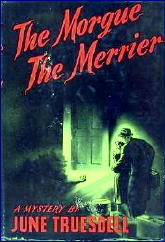
JUNE TRUESDELL – The Morgue the Merrier. Dodd Mead, hardcover, 1945.

   When mystery writer John Grover and his new bride, Lee, arrive at the house in Tree-Top Glen, apparently in Los Angeles, where they are to spend their honeymoon, the door is blocked by a body whose hand is the only part that can be seen. Moments later the body vanishes. Then a woman is murdered in one of the bedrooms, stabbed through the heart and with her throat slit.

   Grover and Lee call upon Julius Gilbert, criminologist not detective, who is five feet two inches tall, with two hundred pounds of tummy. (I suspect that Lee, the narrator, is exaggerating.) Muttering oracularly and managing to postpone the consummation of the marriage, Gilbert clears things up in a semi-fair-play novel after only one more murder.

   Those who like frenetic married-couple types should enjoy this one. While the characters are a bit extreme, as is the plot, in spite of these objections I am keeping an eye out for Truesdell’s later pair of novels, according to Hubin not featuring Gilbert or the Grovers, in which she may have exhibited a little more authorial control.

— From The MYSTERY FANcier, Vol. 13, No. 1, Winter 1991.


  Bibliography:     [Taken from Crime Fiction IV, by Allen J. Hubin]

TRUESDELL, JUNE (1918?-1996?)

        The Morgue the Merrier (n.) Dodd Mead, 1945.
        Be Still, My Love (n.) Dodd Mead, 1947. Film: The Accused, 1949.
        Burden of Proof (n.) Boardman, UK, 1951

Western Writer DOYLE TRENT:
Some Reminiscences.

   Western writer Doyle Trent has been covered before on this blog, the occasion being the announcement of a checklist I was working on for him. The announcement is here. The illustrated checklist is here. As a result of his seeing one or the other, I was contacted by an old friend of Trent, who offered to write up some of his memories of him, and I gladly took him up on it. “No by-line or attribution necessary,” he said. I just wanted to share this anonymously.”


DOYLE TRENT Western Author

   In 1962, Doyle Trent walked into the Tucson Police Department, a newly-hired reporter for the Arizona Daily Star, the town’s morning paper.

   Then in his late 30’s, he was older than the typical “cub” reporter, as some old newspapermen labeled such creatures. He stood about 6-feet, of medium build, with sandy, close-cropped (but thinning) hair. His face was smooth and permanently tanned. From mid-forehead to his hairline was a band of white skin, the permanent trademark of a face long in the sun, partially shielded by a hat.

   In contrast to reporters’ “newsroom-grunge” collection of barely-ironed shirts, rumpled slacks and scuffed shoes, Doyle’s taste ran to tailored Western pants, leather belt with a simple silver buckle, a complementing colored shirt (tie-less) with snap-type pocket flaps and shined cowboy boots. But no cowboy hat. And he ambled, rather than walked.

   Initially working the “day cops beat”, Doyle was a quiet presence in that noisy, smelly environment. He shared the large, wooden “press desk” with the afternoon paper’s cops reporter, consigned to the corner of a large, windowless room which housed police dispatchers. From that vantage point, they observed the endless parade of cops and prisoners.

   Soft-spoken and polite, even with the ever-prickly cops of all ranks, Doyle was a good writer who favored two-fingered typing on one of two battered Underwood typewriters at the press desk. He was thorough, always asking the reporter’s basic “Five-W’s” but always managing to get just a bit more. In one highway accident, an 18-wheeler tractor-trailer had overturned, killing the driver. The truck carried several tons of steel; it was in Doyle’s lead sentence. His rival missed that little detail and had to deal with an unhappy city editor who explained the relevance of a law of physics involving mass and momentum.

   Doyle didn’t talk a lot; personal details were sparse. He never said where he was from, offering only that he had been a cowboy and had served in the Army. Knowing a cowboy’s career was limited, he said he used the G.I. Bill to earn a college journalism degree. He spoke with a slow, soft drawl and, at times, with difficulty. A lifetime of little or no dental care caused him pain, not that he ever really complained. It just added to his taciturn demeanor.

    — These recollections came from another reporter who worked “cops” with Doyle a half-century ago. Decades later, that former reporter stumbled by chance on Doyle’s literary career and he observed that, “Given the list of book titles to his credit, it was obvious that his background as a working cowboy, his journalism experience and a vivid imagination combined to make him a successful Western novelist. In a world of cowboy-writer wannabes, Doyle Trent is the real McCoy.”

A REVIEW BY DOUG GREENE:
   

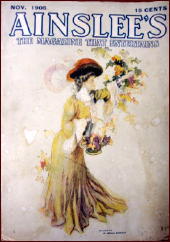
GERALDINE BONNER – The Castlecourt Diamond Case. Funk & Wagnalls, hardcover, 1906. (“Published, December, 1905.”) First appeared in Ainslee’s Magazine, November 1905. Currently available in several different Print On Demand editions. Online edition: https://archive.org/details/castlecourtdiamond00bonnrich

GERALDINE BONNER The Castlecourt Diamond Case

   This is the second version of this review, In the first, employing suitable modesty, I credited myself with the discovery of Geraldine Bonner, an entertaining but (or so I thought) entirely forgotten writer. Having stated that Bonner is unknown, I then belatedly checked my facts … and I found that five years ago Kathi Maio praised another book by Bonner, The Black Eagle Mystery (1916), in Murderess Ink.

   Such are the perils of research.

   Ms. Maio says that Black Eagle is “a charming mystery” — a phrase that also describes Castlecourt Diamond. The story of the theft of the Marchioness of Castlecourt’s diamonds is told in six “statements.” The first, by the Marchioness’ maid, describes the theft, introduces the main characters, and mentions the two detectives, one official, one private.

   The second section is narrated by “Lilly Bingham, known in England as Laura Brice, in the United States as Frances Latimer, to the police of both countries as Laura the Lady.” It’s not much of a surprise that Laura stole the diamonds, though whether she was acting for someone else is not yet clear.

   On the whole, however, the mystery is primarily a vehicle for Bonner to produce a comedy of manners, and the interest in the second part is Laura’s successful attempt to plant the diamonds on an unsuspecting American couple, Cassius and Daisy Kennedy. The Kennedys have been courting London society (they already know “a bishop and two lords”) and thus can’t throw out Laura and her henchman when, pretending an invitation, they arrive for dinner.

   Two parts of the story are statements by the Kennedys, detailing their schemes to rid themselves of the diamonds and culminating in the theft of the jewels by a seeming sneak-thief. John Burns Gilsey, a private detective engaged by Lord Castlecourt, narrates a section that explains his deductions pointing to the Marchioness as the instigator of the plot, but the book concludes with a statement by the Marchioness showing that Gilsey was only partly correct.

   The Castlecourt Diamond Case is indeed charming, and it is made even more so by its brevity — with large type and margins it contains less than 30,000 words, a far cry from many Victorian and Edwardian detective novels, as anyone who has labored through, say, Lawrence Lynch’s novels with their 550 godawful pages will testify.

   I can’t claim to be the discoverer of Geraldine Bonner, but I’m happy to join Kathi Maio in recommending her works.

— Reprinted from The Poisoned Pen, Vol. 6, No. 2, Winter 1984/85.


BIBLIOGRAPHY:   [Taken from the Revised Crime Fiction IV, by Allen J. Hubin]

       GERALDINE BONNER (1870-1930). Born in Staten Island, N.Y.

The Castlecourt Diamond Case (n.) Funk 1906.
The Girl at Central (n.) Appleton 1915 [Molly Morganthau (Babbits)]
The Black Eagle Mystery (n.) Appleton 1916 [Molly Morganthau (Babbits).]
Miss Maitland, Private Secretary (n.) Appleton 1919 [Molly Morganthau (Babbits)]
The Leading Lady (n.) Bobbs 1926.
-Taken at the Flood (n.) Bobbs 1927.

Three by JOHN WELCOME:
Reviews by George Kelley


JOHN WELCOME

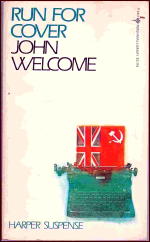
JOHN WELCOME – Run for Cover. Faber, UK, hardcover, 1958. Knopf, US, hardcover, 1959. Harper Perennial, paperback reprint, 1983.

   I have nothing but praise for the Perennial Library series: their selections are high quality fiction attractively packaged and priced. John Welcome’s Run for Cover is fun reading: light as cotton candy. Former intelligence agent Richard Graham is drawn into a tangled plot when the manuscript he is reviewing is stolen.

   The haunting aspect: the manuscript was written by a man Graham knew was dead, Rupert Rawle. But the dead man has come alive and Graham is back on the trail of the man be once idolized, only to have Raw}e leave him for dead during a WWII commando mission. The writing is slick, cultured, and professional. The plotting is fast-paced, wild, and unpredictable. Perfect for vacation reading.

JOHN WELCOME

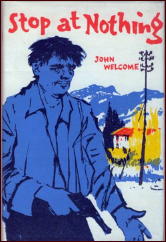
JOHN WELCOME – Stop at Nothing. Faber, UK, hardcover, 1959. Knopf, US, hardcover, 1960. Harper Perennial, paperback reprint, 1983.

   Stop at Nothing is John Welcome’s best book. Simon Herald, former racing car star, faces 40 and a bitter divorce when he falls in love with a younger woman whose brother is hunted by vicious men in order to gain the secret of a formula that makes horses run faster.

   Forget about the corny plot; Welcome fires away from page one and doesn’t let up on the action until a couple hundred pages later. Hairbreadth escape follows hairbreadth escape as Herald faces overwhelming odds, brutal beatings, a psychopathic killer, and an obsessed millionaire. What more could you ask for? This is seat-of-your-pants escapism at its best.

JOHN WELCOME

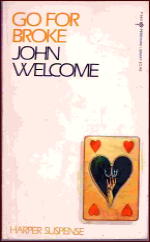
JOHN WELCOME – Go for Broke. Faber, UK, hardcover, 1972. Walker, US, hardcover, 1972. Harper Perennial, paperback reprint, 1983.

   Go for Broke is one of John Welcome’s lesser works, but it still provides more excitement than most thrillers. Eric Vaughan, wealthy financier, accuses Richard Graham of.cheating at cards. Graham is mystified by the false charges, but finds himself drawn into a web of international intrigue where the seeds of treachery and double-cross in the past haunt the present.

   Graham finds himself a social outcast, discharged from his part-time espionage position, and forced to sell his meager land holdings to pay for his legal defense. But he falls in love with a mysterious American woman and finds an unexpected clue to the frame he’s been put in.

   The flaw in Go for Broke is the boring courtroom proceedings that take up too much of the book; once outside the stuffy legal chambers, the pages fly by. The conclusion will surprise no one, but it’s curiously satisfying.

— Reprinted from The Poisoned Pen, Vol. 6, No. 2, Winter 1984/85.


Editorial Note:   A criminous bibliography for John Welcome can be found here on LibraryThing, along with a brief biography, which concludes: “He [John Needham Huggard Brennan] took up writing, under the pen name of John Welcome, to relieve the tedium of the country solicitor’s life.”

« Previous PageNext Page »