Authors


FIRST YOU READ, THEN YOU WRITE
by Francis M. Nevins


   Another baffling Ellery Queen mystery! One of the most fascinating letters from Manfred B. Lee to Fred Dannay that Joseph Goodrich didn’t include in his book BLOOD RELATIONS is dated November 3, 1958. More precisely, it’s dated “Nov. 3” with the year added in brackets, presumably by Goodrich.

   Right at the start Manny tells Fred: “The novel will not be ready on Dec. 1. Its status is as follows: About 2/3 of the rough draft was done quite a while ago, but I found large sections of it unsatisfactory…and began doing them over.” Then he starts describing the health problems that have kept him from finishing this novel.

   Which novel is he talking about? It can’t be THE FINISHING STROKE, which was published very early in 1958. But Manny never wrote another novel from a Dannay synopsis until the late Sixties when he overcame the writer’s block that had handicapped him for almost a decade.

   Is it possible that the bracketed date is a mistake, that the letter was actually written a year or two earlier? No! About halfway through the document Manny talks about the live 60-minute Ellery Queen TV series, then starring George Nader. That series was broadcast only during the 1958-59 season. Manny even mentions that the episode shown the previous Friday was based on perhaps the finest of all Queen novels, CAT OF MANY TAILS (1949). We know that the air date of that episode was October 31, 1958, and Manny even mentions that it was shown on Halloween night. There’s not a chance in a trillion that this letter was written at any time other than what its dateline says.

   What then are we left with? With the distinct possibility that there exists somewhere an “unknown” Ellery Queen novel, perhaps finished, perhaps unfinished. If so, what a find!

   There are other possibilities, but they seem most unlikely. One that I considered and quickly rejected is that the book Manny was working on late in 1958 was published in 1963 as THE PLAYER ON THE OTHER SIDE. If Manny became afflicted with writer’s block soon after writing this letter, Fred might have let his synopsis sit for a few years and then given it to Theodore Sturgeon, who expanded the outline into that novel.

   What rules out that theory? Since we know that Manny was working on the book “quite a while” before November 1958, Fred’s synopsis must have been completed earlier. But the outline for THE PLAYER ON THE OTHER SIDE can’t possibly predate the release of Hitchcock’s PSYCHO (1960), to which the plot of PLAYER owes so much. Even assuming that the influence on PLAYER comes not from the movie but from Robert Bloch’s novel of the same name (1959), the time element still eliminates PLAYER as the outline Fred prepared a year before Bloch’s book was published.

   Let’s explore another possibility. Might Fred have eventually decided that the novel Manny was working on in 1958 — and may or may not have finished — should be cut down to novelet length? There’s one Queen novelet which just might fit the time frame: “The Death of Don Juan,” which was first published in Argosy, May 1962, and is collected in QUEENS FULL (1965). I can find no positive evidence in support of this theory but nothing against it either.

   When speculation fails, search for facts. I recently emailed Fred’s son Richard Dannay, asking if he had ever seen a manuscript that fit the vague description in Manny’s letter. (If only he had left a hint or two as to what the plot was about!) Richard said no but admitted the possibility that he and his brother Douglas had overlooked something while sorting through their father’s huge accumulation of manuscripts and papers. There the trail ends — unless some intrepid literary sleuth spends months combing through every paper in the Dannay archives at Columbia University. Any volunteers?

***

   For three months I’ve resisted offering another assortment of quotations from the one and only Mike Avallone, but I can’t hold back any longer. Here come some more cubic zirconia from the Ed Word of the written wood, all from THE SECOND SECRET (1966, as by Edwina Noone), the same epic from which I culled quotations back in November. With the iron self-control of the Spartan boy who hid the fox under his tunic I shall limit myself to six new ones.

   The biggest conflagration she had ever seen were the playful bonfires set by the children of Englishtown on holidays. (20-21)

   The poor Freneaus. For all their wealth and position, they certainly had not had a barrel of skittles. (22)

   A peach that hung in their midst for years had been abruptly plucked from the communal tree and now no one knew what was in store for her. (46)

   She stood on the boarded sidewalks of the town, staring after the carriage, a bouquet of tulips sprayed over her worn fingers. (46)

   As close as Clara was now, both physically and relationally, she was as distant and remote as the stars… The gossamer veil, netting Clara Freneau’s wantonly darkish face was insufficient to completely mask the hostility of the woman. (47)

   â€œIt was such a beautiful ceremony. Thank you for being bridesmaid.”
   â€œYou’re welcome, my dear… You may thank my late father’s sword also since it served as your best man.” (47)

   Thank you, Mr. Sword. And thanks also to Mike Avallone, whose wacko way with words can lift me out of the blackest moods.
THE BACKWARD REVIEWER
William F. Deeck


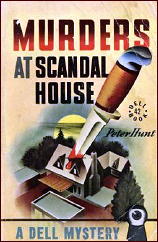
PETER HUNT – Murders at Scandal House. D. Appleton-Century, hardcover, 1933; Dell #42, paperback, mapback edition, no date [1944].

PETER HUNT Murders at Scandal House

   In this, the first novel featuring Alan Miller, chief of police of Totten Ferry, Conn., when he isn’t doing his various other jobs, Miller is on a vacation he feels he doesn’t need and is definitely not enjoying the Adirondacks. Who could blame him if his description of the mosquitos, flies, and gnats is accurate?

   In fact, the mosquitoes are the first murder weapon in the novel. Miller and a game warden check out some overactive buzzards and find a man tied to a tree, drained of blood and filled with poison by the mosquitoes. This is a first in my reading of mysteries, and I hope it’s a last. I can’t think of many less pleasant ways to die.

   The dead man was a chauffeur at the Balmoral Camp, inhabited by Lydia Whyte-Burrell, relict of the unlamented Edgar Burrell, infamous for his evil ways and his various by-blows, some of Burrell’s relatives, various hangers-on, and servants.

   Though not a genuine detective, Miller is asked to investigate since the police are focusing on the more obvious but unlikely suspects. When asked how he is going to operate, Miller replies:

   Prowl a bit, and hope a great deal, and not ask too many questions. Murderers seldom tell the truth. The more clever questions I might ask, the less I would probably find out. If a man plans a killing, he plans an alibi and a reasonable accounting of himself, and that sort of thing only confuses me. Besides, the duller I seem to be, the more careless the murderer will be. Therefore, I shan’t be very bright. I’m not at all bright by nature, so it saves me a lot of effort. Now you know my method.

   In a review of the second novel by Hunt, Murder for Breakfast, in another publication, I said that Miller, though out of his depth professionally — remember, he is only a part-time policeman — is nonetheless an intelligent man with a sense of humor. That is still true here in a not-strictly-fair-play novel.

   For those who may be interested, Hunt was a combination of George Worthing Yates and Charles Hunt Marshall.

— From The MYSTERY FANcier, Vol. 13, No. 4, Fall 1992.


NOTE:   The third and final book in the Alan Miller series was Murder Among the Nudists (Vanguard, 1934). (If the title sounds just a little intriguing, too bad. A quick check on the Internet showed that currently there are no copies up for sale.)

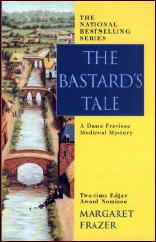
MARGARET FRAZER – The Bastard’s Tale. Berkley Prime Crime, hardcover, January 2003; paperback, January 2004.

MARGARTE FRAZER The Bastard's Tale

   This is the twelfth in Frazer’s ongoing series of medieval mysteries, all with Dame Frevisse as the leading character, and given that her primary residence is the nunnery at St. Frideswide’s, England, it’s not easy to say how she’s happened to become involved in as many cases of murder and intrigue as this. And if you don’t know, I’m not the one who’s going to be able to tell you – this is the first of her adventures I’ve happened to read – but it’s also not difficult to realize that in that particular time and place of the world, death came both more easily and more often.

   So given the controls of a time-traveling machine, I’d not inclined to be heading back to this particular era any time soon, but in fiction, it’s fine, and so is the book. If you like historical mysteries, you shouldn’t allow Frazer’s series slip by you for as long as I did. It’s my error, all the way.

   The year is 1447, the 25th year of reign of Henry VI’s, and as I gathered from the story, at the time he was only just over the same age himself. (Let me insert a confession here, if I may. I obviously was not paying close enough attention back in high school. History classes barely caught my awareness level, especially British history, and it’s starting to show.)

   The character described in the title is Arteys, the illegitimate son of Humphrey, duke of Gloucester, and the Henry’s “well-beloved uncle” — although the king, under the influence of the marquis (formerly earl, later duke) of Suffolk, has a strange way of showing it. To the contrary, he has recently accused Gloucester’s wife, Lady Eleanor, of witchcraft and trundled her off to prison, not an ideal way to keep peace in the family.

   While there is eventually a murder in this novel, or at least an attempt, there is very little question of who ordered it. There are a few pages of investigative activity on the part of Frevisse and the two others assisting her: Joliffe, a man of many past roles, now an actor who is part of a troupe entertaining the king’s entourage; and the singularly non-ambitious but exceedingly observant Bishop Pecock. Overall, though, the amount of actual detective work going on is minimal. It is the intrigue, the constantly shifting of alliances for the power behind the throne that the story is about, along with the characters that Frazer brings so strongly to life.

   And she somehow does it by keeping the major players, those known to history, more or less in the background. What Frazer does very nicely is to describe events from the point of view of the common people, who sense as they do that something’s going on, but who have as much effect on the day’s events as a butterfly in a snowstorm. Frazer’s focus is on everyday activities, but she also manages to keep the big picture well illuminated — and what’s more, she makes it look easy. There is the constant feeling that powerful forces are hard at work here.

   The link between the two worlds is Dame Frevisse, who walks in both of them. Somehow she’s comfortable both in her life as a nun and in the confidence of the aspiring Suffolk’s wife, who is also her cousin.

   In the grand scheme of things, Frazer is limited to and restricted by actual events. She can’t change history, which goes without saying, but if she were to have followed the usual conventions of story-telling, it’s easy to see how the story might have come out quite differently. Arteys, for example, when his demanding role in the story is over, disappears far too soon – but precisely as he did in the annals of history — as much as she or the reader might wish otherwise. (The reader, perhaps, even more so.)

   Looking over the notes I made as I was reading, I see that I said to myself “very good” several times. I’ll let that be the summary as well. Very good. Very, very good.

PostScript: Margaret Frazer began as the joint pseudonym of Mary Monica Pulver (a.k.a. Margaret Ferriss) and Gail Frazer, but after the first six in the series, it’s the latter who’s been writing them alone, including this one. The novels also started out as paperback originals, but they’ve apparently done so well that they’ve switched to coming out in hardcover first.

— December 2003


[UPDATE] 01-23-13.   There are now apparently 22 books in the Dame Frevisse series, plus seven solo appearances by Joliffe the Player, and three novels featuring Bishop Pecock. Unfortunately, as much as I liked this one, it’s still the only one of all of Frazer’s long list of titles that I’ve managed to read.

THE BACKWARD REVIEWER
William F. Deeck


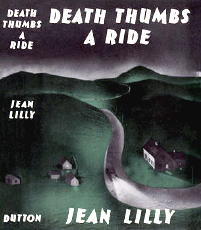
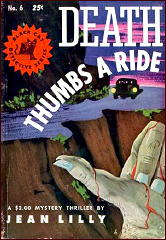
JEAN LILLY Death Thumbs a Ride

JEAN LILLY – Death Thumbs a Ride. Dutton, hardcover, 1940. Black Cat Detective Series #6, digest-sized paperback, 1943.

    “Two murders would probably have gone unsuspected during the last year if Eunice Hale had not eaten a chicken croquette of questionable virtue.” The two murders were the death of a woman, of apparently natural causes, at a tourist camp in the Adirondacks and the presumed hit-and-run death of a senator’s gardener in the same area.

   Even with the aid of the chicken croquette they would have remained unsuspected except for the interest of vacationing district attorney Bruce Perkins, who is asked to investigate a jewel theft but prefers to find the alleged hit-and-run driver and begins to doubt the naturalness of the woman’s death.

JEAN LILLY Death Thumbs a Ride

    While the opening sentence is a good one, the rest of the prose does not get any better than slightly above pedestrian and the characters are essentially lifeless. Lilly somewhat makes up for this with her primary setting, unusual in mysteries, I believe: a lower-middle-class tourist camp. (Could there be such a thing as an upper-class tourist camp?)

    Lilly also provides a, for the most part, fair-play mystery. For the most part, I say, since I could find no explanation, and I certainly couldn’t figure out how the gardener died, or even if it was murder. Maybe the Black Cat publication was abridged and the publisher neglected to mention it.

— From The MYSTERY FANcier, Vol. 13, No. 4, Fall 1992.


Bibliographic Notes:   Death Thumbs a Ride was the last of three recorded cases for DA Bruce Perkins, and the last of four crime novels written by Jean Lilly:

LILLY, JEAN (McCoy), 1886-1961. Born in Milford, Michigan; died in Wallingford, Pennsylvania.

       The Seven Sisters (n.) Dutton 1928 [Connecticut]
       False Face (n.) Dutton 1929 [Bruce Perkins; Academia]
       Death in B-Minor (n.) Dutton 1934 [Bruce Perkins; Long Island, NY]
       Death Thumbs a Ride (n.) Dutton 1940 [Bruce Perkins; New York]

    Thanks to Allen J. Hubin and Crime Fiction IV for the above information. Also note that the contemporaneous Kirkus review suggests that there are no loose ends, at least in the hardcover edition.

FIRST YOU READ, THEN YOU WRITE
by Francis M. Nevins


   During 2012 I spent more time on Ellery Queen than on any other author or character. I hadn’t planned to tackle another Queen project so soon after completing The Art of Detection, but over the holidays I did. A few months ago Joseph Goodrich, editor of the book of selections from the correspondence between Fred Dannay and Manny Lee that was published as Blood Relations (2012), had generously sent me a 97,500-word document containing virtually all of Manny’s letters to Fred, far more material than there was room for in the book.

   I had done some organizing and rearranging and had added a number of bracketed annotations explaining obscure points in the letters but I hadn’t yet made myself thoroughly familiar with the material. This I set out to do over the holidays. Some remarkable discoveries rewarded me. Here’s one of them.

   Among the many problems Fred had to deal with as founding editor of Ellery Queen’s Mystery Magazine was figuring out who would take over in that capacity if he were to die or become disabled. Manny had no interest in short detective fiction and very little editorial experience, but neither man relished the prospect of the magazine being run by a stranger. So, for a short time anyway, Manny was sent some of the stories submitted to EQMM and undertook to write comments on them for Fred.

   Among those he evaluated was a 57-page manuscript by Charlotte Armstrong (1905-1969), who was best known for the spectacularly successful suspense novel The Unsuspected (1946). “Night Mustn’t Fall” begins when a dog is found poisoned in a quiet suburban neighborhood one summer Saturday afternoon. A young visitor named Mike Russell tries to help its 11-year-old owner and his sixth-grade buddies find out whether the poisoner was the homeowner on whose lot the dog was found — and with whom most of the neighborhood kids had had run-ins — or someone else.

   Manny found many things wrong with the tale. In a letter dated April 29, 1950, he agreed with Fred that the story was “at times too sentimental and gushy” and that its “psychological and emotional aspects are over-inflated.” He also considered it far too long. “I could guarantee to take this manuscript as it now stands, without changing one word…, and cut its 57 pages down to, say, 30 (or less!) and thereby improve it one thousand percent. It is repetitious throughout, and whatever is good in the writing is blunted by the sheer bludgeon blows of over-and-over-again.”

   But, he went on, “the story is worth saving. It has its potentialities, certainly, not the least of which is the kernel of its message, which is that truth is a hard job and that children have to be trained to look for truth … and that if more children were so trained, this would be a far different adult world.”

   After some conversations with Fred, Armstrong resubmitted her story as ”The Enemy.” It was published under that title (EQMM, May 1951), won first prize in the magazine’s annual short-story contest, and a few years later became the basis for a feature-length movie (Talk About a Stranger, 1954). The story is included in Armstrong’s collection The Albatross (1957).

   From reading the published version it’s clear that she thoroughly cut, revised and improved the manuscript Manny read. The repetitious writing has been eliminated, the emotions are tightly controlled as in Hemingway or Hammett. Manny had complained that altogether too many people in the neighborhood were able to tell Russell and the boys at exactly what time they had seen the dog, but apparently Fred wasn’t bothered by this point.

   What puzzles me is the number of plot flaws that survived the revision. One minuscule problem: The story needs to take place on a Saturday because the boys couldn’t be on the scene if it were a schoolday. But near the end we learn that one of the witnesses who noticed the dog before its death was a girl had a sore throat that day and was sitting on her porch, “waiting for school to be out, when she expected her friends to come by.”

   A much more serious flaw to my mind is in the solution, which I must reveal in part if I’m to discuss the story seriously. The man on whose property the dog’s body was found lives with his wheelchair-bound wife and crippled stepdaughter. At the climax we discover that when he went out to play golf that Saturday morning, the younger woman, who cooks for the three of them, gave him a lunch box containing hamburger sandwiches laced with arsenic.

   Unable to stomach her cooking, the lucky man ate out. But instead of disposing of the burgers in a trash can like any normal person, he brought them home and threw them onto the empty lot next to his house, where the unlucky dog found them and died minutes later! “The Enemy” is a fine story overall, but was it the best choice for first prize winner?

***

   I hadn’t read one of John Rhode’s detective novels about Dr. Lancelot Priestley in several years. Over the holidays I decided it was time to revisit that curmudgeonly old amateur of crime and chose Death on the Boat Train (1940), which I’d first read in my teens but had completely forgotten long before the 21st century began.

   At the end of a train’s run between the English Channel port of Southampton and London’s Waterloo Station, the body of a poorly dressed man is found in a first-class compartment and Inspector Jimmy Waghorn of Scotland Yard is summoned. The cause of death turns out to be a poison called ricin which was injected into the man’s butt (which Rhode discreetly calls “the right-hand side of the back”) with a hypodermic syringe.

   The victim turns out to be steel magnate Sir Hesper Bassenthwaite, who for some obscure reason had chosen to travel on the Channel steamer from the island of Guernsey to Southampton and then on the Southampton-Waterloo boat train more or less in disguise. Since Sir Hesper had had a compartment to himself both on the steamer and the train, how could anyone have injected poison into his kiester without his knowledge? In due course Waghorn and his boss, Superintendent Hanslet, drop in on Priestley to discuss the case over dinner and drinks and their host, true to form, offers one inspired suggestion after another.

   Death on the Boat Train is among the more solidly plotted Rhodes but, as always, the characters are wooden and the prose leaden. (In the novel’s innumerable Q&A sequences anyone’s answer to a question is followed by the words “he [or she] replied.” It was my noticing that the same linguistic oddity infested the detective novels of another Golden Ager, Miles Burton, that allowed me to deduce, way back in the Pleistocene era, that Rhode and Burton were the same man.)

   What most surprised me about the book is that amid the dry-as-dust exposition and dialogue are a few gaffes almost in the Mike Avallone league. “‘I seem to remember that at one time you knew how to make unprotected females unbosom themselves.’” (219) “She returned her shoulder to him and read a few lines of her magazine.” (221) “His glance wavered round the room as though seeking some form of liquid refreshment.” (273) “Late that night a very weary Jimmy unbosomed himself into Diana’s sympathetic ears.” (281)

   Could this most staid and stolid of English crime novelists have been fixated on a certain body part which shall be nameless?

A new profile of mystery writer Ed Lacy has appeared online. He died 45 years ago yesterday. Check it out at

http://www.tabletmag.com/jewish-arts-and-culture/books/120789/stranger-than-pulp-fiction

Also note that Ed Lynskey did an earlier article about Lacy for Mystery*File on this blog’s primary website:

https://mysteryfile.com/Lacy/Profile.html

THE BACKWARD REVIEWER
William F. Deeck


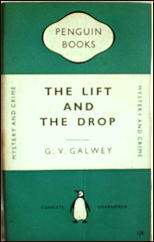
G. V. GALWEY The Lift and the Drop

G. V. GALWEY – The Lift and the Drop. Bodley Head, UK, hardcover, 1948. Penguin Books, UK, paperback reprint, 1951.

   Since his theory of how to catch a murderer is examining the past of the victim, Chief Inspector “Daddy” Bourne has a real dilemma here. For there were six people in the lift at Pleydell House, home of The Voice and other publications, when it plummeted out of control from the sixth floor to the basement. If any of them were meant to die, which one was it? Or was it an act of mindless terrorism, since no murderer could be certain whom he or she might kill?

   A bit too much emphasis on the technical aspects of the murder, a lot too much on the seafaring aspects — I got quite lost as soon as water was approached — a nebulous political scheme, and a murderer with more hubris than I could accept are the weak points here. The strong points are the characters of Bourne and Sergeant Griffiths and their investigation. Well worth reading, and a nimbler mind than mine might find my objections not significant.

— From The MYSTERY FANcier, Vol. 13, No. 4, Fall 1992.


       The Inspector “Daddy” Bourne series —

Murder on Leave. Lane, 1946.
The Lift and the Drop. Bodley Head, 1948.
Full Fathom Five. Hodder, 1951.

NOTE: These were G. V. Galwey’s only works of mystery fiction. To find out more information about him, check out the Golden Age of Detection wiki here.

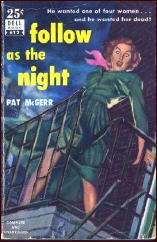
PATRICIA McGERR – …Follow, As the Night… Macfadden, paperback reprint, 1968. Previously: Dell #612, paperback, 1952. First published by Doubleday Crime Club, hardcover, 1950.

PATRICIA McGERR

   Patricia McGerr seems to have a split career as a mystery writer, and if I’m wrong on some of these titles and in which category they fall, perhaps somebody reading this can quickly steer me in the right direction.

   Here’s a list of the titles of the first eight books she did, all for Doubleday’s noted Crime Club series:

Pick Your Victim, 1946.
The Seven Deadly Sisters, 1947.
Catch Me If You Can, 1948.
Save the Witness, 1949.
Follow, As the Night, 1950.
Death in a Million Living Rooms, 1951.
Fatal in My Fashion, 1954.

   After a gap of about ten years, the following grouping came along, with the last three published in hardcover by Robert B. Luce, Inc., a firm about which I know nothing, except that its primary mystery output was by McGerr.

Is There a Traitor in the House? 1964. [Selena Mead]
Murder Is Absurd, 1967.
Stranger with My Face, 1968.
For Richer, for Poorer, Till Death, 1969.
Legacy of Danger (collection of short stories fixed up as a novel) 1970. [Selena Mead]

   And then the last grouping consists of two paperback originals:

Daughter of Darkness, Popular Library, 1974.
Dangerous Landing, Dell, 1975.

PATRICIA McGERR

   To take the last two first, this is a guess, but from the titles they appear to be very much akin to the ubiquitous gothic novels which were very popular at the time.

   Working backward, the middle grouping might be characterized by the Selena Mead counterespionage novels, which two of them are. Someone else will have to say for sure what the other three are — spy thrillers, malice domestic, or a mixture of each, called romantic suspense?

   Most of McGerr’s fame today, of which there is not nearly enough, resides in the first grouping, which include some of the strangest and possibly unique detective novels ever written.

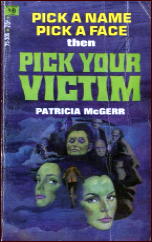
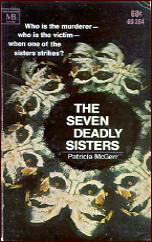
   I’ve read Pick Your Victim, and it’s not one I’ll easily forget. We know there has been a murder done, who has committed it, and from only scraps of evidence is the identity of the victim eventually deciphered. A summary I’ve found of The Seven Deadly Sisters suggests that McGerr upped the puzzle twofold: neither the killer nor the victim is known, and the identities of both have to be worked out.

   …Follow, As the Night… (complete with double ellipses, at least in the paperback version) is very much in the same category. In a brief prologue, we learn someone has died, and in Chapter One, we find the killer (identity known) planning a dinner party, with one of those invited being the person he intends to become the victim of a fatal accident.

PATRICIA McGERR

   Invited are Larry Rock’s two ex-wives (one not yet divorced), his mistress, and his current fiancée, who is also — as if this were not enough — pregnant. It makes for quite an evening. In fact that’s all the time it takes for the events of the entire book to transpire; that is, if flashbacks don’t count.

   The detective per se is Rock’s first wife, who arrives early and finds the loose railing on the penthouse balcony. Knowing exactly what he intends to do, her problem, identify the victim — which may be her!

   The bulk of the book is a character study, then, of a cad, a word that I don’t use very often, but it certainly fits both the period (the late 1940s) and the man. Problem: I knew how the book was going to come out as of page 10, and while there was a good chance that I was wrong, I wasn’t.

   The gimmick didn’t work, in other words, or not for me, but the character study did. It’s not enough for an unqualified recommendation, but from the perspective of a clever approach to a detective novel, it’s certainly worth reading.

— November 2003

FIRST YOU READ, THEN YOU WRITE
by Francis M. Nevins


   While working on the last tedious chores in connection with ELLERY QUEEN: THE ART OF DETECTION, which will come out in January, I expected to devote my final column of the year to someone besides EQ. Almost anyone. But back in October Joseph Goodrich — a name you’re familiar with if you read this column regularly — emailed me a long document consisting of a large number of letters from Manny Lee to Fred Dannay that for space and other reasons he hadn’t included in BLOOD RELATIONS, his collection of the correspondence between the cousins whose byline was Ellery Queen.

   Many of these letters were undated, those that had dates were often out of chronological order, typos abounded, but — Wow! For the next few weeks I alternated between slogging away at the ART OF DETECTION index and working on the Lee document: reorganizing, trying to date the letters that were dateless, adding material in brackets to explain (where I could) who or what Manny was talking about, doing pretty much the same things Joe Goodrich himself had done so well in BLOOD RELATIONS.

   One item I discovered I was able to work into the text of my book at the last minute. The earliest letter in the document dates from very late 1940. Fred Dannay had recently been discharged from the hospital after suffering serious injuries in an auto accident. Manny’s letter mentions that among the people who had called asking about Fred was one Laurence Smith, whom he identifies as the ghost writer behind the then recently published novelization based on the movie ELLERY QUEEN, MASTER DETECTIVE (1940).

   Laurence Dwight Smith (1895-1952) has long been forgotten but a few minutes with Google brings him back to life. Under his own name he wrote four or five whodunits, several mystery/adventure books for young adults, and a few nonfiction books like CRYPTOGRAPHY: THE SCIENCE OF SECRET WRITING (1943) and COUNTERFEITING: CRIME AGAINST THE PEOPLE (1944). His short story “Seesaw” was one of the first originals to be published in Ellery Queen’s Mystery Magazine (July 1942). What else he may have written under other bylines, or even whether he ghosted the other EQ movie novelizations, THE PENTHOUSE MYSTERY (1941) and THE PERFECT CRIME (1942), remains unknown.

***

   It’s long been known that Fred Dannay devised the plots for the Ellery Queen novels, stories and radio dramas and Manny Lee did the actual writing — and also that at a certain point in the nine-year life of the radio series Fred, whose wife had been diagnosed with cancer that eventually (on July 4, 1945) killed her, couldn’t perform his function any longer.

   Exactly when that happened would remain unclear today except for the Lee document. In a letter written on June 30, 1948, shortly after the Queen radio program was cancelled, Manny mentions that he had taken over the series “in January of 1944, when you dropped out of active work.” For most of that year, Manny reminds Fred, he made do by recycling 30-minute scripts from earlier seasons and condensing some of the original 60-minute scripts (1939-40) to half-hour length.

   Eventually, Manny says, he “began doing originals from bought material.” When? In October 1944, at the start of the program’s fifth season. Does this mean that every new weekly episode from then on was based on a plot synopsis by someone other than Fred? Not at all! Manny’s correspondence with Anthony Boucher informs us that Fred was several synopses ahead of schedule at the time he dropped out.

   These Manny squirreled away and fleshed out into scripts over the next two years, the last one (“The Doomed Man”) being broadcast late in August 1946. But most if not all of the new scripts for the fifth season were probably based on “bought material.”

   Bought from whom? For the first several months of the new regime, the plots were devised by a long forgotten scribe named Tom Everitt. Even in the age of the Internet almost nothing is known about this man, but we know a great deal about what Manny thought of him because his letters to Boucher are full of snarky remarks about Everitt’s competence and character. On May 24, 1945, he described himself as “hating [Everitt’s] smug, treacherous guts” and Everitt’s recent plot synopses as “sloppier…even than usual….”

   His letters to Fred Dannay in the Lee document offer more of the same. On November 4, 1947, he called Everitt “a son-of-a-bitch” who at the rate of $400 per synopsis got “tremendously overpaid” even though “the bulk of the creative work was done by me, out of sheer necessity….[Y]ou don’t know the things…that bastard has been saying and is still saying in the advertising business about his ‘part’ in the Queen show. There is no protection against his kind of conscienceless and unscrupulously shrewd self-propaganda….”

   Manny would love to have worked exclusively with Boucher but Tony was unable to come up with complex Ellery Queen plots on a one-a-week basis and Manny had no choice but to continue buying from Everitt until late in the program’s radio life.

   At least 33 of the Queen scripts between January 1945 and September 1947 came from Everitt raw material and are identified as such in my book THE SOUND OF DETECTION (2002). Most of the scripts between October 1944 and mid-June 1945, when the first episode based on a Boucher plot was broadcast, were probably derived from Everitt too. “Cleopatra’s Snake” (October 12 and 14, 1944) finds Ellery as backstage observer at a live production of ANTONY AND CLEOPATRA for experimental TV when the genuine poisonous snake being used in the death scene (yeah, right) bites to death the actress playing Cleopatra.

   In “The Glass Sword” (November 30 and December 2, 1944) Ellery tackles the case of the circus sword swallower who died when the sword in his stomach broke while the lights were out. These concepts strike me as way too wacko to have come from the mind of Fred Dannay. Therefore they almost certainly came from Everitt.

   The vast majority of Everitt-based EQ episodes have never been published as scripts and don’t survive on audio. But it now seems quite possible that one of them was mistaken for a Dannay-based episode and published a few years ago — as the title story in the collection THE ADVENTURE OF THE MURDERED MOTHS (Crippen & Landru, 2005). The episode with that title was broadcast on May 9, 1945. The plot is nowhere near as off-the-wall as those of “Cleopatra’s Snake” or “The Glass Sword” and therefore might be one of those Fred completed before he left the series. We just don’t know. Maybe we never will.

Hi Steve,

   W. B. M. Ferguson’s dates are given everywhere, including Crime Fiction IV, as 1881-1967. The birth is correct according to the Irish births registration, but I have now found in the English National Probate Calendar the death of a William Blair Morton Ferguson on 12 January 1958 in Londonderry.

   I have told Allen Hubin as it seems unlikely there are two people of that name, though one never knows.

   But, as I have said, as the 1967 death is given everywhere, I wonder if you could mention this to see if anyone can provide more information. It would also help to spread the word of that incorrect date – if it is incorrect.

   Many thanks

               John

      BIBLIOGRAPHY     [Taken from Crime Fiction IV, by Allen J. Hubin] —

FERGUSON, W(illiam) B(lair) M(orton) (1881-1967); see pseudonym William Morton; Born in Belfast.

* *The Big Take (Long, 1952, hc) [U.S.]
* *-Black Bread (Long, 1933, hc)
* *The Black Company (Jenkins, 1925, hc) [New York] Chelsea, 1924.
* *Boss of the Skeletons (Long, 1945, hc) [New York City, NY; 1920 ca.]
* _The Clew in the Glass (Chelsea, 1926, hc) See: The Clue in the Glass (Jenkins 1927).
* *The Clue in the Glass (Jenkins, 1927, hc) [U.S.] U.S. title: The Clew in the Glass. Chelsea, 1926.
* *Crackerjack (Long, 1936, hc) Film: Gainsborough, 1938; released in the U.S. as Man with 100 Faces (scw: A. R. Rawlinson, Michael Pertwee, Basil Mason; dir: Albert de Courville).
* *Dog Fox (Long, 1938, hc)
* *Escape to Eternity (Long, 1944, hc) [Dan Cluer; New York City, NY]
* *The Island of Surprises (Long, 1935, hc)
* *London Lamb (Long, 1939, hc)
* _The Murder of Christine Wilmerding (Liveright, 1932, hc) See: Little Lost Lady (Hurst 1931), as by William Morton.
* *Other Folks’ Money (London: Nelson, 1928, hc) Chelsea, 1926.
* *Phonies (Long, 1951, hc) [New York City, NY; U.S. West]
* _The Pilditch Puzzle (Liveright, 1932, hc) See: The Murderer (Hurst 1932), as by William Morton.
* *Prelude to Horror (Long, 1943, hc)
* *The Riddle of the Rose (Jenkins, 1929, hc) [New York] McBride, 1929.
* *Sally (Long, 1940, hc)
* *The Shayne Case (Long, 1947, hc) [Dan Cluer; New York City, NY]
* *Somewhere Off Borneo (Long, 1936, hc)
* *The Vanishing Men (Long, 1932, hc)
* *Wyoming Tragedy (Long, 1935, hc) [Wyoming]

MORTON, WILLIAM; pseudonym of W. B. M. Ferguson, (1881-1967)

* *The Case of Casper Gault (Hurst, 1932, hc) [Police Commissioner Kirker Cameron; *Insp. Daniel “Biff” Corrigan; New York]
* *The Edged Tool (Chelsea, 1927, hc)
* *Little Lost Lady (Hurst, 1931, hc) [New York] U.S. title: The Murder of Christine Wilmerding, as by W. B. M. Ferguson. Liveright, 1932.
* *Masquerade (London: Nelson, 1928, hc) [*Insp. Daniel “Biff” Corrigan; New York] Chelsea, 1927.
* *The Murderer (Hurst, 1932, hc) [*Insp. Daniel “Biff” Corrigan; Police Commissioner Kirker Cameron; New York City, NY] U.S. title: The Pilditch Puzzle, as by W. B. M. Ferguson. Liveright, 1932.
* *The Mystery of the Human Bookcase (Hurst, 1931, hc) [*Insp. Daniel “Biff” Corrigan; Police Commissioner Kirker Cameron; New York City, NY] Mason (U.S.), 1931.

« Previous PageNext Page »