SUSAN HOLTZER – Curly Smoke. Anneke Haagen #2. St. Martin’s, hardcover, 1995; paperback, 1996.
I thought Susan Holtzer’s first book. Something to Kill For, was surprisingly good. I say “surprisingly” because most first novel’s aren’t, and because it was a good bit cozier in type than I usually read.
Anneke Haagen is moving into a rental cottage in Ann Arbor after a fire destroyed her home and all her belongings. The cottage is in .a small residential grouping located in the middle of commercial territory, and it’s in immediate danger of being demolished to make way for another development. The small group living there — which includes the prospective developer — are very much at odds over it all, and Anneke wonders what kind of people she’s landed among. Then on the night of a heavy snow a man is killed, and she knows — murderous.
[Holtzer] still hasn’t written the kind of book I usually like, and she still does a pretty damned good job of it. She has an easy prose style, and a very deft hand at characterization. I like [Anneke Haagen}, her computer consultant sleuth, and her ex-pro football player cop lover (yes, one of those; I told you I didn’t usually like this kind), and with an exception or two the cast of suspects is well done also.
The plot is fairly mundane and seemed the slightest bit contrived to me. I guess that very readable prose and very likable characters overcome a multitude of sins (not that there were that many), and I really liked the fact that Holtzer didn’t have her heroine charge into unnecessary danger and end the story with a burst of needless violence.
— Reprinted from Ah Sweet Mysteries #22, November 1995
The Anneke Haagen series —
1. Something to Kill for (1994)
2. Curly Smoke (1995)
3. Bleeding Maize and Blue (1996)
4. Black Diamond (1997)
5. The Silly Season (1999)
6. The Wedding Game (2000)
7. Better Than Sex (2001)
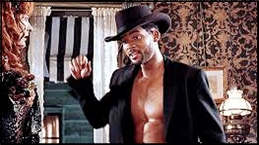
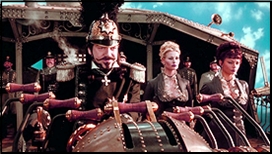
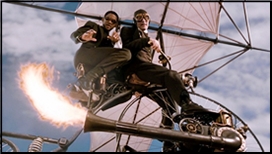
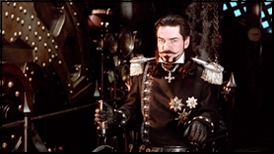
WILD WILD WEST. Warner Brothers, 1999. Will Smith (James West), Kevin Kline (Artemus Gordon), Kenneth Branagh (Dr. Arliss Loveless), Salma Hayek, M. Emmet Walsh, Ted Levine. Loosely adapted from The Wild Wild West, a 1960s television series created by Michael Garrison. Director: Barry Sonnenfeld.
Soon after the American Civil War, impulsive Army Captain Jim West (Will Smith) sets out to find his parents’ killer: the bitterly ruthless ex-Confederate General ‘Bloodbath’ McGrath (Ted Levine). The trail leads to a West Virginia brothel where the blundering intervention of undercover U.S. Marshal Artemus Gordon (Kevin Kline) and an accidental nitroglycerin explosion causes McGrath to escape.
The two Americans may be on the same side, but they dislike each other on sight, so neither are pleased when President Ulysses S. Grant orders them to join forces and continue the hunt for McGrath, who has kidnapped several of the country’s best scientists in a plot which could destabilise the government.
Aboard Gordon’s gadget-laden train ‘The Wanderer’, the fiercely competitive pair follow a bloody clue to the New Orleans home of Dr. Arliss Loveless (Kenneth Branagh), a legless ex-Confederate officer and ingenious engineer in a steam-powered wheelchair and decorous goatee beard. Imprisoned there is singer Rita Escobar (Salma Hayek), who claims her father is one of the captured scientists. It seems that mysterious new weapons are being manufactured, one of which they discover to be an armoured vehicle – what we would now recognize as a tank – that has the power to kill dozens of soldiers in a single sweep.
Yet something even bigger abounds in an eighty-foot mechanical spider stocked with two nitroglycerin cannons. Loveless uses this war-machine to kidnap the President before threatening to destroy the United States if they aren’t divided among other nations and himself. The ensuing struggle on the cliffs of Spider Canyon ends with West – and the fate of the country itself – at risk of falling into a yawning abyss…
In the ’90s, making films of ’60s TV shows was a major trend. Baby boomers were buying tickets to see at the cinema what they had seen in their living rooms as kids. And so, after Batman, we got a cycle of remakes, mostly bad (Lost In Space, My Favourite Martian, The Saint) but some good (Mission Impossible, The Fugitive). Wild Wild West was yet another, based on the quirky action-adventure series made to weather the western genre’s declining popularity by having it capitalise on the James Bond craze – what you might call ‘spies-in-saddle’.
This film version must have sounded great at the time. People who had enjoyed Will Smith and middle-aged straight man Tommy Lee Jones being government agents in sci-fi comedy adventure Men In Black would surely watch Will Smith and middle-aged straight man Kevin Kline being government agents in western comedy adventure Men In Chaps. Smith even chose it over The Matrix, believing it could result in another of his “big Willy weekendsâ€.
Instead, Wild Wild West was a disaster. The script was re-written, scenes were reshot, and the budget ballooned until it became one of the most expensive films of all time. On release, it lost money and “won†five Razzies, including Worst Picture, Worst Screenplay and Worst Director. Smith has repeatedly joked about its failure. It might now be bundled alongside those two other self-afflicting franchise films of the late ’90s, Batman and Robin and The Avengers.
And yet, whereas I think such clunkers could be enjoyed as weird camp classics that just don’t care – the cinematic equivalent of streakers on a sports field – Wild Wild West is just bad.
The pace is off from the start: Smith’s first fight, though shot continuously, is placed either side of a languid scene with Kline in drag, immediately killing any excitement. From there, the humour is ribald, with two different sequences showing scantily-clad prostitutes, and at one point both main characters suggestively fondle a pair of fake breasts. It’s a strange attempt at a running joke with a crude pay-off, much later, in which Smith’s character beats his hands against a woman’s bosom.
The sexism becomes downright tasteless when Salma Hayek’s character unwittingly wears a buttock-exposing night-gown, much to the stunned pleasure of our heroes, who go on to mutter much innuendo built around the word “assâ€. Apart from that, in fact, Hayek is barely in the movie at all. She tries to join them by slipping onto their train, yet Smith’s character doesn’t believe she can handle herself and insists she get off again. The actress herself felt underused in what is little more than an extended cameo. You know they only put a woman in it so they could splash her over the posters.
Elsewhere, Ted Levine – playing yet another southerner – is dependable as always, though he gets dispatched halfway through with little consequence. Branagh is fun, and director Barry Sonnenfeld regularly has him wheel close to the camera to humorous effect. Thinking, though, of how Ken justified all this to his high-brow theatre friends in London is more entertaining than anything managed on set.
The balance, throughout, between Smith and Kline is not quite set and neither appear to be the foil. (Maybe they’re not meant to be equal? Note how the title drops the definite article of the original version, subtly giving Smith the eponymous character – did Kline not notice?).
Characterisation, too, is a bit ropey: at times, Kline gives us an amiably absent-minded scientist, proud of his gadgets and easily distracted by them, yet at others he seems cynical and condescending to his partner. And the decision to have him play the President too is just baffling. It made sense in Fierce Creatures when he was a father and son, but here it’s contrived, convenient and not at all cute.
Meanwhile, Smith’s loud, smart-guy persona seems a little anachronistic in the Old West – and though some of the race jokes work in his favour, others are just clumsy and misconceived, especially a sequence in which he must appease a lynch mob, and another that sees him doing a harem dance (even the director hated it).
Perhaps most importantly, the stakes in this thing are too fuzzily defined: why, for example, must Loveless be caught before the transcontinental railroad is inaugurated? And which is the super-weapon – tank or tarantula?
A boisterous, preposterous romp, Wild Wild Westdoes show occasional flashes of inspiration: the opening, in which a terrified man is decapitated by a flying buzz-saw, is vividly Avengers-esque, and there’s playful humour in all manner of steampunk gadgets. Yet the film never enjoys its western trappings as thoroughly and warm-heartedly as, say, Maverick or Back to the Future Part III, and neither does it do anything with the world of spying. This is an espionage-western which isn’t interested in either genres, focusing instead on infantile comedy, tired buddy-cop tropes and empty, if eccentric, spectacle.
Had it been a light-hearted mystery-adventure with a sense of proportion, it could have been terrific. As a comedy, however, it’s a wild, wild mess.
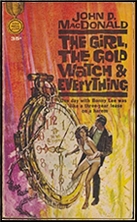
JOHN D. MacDONALD – The Girl, the Gold Watch, and Everything. Gold Medal #s1259, paperback original, 1962. Reprinted many times.
Kirby’s a clumsy doofus. Handsome. Winsome. But a doofus.
Kirby’s got a rich uncle. Super-duper rich. And Kirby has a cushy job from his uncle going around giving oodles and oodles of money, anonymously, to charitable causes.
Then his uncle dies, leaving him nothing, though Kirby was the sole surviving heir.
Nothing, that is, except a gold pocket watch.
In fact, the estate has nearly nothing — even though his uncle seemed to have millions and millions of buckaroos. What happened to the freaking money?
Turns out that Kirby’s uncle got rich by screwing the Mafia and other nogoodnicks by sneaky and conniving means — means of which were so top-secret as to never having been divulged to anyone — much less poor Kirby.
A couple of supervillains of the Boris and Natasha type try to kidnap Kirby to tell them his uncle’s business secrets and where hides the boodle.
Kirby doesn’t know. They can’t figure out if he’s really an imbecile or if he’s just a great actor.
Then one day Kirby is sleeping at a friend’s house, hiding from Boris and Natasha. A luscious, ravishing, blond bimbo leaps naked into his bed in the middle of the night, screwing his brains out, believing in the dark that Kirby is the guy Kirby is house-sitting for.
At first, she’s mad — but she forgives Kirby and they fall deeply in love, discovering meanwhile that the secret to his uncle’s success was the pocket watch!
Turns out, if you wiggle the watch just right, it freezes time!
Of course, freezing time wouldn’t do much good if it froze for everyone. But the bearer is immune from the time freeze.
So while time is frozen, you can engage in whatever high-jinks you like for up to an hour at a time: taking money from tills, changing the trajectory of bullets, sinking subs, altering evidence.
It’s all quite fun and silly. And nobody loses an eye.
Made into an even sillier made-for-TV movie starring Robert Hays (of “Airplane!†fame) in 1980.
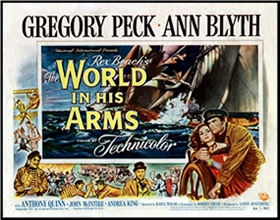
THE WORLD IN HIS ARMS. Universal, 1952. Gregory Peck, Ann Blyth, Anthony Quinn, John McIntire, Hans Conried, and Sig Ruman. Screenplay by Borden Chase and Horace McCoy, from the novel by Rex Beach. Directed by Raoul Walsh.
Rollicking.
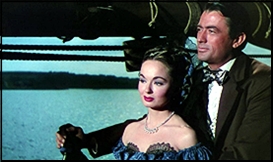
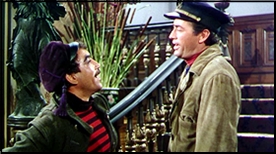
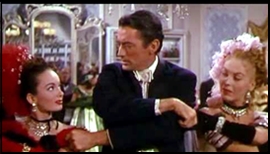
Greg plays a two-fisted seal hunter known as The Boston Man, just arrived in San Francisco (1850) with the richest haul of pelts ever, full of ambitious plans to buy Alaska from the Russians and stop their rapacious seal-slaughter. He also engages in friendly rivalry with a scoundrel called The Portugee (Anthony Quinn, playing the part like Chico Marx) and more serious pursuit of Ann Blyth, a Russian Princess passing as a commoner for the sake of the plot.
Screenwriter Borden Chase once said the secret of his success was to write in a part for John McIntire, a character deliberately added, whose dialogue will provide background, explication and foreshadowing, and relieve the leading man of a lot of burdensome talk. In this case the part is played by McIntire himself as a sort of soloist in a Greek Chorus, and done quite smoothly.
And in this case Chase also wrote in a part for Bill Radovich, an ex-linebacker built like a tow truck and entrusted with the role of Ogeechuk, Greg’s Inuit pal, whose function it is to break down doors and throw folks around—it seems The World in His Arms was originally written for John Wayne, who could do all the door-breaking and folk-throwing himself, but with Greg it just didn’t work. Hence Ogeechuk.
This film could have coasted along on sheer charm, but someone felt constrained to fill in some kind of story. Something about Greg being disappointed in love, fighting with Anthony Quinn, getting blown out of the water and captured by Russians, but the whole thing is so hopelessly interlarded with fights and chases, it’s hard to care about the story, much less follow it.
One thing does stick in my mind, though. I saw this movie on local TV back in the 1960s, and I distinctly remember a scene where Greg and his boys go about clubbing baby seals to death while John McIntire explains that what looks like gleeful Pinniped Slaughter (Clunk!) is actually a responsible culling (Boink!) of excess population (Whack!) necessary to protect the species (Smack!)
Which is as may be, but when The World in His Arms showed up on my streaming service, those few minutes were conspicuously absent.
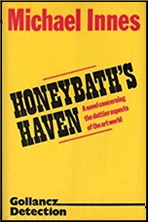
MICHAEL INNES – Honeybath’s Haven. Charles Honeybath #2. Victor Gollancz, UK, hardcover, 1977. Dodd Mead, US, hardcover, 1978. Penguin, US, paperback, 1979.
After not reading Innes for a long while, it comes as a distinctly insidious pleasure to learn that both he and his unmistakably erudite style are still in top form. On hand is not Appleby, in this his latest, but noted artist Charles Honeybath, who is filled with concern with the increasing eccentricities of an old friend and with the inevitable approach of his own old age.
A retirement estate called Hanwell Court seems to be the answer to both problems, but unhappily it is not — and predictably the result is murder. The knobby humor tends to irritate, but full compensation is a worthy consideration of the artistic temperament, one well up to Innes’ standards.
Rating: B
– Slightly revised from The MYSTERY FANcier, September/October 1978.
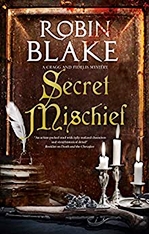
ROBIN BLAKE – Secret Mischief. Cragg & Fidelis #7. Severn House, hardcover, May 2021. Setting: Lancashire, England, 1746.
First Sentence: It was on a breezy Monday in April 1746 that I received a letter from a townsman of Ormskirk.
A letter from a townsman of Ormskirk sends County Coroner Titus Cragg, and his friend Dr. Luke Fidelis, to the farm of Richard Giggleswick. There they find Geoffrey, the farmer’s potent boar, has been shot. Several days later, they are asked to return but now it is Giggleswick who is dead; murdered. They discover Giggleswick was one of six people involved in a Tontine; an agreement where each member contributed an amount of money to be claimed by the last surviving member. The one person who did not join was attorney Ambrose Parr.
One learns about a great deal about the legal system of the 18th century. This was a time when the accused had no right to subpoena witnesses, have their lawyers argue the case for them, or testify on their own behalf. This was not a time when justice was served, especially for the poor. The period is presented in stark and painful accuracy.
There are a fair number of characters, several of whom, though relevant, are dead before the story even begins. One that had the potential for being interesting, Giggleswick’s daughter, is shuffled off almost immediately. Of our two protagonists, Titus comes across as weak and rather incompetent. He leaves his judgment up to the intuition of his clerk. Rather than conducting a full investigation, he is influenced by the opinion of others until it’s too late. Fidelis, especially for a doctor, is bigoted and judgmental, willing to cost a life.
The period is well conveyed, from the descriptions to the dialogue which has a sense of the time without being uncomfortable. In general, a plot involving a tontine can be suspenseful, but the author waited late into the story before creating any real sense of grave danger. Although there are several twists, they aren’t effective enough to save the story.
Secret Mischief is a muddled, rather unpleasant take on And Then There Were None, with the protagonists being annoyingly weak, and the ending patently absurd.
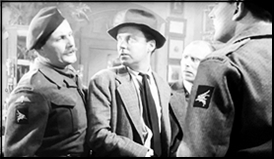
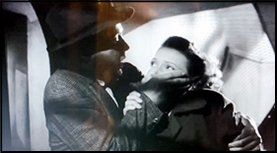
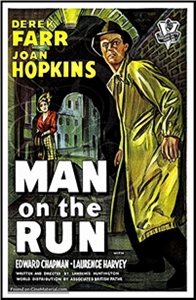
Peter Burden (Derek Farr) is an army deserter, one of twenty thousand British men who live in fear of imprisonment even after the war has ended. After having served four years, the authorities denied his request for compassionate leave in order to attend his mother’s deathbed and he absconded in disgust.
He is now working as a landlord of a country pub and is pulling pints when an old army acquaintance (Kenneth More) walks in and recognizes him. Corporal Newman is newly demobbed and, having found only low-paid work in the area, opportunistically blackmails Burden.
Terrified, Burden flees again, this time returning to London, where a lack of funds and the late rent on a ragged bedsit force him to try and pawn his old service revolver. At the jeweller’s, however, two armed robbers arrive and promptly kill a copper, with Burdon believed to be part of the gang.
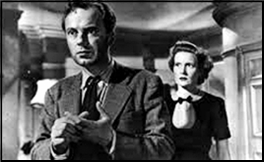
His attempts to elude the police become more perilous than ever and a desperate escape sees him bounding breathlessly into the house of young widow Jean Adams (Joan Hopkins). Jean takes pity on the ex-soldier and agrees to help. The pair become determined to find the robbers, knowing only that one of them (Edward Underdown) is missing two fingers on his left hand.
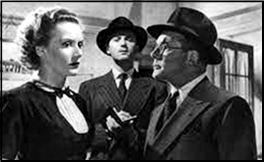
All the while, they must avoid the grimly persistent Chief Inspector Mitchell (Edward Chapman) and Detective Sergeant Lawson (a young Laurence Harvey), who prove to be quite able pursuers…
Lawrence Huntington directed, produced and wrote this foray into near-noir which was presumably inspired by the many deserters still at large long after V.E. Day. His script carefully positions Burdon as a sympathetic figure (the name is well-chosen). The sad circumstances surrounding his desertion and the fact he had spent most of the war in combat is repeated at least once.
To steer clear from presenting him as a coward or a chancer was undoubtedly important as everyone in the audience would have known soldiers or might even have been one themselves. Huntington also has his protagonist plea for a more constructive solution to the problem, particularly when so many such people inevitably turn to crime to survive.
This situation, often forgotten today, makes Man on the Run interesting and slightly more nuanced than other chase thrillers, though it so solidly sides with Burdon that a more minute exploration of similar issues facing other such soldiers – for example, post-traumatic stress or the frustrating futility of war itself – is avoided altogether. There’s a sense that each man would have his own story, though nobody describes what those might be.
Derek Farr is excellent as Burdon: pained, thoughtful, and reluctant to enlist anyone else’s help. It’s a shame he didn’t have more of a career as he could easily have become a Kenneth More. More himself pops up early on, well before his middle-class every-man persona, like an English James Stewart in tweeds and a pipe, would lead him to become one of Britain’s biggest film stars.
The police investigation, meanwhile, is headed by the sort of dogged, pipe-smoking detective familiar to pictures of this period, with Chapman’s chief inspector wry and astute enough to elicit tension. It’s this quietly humming, will-they-catch-him? element which carries the film, particularly in the excellent first half, though a thrilling set-piece of the sort included in The 39 Steps(which also had a bad guy deprived of a digit) or North By Northwest is unfortunately even more elusive than Burdon himself.
Particularly interesting for its glimpses of post-war life (from genuine London locations to a reference to radio’s proto-James Bond Dick Barton), plus some gently amusing moments, Man on the Runmakes for an entertaining and compelling thriller which is much recommended.
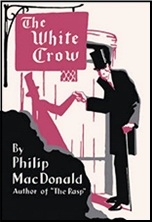
PHILIP MacDONALD – The White Crow. Colonel Anthony Gethryn #2. Collins, UK, hardcover, 1928. Dial Press, US, hardcover, 1928.
This is the second of MacDonald’s books featuring Colonel Anthony Gethryn. The much better-known The Rasp was the first.
In The White Crow he presents a puzzle of the locked-room variety. An elderly financier, clad only in his underwear, sits in his office chair with his throat cut. The door is locked; the window looks out on a sheer drop; there is no way a murderer could have been concealed in the room, nor could the key have been turned from the; outside.
The office boy has disappeared, though at first that seems to have no connection with the murder. He is an interesting office boy, however, with an unusual sideline for bringing in extra money. Lucas calls in Gethryn, and A.G. works side by side with Superintendents Boyd and Pike.
Not a whisper or jealousy or hostility; the police think Colonel Gethryn is just too, too marvelous. Embarrassing, their hero-worship is at times. The will is a puzzler, and some sleuthing on the part of Anthony’s brother-in-law catches a strange element there.
Naturally it is A.G. who sorts out the lot of secretaries, lawyers, and night-club habitues, deduces bow the crime was done, and finds out whodunit. Though there is good detective work done, the identity of murderer-in-chief is pulled out of a hat.
– Reprinted from The Poison Pen, Volume 3, Number 3 (May-June 1980).
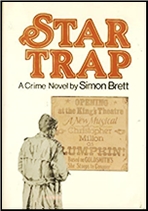
SIMON BRETT – Star Trap. Charles Paris #3. Gollancz, UK, hardcover, 1977. Scribner’s, US, hardcover, 1978. Berkley, US, paperback, 1981. Dell, US, paperback, 1986.
This is the third mystery case tackled head-on by Charles Paris, an aging British actor who’s something of a tosspot, and a guilt-ridden womanizer to boot, but if you enjoy stories that take you behind the scenes of show business and can appreciate immoderate doses of clever sardonic wit, make it a point not to miss any of them.
In this one he’s asked by an important investor in a new West End musical to investigate a series of suspicious accidents happening to some of the cast. Midst the excitement and pressure of a hit show being put together, Paris’s purely amateur sleuthing adds considerably to the charm.
Rating: B
– Slightly revised from The MYSTERY FANcier, September/October 1978.
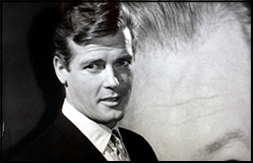
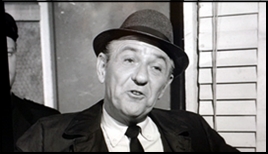
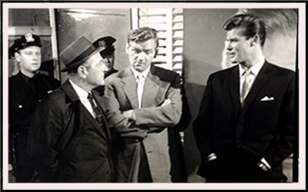
THE SAINT “The Careful Terrorist.†ITC, UK, 18 October 1962 (Season 1, episode 3.) Roger Moore (Simon Templar), Percy Herbert (Hoppy), Alan Gifford (Inspector Fernack). Guest Cast: David Kossoff, Peter Dyneley, Sally Bazely. Based on a story by Leslie Charteris. Directed by John Ainsworth. Currently streaming on the Shout Factory channel.
This third episode in the long-running The Saint series starring Roger Moore is only a little better than average, but it does have a few things to note about it. First of all, it has Simon Templar living comfortably in a New York City apartment, complete with a manservant named Hoppy, straight from the books, and a homicide detective named Furnack, a friendly adversary on the NYPD police force, also from the books. He is also up against a villain whom he deems one of the “ungodly,†and from whom he extracts a particularly wicked revenge.
The fellow, an urbane but totally crooked union boss who blows up a newspaper friend of Templar’s, really doesn’t stand a chance. When The Saint seeks retribution, he gets it, and the boss is thereby “hoist by his own petard.â€
Although he appeared in several of the Saint’s book-length adventures, this was the first and only appearance of Hoppy (Uniatz) in the TV series, and perhaps thankfully so. In this episode he’s played as an out-and-out moron with a mind full of bricks, spending his free time watching kids’ shows on TV and ogling girlie magazines. The fellow who plays Furnack, though, looks much the same as I pictured him, and yet he showed up in only one later episode, due to the fact that he’s pretty much tied down to his home base of New York City.
So it’s fairly obvious that the show’s producers were still feeling their way with this one, only a short way into the series, I thought it was the best so far. (Number two in the series was reviewed here by me.)