Reviews


REVIEWED BY DAN STUMPF:


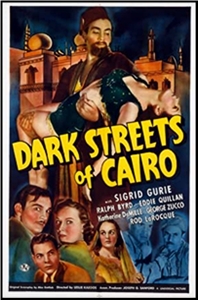
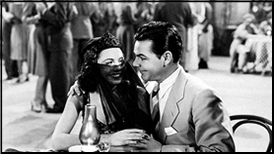
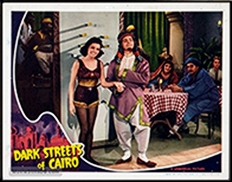
DARK STREETS OF CAIRO. Universal, 1940. Sigrid Gurie, Ralph Byrd, Eddie Quillan, Katherine DeMille, Rod La Rocque, George Zucco, Yolande Donlan, Lloyd Corrigan and Henry Brandon. Written by Alex Gottlieb. Directed by László Kardos.

   An afterthought to The Mummy’s Hand (also 1940) with the same sets, music and extras. George Zucco even wears the same shiny fez! But the players somehow manage to carry it off.

   Alex Gottlieb’s script is nothing special, and the characters are strictly from boilerplate: Stuffy old archeologist (Wright Kramer) his brash young assistant (Ralph Byrd) and the assistant’s wing man (Eddie Quillan) icy aristocratic lady (Sigrid Gurie) just waiting to be melted, dance hall girl (Yolande Donlan) with a heart of gold and a jealous boyfriend (Henry Brandon) etc. etc.

   The actors are so accustomed to parts like these by now they slip into character gracefully and even with a certain amount of authority. Rod La Rocque makes an effective Police Inspector, up against suave master criminal George Zucco, and their wit-matching scenes have that kick that comes when two veteran actors strike sparks together.

   The plot also has a few unusual wrinkles. Stuffy old Kramer has unearthed the priceless jewels that usually turn up in movies like this, and Zucco wants them. In fact, he has already arranged a sale to wealthy collector Baron Stephens (Lloyd Corrigan – and come on now: “Baron Stephens?” Really?) with a cover story that Kramer is selling them under the table, and he’s even got some fakes to switch with the real jewels, when henchman Henry Brandon bungles the theft by killing Kramer — which tips off Baron Stephens that it’s kinda shady under that there table. But when Corrigan backs out of the deal, Zucco abducts him, with an eye to framing him for Kramer’s murder. So it’s up to Byrd and Gurie — who turns out to be Corrigan ‘s daughter — to find and rescue him.

   That’s a lot of plot to squeeze into less than an hour, but director Kardos steps on the gas and runs through it with speed that defies illogic in the plot.

   I’m not here to tell you Dark Streets of Cairo is an undiscovered classic. Bu it’s a little better than it needed to be, and fans of fast-paced B-movies won’t regret watching this one.


FIRST YOU READ, THEN YOU WRITE
by Francis M. Nevins


   In 1946, soon after the end of World War II, the editors of the high-paying Esquire decided to launch a series of short detective stories and invited several authors to create a new character for possible publication in the magazine. Among those solicited was that incomparable filbert Harry Stephen Keeler (1890-1967), who strung together an outrageous plot about a barking clock and an astigmatic witness and dreamed up a 7½-foot-tall mathematically-educated hick from the sticks as his new detective.

   Reasonably enough, Esquire rejected the story. Who won the prize that Keeler lost? A guy who happened to have the same first and last initials as our Harry. The subject of this column.

***

   About the life of Henry Kane very little has surfaced. He was born in New York City on 18 May 1908 as Henry Cohen and apparently graduated from one of the city’s several law schools in the 1930s. How long he practiced law is unknown, but it does seem clear that he preferred writing to legal work.
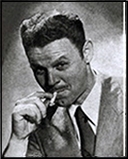
   Whether he served in World War II is also unknown. At the time of Esquire’s hunt for a new series character he seems to have published nothing, and what the editors saw in him is likewise a mystery. The character he created for the magazine was Peter Chambers, a tough but sophisticated Manhattan private richard (as he prefers to call himself) whose first appearance in short-story form was “A Glass of Milk” (Esquire, February 1947).

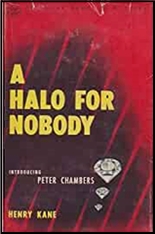
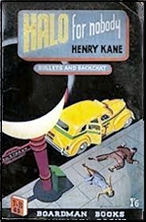
   It was also early in 1947 that Chambers debuted as protagonist of a hardcover novel. Whether the early short stories preceded or followed A HALO FOR NOBODY (Simon & Schuster, 1947) is anyone’s guess: my own is that at least the first couple of them came first. Kane stayed with S&S for a few years, then migrated to the field of paperback originals where he flourished during the Fifties and Sixties, having Chambers narrate his own cases in a wackadoodle style which his admirers have dubbed High Kanese.

   It’s likely that Chambers was the uncredited inspiration for the hit TV series PETER GUNN (NBC, 1958-61), for which the tie-in novel (PETER GUNN, Dell pb #B155, 1960) was written by, you guessed it, Henry Kane. Later in the swinging Sixties Kane reconfigured his character as protagonist in a series of X-rated paperbacks for Lancer (1969-72).

   During the final phase of his career he turned out a number of stand-alone hardcover thrillers, some under his own byline, others as by Anthony McCall, Kenneth R. McKay, Mario J. Sagola (a name probably meant to evoke the Godfather saga) and Katherine Stapleton. He died in his home at Lido Beach, Long Island on 10 October 1988.

***

   A HALO FOR NOBODY opens with a report by Chambers to his friendly enemy NYPD Lieutenant Louis Parker, and of course to us: he was walking down Park Avenue in the lower Eighties on the way to an appointment with a potential client when, a block or so ahead of him, he witnessed an attempted kidnapping and the murder of a woman, who turns out to be the potential client’s wife.
   Being armed at the time — which establishes, I suppose, his machismo — he fired several shots into the back of the taxi in which the criminals were escaping. The taxi is later found in Central Park with two dead men in it: the driver and a known hoodlum.

   Soon afterwards, Chambers is hired by the dead woman’s husband not to solve the murder of his wife, whom he hated, but to find out why someone is trying to blackmail him when he knows he’s done nothing blackmail-worthy. It would take several pages of summary to penetrate deeper into Kane’s Chandleresque plot labyrinth and I doubt it would benefit anyone to read them.

   When A HALO FOR NOBODY was published in 1947, Kane was touted by Simon & Schuster as “a worthy successor to Dashiell Hammett.” Talk about ridiculous! The main connection between the two is that Kane, like so many others, borrowed from Hammett the climax of THE MALTESE FALCON.

   To Raymond Chandler he owed a bit more, including some elements of his protagonist — even the names have the same cadence, Philip Marlowe and Peter Chambers — and the all-but-incomprehensible labyrinthine plot, although he does keep to a reasonable minimum the vivid figures of speech in which Chandler indulged perhaps too often.
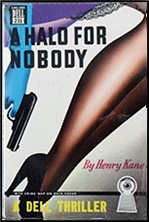
   The stylistic feature of HALO that jumps out at the reader is Kane’s habit of converting several short sentences into a single long one by the repeated use of the most common conjunction in the language. Here’s an example from a nightclub scene.

   Blue smoke curled and wavered and curtained the ceiling and the girl rocked at the microphone and her eyes were closed and her dark eyelids glistened and she sang slowly in a deep, hushed voice, throbbingly, against the wash of subdued conversation.

   I have a vague recollection that this trope started with Hemingway but I doubt that Papa used it to anywhere near the same extent as Kane.

   Anyone writing a dissertation on political incorrectness in PI fiction will go no farther than Chapter Four when Chambers encounters a gay ex-gangster and calls him, to his face, “a fairy, a phony, a queerie, a pervert.” Any such reader will miss perhaps the most memorable scene in HALO, the gunpoint tête-à-tête between Chambers and the most cold-blooded of the novel’s three murderers, who is also perhaps the most philosophical killer in the entire Kane Kanon:
   â€œChambers, a long time ago I learned it was dog eat dog. A human life means nothing; your own life, conversely, means everything. We are taught differently. Comes a war — how quickly they attempt to reteach us. You have no personal grievance against the soldier of the enemy — -but you kill him, unfeelingly. A human life, in the vast perspective, means nothing; but protect yourself. With yourself, there is no perspective.”


   At the end of the scene a slightly wounded Chambers faints, vomits several times, finds a bottle and guzzles nonstop for five minutes. He then segues into the MALTESE FALCON climax from which, unlike Sam Spade, he emerges with five bullets in his stomach. From his hospital bed he identifies the third and final of the book’s murderers. That too, I suppose, is machismo.

   In his review for the San Francisco Chronicle (16 February 1947) Anthony Boucher wisely made no attempt to summarize the plot of HALO but limited himself to describing Chambers as “a private eye who thrives on drink, wenching and coincidences” and the book itself as a “[r]easonably good toughie, at once more literate and more confusing than most….” I cannot better that description.

***

   The second Chambers novel, ARMCHAIR IN HELL (1948), is similar to HALO in opening with three corpses. It’s after midnight when our private richard is ungently pulled out of an alcoholic haze by one of his most lucrative clients, a wealthy gambler known as Ziggy who’s found a naked woman with her throat slit in his house on West 76th Street.
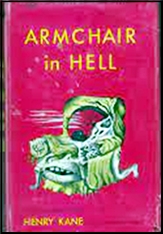
   At the house Chambers and Ziggy find two additional corpses: a henchman of the gambler’s and a prominent art dealer. Chambers has his client steal a car, take the bodies and dump them near the river, then joins Ziggy for a 4:00 A.M. conference over cheesecake and coffee and learns that the gambler had been promised $500,000 to act as go-between in the transfer of some priceless tapestries that had been taken out of France by the Nazis during World War II.

   Those tapestries are Kane’s version of what Hammett called the black bird and Hitchcock the McGuffin. Like any McGuffin worthy of the name, this one is being sought by an assortment of questionable characters, including a blonde sexpot, a brunette sexpot, an art critic (whom Chambers describes as “a California elf”), an oddball Frenchman, a pool shark, a ballroom manager, and a sinister dwarf with a huge moronic goon who, in a scene reminiscent of the beating of Ned Beaumont in Hammett’s THE GLASS KEY, marks Chambers up with a set of brass knuckles.

   The climax calls to mind the conference among all the parties near the end of THE MALTESE FALCON, with Chambers pulling the strings so that the murderer is gunned down in front of witnesses by one of the other contenders for the tapestries.
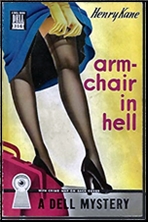
   Our friend the student of political incorrectness will find short rations in this one, mainly the scene where Chambers asks about another character’s sexual preference or, as he phrases it, whether the man is “a nancy…. A fruit, a milky way, a buttercup.” Any such student who stopped there would miss perhaps the most interesting moment in the book, a sort of meta-scene where Chambers describes not only himself but almost every PI who came into the genre in Chandler’s shadow.

   He “has no wife, or sleep, or food, or rest. He drinks, drinks more, and more; flirts with women, blondes mostly, who talk hard but act soft, then he drinks more, then, somewhere in the middle, he gets dreadfully beaten about, then he drinks more, then he says a few dirty words, then he stumbles around, punch-drunk-like, but he is very smart and adds up a lot of two’s and two’s, and then the case gets solved….”

***

   Later that year Simon & Schuster published REPORT FOR A CORPSE (1948), a collection of Kane’s first six short stories, all from Esquire. Whereas in his book-length cases Chambers had been a member of a PI firm complete with senior partner, an old-maidish secretary and at least three legpersons, in these shorter tales he’s a lone wolf with only the secretary Miranda Foxworth carried over from the novels.
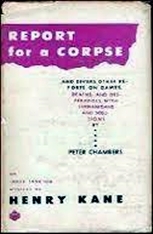
   For some unaccountable reason the stories in book form are not printed in chronological sequence but I shall cover them in Esquire’s order.

   â€œA Glass of Milk” (February 1947) opens on a Sunday afternoon as Chambers enters an elegant Madison Avenue drinking place, spies a beautiful blonde at the end of the bar nursing a glass of milk and orders another: obviously a prearranged signal. The blonde leaves and Chambers follows her to her apartment where she makes him a real drink, tells him she’s changed her mind about hiring him, and gives him fifty dollars for his time and trouble.

   That evening he’s visited by his friendly enemy Lieutenant Parker, telling him that the woman has been found dead, with her face mashed in, and Chambers’ prints all over the hotel suite. Chambers explains about the assignation at the bar but the apartment staff insist she never went anywhere that day and the bartender says he never served any blonde a glass of milk.

   Instantly we’re reminded of the situation in Cornell Woolrich’s iconic novel PHANTOM LADY (1942), with Chambers taking the part of the man who’s wrongly accused of his wife’s murder while he was in a bar with a woman no one else saw. Kane’s version of the story makes more sense than Woolrich’s but then he didn’t have to reach book length.
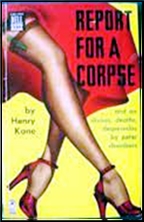
   Criminal lawyer Sonny Evans, who was an offstage character in A HALO FOR NOBODY, has a scene in “A Matter of Motive” (March 1947). It’s at his recommendation that Chambers is hired when a drugstore owner is charged with the murder of one of his clerks, who was blackmailing him over his sideline as a narcotics dealer, and with whom he had an appointment around the time of the killing.

   The next most likely suspect is the dead man’s nightclub-singer fiancée, who was also the beneficiary of his life insurance policy. Chambers searches the scene of the murder and finds a letter indicating that the dead man was having an affair with his blackmail victim’s wife and was about to break it off. With two female suspects, both of whom admit they were near the crime scene at the crucial time, plus of course his client, who also had motive and opportunity, Chambers figures out who done it in a manner reasonably fair to the reader.

   You’d never guess from the flippant title of “Kudos for the Kid” (May 1947) that it’s quite close to a traditional detective tale, with Chambers addressing his friendly enemy as “my dear Parker” and the lieutenant in turn griping about the PI’s Sherlock Holmes act.
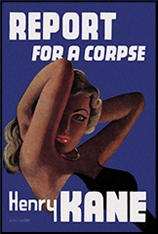
   Chambers happens to stop at a Fifth Avenue candy store to ogle a beautiful blonde staring into the shop window and is immediately invited to accompany her to an apartment hotel. What sounds like an invitation to bedplay quickly turns out otherwise: the blonde had lost a valuable emerald earring at a dance and was waiting for the person who had advertised in the newspaper, asking whoever lost the earring to meet him in front of the candy store, prove ownership of the jewel and take it back.

   Matters are straightened out in the hotel’s tower suite but before leaving Chambers discovers the blonde’s wealthy father dead of two bullet wounds in the stomach. Parker and the police doctor call it suicide but Chambers insists that suicides don’t shoot themselves in the stomach and instantly deduces the murderer (who appears onstage for exactly four paragraphs), then pulls a huge bluff to make the culprit confess.

   In the collection’s title story, “Report for a Corpse” (July 1947), a wealthy old woman hires Chambers to find out how her unfaithful husband, whom she’s refused to divorce (at a time when the only ground for divorce under New York law was adultery), plans to kill her. Shadowing the errant husband, Chambers discovers that he’s surreptitiously collected a huge supply of barbiturates.

   Visiting his client’s stately home to report to her, he gets to meet the couple’s lovely adopted daughter and apparently has a quickie with her. Soon afterwards the older woman is found dead of an overdose of, you guessed it, barbiturates. Chambers fakes an alibi for the husband and then pins the crime on — well, I’d be a toad if I said more.

   With five violent deaths and a plot rooted in events of a dozen years earlier, “The Shoe Fits” (July 1947) leads one to suspect that Kane had begun it as a novel and then, changing his mind, had boiled it down to the length of his other Esquire tales. In Hollywood to act as a $750-a-week technical adviser on a PI epic — perhaps a follow-up to THE BIG SLEEP? — Chambers is offered a bonus by the producer and director of the movie to bodyguard a Nevada casino owner who’s deeply in debt to the Mob and likely to be killed for welshing.

   The guy is murdered before Chambers can take on the job but our sleuth suspects that it wasn’t a Mob hit, follows the trail back to New York and three deaths that took place years before, returns to Hollywood and wraps things up as usual. One of the central clues is gibberish except to dyed-in-the-wool New Yorkers and another stands out like W.C. Fields’ nose to anyone who remembers a little high-school German.

   In “Suicide Is Scandalous” (June 1948) Chambers’ client is another old lady and his job is to prove that one of her stepdaughters, an unaccountably wealthy woman who according to the evidence shot herself to death in her Park Avenue apartment on a Sunday morning, was actually a murder victim.

   If in fact she was murdered, the prime suspects would be the client herself and her other stepdaughter, each of whom inherits half under the dead woman’s will. With the bullet in her head clearly fired from her own gun and with a suicide note in her own handwriting found beside her body, Chambers seems to be up against a stone wall.

   But with the help of a penmanship clue borrowed from A HALO FOR NOBODY, and after a fistfight with the murderer, he breaks down the wall and earns his fee.

***

   Kane’s Esquire appearances were not limited to short stories. The magazine had published a condensed version of ARMCHAIR IN HELL (January 1948) and also ran condensations of his third, fourth and fifth novels, which I’ll discuss in another column, plus a single stand-alone short story, never collected (“Lost Epilogue,” October 1948).

   During the 1950s Kane’s novels were all paperback originals, his short stories appeared usually in Manhunt, and he perfected the oddball narrative style known to his admirers as High Kanese. Perhaps I’ll explore these later too.
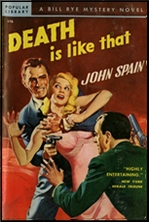
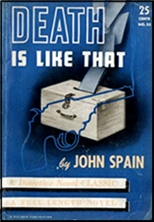
JOHN SPAIN – Death Is Like That. Bill Rye #2. Dutton, hardcover, 1943. Detective Novel Classic #35, digest-sized paperback, 1945. Popular Library #178, paperback, circa 1948-49.

   Bill Rye would be the perfect name for a hardboiled, hard-drinking PI, except that he’s not really a PI. He’s more of a troubleshooter for a political boss named Callahan and his extended family, and boy is there trouble to shoot. Callahan is pulling all the strings he can to get his man into office as the governor, and he can’t afford any scandal to cause the campaign to come crashing down.

   And of incipient scandal, how about either of these? Callahan’s wife has just spent a night in jail after being picked up on a drunk and disorderly charge, and his son’s new wife was a close friend, shall we say, of a notorious gangster, and she’s about to be accused of taking a shot at him.

   The book starts slowly, step by step identifying all the players, which takes more time than usual since it’s a very close continuation of Dig Me a Grave (Dutton, 1942), and there’s plenty of backstory to fill in. But once Rye has Callahan’s wife convinced to accept a divorce, along with a big payoff, and ensconced in a secret sanctuary to dry out, the story bursts into action like gangbusters.

   Lots of violence and plenty of murders, in other words, so many that you’ll need a scorecard to keep track of them all. John Spain, who in real life was the pen name of veteran pulp writer Cleve Adams, not only pulls out all the stops but includes plenty of well-turned phrases in the telling. Not as many as a Raymond Chandler, of course, but well-turned phrases do add to one’s enjoyment to a hard-boiled detective story such as this one.

   And yes, it is a detective story, too, and a decent one at that.

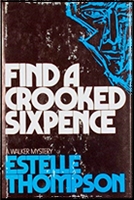
ESTELLE THOMPSON – Find a Crooked Sixpence.  Hodder & Stoughton, UK, hardcover, 1970.  Walker, US, hardcover, 1977; paperback, 1984.

   A flood-swollen river doesn’t quite produce a true “locked room” mystery, but when murder occurs in an isolated farmhouse the umber of possible suspects is thereby strictly limited.

   The scene is Australia, and the detective is the new woman doctor in town. She finds herself attracted to the victim’s husband, the chief suspect in the eyes of the rest of the town. Beneath the overhand of fluttering feminine Gothicism is an iron core of real detection.

Rating: B

– Slightly revised from The MYSTERY FANcier, September/October 1978.


Bibliographic Update: While she wrote a total of 16 mysteries between 1961 and 2000, Estelle Thompson is surely all but forgotten today. All of her books take place in Australia; none of them include a continuing character.

REVIEWED BY DAVID VINEYARD:


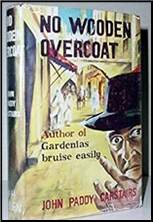
JOHN PADDY CARSTAIRS – No Wooden Overcoat. Garway Trenton #2. W. H. Allen, UK, hardcover, 1959. No US edition.

   My fate seemed a foregone conclusion of torture and finally death, buried in the deep six in a land that wasn’t even my own —  and perhaps not even a wooden overcoat.

   Gar(way) Trenton, ex-Royal Navy pilot and successful novelist, is having a low point, all at sixes and sevens after a previous adventure that left him having nightmares of nearly being killed (I awoke screaming. I was dreaming I was back in the South of France and reliving my “holiday” there), but when a mysterious phone call from a man called Mr. Shadrach offers adventure he can’t resist.

   â€œThis is a Mister Shadrach here,” a voice said.

   â€œAbednego here,” I retorted.

   Mr. Shadrach represents Interpol (yes, this is the kind of book that thinks Interpol is an actual international police organization with agents and international authority —  somebody watched too many episodes of The Man From Interpol with Charles Korvin) and Otto Von Scheidner, the Interpol agent Trenton met in his first adventure (Gardenias Bruise Easily). It seems there is a deadly drug smuggling ring in Tangier and every available Interpol agent has been blown.

   Would Trenton like to help out, all expenses paid, him, with his Mauser Horace, his Aston Martin, and his buddy from his last adventure London Broker Ginger Bier (yes, Ginger Bier  —  it’s that kind of book)?

   What two-fisted all-British kind of hero could pass up that kind of adventure?

   Not this one, though he probably should have.

   Once he and his Aston Martin arrive in Tangier things go steadily downhill. The Mr. Taghore from Interpol he is supposed to meet turns out to be one of the bad guys and the real Interpol agent set to meet him at the airport Captain Captain Edward Cuffley-Evans has been kidnapped by the opposition.

   As the real Mr. Taghore explains Trenton has been blown, his mission over before he begins.

   With twenty four hours to kill Trenton decides to visit a club where Ginger knows a girl who is performing, Fern La Verne — an arresting looking girl in her late twenties, pale and thin with large almond shaped eyes, and long fair hair. Fern (it’s a stage name, and yes, Carstairs fails basic Chandler/Fleming naming of exotic names) is tough but tender, but is she fair or foul is the question.

   Fortunately he is better at character than names.

   â€œ…in life one spends a lot of time wishing for miracles.”

   â€œEver get any?” She inquired.

   “Oh, yes I’m a firm believer in miracles.”

   â€œI wish I was.”

   After a passionate kiss, he finds himself back in his hotel room where a tall stunning English blonde is waiting for him. Clare, wife of Captain Cuffley-Evans, who wants his help getting her husband back. She’s hiding something, but he isn’t sure what, but she is very beautiful and Trenton has decided to stay on and try to help not the least because he is attracted however guiltily to a married woman.

   John Paddy Carstairs was a novelist, a successful artist, screenwriter, and perhaps best known as a director (1933-1970: The Saint in London, Sleeping Car to Trieste, several hit Norman Wisdom comedies, and two episodes of The Saint television series). With Gardenias Bruise Easily he turned to thriller writing with his hero Garway Trenton,who falls somewhere between James Bond and a Peter Cheyney protagonist with occasional forays into Bulldog Drummond.

   Carstairs was also handsome, a musician, and had family in the film business (Anthony Nelson Keys) the lucky talented S.O.B..

   In short order Trenton finds himself kidnapped by the opposition led by the sadistic Paul Garon (It was a handsome dissipated face, arrogant and cynical, and I could picture women being positively anxious for him to be contemptuous of them) and his smoother partner, the sinister mouthed Dragadore, the false Mr. Taghore who met with Trenton earlier.

   Turns out they kidnapped Cuffley-Evans to have his wife assassinate Mr. Taghore for them, but now they have Trenton he seems a much better choice.

   To conceive a plot on a way in which to kill a man — a man well protected — by remote control wasn’t easy. Then too I’d got to think up an antidote, as it were, to save him.
   

   Two-fisted and fast with a gun, Trenton will win out in the end, but not without broken bones, knife wounds, and a few bullet holes worse for wear.

   I’m divided on this one. I thoroughly enjoyed it, but whether anyone else would I can’t guess. Carstairs makes multiple faux pas as a thriller/suspense writer, but he obviously enjoys the genre, knows it pretty well, and his cinematic eye often makes this read more like a really good detailed scenario for a fun film than a novel.

   Perhaps not surprising for the man who had a decent career as a director. (Other than Charteris, Carstairs is the only talent involved with both   RKO’s The Saint series and the ITV version).

   That cinematic reference is not a knock. It’s the quality that makes the book fun. I’ll be looking for Gardenias Bruise Easily, and wish there were more adventures of Gar Trenton. He’s a bit of a block head at times, talks a bit too much, but he’s a colorful guy and his creator nails the glamour, sex and violence, action, tongue in cheek, and exotic locales of the genre like an old pro.

   Had he come along a few years later at the height of the Bond craze, Trenton might have had legs. As it is, he falls in that awkward era between Peter Cheyney and Ian Fleming where the British thriller was transitioning from the older Buchan/Edgar Wallace style to a more Americanized feel.

   All I can say is I would read more of these if they were available and ultimately what more can you say about a thriller writer and series.

   ___

Editorial Note: You’re in luck, David. See below. (But how easily these may be found is another matter.)

      The Garway Trenton series —

Gardenias Bruise Easily (n.) Allen 1958 [France]
No Wooden Overcoat (n.) Allen 1959 [Tangier]
Touch a French Pom-Pom (n.) Allen 1960 [France]
Pardon My Gun (n.) Allen 1962 [Corsica]
The Concrete Kimono (n.) Allen 1965 [Africa]
A Smell of Peardrops (n.) Allen 1966 [Tangier]
No Thanks for the Shroud (n.) Allen 1967 [Los Angeles, CA]

REVIEWED BY DAN STUMPF:


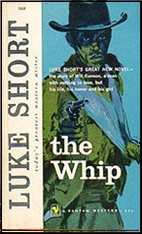
LUKE SHORT – The Whip. Bantam #1668, paperback original, 1957. Reprinted by Bantam several times. Also: Dell, paperback, 1992.  Previously published as a magazine serial; see below.

   A short note after the copyright page tells us the first two-thirds of this was serialized in Colliers until that magazine went out of business, then the remainder was picked up by The Saturday Evening Post  as a tribute to a fallen competitor. And to finish off a crackling fine yarn. (**)

   Said yarn is of Will Gannon, the kind of tough westerner best suited to books like this, who, as the story opens, commandeers a stagecoach from a drunken driver, gets it safely to town, and ends up appointed District Manager of a stretch of road rife with robbery, murder, slack discipline and bad food.

   The charm of this book is Luke Short’s ability to sketch out a tale of sudden violence against a background of the day-to-day work of running a business. He fills it in with a well-drawn cast of characters — mostly standard Western types, but well-drawn as such — and a convincing landscape for horses and men to travel and battle in.

   But as I say, what makes The Whip work is the balance Luke Short strikes between Gannon’s workaday chores and the escalating violence engineered by the ne’er-do-wells he’s replaced. Short builds carefully, effectively, to a prolonged chase and a grim conclusion that rings true.

   Definitely one for Western fans to check out!

      ___

(**) Steve and I have identified the first two parts of the three part serial:

     “Doom Cliff,” (serial) Collier’s Dec 21 1956, Jan 4 1957 [last issue]

   But the third and final installment supposedly published in The Saturday Evening Post has eluded us. Is the statement in the paperback edition incorrect? Have we missed something?

UPDATE: Mystery solved, thanks to the very kind assistance of pulp master Sai Shankar. See Comment #3.

REVIEWED BY BARRY GARDNER:


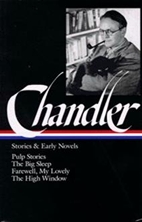
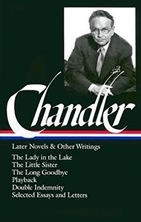
CHANDLER: Stories & Early Novels and CHANDLER: Later Novels & Other Writings.  Two-volume set. Library of America, hardcover, 1995.

   If you, like me, think that any mystery collection is inadequate and incomplete without the works of Raymond Chandler; and you, like me, have acquired his books in mass paperback because you couldn’t afford them in hard covers; and you, like me, have harbored a forlorn wish to have them in a more permanent and respectable yet not outrageously expensive form; then here is what we’ve both been waiting for.

   Since 1982 the Library of America, “an award-winning, non-profit publishing program dedicated to publishing America’s greatest writers in handsome, enduring volumes,” has been doing just that, and the Chandler set makes up the 80th and 81st volumes they have issued.

   In the two volumes you’ll find all of Chandler’s novels, the thirteen short stories that he did not later incorporate into a novel, selected essays and letters, and the screenplay he wrote with Billy Wilder for Cain’s Double Indemnity. The 1199 and 1076 page  volumes also each include notes and an excellent updated chronology of Chandler’s life by Frank McShane.

   These are superbly produced books that bring the essence and essential works of Chandler together in an accessible and affordable form. At $35 the volume they represent as  fine a value as you’re likely to find in the field in these days of $24 first novels and $7 paperbacks.  If you don’t already own Chandler in hardcovers — and how many of us do? — you need to own these.

— Reprinted from Ah Sweet Mysteries #22, November 1995
REVIEWED BY MARYELL CLEARY:


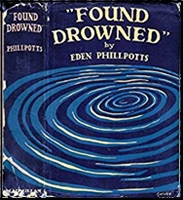
EDEN PHILLPOTTS – “Found Drowned”. Hutchinson, UK, hardcover, 1931. Macmillan, US, hardcover, 1931.

   When an itinerant musician is found dead in a cave near Daleham, the local police inspector and his friend, a retired doctor, differ  about the case, The medical man takes it on himself to investigate what appears to be a simple case of suicide.

   The search leads to the household of Sir Max Fordham, to a vanished dealer in antiques, and then to a serious question of identity. With a little help from Inspector Forbes, Dr. Meredith brings the case to a happy conclusion.

   If we suspect that he has more good luck attending his footsteps than most detectives can boast, well, it’s his first case and perhaps he’s entitled to beginner’s luck!

– Reprinted from The Poison Pen, Volume 3, Number 4 (July-August 1980).


Bibliographic Note: In spite of Maryell’s hint that either Dr. Meredith and/or Inspector Forbes may have had further cases to investigate, there is nothing known to me to suggest they ever did. [Steve]

REVIEWED BY DAVID VINEYARD:


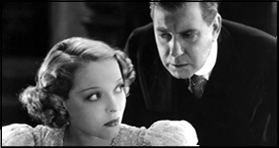
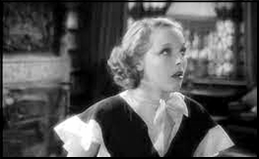
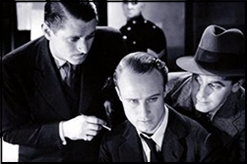
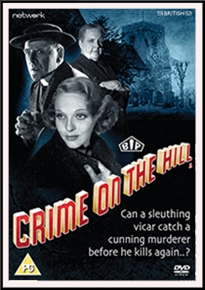
CRIME ON THE HILL. British International Pictures, UK, 1933. Sally Blane, Sir Nigel Playfair, Lewis Casson, Phyllis Dare, Anthony Bushell. Screenplay by Vera Allison, E. M. Delafield, Bernard Vorhaus, Michael Hankinson. Based on a play by Jack Celestin and Jack DeLeon. Directed by Bernard Vorhaus.

   This little sleeper does show its age, but is a handsomely shot and intelligent old fashioned Golden Age fair play mystery with several nice touches that add up to a fairly taut and effecting ending and a genuine Great Detective moment done as nicely as I have ever seen,  as a series of rapid flashbacks point out the things we may have missed or failed to properly give weight to, rather than a talky boring rehash of the case at a gathering of suspects.

   The fact that this is based on a play and not a book is probably to its great advantage, as the dialogue is fairly sharp, and all the cues are hit on time.

   The squire of a tidy little English village dies leaving his estate to his American ward Sylvia Kennett (Sally Blane), but from the start things start to go bad. Sylvia’s boyfriend Tony Fields (Anthony Bushell) won’t marry her because she is now rich, and then attractive middle aged friend Claire Winslow (Phyllis Dare) shows up with evidence she and the Squire were married, making her the heir.

   That’s no problem for Sylvia who can now marry Tony, but he still seems reluctant and is hiding something to do with the attractive maid.

   Worse yet, the villagers are gossiping suggesting murder even though the Squire was being treated by Dr. Moody (Sir Nigel Playfair) for a terminal heart condition, and eventually the gossip gets bad enough Scotland Yard shows up with an exhumation order, the result of which shows the Squire was poisoned, the doctor missing it because his heart medicine had a small amount of cyanide in it.

   Now unpleasant truths start coming out, and in short order Tony Fields finds himself arrested, tried, and convicted of murdering the old man, and as for the maid who was going to tell the police something when she was killed, it turns out she had his baby before he went off to University.

   Detective work here is in the hands of Vicar David Grey (Lewis Casson), hunting and fishing buddy of Dr. Moody, and an old friend of the family. Upset that his little demi Paradise is concealing murder and other darker sins, the Vicar finds himself playing reluctant sleuth when a passing remark by a visitor at the Manor during a local open house accompanying a yearly charity affair puts him on the path to the shocking and unsettling truth about the Squire and his murder.

   Replete with red herrings, colorful characters, alcoholic reporters, sensational headlines, flustered Scotland Yard men, dark secrets, darker revelations, a not too intrusive romance with a more interesting than usual couple, and a fine final set piece and beautifully shot little coda at the end this is an outstanding example of the form, and frankly works better and holds the interest better than many a better known mystery adaptation.

   Bernard Vorhaus’s direction and cinematography by Claude Friese-Greene are both outstanding. A nightmarish fair ground is a particularly good set piece.

   Only running an hour and three minutes, this one is well made with imaginative use of camera angles, camera tricks, and shadows to heighten the effect and dramatize the proceedings. The acting is better than usual and Casson as the unworldly but canny Vicar and Playfair his cynical medical friend are outstanding in what could easily have been merely comedy relief or preachy roles.

   The final scene has real power, is imaginatively shot, and will hold the attention of even the most jaded mystery viewer.

   You might find yourself comparing it to Marjorie Allingham’s Tiger in the Smoke in its portrayal of a truly good, but still interesting man confronted by human evil without losing his faith. I would have loved to have seen a Father Brown movie this well done.


DONALD CLOUGH CAMERON – Death at Her Elbow. Henry Holt & Co., hardcover, 1940. Green Dragon #20, digest paperback, circa 1945-46, abridged.

   After the suicide death of her New York City roommate, Ann Porter fled to the West Coast to get away from the memories. Returning after a year’s absence, she thinks the memories have faded, but not only is she wrong about that, but the body of the man who at the root of Jenny’s death is found murdered in Ann’s bedroom, hit over the head by a heavy statue in the shape of a cat.

   Investigating the murder is homicide detective Peter Gore, whose only appearance in print this seems to be. The story does not follow Gore’s footsteps through the case, but Ann’s, who fears that her former boy friend, who has waited faithfully for her, committed the crime, whereas – you guessed – he thinks she did it.

   This complicates matters, of course, at least as far as Ann and Alec are concerned. Gore – and this is rather surprising – looks kindly upon the pair of lovers and does his best not to suspect either one. But what this means is that are two major themes to Death at Her Elbow. One, the romance, and secondly, the mystery.

   Luckily the mystery does not take a total second shrift. The problem is, as far as solving the murder is concerned, is that there are just a few too many suspects (although at least one is an out-and-out ringer) and not quite enough clues. As for me, I could have done with less romance, but Cameron was a decent writer, describing the characters and capturing the setting well, and I enjoyed this one.

   Cameron wrote a total of six mysteries between 1939 and 1947, three of them starring a chap named Abelard Voss, about whom Wikipedia says was a “young criminologist and detective … who liked to take philosophical reflections during his investigations.” He also wrote extensively for the comic books. I found this interesting enough that I’m going to quote liberally from his Wikipedia page:

   â€œCameron made several notable contributions to the Batman mythos. The story “Here Comes Alfred!” in Batman #16 (April–May 1943) by Cameron and Bob Kane introduced Alfred as Bruce Wayne’s butler. Cameron co-created Tweedledum and Tweedledee in Detective Comics #74 (April 1943) and the Cavalier in Detective Comics #81 (Nov. 1943). His story “Brothers in Crime!” in Batman #12 (Aug.–Sept. 1942) featured “Batman’s Hall of Trophies” a precursor to the Batcave, which debuted in Detective Comics #83 (Jan. 1944). Cameron and Win Mortimer created Batman’s Batboat in Detective Comics #110 (April 1946). In addition, Cameron was one of the writers of the Batman comic strip for the McClure Newspaper Syndicate.

   â€œHis work on Superman includes creating the Toyman in Action Comics #64 (Sept. 1943) and writing the earliest Superboy stories in More Fun Comics.

   â€œCameron created Liberty Belle in Boy Commandos #1 (Winter 1942) and Pow Wow Smith in Detective Comics #151 (Sept. 1949). He was one of the writers of DC’s Hopalong Cassidy licensed series based on the film and TV Western hero. Other comic book work by Cameron includes Aquaman, Congo Bill, and the Western character Nighthawk.”

« Previous PageNext Page »