Reviews


REVIEWED BY MARYELL CLEARY:


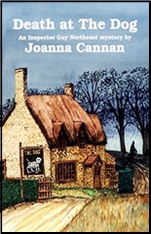
JOANNA CANNAN – Death at the Dog. Inspector Guy Northeast #2. Victor Gollancz, UK, hardcover, 1940. Reynal & Hitchcock, US, hardcover, 1941. Rue Morgue, US, trade paperback, 1999.

   Six weeks after the beginning of World, War II, a rural squire is found dead in his local pub, The Dog.  Mathew Scaife was hated by just about everyone who knew him, so the consensus of public opinion was that it was good riddance and too bad.

   It couldn’t be put down  to natural causes. His son, Edward, and Edward’s wife, are unhappy because the squire won’t come up with the money to modernize the farm  on which they live with him; Crescy Hardwick is upset because he has given  her notice to vacate the cottage she has fixed up and loved.

   His other son gets along neither with him nor with the upper class villagers. Bert Saunders is also being  turned out of his home. Two: other local couples are  suspects mainly because they were in the lounge bar when  he was killed.

   Detective-Inspector Guy Northeast, C.I.D., is delegated the tasks of sorting out these and other motives and finding an intelligent murderer who must also have access to nicotine, a car sponge, and a horse. Northeast is himself an  interesting character who has had run-ins with the local police force in a previous case, and in this one is fascinated by an older woman.

   Carefully drawn characters,   good local  background, and a skillful   murder method give this mystery high marks. I shall  look around for others by Cannan.

– Reprinted from The Poison Pen, Volume 3, Number 4 (July-August 1980).


Bibliographic Update: There was one earlier case for Inspector Northeast, that being They Rang Up the Police (Gollancz, 1939), that perhaps being the one Maryell refers to in this review. As for the author, she wrote a total of thirteen mysteries between 1929 and 1962; of these, five were cases solved by Inspector Ronald Price. 

REVIEWED BY BARRY GARDNER:


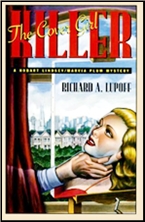
RICHARD A. LUPOFF – The Cover Girl Killer. Hobart Lindsey #5. St. Martin’s, hardcover, 1995. Apparently no contemporaneous paperback edition (!).

   I quit this series after the first, The Comic Book Killer, because I thought the lead was a wimp, but someone told me that I ought to read this one for reasons [you’ll see below], so I did.

   Ace insurance investigator Hobart Lindsey is searching for the model who was the subject of a cover painting for a rare and obscure paperback published in the late 1940s. A tycoon had died in a suspicious helicopter crash, leaving millions either to the unknown model (if she can be found) or to a foundation for indigent artists.

   Hobart finds himself plunged into the world of paperback collectors, while his lover, police Sergeant Marva Plum, struggles with the suspected murder. A personal nemesis from his first case reappears, adding danger and angst.

   Well, I think you may recognize a paperback collector even before his real-life inspiration is named in the afterword. He has something of a regal air about him. This still isn’t going to be one of my favorite series, but it has definitely improved, and I enjoyed it because of the background. Lindsey isn’t quite as much of a wimp as he was, at least. There’s a nice intro by Bill Pronzini, too.

   Required reading [for everyone reading this].

— Reprinted from Ah Sweet Mysteries #22, November 1995


      The Lindsey and Plum series —

1. The Comic Book Killer (1988)
2. The Classic Car Killer (1992)
3. The Sepia Siren Killer (1994)
4. The Bessie Blue Killer (1994)
5. The Cover Girl Killer (1995)
6. The Silver Chariot Killer (1996)
7. The Radio Red Killer (1997)
8. The Tinpan Tiger Killer (1998)
9. One Murder At A Time (2001)
10. The Emerald Cat Killer (2010)

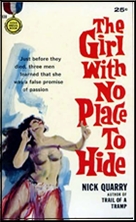
MARVIN ALBERT writing as NICK QUARRY – The Girl with No Place to Hide. PI Jake Barrow #3. Stark House/Black Gat Books #34; paperback, October 2021. Previously published as by Nick Quarry: Gold Medal #938, paperback original, 1959.

   The Girl with No Place to Hide is one of six Jake Barrow novels that author Marvin Albert wrote for Gold Medal as paperback originals back in the late 50s and early 60s, all as by Nick Quarry, one of his various and sundry pen names. Walking home from high school every day around this same time, I’m sure I bought my first copy from one the two spinner racks in the front of the supermarket along the way.

   I’m sure that its lurid cover had something to do with my spotting it and snatching it up right away. (The cover of the Black Gat reprint is perfectly fine, but forgive me, Greg, I still like the original, and it isn’t pure nostalgia that makes me think so.)

   Jake Barrow tells the story himself, so it isn’t exactly clear what he looks like, a PI whose home base is New York City, a town which he knows his way around in quite well, but if I were casting him in a TV series, say, Dane Clark would be my first choice. In this one, he doesn’t have a client for quite a while, but someone eventually volunteer himself as one, so Barrow not only has the satisfaction of solving the case, but he comes off satisfactorily in a financial sense as well.

   The tale begins with a girl – a good looking one, of course – who is obviously on the run from someone or something, but even though Barrow tries to help by inviting her up to his apartment for safekeeping, the sanctuary he offers is far from good enough, and the girl ends up dead there.

   What follows is what seems like an ordinary PI novel from the 50s, complete with sleazy characters, muscle guys, gamblers, boxers, shady gigolos, and more attractive women than you or I would probably meet all year, but Jake does it in less than a week.

   You have to take the bad with the good, though. Barrow gets clunked over the head more times than I could keep track of, which so far hasn’t happened to me yet this year, knocking on wood.

   Hidden amidst all of this action is, believe it or not, a better than average detective story, tangled in more threads than you might think, assuming that this is yet another ho-hum PI story, which while it’s not Hammett or Chandler level, it also most definitely is not as well.

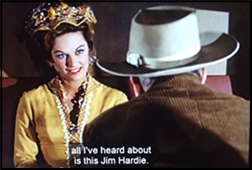
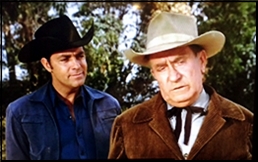
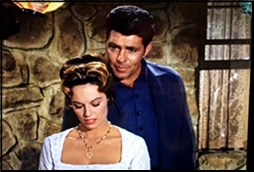
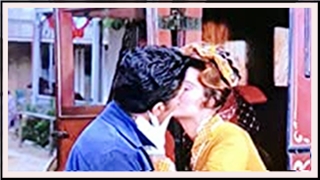
TALES OF WELLS FARGO. “Vignette of a Sinner.” NBC, 02 June 1962, 60 min, color. (Season 6, episode 34.) Dale Robertson (Jim Hardie), William Demarest. Guest cast: Jeff Morrow, Joyce Taylor, James Craig, Edward Platt. Series creator: Frank Gruber. Screenwriter: Al C. Ward. Director: William Whitney. Currently steaming on Starz.

   Tales of Wells Fargo was on NBC for five seasons in black and white, with each episode running 30 minutes. For its sixth and final season, however, they expanded the episodes to 60 minutes and showed them in color. As opposed to my usual custom of reviewing the pilot episodes, “Vignette of a Sinner” is the last one of the program’s last season.

   And quite fittingly so. While riding on a stagecoach to meet Jim, his semi-comical sidekick Jeb Gaine (William Demarest, as a character also added for this final season) regales his traveling companion with tales about his good buddy Jim. And for good reason. His companion is a lady, and Jeb has hopes of being a matchmaker. They would be perfect together, he thinks.

   The good news is that the attraction is mutual. The bad news is that she has come west to marry her fiancé (Jeff Morrow). The even worse news, for her, is that her intended is also a crook, having just robbed a stage of a considerable amount of money.

   The rest of the story I leave to your imagination, but with director William Witney at the helm, there is plenty of shooting and fighting before the smoke clears. Dale Robertson was an excellent choice to play Well Fargo agent Jim Hardie. Not only was he good with his fists and guns, he was good-looking, unassuming, and a fine man on a horse.

   And suffice it to say that while the closing scene shows her riding a stage back to Kentucky, no viewer is left unaware that she fully intends to return. Good show that.


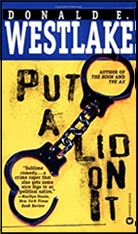
DONALD E. WESTLAKE – Put a Lid on It. Mysterious Press, hardcover, 2002. Warner, paperback, March 2003.

   I don’t know about any of you reading this, but this semi-comic heist novel by the author of the Parker and Dortmunder books simply slipped by me when it first came out. Its protagonist, one Francis Meehan, is in a federal prison with no hope of getting out any time soon when all of a sudden he’s given an offer he can’t refuse: do a small job of thievery for the President’s current campaign committee, and it’s a Get of Jail Free card that in his wildest dreams he never expected.

   Obviously after the flop that was the Watergate burglary, they want a professional, not a crew of amateurs.

   Nowhere near as violent as the Parker books, and not as out-and-out funny as the Dortmunder series, Put a Lid on It is somewhere in between, but closer to Dortmunder than Parker. The focus is on Meehan all the way through, so I never got a clear picture of what he looks like, but if I were to make a movie of this, I might go for George Clooney, except for the fact that maybe he’s tired of making movie like this.

   As for Meehan’s public defender lawyer, Elaine Goldfarb, she looks exactly like you would expect a Jewish public defender named Elaine Goldfarb would look like. I wish she had more of a role in this book than she does, but that’s intentional on her part. She wants no part of what Meehan has agreed to do, and that goes doubly for a little side project he has in mind.

   As far as heists go, I will tell you that getting a gang together on Meehan’s part takes up a lot more time and effort than it should have taken – way more than the middle third of the book – but what I won’t tell you if the heist goes off as planned or not. What Meehan is good at, though, is improvising, and it’s a skill he needs, in spades.

   This one was fun. It’s too bad Westlake never got around to coming up with a sequel.

REVIEWED BY BOB ADEY:


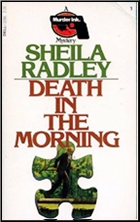
SHEILA RADLEY – Death and the Maiden. H. Hamilton, UK, hardcover, 1978. US title: Death in the Morning, Scribner, hardcover, 1979; Dell (Murder Ink #1), paperback, 1980.

   Excellent debut novel set in East Anglia and featuring “up through the ranks” Chief Inspector Quantrill and newcomer “blue blood” Detective Sergeant Tait. The problem: death by drowning of a pretty teenage girl.

   The writing is top class, the atmosphere keenly evoked and the personal involvement of the two detectives, with their opposing views and methods, realistic and relevant.

   An author to watch out for.

– Reprinted from The Poison Pen, Volume 6, Number 1 (Spring 1984).


      The Inspector Quantrill series —

1. Death in the Morning (1978)
aka Death and the Maiden
2. The Chief Inspector’s Daughter (1980)
3. A Talent for Destruction (1982)
4. The Quiet Road to Death (1983)
aka Blood on the Happy Highway
5. Fate Worse Than Death (1985)
6. Who Saw Him Die (1987)
7. This Way Out (1989)
8. Cross My Heart and Hope to Die (1992)
9. Fair Game (1994)

REVIEWED BY DAN STUMPF:


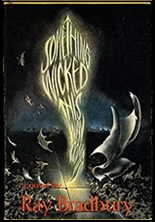
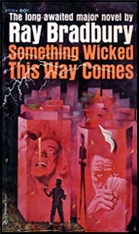
RAY BRADBURY Something Wicked This Way Comes. Simon & Schuster, hardcover, 1962. Bantam H2630, paperback, September 1963.

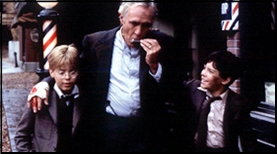
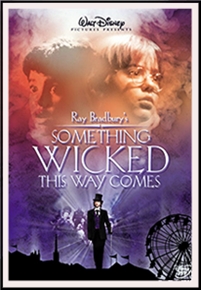
SOMETHING WICKED THIS WAY COMES. Walt Disney Productions, 1983. Jason Robards, Jonathan Pryce, Diane Ladd, Royal Dano, Vidal Peterson and Shawn Carson. Screenplay by Ray Bradbury and John Mortimer (uncredited.) Directed by Jack Clayton and Lee Dyer (uncredited.)

   I first read Something Wicked This Way Comes back in High School. Then again in College. Since then, I’ve come back to it every ten years or so, and each time found the story enchanting, the imagery compelling and Bradbury’s prose irresistible.

   Reading it this year, fifty-five years on and gray-bearded, puffing on a pipe I carved out of deer antler, reflecting that this is likely the last time I shall visit these pages, I was taken out of myself and transformed once again into the boy of wonder whose story this is.

   Or rather boys, not boy. Will Halloway and Jim Nightshade. A dark circus come to their small town to trap the townsfolk’s souls and the boys fall into that childhood dream of forbidden knowledge, the evil only they comprehend, and only they can battle.

   As created by Bradbury, Cooger & Dark’s Pandemonium Carnival is a thing of splendid nightmare, promises of wonder paid with misery amid gaudy colors and laughing crowds. And once they learn its secret, the boys become the prey of brutal Mister Cooger and sinister Mister Dar k — along with a panoply of grotesques passing themselves off as freaks and entertainers.

   Bradbury conveys all of this in poetic prose that never slows down the action or becomes self-important. This is, in short, not so much a novel as a treasure to be taken out and enjoyed .

   A lot of folks in Hollywood took a lot of interest in Something Wicked, including Gene Kelly, Kirk Douglas and Sam Peckinpah, but it ended up with the folks at Disney, where it was filmed, then re-edited, re-shot, re-scored and partly rewritten, all at great expense. The result was a great white elephant of a movie that cost almost twenty million to make (back when that was a lot of money) and grossed less than half that. And along the way to failure, they insulted Bradbury and antagonized his fans, feeding Ill feelings all the way around — almost like the Pandemonium Carnival itself!

   Too bad, that, because the film actually borders on greatness at times. It stays mostly faithful to the novel, casts the boys (Vidal Peterson and Shawn Carson as Halloway and Nightshade respectively) effectively, and embodies Mister Dark chillingly in Jonathan Pryce.

   The makers also get a thoughtful and well-judged performance from Jason Robards as Will’s father Charles — here promoted from janitor to librarian in the opulent small-town library. If Will and Jim are the motivators of the story, Charles is its firm anchor, and Robards rises to the occasion wonderfully. The confrontation between him and Jonathan Pryce is masterfully written, fluidly directed, and played to the hilt by two actors who seem to know they’re on to a good thing — pure movie magic!

   If none of the rest of the film quite lives up to this moment, well it supports it quite nicely indeed, and Something Wicked This Way Comes – book and movie – are literary/cinematic friends I’m glad I’ve known.


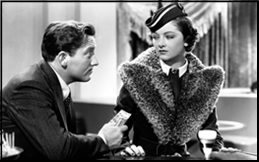
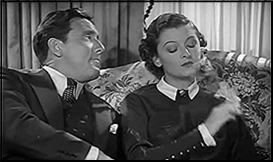
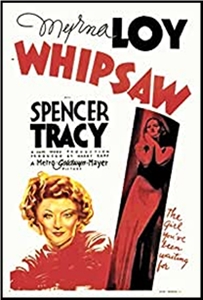
WHIPSAW. MGM, 1935. Myrna Loy, Spencer Tracy. Director: Sam Wood.

   There are other members of the cast, but the only other name I recognized was John Qualen, and he was so far down in the list, I decided to mention only the two leading stars. They’re all that’s needed, though, to make this the best movie I’ve seen in quite some time. If it ever comes on in your area, don’t miss this one.

   She’s a lady crook, working for a gang of jewel thieves, He’s a cop, pretending to be a tough hoodlum to gain her confidence. He doesn’t know she’s onto him, but she needs him to help shake the members of a rival gang who are on her trail.

   It’s a pleasure to watch a movie written with some intelligence behind it. The people in it are thinking, and none of the usual ploys in your usual run-of-the-mill crime caper seem to work as well here as they do in every other film you sit down to see. What’s more, it may be corny, but it’s also a pleasure to watch a picture in which even the crooks (well, some of them) have moral standards.

   And it’s not enough that Myrna Loy can act cool and disinterested and obviously be falling deeply in love at the same time; she’s also beautiful and charming, and she simply fills the screen with her presence every minute she’s on it, Spencer Tracy tries hard, with an intensely casual portrayal of a policeman caught between his job and a woman he begins to care for more and more, but I think this is the lady’s picture, all the way.

– Reprinted from Mystery*File 26, December 1990.


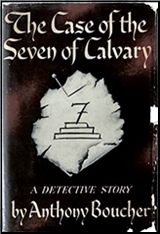
ANTHONY BOUCHER – The Case of the Seven of Calvary. Simon & Schuster, hardcover, 1937. Collier, paperback, 1961.

   Although Anthony Boucher has several differing series characters in his brief but illustrious mystery writing career, TCOT Seven of Calvary has none. Even so, the gentleman who solves the case does so with both precision and aplomb, and if he’d had the opportunity to have been involved in another, I’m sure he would have done equally well.

   He’s Dr. John Ashwin, Professor of Sanskrit at the University of California, Berkley, and what you might call an “armchair detective,” as all of the details of the case are related to him by one of his students, a chap by the name of Martin Lamb. (And as far as I know, the latter never appears again in any of Boucher’s works of mystery fiction, either.)

   While probably not unique, the structure of the tale is unusual. It has a prelude, a postlude, and (I think) three interludes. In these various “ludes” Tony Boucher discusses the case with Mr. Lamb, who is telling the story to the former, who then is tasked with transcribing it into third person book form.

   These discussions include, for example, what it feels like to be the “Watson” for a primary detective, not to mention a “Challenge to the Reader” that in the last Interlude Martin dares Tony to determine the solution to the case based on the facts in the case as told to him so far.

   Tony fails, and so did I.

   I love it when that happens.

   I also love it when the setting is as tweedy an academic setting as this one is. The first death is that of an unofficial peace ambassador from Switzerland, as gentle and unassuming man as there could possibly be, without an enemy in the world and with not a single person who could gain anything from his death. Found next to his body is a strange drawing, one which is also prominently displayed on the front of the jacket of the hardcover edition. (See above.)

   Could an obscure cult of Christian heretics be responsible? It is apparently the only possibility, but Dr. Ashwin is not convinced. Nor of course was I, having read as many detective novels as I have in my lifetime – not, as I suggested above, did it help me in deducing who the real killer was.

   I enjoyed this one. As the author, Anthony Boucher is witty, clever and above all, erudite in telling this particular tale. I also enjoyed being so intimately involved in academia life one time more. It was like being back in grad school again.

REVIEWED BY DAVID VINEYARD:


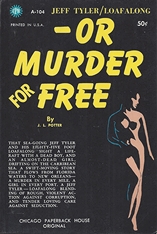
J. L. POTTER – …Or Murder for Free. Jeff Tyler/Loafalong #2. Chicago Paperback House A-104, paperback original, 1962. Wildside Press, trade paperback, 2018.
   I will never forgive this writer for his middle initial being an L. instead of a C., because it ruins a perfect one sentence review.

   Yes, this book is sausage.

   And yet, this second novel in the Jeff Tyler/Loafalong series almost perfectly mirrors what John D. MacDonald would do three years later with his beach bum salvage expert Travis McGee. This book only goes to prove its the delivery and not the idea, because this is not JDM or McGee. This isn’t even William Fuller’s Brad Dolan. At least Philip Wylie’s Crunch and Des caught fish once in a while.

   As boat bum heroes go Jeff Tyler is beached.

   His boat is the Loafalong if I didn’t mention it. God knows he does endlessly.

   Maybe it’s because he gives the damn boat equal credit in every other sentence. Can you imagine the Busted Flush getting credit on the cover next to McGee and over Meyer? This guy loves his 84 foot boat and he is not going to let you forget it.

   He loves that stupid pun name too. Frankly it doesn’t work very well in print. It just doesn’t pay off on the written page. It’s prime thud ear stuff.

   It’s the kind of boat name a retired insurance adjuster gives his fishing boat, not the kind of name a dashing tough semi-private eye salvage expert gives his working boat.

   Busted Flush is clever, but JDM doesn’t beat you over the head with it. They aren’t the Travis McGee/Busted Flush series.

   You know the old joke about how the Gothic genre is basically a girl gets house plot?

   This is a guy owns dreamboat genre.

   Every other paragraph…

   Potter is the kind of guy who repeats a punchline until you just want to scream.

   Did I mention there were four or five of these?

   To give the guy credit, he isn’t awful. He does well with some of the boating stuff, a nice little passage about navigating a river is oddly shown on the back cover instead of an action or sexy passage, but it is well done. He’s pretty good on diving too. His biography shows he had experience as a seaman and a Navy Frogman. A lot more of that and a lot less of tired tough guy stuff would make this better.

   An editor might have done something with J. L. Potter. Not a lot, but something.

   So Jeff and his crewman Red are cruising along when they spot a raft. Inside is a dead young man, and a barely alive nearly naked young woman suffering from sunburn and exposure. The raft is from the Volstok, a private vessel.

   Tyler administers first aid, calls the Coast Guard, gets roped in to getting the girl to help in New Orleans , and calls a good buddy to report he is going for salvage on the Volstok.

   It turns out there were valuable jewels on the Volstok. There was a robbery that went wrong, people died, and the dying young man with a bullet in him and the girl got away in the lifeboat.

   Save that isn’t the story the captain of the Volstok is telling.

   Things get rough. Everyone is lying, which is private eye writing 101.

   Here his his terribly overwritten version of the Philip Marlowe black pool:

   The pain of the massive attack caught me in a flash of crimson that wavered, interspersed with flaming yellow and deathly blacks. The blacks blotted out the pyrotechnics. I felt myself falling. Then nothing.


   I’m guessing Chicago Paperback House didn’t employ editors or were really into Jackson Pollock and splashes of color on too broad a canvas. This is Readers Digest How to Develop a More Colorful Vocabulary stuff.

   Last time I was knocked in the head and passed out, I just fell forward.

   I guess I’m just not colorful. Or maybe he thought he was getting a penny a word.

   We get another colorful awakening from being knocked out, but he does spare us the rainbow vomiting.

   Small favors.

   He’s not very good at the tough guy monologues:

   â€œSure an’ you the innocent type, got you(sic) nickname contributing to Girl Scout cookies every year.”

   
   â€œContributing to Girl Scout cookies?” What, the bad guy bakes?

   Of course he is warned off by an old friend since the mob is involved:

   â€œIf you’re smart enough you’ll drop it here, leave it — and the doll — alone. Otherwise you’ll be swimming the Mississippi in a concrete overcoat.”


   How does that Hammett line go about the cheaper the punk, the gaudier the patter?

   Some sixty thousand words later of a lot of tough guy posing and half digested Mickey Spillane monologues later we find out what was really going on all the lies are sorted out, some people get shot and our hero gets the girl and the reward, neither much worth writing home about, much less writing a novel.

   At the finale after a fairly bloody ending his crew washes down the Loafalong before setting sail even though one of their own has a bullet in him saving them. Got to get your priorities straight. Swamp down the boat then sail for help.

   It’s the boat, stupid. Pardon me, the Loafalong. I think I went almost a paragraph with only mentioning its name once. In Potter’s world you could be shot at dawn for that.

   I know nothing about Chicago Paperback House. Frankly this looks and reads like vanity press stuff, poorly edited with poor production, but then what kind of masochist would publish four or five vanity press books?

   Maybe I’m being too hard on the guy. Maybe the crimson and yellow black meanies are on my back as I plunge forward into this review.

   I read this.

   I fell down.

   I may just stay down.

   I’ve been beaten into submission. I never got knocked down in the ring, but on this one I’m throwing in the towel.

   I’m just gonna loaf along to bed now and contribute to some Girl Scout cookies.
   

      The Jeff Tyler series

Jambalaya Loverman. Newsstand Library, 1961.
Kill, Sweet Charity-Kill. Chicago Paperback House, 1962.
…Or Murder for Free. Chicago Paperback House. 1962.
Room at the Bottom. Chicago Paperback House, 1962.
« Previous PageNext Page »