Reviews


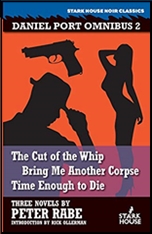
PETER RABE – Bring Me Another Corpse. Gold Medal #864, paperback original; 1st printing, March 1959. Included in Daniel Port Omnibus 2: The Cut of the Whip / Bring Me Another Corpse / Time Enough to Die, Stark House Press, trade paperback, 2015.
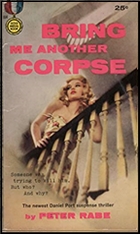
   Some time ago — I think it was last issue, as a matter of fact — I said that I didn’t read crime stories any more, Or something to that effect, That was last issue, though, this is now, and here is a Peter Rabe crime story, There never was a better man to write about the mob, about gangsters and hoodlums, than Peter Rabe.

   This is also a Daniel Port suspense thriller, or so says the cover, Besides stories like Benny Muscles In and Kill the Boss Goodbye, Rabe also did a series about the adventures of a former syndicate man named Daniel Port, and unfortunately this is the first one I’ve read of them. In other words, I can’t tell you very much about the earlier ones, but this is a good one, and I’m going to recommend the others to you, sight unseen.

   It’s a crime story all the way, but (of course) there’s a mystery involved as well, and it’s going to take some filling in.of some background before I can tell you what it is, When Port left the syndicate, he carefully stored away some papers that, when he died, would go straight to the police, Since then, Callo’s men have left him strictly alone.
   Why then, beginning with Chapter One, has a hit man been hired to bump him off? Port doesn’t know, nor does the FBI, who are also interested in Port’s predicament. In fact, they are interested enough to get Port to impersonate another notorious killer and (get this) to offer his services to assassinate himself, the original having been lured off to France, where he’s cooling his heels in a French jail.

   The idea, of course, being to infiltrate the mob from the inside, to discover just why the idea of bumping Port off has come up again.

   It should be obvious, if you were to think about it, but it takes Port 50 pages or so before he finds exactly what is going on. The mystery then, to get back to that, is to discover who the head man behind the assassination plot actually is. No matter how many underlings are disposed of, if the big cheese isn’t nabbed as well, it’s back to square one.

   Rabe’s writing is tough and lean and moody, and somehow — I’m not sure just how — it reminds me of what the result might read like if Cornell Woolrich had ever written a mobster story. The ending is a bit of a letdown, though, in that while Rabe had a decent surprise for the reader with only 15 pages to go —  a totally logical one, I’m happy to say, and since it hadn’t occurred to me, I liked it all the more — I came up with an even greater twist that didn’t occur to Rabe at all.

   Maybe it wasn’t logical, but I had some other agency involved altogether in getting Port mixed up in a scrape like this.


– Slightly revised from Mystery*File 26, December 1990.
REVIEWED BY DAN STUMPF:


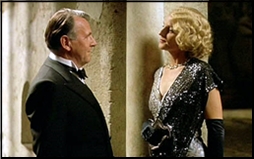
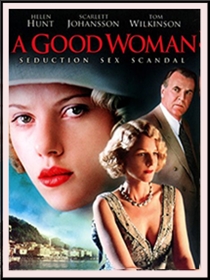
A GOOD WOMAN. Lions Gate, 2004. Helen Hunt, Scarlett Johansson, Tom Wilkinson, Milena Vukotic, Stephen Campbell Moore, and Mark Umbers. Screenplay by Howard Himelstein, loosely based on Lady Windermere’s Fan,   by Oscar Wilde. Directed by Mike Barker.

   Whothehell did they ever think was gonna go see a movie called A Good Woman?

   A pity, that title, because this is an excellent, film: moving, witty and romantic, even as it runs over Wilde’s play with a mulching mower.


   For starters, writer Howard Himelstein moves the action from London to Italy, the scenic towns near Naples, a visual treat beautifully exploited by director Mike Barker. Then he turns Mrs. Erlynne (Helen Hunt) and the Windermeres (Johansson & Umbers) into Americans, the latter two vacationing in luxury, the former penniless and on the prowl.

   From there, Himelstein touches on the play in fits and starts, tossing in Wildean epigrams of his own composing, opening out the action, and rearranging scenes while flirting with the original story line: Mr. Windemere seems to be having an affair with the predatory Mrs. Erlynne, and when Mrs. Windermere finds out, she flees to the amorous Lord Darlington (Stephen Campbell Moore) leading to a tense confrontation on his yacht, where Truth rears its ugly head and promptly ducks back down again when Love shows up.

   All this would be plenty enough for an enjoyable movie, but again, Himelstein gives us more: two wonderfully thought out and affecting scenes (not in the play) that Ms Hunt caries off movingly, just by hiding her emotions, so we can read our own feelings into the thing.

   All of which got fed to the lions. The critics sneered, turned thumbs down, and audiences turned the attention to the cinematic gladiators and chariot races on other screens at the multiplex. Too bad. They missed a fine movie.


REVIEWED BY JIM McCAHERY:


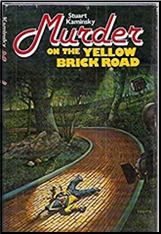
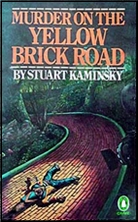
STUART KAMINSKY – Murder on the Yellow Brick Road. Toby Peters #2.  St. Martin’s Press, hardcover, 1977. Penguin, paperback, 1979.

   This is the second in Stuart Kaminsky’s historical series starring his 1940s Hollywood private investigator, Toby Peters (a.k.a. Tobias Leo Pevsner), who made his own debut last year in Bullet for a Star. This second entry is by far superior to the first.

   Once again, Hollywood stars join the fun in both major and minor roles. In this vehicle Toby ls summoned from the Warner Brothers lot (where he helped Errol Flynn in Bullet) to M.G.M. by an urgent call from Judy Garland, who has just discovered the body of a murdered Munchkin on the still-standing publicity set of Munchkin City from The Wizard of Oz, released more than a year earlier.

   Peters is hired by Louis B. Mayer himself to keep the investigation quiet and protect Judy, whose own safety seems at stake. Toby’s interview with the “little” suspect arrested in connection with the murder convinces him of his innocence. Peters, of course, whose wife has already walked out on him and who shares office space with a dentist, is a progeny of the classic Hammett/Chandler tradition. (“My nose is mashed against my dark face from two punches too many. At 44 I’ve a few grey hairs in my short sideburns, and my smile looks like a cynical sneer even when I’m having a good time, but there are a lot around town just as tough and just as cheap. I fit a type, and in my business I was willing to play it up rather than try to cover.”)

   And again: “I was doing what private detectives are supposed to do.  I was walking the mean streets. I was acting like a damn fool.” Indeed, Raymond Chandler also has a bit part as himself in the novel. He spots Toby while doing research on flophouses and decides to shadow him, but is waylaid for his efforts. Since Toby is the first real detective he has ever met, our investigator lets him tag along on the case so he can drink in some local color and dialogue first hand. A second fatal stabbing, a defenestration, and two attempts on Toby’s life all ensue before the climax, in which even Judy has a hand (or an elbow, to be more exact).

   Murder on the Yellow Brick Road is a well-paced and very neat yarn, indeed, even if it doesn’t require a wizard to spot the culprit. The dialogue is crisp and lively, especially between Toby and his antagonistic brother LAPD Lieutenant Philip Pevsner, whose boiling point is nil whenever he runs up against his younger brother.

   Add Clark Gable in a minor role as a prospective witness and several other M.G.M. stars in walk-through parts, and it all adds up to quite a pleasant stroll down memory lane as well. Unfortunately, there was a very careless printing job by St. Martin’s Press on the first edition which will hopefully be corrected in subsequent printings, including that scheduled for the Mystery Guild.

   Kaminsky’s third work is already in progress and will involve Toby Peters with the Marx Brothers.

– Reprinted from The Poison Pen, Volume 1, Number 3, May 1978).


Editorial Notes: The title of that next book in the series was You Bet Your Life (1978). There were in all 24 books in the series before it ended.

   Jim McCahery was an early member of DAPA-Em whom I met once in a party held at Jeff and Jackie Meyerson’s home. A lot of mystery fans who had met only by zine exchanges met in person for the first time there. I asked Jeff today and he told me that Jim had been a teacher at Xavier High School in Manhattan and had just retired at 60 when he died of a heart attack.

   His ambition in retirement was to become a full time writer. Before he passed away, he had written two mysteries:

McCAHERY, JAMES (R.) (1934-1995)
      Grave Undertaking (Knightsbridge, 1990, pb) [Lavina London; New York]
      What Evil Lurks (Kensington, 1995, hc) [Lavina London; New York City, NY]

   Lavina London is described online as a “spry and savvy septuagenarian sleuth … a retired radio actress.” I enjoyed reading both books.

A 1001 MIDNIGHTS Review
by Karol Kay Hope


JOHN CREASEY – The Insulators. Dr. Palfrey #30. Hodder & Stoughton, UK, hardcover, 1972, Walker, US, hardcover, 1973. Manor 12311, US, paperback, 1975.

   One could speculate that John Creasey was really a trademark for some kind of bizarre writing machine secreted away in the English countryside. In reality, he was an individual who produced some 560 books under more than twenty pseudonyms over a forty-year period. Some writers are prolific. Creasey was incredibly so. No other mystery writer can boast of such an output.

   On the other hand, if you are writing to a rigid formula, as Creasey did, you can probably put a plot together during a TV commercial. Your characters are set and good; all you have to do is imagine a catastrophe that is suitable to the talents and circumstances of one of your heroes, and off you go. That is, if you have a mind with the inventive bent of Creasey’s — and more ideas per minute than most people entertain in a lifetime. That was Creasey’s real forte — the number and variety of his ideas.

   Under his own name-he also wrote under such pseudonyms as Gordon Ashe, Michael Halliday, J. J. Marric, and Jeremy York. Creasey created four basic heroes. Two — Richard Rollison (“the Toff”) and Superintendent Roger West — are involved with domestic crime, bringing to justice or disgrace bad boys and girls within the British borders. The other two — Dr, Palfrey and Gordon Cragie — are world travelers; they worry about international villains, the kind that alone or, usually, in gangs lust for world domination.

   The Insulators features Dr. Palfrey and the men of Department Z5. From the start we know the good guys are going to win. If they don’t, the world is going to blow up, and Creasey was the kind of writer who would never let that happen. He takes us to the brink, however, showing us the kind of absolute evil that exists in the world.

   The “insulators” of this title are a gang of mad scientists/power mongers who have discovered a magic gas that can insulate humans against atomic radiation. With that as a tool, along with the requisite bombs, they try to blackmail every world government into total capitulation.

   Department Z5, the good guys, is a gang of   international policemen headed by our hero, Dr. Palfrey — sort of a cross-cultural crime-fighting organization that pools its resources and its talents in times of world crisis. They come together in a fantastic effort to keep these scientists from erasing human misery through enslaving the world’s population.

   There are too many weaknesses in this plot, although it is  entertaining. How many of us can believe that the bad guys could build underground nuclear arsenals all over the world without anybody noticing? And it’s also hard to believe in Z5; Creasey’s good guys are just too good.

   Other titles about the men of Z5 include Traitors’ Doom (1970), The Legion of the Lost (1974), The Voiceless Ones (1974), and The Mists of Fear (1977).

     ———
   Reprinted with permission from 1001 Midnights, edited by Bill Pronzini & Marcia Muller and published by The Battered Silicon Dispatch Box, 2007.   Copyright © 1986, 2007 by the Pronzini-Muller Family Trust.

REVIEWED BY BOB ADEY:


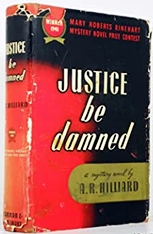
A. R. HILLIARD – Justice Be Damned. Judge Thomas W. Manfred #1. Farrar & Rinehart, hardcover, 1941.

   Unusual story — almost a tour de force. Counsel for the defence Jerome Carver finds himself defending Frank Peabody for the second time against a charge of murder. Acquitted once when his wife was the victim, he now stands trial for the murder of her lover.

   In flashback sequences the ground is covered leading to the present predicament, and we watch Carver wriggle, apparently unsuccessfully, to get his man off the hook. But after the verdict and sentence, the twists and turns really begin, and the trial judge turns detective and poses a series of seemingly loony questions of which John Dickson Carr would have been proud.

   I did guess the real murderer — but not much else. Hilliard only wrote two mysteries – a pity.

– Reprinted from The Poison Pen, Volume 6, Number 1 (Spring 1984).


Bibliographic Update: The second and final case solved by Judge Thomas Manfred was Outlaw Island (Farrar, hardcover, 1942).

REVIEWED BY BARRY GARDNER:

   
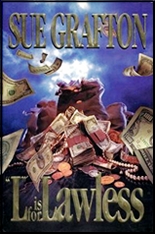
SUE GRAFTON – “L” Is for Lawless. Kinsey Milhone #12. Henry Holt, hardcover, 1995. Fawcett Crest, paperback, 1996.

   The Grafton/Milhone express keeps chugging along. I really liked the “K” book. Matter of fact, I’ve liked most of her books. She’s one of the few bestsellers who I think generally lives up to her reputation and sales. Most of the time I rate her and Muller about even, way ahead of Paretsky.

   Kinsey is getting ready to attend a wedding. Her landlord’s brother and her Hungarian friend Rosie are getting hitched, but a little before the happy event her landlord asks her to help out the relatives of an old acquaintance of his, said acquaintance being recently deceased. It seems the man was supposed to have been a veteran, but when his relatives try to get benefits from the government, no record of him exists.

   Kinsey is asked to see what she can do, and the seemingly innocent and simple request turns into something very complex indeed, and dangerous. The dead little old man was more than he seemed, and had some very nasty friends.

   Grafton still writes well, but the plot in this one left me so cold that I basically skip-read the last third or so. I didn’t believe any of it, and I didn’t get interested in it. I didn’t give a damn about any of the characters aside from Kinsey, either, and she acted like an idiot for most of the book I’m sure most of her fans will love it, but the best I can say is it wasn’t egregiously bad. It sure wasn’t good, though.

   I seem to be a lot more demanding of rational behavior from my fictional heroes than most people are; or maybe I just have different ideas as to what’s rational. Sometimes I wish I didn’t, because it spoils a lot of books for me that I might otherwise like.

— Reprinted from Ah Sweet Mysteries #21, August-September 1995
REVIEWED BY DAVID FRIEND:


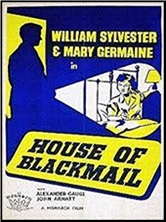
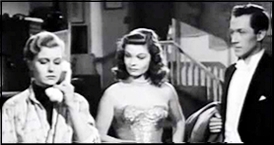
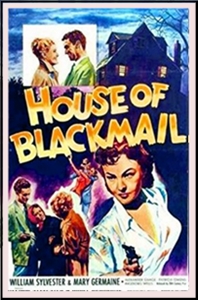
HOUSE OF BLACKMAIL. Monarch Film Corp., UK, 1953. William Sylvester, Mary Germaine, Alexander Gauge, John Arnatt, Denis Shaw. Story & screenplay by Allan Mackinnon. Director: Maurice Elvey.

   A foolish young man named Billy Blane has forged a cheque for £200 and is threatened with arrest unless he pays £5,000 to the urbane and wealthy Markham. His artist sister, Carol (Mary Germaine) tries to get him out of it by agreeing to meet Markham in his old country house. On the way, she picks up a good-looking and garrulous hitch-hiker (William Sylvester) who calls himself Jimmy. The radio, meanwhile, speaks of an escaped convict from a nearby prison. Jimmy agrees to accompany Carol to the house and pose as her lawyer in an attempt to unnerve Markham.

   There, they meet Markham (Alexander Gauge) and his two associates, an elderly Eastern European doctor (Hugo Schuster) and a sharp-tongued American (John Arnatt), also a Polish maid (Ingeborg von Kusserow) and a seedy, spying butler (Denis Shaw). After some sparring from Jimmy, Carol agrees to pay the money, but is unable to withdraw it from her bank until morning. The pair must remain until then and, with the windows electronically secured, there is no way to escape. During the night, Markham is murdered, and the killer could only have been someone staying at the house…

   There is much intrigue and some witty dialogue to be enjoyed in this early fifties B-film, which reveals its small budget with its studio-bound setting and recycled score (at one point, it sounded like something from a Norman Wisdom film!). American William Sylvester is ebullient as Jimmy and, with his mid-Atlantic accent, could well have made an excellent Saint.

   As usual, Alexander Gauge is wonderfully erudite as the disreputable Markham, another of his reasonable-criminal roles, while the British actor John Arnatt displays a convincing American accent as the man who takes charge. There is also some decent characterisation – for example, with Bassett the butler and his listening at keyholes and room of pin-ups – and much creepy sneaking about, which I always love.

   Despite the gothic aesthetics, however, this is emphatically a mystery, not a thriller, and a pretty straightforward one at that. It’s about the characters’ interaction – not wanting to be alone or with any of the others either – and also keeps us guessing as to whether Jimmy is the escaped prisoner or not. The ending is neat, simple and reasonably satisfying, while everything before it is enjoyable too.

   An average film, of course, but that should be no insult when such things are as fun as this.

Rating: ***


REVIEWED BY DOUG GREENE:


WILL SCOTT – Giglamps. Cassell, UK, hardcover, 1924. No US edition.

   I have seldom enjoyed a book more than Giglamps, a collection of short stories about a tramp who sometimes acts as detective and sometimes runs afoul of the law himself — all told with rare warmth and humor. Giglamps himself is a marvelous character:

   He was sockless, tieless, collarless and shaveless. His attire was a pair of inadequate trousers, a cutaway coat that had once belonged to somebody else — and probably did still — and a straw hat that could not imaginably ever have belonged to anybody. Twenty in heart, sixty in experience, he was somewhere between the two in years. By inclination he was always disinclined. By profession he did not practise any.

   Will Scott’s style is Chestertonian in its use of paradox and unexpected juxtaposition of ideas, but it avoids GKC’s atmospheric preoccupations and occasional obscurity,

   “The Vanishing Rouse,” the first story in Giglamps, has two mysteries. First, why did someone steal Giglamp’s dilapidated boots and replace them with “good boots; great boots; boots worthy of being sung, fit to pass into the epics and the legends of highway and casual ward”? Second, how can a house simply disappear like smoke?

   Eavesdropping outside a small house in the middle of a field, Giglamps witnesses a murder, When he brings the law to the scene, however. there is no house to be found. This fine tale, filled with humor and a variety of incidents, is damaged only by the unlikelihood that no sign whatever would have been left of the removal of the house.

   Just as good a story is “A Holiday By the Sea,” in which Giglamps consciously becomes a detective and discovers a completely unexpected crime. Most of the other stories do not have pure detection, but in each one Giglamps has to resolve some sort of problem.

   EQ did not know of Giglamps; if he had, the book surely would have been a Queen’s Quorum choice.

– Reprinted from The Poison Pen, Volume 6, Number 1 (Spring 1984). Permission granted by Doug Greene.


      Contents:

The Battle of Sideways · ss Pan Jan 1923
The End of the Road · ss Pan Jul 1923, as “Good-bye Giglamps”?
Giglamps in Eden · ss Pan Apr 1923
A Holiday by the Sea · ss Pan Aug 1922
Medals for It · ss Pan Oct 1922
Meeting of Creditors · ss Pan May 1923, as “Giglamps Meets His Creditors”
One in a Million · ss
Roads to Rome · ss Pan Sep 1922
Too Much Mercury · ss Pan Jun 1923
Trussed to Luck · ss Pan Dec 1922
The Vanishing House · ss
When Snakes Were Ladders · ss Pan Nov 1922
A Wish for a Cigar · ss Pan Mar 1923, as “Giglamps Revokes”

IT IS PURELY MY OPINION
Reviews by L. J. Roberts


JERI WESTERSON – Spiteful Bones. Crispin Guest #14. Severn House, hardcover, 2020.

First Sentence: Nigellus Cobmartin stood in the courtyard of his family home – its garden walls crumbling, its arched windows overlooking the tired and weedy garden with its dead flowers and gnarled trees – and sighed.

   The year is 1398, and Crispin Guest’s house is filled with his assistant Jack, his wife Isabel, and their many children, as well as the satisfaction of watching grow and providing training for Christopher Walcote, the son he can never acknowledge.

   Into that tranquility comes John Rykener/Eleanor Cobmartin with an urgent summons. In restoring the home, he inherited, John’s “husband’s” workers uncover a body holding a precious relic. The body had been bound and sealed within a wall for 20 years. It is up to Crispin to discover the killer while protecting the secret of John’s true identity.

   One can appreciate that the author of Spiteful Bones, an historical mystery, provides a section of “Notes About Characters,” as well as a “Glossary.” The sections are not only helpful but interesting in themselves.

   No one stays the same age forever, having characters who age, and whose life circumstances change, adds realism to the story and, in the 14th book of this series, much has changed for Westerson’s characters. Readers of the series will appreciate that, but even new readers are given a sense of how time has progressed.

   Westerson has a wonderful voice. Her dialogue is reflective of the period without being mired in it. She writes with a balance of humor and drama. It is interesting to see how, even in this period, forensic evidence was taken into account— “But it looks as if someone coshed him good. Aye, look at the wood of the uprights here. If he was still awake, there would have been scratches and scuffs from a struggle.”

   One issue, however, is the frequent use of Latin phrases. While is it very appropriate to the period, an immediate translation of each phrase, as is often done by other authors, would not have been amiss. Still, there are lines which make one smile— “Sometimes, Jack, the Church, in all its wisdom, is lacking when it comes to compassion.”

   The relationships are enjoyable and add dimension yet don’t overtake the plot. They provide richness and emotion. One becomes attached to the characters. There are times where one might question whether Crispin is too modern; too good, too noble. Yet, it is part of the development one has seen in the character and is part of what draws one back to the series.

   Spiteful Bones presents an effective twist and an exciting climax. Historical mystery devotees will be pleased.

Rating: B plus.

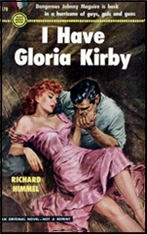
RICHARD HIMMEL – I Have Gloria Kirby. Gold Medal #179, paperback original, 1951. Reprinted by Gold Medal several times.

   Gloria Kirby was Johnny Maguire’s first love, and when she comes storming back into his life, it’s at least fireworks all over again. But she’s in trouble, hooked on dope, and on the lam with $70,000 in hot money, and who else can she turn to?

   Maguire’s not a private aye, but as the next thing but, he’s a semi-successful lawyer, one who’s fought his way up out of a neighborhood on the wrong side of the tracks, the same neighborhood that spawned Gloria Kirby, and her currant boy friend, the notorious Danny Nelson, who wants her back.

   Although the fatal attraction of raw sex appeal seems overstated, it is a theme that always struck home in a simpler age. Maguire’s love life is so messed up as to brand him a hopeless romantic, yet with a girl like Tina at home, I doubt that my eye would wander quite so easily.

   As for the story, maybe you think you could take it from here. Maybe so, but only if you kept things moving and at the same time mixed things up pretty well by introducing a secondary problem Who stole the money in the first place, and why?

Rating: B

– Slightly revised from The MYSTERY FANcier, September/October 1978.


      The Johnny Maguire series —

I’ll Find You. Gold Medal 1950
The Chinese Keyhole. Gold Medal 1951
I Have Gloria Kirby. Gold Medal 1951
Two Deaths Must Die. Gold Medal 1954
The Rich and the Damned. Gold Medal 1958

« Previous PageNext Page »