Reviews


REVIEWED BY DAN STUMPF:


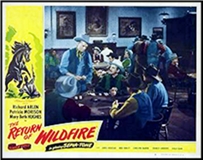
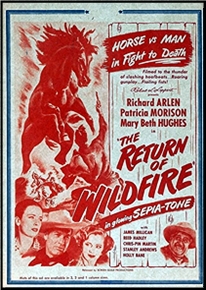
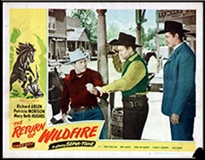
THE RETURN OF WILDFIRE. Lippert, 1948.  Richard Arlen, Patricia Morison, Mary Beth Hughes, James Millican, Reed Hadley, Chris Pin-Martin, Stanley Andrews and Mike Ragan. Written by Betty Burbridge and Carl K Hittleman. Directed by Ray Taylor and Paul Landres.

   Whence the title? Return of Wildfire isn’t a sequel, and the eponymous stallion never actually leaves anyplace, so the issue of returning doesn’t arise here. Well never mind, it’s a bit draggy at times, but well played, and with a terrific finish.

   The story opens on a ranch owned by Stanley Andrews, the widowed father requisite in B-Westerns, with two daughters (Mary Beth Hughes and the lovely Patricia Morison.) Andrews raises horses, and suffers from the depredations of outlaw horse Wildfire, who keeps running off with his stock. But his real problem is with dress-heavy Reed Hadley, who aims to corner the market and will stop at little or nothing to get his hands on Andrews’ herd.

   About this time driftin’ cowpoke Richard Arlen blows in, helps out Ms Hughes, who has been injured hunting Wildfire, and is promptly hired on. He also takes a yen for Ms Morison, which leads to some very tiresome complications with Hughes, but before things can get too bogged down, Hadley makes his play and things liven up.

   Andrews gets murdered by his own foreman (James Millican, in a well-judged role as a vacillating bad guy) Hadley jumps in and scarfs up the horses in a dirty business deal, and when Arlen whips up replacements from Wildfire’s herd, Hadley just plain steals them, too.

   Up to this point, The Return of Wildfire has run on the tepid side, but from here on out, it’s non-stop action, with a running gun battle across the Sierra Peloma Mountains, capped with an exhausting fistfight that recalls similar moments in Winchester 73 and The Naked Spur. And I have to say directors Taylor and Landres do it just as well as Anthony Mann could have. Quite a surprise coming from producer Lippert, and one that makes for fine viewing.

   I said The Return of Wildfire was well played, and it is. Besides Millican’s wavering, we get Arlen’s type-cast toughness, and Reed Hadley’s sepulchral villain. And best of all, there’s Patricia Morison, who makes any film she’s in a delight to watch.


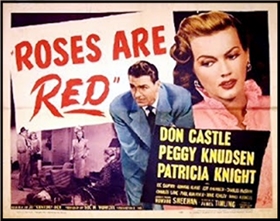
ROSES ARE RED. 20th Century Fox, 1947. Don Castle, Peggy Knudsen, Patricia Knight, Joe Sawyer, Edward Keane, Jeff Chandler, Charles McGraw, Charles Lane, Paul Guilfoyle, Doug Fowley), James Arness (as James Aurness). Director: James Tinling.

   With a title such as this one, you could be excused for thinking that this particular film would be a romantic comedy/musical starring Doris Day or Betty Hutton. But no. “Ha!” on you. What this is instead is a snappy 60-minute crime mystery with a cast that’s totally in sync with the story all the way through. (Just take a look at the names. Fans of B-movie mysteries from the 40s will recognize them all.)

   Not only is the cast picture perfect for this sort of thing, the plot has a twist added to a twist that I don’t remember seeing before. Finding a career criminal who looks exactly like the newly elected district attorney and arranging it so the former is ready to step in to impersonate the latter, that’s twist number one. What was new to me was to carry the twist one step further (trying to be clear as I can without revealing all).

   I’m not exactly sure why they came up with the title they did. The movie does open with police lieutenant Joe Sawyer on the scene of a murder of a girl in whose hand is found a red rose, but there’s no real reason for the rose nor, in fact, does the killing have much to do with rest of the story. (See above.)

   One other thing that I found amusing, in a trivia-of-the-day sense, was seeing both Jeff Chandler and James Arness in the same movie, both in important but rather minor roles, both in the early stages of their respective careers. Fun facts such as this make movies such as this all the more fun.


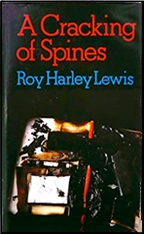
ROY HARLEY LEWIS – A Cracking of Spines. Matthew Coll #1. St. Martin’s, US, hardcover, 1981. Previously published in the UK by Robert Hale, hardcover, 1980.

   Mood, atmosphere, and background are essential attributes of a detective story, but in and of themselves they’re hardly enough.

   Any number of examples abound, but let’s take A Cracking of Spines as one in particular.

   Mystery readers invariably gobble up mysteries that involve both books and book collectors, so at first glance here’s one they (we) should go for right away.

   Completely permeating Matthew Coll’s hunt for a ruthless gang of antiquarian book thieves is a love for the printed page and showy leather bindings, but — and it hurts to say this — that’s about all this book has going for it. The plot has to be turned upside down before it begins to make any sense at all.

   Coll, formerly of military intelligence, is now retired as — guess what? — the new owner of a small English bookshop. His detective abilities turn out to be hampered by a puzzling taste in women, however, and he cripples his own investigation by two disastrous (and obvious) errors in judgment.

   In spite of his several faults as a detective, Coll is a rather likeable fellow, and I’11 be looking forward to his follow-up case, due to be published any day now. Let’s hope it’s a little bit more solid than this one, though.

Rating: C

– Slightly revised from The MYSTERY FANcier, September/October 1982.


      The Matthew Coll series —

A Cracking of Spines. Hale 1980.
The Manuscript Murders. Hale 1981.
A Pension for Death. Hale 1983.
Death in Verona. Hale 1989.
Miracles Take a Little Longer. Lythway 1991.

A 1001 MIDNIGHTS Review
by Marcia Muller


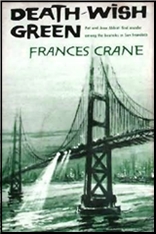
FRANCES CRANE – Death-Wish Green. Random House, hardcover, 1960. No paperback edition.

   Pat and Jean Abbott, a private investigator and his wife, are returning to foggy San Francisco from a weekend in the sun. As they reach the toll plaza of the Golden Gate Bridge, they spot a familiar car being inspected by highway patrolmen and the local police.

   The car, which was abandoned on the bridge, belongs to Katie Spinner, daughter of friends of the Abbotts, and it appears she has jumped off the bridge. Jean Abbott, however, is not convinced the girl committed suicide; and when Pat is hired by Katie’s aunt to investigate the disappearance, it becomes apparent Katie is still alive.

   The Abbotts, who often work as an investigative team, focus on bohemian North Beach, one of the last places Katie was seen before she started across the bridge. There they encounter an art-gallery dealer with a taste for Zen Buddhism and opium; a model who calls her favorite color “death-wish green,” and dies wearing it; a mysterious stranger with a large auburn beard who was seen with the missing girl in a coffeehouse; and errant sons and daughters of some of the city’s wealthiest and most respected families. For all Pat Abbott’s investigative skills, in the end it is Jean who sees most of the action and carries the day.

   Frances Crane’s descriptive powers are considerable, and the sense of place — particularly of the fog and its effect on San Francisco — is powerful. Her secondary characters are well drawn and indeed far more vividly drawn than either Pat or Jean. Jean, the narrator/observer, remains just that, and we come away without really having gotten to know her. Pat, the detective, is merely a figure going through investigative motions.

   Frances Crane has written many other novels, all of them with colors in their titles, featuring the Abbotts. Among them are The Amethyst Spectacles (1944), The Buttercup Case (1958), and The Amber Eyes (1962). In addition to San Francisco, they are set in such locales as Tangier (The Coral Princess Murders, 1954); New Mexico (Horror on the Ruby X, 1956); and New Orleans (The Indigo Necklace, 1955).

     ———
   Reprinted with permission from 1001 Midnights, edited by Bill Pronzini & Marcia Muller and published by The Battered Silicon Dispatch Box, 2007.   Copyright © 1986, 2007 by the Pronzini-Muller Family Trust.

REVIEWED BY DAVID VINEYARD:


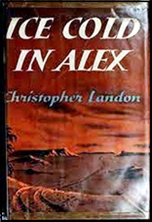
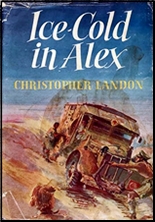
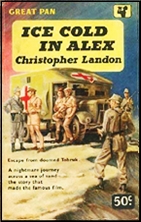
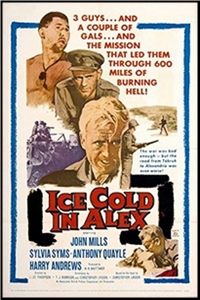
CHRISTOPHER LANDON – Ice Cold in Alex. Heinemann, UK, hardcover, 1957. Sloane, US, hardcover, 1957. Also published as Hot Sands of Hell (Zenith ZB-43, US, paperback, 1960).

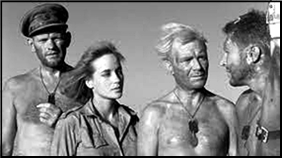
ICE COLD IN ALEX. ABPC, UK, 1958; released in the US as Desert Attack. John Mills, Sylvia Sims, Anthony Quayle, Harry Andrews, Diane Clare, Richard Leach, Liam Redmond, Walter Gotell. Screenplay: T. J. Morrison, based on the novel by Christopher Landon. Directed by J. Lee Thompson.

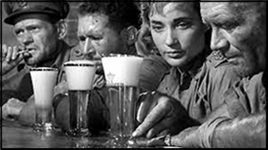
   They served it ice cold in Alex …

   
   â€œIt” is beer, they serve it ice cold in Alexandria, Egypt at the canteen, and for Captain George Anson who is stationed in Tobruk on the eve of its fall to the advancing forces of General Erwin Rommel, beer has become a beacon of hope amid the routine and routine fear of the pounding being taken as Rommel advances and there is less and less chance of survival…

   He knew that the fear had come to stay now — not coming and then draining away, as it had for the last two days.

   Anson has been drinking more heavily with the fear and now the fear is constant as is the dream of that ice cold drink in Alex. That’s why it seems like a dream when his commander sends him, and Sgt-Major Tom Pugh on a special assignment to escort two nurses across the desert avoiding the Germans to the relative safety of Alexandria.

   He can almost taste the beer. “Four Rheingolds come before any bloody war.”

   
   The two nurses are Sister Diana and Sister Denise, the latter who has nearly lost her nerve under the German bombardment. Anson has missed the convoy, but it they leave now they can rendezvous with another for escort. At least that is the plan.

   Like many classics the set-up is a simple one. It’s the complications that follow that make the tale. Complications about the German patrol that lets them go if they will take on the South African civilian Zimmerman with them, like the impossible terrain they are forced to take to avoid more Germans, like mine fields, breakdowns, missed rendezvous, unexpected romance, salt marshes, death, thirst, fear, pain, and just maybe a German spy in their midst and perhaps that he might be their only hope to survive…

   Were they very clever … or complete stupid fools? His mind dodged back to every incident … how they reacted … how his own varying moods of contempt and wariness had pulled him this way and that like a straw in the wind.

   
   Christopher Landon is better known in the UK than here, and mostly for this book, though he wrote several other well-received thrillers. Perhaps it was just his fate to come along during the Golden Age of the British thriller at the same time as Hammond Innes, Victor Canning, Alistair MacLean, Gavin Lyall, Desmond Bagley, and Elleston Trevor (whom Landon most closely resembles). Somehow Landon slipped a little between the cracks, at least with American audiences.

   It could be some of his books are a bit bleaker than the other writers on that list , that he wanders into Graham Greene country of moral ambiguity and redemption rather than high adventure, or maybe he was just too grounded to compete with the higher flying competition.

   Whatever the reason this book was a masterpiece, and it was snapped up for a film.

   Some films are better than the book.

   This one took a fine book and turned it into a legendary war film, one of the best of its era, one of the best of any era.

   John Mills, the everyman (at least every Englishman) of his acting generation, was Anson. Sylvia Sims was Diana Norton, Harry Andrews (who else) Mechanist Sgt-Major Pugh, and Anthony Quayle, the mysterious man who joins them on their adventure across the Sahara.

   J. Lee Thompson of Cape Fear and The Guns of Navarone directed with the same set of skills demonstrated in those other films.

   The plot, most of the incidents from the book are the same are but boiled down to a little over two hours, bleakly photographed in black and white, nerve-wracking foot by foot of the journey, their fear, thirst, and distrust writ tautly across the screen, and the nerves ratcheted up right down to the final minutes and the satisfying humanity reaffirming anti climax.

   Like Flight of the Phoenix, another adventure film about unlikely survival in the desert this one holds you right down to the end.

   Ice Cold In Alex is an anti-war film, it is about humanity among a small group of diverse people in danger. Films like Lost Patrol, Sahara, and Bridge on the River Kwai come to mind. This one stands beside them.

   Mills, Quayle, and Andrews steal the show, and Andrews very nearly steals it from the other two. Acting styles may be a bit different than today, some might find there are too many speeches designed to explain things, the considerable acting skills a bit more on the nose than modern audiences are used to.

   That really doesn’t matter much. This is a superb film, a classic, one of the best war films from an era when some of the finest war films ever made were being turned out. It features three of the finest actors the British film industry had to offer, and it still has something to say about men in war and where survival outweighs politics.


REVIEWED BY DAN STUMPF:


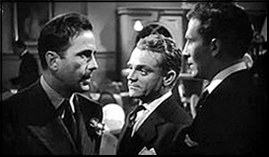
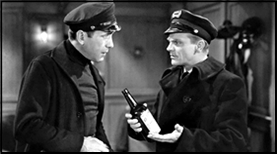
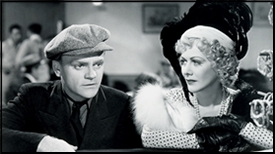
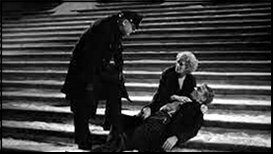
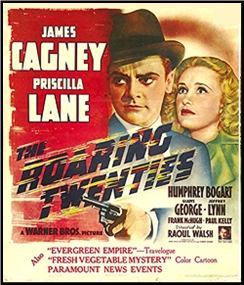
THE ROARING TWENTIES. Warner Brothers, 1939. James Cagney, Humphrey Bogart, Priscilla Lane, Gladys George, Jeffrey Lynn, Frank McHugh, Paul Kelly, Joe Sawyer, and Abner Biberman. Written by Jerry Wald, Richard Macaulay, Robert Rossen, Mark Hellinger, Earl Baldwin, Frank Donoghue, and John Wexley. Directed by Raoul Walsh.

   Not so much a roar as a whimper. Warners obviously lavished a lot of care on this one (Just look at all those writers.) and the result was a lot of tedium.

   Note that The Roaring Twenties was made in 1939. Everyone who worked on it, and most of the audience, would have remembered the era in a glow of youthful reminiscence, and the film became less a gangster picture than an exercise in nostalgia. So in place of fast-moving action, we get lengthy and rather pedestrian musical productions of the golden oldies of yesteryear.

   The story (WARNING!) starts with three doughboys (Cagney, Bogart & Lynn) who meet in the trenches of The Great War and strike up a tentative friendship. Back at home, Lynn becomes a lawyer, and Cagney a bootlegger who runs an honest racket, while Bogart tends toward the seamier side of law-breaking. Cagney takes a shine to young songstress Priscilla Lane, and invests in a nightclub to showcase her talents, but she falls for Lynn, and when they run off and get married, Jimmy takes to drink.

   Come the Great Depression — seems like everything was “the Great” back then — Cagney loses everything and ends up a lowly cab driver, whenever he’s sober enough to drive. Chantoosie Gladys George has stuck with him through all this, with patience that outlasted mine by at least a half hour of running time, but he still burns his torch for Priscilla.

   If all this seems a bit staid, that’s because it is. And as I say, it’s not helped any at all by musical interpolations that stop the story quite dead in its proverbial tracks. Compare this with Edward G. Robinson’s similar arc in The Hatchet Man, a fast-paced half-hour shorter, and you’ll see what I mean.

   But then there’s the ending.

   If you’ve never seen The Roaring Twenties, I won’t spoil it for you. Suffice it to say that Lynn and Bogart end up on opposite sides, and when Bogie gets menacing, Ms Lane turns to Cagney for help. The scene where he confronts Bogart is perfectly choreographed and effectively played: seedy cabbie vs big-shot gangster, with Jimmy at first humble, and Bogart dismissive.

   The knowing, defeated look in Cagney’s eyes when Bogart says, “It’s cold out, Eddie. I think I’ll have the boys give you a ride home.” Is almost worth sitting through the preceding ninety minutes. And Bogie’s cowardice when things go bad is just as convincing. The burst of action that follows is beautifully done by Raoul Walsh, a master stylist whose elegance was never fully appreciated.

   I just wish the ending had come a bit earlier in the film. As it is, it makes the movie memorable. Watch it, but keep a finger poised on the Fast Forward button.


REVIEWED BY BARRY GARDNER:

   
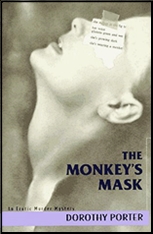
DOROTHY PORTER – The Monkey’s Mask. Jill Fitzpatrick #1. Hyland House, Australia, paperback, 1994. Arcade, US, hardcover, 1995. Serpent’s Tail, UK, paperback, 1997. Picador, Australia, paperback, 2000. Film: Strand, 2000, with Susie Porter as Jill Fitzpatrick.

   I note this offering from a publisher new to me by an author likewise because it is surely the oddest “mystery” I’m likely to see this year, and maybe any other: an Australian lesbian PI novel written completely in verse. Trust me. If I’m lyin’ I’m dyin’. Porter has written several books, and this [the Arcade edition] is not a vanity press.

   The book is blurbed as “an erotic murder mystery,” and I believe that’s a fairly apt description of the story underneath the verse. Details I’m not going to give you, because when someone tells you a dog sang, you don’t ask in what key.

   And if you’re expecting any critical insights you’re out of luck there too, because a) I didn’t read it thoroughly or closely, and b) I’m not qualified to evaluate poetry. The verse is free — it doesn’t rhyme, anyway — and some of it struck me as pretty good; this, though, from someone who thinks Swinburne’s “Garden of Prosperpine” is about as good as it gets. What else can I say?

— Reprinted from Ah Sweet Mysteries #21, August-September 1995

   
Bibliographic Notes: This is the only entry for the author in Al Hubin’s Bibliography of Crime Fiction IV, but note that that book stops with the year 2000. It was the winner of the National Book Council Banjo Award (Australia’s equivalent to the Pulitzer Prize).

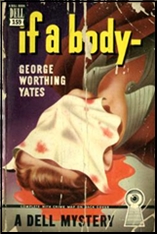
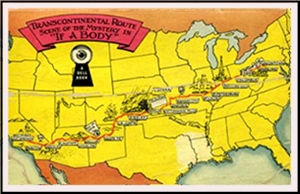
GEORGE WORTHING YATES – If a Body. Hazlitt G. B. Woar #3. Morrow, hardcover, 1941. Triangle, hardcover reprint, 1942. Dell 159, paperback, mapback edition, 1947.

   Someone reading this may come up with another example – and if so, it would be most welcome – but at the moment I think the murder investigation in this book could easily be unique: it takes place during a cross-country drive clear across the US, from a dinky tourist camp in eastern Ohio to some cabins for rent in Palmyra Hot Springs, a tiny town in the desert within shouting distance of Los Angeles, California.

   Of the 15 travelers, couples and families, who stopped for the first night in a rainstorm, only 14 leave. The death of one of them the authorities rule an accident, but a secret pact between some of them indicates that not only did they know that something was fishy about the death, but they’d also rather hush up about their suspicions so their travel plans would not be delayed.

   But what this somehow means is that they end up taking the same route, their paths constantly crossing and overlapping each others. Two of them are husband and wife: Hazitt Woar and his new wife Kathern. They are on their honeymoon. His past includes a stint as a British detective, but in the previous book he ended up on the wrong side of the law in the US, and they are traveling under fictitious names and doing their best to avoid wanted posters as they go.

   But Woar’s instincts as a detective cannot be denied, and to his new wife’s extreme frustration and displeasure, he finds he cannot deny his true calling. (At the end of the book, she gives in and allows him to start a new life in San Francisco as a private detective. Unfortunately this was the last of Woar’s three recorded adventures.)

   This book took me a long time to read. An investigation conducted under such stretched out circumstances meant that the long middle section was continuously bogged down, especially while Woar is trying to keep his identity a secret at the same time he’s trying to solve a murder which may not be a murder at all.

   While not deeply depicted, the characters are interesting, though, and individual people. And there are reasons their paths keep coming together every evening, which is due to very clever writing on Yates’s part. The ending is quite chaotic, though, and if I’m reading it right, the killer’s identity is revealed several pages before Woar explains all.

   If you decide to read this anyway, after reading these observations and comments of mine, do it for fun, which it is. The details (and considerable pitfalls) of driving cross-country in the early 1940s are worth the price of admission in themselves.


   The Hazlitt G. B. Woar series –

The Body That Came by Post. Morrow 1937.
The Body That Wasn’t Uncle. Morrow 1939.
If a Body. Morrow 1941.

REVIEWED BY DAVID FRIEND:


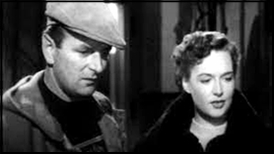
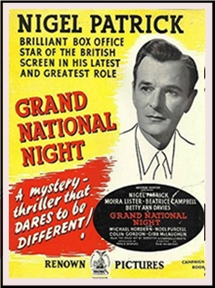
GRAND NATIONAL NIGHT. Renown Pictures, UK, 1953; Allied Artists, US, 1955, as Wicked Wife. Nigel Patrick, Moira Lister, Beatrice Campbell, Betty Ann Davies, Michael Hordern, Noel Purcell, Leslie Mitchell. Director: Bob McNaught.

   There are certain sub-genres of the crime drama which I will diligently seek out. Heist films, prison escape movies and the murder story in which we see who did it and how. 1920s crime fiction writer R. Austin Freeman invented the form and called it the ‘inverted detective story’. Columbo, of course, is the most famous example of this format on television while, in film, we have Hitchcock’s Dial M for Murder. They’re not so much whodunits as will-he-get-away-with-its? and are often headily suspenseful.

   This thriller from Nettlefold Studios is slightly different. Racehorse trainer Gerald Coates (played by the always excellent Nigel Patrick) doesn’t intend to kill his drunken, mean-spirited wife Babs (Moira Lister). As an accident, therefore, there is no careful preparation and cool-headed problem-solving of the kind Ray Milland or Jack Cassidy had to deal with.

   In truth, this decision makes the story less dramatic, but it also makes for an interesting change of pace, and ensures the protagonist has our sympathy. It could even be argued that he is the true victim of the piece as the viewers will surely wish they could kill Babs themselves.

   The film was previously a radio serial on the BBC and, originally, a stage play by Dorothy and Campbell Christie. Its stage-bound origins are certainly obvious, as most of the action takes place in one large room at the Coates’ country estate. Indeed, many such stories, in my experience, do originate on stage. (There seems to be something about watching people die at a very close distance that engages theatre audiences like little else.)

   In Grand National Night there are a few scattered instances in which we go beyond those walls – we visit Aintree racecourse, for instance, there’s an all-too-brief moment when Coates tries to evade the police on horseback, and a dreamily atmospheric flashback near the end.

   The flashback, in particular, is required as, for most of the film, we are not sure just what has become of the dead wife. Indeed, it appears for a time as though she is still alive, as that is initially what Coates leads everyone to believe. Things do not seem any clearer when Babs is revealed to have died in nearby Liverpool. Coates tries to keep a diligent detective – played by the legendary Sir Michael Hordern – from discovering that Babs had, in fact, returned to the house before her death.

   It is a shame that Nigel Patrick didn’t get more starring roles as he was clearly a very dependable actor. He was often cast as suave gentlemen, but I also caught him as a comically hyperactive spiv in 1948’s tonally inconsistent Noose (avoid it).

   Also magnificent was Colin Gordon, a regular face on film and later television, who appears here in an unexpectedly key role. A neat bit of business, involving the two, wraps everything up neatly, making Grand National Night a pleasant and undemanding B-film.

Rating: ***


FIRST YOU READ, THEN YOU WRITE
by Francis M. Nevins


   There’s a general rule to which the most conspicuous exception in our genre is Agatha Christie: an author’s work dies with the author. Certainly Aaron Marc Stein’s has. Over a period of almost half a century he wrote a total of 114 novels, all but three of them whodunits, and at the peak of his career he was praised by Anthony Boucher of the New York Times Book Review as the most reliable professional detective novelist in America.

   Try to find any of his books now. I began reading Aaron in my teens and got to meet him when he was in his early seventies. We remained friends for the rest of his life. Isn’t it time that I try to resurrect him?

   He was the consummate New Yorker, born there on 15 November 1906, and for his college education went no farther than Princeton University, across the Hudson in New Jersey, from which he graduated in 1927, summa cum laude and Phi Beta Kappa. His first publisher was Covici Friede and his first novels, SPIRALS (1930) and HER BODY SPEAKS (1931), were of the avant-garde type and saw print thanks to endorsements from Theodore Dreiser.
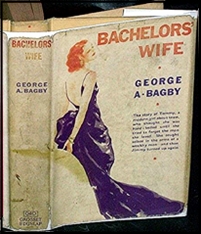
   He then adopted the pseudonym of George Bagby for a long-forgotten romance novel, BACHELOR’S WIFE (1932). By this time he’d become interested in mystery fiction and, still using the Bagby byline, began writing what turned out to be a 48-book series of whodunits featuring Inspector Schmidt, a Manhattan police detective who is characterized mainly by taking off his shoes whenever possible, to ease the sore feet he developed in his early years as a beat cop.

   The first three Schmidts were published by Covici Friede, with either Aaron or his editor opting to use Bagby as both the byline on the novels and the Watson figure. Bagby the character is not a cop but a professional writer commissioned to turn Schmidt’s cases into fiction. He calls himself Schmidty’s ghost writer but, since he not the Inspector is presented as the author, it’s more accurate to describe him as Schmidty’s chronicler, just as S.S. Van Dine, still a name to reckon with in the first half of the 1930s, was the chronicler of his detective hero, although Bagby is much more vivid than his unheard and invisible counterpart in the Philo Vance novels.

***

   The fourth Schmidt, which is the earliest I have on my shelves, was the first of dozens of Aaron’s novels published over the next near half-century by Doubleday Crime Club. With the income from his early books rather paltry, he prudently kept the day job he’d held since shortly after graduating from Princeton, as a reporter for the New York Evening Post.

   Eventually he became the paper’s radio critic, learned a huge amount about the inner workings of a broadcasting system, and put his knowledge to use in MURDER ON THE NOSE (1938). Schmidty and Bagby are implausibly first on the scene when the report comes in of what might almost be a John Dickson Carr impossible-crime situation: At the end of his signature tune “I Telegraph My Love to You,” and simultaneous with the sound of a clashing cymbal from the small orchestra backing him up, radio crooner Roddy James has been shot to death by an invisible assassin with an invisible gun in a broadcast studio full of people who saw nothing and heard nothing.
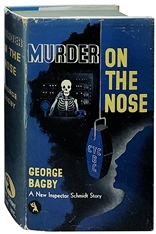
   It soon develops that everyone on the scene — the musicians, the announcer, the sound control engineer, the sponsor — had opportunity to commit the murder, but no one seems to have a motive, and the only real mystery besides the obvious one of how-was-it-done concerns why the program’s sponsor, a manufacturer of toothache remedies, insisted on James as the program’s singer when he was unpopular, technically inept, and did nothing to promote the sponsor’s product.

   Eventually there’s a second murder, a poisoning in a jazz club, and then a third, which bears a cousinly resemblance to the first, the victim this time being shut inside the broadcast system’s transmitter and electrocuted. With Schmidt we learn a great deal about the inner workings of 1930s radio before the solution, which is perhaps a bit too technical but indicates that Aaron must have done a prodigious amount of research into the nuts and bolts of broadcasting.

   There are far too many said substitutes, the most overused of the lot being “murmured,” and a few incidental details, like the group of female gospel singers from Harlem who keep turning up at murders, are treated in a manner that might offend some 21st-century political correctness freaks. But I must say I enjoyed the book and am delighted to have had Aaron sign my copy more than forty years ago.

***

   Before his next novel appeared, Aaron started working as a staff writer on Time magazine but he waited a few years to make use of that background. For the sixth Schmidt, THE CORPSE WITH THE PURPLE THIGHS (1939), he tapped into memories of his tenth reunion at Princeton in 1937, which I can’t believe was as chaotic or liquor-soaked as its fictional counterpart.

   Although neither the town of Princeton nor its university is mentioned specifically, Bagby tells us that he is of the class of 1927, which Aaron was too. Having traveled by train to the nameless town from whose nameless university he’d graduated ten years earlier, and wearing the pirate costume that is the uniform for the class of ‘27, George makes for the firehouse that is serving as headquarters for the alumni of his year. (Alumni is precisely the right word here since all the grads are men. Princeton didn’t go co-ed until the late 1960s.)
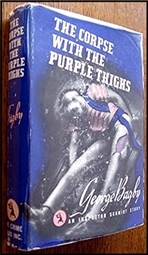
   After some imbibing and a crap game he leaves the firehouse and, in the alley alongside the building, stumbles in the dark over what he first assumes is a drunk sleeping it off but quickly discovers is a corpse. He calls the local police, then returns to the alley with a fellow member of the class of ‘27 who’s a doctor. Voila! No corpse.

   The Inspector drives down, arriving late that night, and tells Bagby that someone tried to run his car off the road after he’d stopped for directions at a local roadhouse, which happens to be run by a scar-faced mobster. Schmidty immediately takes over the local police department and soon gets to meet several of Bagby’s classmates including that doctor, a football hero known as Stinker, a congenital drunk known as Zipper, and a guy with a movie camera who’s determined to get every member of the class into his film.

   Complications keep piling up during the long Friday night and, thanks to a total of three murders (the same total as in MURDER ON THE NOSE), nobody gets much sleep. Soon after the traditional Saturday morning parade of the various classes of grads, Schmidty pulls the proverbial rabbit out of the hat and, with total unfairness to the reader, collars the killer.

   Bagby’s summary of everything that happened consumes several pages and leaves us wondering why the culprit made such a microscopically detailed confession. Frankly, I found this exploit rather uninvolving. Could Aaron have made a mistake taking Schmidty out of the big city? I didn’t try to count the number of lines of dialogue that the characters murmur but it must be huge.

***

   We’re back in Manhattan with the next Schmidt novel, THE CORPSE WORE A WIG (1940). Like the previous books I’ve discussed here, this one features three murders, a very tight time frame, and countless lines of dialogue that their speakers murmur. (On one page that verb appears three times in ten short paragraphs.)

   We also find what in later years was to become one of Aaron’s trademarks, a host of long long sentences worthy of Hegel or Faulkner. Here’s a typical example from early in Chapter One.

   Just as my long career as Schmidty’s ghost has convinced me I cannot hope to rival his capacity for unraveling the tangled threads of a crime into its logical components and reassembling these into the inevitable web of the crime’s true texture, just so I do flatter myself that I have profited from this association with Schmidty at least to the extent of being able to confront a simple point of evidence with an open mind and read it for what it is worth.


   The plot begins when a medical examiner doing a routine autopsy on another doctor, who seems to have died of natural causes, calls in Schmidty upon discovering that, as per the title, the cadaver was wearing a hairpiece — and beneath it a bullet hole which, on its way into the top of his skull, penetrated a perfectly fine head of hair identical to the wig.
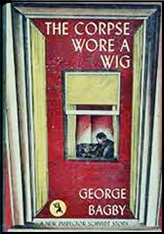
   With Bagby in tow as usual, the Inspector visits the dead man’s office and residence, on the ground floor of an East 77th Street apartment building, and soon discovers that the doctor had only seven patients and wanted no more.

   Questioning his nurse and her artist boyfriend reveals that the doctor had taken up the hobby of etching, and that a great deal of the cyanide he’d been using in his hobby is missing. During the Q&A two visitors come knocking, a former criminal turned theatrical wigmaker and a clearly but subtly gay hairdresser who prefers to be called a scalp specialist.

   It soon develops that the doctor derived most of his income from operating a private medical service for injured criminals. Later that day the wigmaker and an employee of the hairdresser are found poisoned, giving us the requisite three bodies. Before midnight Schmidty has solved all three crimes, although Aaron denies us any chance to anticipate the solution and reveals the little-known fact that triggered Schmidt’s suspicions only in the last paragraph.

   Nevertheless I sort of liked the book, mainly because of some interesting situations — would a woman try to create an alibi by tethering herself to a permanent-wave machine that burned her hair and scorched her scalp? — and the glimpses of offtrail environments like the wigmaking and hairdressing emporiums. But purely as a detective novel it’s nothing special.

***

   The eighth in the series, RED IS FOR KILLING (1941), differs from earlier Bagby novels in several respects. There’s only one murder — supplemented by two near-fatal assaults, one of them on Bagby himself — the time span covers two whole days and nights, and Aaron seems to have cured himself of the Faulkner sentence syndrome and murmuritis.

   He also made such use of his stint at Time magazine, which he portrayed (whether fairly or not I have no idea) as a zoo full of screwballs writing their journalism in a wacko parody of normal English, that he would surely have been fired if he hadn’t already resigned to become a professional novelist.

   Schmidt and Bagby visit the offices of the upstart newsmagazine Tidings, on the top three floors of the same skyscraper that houses the Coast to Coast Broadcasting Network from MURDER ON THE NOSE, when the body of its newest employee, the sharp point of a letter spike buried in the back of his neck, is found in one room of the magazine’s offices, a special library devoted to the collapse of an automotive empire.

   His aching feet encased in comfortable slippers, Schmidty comes to suspect that the more he learns about the dead man and why he was hired the more likely he’ll find the murderer, and starts questioning several of the Tidings brass — a can of mixed nuts of the first water — and a few outsiders including an obnoxious gossip columnist, a politically ambitious plutocrat and the widow of one of the men involved in that business collapse.

   Readers are apt to figure out the late Harold Quimby’s real identity sooner than Schmidt does but have no chance of solving the murder puzzle ahead of the Inspector since Aaron as usual has no interest in playing fair. But his vivid if perhaps biased evocation of the newsmagazine environment, foreshadowing his explorations of various Manhattan milieus in later novels, helps make RED IS FOR KILLING one of his better early efforts.

***

   Those efforts consist of nine Bagbys plus the first four whodunits published under his own name, which featured the archaeologist/amateur detective team of Tim Mulligan and Elsie Mae Hunt.

   What put an end to his first period was Pearl Harbor. He joined the Office of War Information and later the Army, in which he served as a cryptographer. On his return to civilian life he went back to writing full-time and continued to do so until his death forty years later.

   It was the novels he wrote in the late Forties and Fifties that led Anthony Boucher to call him the most reliable American practitioner of his genre. In later columns I hope to explore some of them.
« Previous PageNext Page »