Reviews


A 1001 MIDNIGHTS Review
by Susan Dunlap & Marcia Muller


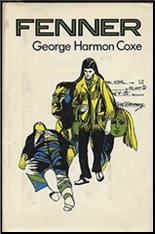
GEORGE HARMON COXE – Fenner. Alfred A. Knopf, hardcover, 1971. Manor Books, paperback, 1974.

   George Harmon Coxe was an extremely prolific writer whose early work appeared in such pulp magazines as Black Mask, Dime Detective, and Detective Fiction Weekly. His news-photographer hero, Flash Casey, first appeared in Black Mask in the early  1930s, and later Coxe used him in a number of novels, among them Silent Are the Dead (1942) and Error in Judgment (1961).

   His other news-photographer sleuth, Kent Murdock, appears in many more novels than Casey, and is a more fully realized character than the creation of Coxe’s pulp-writing days. Coxe also created series characters Paul Standish (a medical examiner), Sam Crombie (a plodding detective), Max Hale (a reluctant detective), and Jack Fenner (Kent Murdock’s private-eye sidekick who starred in several novels of his own).

   Many consider Fenner the most entertaining of Coxc’s later novels. Although published in 1971, it has the feel of the Forties. (Indeed, the hippie reference seems an anachronism.) Coxe has a simple formal style; he describes his characters but seldom invites the reader to identify with them. Action-oriented readers may find Coxe’s work dull; there is virtually no violence, but rather a charming concern for decorum (another hint of bygone days).

   In Fenner, Coxe begins with heiress Carol Browning’s escape from a state mental institution. (Her husband committed her.) The scene shifts to Fenner’s office, where the husband, George Browning, hires the detective to find his wife. Why, with all her money, did he send her to a state hospital rather than a more tolerable private one? Fenner asks. Browning’s answer is unconvincing. Before Fenner can get to the bottom of this, Browning is murdered-in his wife’s apartment. There’s the hook; expect some good twists and a plausible conclusion. No more, no less.

   Jack Fenner reappears in The Silent Witness (1973) and No Place for Murder ( 1975), as well as playing a role in many of the Kent Murdock novels.

     ———
   Reprinted with permission from 1001 Midnights, edited by Bill Pronzini & Marcia Muller and published by The Battered Silicon Dispatch Box, 2007.   Copyright © 1986, 2007 by the Pronzini-Muller Family Trust.

REVIEWED BY DAVID VINEYARD:


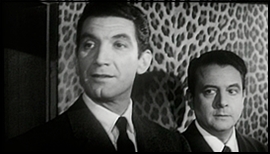
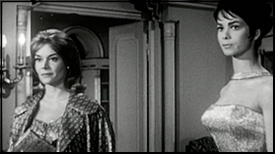
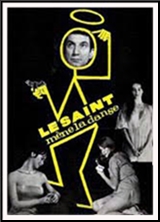
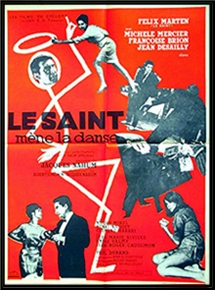
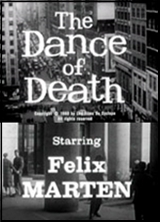
THE DANCE OF DEATH. 1960. Originally released as Le Saint mène la danse (The Saint leads the Dance); also known as  Le Saint conduit le bal (The Saint leads the Ball). Felix Marten, Michèle Mercier, Jean Desailly Screenplay. Albert Simonin, Jacques Nahum, Yvon Auduard. Based on the story “Palm Springs” by Leslie Charteris. Directed by Jacques Nahum.

   It will come as a surprise to no one that actor Felix Marten (Elevator to the Gallows), a singer and composer, capable as he was at playing action heroes and suave tough guys, is exactly no one’s idea of Leslie Charteris’s Brighter Buccaneer Simon Templar, the Saint. It will come as a greater surprise that he is damn good at it and easy to see as the Saint even in the English language version under another name.

   This unauthorized 1960 film, was the first Saint film since the Louis Hayward The Saint’s Girl Friday, was filmed, but after author and creator Leslie Charteris went to court to have any reference to Simon Templar expunged outside of France, the hero was given a new name.

   Ironically the film is a better adaptation of the original story than the George Sanders outing The Saint in Palm Springs previously filmed in the RKO series, and Marten’s much closer in style to Charteris’s hero than Sanders had been, at least to the tougher Post-War Saint.

   Curiously Marten does look a bit like the John Spangler/Doug Wildey version of the Saint in the long running comic strip though minus the spade beard.

   Marten is at least not diffident to women or violence in the Sanders manner and has a positively saintly smile in action. He even breaks the fourth wall and addresses the audience at the end of the film,and whistles what I am willing to bet was the original Saint theme written by Charteris in the French version.

   Despite being unauthorized this is an expensive and well made production. It clearly wasn’t made hurriedly or on the cheap.

   A scene in a restaurant where he disposes of two punks bothering Gina (a sub-plot that complicates the action) is mindful of the well-staged fights from the Moore series and shows off Marten’s physicality. (I can find no reference to it at IMDb but I seem to recall he had served in the French Paratroops, the old Foreign Legion, before coming to the screen.)

   Stuart Thompson (Felix Marten who in some movies plays a character simply called Felix Marten), is a private eye hired in Paris by Fred Pellman, an avid hunter and millionaire who a year earlier helped in the capture of a public enemy in Boston. Now he’s receiving death threats and afraid the police can’t handle them. At a $1,000 a day Thompson agrees to take the job protecting Pellman at his villa where he lives with three beautiful women, his secretaries (late in the film it comes to light one of them may have a motive for killing their boss).

   And when the women are Norma (Françoise Brion), Gina (Nicole Mirel), and Dany (Michèle Mercier star of the five “Angelique” historical epics with Robert Hossein and one of the notable beauties of the era in an early role and a brunette here) that is pretty good company, even if the cat claws are out and any and all of them might be involved in the plot to kill Pellman which Thompson isn’t sure is tied to the Boston incident after all, at least not gangland revenge.

   Ten million dollars is a lot of motive for murder, even the servants are suspicious.

   A guard dog dies, a knife (meant for Pellman) nearly misses Dany (who proves to be a crack shot) while Gina is putting moves on Thompson, and Commissar Richard of the Surete supplies information casting doubt on Pellman’s chauffeur who ends up killed by the fan blades of a car.

   It is a solid Euro-Thriller, as much gothic horror as mystery, replete with Marten finding himself entombed, and more than worth catching. Handsomely and atmospherically shot it is a small gem of a mystery with more than enough horror if not supernatural elements to make it interesting, with the caveat that Euro-thrillers can be something of an acquired taste, and the dubbing is standard.

   The ending, a car chase through spooky woods and final reckoning in a hunting lodge puts a final and satisfying twist on the proceedings.

   This ranks with The Saint in New York and The Saint’s Girl Friday as probably one of the best Saint outings on film before the advent of the Roger Moore series. Like The Steel Key, another non Saint outing of the Saint, it is better than most of the previous Saint films with Sanders and Hugh Williams. Leslie Charteris could have done worse than to let this one be released in English as an exploit of the Saint, and if you want to watch the dubbed version and just ignore Marten’s new name you might enjoy it as a different kind of Saint movie.

   But enjoy it you likely will with an attractive cast, intelligent script, good direction, a jazzy score, and handsome cinematography it is a tasty mix of mystery and horror, and certainly one of the most offbeat interpretations of a Saint adventure ever attempted.

   You can usually find it on YouTube, and it is available from Sinister Cinema.
   

REVIEWED BY DAN STUMPF:


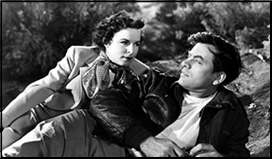
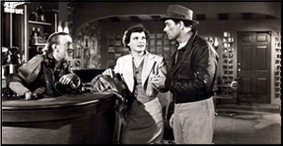
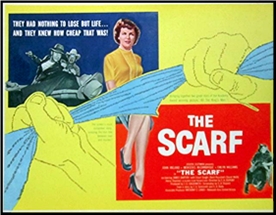
THE SCARF. Gloria Productions, US, 1951. John Ireland, Mercedes McCambridge, James Barton, Basil Ruysdale, Emlyn Williams, David Bauer (as David Wolfe) and King Donovan. Written by E A Dupont, Isadore Goldsmith, and Edwin Rolfe. Directed by E A Dupont.

   Robert Bloch contended that The Scarf was ripped off from his book of the same name, but the spirit of the thing comes closer to Goodis than Bloch, and aside from the title and a bit of 40s pop-psychology, it’s an original film — not a complete success, but strange enough to keep watching.

   John Ireland, a couple years after All the King’s Men and struggling to achieve leading-man status, stars as an amnesiac escapee from a state mental hospital who makes his way across the desert and onto the poultry farm of philosophical turkey-rancher James Barton, who asks him not so much about his crime as about his place in the universe.

   Okay, that caught me by surprise. As did a too-clever cop who turns up to trade quotations from the great thinkers with Barton. Later on we get David Wolfe (an actor who spent most of his career in uncredited bit parts) as Level Louie, a thoughtful bartender, and Mercedes McCambridge (also of …King’s Men) as “Cash ‘n’ Carry Connie” a torch singer in one of the seediest bars in the B-movies. The sight of McCambridge slinking awkwardly about this poverty-row dive trying to be Lizabeth Scott is hysterical in every sense of the word, but somehow it’s not without a certain desperate charm, as one studies the actress and the character and wonders how a woman could fall so low.

   All this is directed by E.A. Dupont, himself once a director of note, now fallen on harder times, who focuses more on the characters than the plot, which is a good thing because the story is a rather silly affair of murder supposedly committed by a mental patient but actually done in a moment of mad passion by the most obvious suspect in the film. I don’t mean to sound dismissive, though; The Scarf, for all its faults and pretensions, carries enough loopy appeal to keep lovers of strange movies happy enough for its brief running time.


IT IS PURELY MY OPINION
Reviews by L. J. Roberts


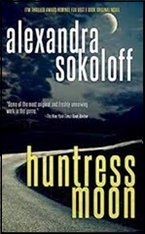
ALEXANDRA SOKOLOFF – Huntress Moon. Matthew Roarke #1. Thomas Mercer, paperback, November 2014.

First Sentence: FBI Special Agent Matthew Roarke is closing in on a bust of a major criminal organization in San Francisco when he witnesses an undercover member of his team killed right in front of him on a busy street, an accident Roarke can’t believe is coincidental.

   Waiting for his undercover agent to cross a busy street, Agent Matthew Roarke’s attention is captured by a woman standing behind the agent. Moments later, the agent is dead and the woman has disappeared. As he tracks the woman, he discovers several deaths at which she was present. Is she that most rare of killers: a female serial killer? She is canny, and always one step ahead leaving bodies behind as Roarke begins to piece together her motive and her objective.

   What an intriguing book, and one where readers are kept off-guard from start to end. It’s also a hard book to review without spoilers. Matthew Roarke is a driven character who we come to know in small bits. He is intuitive, yet logical; a perfect balance for someone in his job. But it’s the female character who keeps us going. Initially, we don’t know the identity of the killer until the “ah-ha” moment, and the tension builds from there.

   Information on the main characters is provided in bits as the story progresses. It is that information which then provides motive for their actions. Damien Epps, Roarke’s second, is the breath of fresh air.

   That the story is told in days heightens the suspense. The story alternatives between Roarke and the woman, and it works. The introduction of a man and his 14-year-old child raises the stakes even higher. The author has an ability not only to set the scene, but to convey the underlying emotions of it— “He steps through the open doorway, past the carved wooden door, into the entry hall with its white painted brick walls and tiled floor. … The terror has turned every cell in his body to ice; his feet can barely move him forward.”

   Just as Sokoloff has not given the investigators anything definite they can track, she leaves the reader directionless. It is clear the moon has significance, but what is unknown. However, evil, the sense of it, is a prevalent and effective theme.

   As the story progresses, the killer takes on the identity first as “Huntress,” and finally her name and background are revealed with a powerful twist. The author’s skill is clear in the killer’s progression. I don’t recall another author being able to transition one’s attitude toward a killer in the way Sokoloff does.

   This is not a perfect book. There are some plot holes and weaknesses such as the description of the Tenderloin, which is not nearly as grim as portrayed. The primary thing which did not ring true is Roarke, an FBI Agent, seemingly surprised by the idea of a female serial killer. He just couldn’t be that naïve. Another slight miss was the inference of a supernatural element which was not developed.

   Huntress Moon, the first in a series, is rather a first chapter in one long book with an arching theme: Evil. It is a page-turner and truly a popcorn book in that no one will be able to read just one. If you like the first, chances are you will want to continue.

Rating: VG Plus.
   

      The Huntress/FBI series

1. Huntress Moon (2013)
2. Blood Moon (2015)
3. Cold Moon (2015)
4. Bitter Moon (2016)
5. Hunger Moon (2017)
6. Shadow Moon (2019)

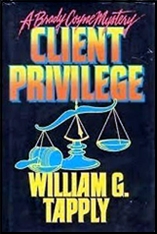
WILLIAM G. TAPPLY – Client Privilege. Brady Coyne #9. Delacorte, hardcover, 1990. Dell, paperback, 1991.

   This is the ninth book to chronicle the adventures of Boston attorney Brady Coyne, and the first I’ve happened to read. Some general impressions in a minute, some favorable, some not, but let’s get to the story first.

   A long-time friend of Brady’s, about to be nominated to become a federal judge, asks him to act as his legal representative in a matter of blackmail. When the blackmailer turns up dead (no surprise), Brady is prevented by the doctrine of “client privilege” and his own stubborn sense of ethics from revealing to the police anything he knows about the case.

   And by refusing to talk, he quickly becomes suspect himself. This is all very predictable, so much so that it is greatly surprising that Brady Coyne doesn’t see it coming himself. This is not Brady’s first brush with a murder investigation, yet after the first interview he has with the police, he tells his client, “I feel so – so guilty. They asked me these questions, and I couldn’t answer them very well, and somehow they made me feel as if I had done something wrong.”

   Perry Mason was never such a wimp. Something is wrong here. Coyne has a lot of wealthy clients and he makes a lot of money, and I think I know more law than he does. [WARNING! From this point on, I’m going to be going over details of the story you might not want to know without having read the book first.]

   Case in point: He’s later moaning over the fact that he has all this information about the case, and he can’ tell anyone. Client privilege. My response, “Hire a lawyer yourself.” A while later, that’s exactly what he does. He tells the other guy everything.

   Second case in point: He’s trying to find the woman in the case, but he’s stumped when he discovers she has married in the meantime and he doesn’t know her new last name. After a while his ex-wife has a brilliant idea. “There are records, aren’t there? When someone takes out a marriage license?”

   Perry Mason was never as inept as this. And it never occurs to Brady Coyne that it may be that his client is guilty until some 100 pages have gone by, and it occurred to me as soon as the murder was announced. Well, all right, the guy is a friend of his, and who’s going to believe that of a friend? On the other hand, as soon as he does start to think it over, he’s convinced the guy is guilty, and right away he’s trying to find ways to get out from behind “client privilege” without actually saying anything to the cops himself.

   So he starts investigating on his own, but in doing so, leaving a trail behind him so wide that both the police and the media can follow without breaking a sweat. Is it any surprise that the girl in the case is soon found half beaten to death? It is to Brady Coyne.

   Perry Mason was never of such doubtful intellect as this. Or so disloyal to his friends. I certainly would not care to have him representing me, strong code of ethics or not.

   On the other hand, while the story is so nicely predictable, Tapply is a tremendously smooth writer, with ace-high dialogue throughout the book. Even though I took a moderately strong disaffection for his hero – maybe I don’t identify with yuppies very well – I found myself tearing through the book, caught up in the tale and the need to discover how it dame out.

   All in all, though, in summing it up, what I think I’ll remember most about this book is that it should have made a a lot more use of Tapply’s top-notch storytelling talent than it does.

– Slightly revised from Mystery*File #30, April 1991.


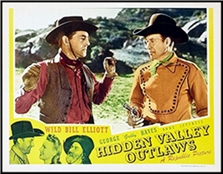
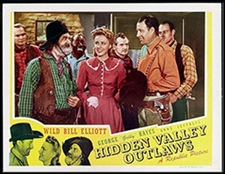
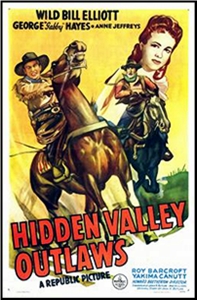
HIDDEN VALLEY OUTLAWS. Republic Pictures, 1944. Wild Bill Elliott, George ‘Gabby’ Hayes, Anne Jeffreys, Roy Barcroft, Kenne Duncan. Story and co-screenwriter: John K. Butler. Director: Howard Bretherton.

   Right on the heels of Sundown in Santa Fe (reviewed here ), here is a review of another B-western, and if you don’t like them and if this happens to be one too many for you, you can ask for your money back. (Let me repeat that. You can ask.) This one’s a jim-dandy one, though, and I think maybe the key is one of the names up above in the credits.

   If you’re a long time reader of the detective pulp magazines of the 1930s and 40s, you may have spotted him already. John K. Butler. The story is what makes this one go. Butler made a living at writing, and what’s more he was awfully good at it. This one is as tightly plotted as it can get. You’ve got to watch the actions of everyone every minute, and listen to the dialogue, too. There’s humor (*), there’s action when it’s needed, and while there is a good-looking woman involved, not a bit of romance is even hinted at.

   The story concerns a rancher who’s murdered for his land, his son who tries his hand at revenge until his equally untimely death, and Wild Bill Elliott, who along with his friend Gabby, is framed for the murder in the slickest bit of trickery you can imagine. They escape, join up with ranchers, try to persuade them not to become vigilantes, and bring the crooked lawyer behind it all to justice.d b
   This review has gone on long enough, but one of these days I’m going to have to put in a word for comic sidekicks in western movies. B-variety detective movies had them, too, I know, but it was the westerns who couldn’t exist without them, and Gabby Hayes was surely the rootin’, tootin’ best of the lot of them.
      ___
   
(*) Here’s the line I liked best. A crooked actor has been hired to play several parts in the fraud being played against Wild Bill and his friends, and one of the other owlhoots has this to say about him: “I don’t like actors. My wife ran away with one, but I still don’t like actors.”

– Considerably revised from Mystery*File #30, April 1991.


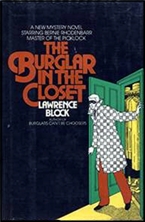
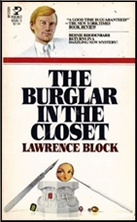
LAWRENCE BLOCK – The Burglar in the Closet. Bernie Rhodenbarr #2. Random House, hardcover, 1978. Pocket, paperback, August 1981. Film: Warner, 1987, as Burglar (starring Whoopi Goldberg).

   In close cahoots with his dentist, who somehow has discovered how Bernie makes a living, the latter attempts to burgle the former’s ex-wife. Intended target: a small fortune in jewelry. And all is going well until the lady comes home. What’s worse, she’s not alone. A man who is obviously one the lady’s lovers is with her, and Bernie is stuck – no, worse, locked – in the lady’s bedroom closet.

   And even worse, could that be possible, when the lover has left, there is another knock on her apartment door. This visitor, as it so happens, is a killer, with Bernie, you guessed it, still locked in the closet. It is a ticklish situation, to say the least.

   With the help of the dentist’s cuddly hygenist, Bernie decides that the only way to clear himself from being arrested for the crime is to find the killer himself. This of course he does, or there wouldn’t have been a whole series of additional murders to solve, there being to date nine more over the years.

   But what has made the series such a smashing success over all those years is Lawrence Block’s consistently witty and often irreverent way of telling Bernie’s tales, told by the latter in first person. But after such a smash of an opening act in this one, the detective work sags a little in the middle stanza, but in a “gather all the suspects together at the end” type of finale, both Block and Bernie demonstrate that the reader who hadn’t been paying attention really should have been. The biggest clue of all is right in front of your face as a reader, and mine is red, too.

   Even after reading quite a few of Bernie’s adventures, I still don’t know who I’d cast for the role, be it either TV or another movie. Not Robert Redford. Not Elliott Gould. Not Tom Cruise. But who? Certainly not Whoopi Goldberg.

REVIEWED BY DAVID VINEYARD:


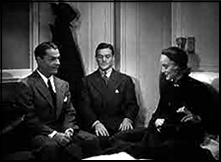
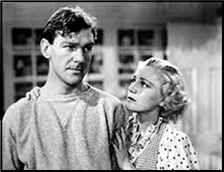
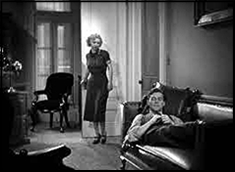
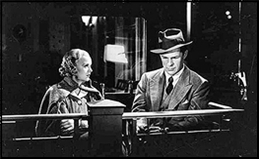
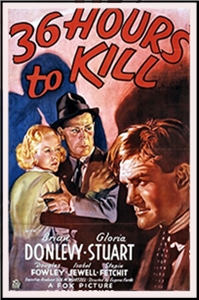
36 HOURS TO KILL. 20th Century Fox, 1936. Brian Donlevy, Gloria Stuart, Douglas Fowley, Isabel Jewell, Warren Hymer, Stepin Fetchit, James Burke. Based on a story by W. R. Burnett. Directed by Eugene Forde. Released commercially on DVD.

Anne Marvis (Gloria Stuart): So this is Albuquerque?

Frank Evers (Brian Donlevy) There’s no Indians.

Anne: They’re all working for the WPA.

Frank: What a relief.

   Get it?

   That’s the wise cracking speed of the humor in this not quite a mystery comedy, that still manages to pack quite a bit of screwball into the tale of a Public Enemy on the run and a blooming romance on a train from Los Angeles to Topeka that accompanies his journey.

   Alvin Karpis has just met his rendezvous with J. Edgar Hoover, the headlines proclaim, while Duke Benson (Douglas Fowley) sweats out hiding in the suburbs of LA with his moll/wife Jeanie (Isabel Jewell) while flunky Hazy (Warren Hymer) makes house calls to deliver the news.

   This time he brings a newspaper from home, Topeka, with him and Duke spies in the paper that a mysterious lottery winner who signed himself Little Boy Blue has won $150,000, and Duke is Little Boy Blue, the winning ticket in his wallet. Just one problem: How will he ever cash it in with the Feds everywhere looking for him?

   Duke comes up with a plan. Jeanie will fly to Topeka since it is dangerous for them to travel with each other, and after arranging with his old gang for a place to hide out once there, Duke will book tickets on the train, Hazy getting on board first, and Duke making a daring transfer from a moving car in the dark as the train is still moving slow. Then Duke will hideout in his compartment for the rest of the trip.

   Complicating things at the train station is reporter Frank Evers, who is hounding a man he claims is a famous scientist he has to get a story on so desperately he buys a ticket to come along, a little girl traveling by herself who takes a shine to Hazy, and boarding at the first stop, Anne Mavis, an attractive blonde fleeing process server James Burke until she can cross over into Arizona.

   When Duke has to leave his compartment for annoying porter Stepin Fetchit to make his bed Anne, hiding from the process server, climbs in Duke’s unoccupied bed, and in true screwball style mistaken for Duke’s wife by the process server, but not by Evers who has already cozied up to Duke.

   Later still Jeanie, when her plane is forced down by a storm, will join the train finding Anne’s gloves in Duke’s compartment and jumping to conclusions so Anne has to pretend to be Frank’s wife to appease Jeannie’s insane jealousy, not really all that insane considering Duke’s proclivities and designs on Anne and how handy Jeanie is with a knife.

   And when they reach Topeka and Duke realizes the Feds are hot on his trail when the porter finds a microphone in his compartment (“Dat one of them new telephones, Mr.?”) things get really complex when he kidnaps Anne and takes her to the phony sanitarium run by his former gang and Frank has to rescue her by posing as the agent from the Insurance Agent paying the lottery ticket off to Duke’s lawyer (Charles Lane).

   Mostly the movie crackles, It speeds along, pauses for laughs, develops just enough character to keep you interested, and relies on the considerable skills of Donlevy, Stuart, Fowley, Hymer, and Jewell to keep things sparking as nothing and no one is exactly who they seem to be and complications arise. Almost every main character has a revelation to make that isn’t exactly what you expect, though one of them is pretty obvious no mater how hard I try to avoid giving it away.

   It might not seem Black Mask material, but you can imagine it i5n Dime Detective or Detective Fiction Weekly. It’s the kind of story you can imagine Richard Sale, Robert Reeves, John K. Butler, or Dwight Babcock might have written.

   Admittedly there is the always nagging problem in films of this era of the role Stepin Fetchit plays, mostly comedic relief as he infuriates Duke, but also fairly important to the plot in that his clumsiness is set up so he finds the microphone that tips Duke off he is being followed.

   Hymer’s Hazy is an odd character too, very much as if a Damon Runyon character had wandered into a Warner’s Gangster flick, his scenes with the little girl quite effecting, and his pride in having made a prune whip for the captive Anne even sweet.

   The ending as you might expect is slam bang, with guns blazing, but who gets shot by whom and why may surprise you.

   Plus I am a sucker for stories like this on a train, and if the finale isn’t on the train, the trip itself is a delight, and the cast fine companions for any journey. This is little gem I only saw for the first time recently, and never heard about, but will no doubt watch again.


.

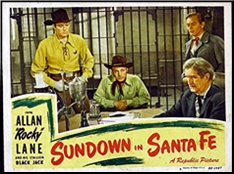
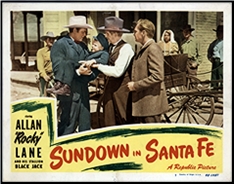
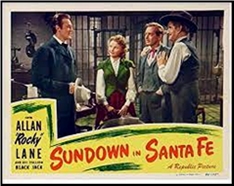
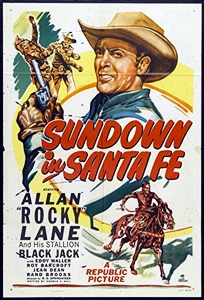
SUNDOWN IN SANTA FE. Republic Pictures, 1948. Allan ‘Rocky’ Lane, Eddy Waller, Roy Barcroft, Trevor Bardette, Jean Dean. Director: R. G. Springsteen.

   B-westerns get no respect. They’re seldom listed in any of the various video guides or other standard reference books. Mysteries of the same vintage and caliber seem to be included, even with the same production values and indifferent plots, but not the movies of Rocky Lane, Lash LaRue, or Sunset Carson. Not even the films of Roy Rogers, the King of the Cowboys himself. And hey, come on, they’re not that bad.

   To remedy that, to some small minor extent, I’m going to be including a few of them from time to time in these pages. Not a lot of them. Only the ones I watch, and if I watch too many of them, my mind will turn to mush, if I can say that without spoiling the point I was making, but what else can I say?

   The opening scenes are very promising. Armed robberies that are taking place near and about Santa Fe are linked by the discovery of similar daggers at the site of each, suggesting that somehow or another Walter Durant, leader of the Lincoln conspiracy ring, is involved. Rocky is sent in as an undercover investigator to find out exactly what is going on.

   There’s very little mystery to the affair, however, as it turns out, since the son of the sheriff that Rocky goes to work for soon shows his true colors. He’s in love with the daughter of the rancher who is running the gang, although the man (as it turns out) is not really the mastermind behind it all. While the secret identity if that man is no secret either, at least to the audience, it takes Rocky most of the picture to figure it out.

   There’s plenty of action, but there’s also too much plot for such a relatively short feature, and details of what’s happening (and why) soon get swamped in the desire to get the story over with in its allotted amount of running time. While Rocky is ruggedly handsome, there’s no love interest for him at all, and maybe that’s why as a kid, I liked his movies so much. No gooey, gloppy stuff for him, at least not in this one.

– Slightly revised from Mystery*File #30, April 1991.


NOTE: I first read this book in 2006, and this review was first posted in June 2009. I’ve just read the book again, but instead of writing a new review, I’ve decided to re-post this old one.
   

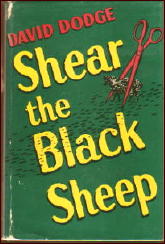
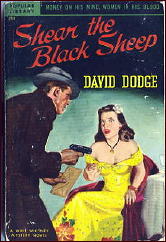
DAVID DODGE – Shear the Black Sheep.   Popular Library 202, paperback reprint; no date stated, but circa 1949. Hardcover edition: The Macmillan Co., 1942. Magazine appearance: Cosmopolitan, July 1942.

   After I finished reading this, the second murder mystery adventure of accountant detective Jim “Whit” Whitney, I went researching as I usually do, and it didn’t come as any surprise to learn (from a website devoted to David Dodge) that Dodge was also a CPA by profession, and that he started writing mystery fiction only on a dare from his wife.

   Although Dodge went on to another series (one with private eye Al Colby) and after that several standalones, there were only four books in the Whit Whitney series, to wit:

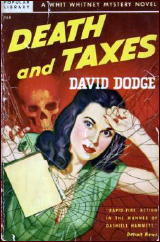
Death and Taxes. Macmilllan, hc, 1941. Popular Library 168, pb, 1949.

DAVID DODGE

   
Shear the Black Sheep. Macmillan, hc, 1942. Popular Library 202, pb, 1949.

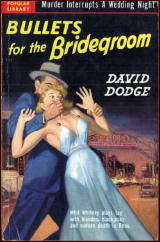
Bullets for the Bridegroom. Macmillan, hc, 1944. Popular Library 252, pb, 1950.

DAVID DODGE

   
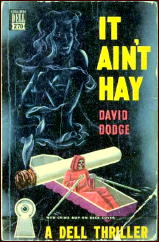
It Ain’t Hay. Simon & Schuster, hc, 1946. Dell 270, pb, mapback edition, 1949.

DAVID DODGE

   
   You can find much more detailed entries for each of these books at the David Dodge website, which includes a complete bibliography of all of his other books, both fiction and non-fiction. Not to mention his plays, his magazine stories, the articles he wrote and all of the radio, TV and movie adaptations of his work, the most well-known of which is To Catch a Thief, the Cary Grant and Grace Kelly film from 1955. Comprehensive is an understatement, and it’s definitely worth looking into, just to see a bibliography done right.

   As for Whit Whitney, his home base is San Francisco, but in Shear the Black Sheep he is talked into taking a case in Los Angeles over the New Year’s Eve holiday weekend. Against his better judgment, he agrees to check into the activities of a client’s son, who seems to be spending too much of his father’s money in the business they’re in. They’re a wool brokerage firm — hence the title. The son has also left his wife and new-born baby. Is there another woman?
DAVID DODGE

   Assisting Whitney — or making her way down to LA on her own to spend the holiday with him, or as much of it as there is left after Whit’s investigative duties are over– is Kitty MacLeod, “the best-looking girl in San Francisco, and pretty clever as well,” as she’s described on page 12.

   I’ve not read the first book in the series, and make no doubt about it, I will, but in that book (according the short recap on just about the same page) Whit’s former partner was murdered and at the time, Kitty was his wife.

   It’s now six months later, and Whit and Kitty have become very close. Whit is beginning to worry that some of his colleagues are starting to talk. There had even been some talk at the time that Whit had had something to do with Kitty’s ex’s departure from life, and getting out of the jam at the time seems to be the gist of the story in Death and Taxes.

   But that was then, and this is now. There is indeed a woman involved, as suspected — getting back to the case that Whit was hired to do — and the woman leads to a hotel room, and in the hotel room are … gamblers. A crooked card game, and the black sheep is getting sheared.

   It is all sort of a light-hearted tale, in a way, but then a murder occurs, and a screwy case gets even screwier — in a hard-boiled kind of fashion. Let me quote from page 160. Whit is talking to his client, who speaks first:

    “I don’t think it’s wise to interfere with the police, Whitney.”

   “I won’t interfere with them. I’d cooperate with them except that they’ve told me to keep out of it. I want you to know how I feel, Mr. Clayton. You hired me to find out what Bob was doing with your money, and to stop it. I found out what was going on, but I thought the best way to stop it was to let these crooks get out on a limb, and then saw it off behind them. I thought I could protect your money and show Bob what was happening at the same time. I guessed wrong. I don’t know who killed […] or why he was killed, and I don’t think I’m responsible for his death, but I’m in a bad spot and I’d like to bail out of it by myself — for my own satisfaction. The police needn’t know what I’m doing. I don’t have to tell you that I don’t want to be paid for it, but if you haven’t any objection, I’ll try to find out who killed […] and get your money back.”
   
DAVID DODGE

   Here are a few lines from page 170, at which point things are not going so well:

    He got off the bed and prowled thoughtfully around the room in his stocking feet, still holding the beer glass. What would Sherlock Holmes do with a case like this? Probably give himself a needleful in the arm — Whit drained his beer glass — and deduce the hell out of the case.

   Whit tried deduction.

   
   Those were the days when mystery thrillers were also detective novels. After a long paragraph in which Whit tries out his best logic on the tangled threads of the plot, and who was where and when and why:

    It was a pretty wormy syllogism. As a deducer Whit knew he was a lemon when it came to logic, and he was an extra-sour lemon because he didn’t know enough about Bob Clayton to figure out what he might do in a given set of circumstances. Such as having a pair of football tickets to dispose of, for example. Ruth Martin might have known where they went, but didn’t, ditto Mrs. Clayton, ditto John Clayton. Jack Morgan was the next one to try.

   
   What’s interesting is that Kitty has more to do with solving the case than Whit does. Things happen rather quickly at the end, and if all of the loose ends are (or are not) all tied up, no one other than I seems to think it matters, as long as the killer is caught — who was not someone I suspected, or did I? I probably suspected everyone at one point or another.

   I also wonder if what happens on the last page has anything to do with the title of Whit Whitney’s next adventure in crime-solving. Read it, I must. And I will.

— March 2006.

   
[UPDATE #1] 06-24-09.   That’s a promise to myself that I haven’t kept yet, alas, and re-reading this review (and looking at those paperback covers) gives me all the resolve I need to follow through. You can count on that and take it to the bank. Non-negotiable.

[UPDATE #2] 06-29-21. Looks like I can’t keep promises very well, even those I make to myself. This is still the only book in the series I’ve read. I have just given myself a good talking to.
« Previous PageNext Page »