Reviews


REVIEWED BY DAVID VINEYARD:


(MARIE-FRANÇOIS) GORON &ÉMILE GAUTIER – Spawn of the Penitentiary, aka Fleur de Bagne. Black Coat Press (French Mystery Book 4). Paperback / Kindle edition, 2013. First published as a serial (feuilleton) in the Parisian newspaper Le Journal, 1901. Adapted and with an introduction by Brian Stableford.

   The feuilleton, or newspaper serial, remained the dominant form of French popular literature from the heyday of Alexandre Dumas peré well into the early 20th Century, and continued into WW II and beyond in some cases. Some of the great works of French literature were written for this format, Hugo’s Les Miserables, Dumas’ The Three Musketeers and The Count of Monte Cristo, and Eugene Sue’s Mysteries of Paris (one of the most influential novels ever written imitated all over Europe), but by far most such serial fiction was consumed and forgotten however influential.

   Paul Feval with his Jean Diable and Les Habits Noir pioneered the crime novel (his Gregory Temple the first Scotland Yard detective in popular fiction); nobleman turned pulpster Ponson du Terraill crated the rogue turned hero Rocambole whose very name came to represent a kind of popular tale. Rocambolesque; Jean de la Hire’s Nyctalope is literature’s first true superhero; and of course there were the adventures of Maurice Leblanc’s Arsene Lupin and Gaston Leroux’s (Phantom of the Opera) various heroes. D’Artagnan, Lagrdarie (Le Bossu), Cyrano, Jean Valjean, Quasimodo, Edmund Dantes, Eric the Phantom, and Prince Rodolphe are merely a few of the characters to wander through these fictions.

   Spawn of the Penitentiary is in many ways a typical such adventure, a complex series of chases, twists, victories, defeats, and adventures, not always developed fully as writers changed plots and dropped sub plots and characters as readers reacted to weekly installments. Imagine Star Wars if George Lucas instead of planning it out in advance had plotted it on the run filming each weeks installment based on his fan bases likes and dislikes.

   So while there is much to admire about Spawn of the Penitentiary it is in many ways the most basic kind of pulp fiction with barely drawn characters and frequent false trails that lead the reader nowhere, something acknowledged by translator and adapter, SF and Horror novelist and anthologist Brian Stableford (I say adaptation because Stableford has not just translated this and other books in Black Coat Press series, but edited and adapted them to better entertain modern audiences where possible, trying to at least make names uniform throughout a series).

   The plot here involves master criminal Gaston Rouzen whose plans will ultimately pit him against both Monsieur Caredac of the Sûreté, but also against a group of anarchists Rouzen attempts to use for his own purposes and betrays to his own needs.

   Frankly whenever Rouzen’s plans are revealed they prove to be pretty lame usually, he’s a prototype of the super criminal and he’s no Dr. Fu Manchu, Carl Peterson, or Dr. Nikola. Moriarity would probably drown him. As super villains go he sometimes resembles Boris and Natasha from Rocky and Bullwinkle more than Ernst Stavro Blofied.

   Far more interesting than its villain is the book’s attempt to show the impact on both criminal and police of the burgeoning technology of the early 20th Century. Even that is primitive, but it is there.

   But to be brutally honest for anyone not interested in the history of the crime novel or in French serial fiction the most fascinating part of this book are its authors.

   For reasons that will become obvious shortly, I will deal with Emile Gautier first.

   Emile Gautier was a lawyer, but he was also an Anarchist. Before you imagine a man in a black cloak and slouch hat running around with a lighted bomb or a hairy faced radical I should point out that Anarchy was an actual political movement in late 19th and early 20th Century Europe and not merely conspirators meeting and plotting in cellars.

   Gautier was one of its brightest lights, but as you might expect, his politics made him unpopular with the French government. He was arrested, tried, and sentenced to ten years hard labor on Devil’s Island.

   He would have served those ten years in that hellish prison if not for an older friend from his childhood, his future writing partner Marie-François Goron, and Goron was in good position to help him receive a pardon.

   Marie-François Goron was head of the Sûreté from 1887-94, one of the most famous heads of that body in its history, perhaps only behind its first leader, Eugene Vidoq. The Anarchist and convicted felon (political or not) teamed with the Policeman, and not just any policeman, has to be one of the oddest writing teams of all time.

   The Black Coat Press edition has a lovely cover and a fine introduction by Brian Stableford (I will admit to some prejudice as they are my publisher and Jean-Marc Lofficier its publisher my editor and a friend). It is not for everyone, but lovers of pulp fiction, historians of the crime novel, and for anyone interested in the course of popular literature around the world it is a fascinating read.

   Today when most popular literature is celebrated, written about, and collected by devoted fan bases it is fascinating to see how disposable our past entertainment once was, swashbucklers, heroes, tragedy, soap opera, fantastic journeys, dreams and nightmares on faded newsprint, a thrill or a tear a week, imagination and wonder for pennies.

   The uncommon art of the common man.
REVIEWED BY BARRY GARDNER:


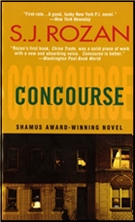
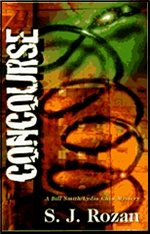
S. J. ROZAN – Concourse. Lydia Chia and Bill Smith #2. St. Martin’s, hardcover, 1995; paperback, 1996. Shamus Awards Best Novel winner (1996).

   I thought that the first Rozan book, 1994’s China Trade, was one of the better first novels of the year, and for that matter one of the better PI novels of the year, period. Despite the ethnicity of that book’s heroine, Rozan herself is not Oriental.

   Bill Smith, the private detective who assisted Chin in the first book, takes center stage here. His former mentor, who operates a security service, calls him for help when one of his operatives is brutally beaten to death. The young man, who was also his nephew, was working as a guard at the Bronx Home for the Aged, which is situated in the midst of a particularly violent gang area – and the police and others suspect that the murder is gang-related. Bill isn’t so sure, even though he manages rather quickly to run afoul of the area’s major gang himself.

   This isn’t really a Lydia Chin book, though she is frequently in and out of the narrative, any more than the first was a Bill Smith book. It’s told first-person from his viewpoint, and Rozan appears to be one of the few women who can write from a male viewpoint effectively and credibly.

   This lady does just about everything right. Her characters are likable and believable, her pacing is excellent, and her prose is smooth and readable. On the basis of two books, I’d have to say that she is one of the better of the 90s crop. It will be interesting to see where she goes with Chin and Smith, both in terms of their relationship and to see if she continues to alternate between the two as narrators. I’ll certainly be on hand to see.

— Reprinted from Ah Sweet Mysteries #21, August-September 1995


      The Bill Smith & Lydia Chin series —

1. China Trade (1994)
2. Concourse (1995)
3. Mandarin Plaid (1996)
4. No Colder Place (1997)
5. A Bitter Feast (1998)
6. Stone Quarry (1999)
7. Reflecting the Sky (2001)
8. Winter and Night (2002)
9. The Shanghai Moon (2009)
10. On the Line (2010)
11. Ghost Hero (2011)
12. Paper Son (2019)
13. The Art of Violence (2020)
14. Family Business (2021)

REVIEWED BY DAN STUMPF:


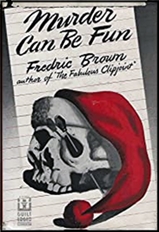
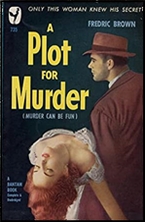
FREDRIC BROWN – Murder Can Be Fun. Dutton, hardcover, 1948. Expanded from a short story, “The Santa Claus Murders” in Street & Smith’s Detective Story Magazine. Reprinted as A Plot for Murder (Bantam #735, paperback, 1949); and under its original title by Carroll & Graf, paperback, 1989.

   â€œWhy, Baldy, are mysteries so popular?”

   â€œBecause a lot of people read ’em?”

   Bill Tracy starts out the story as a Radio hack, grinding out scripts for a popular soaper called Millie’s Millions. But he has aspirations toward something higher; he’s working on a new series he hopes to call Murder Can Be Fun, where the radio audience will figure out the case from clues provided in the story, with the surprise solution given right after the last commercial break.

   Tracy has even worked out some clever ideas, kept in his desk at home till he can turn them into scripts: Murder done by a guy in a Santa suit; a janitor stabbed in the back and stuffed in a furnace; a man garroted with his own necktie….

   Then his boss is killed by a man in dressed as Santa.

   When the janitor in Tracy’s apartment building gets stabbed in the back and stuffed into a furnace, Tracy becomes genuinely alarmed. He gets even more alarmed when the cops find out about his stories, and finger him as Suspect #1. And when they begin closing the net around him, Bill Tracy reluctantly turns from writing detective stories to starring in one.

   Fredric Brown had the happy knack of writing as if the words flowed right from his head to the page. The prose never seems skimpy or overdone, the characters are fleshed out perfectly, with little touches that bring definition—and offer intriguing leads to secrets and dead ends. And in a well-judged bit of plotting, the events that bring about the solution also bring about a resolution in Tracy’s character that lifts him and this book well above the level of hack work.

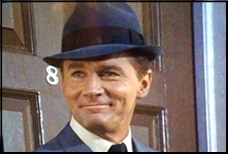
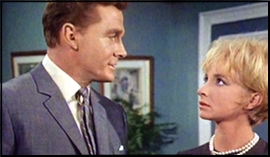
THE BARON “Diplomatic Immunity.” ITC, UK, 28 September 1966 (Season 1, Episode 1). Steve Forrest as John Mannering (alias “The Baron”), Sue Lloyd as Cordelia Winfield, Colin Gordon as John Alexander Templeton-Green, Paul Ferris as David Marlowe. Based on the character created by John Creasey. Director: Leslie Norman. Currently streaming on Britbox.

   The Baron was one of the lesser known series characters created by John Creasey (writing as Anthony Morton), but when the folks at ITC decided they wanted a TV show to compete with the James Bond movies and the U.N.C.L.E. TV shows, they decided that The Baron would do very well.

   The series, which lasted only one season and 30 episodes, was filmed in color, somewhat unusual in those early days of British TV. In the TV version, fairly closely to the books but with some differences, John Mannering is a wealthy antiques dealer with connections all over the world, which makes him a highly regarded person of interest to be co-opted by a secret British secret service agency to work for them undercover for them.

   In “Diplomatic Immunity” Mannering is asked to go to a fictional European country to retrieve some valuable pieces of jewelry stolen by a female employee of the head of one of that country’s top governmental agencies, using her diplomatic immunity to get them back into her country.

In all-out imitation of the James Bond films, Mannering goes fully equipped with all kinds of secret gadgetry, and it is best you pay close attention, since – wouldn’t you know – he gets to use all of them whenever he needs them. The story is slight – the basic story line doesn’t need the full hour’s running time – but it’s entertaining, and Steve Forrest is hunky enough and the girls he meets all seem willing enough for viewers of either sex to have something to look at.

On the other hand, the series was picked up by ABC in this country for only part of its run,  then could only be seen in syndication. It may be that “hunky” is not good enough: you need the charisma of a Roger Moore as well, and that Steve Forrest unfortunately didn’t have.

A 1001 MIDNIGHTS Review
by Bill Pronzini


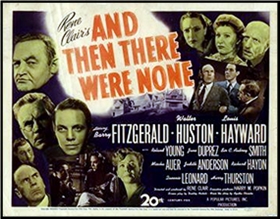
AGATHA CHRISTIE – And Then There Were None. Dodd Mead, hardcover, January 1940. Pocket Books #261, US, paperback, 1944. Prior serialization in the Saturday Evening Post in seven parts from 20 May to 01 July 1939 Published first in the UK (Collins, hardcover, November 1939). Reprinted in both countries many times in both hardcover and paperback. Numerous film adaptations, beginning with And Then There Were None in 1945.

   Perhaps the most famous of all of Dame Agatha’s novels, this is both a masterful cat-and-mouse thriller and a baffling exercise for armchair sleuths – a genuine tour-de-force. And like all of her best work, it has inspired countless imitations and variations – the ultimate compliment for any crime novel and crime-novel writer.

   Ten men and women, none of whom know one another, are either invited or hired to spend a weekend on isolated Indian Island off the Devon coast. Their host is someone calling himself “U. N. Owen” (Unknown), and it soon becomes apparent that he is either a separate individual who is hiding somewhere on the island or that he is one of the ten. Each guest harbors some sort of dark secret or past indiscretion that makes him or her a target for homicide. And one by one, they begin to die in bizarre and frightening ways that loosely coincide with the ten verses of the nursery rhyme “Ten Little Indians,” wherein lies the novel’s primary clue.

   But there is no detective, professional or amateur, here; no one left at all, in fact – except the reader – to explain the murders when the weekend (and the book) draws to a close. Thus And Then There Were None is a perfectly apt title.

   The effects of the novel are multiple: a gradually mounting sense of terror and suspense that binds reader to chair; a skillful shifting of suspicion from one individual to another, principally through the introduction and manipulation of red herrings; in-depth characterization (not always Christie’s long suit); and a surprising denouement that perhaps justifies one critic’s judgment of the novel as “the ultimate in whodunits.”

   And Then There Were None was filmed three times: in 1945, 1965, and 1975. The first of the three versions, directed by René Clair and starring Barry Fitzgerald, Walter Huston, and Louis Hayward, is by far the best and most faithful to the novel – a small classic in its own right.

     ———
   Slightly revised with permission from 1001 Midnights, edited by Bill Pronzini & Marcia Muller and published by The Battered Silicon Dispatch Box, 2007.   Copyright © 1986, 2007 by the Pronzini-Muller Family Trust.


REVIEWED BY MARYELL CLEARY:


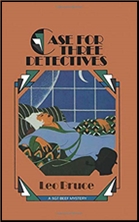
● LEO BRUCE – Case for Three Detectives. Sgt. Beef #1. Academy Chicago Limited, paperback. First published in the UK, by Nicholson, hardcover, 1940. First US edition: Stokes, 1937.

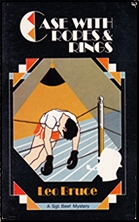
● LEO BRUCE – Case with Ropes and Rings. Sgt. Beef #5. Academy Chicago Limited, paperback; 1st US edition, 1980. First published in the UK, by Nicholson, hardcover, 1940.

   Academy Chicago Limited, a publisher new to this reviewer, is reprinting the Sgt. Beef novels of Leo Bruce, pseudonym of Rupert Croft-Cooke. In paperback they are done up with classy art deco covers; very attractive. I wish I could say as much for the inside of the books.

   Case for Three Detectives allows us to see the village policeman, Sergeant Beef, beat three well~known amateur detectives at their own game. Lord Simon Plimsoll, accompanied by Butterfield; M. Amer Picon; and Monsigneur Smith, whom we all recognize, I’m sure, investigate the locked room murder of an inoffensive lady named Mrs. Thurston.

   The joke is that while they run around the country and theorize madly, Sgt. Beef is placidly collecting hard evidence which convicts the real killer. Picon has a Watson equal to anything Hastings could ever have been, a young man named Townsend who becomes Sgt. Beef’s amanuensis. As a take-off of three well-known mystery writers’ works, it’s fine. As a murder mystery for readers, it drags.

   Not as much as Case with Ropes and Rings, though. Here we must read of Townsend’s resentment against his now-famous detective friend. Beef is still a diamond in the rough, liking his beer and darts game and, according to Townsend, not fit for association with the upper classes. This case takes him to Penshurst School, where the youthful boxing champion has been found dead by hanging in the school gymnasium.

   As his father is a lord, Townsend worries that Beef will come a cropper. When another lad is found dead in the same way in a London gym noted for its rough characters, Townsend thinks that this is more suitable for Beef. Townsend can’t see any connection between the cases, but Beef insists there is one.

   We are treated to constant complaints from Townsend that the investigation isn’t moving fast enough. there’s not enough action, his book will be dull. He’s right. It is dull. Still, the solution is a neat one. One up to Beef for that.

– Reprinted from The Poison Pen, Volume 4, Number 5/6 (December, 1981). Permission granted by publisher/editor Jeff Meyerson.


REVIEWED BY DAN STUMPF:


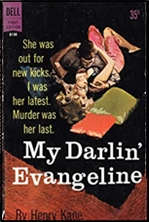
● HENRY KANE. My Darlin’ Evangeline. Dell First Edition B198, paperback original; 1st printing, 1961. Revised and reprinted as The Perfect Crime (Belmont, paperback, 1967). TV Adaptation: As “An Out for Oscar,” The Alfred Hitchcock Hour, 05 Apr 1963 (screenplay by David Goodis).

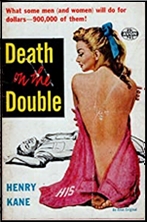
● HENRY KANE. Death on the Double. PI Peter Chambers #13. Avon #761, paperback original; 1st printing, 1957. Signet D2644, paperback, 1965.

   A week or so ago I looked through my vast, well-organized (HAH!) bookshelves and noticed some books about which I could remember nothing. Intrigued, I pulled a few out and….

   Henry Kane is best-remembered for his character Pete Chambers, Private Eye (Or Private Richard, as Chambers put it.) but My Darlin’ Evangeline is a stand-alone about meek bank clerk Oscar Blimmey, who meets and falls in love with a globe-trotting town tramp, Evangeline Ashley. They meet in Miami, where Kane also rings in Bill Grant, a small-time heel who dreams of becoming a big-time cad. When Evangeline and Bill run afoul of a local drug lord, he takes a powder, and she quits the scene by marrying the closest available chump — Oscar Blimmy.

   That’s just the beginning of Oscar’s woes though, because he happens to be in charge of the cash handed out on Thursdays to several large payroll accounts; this was the early 60s, remember, when lots of cash money changed hands, banks were built like marble tombs, and bank tellers were trained to use firearms. So when Evangeline re-connects with Bill, and they….

   Write the rest yourself. Any decent writer could, and many did it pretty well, but Kane stumbles in his portrait of the central character. Besides being a perfect schlemiel, Oscar is also built like an Adonis but shy with women, proficient with guns and fists, but a confirmed pacifist and a devout coward. The contradictions in character are just too many and too convenient to the story to make it at all convincing.

   Death on the Double consists of two novelettes featuring Peter Chambers. The writing in the first, “Watch the Jools,” is agreeably glib, but the plot is something Keeler would have rejected as overly fanciful. Something about a rare gem with a curse on it, a man found drowned in his locked (and quite dry) private office, a costume party where everyone must dress in the costume dictated by an eccentric millionaire, and… well by the time Kane rang in the sword-swallowing Master Criminal, I was ready to call it quits.  “Beautiful Day,” the second half of Death on the Double awaited, but I had a Fredric Brown next on the pile….

      —
Note: Updated to include information about the TV adaptation of My Darlin’ Evangeline. (See comment #3.)

REVIEWED BY DAVID VINEYARD:


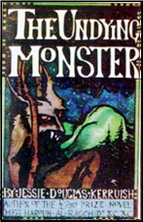
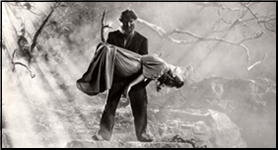
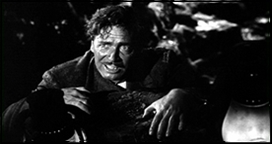
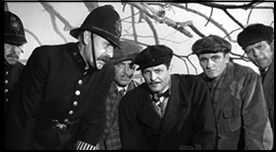
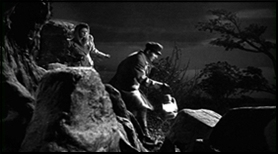
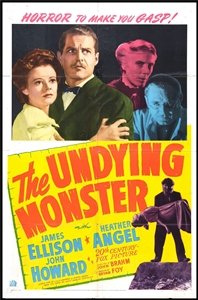
THE UNDYING MONSTER. 20th Century Fox, 1942. James Ellison, Heather Angel, John Howard, Bramwell Fletcher, Heather Thatcher, Aubrey Mather, Halliwell Hobbes. Screenplay by Lillie Hayward and Michael Jacoby, based on the novel by Jessie Douglas Kerruish (Heath Cranton, UK, hardcover, 1922. Macmillan, US, hardcover, 1936). Directed by John Brahm.

   This is a B-movie. Don’t get confused because it is well done, it’s a B by a director, John Brahm, who was about to breakout into a brief A career (The Lodger, Hangover Square, The Brasher Doubloon) before eventually ending up directing television. What he does here is to bring an A sensibility and skills to a B film for all its B trappings and cast.

   The novel, by Jessie Douglas Kerruish, is among other things, one of the best werewolf novels ever written. Admittedly that isn’t a very wide area, there’s Dumas’s The Wolf Leader, Stevenson’s updated Strange Case of Dr. Jekyll and Mr. Hyde, Guy Endore’s Werewolf of Paris, and in modern times, a handful of books by Poul Anderson, Stephen King, Robert McKinnon, Gary Brander, and Richard Jacoma, but for all their popularity in film, there are relatively few literary werewolves worth noting.

   I guess they are too hairy and smelly to be as sexy as vampires.

   The novel is somewhat more serious and better than the film, though the basic story is the same. John Hammond is the scion of cursed family haunted by a monster that takes the life of the oldest born. He brings in a friend to help and it is discovered an ancient Viking curse turns the Hammond men into ravening beasts at a certain age. Much of the novel is uncovering that curse and then finding a way to reverse it before it is too late.

   It is an excellent supernatural novel that comes close to actually making werewolves halfway believable and is full of invention and ideas. Of its kind it is a small and distinguished classic.

   The film keeps the central idea, but loses much of what makes the novel a classic of its kind.

   Yet in its own way the movie, B as it is, is a minor classic too, standing comfortably only just behind The Wolfman and The Werewolf of London despite its cheaper production values.

   John Howard (Paramount’s Bulldog Drummond) is John Hammond, scion of the Hammond family, and “victim” of the family curse when his little dog is killed by something in the dark on a foggy night. Not much later there is a human death and Scotland Yard is brought in.

   Inspector Craig (Aubrey Mather) thinks this is the perfect case for scientific detective Robert Curtis (James Ellison who had a relatively brief career as a minor leading man and cowboy star) and his female assistant Christy (Heather Thatcher), who is a bit on the screwball side and something of a suffragette (the period is Pre-WW I), who is dispatched to Hammond manor to lay the beast, or the murderer, whichever it may be.

   Largely set-bound, Brahm does a good job with dark and light and fog to keep everything swirling around all the fuzzy edges. There is a claustrophobic feel to the film of something awful in the shadows that is well contrasted with Ellison’s bright scientific mind trying to shine light in all those dark corners, even if that light may reveal something science isn’t ready for

   This film is as close as you get in the period to “Sherlock Holmes Meets the Wolfman.”

   Things aren’t easy either, Hammond’s beautiful sister (Heather Angel) is endangered, butler Halliwell Hobbes is hiding something, and Dr. Bramwell Fletcher is downright suspicious — is he just jealous of Curtis attraction to Heather Angel, or is there something more going on? He is certainly hiding something.

   He knows something.

   And why is he poisoning John Hammond?

   It’s a fast moving movie, and builds to a fine finish on the cliffs with the mystery of the Hammond curse laid at last, very nearly finally for Curtis.

   In some ways the most interesting character in the film is Heather Thatcher’s Christy, Watson to Curtis Holmes. She is a modern mature woman, not a helpless young thing, and she has some actual skills though she is in part comic relief. For once though you can actually see why Curtis might have her around. She isn’t just there to point a gun at the bad guy after Curtis exposes him or look good around the office.

   This is no masterpiece. Younger viewers may not have as much patience with it as those of us who grew up on B films.

   I would still like to see a more faithful adaptation of the Kerruish novel, but this is damn good on its own and hold up fairly well.

   For now you can catch it on YouTube, and it is actually worth a look.


TECH DAVIS

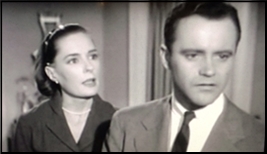
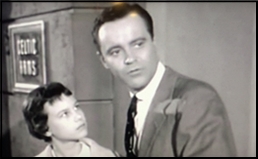
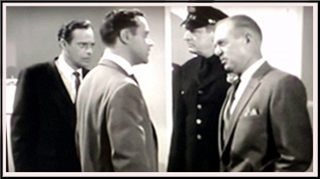
GOODYEAR THEATER. “The Victim.” 06 Jan 1958 (Season 1, Episode 8). Jack Lemmon, Doe Avedon, Lana Wood, Ross Elliott, John Eldredge, John Gallaudet. Writer: Marc Brandel. Director: Robert Florey. Currently available on YouTube here.

   A minor, moody semi-crime thriller. A man who has recently lost his wife is on the verge of losing his daughter as well, leaving her in the custody of his sister while struggling to find meaning in life once again. He keeps making promises to her but can’t follow though, and when she asks when she can come back home so they can live together, all he can summon up are the vaguest of promises.

TECH DAVIS

   But then he finds himself being followed by two men, no matter where he goes. He has no idea why, and there’s nothing to take to the police. The mystery does give him some purpose in living, though, and although the plot gets really creaky at the end, all ends well.

   Jack Lemmon, one of my favorite actors, plays the “everyman” almost perfectly, as he did throughout his career. Lana Wood was only twelve at time this was filmed, and unfortunately has little to do – nothing to indicate that she had a long career on TV and the movies ahead of her. The rest of cast are old pros in the business, and it shows.


REVIEWED BY DOUG GREENE:


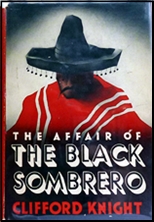
CLIFFORD KNIGHT – The Affair of the Black Sombrero. Professor Huntoon Rogers #5. Dodd Mead, hardcover, 1939. No paperback edition.

TECH DAVIS

   Clifford Knight bad several abilities as an author of detective stories. His writing style, though not exactly scintillating, was several cuts above the average for the 1930s. He had a genuine sense of place and an occasional gift of vivid description. Yet, despite these abilities, Knight was on the whole only a fair writer. He could be fairly good, as with The Affair of the Scarlet Crab and The Affair of the Heavenly Voice; or fairly bad, as with The Affair of the Fainting Butler.

   The Affair of the Black Sombrero is simply, well, fair. The major character is a bright young thing named Elsa Chatfield, whom Knight clearly wants us to admire. She represents, Knight tells us, “something eternal in the spirit of American youth.” If that’s true, I’m glad I’m not young any more, for Elsa is utterly insensitive and given to minor cruelties (which Knight probably considers high spirits).

   The detective, an English professor named Huntoon Rogers whose connection with university life seems tenuous at best, is interested in the mysterious death of Elsa’s Aunt Kitty a year earlier. But little happens in the first hundred pages of the book except to describe Elsa’s career as a commercial artist. The pace picks up when Rogers is invited to join Elsa’s family on a sailfishing trip to Mexico. The Mexican scenes are well-done, and the description of the fishing itself – resulting in the horrifying death of one of the main characters – is effective. Two more murders occur before Rogers rather haphazardly tosses off the solution, based in part on information never given to the reader.

   The Affair of the Black Sombrero indicates why Knight’s books never quite became memorable. He lacked a sense of pace, and his characters never became alive. Although most characters in 1930s detective novels are cardboard, a good writer could trim his cardboard into distinctive shapes. But all of Knight’s paper dolls remain alike. On the other hand he always included enough good scenes and, off and on, enough mystery to make his books mildly entertaining. It’s too bad that he didn’t do more.

– Reprinted from The Poison Pen, Volume 4, Number 5/6 (December 1981). Permission granted by Doug Greene.


      The Huntoon Rogers series —

The Affair of the Scarlet Crab. Dodd 1937
The Affair of the Heavenly Voice. Dodd 1937
The Affair at Palm Springs. Dodd 1938
The Affair of the Ginger Lei. Dodd 1938
The Affair of the Black Sombrero. Dodd 1939
The Affair on the Painted Desert. Dodd 1939
The Affair in Death Valley. Dodd 1940
The Affair of the Circus Queen. Dodd 1940
The Affair of the Crimson Gull. Dodd 1941
The Affair of the Skiing Clown. Dodd 1941
The Affair of the Limping Sailor. Dodd 1942
The Affair of the Splintered Heart. Dodd 1942
The Affair of the Fainting Butler. Dodd 1943
The Affair of the Jade Monkey. Dodd 1943
The Affair of the Dead Stranger. Dodd 1944
The Affair of the Corpse Escort. McKay 1946
The Affair of the Golden Buzzard. McKay 1946
The Affair of the Sixth Button. McKay 1947

NOTE: Updated to correctly list Scarlet Crab as the first in the series. (See comments.)

« Previous PageNext Page »