HONEST THIEF. Briarcliff Entertainment, 2020. Liam Neeson, Kate Walsh, Jai Courtney, Jeffrey Donovan, Anthony Ramos, Robert Patrick, Jasmine Cephas Jones. Directed by Mark Williams.
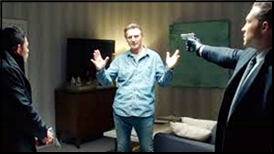
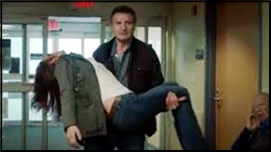
For an action movie that benefits from the presence of several great character actors, Honest Thief is surprisingly dull and lifeless. Which is somewhat surprising. After all, the film has an intriguing premise – a veteran bank robber decides to go straight and turn himself into the FBI – and a solid lead in Liam Neeson. It’s just the execution that is lacking. The movie just plods along from scene to scene without the kinetic energy that the movie demands.
Neeson, in yet another outing as a grizzled, world-weary man with a special set of skills, portrays Tom Dolan, a Marine veteran turned bank robber. Called the “In and Out Bandit†by the press and the feds (a term he loathes), Dolan eventually decides to go straight. Why? He meets a woman he adores and figures he wants to settle up his past debts before beginning a new life with her in suburban Boston. So far so good. But things don’t go as planned. (do they ever?) As it turns out, the two FBI agents who follow up on Dolan’s request to turn himself in in exchange for a lighter sentence are themselves corrupt. You see, they are interested in his stashed loot, not his newfound conscience.
As I said earlier, an intriguing premise. But alas, it mostly doesn’t work. Part of that has to do with how formulaic and derivative it all feels. There’s very little in the movie that hasn’t been done – and done better – before. Also hampering the production is the fact that the movie, while set in Boston, was filmed in Worcester, Massachusetts. Nothing against Worcester, but it so obviously doesn’t look like Boston that it only serves to make the movie look more downmarket than it actually is.
Final thought. Although his late career as an action hero may be coming to a close, Liam still could do a lot better. So can you.
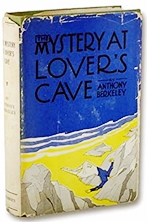
ANTHONY BERKELEY – The Mystery at Lovers’ Cave. Roger Sheringham #3. Simon & Schuster, US, hardcover, 1927. Jacobsen Publishing Co., US, reprint hardcover (shown), 1927. Originally published in England as Roger Sheringham and the Vane Mystery (Collins, hardcover, 1927).
“You are getting ready to be Roger Sheringham,” Tommy remarked to Tuppence in Agatha Christie’s Partners in Crime. “If you will allow me to make a criticism, you talk quite as much as he does, but not nearly so well.”
As befits someone whose early works were sketches for Punch, Anthony Berkeley excelled at light, witty dialogue. He began writing about Roger Sheringham to satirize the great detectives of literature, and this book, like the later and more famous Poisoned Chocolates Case, emphasizes the detective’s foibles rather than his brilliance. The plot is relatively simple. A nasty woman has been pushed off a cliff,. and Roger hies off to investigate the case for a newspaper.
He sometimes makes clever deductions, sometimes misreads the evidence, and always has the amused attention of the official policeman, especially after Roger’s cousin falls in love with the chief suspect.
Berkeley handled physical evidence and setting well, but the book is worth reading primarily for the dialogue. As Agatha Christie pointed out, Roger talks constantly but always entertainingly.
– Reprinted from The Poison Pen, Volume 4, Number 5/6 (December 1981). Permission granted by Doug Greene.
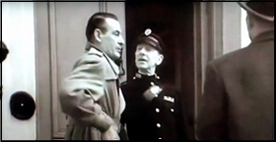
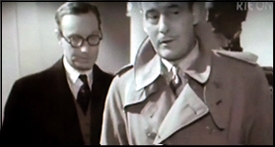
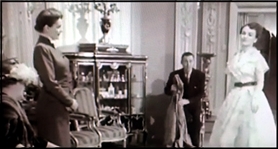
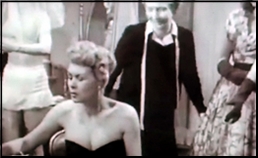
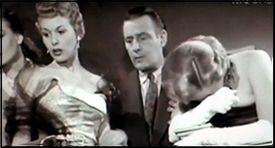
This low budget private eye mystery has a surprisingly decent plot going for it, though it never quite amounts to much, despite a good cast.
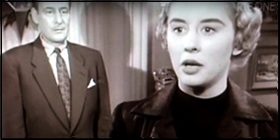
Far from Film Noir it’s more in a minor Peter Cheyney key as a designer fashion house in London is robbed of the jewels used by their models, jewels on loan from vaguely foreign Mr. Mercedes (Eric Pohlman, the voice of Blofield in the early Bonds and a noted character actor), whose personal investigator arrives at the same time as Inspector McLeod of the Yard (bespectacled Richard Wattis as an unlikely Scotland Yard Inspector).
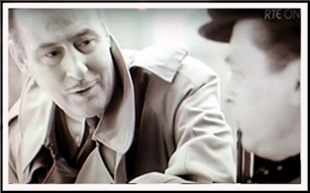
That private detective is former FBI agent Tom Conway (and yes, Tom Conway plays Tom Conway in this one, no doubt in an attempt to connect in British viewers minds with his role as Tom Falcon in the Falcon series).
At the shop the morning after the robbery is a middle aged peeress who claims when she was there the day before she saw two of her own jewels among the stones in Mercedes collection, and shortly after that Mercedes decides he doesn’t want Conway wasting time investigating the theft.
Conway, being American, and a private eye, doesn’t listen and is there the night of the upcoming show when one of the models plunges to her death wearing a blood orange gown designed by Helen Pascall from a defective railing Conway saved Simpson from earlier in the day.
When the woman who claimed to have seen her stolen jewels is murdered, also in a blood orange gown, after a visit by Conway it starts to look bad for him since bodies keep showing up at his feet, and when he finds a third model murdered again in a blood orange gown his relationship with reserved McLeod deteriorates further.
The police are suspicious of Mr. Mercedes (Pohlman is subdued, but not bad in the closest thing to a colorful performance in the film save for the killer who I won’t give away), and Conway is getting too close to something so his own boss ends up kidnapping him only for a police raid to throw Mercedes off. Mercedes fakes having a bomb and escapes, and Conway ends up in custody suspected of being in with Mercedes who it turns out was an international crook with a record across the world using his business interest in the fashion house to launder money and re-cut stolen jewels.
Then Mercedes is murdered, no doubt by an unsuspected partner, and Conway has to set a dangerous trap for a killer who has killed four people and who is willing to kill again.
And in fairness, it is a pretty good trap, replete with a twist that I admit I did not see coming, and which made complete sense. In fact that is why I bothered to review this one at all.
Jealous lovers, criminal conspiracy, and a ruthless killer are the key ingredients here.
Admittedly Conway is tired by this point in his career (and drinking heavily), and while he still wears a trench coat well, he is not at his best. While there are some good scenes, especially between Conway and Naomi Chance as the sophisticated model Gina, there is nothing here that really clicks though the plot is more than serviceable for the short running time.
A tighter script, and less tired leading man, and a few touches of directorial flare would have boosted this immensely. As it is it kills an hour not unpleasantly even if it is instantly forgettable.
Probably the most interesting thing about this film is the studio where it was made, legendary Hammer, well before its horror days, and the director, Terence Fisher, who would helm many of the horror films that put Hammer on the map. Beyond that it is little more than a B programmer with a better than usual cast and some decent sets.
Frankly, while still a pro, Conway often looks as if he would prefer to sit down and have a drink, giving his brother George Sanders a run for bored and indifferent.
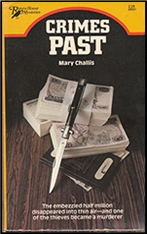
MARY CHALLIS – Crimes Past. Jeremy Locke #1. Raven House, paperback original, 1980.
Just by coincidence, if you believe in such things, I got a letter from Al Hubin yesterday, and he admits he doesn’t know who “Mary Challis” is, either. (But if there’s anyone else who’d be more sure of ferreting out the truth, I don’t know who it might be.)
According to the back cover, Mary Challis is the pseudonym of a writer with more than thirty mysteries to her credit. (*) She also lives in London, Ontario, if that helps. If this book is an example of her work, however, 1 think I’ll pass on the thirty others, thank you.
There are twelve chapters in this book, and I warn you, Chapter 11 is a complete waste of time. I’ve heard of padding before, but this is ridiculous. The culprit is known on page 162 [of 188 total]. One suspects, even eagerly awaits the surprise twist … but … there is none. There is absolutely nothing of importance that happens in the next twenty pages.
It hadn’t been a particularly gripping story even up to then. It seems that lawyer Jeremy Locke’s brother has returned to England after fourteen years of self-imposed exile. He fled the country when he did to avoid imprisonment on embezzlement charges. No one has ever found the money, and now one of Derek Locke’s old comrades is found murdered.
Jeremy, who is thirty years old and eight years a lawyer, acts like a gawky, teen-aged kid. With the police; with his guardian and senior partner; with his older brother, when he finally shows up; and with his new girl friend, Lisa Marlowe, who is also the secretary of a mystery writer named Stephen Jackson.
Mr. Jackson is mentioned once or twice more, but nothing ever comes of it. What a shame. His presence might have done something (anything!) to waken up this sleepy, placid little novel.
Rating: D
–Reprinted from The MYSTERY FANcier, Vol. 5, No. 2, March/April 1981.
(*) It is now known that Mary Challis was one of several pen names of the author best known as Sara Woods, who before she was done, wrote forty-nine mysteries featuring an English barrister by the name of Antony Maitland. As for the books she wrote as Mary Challis, there were three additional case adventures for Jeremy Locke, all from Raven House, a not very successful line of mystery paperbacks from Harlequin in the 1980s.
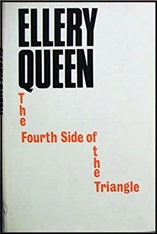
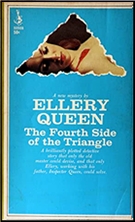
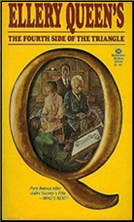
ELLERY QUEEN – The Fourth Side of the Triangle. Random House, hardcover, 1965. Paperback reprints include: Pocket, 1967; Ballantine, 1975, 1979. Actually written by Avram Davidson, from detailed story outline by Fred Dannay. TV pilot: 23 March 1975, as Ellery Queen: Too Many Suspects (screenwriters: Richard Levinson & William Link; Jim Hutton as EQ & David Wayne as Inspector Queen).
An earlier report on this later stage EQ novel was posted here as part of my series of Diary Reviews written over fifty years ago. Since a copy of the book came back into my hands soon after the earlier review went online, I thought coincidences like that should rewarded, and a re-read really really ought to take place. And so I did.
It’s a strange hybrid of a book in a couple of ways. First of all, although his name is on the title page, Ellery Queen didn’t really write it. As the bibliographic info up above so states, SF writer Avram Davidson did, following an outline furnished by Fred Dannay, who probably polished it afterward as well.
To me, the collaboration worked well. A second reading over this past weekend showed that either (A) I couldn’t tell that EQ himself didn’t write it, or maybe (B) it’s been so long since I’ve read an EQ novel that I couldn’t recognize a book written by EQ if my reputation as a devout reader of EQ in my youth depended on it.
The other double-headed nature of the book is that it was written in the midst of the Swinging Sixties, and the authors’ sensibilities suggested strongly that a book written in the 60s ought to reflect that, but also with the realization that maybe EQ readers in the 60s really wanted to read an EQ mystery of the 30s as well, complete with a wacky puzzle to be solved.
Which is exactly what this book provides. A leading character, a famous female dress-designer is known for her many companions in bed, lovers who come, however, serially, strictly one at a time. She has seen no reason to get married to any of them, an idea that was certainly around in the 30s but it would have been highly unlikely in an EQ novel.
The triangle of the title consists of (1) the aforementioned fashion designer, (2) her latest lover, (3) the man’s wife, and (4) the man’s son, who upon learning the liaison between father and mistress, decides to become the lady’s lover himself. Well, given the four sides as just described, it is not surprising that one of the them is killed, and each of the other three is put on trial for that person’s death, serially, one at a time.
It is obvious, I think, that this is a situation that would never come up in the real world, but in the world of Ellery Queen? Yes. Along with several twists along the way, a couple of mammoth coincidences and a wicked puzzle to be solved. Is Ellery Queen as an armchair detective (two broken legs) up to solving it? Read this one and see.
PostScript: I gave this one 3½ stars out of five the first time I read it. That’s an assessment that’s a little high this time around, but all in all, it’s close enough.
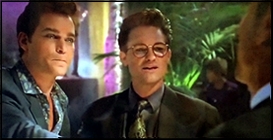
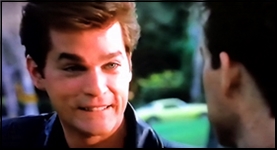
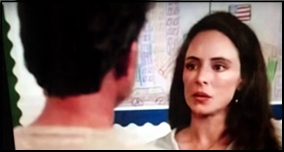
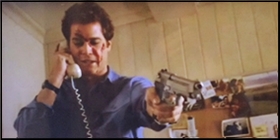
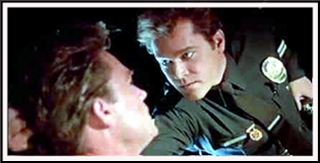
UNLAWFUL ENTRY. 20th Century Fox, 1992. Kurt Russell as Michael Carr, Madeleine Stowe as Karen Carr, Ray Liotta as Officer Pete Davis, Roger E. Mosley as Officer Roy Cole. Director: Jonathan Kaplan. Currently streaming on Starz & Starz/Amazon Prime.
The movie begins with an image of suburban bliss. A two-floor house in an affluent part of Los Angeles, a married couple, and their house cat. The perfect setting for the perfect life. But if it were only so peaceful, there’d be no story to tell. And in the case of Unlawful Entry, it doesn’t take very long whatsoever for a shocking act of violence – a home invasion by a crack-addled burglar – to permanently change the course of this married couple’s lives. As if that were not bad enough, one of the cops assigned to the case turns out to be even more dangerous than the criminal.
Such is the plot of Jonathan Kaplan’s taut and suspenseful thriller. Kurt Russell, always good as an everyman, portrays Michael Carr, a club owner who is working to get his latest project off the ground. Madeleine Stowe, who appeared in numerous thrillers in the 1980s and 1990s, plays his wife, a teacher at an exclusive private elementary school.
But the real juicy role goes to Ray Liotta, made famous to audiences from his roles in Field of Dreams (1988) and Martin Scorsese’s Goodfellas (1990). As LAPD patrolman Pete Davis, Liotta gets to showcase his acting chops. Davis is a lonely, angry man with more than a bit of a misogynistic streak. It’s clear that years of being exposed to the worst of humanity on the mean streets of the City of Angeles has warped his mind. Even his partner, the cynical but clear headed Roy Cole knows that to be the case.
As much as Unlawful Entry is a movie about a suburban nightmare, it is also a story of unrequited love and dangerous temptation. Things go completely haywire once Pete (Liotta) begins to develop a pathological obsession with Karen Carr (Stowe). At some point, Pete is no longer an unhinged cop; he’s a stalker. And if stalkers are terrifying, think of the damage a stalker with a badge can do. Break into your home and claim they are there to protect you? Check. Fix the computer system so it looks like you have unpaid parking tickets? Check. Boot your car? Check.
What makes this film work is that, despite the occasional moments in which it verges into dark comedy, it never condescends to the audience, nor winks at it as if it were all a game. It’s a disturbingly effective thriller with many film noir aspects. There’s not a lot of light in this tonally dark film. At the end of the day, it asks the question that never ceases to provoke ample fodder for genre cinema: how far would you go to protect your family when the duly sworn authorities cannot be trusted?
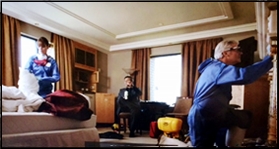
MR. & MRS. MURDER “Early Checkout.†Network Ten, Australia, 20 February 2013 (Series 1, Episode 1). Shaun Micallef as Charlie Buchanan, Kat Stewart as Nicola Buchanan, Jonny Pasvolsky as Detective Peter Vinetti, Lucy Honigman as Jess Chalmers. Director: Shirley Barrett. Currently streaming on Amazon Prime (until January 31st.)
As detective mysteries on TV go, or even books, it’s a premise that’s a natural, but even so, it’s one I don’t recall ever being used before, except maybe in comic books. Who’s job is it to come in and clean up the murder scene after the cops and crew are done with it and the victim removed? Charlie and Nicola Buchanan, that’s who, having set themselves up as specialists who do exactly that.
Of course it helps to have helped a homicide detective on previous cases, even though “Early Checkout†is the first episode of thirteen of the cases they help solve. In this one a natural hero turned self-help guru (if, as noted, that is not a contradiction in terms) is murdered in his hotel room. As a detective story in and of itself, it’s a good one, with an abundance of clues, suspects, motives and opportunity.
But what makes the difference between this and other series with same desire to make a successful detective mystery series is the sprightly rapport between the two leading players. Imagine, if you will, a married couple who actually like each other, with plenty of cheerful banter between them and playfully zapping each other and appreciating it when one gets the better of the other, if only for the moment.
I will do my best to watch the other twelve episodes before Amazon pulls the plug on the series at the end of the month. If there were only 13 episodes in the series, I can only hope it was because the writers ran out of settings for possible stories for murder clean-ups to take place in. If Australian audiences didn’t care for the series and stopped watching it, then boo on them.
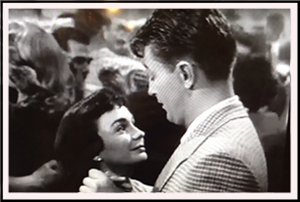
ANGEL FACE. RKO, 1953. Robert Mitchum, Jean Simmons, Herbert Marshall and Kenneth Tobey. Written by Frank Nugent, Oscar Millard and Frank Erskine. Directed by Otto Preminger.
One of those movies like Woman on the Beach that puts me at a loss. It’s compelling, dull, forceful, meandering, ordinary and dreamlike all at the same time. I couldn’t call it a really successful film, but once I start watching it I have to finish.
The plot has Robert Mitchum involved with a potential murderess, as in Out of the Past, but without that film’s lush romanticism. Everyone in Angel Face is worried about conventional things like jobs and living expenses, which mitigates against the interest of the whole thing but adds considerably to the realism. The story moves at a snail’s pace as working-stiff Mitchum tries to figure out whether or not he loves wealthy neurotic Jean Simmons, while she tries to get around to murdering her stepmother.
So things just sort of drift along until we suddenly realize, about the same time Mitchum does, that he has somehow moved too far away from his workaday life to return to it, and that his old friends don’t want him back anyway. About this time, the story shifts into Heavy Melodrama from which, like its hero, it tries to draw back but never quite gets there.
The ending, with another working stiff calling to a man who will never answer, somehow sums the whole thing up with a poetic terseness that lingers in the mind…. as I say, not an easy film to like, but one that stays with you.
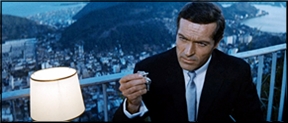
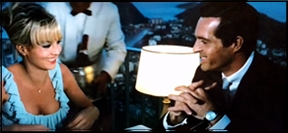
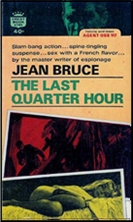
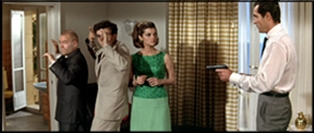
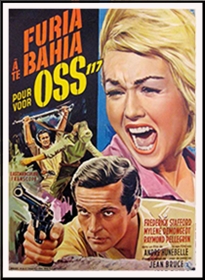
OSS 117: MISSION FOR A KILLER. Valoria Films, France/Italy, 1965. Embassy Pictures, US, 1966. Originally released as Furia à Bahia pour OSS 117. Frederick Stafford (Hubert Bonnisseur de la Bath, alias OSS 117), Mylene Demeonget, Raymond Pellegrin. Based on the novel Dernier quart d’heure by Jean Bruce, his 44th OSS 117 book, published in English in 1965 under the title Live Wire (UK) and The Last Quarter Hour(USA). Directed by Arthur Hunnebelle.
This third outing in the series of OSS 117 films in the Sixies features Frederick Stafford (Topaz, 1969) as Hubert Bonisoir de la Bath, OSS 117, the American CIA agent created by popular French journalist and former Resistance fighter and FFI agent Jean Bruce.
Unlike most of the briefly popular Eurospy genre that followed in the wake of the James Bond craze, the OSS 117 films were mostly expensive productions in the Bond mode, this one filmed on location in Brazil and with some sets and big action scenes rivaling a James Bond film of the era.
Hubert (Frederick Stafford) has been called off his vacation because of a series of terrorists acts in South America. A journalist in Rio de Janero has information leading to a mysterious group that is using some unknown drug to turn innocents into deadly killers, and it is the job of OSS 117 to contact him and follow the clues to the plans of these dangerous assassins.
The usual beautiful women and dangerous games follow, handsomely shot in Eastmancolor with fine cinematography in Francoscope, the French equivalent of Cinemascope and thanks to the Bruce novel, the story is loosely based on a more cogent plot than most Eurospy films could manage. The budgets and production values far exceed the George Nader / Jerry Cotton films or the Joe Walker / Kommisar X films, much less the various films starring Roger Hanin, Ken Clark, German Cobos, Ray Danton, Gordon Scott, Brett Halsey, or Anthony Eisley to name a few.
Stafford, who was wooden in Alfred Hitchcock’s Topaz, is relaxed and playful in his first outing as Bruce’s dashing agent who had previously been played in two films with Kerwin Matthews and would be played one more time by Stafford before a final outing with John Gavin in the role.
Of course when OSS 117 reemerged in the 21rst Century it would be in the person of Jean Dujardin in two brilliant spy comedies that recreated the look and feel of the original films, but with Hubert something of a sexist dunce whose 1950’s early 1960’s Playboy lifestyle sensibility is clashing with a changing world. In addition the two Dujardin films turned Hubert into a French spy, rather than the Louisiana-born Creole aristocrat CIA agent of the books.
Aside from the novels by Jean Bruce, OSS 117 was successful in comics and other mediums in his long run though the books never did well here (two were published by Fawcett Crest in the Sixties). There were more published in England, but still Hubert never saw anything like the same success in English as he had on the Continent.
It should be pointed out that however much this series of films was influenced by the success of the Bond films, OSS 117 himself was created in 1948, and had a five year run before 007 made his debut in Casino Royale in 1953. In addition the first OSS 117 movie appeared in 1957 well before Dr. No in 1962.
Desmond Cory’s Johnny Fedora also beat Ian Fleming and Bond into print by five years, as did several other post war spies including Burke Wilkinson’s Geoffrey Mildmay (Proceed at Will, Run Mongoose) and Sea Lion’s Desmond Drake (Damn Desmond Drake), the influence for all for all but Wilkinson being Peter Cheyney’s well received “Dark” series of spy novels written during the war and even praised by Anthony Boucher, who wrote the introduction to the omnibus edition of the books.
It was simply an idea whose time had come and Fleming was best positioned with a mix of style, panache, war time experience, and luck to cash in. He was of course a better writer than all but Cory (Shaun McCarthy), and a more serious one than him, plus Fleming kept an eye out for the American market from the start even if it took time to crack it.
The parallels between Fleming and Bruce are still notable both in the numeric identification of their heroes, their war time intelligence ties, both men being journalists, their legendary drinking and womanizing, and both dying in 1964 at relatively young ages (Fleming of a heart attack, Bruce in a wreck in his beloved sports car). And like Bond, Bruce’s creation lived on as a sort of family cottage industry.
Arthur Hunnebelle (Fantomas) directed this one which finds Hubert teaming with beautiful Mylene Demeonget and hostage of a supervillain who plans nothing less than taking over all of South America by assassinating the current leaders and creating a new super power and world order dedicated to harmony and peace, and if murder and torture are what it takes to achieve that end,..
Eggs cracked and all that.
The finale is a battle with Hubert and a handful of allies and natives who the madman has enslaved and experimented on shooting it out in a jungle mountain fortress before the arrival of the Brazillian army by parachute (in a scene mindful of the similar arrival of the cavalry in Thunderball) and a final confrontation between the fleeing villain and Hubert over a vast waterfall as he rescues Demeonget.
It’s all nonsense, but by the standards of the Eurospy genre as spectacular as the then contemporary Bond films if lacking some of the narrative drive and those pulsing John Barry scores — and of course, Sean Connery.
The five Sixties films are worth seeing still (available in a boxed set on DVD), and by all means the wonderful Jean Dujardin films, OSS 117: Cairo Nest of Spies, and OSS 11:7 Lost in Rio(DVD and Blue Ray). The 1957 film is available in French on YouTube, OSS 117 is not Dead with Ivan Desny. A couple of other non-OSS 117 Jean Bruce books into films are also out there and available on YouTube including Mission to Venice with Sean Flynn and ex-OSS 117 star Kerwin Matthews as The Viscount, a suave insurance investigator.
Filmography:
OSS 117 is not Dead (1957) Ivan Desny (B&W)
OSS 117 is Unleashed (1963) Kerwin Matthews (B&W)
OSS 117 Panic in Bangkok (1964) Kerwin Matthews
OSS 117 Mission for a Killer (1965) Frederick Stafford
OSS 117 Mission to Tokyo (1966) Frederick Stafford
OSS 117 Double Agent (1968) John Gavin
OSS 117 Cairo Nest of Spies (2006) Jean Dujardin
OSS 117 Lost in Rio (2009) Jean Dujardin
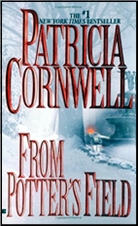
PATRICIA CORNWELL – From Potter’s Field. Kay Scarpetta #6. Scribner, hardcover, 1995. Berkley, paperback, 1996.
Cornwell is an author whose books I’ve enjoyed somewhat, but judging by her sales, not to anywhere near the extent that others have. A strong female protagonist, serial killer, and big, thick books seem to make a formula for the 80s and 90s. I guess it’d be fair to say that I think her a bit overrated.
Kay Scarpetta is chief medical examiner for the State of Virginia now, and a consultant to the FBI. As the story opens, her “routine†duties are interrupted by news of a killing in New York that is suspected to be the work of a serial killer who has eluded capture for several years now. Kay is off to New York on the next plane with her Richmond police friend who also assists on serial killer cases and the FBI agent who is also her lover. The killing is indeed the work of their quarry, and as he escalates his activities it becomes apparent that Kay herself is in some way an object of his perverse affections. Who the hunter and who the hunted, indeed.
Cornwell is a quite competent writer in terms of prose and pacing, but her prose is straightforward and not remarkable, and pacing only becomes a conscious factor when it’s lacking or faulty. Books like this stand or fall on how much you can become involved with the characters, and how much the subject matter appeals to you. Serial killers don’t, to me; my interest in psychopaths is limited. There’s little real suspense in such books, only “thrills” which don’t. Nor do I find Kay Scarpetta or many of the other characters Cornwell creates particularly appealing or interesting. Too, having a personage of Scarpetta’ s rank end up mano a mano with the killer may be de rigueur for books of this nature, but it’s still silly. My affections for Patsy and Kay remain lukewarm, I’m afraid.
— Reprinted from Ah Sweet Mysteries #21, August-September 1995