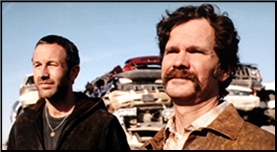
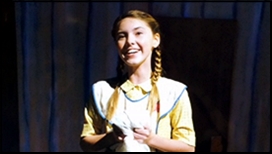
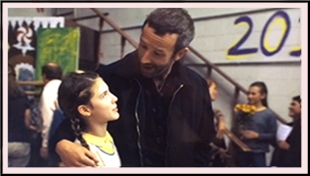
GET SHORTY. “The Pitch.†Epix, 13 August 2017. Chris O’Dowd as Miles Daly, an enforcer for Amara De Escalones, a casino owner and gang boss in Pahrump, Nevada, who looks to escape his criminal lifestyle and enter into the film industry; Ray Romano as Rick Moreweather, a film producer; Sean Bridgers as Louis Darnell, Miles’ partner; Lucy Walters as Katie Daly, Miles’ wife; Carolyn Dodd as Emma Daly, Miles and Katie’s daughter. Miles’ pet name for her is “Shorty.†Lidia Porto as Amara De Escalones. Based on the novel by Elmore Leonard. Writer: Davey Holmes. Director: Allen Coulter. Currently streaming on Cimemax via Amazon Prime.
Once again I am indebted to Wikipedia for the list of characters, the actors who play hem, and their roles in Get Shorty, the TV series. While the movie (1995) followed the book (1990) fairly closely, the TV series bears only a passing resemblance to either. Only the general idea stays the same: that of a professional hitman trying to improve his life and/or using Hollywood and the lower level movie business to launder money for the mob.
This, the first episode of the TV series, which lasted for three season of nine episodes each, consists largely of setting up the characters and the basic premise. There’s no standalone story line to go with it. On the other hand, I don’t think anyone watching this would go away not knowing what the future of the series would be like and whether or not they’d be likely to following along.
The appeal so far, though, is in the characters, and in the black tongue in cheek attitude the two partners in the hitman business have toward their business. Miles Daly, more or less the featured player in this large ensemble show, would like to get out of it, however. He’s separated from his wife, who doesn’t care for the business he’s in, and that interferes greatly with Miles’ wish to see and be with his daughter Emma.
The other star is Ray Romano as minor league (very minor) Rick Moreweather, who as the series begins is grasping at straws so that he can finish his (very) minor film epic. Obviously when Miles comes knocking at his door, it will be a match made in heaven.
HAWAII FIVE-O “…And They Painted Daisies On His Coffin.†CBS, 07 November 1968 (Season 1, Episode 5). Jack Lord (Det. Steve McGarrett), James MacArthur (Danny Williams), Zulu, Kam Fong. Guest star: Gavin MacLeod. Writer: John D. F. Black. Directed by John Peyser.
A tense, well written episode from Hawaii Five-O’s first season, “…And They Painted Daisies On His Coffin,†has two intersecting storylines. The first and central one concerns Danny Williams (James MacArthur) who, after a night of light drinking, confronts and kills a teenager who he witnessed trying to break into a car. The kid was hardly an angel, having had fired a gun at Dano.
The problem is: when the rest of the police arrive at the scene and find the kid’s body, the gun has mysteriously disappeared. What Dano and McGarrett (Jack Lord) don’t immediately know, but the audience does know is that the deceased’s seventeen-year-old girlfriend was in the apartment and absconded with the weapon while Dano wasn’t looking.
A good part of the episode is devoted to exploring the devastating impact that killing a suspect has on Dano. The media has already judged him as guilty. And so, it would seem, has the District Attorney who has him booked for murder. It’s up to McGarrett and his team to find the gun and the girl.
This is where the episode moves squarely into the realm of what could only be called “hippiesploitation.†McGarrett tracks down the girl he’s been looking for. Turns out she’s a junkie and getting her supply from a flamboyantly deviant dealer named Big Chicken. Portrayed by Gavin MacLeod, who would go on to appear in The Mary Tyler Moore Show and star in The Love Boat, Big Chicken is the type of over-the-top counter-cultural criminal figure omnipresent in late 1960s crime television. It’s a solid memorable performance.
All told, this episode is a rather cynical exploration of societal darkness in brightly lit Hawaii and still packs a bit of a punch.
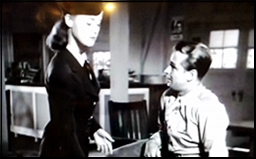
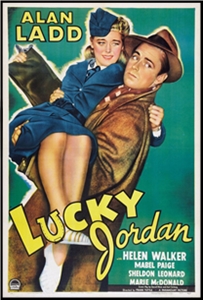
LUCKY JORDAN. Paramount Pictures, 1942.Alan Ladd, Helen Walker, Sheldon Leonard, Helen Page, Lloyd Corrigan, John Wengraf, Miles Mander. Screenplay by Darrell Ware, Karl Tunberg, Story by Charles Leonard. Directed by Frank Tuttle. Currently available on YouTube.
Flag waving gangster epic on a familiar note. Ladd is tough slick New York gangster Lucky Jordan who has just survived a murder attempt orchestrated by his partner Slip Moran (Sheldon Leonard) when he gets the bad news his shyster lawyer Ernest Higgins (Lloyd Corrigan) can’t keep him out of the Draft.
Ladd tries getting Annie (Helen Page) to pose as his needy mother, but when that doesn’t work, he is in the army and not handling it too well. Still he manages to meet beautiful WAC Jill Evans (Helen Walker) before getting thrown into the brig.
Lucky isn’t going to take that lying down and slugs a guard and escapes, managing to steal a car and kidnap Jill along the way. Despite that, the two, as is always the way when a good girl is kidnapped by a gangster in Hollywood’s Fairy Tale world, they fall for each other.
Once on the outside, he goes after his partner Slip, who he knows is moving in on his business and when they clash, he beats up Slip, who he discovers has secret papers he is selling to Nazi Spies.
Helen begs him to return the papers and become a hero, but Lucky see dollar bills to fund him in his life as a deserter.
When he goes to sell the papers back to Slip, Annie stops him warning him she saw Slip setting up an ambush. Lucky hides out with Annie, stores the papers in her place, and begins to warm to the old dame.
When he returns from arranging another meeting with Slip he finds he was followed home earlier and the thugs have worked over Annie. Lucky, not being too bright right then, gets slugged and the Nazi’s get the papers.
Don’t ask why they don’t kill him or the old woman. Maybe they are sentimental thugs.
But Lucky’s two-timing secretary Mabel (Marie McDonald), knows one thing, the name of a flower, a rare tulip Slip talked about delivering. Lucky tracks down tulips and finds an estate up in Far Rockaway that has tours of its flower gardens. Along the way Jill has seen him and follows him.
And yup, it’s the Nazi hideout owned by Miles Mander, where John Wengraf has been dealing with Slip.
Slip arrives with the papers, but when he meets Mander in the greenhouse Lucky turns the water works on them and drops in through the glass ceiling to snatch the papers. There is some agile stunt work here, a little of it done clearly by Ladd, though not all.
But now he can’t escape the estate, and Jill, thinking Mander is working with the FBI (she is perfect for Lucky, not too bright herself) is unknown to her a prisoner, and when Lucky gets rid of the papers will the citizen he planted them on call the FBI, and can he stall Wengraf and Mander long enough for the FBI to get there?
No Spoilers, but if you have any doubt, you don’t know Hollywood.
Though it is hardly in a class with Sam Fuller’s classic on the theme Pick Up on South Street or Mr. Lucky or as funny as All Through the Night, it is a fairly smart little film with a charismatic performance by Ladd as the usual tough guy with a heart, though to give him credit, his Lucky is far less sentimental than the same roles played by Lloyd Nolan and others in the same period. Even the ending hits a comically sour note.
Lucky Jordan is nothing new, nothing special, but it is well acted and written all around, and I confess I’m still a sucker for those Patriotic speeches given by tough guys who find out just how much fun it is to punch a Nazi in the face.
It’s an entire genre of Hollywood films with the good bad guy deciding he is more good than bad when it comes to flag waving and some of his former partners deciding they only see dollar signs.
Ironically it works in so many movies, and here it has Ladd at his most attractive, full of quiet menace, easy physicality, and a hint of something wounded behind his eyes. Walker is beautiful and smart, Leonard always good, Mander and Wengraf make for fine villainy, and the Damon Runyonesque Lady for a Day business between Ladd and Page is satisfying without getting cloying.
This is hardly up to the classic that Ladd and director Stuart Heisler put together in The Glass Key, but then there is no Veronica Lake or William Bendix, and at times this one is just a little rushed and half-hearted, an A film that is at heart a B with a little attitude.
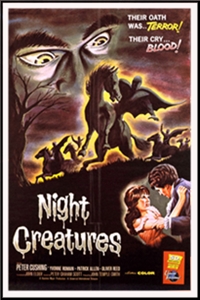
NIGHT CREATURES. Hammer Films, UK, 1962, as Captain Clegg. Universal Pictures, US, 1962. Peter Cushing, Yvonne Romain, Patrick Allen, Oliver Reed, Michael Ripper. Loosely based on the character Doctor Syn, created by Russell Thorndike (not so credited). Director: Peter Graham Scott.
Though the movie has numerous elements of horror and some strong frightful imagery of skeletal figures on horseback, Night Creatures is not a horror movie per se. Rather, it’s an thoroughly entertaining adventure film/swashbuckler that neither takes itself too seriously, nor makes a mockery of the proceedings. Released in the UK as Captain Clegg, the movie is rich in atmospherics and benefits from very good set design, costumes, and lighting. Above all, Night Creatures contains a strong leading performance by Peter Cushing and a good supporting performance by a somewhat youthful Oliver Reed whose physicality is on full display here.
Set in late 18th-century England, the movie pits revenue men against the good (and not so good) townsfolk of a coastal village in Kent where smuggling gin is a primary livelihood. Like Southern moonshine movies of the 1970s, the film very much wants you to be sympathetic, at least somewhat, to the smugglers. The authorities are cold, cruel, and not overly likeable. Holding the town together is the local preacher, Dr. Blyss (Cushing). He seems to have their welfare at heart. But preaching isn’t the only thing he does! He moonlights as the ringleader of the local smuggling outfit.
As the story unfolds, it turns out that Blyss (Cushing) spoilers alert has a secret. It turns out that Captain Klegg, an infamous pirate who long outwitted the authorities and was presumed dead, isn’t buried in the local graveyard after all. Blyss, it is revealed, is Clegg and has been living under an assumed identity for all these years. There’s also a subplot involving a love affair between the squire’s son (Reed) and Blyss’s daughter (Yvonne Romaine). It works well and serves to humanize Blyss/Clegg.
All told, the movie is worth your attention. This was my second viewing and I appreciated it a lot more this time. Cushing, because he primarily did horror films, never received the proper acclaim for his acting skills. This movie should prove skeptics wrong. He’s very good here, with the proper amount of cheekiness and deviousness. Captain Clegg is a memorable antihero. Good escapist fun with the proper amount of understatedness. Look for Irish actor Jack MacGowran in a small role.
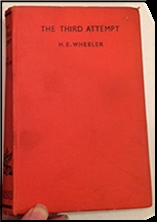
H. E. WHEELER – The Third Attempt. Chief Inspector Stephen Rant #2. Herbert Jenkins, UK, hardcover, 1946. Probably never reprinted.
When a wealthy widow of several years standing unexpectedly decides to marry a man who everyone assumes (correctly) is doing so only for her money, it gives all of her relatives and hangers-on who are living with her plenty of motive for doing away with her before she can change her will.
And from the title of this rather obscure mystery novel, you may easily deduce that the third attempt is the one that calls in Inspector Rant to handle the investigation that follows. Accompanying him is Sub-Inspector Barry Ellingham, who serves him extremely well as his Watson – even though Rant sees no reason to confine in him very much.
Rant himself is of an extremely miserly nature, a man who is called “Blister†behind his back by his subordinates, and in particular considered “a cross-grained old curmudgeon†by Ellingham. But the mystery is an interesting one that’s well-plotted with a clever twist or two. There’s not much to the story but a lot of questioning of the witnesses, but the characters are clearly delineated, even if their appearances in the tale are there only for the sake of the mystery.
Most of Wheeler’s books fall into the “hard to find†category. The Third Attempt seems to be easiest, probably because it’s the last one he wrote, and post-war at that. Lots of equally little know mystery writers from the same era are being reprinted today. Based on this particular one, I see no reason why he shouldn’t be among them.
The Inspector Stephen Rant series –
Death Takes a Ride. Jenkins 1942
The Third Attempt. Jenkins 1946
Wheeler also wrote three novels about a fellow named Kandal Graydon, profession unknown, plus one standalone crime novel, all within the span of twelve years, 1935-1946, all published by Jenkins.
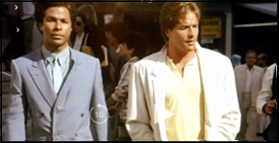
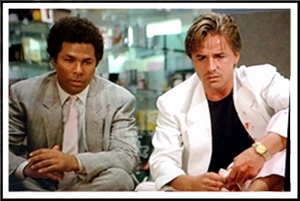
MIAMI VICE. “Milk Run.†NBC, 04 January 1985 (Season 1, Episode 12.) Don Johnson, Philip Michael Thomas, Edward James Olmos. Writer: Allison Hock. Director: John Nicolella.
If by twelve episodes into the first season, viewers hadn’t realized that they were a long way from Cabot Cove territory, they certainly would have after watching this one. Murder, She Wrote had begun the year before, and while the two shows were never on opposite each other (that I know of), half the country, I’m sure, would have been watching that one, while the other half found a lot more to watch in this one.
There’s not time for a lot of byplay between the main characters in “Milk Run.†The story begins at the beginning and plays through with no digression to the end. It is assumed that viewers knew who Crockett and Tubbs were when they started watching, and if they didn’t, it was certainly easy enough for them to catch up.
The main story line involves two young boys who have come down to Miami to turn they life savings into real money. Unfortunately their plan of action requires dealing with a smuggling ring, with one of the two traveling to Columbia, picking up a religious statue filled with drugs, and bringing it back into this country.
Which is not at all a good idea.
While the skies in Miami are generally clear and sunny in this one, there is more than the usual sense of darkness and suspense than I think there were in most crime-related television series at the time. The setting, the music, the clothes, all mesh together in a perfectly choreographed tale of crime gone wrong that’s at one time very simple but also very complicated.
Even better, it’s a story that easily be shown today with very little updating needed.
MICHAEL ROBOTHAM – When She Was Good. Cyrus Haven/Evie Cormac #2. Scribner, hardcover, July 2020; paperback, July 2021. Setting: Contemporary England.
First Sentence: Late Spring. Morning cold. A small wooden boat emerges from the mist, sliding forward with each pull on the oars.
In this follow-up to Good Girl, Bad Girl, the mystery of Evie Cormac continues. Found hidden away in the hidden room off the bedroom where a man was tortured and killed, the question remains as to whether he was her kidnapper, or her protector. Although the press are still curious, someone more sinister is after the information, and Evie, while psychologist Cyrus Haven, plagued with monsters of his own past, teams up with Sacha Hopewell, the former Constable, who found Evie, to try to protect her.
There are several elements needed for a memorable book and description/sense of place is one. Robatham has that well in hand— “The air outside smells of drying seaweed and wood smoke, and the distant hills are edged in orange where God has opened the furnace door and stoked the coals for a new day.”
It is useful to have already read Good Girl, Bad Girl. However, Robotham not only fills in the backstory of Evie, but includes new information. The way in which Cyrus’s background is conveyed is brilliantly understated yet establishes an important link. We also learn much more about Terry Boland, the man whose body was found in the house where Evie was hiding.
This is a dark book. Robotham has written a clear and strong example of the impact of abandonment. Then he changes the pace with a surprising plot twist and an example of Edie’s ability as a truth wizard — one who can tell when others are lying.
There are observations which cause one to pause and are relevant to today— “The real power belongs to the people who control information… Individuals who can suppress stories, fix problems, spin news, and plant false information.” —and make us think of current situations— “…is a classic sociopath, who seeks power and influence rather than fame.
Where others notice the beauty in the world, he sees only how it could benefit him. Relationships are designed to further his own interest. It’s not about loving or hating but about duplicity and deception and his own corrupt lust.” Intended or not, and although the author is an Australian living in England, the story cannot help but make one think of current events.
When She Was Good is a complicated story with unique characters and a satisfactory ending. Slow in places, it picks up with well-done twists.
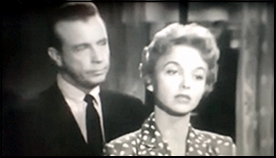
FOUR STAR PLAYHOUSE “Bourbon Street.†CBS, 09 December 1954 (Season 3, Episode 11). Dick Powell, Beverly Garland, William Leicester, Clarence Muse, Ed Platt. Writer: Richard Carr. Director: Roy Kellino.
In many ways this noirish 25 minute play has more going for it than many a shoot ’em up, ultra violent neo-noir two-hour extravaganza in full color does today. Dick Powell is in full hard-boiled tough guy mode in this one, as a piano player who has managed to make his way out of the quicksand life of New Orleans, only to return when he learns that the girl he loved has committed suicide.
He blames the young hoodlum who stole the girl from him, and the only thing on his mind is revenge. Along the way he meets another girl (Beverly Garland) who pleads with him to give it up and take her along with him. Does he? Not a chance. He walks out, closing (but not slamming) the door behind him.
Right into an out-and-out beating and a twist that maybe you will see coming, but I didn’t. It’s beautifully set up, though, and if you decide to watch it (video clip provided), I hope you agree. I liked this one.
FIRST YOU READ, THEN YOU WRITE
by Francis M. Nevins
We never met but once we came close to having a conversation. It was the late Seventies, and I was in La Jolla to attend the annual meeting of the University of California library board on which I served. He lived in the same town, and I was given his phone number and tried to call him one evening. His wife answered, saying he literally couldn’t talk with me: he’d just gotten out of the hospital after surgery for throat cancer. That was as close as I came to contact with Jonathan Latimer.
If you watched PERRY MASON regularly during its first-run years on TV (1957-66) you saw his name in the credits again and again. Erle Stanley Gardner is said to have called him the only writer who really mastered the art of writing MASON scripts. Between the second of the show’s ten seasons (1958-59) and its last (1965-66) he wrote a total of 32 hour-long scripts for the series: 25 originals, 6 adaptations of Gardner novels and, I kid you not, one script based on a short story by Hugh Pentecost. But that was the tail end of his career. Our main concern here is with his beginning.
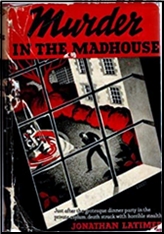
He was born in Chicago on 23 October 1906 and named Jonathan after his great-great-grandfather, who had served on George Washington’s staff during the Revolutionary War. After graduating from Knox College (Galesburg, Illinois) in 1929 he returned to Chicago and worked as a crime reporter for the Herald-Examinerand the Tribune, meeting several celebrity gangsters while on the job. He was in his late twenties when he began writing novels, the first six published by Doubleday Crime Club, five of them featuring a private detective and somewhat under the influence of the overwhelmingly dominant author of that genre during the 1930s, Dashiell Hammett. The first of these was MURDER IN THE MADHOUSE (1935).
***
It opens inside an ambulance with a guy named William Crane in handcuffs and being transported through upstate New York to a private sanitarium for well-to-do mental cases. No sooner has he arrived than he seems to establish why he’s there by claiming to be a famous detective, no less in fact than C. Auguste Dupin.
The kicker is that he really is a detective, a PI hired to infiltrate the sanitarium and look into the claim of one of its residents, a dotty old lady who loves to knit, that a box containing negotiable bonds worth $400,000 — a huge amount back in the days when gasoline cost 11 cents a gallon — has vanished from her room. (If you’re wondering why she kept that fortune unprotected, well, didn’t I tell you she was dotty?)
The inmates of this nameless loony bin, whom Crane quickly meets and begins to interact with, include a fellow who thinks he’s Abraham Lincoln, a wolf man who prowls around the grounds on all fours, another guy who hasn’t spoken a word in four years, and several more, perhaps a few too many. The doctors in charge are at each other’s throats, most of the nurses are predatory sexpots in starched whites, and the staff is mainly composed of weirdoes like the religious maniac who acts as night watchman.
As per the title, there is a murder in the madhouse, four of them in fact. The local law enforcement people are idiots, but there are genuine clues to follow and Crane does a neat job of reasoning in between hearty slugs of the local applejack.
Like Hammett’s Continental Op, Crane is not a lone wolf but works for a big agency, its head being an unseen character known as the Colonel (later expanded to Colonel Black). Unlike the Op, he doesn’t narrate his own cases. But Latimer’s style consists mainly of simple declarative sentences such as we find in Hammett’s THE MALTESE FALCON and THE GLASS KEY. And Crane, like Nick Charles in THE THIN MAN, drinks gallons of booze.
What Latimer contributes to these established ingredients is a sardonic gallows humor whose like is not found in Hammett. We don’t find a great deal of this in MURDER IN THE MADHOUSE but it soon becomes prominent.
***
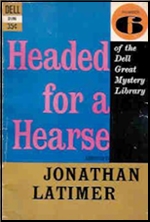
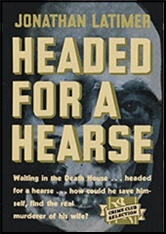
Like Sam Spade in THE MALTESE FALCON and Ned Beaumont in THE GLASS KEY, Crane was onstage at every moment of MADHOUSE, but his next case features several scenes without him. In HEADED FOR A HEARSE (1935) he’s still based in New York but spends almost all of his time in Chicago, racing against the clock to save an innocent man from the electric chair. Joan Westland was found shot to death in her locked apartment, to which only she and her estranged stockbroker husband Robert had keys.
There’s no murder weapon on the scene but ballistics tests establish that the fatal bullet came from a rare British pistol of World War I vintage. Robert owned such a pistol, which has mysteriously vanished. The people in the apartment below Joan’s testify that they heard a shot at a time when by his own admission Robert was visiting her.
He’s convicted and sentenced to death, but shortly before his execution he receives a note, apparently from a criminal prowling in Joan’s apartment building at the time of the murder, who claims he can prove Robert’s innocence. With less than a week before his date with the chair, Robert brings in a sleazy criminal lawyer named Finklestein, who in turn brings in Crane.
As in MURDER IN THE MADHOUSE, our PI spends many hours guzzling the sauce as more bodies pile up but somehow manages to get sober for the denouement two hours before Westland is to be fried. The plotting is tight and the solution to the locked-room puzzle pretty simple by John Dickson Carr standards but rather ingenious, although the tie-buying clue and the telephone-call gimmick still leave me scratching my head.
The most powerful scenes take place in the death house at the beginning and end of the novel. In Chapter XI comes a pure specimen of Latimer’s gallows humor as we get a description of a Bascom Wonder Funeral, “including a handsome Lincoln hearse, three automobile loads of mourners (we can augment your mourners if you desire), the use of our private chapel with the $8000 Barton organ and the Golden Isle Quartette,†plus “a choice of five distinctive caskets.†All for the low low price of $217!
Those not at home in the geography of the Windy City can have a lot of fun with a map tracking Crane’s taxicab journeys back and forth across the Chicago River from Point A to Point B in search of the vanished pistol. But I must warn potential readers that, its merits as a whodunit to one side, HEARSE is a generous anthology of political incorrectness, with epithets taboo in the 21st century strewn all over the landscape: Heeb, sheeny, Chink, dago, even the six-letter word which I’d be screamed at as a racist if I repeated.
All this is okay when coming from the mouths of characters of the Archie Bunker ilk but not so okay in the early pages of Chapter IX when it seeps into the third-person narrative. Small wonder that HEARSE didn’t appear in paperback until more than twenty years after its hardcover publication and then, like another Latimer novel we’ll discuss eventually, only in bowdlerized form (Dell pb #D1896, 1957).
Two years after its publication HEARSE became the basis of the first in Universal Pictures’ 8-film Crime Club series. THE WESTLAND CASE (1937) was directed by industry old-timer Christy Cabanne (1888-1950) from a screenplay by Robertson White. Preston Foster played Crane, with Frank Jenks as his sidekick Doc Williams.
I can’t recall ever seeing this picture but from what I’ve read on the Web (including Dan Stumpf’s review for Mystery*File) it seems to have followed Latimer’s plot fairly closely, although I’m willing to bet that none of the racial and ethnic epithets with which the novel abounds survived into the movie.
***
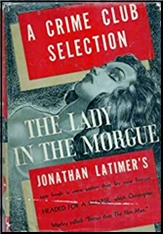
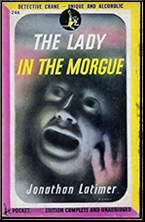
In his first two books Latimer tried his hand at the whodunit laced with gallows humor but the next one was his masterpiece in that vein. In THE LADY IN THE MORGUE (1936) New York is still Crane’s base but while temporarily in Chicago he receives a wire from his boss, Colonel Black, directing him to hang out at the Cook County morgue and try to identify the body of an attractive blonde who apparently hanged herself in her cheap hotel room right after taking a bath and disposing of all her shoes. (As we learn later, the firm has been hired by members of a wealthy family who are afraid the dead woman might be the clan’s rebel daughter.)
But the body is stolen from the morgue during the wee hours and the night attendant bludgeoned to death. The hunt for the missing corpse soon leads to the murder of an undertaker and a wave of wacky-gruesome incidents as Crane and his sidekicks Doc Williams and Tom O’Malley encounter a pair of feuding gangsters, a gaggle of luscious blondes, and an alcoholic bulldog in whose company they conduct a midnight search of a cemetery for another (or is it the same?) vanished female body.
Crane finds little time to sleep but plenty to guzzle — including a slug of embalming fluid unaccountably kept in a bottle of Dewar’s Scotch — as he and his buddies lurch from one cockeyed venue to another, perhaps the most vivid being the dime-a-dance joint where all the girls dance in their underwear and the morgue where Crane wraps himself in a sheet and, posing as an embalmed corpse, waits for the murderer.
The solution is chaotic and what passes for reasoning leaves much to be desired, but what a madcap epic! In his entry on Latimer in 20th CENTURY CRIME AND MYSTERY WRITERS (3rd ed. 1991) Art Scott calls it “a genuine mystery classic….grotesque and hilarious at the same time, a masterpiece of black comedy.â€
That may be too thick a coat of encomium, but if you’re going to read any Latimer at all it’s gotta be THE LADY IN THE MORGUE. Note for the triviac: In the first edition the drug best known as pot is rendered as marahuana, a spelling I’ve never seen before, but in Crime Club’s hardcover reprint of 1953 it’s changed to the form we all know and love.
Under the novel’s title but without much resemblance to its anarchic plot, THE LADY IN THE MORGUE (1938) became the third entry in Universal’s series of Crime Club movies, with Preston Foster returning as Crane. This one was directed by Otis Garrett, who had served as film editor on THE WESTLAND CASE, with screenplay by Eric Taylor and Robertson White.
A copy of the movie accessible on YouTube shows us that the man claiming to be the vanished corpse’s brother was portrayed by Gordon Elliott, who later in 1938 started going by Bill or Wild Bill Elliott and, under these monickers, quickly become a notable star of B Western flicks.
***
No novel under Latimer’s byline appeared in the year after MORGUE but a novel by Latimer did. THE SEARCH FOR MY GREAT-UNCLE’S HEAD (1937) was published as by Peter Coffin, who also serves as first-person narrator (Peter Nebuchadnezzar Coffin, to give him his full name). Anyone who had read an earlier Latimer novel was unlikely to have been fooled by the new byline since the detection is done by none other than Colonel Black from the Crane series.
In his ENCYCLOPEDIA MYSTERIOSA (1994) William L. DeAndrea called it “a weird hybrid of country house cozy and hard-boiled effects.†That’s good enough for me. Sometime soon I’ll explore Latimer’s three final PI novels — two about Crane, the third not.
THE BROKENWOOD MYSTERIES “Blood and Water.†Prime, New Zealand. 28 September 2014 (Season 1, Episode 1).. Neill Rea (Detective Senior Sergeant Mike Shepherd), Fern Sutherland (Detective Kristin Sims), Pana Hema Taylor, Cristina Ionda, and a large remaining ensemble cast. Writers: Tim Balme (also creator) & Philip Dalkin. Director: Mike Smith. Currently streaming on Acorn TV via Amazon Prime Video.
When an elderly man who has been grieving the death of his wife for several years is found drowned below the bridge he came to on the same date every year, the immediate assumption is that he committed suicide. But why then, has Auckland almost immediately sent Det. Sgt. Mike Shephard (Neill Rea) to the small town of Brokenwood to investigate?
With the head of the small local police force stepping out of the picture in deference to Shepherd, it is up to Detective Kristin Sims to deal with Shepherd’s brusque and often unorthodox approach to police work, but (to no viewer’s surprise, including mine, nor should it) she gradually and begrudgingly learns that Shepherd really does know what he’s doing.
As Mike Shepherd, Neill Rea is really the star of the show, which has been on now for six seasons of four two-hour episodes each. (It comes as no surprise that at the end of the first episode Shepherd has decides to stay on, having come to appreciate the advantages of living and working in a small town filled with quirky characters.) He is overweight, scruffy, has an unspecified number of ex-wives – he admits to three, maybe four – but possesses a quick mind that is always working.
The detective work is better than average, the setting is often beautiful, but it’s the people in the stories that follow that will have me coming back often, I’m sure.