Reviews


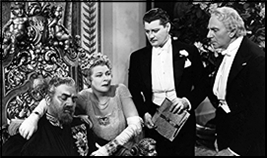
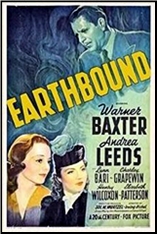
EARTHBOUND. 20th Century Fox, 1940. Warner Baxter, Andrea Leeds, Lynn Bari, Charley Grapewin, Henry Wilcoxon, Elizabeth Patterson. Director: Irving Pichel.

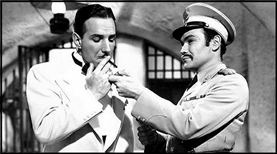
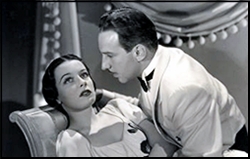
   This is one of those films in which after a person’s death, his ghost is forced to remain on earth until he somehow rights the wrongs committed by his murderer. The ghost this time around is that of Nick Desborough, Warner Baxter’s character, whose one offense he’s done on the earth is to have ab affair with Lynn Bari’s character while married to Adrea Leeds, who plays his wife.

   And he’s broken off the affair. Lynn Bari doesn’t take this lightly and pulls a gun on him. In the ensuing struggle, the gun goes off, and Baxter is dead. Bari’s husband (and Baxter’s business partner, played by Henry Wilcoxon) takes the blame, and according the one of the rules that ghosts have to play by, it is up to Baxter to exonerate him, even as the case goes to court.

   Charley Grapewin plays Baxter’s elderly and somewhat whimsical Bible-wielding mentor in this land of limbo he is in, but no matter much running around and talking to people that Baxter does, no one can hear him. One should think he would figure this out long before he does, but he perseveres, the real killer is determined, and eventually all is right in the world and beyond.

   I don’t know what you might think, but none of this made a lot of sense to me. The special effects are more than OK, however, making Warner Baxter quite transparent after his character dies and he must carry on in his new ghostly realm.

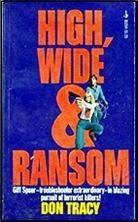
DON TRACY – High, Wide and Ransom. Giff Speer #7. Pocket 80254, paperback original; 1st printing, January 1976.

   Giff Speer, one-time member of a secret Military Police elite, now a run-of-the-mill private investigator, is embarrassed by a skyjacking he can’t lift a finger to stop. A stewardess is killed before his eyes, and it doesn’t go down very well. He also senses that the terrorists responsible are not really on their way to Algeria.

   Speer is not the most cerebral agent around, but he soon becomes the center of a lot of action. Run of the mill.

Rating: C

–Very slightly revised from The MYSTERY FANcier, Vol. 1, No. 2, March 1977.

      —

Bibliographic Notes: Tracy was the author of nine Giff Speer novels. I do not know when he stopped working as an undercover agent for the Military Police and became a PI working on his own, but even though he doesn’t have an entry in Kevin Burton Smith’s Thrilling Detective website, he deserves one.

   For more on the author and his writing career (including a long list of Peyton Place sequels as by Roger Fuller in paperback) go here. One thing I did not realize until now is that the Don Tracy who wrote the Giff Speer paperbacks in the 1970s was the same Don Tracy who wrote four hardcover crime novels in the 1930s.

REVIEWED BY DAVID VINEYARD:


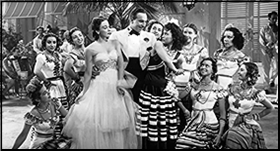
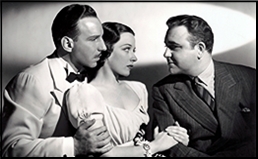
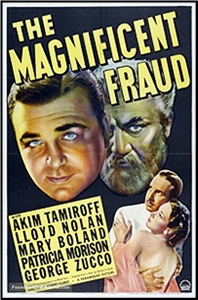
THE MAGNIFICENT FRAUD. Paramount Pictures, 1939. Akim Tamiroff, Lloyd Nolan, Patrica Morrison, Mary Boland, Ralph Forbes, Steffi Duna, George Zucco, Robert Warwick, Albert Biberman. Screenplay by Gilbert Gabriel and Walter Ferris, based on the unpublished short story “”Caviar for His Excellency,” by Charles G. Booth. Directed by Robert Florey. Remade as Moon Over Parador (1988).

   President Alvarado (Akim Tamiroff) is the wise leader of a poor South American nation negotiating with wealthy American Harrison Todd (Ralph Forbes) to save his country, but when Alvarado is assassinated it falls to his right hand man fast talking Yankee Sam Barr (Lloyd Nolan) to cover up the crime so that Alvarado’s crooked successors and Sam can get the money.

   To that end Sam has the bright idea of employing theatrical impersonator Jules LaCroix (Tamiroff) to impersonate Alvarado until the deal is sealed and then take his bribe and run. And it seems the perfect plan, with Sam so close to the President no one will doubt his word that Alvarado survived the assassination attempt. Especially with crooked general Robert Warwick and Police Captain Albert Biberman behind him.

   All he has to do is keep the honest Dr. Luis Virgo (George Zucco) away until the deal is sealed and limit who sees LaCroix to a distance.

   Sounds easy enough until the complications start to pile on, but then it did in The Prisoner of Zenda too.

   Complications include the French policeman Duval (Eugene Crossart) who has just shown up to arrest Jules LaCroix for crimes he committed in France and has been a fugitive from for years. Or Mme. Geraldine Genet (Mary Boland), the famous diva who once was President Alvarado’s lover, and who is there accompanying Claire Hill (Patrica Morrison) as her chaperone as she travels with fiance Harrison Todd.

   Then there is the general greed of all the parties involved including LaCroix who finds he likes being President Alvarado and Mme. Genet and Sam’s less than trustworthy partners who are infighting over who replaces Alvarado.

   Add beautiful Claire and Sam Barr falling for each other, and Carmelita (Steffi Duna) a Spanish dancer who thinks Sam is already hers and doesn’t like his new attention to Claire, and things are starting to get sticky.

   Nor does it help when Sam starts having second thoughts about this little con game and his partners arrest him and throw him in prison with plans for him to “escape” all too easily and collect a bullet in the back. All the while Jules LaCroix is starting to be infected by the nobility of the late President he is impersonating and wondering if the country wouldn’t be better off with Dr. Virgo in charge, certainly as Sam’s partners seem to be planning another assassination.

   If this sounds like the kind of fast paced pulp story you might have found in the pages of Argosy, Blue Book, or Adventure you aren’t far off, especially considering the screen story is from Charles G. Booth, one of Joe Shaw’s Black Mask Boys who wrote novels like The General Died at Dawn and Mr. Angel Comes Aboard (and picked up an Academy Award for best story for The House on 92nd Street, ironically also with Nolan starring).

   The pacing is that of a pulp story too: tough, fast paced, slightly screw-ball, and filled with eccentric colorful characters. This might be a minor A from Paramount, but the money spent on it shows in the sets and production values.

   It’s mostly a showcase for Nolan and Tamiroff who are clearly having fun making it. Nolan, sporting a pencil thin mustache, is playing a familiar role for him, the fast-talking, fast-thinking semi-honest smart guy who goes good at the last possible minute, and Tamiroff adds another great character to his repertoire. The two of them obviously enjoying themselves would be enough alone, but this one is lively fun played in just the right key of laughs, intrigue, action, romance, and Latin American Zenda-ing with wisecracks replacing sword fights.


REVIEWED BY RAY O’LEARY:


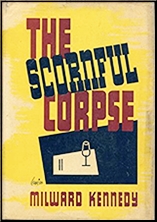
MILWARD KENNEDY – The Scornful Corpse. Dodd Mead, hardcover, 1937. No paperback edition. First published in the UK as Sic Transit Gloria (Gollancz, hardcover, 1936).

   James Southern, a successful British novelist, keeps a one-room apartment for use when he visits London. Though married, he has a platonic relationship with an American named Gloria Day, whom he has given a key to the place, and The Scornful Corpse concerns itself with what happens when he finds her there dead.

   The Police find a brief typewritten note at the scene, and when they learn Gloria was “up the spout” as they say over there, they classify the death as Suicide. Southern, convinced that Gloria would never kill herself, decides to investigate, and learns that she was rather actively involved in the Anti-Nazi movement, and in fact, there are shadowy agents out there looking for her Address Book.

   Slow-moving, tedious and predictable, this may be the earliest Mystery involving Evil Nazis, but that would be its only claim to interest: There’s also some Unintentional humor in a couple of the Character Names: Southern’s wife is Ann (presumably before she left for Hollywood) and the erstwhile father of Gloria’s baby is named. after the gay German hero of the American Revolution — Baron Von Steuben.

— Reprinted from A Shropshire Sleuth #66, July 1994.

   
Bibliographic Notes: Milward Kennedy was pseudonym of Milward Kennedy Burge, (1894-1968). Other pseudonyms were Evelyn Elder & Robert Milward Kennedy. Between the three pen names he wrote 18 detective novels, of which perhaps only half were reprinted in the US. For more information on the author himself, his Wikipedia page is here.

THE OLD GUARD. Netflix, 20 July 2020. Charlize Theron as Andy / Andromache of Scythia,
KiKi Layne as Nile Freeman, a former US Marine, Matthias Schoenaerts as Booker / Sebastian Le Livre, once a French soldier who fought under Napoleon, Marwan Kenzari as Joe / Yusuf Al-Kaysani, a Muslim warrior who had participated in the Crusades, Luca Marinelli as Nicky / Niccolò di Genova, a former Crusader, Chiwetel Ejiofor as James Copley, former CIA agent, Harry Melling as Steven Merrick, greedy CEO of a pharmaceutical empire. Screenplay: Greg Rucka, based on his comic book of the same title. Director. Gina Prince-Bythewood .

   If you’ve read any amount of science fiction, you’ve probably come across the premise of this recent Netflix release before, or something close to it. A band of immortal vigilantes find themselves in a new situation on two fronts: First, they discover that there is a fellow immortal who they must incorporate into their group, a young female marine and the first such recruit in several hundred years. Secondly, their existence is leaking out into the real world, and the villainous head of Merrick Pharmaceuticals wanted their secret to “help the world,” but the profit incentive is his real obsessive purpose.

   Even if there’s nothing very much new in all this, the movie is both well filmed and well acted. Being killed and finding yourself coming back to life over and over again can extract a terrible mental toll on a person. Charlize Theron as Andromache of Scythia, is the oldest of the group, and their de facto leader, and more than her own personal beauty she manages to display a weariness that weighs so heavily on her after so many centuries of life.

   KiKi Layne, as the new addition to the group and the other of the two female leads, is also very impressive, showing both disbelief at first to her new status, then the agony of learning that she is now being forced to leave her family behind. Only the supervillain hard on the group’s trail shows the film’s comic book roots, but as such, once again, that aspect of the story is also most excellently done.

   There’s lots of guns and other bloody action involved, as well as hand to hand combat, for those for favor that aspect of watching thriller extravaganzas such as this, but I found the personal side of the film, and the characters in it, were what made spending the two hours with them all the more worthwhile.


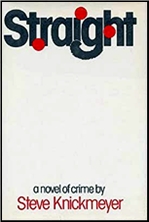
STEVE KNICKMEYER – Straight. Steve Cranmer & Butch Maneri #1. Random House, hardcover, 1976. Pocket, paperback, 1977.

   Referring to the comment with which I ended my previous review, it is too early to mourn the passing of the private eye yarn. This is Knickmeyer’s first novel, and one presumes it won’t be the last we shall hear of the detective agency team of Steve Cranmer and Butch Maneri.

   There office is in Oklahoma City, a locale which certainly is not the usual New York, Los Angeles or San Francisco. A jeweler in the small town of Solano, population 3000, is at first thought to have committed suicide, but their investigations delve deeply into this outwardly friendly country of western swing and John Wayne rednecks. Intruding on the scene are two high-powered syndicate killers, hired for local reasons.

   Knickmeyer has good control over his main characters, although Maneri might agree that he could reign in his active sex life a lot more effectively. The minor characters are less well drawn, and in particular the transformation of Richard Straight from dedicate city cop to mysterious Mafia hit-man seems too flatly stated.

   In the end, it is the wry humor throughout and the strong portrayal of a pair of private eyes happy with what they’re doing that carry the book along so agreeably.

Rating: B

–Very slightly revised from The MYSTERY FANcier, Vol. 1, No. 2, March 1977.

      —

Bibliographic Update: Knickmeyer has only one other entry in Al Hubin’s Crime Fiction IV, that being Cranmer (Random House, hardcover, 1978).

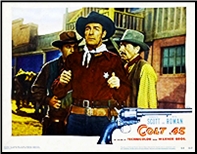
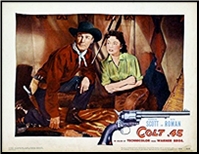
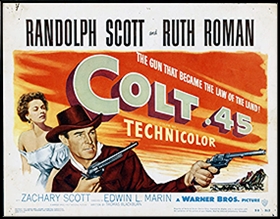
COLT .45. Warner Brothers, 1950. Randolph Scott, Ruth Roman, Zachary Scott, Lloyd Bridges, Alan Hale, Ian MacDonald, Chief Thundercloud. Screenwriter: Thomas W. Blackburn. Director: Edwin L. Marin.

   One of Alan Hale’s last films, alas, and I wish I could say it was a good one, not that either Alan Hale nor leading man Randolph Scott were at fault, nor Ruth Roman, radiantly beautiful in a Technicolor western.

   Scott plays a salesman named Steve Farrell traveling the west to sell the newly designed repeating Colt .45’s. His target buyers are lawmen who desperately need them to keep the unlawful elements of their territories at bay. Unfortunately, the fatal error on the part of one sheriff allows a pair of the guns to fall into the hands of a notorious outlaw (Zachary Scott), who then uses them on a spree of killing and robbing, while Farrell spends the next few months in jail.

   It’s quite a mixup, and not a very believable one, nor is the rest of the story, which continues with Farrell’s release from jail, vowing to track down the man who stole his guns. Zachary Scott always made a good villain, but someone let him pull out all the stops here, leering and spouting eye-bulging vitriol at anyone who dares cross his path, including members of his own gang.

   One of whom is played by Lloyd Bridges, whose acting in this film is barely above that of an amateur in high school — or it could be the dialogue he is forced to say while trying his best not to be embarrassed by it. Bridges’ wife is portrayed by Ruth Roman, who gradually begins to realize the truth about her husband.

   One twist I didn’t see coming involves Alan Hale’s character, a sheriff with ulterior motives, and I dare not say more about that. It isn’t a big part, so I’d have to say that the only two reasons for watching this otherwise mediocre western are Randolph Scott, who could play any good guy in a western and make it convincing without half trying, and lovely Ruth Roman.


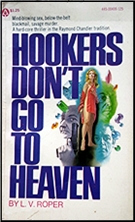
L. V. ROPER – Hookers Don’t Go to Heaven. Mike Saxon #1. Popular Library, paperback original; 1st printing, August 1976.

   The wife of Mike Saxon’s old army buddy was killed in what the police call a hit-and-run accident. Saxon investigates and not too surprisingly concludes it was murder. (The police are dense.) The trail leads to Las Vegas ad the wife’s high-priced call girl past. She also dabbled in blackmail on the side.

   Both the front and back cover invite comparison with Raymond Chandler, but I strongly demur. The plot is straightforwardly sappy, the patter strictly sub-standard, and the attitude and tone are frozen 20 years in the past. With hardcore pornography available now no further than the nearest art theater or one of those bookstores, it’s hard to say what all the excitement’s about.

   The rating below follows because I was able to read this one all the way through with only momentary cringes, but if private eye fare is not usually for you, don’t get within ten feet of this one. What I fear most is that when misrepresentation like this don’t sell, paperback publishers will give up on the real thing as well.

Rating: D

–Very slightly revised from The MYSTERY FANcier, Vol. 1, No. 2, March 1977.

      —

Bibliographic Update: L(ester) V(irgil) Roper wrote five paperback originals for Curtis and Popular Library between 1973 and 1976, then one last book for Dell in 1981. This was Mike Saxon’s only recorded adventure, but two of the other Popular Library books featured another PI known as Jerry “Renegade” Roe. Check out the latter’s page here on the Thrilling Detective website.

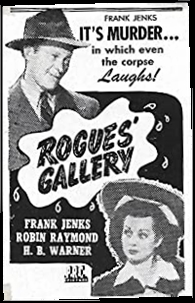
ROGUES GALLERY. PRC, 1944. Frank Jenks, Robin Raymond, H. B. Warner, Ray Walker, Davison Clark, Bob Homans. Director: Albert Herman.

   First of all, this movie has nothing to do with the radio show of the same title, the one starring Dick Powell as a tough guy PI by the name of Richard Rogue, which ran as a summer replacement show on NBC for three years, 1945, 46 and 47. Nor does the title have anything to do with movie itself, a happening which was all too common for Poverty Row movie productions such as this one back in the 40s.

   Robin Raymond may have gotten second billing in this one, but she’s really the star of the show. She plays a feisty young reporter named Patsy Clark, hellbent on always getting the big story on the next breaking story. Frank Jenks, her camera-toting partner in crime solving, is there only for comedy relief, as you probably realized as soon as you saw his name in the credits.

   At stake in this otherwise totally unremarkable exercise in detective-comedy movie making, is a device cooked up by a home-based inventor that can eavesdrop on any conversation anywhere in the world.

   Dead is one of the members of the board financing him, but whenever the cops are called in, the body always seems to disappear before they get there. Not once, but twice.

   Pretty ho-hum stuff, you might say, and you’d be right if you did. The mugging act that Jenks puts on gets tiresome after a very short while, but Robin Raymond, who built a career in movies and TV playing uncredited roles over a long period of time, is quite another matter. I used the word “feisty” before, and believe me, she takes no guff from anyone. The way he walks into a room with fast energetic strides,  her elbows pumping, made me smile every time she did.

   It’s curious what catches your attention in small all-but-unknown murder mysteries like this one. Maybe it’s because there’s no real point in following the story itself.

PostScript. I’m spelling the title as it’s shown on the screen, not as you see it on the poster and the newspaper ad.


REVIEWED BY DAVID VINEYARD:


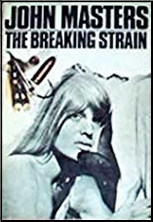
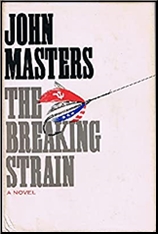
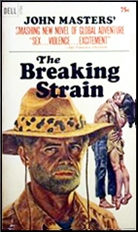
JOHN MASTERS – The Breaking Strain. Michael Joseph, UK, hardcover, 1967. Delacorte, US, hardcover, 1967. Dell, paperback, January 1968.
   The Thames flowed close by at the foot of the embankment wall, but no sound came up to tell them whether the tide raced, straining, past buoys and bridge abutments, or whether the water lay slack and still. No ship moved on the river. In the roadway no wheeled traffic moved. For a long time they had met no other pedestrians. The fog lay deep, yellow, cored with black, over London.

   They are sportsman V. K. G. Hawker (the thin high bridged nose gave him the look of pale eagle) and his beautiful and innocent younger sister Anne (she was tall for a woman and steady eyed), a pair with seven league boots, each other all either has in the world, on the way to Scotland for a bit of salmon fishing, neither really bound by anything save each other and the pursuit of distraction.

   â€œAt any moment Sherlock Holmes will loom up, hypodermic at the ready. But first we’ll hear his fiddle and smell his vile shag tobacco.”

   They are about be thrown into a bit of international intrigue that even Holmes might pale at,

   Out of the fog they spy a group of men throwing a bound young woman (She was not quite young, dark haired, voluptuous …) over the embankment into the river. Anne dives after her, and V. K. brandishes the blade in his sword stick. Luckily for him two other men arrive to help, a fat Frenchman named Robert de Guise and an American named Bill Hammond (a sort of black haired Gary Cooper), son of a wealthy industrialist whose overbearing father left him with a pronounced stutter despite his physique and good looks.
   They rescue the girl, a beautiful sensual European named Ingrid, who coincidentally is staying at the same hotel, the Savoy of course, as all four of them, and when they deliver her home they get a shock, because waiting for her in her room is Lord Redmond, a famous physicist, Joseph Webber of “the Department of Agriculture” (aka the CIA), and her father, Sigurd Tellefsen. The latter has just defected to the West from the Soviet Union and is on his way to New Mexico to work on a clean nuclear energy project that could make the West and the world independent of all other energy sources. Hawker and Hammond are both more than a little cynical that is all his project will be used for despite protestations to the contrary.

   The men trying to kill Ingrid were members of HPS (the Russian Department of Health and Sanitation aka the KGB), men who had exceeded their orders, given by their boss, Gregory Parkezian (“Head of their Security Police … Hoover and our Director combined…”).

   And just whose side de Guise will end up on is up for grabs, since he is working for Parkezian, but not a fanatic about it.

   In short order the Tellefsens’ trip to New Mexico is sidelined for a bit of salmon fishing with Hawker, Hammond, and de Guise as bodyguards at Hawker’s friend Sir Alan Gobhair’s Scottish castle. (The northward view swept down to Loch Tumel, then rose past Tulach and the cleft of Glen Garry to the purple haze of the Forest of Atholl.)
   But when HPS shows up there it is decided the Tellefsens must be dispatched to New Mexico and Hawker (You felt that if you offered him something to eat you better pull your hands back quickly.), who now has eyes for Ingrid, his sister, and Hammond accompany them.

   Admittedly up to this point it is more John Buchan, with sex, than Ian Fleming and James Bond, but when Tellefsen is kidnapped and the Hawkers and Hammond set out to retrieve him under Webber’s orders Hawker and Hammond’s tensions will come to a head, passions (Hammond and Anne much to Hawker’s disdain), and other things will boil over, and it all ends in a tense flight over the Atlantic pursued by Russian long range bombers with them caught in their electronic sites.

   The plot and characters are well drawn, the latter complex human beings with warts, hangups, and flaws that threaten them all.

   You are in the sure hands of a master here, having a little fun in a mix of Robert Ruark and Ian Fleming. John Masters was a major bestselling novelist best known for his books about India in the Savage family chronicles that followed one family from their first adventure in India in the 17th Century (Coromandel) to the last days of the British Raj (Bhowani Junction and To the Coral Strand).

   Along the way he wrote books like The Deceivers (a fictional account of the destruction of Thugee in India), Lotus in the Wind (the Great Game in late 19th Century India on the Northwest Frontier), Bhowani Junction (about race in post War India and a foiled attempt to kill Ghandi), The Venus of Kompara (sensual adventure excavating an idol in the jungle), and The Himalayan Concerto (a spy novel set at the roof of the world). Fairly late in his career he also wrote big best selling doorstop novels like The Rock (Gibraltar), a WW I trilogy beginning with Now God Be Thanked, and The Ravi Lancers (about Indian soldiers serving in the First World War).

   Masters was known for his vivid novels full of visceral sex and violence, his lean prose, and his expertise as both a former soldier in India in WW II (he wrote two non-fiction works about his adventures) and himself an Englishman who considered India his home. From Nightrunners of Bengal (about the 1857 Mutiny) on he was a frequent name on bestseller lists around the world.

   The Breaking Strain ends with Hawker and Hammond reconciled and teaming up as sort of roving amateur agents for Webber useful where other agents might fail. Alas there is no second book in the series, so we never find out where they end up. A shame, since “International Sport … sex … violence and high adventure …”, as the San Francisco Chronicle praised the book, was a pretty heady mixture in 1967, and a pleasant distraction from the lesser Bond imitations.

   It’s not bad now either.
« Previous PageNext Page »