Reviews


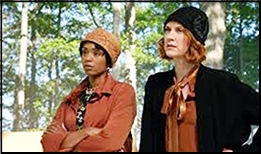
FRANKIE DRAKE MYSTERIES. “Mother of Pearl.” CBC, 06 November 2017 (Season 1, Episode 1.) Lauren Lee Smith as Frankie Drake, Toronto’s first female private detective (in the 1920s) and the owner of Drake Private Detectives, Chantel Riley as Trudy Clarke, Frankie’s partner; Rebecca Liddiard as Mary Shaw, a morality officer in Toronto’s police force who often helps Frankie; Sharron Matthews as Flo Chakowitz, a pathologist at the Toronto City Morgue. Recurring: Wendy Crewson as Nora Amory, Frankie’s mother and a con artist; Steve Lund as Ernest Hemingway, a reporter for the Toronto Star. Director: Ruba Nadda.

   You can’t tell the players without a scorecard, especially when there are as many players as this. Thanks go to Wikipedia for providing all the names above and who they are. This first episode shows exactly how a pilot should be done: introduce the characters while at the same time building  a story around them doing just that and managing to be entertaining on its own.

   In this case, the story begins with a valuable diamond necklace being stolen from the hotel room of a wealthy steel magnate visiting from Pittsburgh. Curiously the thief leaves in its place a single duck’s feather – or more specifically, a drake’s feather – somehow bringing suspicion directly to Frankie’s door.
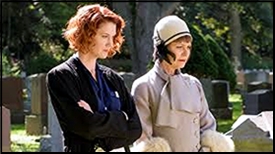
   This may be more than I’d usually tell you in a review, but things do get complicated from this point on. It seems that the steel man’s wife is none other than Frankie’s mother, who abandoned her and her father when she was but a child. As the story progresses, Frankie Drake (a shortened version of Francis Drake) learns more about her father as well.

   The tone is definitely light-hearted. I don’t believe that “dark streets” is anything close to what the producers of the show have in mind. The reception to the series has been such (quite favorable) that it is scheduled to start its fourth season next year. The ambience is everything it should be, the acting, so far, is adequate. Frankie herself seems, unfortunately, rather plain and and ordinary, especially compared to her flamboyant mother and her young sassy assistant.

   I’d have to see another episode, one that involves a much more ordinary, less personal case, to be able to say more. Based on this, the first installment, I found it entertaining enough to say that I will.


   

REVIEWED BY JONATHAN LEWIS:


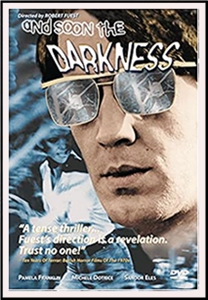
AND SOON THE DARKNESS. EMI/Warner-Pathé, 1970. Pamela Franklin, Michele Dotrice, Sandor Elès, John Nettleton, Clare Kelly. Story and screenplay: Brian Clemens & Terry Nation. Director: Robert Fuest.

   In 1970, one year before he worked with Vincent Price in The Abominable Dr. Phibes (reviewed by me here), Robert Fuest directed And Soon The Darkness, a lesser known, but occasionally effective little thriller. Minimalist at its core and with a score reminiscent of Bernard Herrmann, the movie is a slow burn. So much so that, one is tempted to give up after twenty minutes or so. The movie just doesn’t seem to be going anywhere. But it eventually reveals itself to be a solidly constructed, if haphazardly edited, psychological thriller. One that relies far more on atmosphere and an overarching sense of dread than on violence and gore.

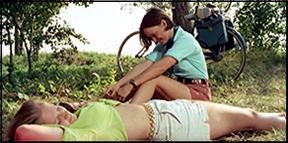
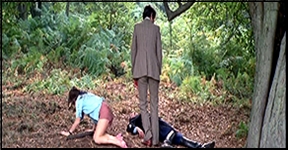
   The plot follows two twenty-something British woman on holiday in rural France. Bicycling their way through the sparsely populated countryside, the two eventually become the unwitting prey of a sexually deviant killer in the surrounding area. When Cathy (Michele Dotrice) and Jane (Pamela Franklin) stop in a café for a drink and some rest, they see a handsome stranger (Sandor Elès) a few tables away. They eventually continue on and decide to take another break in the woods. That’s where the two have a bit of an argument, with Cathy deciding that she wants to just stay put and sunbathe. Jane decides, with more than a little nudging on Cathy’s part, to ride on and makes her way to the next village.

   But Cathy never shows up. What happened to her? Jane doesn’t know, but she is determined to find out. That handsome stranger from the café shows up and introduces himself as Paul. He also says he works in law enforcement and is down in this area because of a murder of a female tourist a while back. He has an obsession with the crime. There’s something not right about Paul, though. He seems to be holding something back. Still, he is willing to help Jane look for Cathy.

   The story follows Jane as she tries to navigate the perils of being lost and confused in a strange land. Not all of the locals speak English very well, but one of them knows enough to tell her that the local gendarme is trouble. There’s a middle-aged English woman who lives alone out here. Who is she? Why is she here? And the gendarme’s father, a deaf World War I veteran, seems to have a few screws loose.

   There’s a natural sensibility to the movie, one that doesn’t rely on special effects or gimmicks. One intuitively feels the danger lurking behind the bucolic farmland. On the surface, everything seems so perfect, so charming. Baked under the warm French sun, the landscape radiates with warmth and community. But beneath this façade is something much more sinister. Something Jane will confront when she stumbles upon a decaying trailer park, one that serves as a most vivid contrast with the splendor of the natural world.

   Although the film plays with the viewer’s expectations, it is never overtly manipulative. Still, there is something almost artificial about the ending. As if the viewer has been slightly cheated out of a comprehensive explanation for everything that has occurred. What the film lacks is a theme. There’s no coherent underpinning to the whole enterprise. Yes, you’re thrilled. And the chills are real. But to what end?


REVIEWED BY RAY O’LEARY:


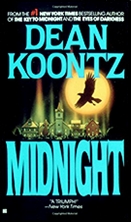
DEAN R. KOONTZ – Midnight. G. P. Putnam’s Sons, hardcover, 1989. Berkley. paperback, 1989.

   Thomas Shadduck, owner of New Wave Microtechnology, dreams of turning Mankind into a race of emotionless logicians — Vulcans, to you Trekkies out there. Toward this end, he has administered most of the leading citizens of Moonlight Cove, California, with a fluid which will make them stronger, smarter, and virtually invulnerable. Unfortunately, as they say in Sci-Fi, there are Side Effects: some of the converts have chosen to make frequent regressions turning themselves into animals and killing anything in their way.

   Now, as Shadduck plans to convert the rest of Moonlight Cove, four people struggle to survive and get help: Sam Booker, an FBI agent sent to investigate the sudden rash of violent crime; Henry Talbot, a crippled Vietnam Vet; Tessa Lockland, whose sister supposedly committed suicide a few weeks earlier; and Chrissie Foster, who caught her parents regressing and escaped when they tried to inject her with the fluid.

   Koontz throws in elements from various sources, which he freely Acknowledges: Invasion of the Body Snatchers, Island of Doctor Moreau, Dr. Jekyll and Mr. Hyde, and even Aliens. Chrissie seems inspired by the Space Orphan in that film, and Koontz throws in a scene where her Parish Priest transforms into the Alien monster.

   Though hardly a master craftsman, Koontz makes you care about bis characters and he writes a story that propels the reader helplessly, gladly along with it.

— Reprinted from A Shropshire Sleuth #66, July 1994.


McMILLAN & WIFE “Murder by the Barrel.” NBC, 29 September 1971 (Season 1, Episode 2). Rock Hudson (Police Commissioner Stewart McMillan), Susan Saint James (Sally McMillan), John Schuck (Sgt. Charles Enright), Nancy Walker (Mildred). Guest Cast: Kenneth Mars, David Huddleston, Vito Scotti. Director: John Astin.

   According to Wikipedia, this second episode of the series was preceded by the pilot “Once Upon a Dead Man” on 17 September 1971, while IMDb calls this the first episode. (The pilot they call episode 0.) The pilot was two hours long; the episodes of the series itself varied between 90 minutes or two hours long; this one runs 90 minutes, including commercials. I’m not sure how long it lasted as part of NBC’s Mystery Movie wheel series, but at least at the beginning, it ran in rotation with Columbo and McCloud.

   â€œMurder by the Barrel” begins with the McMillans moving into their new home, but with Mac having left for the office, Sally finds a body in one of the barrels, one that her grandmother’s best china is supposed to be in. Of course, when Mac and Sgt. Enright get there, the body is gone. What follows is a hearty mixture of laugh-out-loud comedy and detective work that’s at least adequate, split about fifty-fifty.

   There are a lot of suspects – everyone that the three leads comes across is somehow connected with the case, which of course begins with the moving company as the focus of all their attention. Even though Rock Hudson had the bigger name at the time, I think that the more than outgoing Susan Saint James is the real star of the show – a throwback to days of Nora Charles and Pam North and lots of other female halves of many many other detective duos, each in their own distinctive way, of course.

   Wordplay is a strong key to the comedy. A full minute is spent, for example, with the three of them in a police car riffing on the difference between shipping barrels and storage barrels: You can ship in a shipping barrel and store in a storage barrel, and you can store in a shipping barrel, but you can’t ship in a storage barrel.

   Well, I thought it was funny.

   It is no wonder that the series was on for six years. The last season was a dud, though. Because of a salary dispute with Susan Saint James, Sally McMillan was killed off, and the show tried to go on without her, emphasis on the word “tried.”

      —

   For as long as it stays up on YouTube, here’s a video of this particular episode:

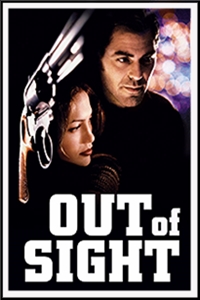
OUT OF SIGHT. Universal Pictures, 1998. George Clooney (Jack Foley). Jennifer Lopez (Karen Sisco), Ving Rhames, Don Cheadle, Steve Zahn, Albert Brooks, Dennis Farina, with cameos by Michael Keaton & Samuel L. Jackson. Based on the novel by Elmore Leonard. Director: Steven Soderbergh.

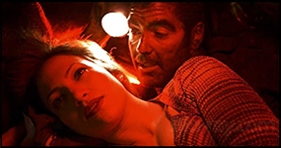
   I can easily image that everyone reading this already knows the story, even if you haven’t actually seen the film. I’ll recap, though, just in case, but as briefly as I can. When a career bank robber by the name of Jack Foley (George Clooney) breaks out of a Floridan prison, he’s forced to share the trunk of the getaway car with a federal marshal by the name Karen Sisco (Jennifer Lopez). And as it so happens, as they talk about movies and other things, propinquity prevails and romantic sparks fly, as unlikely a thing as that might be.

   Except in the movies, of course.

   It was a huge hit, rightfully so, and the beginning of very successful movie-making careers for both of the two lead stars. But the secondary players may even be better in this one, thanks to dialogue that if it didn’t come straight from Elmore Leonard’s novel, it could have.

   It’s a wonderful romantic film, with a lot of shooting toward the end. I have only one kind of sour note to add to this short commentary, and I feel like a churl for bringing it up, but it did bother me somewhat. How did they get two adults in the same trunk at the same time? I don’t think I could fit curled up in a trunk all by myself, much less along with a fine young lady such as J.Lo.

   I’d be willing to try, though.


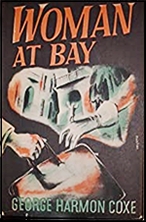
GEORGE HARMON COXE – Woman at Bay. Alfred A. Knopf, hardcover, 1945. No paperback edition. Kindle edition available.

   When one thinks of Coxe, one usually thiks first of Flashgun Casey or Kent Murdock, ubiquitous photographers for Boston newspapers, but Coxe often did switch his non-series mysteries to scenes of the Caribbean, If this book were the only evidence, however, I’d say it’s awfully difficult to distinguish a round of nightlife in the Boston area from night clubs, cafes and liquor spots in Havana.

   This adventure occurs just before the end of the war, when Cuba was useful for European refugees as a stopping-off place before entry into the States. Paul MacKinnon is sent by a secret government agency on a hunt for the diary of a top-rank Vichy official whose window once was Mrs. MacKinnon. His job is the diary and not to fall in love again – he keeps telling himself.

   The key to the resulting murder is an obvious one, but Coxe has always been capable of a pleasant shuffle surrounding the charade. This one’s no exception. by far.

–Very slightly revised from The MYSTERY FANcier, Vol. 1, No. 2, March 1977.


REVIEWED BY DAN STUMPF:


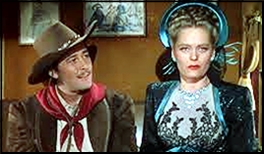
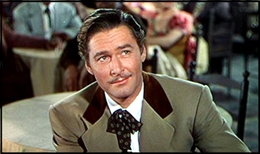
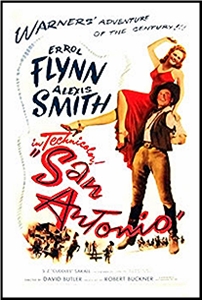
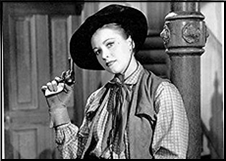
SAN ANTONIO. Warner Brothers, 1945.Errol Flynn, Alexis Smith, “Cuddles” Sakall, Victor Franken, John Litel, Paul Kelly and Tom Tyler. Written by Alan Le May and W. R. Burnett. Music by Max Steiner. Directed by David Butler, Robert Florey (uncredited) and Raoul Walsh (uncredited).

   This generally gets compared unfavorably to Dodge City (1939) and dismissed as inferior, but I find a lot in San Antonio to enjoy. With three directors and two talented writers, it’s hard to say who might be the real auteur of the film, but my bet is Max Steiner.

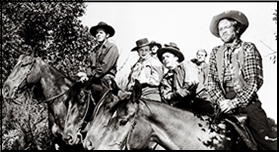
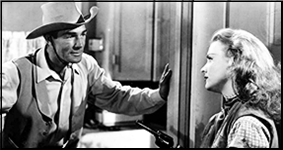
   Flynn plays Clay Hardin, a South Texas rancher shot to pieces sometime before the movie started (Tom Tyler quips “They must be picking lead out of him yet!”) recovering from his wounds in Mexico and gathering evidence against Paul Kelly, who heads up a combine of organized rustlers preying on honest cattlemen. As the film opens, Flynn’s got hold of the vital Macguffin that will convict Kelly, and means to make his way to San Antonio (hence the title of the piece) through outlaw-infested territory to get his man — with a few time-outs to romance itinerant chanteuse Alexis Smith.

   It’s a plot that wouldn’t be out of place in a film noir. Kelly owns the nightclub saloon where Ms Smith performs and he has a suave and treacherous partner in Victor Franken. Unfortunately, somebody lets the pace slacken, throws in too much witless time-wasting bits with Cuddles Sakall, and generally prolongs things when they need speeded up. BUT we also get a death scene from Tom Tyler to match his memorable exit in Stagecoach and a dandy saloon-wrecking shoot-out where everyone who gets hit smashes into something, falls off of something, or just flies into the air — or as we kids used to say “He died neat!”

   There are also as couple of quieter moments that surprised me: Like Errol Flynn looking visibly shaken after killing Tom Tyler in the street. I’ve never seen such a haunted look from Flynn or any other movie cowboy coming out of a fight. And satanic Victor Franken, double-crossed and dying, smiling up at his killer and saying “I’ll be waiting for you!”

   Small things, but together with the bigger scenes, thy make San Antonio a fun movie, and one worth seeing.


REVIEWED BY RAY O’LEARY:


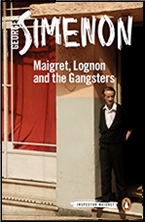
GEORGES SIMENON – Maigret and the Gangsters. Inspector Maigret #39. Harcourt, US, hardcover, 1986. First published in the UK by H. Hamilton, hardcover, 1952. Reprinted in the US by Harcourt, hardcover, 1954, as Inspector Maigret and the Killers. Translation of Maigret, Lognon et le Gangsters (Paris, 1952). Film: Comacico, France, 1963, as Maigret Veit Rouge (“Maigret Sees Red”).

   Madame Longon, the semi-invalid wife of a policeman nicknamed “the Old Grouch” asks Maigret to help when her home is visited twice in three days by American gangsters. She’s been in phone contact with her husband, but hasn’t actually seen him since the Bad Guys came calling.

   Maigret finally talks to Longan and learns that a few nights earlier, the Old Grouch saw a body dumped from a car. But as he was calling in to report it, the body was spirited away. With nothing to back up his story, Longon has been investigating on his own and learned the identity of the killers — who have, in turn, learned his.

   When Maigret takes over the investigation, he is warned off by a restauranteur, who knows the Americans, and even a friend in the FBI cautions he may be in over his head. Maigret takes the warnings as an insult to the French Police and determines not only to catch the killers, but also to learn who it was that retrieved the body.

   One of the many novels written during Simenon’s American sojourn, this is up to his usual standard, with believable characters and perhaps a little more detective work than usual.

— Reprinted from A Shropshire Sleuth #66, July 1994.
   

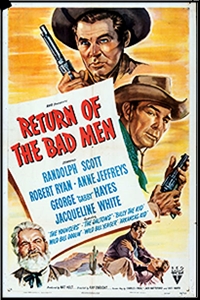
RETURN OF THE BAD MEN. RKO Radio Pictures, 1948. Randolph Scott, Robert Ryan, Anne Jeffreys, George ‘Gabby’ Hayes, Jacqueline White, Robert Armstrong. Director: Ray Enright.

   It must have seemed like a good idea at the time. Bring together all of the famous bad men of the west, or a good passel of them, whether or not they ever met each other in real life, or were active at the same time, and create a gang of outlaws even a figure as solid and stalwart as Randolph Scott could handle them. Audiences would simply flock in, or I’m sure that’s what was the expectation was.

   I haven’t researched the historical facts well enough to tell you whether anything in this movie is true, but I doubt it. In any case, the result is surprisingly sub-par. Not even the evil presence of Robert Ryan as the Sundance Kid, nor the alluring beauty of Anne Jeffreys as Cheyenne, the niece of Wild Bill Doolin, help a lot to make Return of the Bad Men more than a barely passable way to spend 90 minutes f your time.

   For the record, here’s a list of the outlaws that gangleader Bill Doolin (Robert Armstrong) puts together: The Youngers (Cole, Jim and John), the Daltons (Emmett, Bob and Grat), Billy the Kid, Wild Bill Yeager, and the Arkansas Kid. I hope I didn’t leave anyone out. I didn’t list any of their names as part of the cast because other than Robert Ryan, who’s as mean as they come, all of them are very minor roles.

   It turns out that Randolph Scott has a sweetheart that he plans to marry, but what Anne Jeffreys’ character, once reformed (or is she), thinks about that is that she will have something to say about it. Scott is quite oblivious. Unfortunately, the writers not knowing how to write themselves out of this romantic triangle they’ve written themselves into, take the weakest, lamest way out.

   George ‘Gabby’ Hayes, as a bank president, no less, adds comedy relief, but the story is overwhelmed by characters who are simply not very interesting. Not even the sight of the masses of men on horseback and in flimsy wagons at the beginning of the Oklahoma Land Rush adds any excitement to the proceedings.

   Passable entertainment, but barely. Only the sharp, clear black and white photography is worth a mention (J. Roy Hunt , cinematographer). Credit where credit is due.


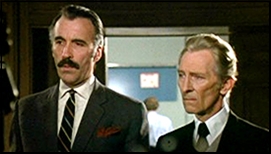
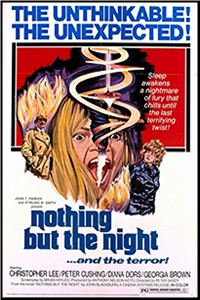
NOTHING BUT THE NIGHT. Rank Film Distributors / Charlemagne Productions, UK, 1973. Christopher Lee (Colonel Bingham), Peter Cushing (Sir Mark Ashley), Diana Dors, Georgia Brown, Keith Barron, Gwyneth Strong. Based on the novel by John Blackburn. Director: Peter Sasdy.

   When Martin Edwards recently reviewed this movie on his blog, he praised it in part (“It’s fair to say that the whole is less than the sum of its considerable parts.”) but in part only. What caught my attention was how he did his best to talk around the actual plot of the movie without ever talking about exactly what kind of movie it is. Obviously he didn’t quite succeed because I tend to notice little things like that, and I wondered why.

   Well, now I know, and in my review in turn, I’m going to do the same exact thing. But if you know who John Blackburn, the author of the book the film was based on, and the kind of books he wrote, then you will know what it is that I’m going to do my best not to say.

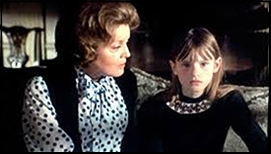
   The story begins with a series of murders to various trustees of an orphanage located on a small island of the shore of Scotland. They all appear to be accidents or suicides, but we the viewer know better. But when a young girl who is also one of the orphans is involved in a bus accident later on begins to have unexplained nightmares and hallucinations, her doctor becomes suspicious. He calls upon his superior (Peter Cushing) for help, who in turn is abetted by a retired police officer (Christopher Lee) who has taken an interest in the case.

   Complicating matters is that the girl’s mother (a most floozy Diana Dors) wants back the custody of her child, and to that end, calls upon a lady journalist (Georgia Brown) for help. At which point a rather conventional murder story turns into … whatever it turns into, and in the most traditional way of telling such a story, and in the way the British seem to do it best.

   It’s a great cast, and the photography is excellent. The ending is suitably chilling, and it would be even more so if there were not so many holes in the plot. They can be ignored, but a tighter (and more realistic) hold on the story on the part of the screenwriter would have improved things immensely.

   It’s still a fun movie to watch, and I have Martin Edwards’ review of it to thank for having brought it to my attentions.


« Previous PageNext Page »