Reviews


A 1001 MIDNIGHTS Review
by Bill Pronzini


CLYDE B. CLASON – Blind Drifts. Theocritus Lucius Westborough #3 or 4 (two book appearances in 1937). Doubleday Crime Club, hardcover, 1937. Rue Morgue Press, trade paperback, 2012.
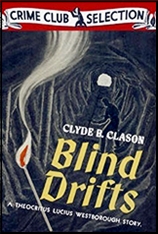
   Mild-mannered Professor Theocritus Lucius Westborough, an expert on the Roman emperor Heliogabalus, is an amateur sleuth in the classic mold of the Twenties and Thirties: He solves convoluted puzzles through the time-tested Sherlockian methods of keen observation, a storehouse of esoteric knowledge, and deductive reasoning. Westborough – and his creator specializes in locked-room “miracle problems.” Even the best of these offers no challenge to John Dickson Carr, but for the most pan they are cleverly constructed and well clued. The one in Blind Drifts offers a particularly neat and satisfying variation on the theme.

   Westborough’s home base is Chicago, but here he travels to Colorado to visit a gold mine in which he has inherited 70,000 shares. Not long after his arrival, he finds himself investigating, first, the disappearance or one of the mine’s directors, and then the murder of its owner, Mrs. Coranlue Edmonds, known far and wide as a “bearcat on wheels” – a murder by shooting that takes place in front of seven witnesses, in a “blind drift” deep inside the Virgin Queen mine. by a seemingly nonexistent gun.

   The plot is twisty and complex, the clues numerous and fairly presented, the motive for Mrs. Edrnonds’ murder plausible, and the method likewise. The Colorado setting is well depicted, as are the details of the operation and physical makeup of a large gold mine. It is Clason’s attention to such detail, more than anything else, that lifts his work above the average puzzle story or the period; you can’t read a Westborough novel without learning something, and something interesting at that.

   The one drawback to this and the eight other entries in the series is Clason’s sometimes florid, often prolix style. Blind Drifts is the only book of his that would not benefit greatly from the excision of ten or fifteen thousand words, and at that it could stand to lose five or six thousand here and there.

   The most appealing of Wcstborough ‘s other cases are The Death Angel ( 1936), set on a Wisconsin country estate called Rumpelstiltskin, where a murder happens in spite of 1542-to-l odds against it. and a murderer is twice guilty of killing the same man; The Man from Tibet (1939), which features a locked-room murder and contains some fascinating background material on the strange customs and rites of Tibet; and Green Shiver (1941), which has a Los Angeles setting and another “impossible” plot, the solution to which depends on Westborough’s knowledge of Chinese jade.

———
Reprinted with permission from 1001 Midnights, edited by Bill Pronzini & Marcia Muller and published by The Battered Silicon Dispatch Box, 2007.   Copyright © 1986, 2007 by the Pronzini-Muller Family Trust

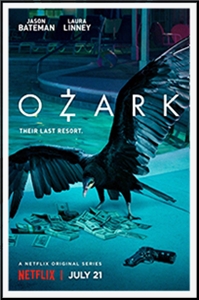
OZARK  “Sugarwood,” Netflix, 21 July 2017. Jason Bateman, Laura Linney, Sofia Hublitz, Skylar Gaertner, Esai Morales. Director: Jason Bateman.

   As a pilot for this series that’s now in its third season on Netflix, it does its job exceedingly well. Due to some serious lapses on the part of his fellow members in a plan to skim off a potion of the profits in a money-laundering scheme they are working on for a Mexican drug cartel, Marty Byrde, his wife and two children must pack up their bags overnight and leave Chicago behind so he can start anew in the area around the Lake of the Ozarks.

   I did not know that the shoreline of the lake is longer than hat of the entire state of California, did you? With tourists and other visitors from all over the world, it seems as though the area wold be a great spot to start business up again, or so Byrde manages to convince Camino “Del” Del Rio (Esai Morales) in a desperate attempt to save his life.

   It takes the full hour to set up the premise. It is assumed that things are Not Going to Go Well. Other than that, though, there is, however, no indication of where the story line will go from here. In fact I should not even pretend that I am reviewing the series at all, based on this first episode, which is well enough done that watching the second one is a must before passing judgment, so I won’t.

   I will say this, however. I found nothing interesting to say so far about the newly exiled father, who as a crook and not a very good one at that, is very nearly a cipher, even at episode’s end; nor his wife, who has been cheating on him; nor his daughter, a whiny teen-aged girl; nor his nebbish younger son.

   No, the standout at this point is Esai Morales, a loyal lieutenant in the drug cartel and a man who knows his job and does it well. He also knows the answer to the question he poses to Byrde and his associates when he first finds them out: If a loyal female clerk in a family business for many years is found taking the cash from the till, should she be fired, or should she be forgiven?

   I knew the answer, the crime boss knows, and by the end of this first episode, Marty Byrde has figured it out as well.


BRUNO FISCHER – Quoth the Raven. Doubleday Crime Club, hardcover, 1944. Bestseller Mystery #B82, digest-sized paperback, 1950. Reprinted as The Fingered Man, Ace Double D-27, paperback, 1953; published back to back with Double Take by Mel Colton.

   Grocer Sam Tree’s wife had two previous husbands. The first was killed escaping from the police; the second is a drunk, a gambler, and not averse to a little blackmail. Where is his wife getting the money to pay him? And is her first husband really dead?

   In this book Fischer deftly balances the clever with the cheap cliché. Except for Sam’s wife, who has neatly mastered the technique of cuddly double talk to answer her way around any question, the dialogue is trite and corny. But I will tell you this: the ending surprised me.

Rating: C plus.

–Very slightly revised from The MYSTERY FANcier, Vol. 1, No. 2, March 1977.

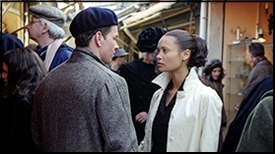
THE TRUTH ABOUT CHARLIE. Universal Pictures, 2002. Thandie Newton, Mark Wahlberg, Tim Robbins, Christine Boisson, Simon Abkarian, Charles Aznavour. Based on the film Charade (1963). Director and co-screenwriter: Jonathan Demme.

   There was a lot of talent involved in making this movie, but the end result certainly doesn’t show it. I came across this film by researching the credits of the leading female star, Thandie Newton, whom I most recently saw in the mini-series Rogue, which I recently reviewed here.

   She has the second-most undesirable task of playing the part that Audrey Hepburn played in the movie this one is a remake of, and I’m happy to saw that she does a creditable job of imitating the pixieish charm of Miss Hepburn. On a scale from one to a hundred, I’d give her a 60. Mark Wahlberg, however, displays — well, let’s put it this way. Cary Grant had more charm in the pinkie of his left hand than Mark Wahlberg shows in trying to follow in his predecessor’s most considerable footsteps.

   I know Wahlberg has gone on to bigger and better things, but at this stage of his career, he was out of his league. And Tim Robbins in Walter Matthau’s shoes? Not on your life, not ever.

   The story’s almost the same. A young woman who’s not been married long but is already thinking divorce comes home from a brief vacation to find the apartment they share all but empty and what furniture there still is destroyed. Turns out the man is dead, he had many many secrets, and many people want something — a fortune in diamonds that he had in his possession.

   All of the fancy camera doesn’t help a muddled and badly told story, and it often served to make me dizzy. This was a mess, through and through — there’s no better word to describe it — a film best avoided if possible, and I don’t say that lightly. The only reason I watched until the bitter end was to see Thandie Newton, whose name and fame does not match that of any of the others involved in this production, but it should.

PS. There is still the same fatal flaw in the plot that the first movie had, and if anyone wants to know, I’ll bring it up in the comments. That’s the one thing they could have improved upon in putting this remake together, and why they didn’t, I can’t possibly imagine.


REVIEWED BY RAY O’LEARY:


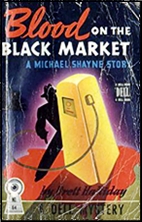
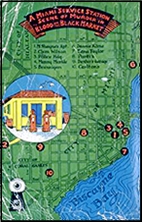
BRETT HALLIDAY – Blood on the Black Market. Dodd Mead, hardcover, 1943. Dell #64, paperback, 1944. Many other paperback edition exist. Revised edition: Heads You Lose. Torquil/Dodd, hardcover, 1958.

   As I mentioned in my review of Death from a Top Hat, having watched the Mike Shayne movies, I decided to re-read one of the Shayne books in my vast, well-organized files. This one is the earliest of the five Shayne map-backs in my collection.

   Mike Shayne, still grieving over the death of his wife, is woken from a sound sleep by a telephone call from Clem Wilson, a friend of his who owns a gas station. Before Clem can really tell him anything, Shayne hears a shot and the sound of a falling body. Telling the desk clerk of his hotel to call the police, Shayne rushes to Wilson’s filling station where his friend Chief Will Gentry is on the scene.

   Shayne intimates to Gentry and a few others that Wilson has told him enough about a ring trying to get him to sell black market gas (during World War II) to make Shayne dangerous to them. Soon he finds himself a target for would-be assassins as well as being courted by the newly-fanned Motorists Protective Association and its pretty female lawyer Edna Taylor.

   It’s a passable effort, with Shayne breaking the law at will and treating women in the time-honored way of the American tough-guy. I pretty much remembered who the killer was, or it was relatively easy to figure out. In a rather egregious implausibility, two different characters shoot someone down in cold blood in front of Shayne on the pretext that they thought those unarmed someones were dangerous. Once I could swallow with difficulty but twice is getting preposterous.

— Reprinted from The Hound of Dr. Johnson 53, September 2007.

REVIEWED BY BARRY GARDNER:


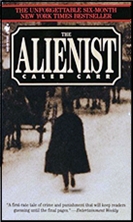
CALEB CARR – The Alienist. Random House, hardcover, 1994. Bantam, paperback, 1995. TV adaptation: A ten-episode limited series on TNT, January 22 to March 26, 2018.

   Carr is a young native of NYC with a degree in history who writes frequently on political and military affairs. His first novel was one of the bigger ones of ’94, and I missed it. Why is it that I get review copies by the basket that I wouldn’t read on a bet, but not the ones I want to? I actually had to buy a second-hand copy. It’s not fair.

   It’s 1896, and Theodore Roosevelt is Police Commissioner of New York City. Dr. Lazlo Kreizler is a controversial psychologist, or “alienist.” John Schuyler Moore is a crime reporter for the New York Times. The three men met in their youth at Harvard, and now they must form an unlikely and secret alliance. Someone is killing the city’s children, and viciously mutilating their bodies.

   Dr. Kreizler believes it is the same someone, and that he will kill at increasingly shorter intervals. His theories about insanity are so unpopular that Roosevelt cannot be publicly associated with him, so they must work covertly to catch the murderer, a serial killer before that was a phrase for it, or public that would or could believe in it.

   I’m enough of a literary snob that it goes against the grain for me to admit I like a bestseller, but I’ve got to ’fess up — this was a damned good book. A serial killer book, too, and I don’t like those at all. I’m always amazed when a young writer and first time novelist writes so well.

   It’s a fascinating detective story, as well as being an equally fascinating picture of New York City at the end of the 19th century. Carr’s slowly painted portrait of the killer is chilling, and his characterizations of the team following him solid. I would have liked to have seen Moore, the narrator, a little better developed. But it’s hard to quarrel with the foci Carr chose.

   It’s a thick book, and at times I thought the very picture of the city that I found so interesting slowed the story a bit too much. All told, though, it was an excellent book and would surely made my 1994 awards list.

— Reprinted from Ah Sweet Mysteries #19, May 1995.


REVIEWED BY DAN STUMPF:


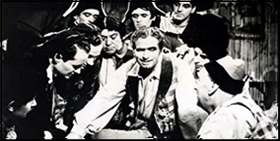
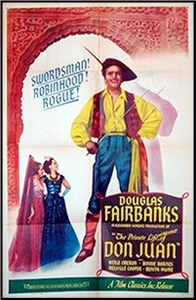
THE PRIVATE LIFE OF DON JUAN. United Artists, 1934. Douglas Fairbanks, Merle Oberon, Bruce Winston, Benita Hume, Gina Malo, Binnie Barnes. Director: Alexander Korda.

   The Private Life of Don Juan lacks wit or pace of action, but it offers an elegant coda to the career of its star, Douglas Fairbanks, Sr., here in his fifties and looking tired of the whole thing. When an imposter masquerading as Don Juan is killed by a jealous husband, the legendary lothario takes advantage of the situation and retires to the country, with tepid results. Doug doesn’t do any stunts, there’s no swordplay, little plot, and yet …

   … Halfway through the film, Don Juan attends his own funeral, and director Alexander Korda deals it out with his usual splendour, all billowing cloaks and wailing women, as America’s cavalier strolls through the palazzo contemplating his own mortality. Fairbanks never made another movie, lending an odd elegiac tone to a film that doesn’t really deserve it.

— Reprinted from The Hound of Dr. Johnson 53, September 2007.


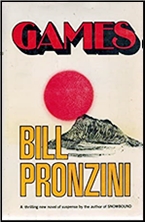
BILL PRONZINI – Games. G. P. Putnam’s Sons, hardcover, 1976. Crest, paperback, 1977. Stark House Press, trade paperback, 2007, published in tandem with Snowbound.

   A Senator from Maine, burdened by a marriage in name only, takes his mistress to his isolated island retreat for a quiet Memorial Day weekend. He intends that they should be alone, but on the first night, they discover that the house has been broken into. Guns have been stolen. A squirrel is found bloody and disemboweled near what looks like an altar. The crash of a broken window, a jagged piece of bone.

   A senator’s games are of politics, as well as he games everyone plays, games of love, of life itself. Senator Jackman finds himself in a chilling, then mind-exploding game of cat-and-mouse – the most dangerous game. The horror of something unpleasant of something happening to someone else is compounded when you’re forced to realize how each of us is to becoming the object of the crazed torment of persons unknown. You won’t escape this book without being shocked at least once.

   This is a suspense story with a kick, some twists, and an impact that’s as real as anyone’s worse nightmares. Yet what’s also remarkable is seeing a person’s philosophy change before your eyes. Jackman is forced to understand himself for the first time, as few of us do.

Rating: A

–Very slightly revised from The MYSTERY FANcier, Vol. 1, No. 2, March 1977.

DELLAVENTURA “Above Reproach.” CBS. 23 September 1997 (Season One, Episode One). Danny Aiello (Anthony Dellaventura), Ricky Aiello, Byron Keith Minns, Anne Ramsay. Guest Cast: Meg Gibson, Anthony Franciosa. Cameo: Rudolph Guiliani. Created by Richard Di Lello, Julian Neil and Bernard L. Nussbaumer. Director: Peter Levin.

   Anthony Dellaventura is a Manhattan-based PI who once worked for the police department but quit when he became fed up with internal politics and crooks getting off too easily. One of the D.A. he approves of, though, is Sarah Macalusso (Meg Gibson), who is scheduled to soon be sworn in as a municipal judge. A small problem has arisen, however. She was kidnapped overnight, drugged, and videotaped in shall we shall we say compromising positions.

   Even though Dellventura talks quietly, he’s also the kind of street guy who also talks tough, or that’s the premise of the show. I think he’s also the kind of guy who doesn’t think before making promises too quickly. There’s also no sense of real danger or suspense when he charges in without a plan other than confrontation and hoping for the best. He’s all brave braggadocio, but little more than that, and without a small gang of loyal assistants, I don’t think he’d get very far in the real world.

   The show is still mildly enjoyable, in a homespun sort of way, but overall, viewers seem to have agreed with me. Thirteen episodes and that was it for this short-lived PI series, now probably forgotten by everyone other than those involved. Incidentally, and for the record, Episode Two is titled “Pilot,” This wasn’t it.

HUSTLE “The Game Is On.” BBC One, UK. 24 February 2004 (Series One, Episode One). Adrian Lester, Marc Warren, Robert Glenister, Jaime Murray, Robert Vaughn. Creator-screenwriter: Tony Jordan. Director: Bharat Nalluri.

   Of the eight seasons this British TV series was on, only four have been released on DVD in the US. I recently caught up with the first episode when I saw that it was streaming online. Well worth the wait, I’d say, on one hand, but on the other, I have to ask myself, why did I wait so long?

   I have known what the basic premise was all along, of course. Every week it was on a gang of very experienced con artists pull off a long complicated scam on some unsuspecting victim. One crucial ingredient, or so I’m told, is that very often in each episode when it looks as though their plan is going to collapse, that’s when the real con takes over. It is difficult to imagine how many times the writers of this show can fool the viewer for eight seasons like this, but spread out over as many years, well, why not? Obviously they did it.

   In “The Game Is On,” not only do the basic members of the gang get together for “one last con,” but a new member of the team invites himself in, all the while playing on the greed of a victim who thinks he’s about to make a no-risk fortune on the stock market.

   The story is told in very obvious tongue in cheek, and it’s pleasure to see Robert Vaughn (the senior member of the group and the only member of the cast I recognized) play a role obviously meant for him. It is also very obvious that this is a series that I will be watching more of.


« Previous PageNext Page »