Reviews


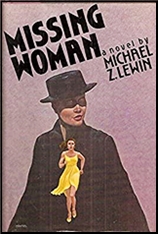
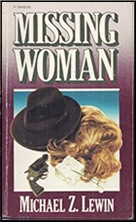
MICHAEL Z. LEWIN – Missing Woman. Albert Samson #6. Alfed A. Knopf, hardcover, 1981. Berkley, paperback, 1982. Perennial Library, paperback, 984.

   There are a number of op-notch candidates for the best private eye series going today. On the top of a good many lists would be Robert B. Parker’s Spenser books, but fans of the more traditional PI yarn would probably go more for the likes of Bill Pronzini’s nameless detective or Arthur Lyons’ Jacob Asch books.

   Sometimes lost and passed over in the shouting is Albert Samson, billed at one time as “the cheapest detective in Indianapolis.” He’s undoubtedly still cheap. At the beginning of this book he is definitely broke, and about to be evicted from his office as patr of a big, downtown redevelopment project.

   Which is not to say he’s not honest, dependable, and next to impossible to pry loose from a case. Even if he sounds a bit sour on his life (not on life, just his), his sense of humor never leaves him. Mostly it’s of a subtle variety, but not always, especially when he’s irritated. His relationship with Lt. Powder of Missing Persons does seem to be improving, however.

   Luckily so, for, as you’ve already gathered from the title, that’s the kind of case that this latest one is. Samson jumps in with no abandon, treating it as the intellectual challenge it is, when suddenly he’s caught up with the abrupt realization that Murder Is Not a Game.

   Detective stories do tend to tread a thin line between reality and fantasy. Michael Lewin’s big achievement here may very well be that he manages to give us the best of both.

Rating: A

–Very slightly revised from The MYSTERY FANcier, Vol. 5, No. 6, Nov/Dec 1981.

SUSPENSE ‘The Crooked Frame.” CBS, 30m. 29 July 1952. (Season 4, Episode 45). Richard Kiley, Neva Patterson, Dean Harens, Lois Wheeler. Screenplay: Mel Goldberg, loosely based on the novel by William P. McGivern. Director: Robert Mulligan.

   The relationship between the book and the TV adaptation is minimal, but you can hardly expect more when the screenplay has to be crammed into a 30 minutes time slot, less commercials. Here’s the resemblance. The book takes place in the editorial offices of a magazine; the tv show takes place in that of a small comic books company. I grant you that. Better visuals.

   It’s been a while since I’ve read the book, so I’ll concentrate on the TV show, but my sense is that the last line of the previous paragraph is as close as it gets. When the episode begins, the office is in an uproar. The creator of the comic strip “Sally Forth” has derided to quit, and if she follows through, the company has nothing as big (or profitable) to fall back on, and chances are they will have to close up shop for good.

   One of the writers (Richard Kiley) goes to see her that night, they quarrel, he blacks out, and of in the morning her body is found dead. Luckily the lady was not so very nice, and there are other suspects. The 30 minutes go by very quickly, the acting and directly are perfectly fine, but the show is clearly a small scale production, and at this late date, little more than a curio from the past. William P. McGivern was a very good writer, in a strong noirish vein. I hope he got paid well for the use of his story, but somehow I don’t think it was all that much, even at the time.

PostScript: Fifteen or so years later, comic book artist Wally Wood also came up with a “Sally Forth” comic strip. I don’t think there’s any connection, but you never know.

PHILIP K. DICK’S ELECTRIC DREAMS “Real Life,” Channel 4, UK, 25 October 2017 (Episode 5). Amazon Prime, US, 2018 (currently streaming as episode 1). Anna Paquin, Terrence Howard, Rachelle Lefevre, Lara Pulver. Teleplay by Ronald D. Moore, loosely based on .the story “Exhibit Piece” by Philip K. Dick (If, August 1954). Director: Jeffrey Reiner.

   I have not researched this at all, but it’s quite possible (a hypothesis, then) that more of Philip K/ Dick’s work have been filmed for either movies or TV than any other SF writer. (Think Blade Runner as the most well known.) Not bad for a writer who pretty much only had a small cult following when he died in 1982, just as Blade Runner was about to be released.

   Electric Dreams was a 10-part anthology of Dick’s short stories as adapted for TV. One of his favorite themes in his early fiction was the question of what is real around us, and what is not. “Real Life” takes that idea and runs with it with considerable success, I think. A lesbian cop in the future with a flying car is wracked with guilt after being the survivor of the massacre of several of her colleagues. She’s advised to take a virtual reality “vacation” from her life…

   … and ends up in the body of a black billionaire who’s not only the head of huge tech company but also a vigilante by night, being dead set on revenging the death of his wife at the hands of …

   … the same master criminal he/she’s after back in the future. Not only in the quest for revenge the same in the two worlds, but so are many of the people and locations in each. The overridng question is, which of the two worlds in the real one?

   This is one of those stories, as televised, that starts off as confusing to the viewer as it is to the primary character in it, perhaps even more so, but when eventually the viewer begins to straighten him or herself out, the problem of which world is which still remains, to both the character and the viewer. I won’t tell you, of course, and that’s even assuming that I know even now, which I don’t. I really enjoyed this one.


FIRST YOU READ, THEN YOU WRITE
by Francis M. Nevins
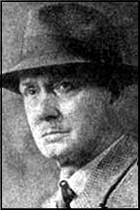
   

   Does anyone still read Christopher Bush, or even remember him?

   Dean Street Press, a small English publishing house, is determined to make sure that both questions are answered Yes by setting out to reprint every single one of Bush’s detective novels, each with a superb general introduction by Curtis Evans based on information from Bush’s grandniece. The introduction is comprehensive enough that I need do no more than hit a few high spots here.

   Most print sources give the year of Bush’s birth as 1888, but according to Evans, he was born to farm-laborer parents in Norfolk, East Anglia, on Christmas Day of 1885 and given the rather odd name of Charlie Christmas Bush. Early in the 20th century he obtained a job as instructor at Wood Green School, a co-ed institution in Oxfordshire. He served in World War I, being stationed for one year in the Middle East, and returned to his schoolmaster position when the war was over, retiring in 1931 to write full-time.
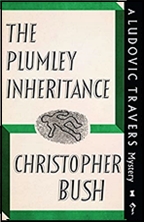
   Between 1926 and 1968 he turned out a total of 63 detective novels, most of them published in the U.S. as well as England, many of them centering around a “perfect alibi” gimmick, all featuring a character named Ludovic Travers. He died at age 87, in September 1973.

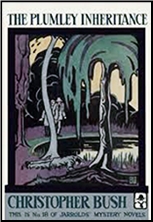
   In THE PLUMLEY INHERITANCE, published in 1926 but set in 1919, Travers is a relatively minor character, an invalided war veteran serving as private secretary to wealthy financial wizard Henry Plumley, who kills himself after making a cryptic speech. The hero of this debut novel is Geoffrey Wrentham, a Bulldog Drummond type who enlists Travers in the search for Plumley’s missing money.

   In Bush’s second novel, THE PERFECT MURDER CASE (1929), Travers has come up in the world. “After an exceptionally brilliant career at Cambridge he had written that perfectly amazing Economics of a Spendthrift, a work not only stupendous in its erudition but from the charm of its style a delight in itself. Then had come World Markets, now a textbook in the schools, and finally with The Stockbroker’s Breviary a return to the whimsical style of his best known work.”

   Thanks to inherited money and huge royalties he doesn’t need to work, but he’s taken a position as head of the financial department of Durangos Limited, a firm of “expert consulting and publicity agents for the world in general….” Funnily enough, Durango House also boasts a Detective Department, headed by John Franklin, who in Bush’s next several novels is something of a co-protagonist with Travers as they team with Scotland Yard Superintendent George Wharton to solve various bizarre murders. By 1934 Durangos has vanished and Travers has morphed into a wealthy dilettante and amateur sleuth.

   I first discovered Bush sometime in the latter half of the 1950s. I was in my late teens at the time and spent most of my leisure hours haunting the shelves in the mystery section of the public library in Roselle, New Jersey. The only Bush novels the library had were the relatively recent ones, dating from the late Forties and the Fifties, all narrated by Travers who has launched his own private detective agency after World War II, all dull as dishwater. After four or five tries I gave up on both author and character. At that time I had no idea that the earliest Bush novels dated back to the late 1920s and, until the outbreak of war, had been without a first-person narrator.
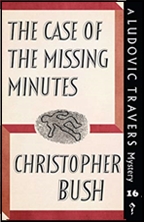
   A few years later, thanks to various secondhand bookstores, I discovered some of those novels and began buying and reading them—and found them much more satisfying than the pedestrian products of the postwar years. One of them, THE CASE OF THE MISSING MINUTES (1937; US title EIGHT O’CLOCK ALIBI), struck me decades ago and still strikes me now as one of the finest detective novels of England’s Golden Age. But I’ve read many more from that period than I’ve discussed in this column, and recently I decided to re-read a few of them and see how they stood up today.

***

   Beginning in 1932, the titles of all the Bush novels began with THE CASE OF, but his American publishers, perhaps fearing confusion with the Perry Mason novels which had been launched in 1933, changed most of the titles, so that THE CASE OF THE THREE STRANGE FACES (1933) became THE CRANK IN THE CORNER and THE CASE OF THE 100% ALIBIS (1934) crossed the pond as THE KITCHEN CAKE MURDER. For some unknown reason the English titles remained intact on a few, including THE CASE OF THE CHINESE GONG (1935) and THE CASE OF THE TUDOR QUEEN (1938). I’ve reviewed both of those in an earlier column so let’s move on to another pair.
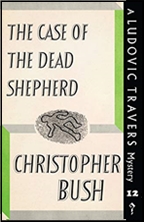
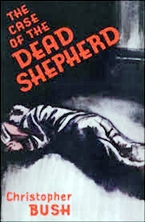
   In THE CASE OF THE DEAD SHEPHERD (1934; US title THE TEA TRAY MURDERS) Travers happens to be visiting Wharton in his Scotland Yard office when the walrus-mustached Superintendent invites the bespectacled amateur of crime to come along and help him investigate a murder at Woodgate Hill County School, an educational institution for boys and girls between the ages of 12 and 18, located in one of London’s outer burbs.

   History master Charles Tennant has been found dead in the Masters’ Common Room, apparently of oxalic acid poisoning, his hand clutching a huge 1910-era catalogue of chemical apparatus. (No, this is not an Ellery Queen-style dying message, and its meaning is impossible to figure out until Bush gets good and ready to tell us.) The headmaster, Mr. Twirt, is strangely absent from the school even though he had arranged a meeting with several people including a constable at four o’clock.

   His absence is soon accounted for when he’s found murdered too, in the shrubbery outside the school, apparently by a heavy sledgehammer lying nearby. “[A] miserable specimen of a man” Travers calls him, based on nothing but the look of his dead body. It quickly becomes apparent that Travers’ opinion of Twirt is shared by virtually everyone at the school:
   â€œHe was humbug personified,” says his colleague Maitland Castle. “I generally alluded to him as the bastard.” Later Castle calls his former boss “a loose talker, a liar, and generally unscrupulous” and “an egomaniac….[W]hen people ventured to protest he’d say he had a disloyal staff, and threaten them with the sack.” (Sound like anyone we see every day in the news?) He was “the most loathsome little swine I’ve ever met….[I]n his love for himself, he was the most devoted of men….It was consoling to think of Twirt as dead, it didn’t matter a damn how.” As for the women instructors, “[h]e used to bully them unmercifully.”

   All the other present and former school personnel that Travers and Wharton interview pay similar compliments to their erstwhile boss. Mr. Godman: “When Twirt got his knife into anybody, he was absolutely unscrupulous in making that person’s life hell….He was the filthiest little squirt I ever ran across.” Miss Holl: “He was the dirtiest little rat.” Mr. Furrow: “The man was a public danger….He’d driven more than one of us to the edge of a breakdown.” Mr. Lustiford: “If ever there was a poisonous swine, it was he.”

   It’s a wonder that no one refers to him as a toad, but then the English have always had a soft spot in their hearts for the inoffensive and sweetly singing little critter known to biologists as Bufo bufo. The crimes are solved not by rational deduction but rather by a series of inspired hunches, culminating in Travers’ attending an outdoor performance of A MIDSUMMER NIGHT’S DREAM where a few Shakespearean lines turn on the light bulb in his head, so to speak, and enable him to reach the ultimate solution.

   Twirt’s murderer is rather easily guessable, and one or two maps of the grounds around the school would have been helpful supplements to the two diagrams of the building’s innards that Bush provides. But DEAD SHEPHERD is one of the better Bushes I’ve read, and one of the most personal. His portrait of the County School and its denizens—or should I say inmates?—leaves no room for doubt as to how he would have described his schoolmaster years. In a word, hellish.

***

         Remember remember the fifth of November
         For gunpowder treason and plot.
         We see no reason why gunpowder treason
         Should ever be forgot.
   This is one version of the first lines of a poem dating back to around 1870. The Gunpowder Plot was a conspiracy in 1605 among a number of Catholic terrorists, the best known of whom was Guy Fawkes, to blow up the Houses of Parliament during an address to that body by the Protestant King James I. The plot failed and Fawkes was sentenced to be hanged, drawn and quartered (although he escaped that grisly fate by falling off the scaffold and breaking his neck), and the Brits have memorialized the plot every November 5 by lighting bonfires all over the countryside.

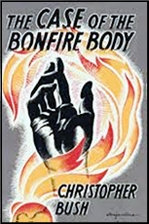
   If you aren’t familiar with that event in English history you’ll be lost in Bush’s THE CASE OF THE BONFIRE BODY (1936; US title THE BODY IN THE BONFIRE), which begins with what turn out to be multiple coincidences and climaxes with more of the same.

   On a foggy November 4 afternoon, Travers is driving back to London after attending an auction. As he’s passing the outer suburb of Garrod’s Heath he sees a man running wildly beside the road and pulls over. Rev. Giles Ropeling, who’s also the local scoutmaster, has a gruesome story to tell. He and two scouts were rebuilding the amateurish bonfire they had prepared for Guy Fawkes Day when they discovered inside the bonfire structure a man’s body, naked and with its head and hands cut off.
   Travers hangs around until the local police arrive, then continues on to London. Later, in Wharton’s office at Scotland Yard, he shows the Superintendent what he picked up at the auction, a rare silver coin known as the Limerick Crown which is worth about £60, a small fortune back in the Thirties. On the way home he sees a beggar selling matchbooks outside the old Piccadilly underground station and gives him what he thinks is a half-crown but just might be the rare coin he’d bought earlier that day, which he can’t find when he gets home.

   Soon after he’s back in his flat he gets a phone call from Wharton, inviting him to come along and help investigate the stabbing murder of a doctor. Would you believe that all three of these incidents turn out to be interconnected?

   At the denouement Travers exposes another round-robin of coincidence: the murderer “knew the old story that if a man stands all his life in Piccadilly Circus, sooner or later the man he’s looking for will pass by under his nose.” In this case the murderer was looking for two men. Would you believe they both passed by under his nose, and that he recognized both of them even though he hadn’t seen either man for roughly ten years?

   Much of the novel is taken up by dueling speculations on the part of Travers and Wharton—speculations which have nothing in common except a lack of factual basis. But the final chapters feature more physical action than one usually finds in Golden Age detective novels, and despite the orgy of coincidences I found it an absorbing read, full of alibi gimmicks devised by Bush with fiendish delight.

***

   Thanks to Curtis Evans and Dean Street Press, anyone interested in English detective novels of the Golden Age can learn a great deal about Bush’s life and read all 63 of his novels. Personally, I’ve read enough for a while. No one — well, almost no one — would call Bush one of the greatest names of that noble era but he does deserve to be remembered, and at least a few of his books to be read.
REVIEWED BY DAVID VINEYARD:


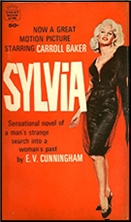
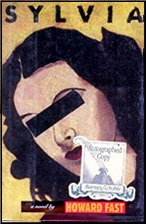
E. V. CUNNINGHAM – Sylvia. Alan Macklin #1. Doubleday, hardcover, 1960. Crest d789, paperback, 1965. Also published as by Howard Fast: Carol Publishing, hardcover, 1992.

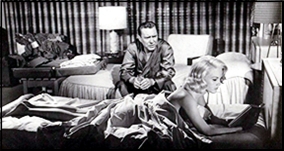
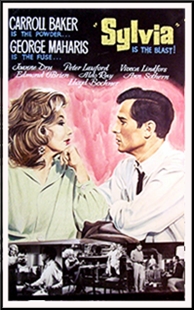
SYLVIA. Paramount Pictures, 1965. Carroll Baker, George Maharis, Joanne Dru, Viveca Lindfors, Peter Lawford, Edmond O’Brien, Aldo Ray, Ann Sothern, Lloyd Bochner, Jay Novello, Nancy Kovak. Screenplay by Sydney Boehm, Howard Fast (E. V. Cunningham), based on the latter’s novel.  Directed by Gordon Douglas.

   Most people go on doing whatever they were doing before, if they were doing it yesterday, they’re doing it today, and the odds are they’ll be doing it tomorrow as well. It applies to myself. I make a poor living in rut and routine, and my work is miserable and routine. When I have a buck I can push aside the really filthy jobs and accept the moderately filthy jobs, and then perhaps I feel a cheap sense of virtue, as empty and meaningless as everything else I feel.

   That’s the voice of private eye Alan Macklin (if it sounds familiar both Lew Archer and Philip Marlowe say close to the same thing), who specializes in digging into people’s past, whether they want to be uncovered or not. His love is ancient history, and it makes him good at digging into the history of the people he is hired to investigate. Luckily this looks like one of the nicer cases he might be called to exercise his skills on, one of those “moderately filthy jobs”.

   His client is one Frederick Summers, a cool piece of work, wealthy, patrician, attractive, and cultured and anxious to investigate his fiancé Sylvia West— No object on earth is so rigged with weary sound than the face of a beautiful woman, and with Sylvia it was the quality of the face not the measurement of it. She did not look like anyone else, she looked like herself.

   There isn’t much to go on, either. Reasonably a man engaged to a woman might expect her to have a history, family, even distant family, but Sylvia appeared out of nowhere a year earlier, became engaged to Summers, the story she told him about who she was is a lie, and Summers wants to know the real story. He’s the scion of big money, oil money, and he wants no surprises popping up after he marries.

   She writes poetry, indifferently, she speaks Chinese, but with a child’s vocabulary, she can mimic a faint British accent, she is well read, she has a passion for roses, and she has a peculiar way of phrasing things almost as if English wasn’t her first language.

   Summers simply wants to know who she is, and he wants Macklin to do the job without ever meeting her. He doesn’t want her suspicious he is looking into her past. If she knew it would be the end of their engagement.

   If it sounds like a variation on Laura it is. Macklin is going to delve into Sylvia’s past and the more he learns, the deeper the mystery and the closer he comes to being obsessed with and then in love with the woman and the mystery.

   E. V. Cunningham was novelist Howard Fast who was a bestselling mainstream writer of books like April Morning, and wrote science fiction (under his own name) and a number of mysteries under various names, including Mirage which became a suspense film with Gregory Peck and Walter Matthau. His later books as Cunningham featured a Japanese-American policeman, but he also wrote a series of suspense novels all named after women, Sally, Penelope, Sylvia… several of which were filmed (all three of those named), and were often book club and Reader’s Digest choices.

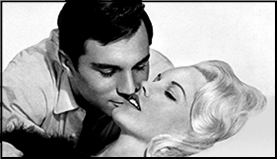
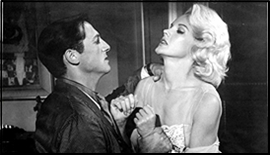
   Sylvia was filmed with Carroll Baker in the title role, George Maharis as Macklin, and Peter Lawford as Summers. It looks pretty much like a television production, and features a cast of stars who often appeared on television as the suspects Macklin encounters while digging into Sylvia’s past. It’s not bad, but Maharis never quite registers as tough, world weary, and cynical as Macklin in the book, and Baker, a fine actress normally, is far too earthy and real for the mysterious Sylvia, who to be fair, turns out to be closer to Baker at books end as Macklin falls for the real Sylvia as opposed to the shadow Summer’s wants to possess.

   Despite how it might sound, I like the movie. It at least tries to be something more, thanks to the script by Boehm and Fast. It’s just that the structure of the movie is too much of a gimmick to sustain the promise of the novel. It becomes one of those which star will pop up next projects that too many films devolved into in that period.

   And Macklin does finally solve both the mystery of Sylvia, and because Fast, under any name, is too good not to, it is Alan Macklin who proves to be more interested in being a decent human than a detective, and pretty much stamps all over all the Archers, Marlowes, and others who put loyalty to a client above the law and all else.

   Sylvia is almost an anti-private eye novel. The ending throws the whole genre for a loop.

   It’s that ending that makes this something more than just another hard boiled private eye novel, and a good one at that. Sylvia is ultimately a novel about a private eye and not a private eye novel.

   â€œâ€¦ touching life where it hurts most and bleeds most, because as rotten and sadistic and superstitious as our race (human) is, we are also the only thing the world can promise, and not a bad promise at that.”


A 1001 MIDNIGHTS Review
by Edward D. Hoch


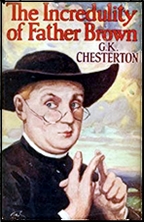
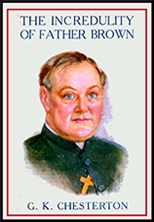
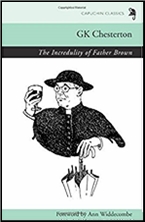
G. K. CHESTERTON – The Incredulity of Father Brown. Dodd Mead, US, hardcover, 1926. First published in the UK by Cassell, hardcover, 1926,. Many reprint editions exist.

   As several critics have observed, the Father Brown stories are small gems to be relished sparingly. If too many are read at one time, the effect is lessened and one might even begin to pick holes in their logic. But as detective stories, they are still masterpieces, and the most lasting of all the writing Chesterton produced in his prolific career. Their influence upon later mystery writers — especially John Dickson Carr – was enormous, and Carr’s major detective character, Dr. Gideon Fell, was patterned after Chesterton himself.

   The Incredulity of Father Brown is not the best of the five Brown collections, but it is unique in that seven of its eight stories contain locked rooms or impossible crimes as a part of their plot. One of these, “The Oracle of the Dog,” is perhaps the best of all Father Brown stories, and one of the best detective short stories ever written. The stabbing death of Colonel Druce while alone in .a summerhouse whose only entrance is under constant observation, together with a dog that seems to howl at the moment of the colonel’s death, sets up a classic situation in which the impossibility of the crime is linked to a seemingly supernatural event. It was a situation to be explored often by Carr and other writers that followed, but their solutions have rarely been us ingenious as the one Chesterton offers here.

   The other six impossible-crime stories in the book are “The Arrow of Heaven,” in which an American millionaire is killed by an arrow inside a guarded room; “The Miracle of Moon Crescent,” featuring the disappearance of a man from a guarded apartment; “The Curse of the Golden Cross,” about a curse on defilers of an ancient tomb; “The Dagger with Wings,” in which a strange cloaked figure is found dead in unmarked snow; “The Doom of the Darnaways,” involving a locked-room poisoning: and “The Ghost of Gideon Wise,” wherein Father Brown is confronted with a ghostly appearance. In all, the atmosphere of the inexplicable is brilliantly realized.

   ———
Reprinted with permission from 1001 Midnights, edited by Bill Pronzini & Marcia Muller and published by The Battered Silicon Dispatch Box, 2007.   Copyright © 1986, 2007 by the Pronzini-Muller Family Trust.

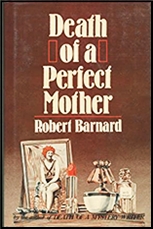
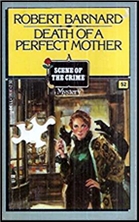
ROBERT BARNARD – Death of a Perfect Mother. Scribner’s, US, hardcover, 1981. Dell/Scene of the Crime #52, paperback, 1982. Published preciously in the UK as Mother’s Boys (Collins, hardcover, 1981).

   To tell the truth, as a second thought about the title might tell you, Lill Hodsden is something less than perfect as a mother, and as a wife. She is the loud, vulgar type, the victim of an over-indulgent self-love, and a haggard creature of sexual cravings and wiles – or so she’s pictured. It is no wonder her two sons are planning to kill her.

   Nor are they the only ones. Upon Lill’s untimely passing, the fatal victim of a “mugging” attack before her boys can do more than plan, the spotlight falls on the motives of at least a dozen others as well.

   A detective story of sorts does evolve as a result, but it’s a detective story steeped in large amounts of delightfully unmitigated cynicism. And contempt. as well, especially for middle-class conventions, as exemplified best by the fairly incompetent inspector who’s been placed in charge of the case.

   I don’t really know what the minimum daily requirement for well-regarded misanthropism in everyone’s diet may be, but there must be one, and in this book Barnard seems to be at odds enough with the world for all of us. Most certainly, for all its inherent honesty, this is not quite the book to be read and appreciated on Mother’s Day.

   Rating: B

–Slightly revised from The MYSTERY FANcier, Vol. 5, No. 6, Nov/Dec 1981.

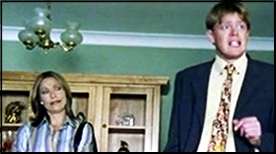
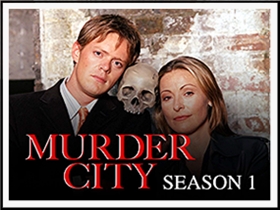
MURDER CITY “The Critical Path.” ITV/Granada Television, 18 March 2004 (Season 1, Episode 1). Amanda Donohoe (DI Susan Alembic), Kris Marshall (DS Luke Stone), and a large ensemble cast. Guest Cast: Mac McDonald, Stephen Martin Walters. Writer: Robert Murphy. Director: Sam Miller.

   The large ensemble cast consists of a group of actors playing various members of a homicide squad in a single station based somewhere in London. I have read that many of these players take turns having leading roles as the series went on (it lasted for two seasons and a total of ten episodes), but for the most part it the the mismatched couple of Detective Inspectors Susan Alembic and Luke Stone who were most commonly paired off, as it is in “The Critical Path,” the pilot episode.

   Susan is in charge of one case, that of a missing teen-aged girl, with the assistance of a self-described psychic magnificently cast heavy set Mac McDonald, who steals the show with his innocent but craggy expressive face. That he seems to have knowledge of the case he could not really have disgusts Luke Stone no end – he being a detective who builds his cases on facts, not ESP or worse.

   Which comes into play on his own case, very much a counterpoint to Susan Alembic’s. A man is shot and killed by an arrow in an all but deserted office building in which the surveillance cameras are all working but show absolutely no sign of anyone entering or moving throughout the building. Stone has a suspect, a egotistical man who simply dares Stone to find out how he did it.

   I do not know if the contrasts in techniques and procedures will continue through the rest of the series, but I’ll be watching to find out. I enjoyed this one. It helps considerably when all of the actors are as top notch as they are in this very first episode.


A 1001 MIDNIGHTS Review
by Francis M. Nevins

   
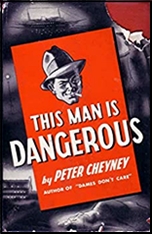
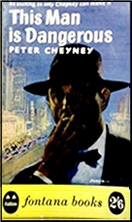
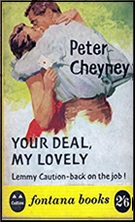
PETER CHEYNEY – This Man Is Dangerous. Lemmy Caution #1. Collins, UK, hardcover, 1936. Coward McCann, US, hardcover, 1938. Reprinted many times. Film: Sonofilm, France, 1954, as Cet Homme Est Dangeureux.

   Peter Cheyney (1896-1951) never visited the United States in his life and knew next to nothing about Americans, but in the late 1930s he became an instant success in his native England and in Europe, especially France, a writer or fake-American hard-boiled novels. In This Man Is Dangerous and ten subsequent titles, he chronicled the adventures of rootin’-tootin’-two-gun-shootin’ Lemmy Caution, an indestructible FBI agent who downs liquor by the quart, laughs at bullets flying his way, romances every dame in sight, and blasts away at greasy ethnic-named racketeers and (in thelater novels) Nazi spies.

   Americans, of course, saw these ridiculous exercises for what they were, and only the first few were ever published here.

   Certainly no one would read Lemmy Cautions for their plots, which are uniform from book to book — all 1hc nasties double-crossing each other over the McGuffin — nor for their characterizations, which are pure comic strip. But mystery fans with a taste for lunacy may be attracted by Cheyney’s self-created idiom. Lemmy narrates his cases in first person and present tense, a wild-and-crazy stylistic smorgasbord concocted from Grade Z western films, the stories of Ring Lardner and Damon Runyon, eyeball-poppers apparently of Cheyney’s own inventor (like “He blew the bczuzu” for “He spilled the beans”), and a steady stream of British spellings and locutions.

   Nothing but quotation can convey the Cheyney flavor. From This Man ls Dangerous:

   I says good night, and I nods lo the boys. I take my hat from the hall and walk down the stairs to the street. I’m .feeling pretty good because I reckon that muscling in on this racket of Siegella’s is going to be a good thing for me, and maybe if I use my brains and keep my eyes skinned, I can still find some means of double-crossing this wop.

   From Don’t Get Me Wrong (1939):

   Me — l am prejudiced. I would rather stick around with a bad-tempered tiger than get on the wrong bias of one of these knife-thrown’ palookas. I would rather four-flush a team of wild alligators outa their lunch pail than try an’ tell a Mexican momma that I was tired of her geography an’ did not wish to play any more.

   From Your Deal, My Lovely (1941):

   Some mug by the name. of Confucius – who was a guy who was supposed to know his vegetables – once issued an edict that any time he saw a sap sittin’ around bein’ impervious to the weather an’ anything else that was goin’, an’ lookin’ like he had been hit in the kisser with a flat-iron, the said sap was suffering from woman trouble.

   Lemmy Caution became. so popular on the Continent that Eddie Constantine, an American. actor, portrayed him in a series of French films. These films were so successful that Jean Luc Godard used Constantine as Caution in his New Wave film Alphaville.

   Eventually Cheyney launched a second wave of novels, written in a spare ersatz-Hammett style and featuring Slim Callaghan, London’s toughest PI. But for those who love pure absurdity, and appreciate the wild stylistic flights of Robert Leslie Bellem and Henry Kane and Richard S. Prather, a treat of compatible dimensions is in store when they tackle the adventures of Lemmy Caution.

———
Reprinted with permission from 1001 Midnights, edited by Bill Pronzini & Marcia Muller and published by The Battered Silicon Dispatch Box, 2007.   Copyright © 1986, 2007 by the Pronzini-Muller Family Trust.


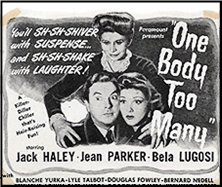
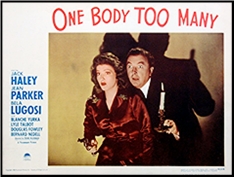
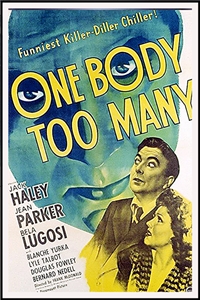
ONE BODY TOO MANY. Paramount Pictures, 1944. Jack Haley, Jean Parker, Bela Lugosi, Blanche Yurka, Lyle Talbot, Douglas Fowley. Director: Frank McDonald.

   There’s no way of getting around it. One Body Too Many owes more than a lot to The Cat and the Canary, the movie with Bob Hope and Paulette Goddard that came along five years earlier. Not that that’s a bad thing, but any movie reviewer worth his salt has to point out things like this.

   In this one leading actor Jack Haley plays an insurance salesman who finally has an appointment with a wealthy recluse to sell him a $200,00 life insurance policy. Little does he know that by the time he gets there, the man is dead and his relatives, almost all of whom he had despised in his lifetime, have gathered around to hear the reading of his will.

   All they get, however, is a preliminary statement from the lawyer, which in essence says that if he is buried above ground, the estate is divided one way, but if he is buried under ground, the bequests will be distributed in the reverse order. (Don’t ask.) More, all the relatives are required to stay in the house together until such time as the burial occurs.

   When he arrives, Haley is mistaken for the PI the attorney has hired the watch the body, the PI having been met and disposed of just as he arrived. This causes a lot of happy confusion, as you might expect, before that particular matter is all straightened out. In the meantime, Haley and Jean Parker, the dead man’s favorite niece, have become attracted to each other, and he decides to stick around to give her what assistance he can.

   There are lots of hidden passages, sliding panels, trap doors, and eyes that watch rooms through the eyes of paintings on the wall, not to mention a sudden thunderstorm and lights that go on and off. The body itself seems to come and go at will, and the butler, superbly played by Bela Lugosi, acts even more suspicious than the other relatives, a greedy lot all.

   Jack Haley, I think, was underrated as a comedian, probably because he never goes as over the top as a Bob Hope, say, or heaven forbid, at least as far as this film is concerned, a Red Skelton. Haley is far more subtle here than either of those gentlemen, and he’s a huge factor in making the movie as much of a success as it is, if this is the kind of movie you like as much as I do. That said, at 75 minutes, it runs maybe 15 minutes too long. If it had been up to me, although I was only two at the time, I’d have trimmed the scene in which the coffin, with Haley inside, was tossed in the pool. Your opinion may vary.


« Previous PageNext Page »