Reviews


REVIEWED BY DAVID VINEYARD:


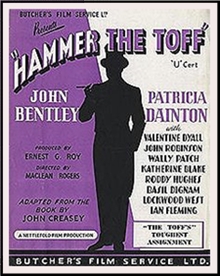
HAMMER THE TOFF.  Butcher’s Film Service, UK, 1952.  John Bentley, Patricia Dainton, Valentine Dyall, John Robinson, Roddy Hughes, Wally Patch. Screenplay John Creasey, based on his novel.  Directed by Maclean Rogers.
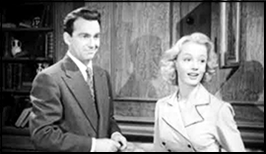
   An elegant top-hatted figure in white tie and tails, sporting a long cigarette holder, walks out of a West End club and is silhouetted against a wall, introducing us to the titles, and to the Honorable Richard Rollinson, aka the Toff.

   This once “lost” film is currently available on Amazon Prime.

   In this case the Toff is played by popular British leading man John Bentley (Calling Paul Temple) whose career in the late forties, fifties, and sixties spanned British film and television, often as not in crime films.

   It’s just about perfect casting too, with Bentley managing to be suave, tough, smart, romantic, and all with an appropriately light touch in this extremely faithful adaptation of the John Creasey novel that manages to pack just about everything and everyone in from the popular book series (alas, no Aunt Gloria).
   For anyone who came in late, the Toff, Richard Rollinson, is a well-born amateur crime fighter well connected at Scotland Yard with his friend Inspector Grice (Valentine Dyall) and in London’s criminal East End with pub owner and ex-prize fighter Bill (here Bert) Ebbuts (Wally Patch). Aided by his valet and invaluable man Jolly (Roddy Hughes) Rollinson, known as Rolly to his friends, cruises on the sunny side of the law but only just, leaving behind his calling card, a caricature of a man in top hat, monocle, and smoking a cigarette in a long holder.

   Hammer the Toff was Bentley’s second outing as the Toff, Salute the Toff coming earlier (1951), and turns out to be a fast-paced and well done B level thriller from the reliable Maclean Rogers.

   As in the Creasey novel, we are plunged right in when Rolly, on holiday, enters a compartment on a speeding train occupied by beautiful Susan Lancaster (Patricia Dainton) just moments before two men on a waiting hill side fire into the compartment as the train passes.

   Without much ado we discover Susan Lancaster’s uncle (Ian Fleming, who was the intended victim on the train) has a formula wanted by a criminal who calls himself the Hammer. In typical style the Toff foils two Spaniards who try to rifle Susan’s hotel room, and throws himself full into the investigation, but the next day when her uncle is murdered in front of him and Susan in a crowd all seems lost.
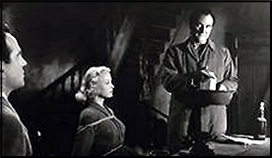
   From his friend Grice, Rolly learns that the Hammer was a Robin Hood type well loved in the East End who suddenly a few months earlier committed a murder and has since turned deadly. He wants the formula, which Susan has no idea where it may be, and will stop at nothing to get it.

   Rolly, being Rolly, takes Susan into his and Jolly’s protection after thwarting an attempt to kill Susan with a poisoned syringe in a brief case, and at Grice’s request heads for the East End to try and use his connections there to get a hand on the Hammer.

   What he finds surprises him, because the East Enders insist the Hammer is innocent, a Robin Hood above suspicion (a nod surely to fellow Thriller alumni Leslie Charteris and the Saint in his early outlaw days), and when Rolly arranges to meet with him he is impressed with the man named Linnett (John Robinson) who swears he is being impersonated, but determined to uncover the fake Hammer and mete out his own justice.
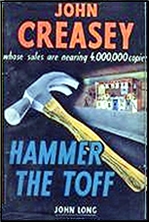
   Unfortunately before Rolly can finish feeling Linnett out the police arrive and Rolly finds himself unjustly hated by his East End friends for having betrayed the Hammer.

   From then on the film races to the finish, with mysterious messages hidden in plain sight, evil minions, angry former allies in the East End, the fake (or is he?) Hammer, and an uncomfortable truce between the Toff and the (real?) Hammer.

   Hammer the Toff is a fast moving B, well written (credit to Creasey for getting so much of the book into a 71 minute format without being crowded), attractively played, well directed by an old pro, and obviously with some expense in terms of sets and location photography. Among other small favors they get the Toff’s flat almost exactly as I imagined it in the books, right down to the entrance and his collection of trophies, a nice touch for any film based on a popular series of books.

   If you like the Toff, Creasey, and British B thrillers in general, this is an attractive and well done entry in a series that sadly didn’t go anywhere.
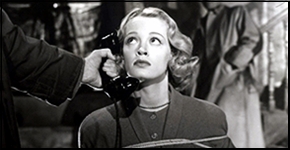
   Truth is, the Toff just didn’t fare very well outside of The Thriller and books. In addition to the two films the Toff appeared in several black and white comic digests in the Super Detective Library, and two BBC radio serials (“The Toff and the Runaway Bride” and “The Toff on the Farm”). It wasn’t until the mid-1960s and the Pyramid paperback reprints here that he even had an American imprint, though the Baron had appeared early on.

   The television version of this book was just an episode of Patricia Dainton Presents from 1958 edited from this film.

   But for long time fans like me, this is a delightful chance to see Creasey’s creation in action, with John Bentley just about perfect as the Toff we know and love. He’s the face I will associate with the character from now on, and that is a compliment.
   

A 1001 MIDNIGHTS Review
by Marcia Muller


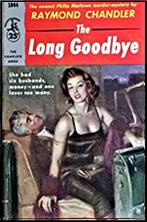
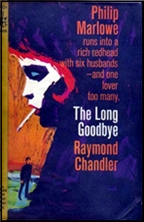
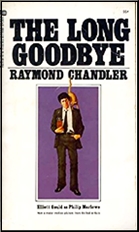
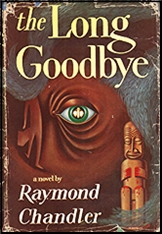
RAYMOND CHANDLER – The Long Goodbye. Philip Marlowe #6. Houghton Mifflin, hardcover, 1954. Pocket #1044, paperback, 1955. Reprinted many time, both in paperback and hardcover. TV adaptation: “The Long Goodbye” on Climax, 07 Oct 1954. with Dick Powell as Philip Marlowe. Film: United Artists, 1973, with Elliott Gould as Philip Marlowe.

   The title of this novel is apt. It is a long book and a complex one, and its detractors say they wish Chandler had said goodbye two-thirds of the way through. What these critics fail to understand is that the novel is one of the most realistic looks into the day-to-day life of a private investigator, and the central plot element, that of Philip Marlowe’s friendship for the mostly undeserving Terry Lennox, is a compelling unifying element. In it we also see a different side of Marlowe than in Chandler’s other novels: the man who is as honorable in his personal relationships as he is in his professional ones.

   The story begins when Marlowe first sees Terry Lennox, dissolute man-about-town: he is “drunk in a Rolls-Royce Silver Wraith outside the terrace of the Dancers,” a ritzy L.A. nightspot, with a redheaded girl beside him whose blue mink “almost made the Rolls Royce look like just another automobile.” The girl leaves Terry, Good Samaritan Marlowe takes over, and a friendship begins.

   It is a friendship that Marlowe himself questions, but it persists nonetheless. Marlowe tells Lennox he has a feeling Terry will end up in worse trouble than Marlowe will be able to extricate him from. and in due course this proves true. The redhead, Terry’s ex-wife, whom he admittedly married for her money, is murdered in the guesthouse at their Encino spread and the trouble that Marlowe sensed begins.

   Lennox runs to Mexico, and it is reported that he made a written confession and shot himself in his hotel room. But something feels wrong: The Lennox case is being hushed up, and Marlowe begins to wonder if his friend really did kill his ex-wife. A letter that arrives with a “portrait of Madison” – a $5000 bill that Terry had once promised Marlowe – convinces him his suspicions are justified.

   He tells himself it is over and done with, but he isn’t able to forget. The matter plagues him while he is working a case involving an alcoholic writer of best sellers in wealthy Idle Valley (where, he says, “I belonged … like a pearl onion on a banana split”). It begins to plague him even more when Sylvia Lennox’s sister, Linda Loring, appears and plants additional suspicions in his mind. The suspicions spur him onward, and finally his current case and the Lennox case come together in a shattering climax.

   At the end Chandler neatly ties off all the strands of this complicated story, and provides more than a few surprises. An excellent novel with a moving ending.

———
   Reprinted with permission from 1001 Midnights, edited by Bill Pronzini & Marcia Muller and published by The Battered Silicon Dispatch Box, 2007.   Copyright © 1986, 2007 by the Pronzini-Muller Family Trust.


REVIEWED BY BARRY GARDNER:


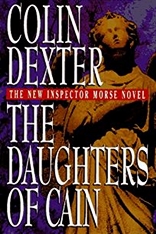
COLIN DEXTER – The Daughters of Cain. Inspector Morse #11. Crown, US, hardcover, 1995. Ivy, US, paperback, 1996. Published earlier in the UK by Macmillan, hardcover, 1994. TV movie: ITV, UK, 27 Nov 1996 (Season 9, Episode 1) with John Thaw as Chief Inspector Morse and Kevin Whately as Detective Sergeant Lewis.

   I have not heretofore been a Morse fan. There, I’ve said it. Everyone else seems to be, though, so I thought I’d try another one, as I haven’t read that many.

   Dr. Felix McClure, late of Woolsy College, Oxford, is dead. Butchered. Morse and Sergeant Lewis think they know who did it, but they can’t find the weapon, and the man’s wife alibis him. And then there’s the couple’s daughter, a runaway and prostitute strangely attractive to both McClure and Morse.

   While the case meanders on, Morse must deal with both his deteriorating health and a potential reduction in rank due to an efficiency study. The former, it seems, is demanding payment for all the years of Scotch, cigarettes, and general neglect.

   There’s no question but that Morse is one of the major figures in modern crime fiction, my own lukewarm attitude notwithstanding. Though the amount contributed to this popularity by television is an open question. In fairness, not only did I like this book better than any others I’ve read if his, but there’s no doubt that his characterization is superb.

   Dexter writes a particular kind of story: leisurely, convoluted, and told much in the way Morse’s mind works – in fits and starts, and darting this way and that. The prose is excellent, and none of the characterizations are less than very, very good. This seemed to me a bit different in tone than the previous ones I’d read, a bit mellower, even more sentimental.

   Bur perhaps I was just in a mood more conducive to enjoyment of it. Whatever. I did enjoy it considerably, and am even tempted to go back and try some of the earlier ones.

— Reprinted from Ah Sweet Mysteries #19, May 1995.

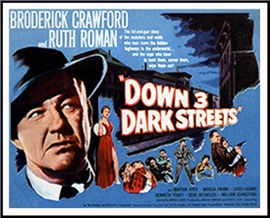
DOWN THREE DARK STREETS. United Artists, 1954. Broderick Crawford, Ruth Roman, Martha Hyer, Marisa Pavan, Max Showalter, Casey Adams, Kenneth Tobey, Jay Adler, Claude Akins. Screenplay by Gordon Gordon & Mildred Gordon (as The Gordons) and Bernard C. Schoenfeld, based on the novel Case File: FBI by The Gordons. Director: Arnold Laven.

   Told in semi-documentary fashion, Down Three Dark Streets tells the story of how FBI Agent John ‘Rip’ Ripley (Broderick Crawford) finishes up the three cases that fellow agent Zach Stewart (Kenneth Tobey) was working on when he was gunned down and killed. He assumes that the killer was involved in one of the three cases, but which one and who.

   The cases: (1) A killer on the loose. A possible contact: his girl friend (Martha Hyer). (2) A car theft gang. Possible contact: the blind wife of one of the members (Marisa Pavan). (3) An extortion threat to a recent widow (Ruth Roman) involving her young child.

   The kidnapping threat is the major one, the one Ripley spends most of his time on. There are several suspects, but if you don’t mind my saying so, while you could easily pick any one of them, the obvious one is the one. Of special note is that the semi-suspenseful finale takes place at the base of the Hollywood sign high up in the LA hills.

   Broderick Crawford is his usual gruff down-to-business self. Ruth Roman was always a fine actress, as she is in this above average crime thriller, but her career never developed as much in my mind as it should have. On the other hand, Martha Hyer’s career went into high gear soon after this, in which she quite effectively plays the gunman’s moll, outwardly tough and brassy, but ultimately fragile and insecure on the inside.


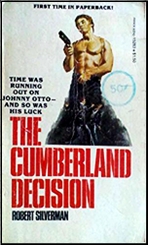
ROBERT SILVERMAN – The Cumberland Decision. Manor, paperback original, 1977.

   You may have noticed that from time to time I take up valuable space by delving into the publishing phenomenon in the field of mysteries that produced the flood of paperback originals from Gold Medal/Fawcett Publications all during the 1950s. I’m firmly convinced that these novels, all easy to find for the most part, and mostly in the hard-boiled genre as linear descendants o the pulp magazines, are unjustly neglected.

   You may tire of me telling you so, but for characters involved in down-to-earth situations and for sheer story-telling ability, the authors in the Gold Medal group are not easily surpassed. (Outstripped?)

   Even in their heyday, however, these novels were all too easily panned by snobbish reviewers, if not totally ignored. There were the indiscriminate pitchforks dispensed by the anonymous reviewer for The Saint Magazine, for example, but there also was Anthony Boucher, in the New York Times, as one reviewer who did not automatically subscribe to the “paperback equals junk” theory.

   It occurs to me that 20 years from now, retrospective reviewers may find that today’s Manor paperbacks are also exceptional examples of neglected writing, and in reality saying a great deal about American society and culture of [the 1970s].

   It’s possible, but I found ex-cop-turned-mystery-writer Johnny Otto crude and semi-literate, a macho chauvinist who seems utterly incapable of writing a coherent sentence, let along a best-selling novel, or having an intelligent lady friend as a girl friend. His method of ending an argument is slipping his hand inside her blouse and leading her to bad. “Yeah, baby.”

   As I say, it’s possible that Johnny Otto describes a definitive figure in American life, but he is most definitely a flop as a detective. The true villain behind the death of his former partner on the police force and the huge shipment of heroin about to be smuggled into San Francisco is obvious at first meeting, and I think I found comical overtones in the climactic rescue and capture that were not wholly intended.

   Redeeming social value? Ask me in 20 years.

Rating: D

–Reprinted from The MYSTERY FANcier, Vol. 2, No. 3, May 1978.


Note: Robert M. Silverman has one other entry in Al Hubin’s Crime Fiction IV, that being The Colombian Connection, also a paperback original from Manor, also in 1977.

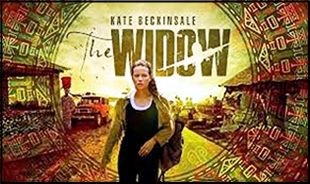
THE WIDOW “Mr. Tequila.” Amazon Prime Video. 01 March 2019 (Season 1, Episode 1). Kate Beckinsale and a large ensemble cast. Created and written by Harry Williams & Jack Williams. Director: Samuel Donovan.

   As the pilot of this one season, eight-episode series, it does its job in one solid way: it sets the course for the season with a strikingly visual presentation consisting of at least three different story lines. What it does not do, and by no means is this a problem, it only tangentially brings any of them together, nor obviously are any of them concluded. This is the only episode I’ve seen.

   Kate Beckinsale plays the title character, a widow who lost her husband, a medical aid worker in the Democratic Republic of the Congo who he died when his plane went down in wide swatch of jungle while on his way home. Watching a televison news report of civil unrest in that country three years later, she’s sure she sees her husband, either fighting or taking cover from the action.

   She immediately hops a plane to the Congo to investigate, where she’s met by one of two men with whom she bonded as a small survivors’ group in the airport after the crash. There appears there is more to be known about the third, known locally as “Mr. Tequila,” which is about as far as this story line goes.

   I plan to keep watching. I always enjoy watching Kate Beckinsale in action, and this is obviously a star vehicle built especially for her. She always lights up the screen whenever she appears. I don’t know exactly how she does, but she does.


A 1001 MIDNIGHTS Review
by Bill Pronzini


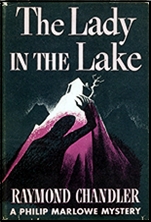
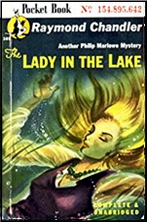
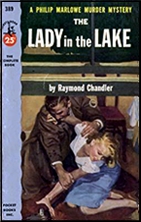
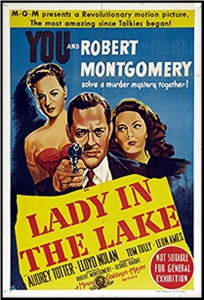
RAYMOND CHANDLER – The Lady in the Lake. Alfred A. Knopf, hardcover, 1943. Pocket #389, paperback; 1st printing, September 1946.  Film: MGM, 1946, as Lady in the Lake (with Robert Montgomery as Philip Marlowe).

   Even though The Lady in the Lake is not Chandler’s best novel. it is this reviewer’s favorite. It too was “cannibalized” from three pulp novelettes: “Bay City Blues·” (Dime Detective, November 1937), “The Lady in the Lake” (Dime Detective, January 1939), “No Crime in the Mountains” (Detective Story, September 1941), but it is not as seamless as The Big Sleep or Farewell, My Lovely, nor as wholly credible. Nevertheless. there is an intangible quality about it, a kind of terrible and perfect inevitability that combines with such tangibles as Chandler’s usual fascinating assortment of characters and some unforgettable moments to make it extra satisfying.

   The novel opens with Marlowe hired by Derace Kjngsley, a foppish perfume company executive, to find his missing wife. Crystal (who he admits he hates and who may or may not have run off with one of his “friends,” Chris Lavery). Marlowe follows a tortuous and deadly trail that leads him from L.A. to the beach community of Bay City, to Little Fawn Lake high in the San Bernardino Mountains, to the towns of Puma Point and San Bernardino, and back to to L.A. and Bay City. And it involves him with a doctor named Almore, a tough cop named Degarmo, a half-crippled mountain caretaker, Bill Chess, whose wife is also missing, Kingsley’s secretary, Miss Adrienne Fromsett and the lady in the lake, among other victims.

   As the dust jacket or the original edition puts it, it is “a most extraordinary case, because … Marlowe understands that what is important is not a clue – not the neatly stacked dishes, not the strange telegram … but rather the character of [Crystal Kingsley]. When he began to find out what she was like, he took his initial steps into a world of evil, and only then did the idea of what she might have done and what might have been done to her take shape. So it was that not one crime but several were revealed, and a whole series of doors that hid cruel things were suddenly opened.

   “Again Chandler proves that he is one of the most brilliant craftsmen in the field, and that his Marlowe is one of the great detectives in fiction.”

   Amen.

   The Lady in the Lake was filmed in 1946. with Robert Montgomery (who also directed) as Marlowe. For its time, it was a radical experiment in film-making, in that it is entirely photographed as if through the eyes of Marlowe — a sort of cinematic version of the first-person narrator, with Montgomery himself never seen except in an occasional mirror reflection. The technique doesn’t quite work – it, not the story, becomes the focus of attention – but the film is an oddity worth seeing.

         ———
   Reprinted with permission from 1001 Midnights, edited by Bill Pronzini & Marcia Muller and published by The Battered Silicon Dispatch Box, 2007.   Copyright © 1986, 2007 by the Pronzini-Muller Family Trust.


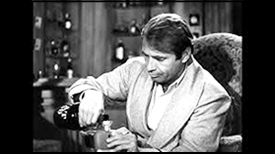
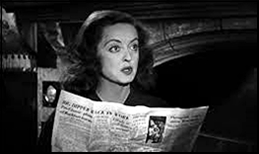
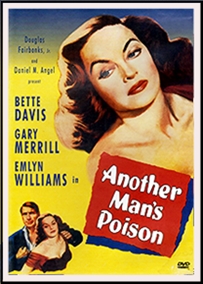
ANOTHER MAN’S POISON. Eros Films, UK, 1951. United Artists, US, 1952. Bette Davis, Gary Merrill, Emlyn Williams, Anthony, Barbara Murray. Screenplay by Val Guest, based on the play “Deadlock” by Leslie Sands. Director: Irving Rapper.

   There is a funny story I’d like to tell you about regarding this movie. Well, it’s funny to me, not laugh-out-loud funny, but just a little bizarre kind of funny. The first time I tried to watch this movie, it was on a videotape I’d made fro TCM, and about ten minutes from the end, either the movie had run long, or the tape had run short. What can be worse than missing the last ten minutes of a rattling good murder mystery movie?

   Then a couple of nights ago, I spotted the movie again on Amazon Prime Video, a freebie, no less. Finally, I thought, here’s my chance to see the ending. And of course I decided to watch it all the way through from the beginning. It had been too long. I’d forgotten most of the story line.

   So I settled in for the evening. Ha! You guessed it. Ten minutes before the ending, the picture froze. I had to shut everything down and work my way back to where I’d left off. Took me fifteen minutes. Twice now.

   Three times is the charm.

   I might not have done this for just any old movie, but to my mind, this one’s a good one, and well worth the trouble. Bette Davis can do little wrong, as far as I’m concerned, and she’s at her bitchy best in this one. .(There’s no other word I can use.)

   I don’t recall if the story begins on a dark rainy night or not – but for sure that comes later. She’s a mystery writer who lives almost alone in an well-isolated manor house with a deep dark tarn in the back and facing an empty stretch of moor on the other. She has two visitors. The first is her estranged husband, then after she disposes of him, another man shows up – her husband’s partner in a bank robbery, looking for shelter.

   When I said disposed of, I meant it. The man is dead. Poisoned. Her second arrival grabs the chance when he can get it. He dumps the body in the tarn, and forces the newly minted widow to let him pose as her husband.

   It’s an audacious plot, and they might have gotten away with it, if not for a live-in secretary, her fiancé (who the lady in charge has Bette Davis eyes) for, and an extremely nosy veterinarian who lives in the estate next door.

   I apologize for running on like this, but this is just the setup. You’ll have to use your imagination for what goes on in the remaining hour or so, but with a setup like this, the possibilities are many, and it all comes off like clockwork. Well worth the long intermission(s) for me.


IT IS PURELY MY OPINION
Reviews by L. J. Roberts


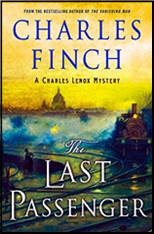
CHARLES FINCH – The Last Passenger. Charles Lenox #13 (prequel #3). Minotaur Books, hardcover, February 2020. Setting: England, 1855.

First Sentence: On or about the first day of October 1855, the City of London, England decided it was time once and for all that Charles Lenox be married.

   In this third, and final, prequel Charles Lenox is still working to establish himself as an enquiry agent. Asked to visit the scene of a gruesome murder, he finds someone has gone to extraordinary lengths to remove anything which might lead to the victim being identified. Although Inspector Dunn blames the murder on gangs, Lenox convinces Sir Richard Mayne, now Commissioner of the Police, to let him assist with the investigation. On a personal front, Charles is having to fend off his female relatives and friends who are determined to find him a suitable wife.

   It’s lovely to have an opening which makes one smile, as this one does. It’s also nice that, even for those of us who follow the series, Finch provides an introduction of Lenox, his situation, appearance, and ambition, as well as other major characters, including Lady Jane and her husband, Lord Deere. Neither does Fitch overlook the secondary characters. The way in which Finch introduces them, including the members of Lenox’s household, is seamless. No long explanations, yet we have a sense of each character’s personality. In fact, some of them are among the most interesting, particularly freed slave Josiah Hollis from Atlanta, and a young newsboy.

   One appreciates Finch’s voice and that it has something of the formality of the period in which the book is set– “Hemstock strolled in without a care in the world. You had to hand him that much: He had insouciance.”

   The plot is nicely divided between the investigation and Lenox’s personal life. The repartee between him and his older brother Edmund is delightful. His courtship of Miss Catherine Ashbrook provides a delightful excuse for quoting Pride and Prejudice and a lesson in the history of the idiom “mind your p’s and q’s.”

   Finch perfects the balance of providing information on the slave trade, including discussion of the treatment of slaves, but keeping it a part of the plot, rather than the focus of it. It is interesting to see our history through British eyes. Yet an encounter which makes one cringe is Lenox taking Hollis to a doctor who proclaimed– “He was not expert in their kind.”

   This is the transitional book for Lenox showing his passing into maturity both in his life and his business. A conversation between Lenox and Hollis is thoughtful, enlightening, and causes one to reflect. Another conversation with Jane illuminates the reason why marriage for love often wasn’t the priority for women of the period. Both are examples of excellent writing.

   The Last Passenger is a wonderful book. There are well-timed, well-done plot twists. The logic behind Lenox’s deductions is clever, yet not overly contrived. Rather than being focused on suspense, although that is there, it is a book that speaks to injustice, maturing, and friendship; true friendship. The end, particularly, stays with one long after closing the book.

Rating: Excellent.
   

      The Charles Lenox series —

1. A Beautiful Blue Death (2007)
2. The September Society (2008)
3. The Fleet Street Murders (2009)
4. A Stranger in Mayfair (2010)
4.5. An East End Murder (2011)
5. A Burial at Sea (2011)
6. A Death in the Small Hours (2012)
7. An Old Betrayal (2013)
8. The Laws of Murder (2014)
9. Home by Nightfall (2015)
10. The Inheritance (2016)
10.5. Gone Before Christmas (2017)
11. The Woman in the Water (2018)
12. The Vanishing Man (2019)
13. The Last Passenger (2020)

REVIEWED BY DAVID VINEYARD:

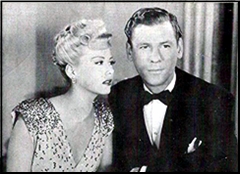
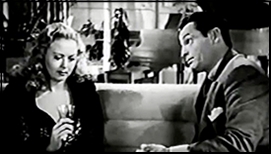
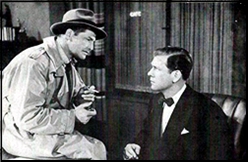
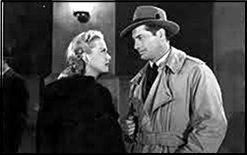
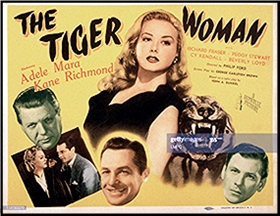
THE TIGER WOMAN. Republic Pictures. 1945.  Adele Mara, Kane Richmond, Cy Kendall, Richard Fraser, Peggy Stewart, Gregory Gaye (billed here as Gay). Screenplay by George Carlton Brown., based on a play by John Dunkel. Directed by Philip Ford.

   Here is a surprisingly solid B movie from Republic that more than makes up for any flaws with attractive leads in a minor noirish if not quite true noir mode (it’s less noir than damn good hard-boiled pulp) about a tough smart private detective, a beautiful femme fatale of the most fatal kind, and two murders going on three she almost gets away with (not counting framing an innocent for her crimes).

   The private detective in the case is Jerry Devery (Kane Richmond) who only wants to leave on his annual fishing trip but who has an appointment with Sharon Winslow (Adele Mara) chanteuse at the Tiger Club, owned by her husband. Seems her husband borrowed some money from gambler/gangster Joe Sapphire (Gregory Gaye in a nice turn as a suave charming but reluctantly lethal crook) and Joe is threatening to get a little rough.

   Devery gets a friendly greeting from Joe though. He’s done Joe a few favors, mostly legal or at least only skirting the law, and Joe is a convivial type willing to help an old friend. In any case laying off Winslow is no trick because Joe assures Devery Winslow paid up only that morning.

   But when Winslow turns up dead, Devery’s little talk with Joe suddenly puts Joe in the hot seat, something Joe isn’t happy about,.  And who is the mysterious young woman hanging about the Tiger Club who was seen arguing with Winslow and what does she know?

   Devery’s friend Inspector Henry Leggett (Cy Kendall) knows Devery will eventually find out who-dunnit, if he survives Joe Sapphire, the mysterious young woman who is fast becoming a suspect (Peggy Stewart), and of course the lady of the title the very lethal Adele Mara.

   To be honest, there is no need for Spoilers here because there is no real mystery. We know Mara killed her husband and is having an affair with his partner Steven Mason (Richard Fraser).  The only question is will Devery put it together in time, because when Sapphire is cleared after taking Devery and the mystery girl (who turns out of be Winslow’s daughter by an earlier marriage) on a ride the chief suspects are Mason and the girl.

   Then when Mara conveniently pushes Mason from an upper office window as he starts to get cold feet about framing the girl,the evidence all seems to point to Phyllis Carrington (Stewart) and the police have no choice but to arrest her.

   Leaving Devery only one chance, to seduce Mara into taking a trip with him, ostensibly his delayed fishing trip, get her on a train, lower her guard, and get her to confess to the two murders when she tries to kill him.

   Yup, it even has murder, attempted anyway, on a train.

   And I appreciated Devery isn’t attracted to or interested in Stewart’s younger woman. He knows she is innocent and intends to protect her, but Mara is much more his type and he knows it. It’s a nice touch since it would have been so easy to have him fall for Stewart and be a bit more sympathetic, but instead he stays in character.

   Granted that isn’t the most original plot ever, or even the smartest one, but I judge a movie by its ability to pull off that sort of thing so that you don’t think about it during the film and let it ruin things, and on that level the movie succeeds. You want to see what happens on the train between Richmond and Mara, and it may shock you that it is worth watching however contrived.

   It even makes sense, because clever and lethal as Mara’s character is, she is also impulsive, driven by her passion, and like every great femme fatale overly confident of her ability to get what she wants with her body and brains from anything in pants. She is a Tiger Woman, with the strengths that suggests, but also the weaknesses.

   Okay, it’s minor Sam Spade and Bridget or Philip Marlowe and Velma, but for a moderate budget Republic mystery it actually works very well. Among its virtues are that it is shot well, using shadows and darkness well to add mood. It is fairly sharply written, with Richmond’s cynical private eye entirely believable {Richmond is still Richmond, at best an attractive leading man if a bit cardboard, but at least here the cardboard is a bit better made than usual), his relationship with Kendall’s cop played for laughs but never as a dumb cop joke, and everyone’s motives are explained and make sense. At least the kind of sense that real life sometimes makes only the people aren’t half so attractive and the dialogue half as good.

   Of course what really makes this film work is the performance at its center by Adele Mara. Her Sharon Winslow is very much a prowling tiger killing whenever it feels threatened, ruthless, heartless, and at the same time beautiful and desirable. Mara’s Sharon Winslow may not stand up with Barbara Stanwyck in Double Indemnity, Claire Trevor’s Velma in Murder My Sweet, or Mary Astor in The Maltese Falcon, but they would certainly recognize her as a member in good standing of the club. Her bite is far worse than her lethal purr, her claws fatal to any man who falls under them.

   It is Mara, and surprisingly Richmond, who mostly lift this above itself. Certainly her more than him, but if he didn’t handle his own well as a smart tough slightly mercenary private eye more in the Spade or Michael Shayne mode than Philip Marlowe Mara would have no one to play off of. His slight cardboard quality lets her shine but is still attractive enough that you aren’t surprised she is attracted to him. He manages to convey toughness with his brains and not his brawn or his gun.

   You believe he could outwit her, only just, but still outwit her.

   This is much better than most private eye fare from this period and from a relatively low budget (slightly better than a B, but not quite an A). A good cast, a terrific central role by Mara, and good work all around by cast and crew make it worth catching.

   Just watch out, because Adele Mara’s Sharon Winslow has claws.


« Previous PageNext Page »