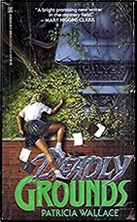
PATRICIA WALLACE – Deadly Grounds. Sydney Bryant #2. Zebra, paperback original; 1st printing, May 1989.
I don’t remember the title of the first one, but this is [San Diego-based] PI Sydney Bryant’s second recorded adventure. She’s hired here by a neighbor, a 15-year-old schoolgirl who finds the body of a friend along a pathway of the private girls’ academy they both attended.
Complicating the story is Sydney’s potentially torrid love affair with the policeman in charge. While Wallace’s easy writing style often seems to explain too much, as if telling the story to someone reading a mystery for the first time, she does know teenage girls.
PostScript: Well, she convinced me, at least. It’s really too badthat both the title and packaging make th book look to much like a run-of-the-mill horror novel, at least at first glance — and how much chance does a book get to find its proper audience, anyway?
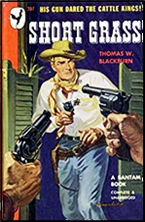
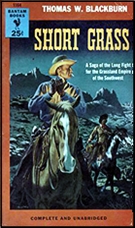
THOMAS W. BLACKBURN – Short Grass. Simon & Schuster, hardcover, 1947. Bantam #207, paperback, 1948; #1164, paperback 1953. Other editions include Dell, paperback, 1973.
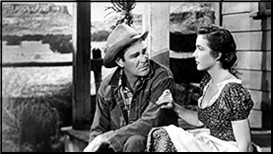
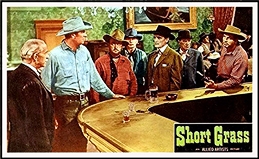
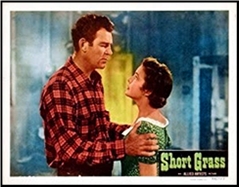
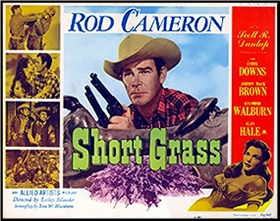
SHORT GRASS. Allied Artists, 1950. Rod Cameron, Johnny Mack Brown, Cathy Downs, Morris Ankrum, Alan Hale Jr. Raymond Walburn, Harry Woods, Stanley Andrews, Riley Hill, Jeff York, Tristam Coffin and Lee Tung Foo. Screenplay by Thomas W. Blackburn. Directed by Lesley Selander.
An excellent book turned into a superior B Western.
I started watching Short Grass last month and was immediately struck by something rare in B Westerns: Depth. Early on, wandering gunfighter Steve Lewellen (Rod Cameron) gets dry-gulched by Myron Healey, who is in the employ of big rancher Hal Fenton (Morris Ankrum.) He survives (Healey doesn’t) and is nursed back to health by small rancher Pete Lynch (Stanley Andrews) and his daughter Sharon (Cathy Downs — whom you may remember in the title role of My Darling Clementine.)
The whole episode serves as a plot device to put Rod on the side of the small ranchers, but the film takes a few minutes to tell us a bit about Myron Healey’s character, and how he comes up against Rod Cameron. The two even have a bit of edgy interaction before getting on with the story, and I wondered why a B-Western would take such pains with a throwaway character like Healey’s. Then I saw that the screenplay was by the author of the book, who would naturally try to get as much of his story on screen as he could.
Then I started wondering about the book itself. So I dug out a copy to compare and contrast with the film, and it was a revelation.
Don’t get me wrong. Short Grass is not a great novel. But it’s a damn fine one, and it made a superior B Western. But where was I?
Oh Yeah: In the book, Steve Lewellen uses his prowess to keep Pete Lynch from being crowded off his range. But when he kills Fenton’s hot-head brother he realizes the odds are too great, and if he stays it will bring worse trouble. So he advises his friend to sell out and rides away from the woman he has grown to love.
That’s book one of a two hundred page novel. Book two finds Lassiter three years later, farming on the outskirts of a small town called Brokenbow, which threatens to become a wide-open town since the railroad arrived and drew in the cattle drives—headed by Fenton.
And this is where Blackburn turns a standard western into something a bit better, sketching out vivid portraits of the townsfolk: a town-taming sheriff, a Swede farmer, crusty old doctor, shopkeeper… and even a Chinese Cook. They all come to life here and join in the action, of which there is plenty.
Ah yes, the action. You couldn’t ask for anything better. In one scene Lewellen takes on four opponents and Blackburn makes it read real, not like some pulp-book superman. And he wraps things up with a running gun battle through the streets: Townsfolk vs drovers, and never lets the reader lose track of who’s where and what hit whom—a neat trick, and he does it well.
***
When Allied Artists made this into a movie they were still sloughing off the Monogram persona, like a caterpillar turning hopefully moth-ward, and they fashioned Short Grass firmly in the B+ mode, with sturdy sets, good stunting, lots of extras, and names familiar to Western fans.
Blackburn cut out the unnecessary characters, put the bit parts in deep focus (as in the opening cited above) and changed what needed changing; in the book, the virile, town-taming sheriff is fooling around with the wife of the Newspaper Editor. In the movie he’s tough, paunchy Johnny Mack Brown, loving her pure & chaste from afar.
Allied Artists picked Lesley Selander to direct, and no one could have made a better job of it. Selander was a dab hand with action, and he visualizes Blackburn’s fights and shoot-outs just as he wrote them. But more than this, Selander — who brought Hopalong Casssidy and The Lone Ranger to the scree — had a feel for the mythic qualities of the men and their story. When, after many minutes of furious battle, the battered gunman and the wounded lawman lock arms and march across the street into a saloon full of bad guys, it carries all the feeling of a similar moment in Ride the High Country. Peckinpah did it better, but Selander did it first.
You can enjoy Short Grass equally as book or movie, but I recommend you try both. And before I wrap this up, I should add that Tom W Blackburn was also a songwriter of sorts with one solid gold record to his credit.
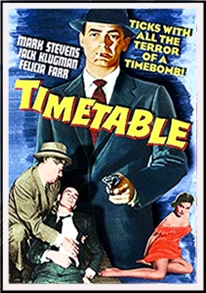
TIME TABLE. United Artists / Mark Stevens Productions, 1956. Mark Stevens, King Calder, Felicia Farr, Marianne Stewart, Wesley Addy, Alan Reed, Jack Klugman, John Marley. Director: Mark Stevens.
The first third of this small-time heist film is all very much routine. A train is robbed of a large payroll in cash, and assigned to the case are a insurance investigator (Mark Stevens) and a railroad detective (King Calder). They have worked well together before, and except for one thing, this one shows no sign of being different. This case and except for the stilted language this one does not have, the way they approach could have just as well have been dramatized on Dragnet.
That one thing, though, has them stumped. The theft was carried out is such meticulous detail, they can find nothing to get hold. In terms of cracking the case, they soon discover they have completely run out of leads. But as both you and I know, no heist in either a book or a movie can be carried out without something that goes wrong. And when that crack first occurs, then everything else starts to fall into place — for the pursuers, I mean.
There is also one big surprise along the way, and if you ever plan to see this film, I may have said too much already. Since I do not wish to give too much away, suffice it to say that the last two-thirds of the movie play out in s much more noirish vein, with plenty of dark streets, dingy Mexican cafes and gunfire.
Surprisingly, though, while the performance of rest of the cast is a solid notch better than just OK, actor-director Mark Stevens is almost as stiff as Jack Webb ever was in all those TV shows he was on. (The key word, though, and saving grace, is “almost.”)
Richard Doyle is one of those writers who had a good if not spectacular career in England and Canada, but only had one or two books cross the Pond to have any success here. His best known novel, Flood, made into a two part mini series in England which played here, wasn’t even published in paperback in this country that I know of.
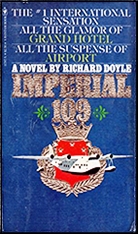
Imperial 109 was. It’s one of those grand hotel in the air mixes of adventure, soap opera, and intrigue, set on â€the S30C Empire class ‘boat’ of Britain’s Imperial Airways was one of the most beautiful aircraft ever to fly, carrying passengers in a style and luxury unmatched since the passing of the great air ships a decade earlier.â€
While it’s not Ernest K. Gann’s The High and the Mighty or Ken Follett’s similar Night Over Water, it is a big entertaining tale full of incident and action with attractive characters caught up in everything from trouble in the air to racing cars along the Nile.
Richard Doyle is named for his famous illustrator great grandfather, but it is his more famous writer grandfather Sir Arthur Conan Doyle he takes after.
He’s no ACD, but he is a good writer and this is more than entertaining fun.
The hero is pilot Captain Desmond O’Neill whose job is keeping passengers and crew in on piece and make a gold delivery on what should be a routine flight, but isn’t right from the start when his incompetent co-pilot fails to detect a fuel leak and they are forced down over Africa in the Sud in an outpost far off their usual track.
Among the complications beyond the leaky fuel line are the weather, the perils of long distance navigation, and the all too human worries involved including a crooked financier on the run, an Italian nobleman whose sexy wife is pursued by her lover, a passionate mysterious sheikh, and a pair of Jewish refuges, father and daughter, pursued by the Gestapo.
The book is divided into three sections, part one being the flight from South Africa for the Sudan, Khartoum, and Cairo, with part two the layover in Cairo, and the final section Alexandria, Athens, Rome, London, and onto New York where a hijacker waits ready to shoot down Imperial 109 for the gold they are transporting.
Admittedly the novel is structured more along the lines of a bestseller than a suspense novel. There is a bit of sex, more than a bit of romance, adventure, stalwart heroes, bad guys with unambiguous motives, and incident piled on incident. It’s hard not to imagine the book as one of those big late fifties early sixties films with a cast of international stars careening from one set piece to the next. In fact it is hard not to indulge in a bit of fantasy casting while reading it, which is one of the pleasures of this sort of book.
Not to oversell it, but if you are looking for a charming adventure set in the pre-war period (1939) with an attractive cast of characters, plenty of incident, the romance of travel and flying from the classic era, and a well balanced mix of bestseller candy dish elements this is a pleasant diversion.
RAYMOND CHANDLER – Farewell My Lovely. Alfred A. Knopf, hardcover, 1940. Pocket Book #212, paperback, 1943. Reprinted many times.
Many critics consider The Long Goodbye to be Chandler’s finest novel. This one disagrees. That distinction should probably go to Farewell, My Lovely – a more tightly plotted, less self-indulgent and overblown book, with characters, scenes, and prose of such artistry that it ranks as not only a cornerstone private-eye novel but a cornerstone work in the genre. Its near-flawless construction is all the more awesome when you consider that like The Big Sleep, it is a product of “canniballzation”: It makes extensive use of “The Man Who Liked Dogs” (Black Mask, March 1936); “Try the Girl” (Black Mask, January 1937); and “Mandarin’s Jade” (Dime Detective, November 1937).
Marlowe’s client in this case is Moose Malloy, a giant ex-con with a one-track mind: All that matters to him is finding his former girlfriend, Velma, a redhead “cute as lace pants,” who disappeared after he was sent to prison. Marlowe is a reluctant detective, his first encounter with Malloy having ended in the wreckage of a bar, Florian’s, where Velma once worked and a black bouncer suffering a broken neck; but Malloy won’t take no for an answer.
As Marlowe’s search for Velma develops, “the atmosphere becomes increasingly malevolent and charged with evil.” Among the characters he meets are a foppish blackmailer named Lindsay Marriott; a gin-drinking old lady with secrets and a fine new radio; a beautiful blonde with no morals and a rich husband who doesn’t give a damn; a Hollywood Indian named Second Planting who has “the shoulders of a blacksmith and the … legs of a chimpanzee”; a phony psychic, Jules Amthor: Dr. Sonderborg, who runs a private psychiatric clinic staffed with thugs; Laird Brunelle, the tough operator of a gambling ship called the Royal Crown; and L.A. and Bay City cops, some of whom are as crooked as a dog’s hind leg.
The climax, in which Marlowe and Moose Malloy both come face-to-face with the elusive Velma, is a stunner. Like a number of other scenes — especially Marlowe’s drugged imprisonment in Sonderberg’s clinic, in a room “full of smoke [that] hung straight up in the air, in thin lines, straight up and down like a curtain of small clear beads”-it remains sharp in one’s memory long after reading.
Farewell. My Lovely was filmed twice, once in 1944 as Murder, My Sweet, With Dick Powell as Marlowe, and once in 1975 under its original title, with Robert Mitchum in the starring role. The Powell version is the better of the two, even though Mitchum, aging and slightly seedy, better captures the essence of Marlowe. (Powell isn’t bad, though-a surprisingly gritty performance for an actor who began his career as a crooner in Busby Berkley musicals.) Mike Mazurki’s portrayal of Moose Malloy in Murder My Sweet is more memorable (and credible) than Jack O’Halloran’ s in Farewell. And the noir style of the earlier film better captures the flavor of Chandler’s work than the arty, full-color remake.
THE ASSASSIN NEXT DOOR. Israel, 2009. Original title: Kirot (Hebrew: קירות‎; literally “Walls”). Olga Kurylenko (Galia), Ninet Tayeb (Eleanor), Vladimir Friedman, Liron Levo, Shalom Micahelashvili, Zohar Strauss. Written and directed by Danny Lerner.
As you watch this film, it will at times have you both frustrated and enraptured, but thankfully not at the same time. It is also, fatally flawed, especially at the very end, at which point a bloody shootout takes place at an Israeli airport, and not a single security office ever shows up. In Israel? At an airport? I think not.
Mitigating that is the fact that the film is wonderfully acted and beautifully photographed, and the story will suck you right in, in spite of its flaws.
I am, of course, ahead of myself. Olga Kurylenko (Quantum of Solace) plays Galia, a immigrant to Israel from Ukraine who has gotten herself trapped in the sex trade by a Russian mobster. See a certain potential in her — she is superbly slim and athletic — he “recruits” her as an assassin, a sideline she hates, but without her passport and money, she has no choice.
Living next door to her are a married couple, but not happily. He abuses her almost every night, and Galia cannot help but notice. Thin walls keep her up most of the night. She slowly and hesitantly befriends the wife, a young woman named Eleanor, played to perfection by Ninet Tayeb as the model of a woman who cannot help but blame herself for her husband’s failures.
You may think you know where this is going — I certainly did — but I was wrong and you may be too. There is a lot of violence in his movie, and as I said up above, especially at the end. The fantasy aspect of the final scene is overshadowed, however, by the amount of tension that is released.
But when it comes down to it, it is the friendship between the two women, both in extremely dangerous situations, that will stick with you later, well after the movie is over. Overall? Flawed but fascinating.
Best line? “You hold gun like little girl. Hold gun like woman.”
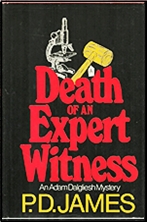
P. D. JAMES – Death of an Expert Witness. Inspector Adam Dalgliesh #6. Scribner’s, hardcover, 1977. Popular Library, paperback, 1977? Reprinted many times since. TV movie: “Death of an Expert Witness,” ITV/PBS, 1983, with Roy Marsden as Adam Dalgleish.
What better place for a murder (fictional, of course) could there be than inside a police forensic science lab? Just imagine the opportunity to fiddle with the evidence! It comes as no surprise that this lengthy (322 pages) tale is filled to he brim with suspects, clues, and plenty of false trails.
On the case is Scotland Yard’s Commander Adam Dalgleish, who seems more personally involved than usual with the other characters, all of whom, as in most of James’s fiction, are forever burdened with the twin weights of worry and misery.
The ending could hardly be called a cheerful one, which is not wholly unexpected, but no self-respecting mystery lover should pass this one by.
–Reprinted from The MYSTERY FANcier, Vol. 2, No. 3, May 1978.
COLLIER YOUNG – The Todd Dossier. Delacorte, hardcover, 1969. Dell, paperback, 1970.
The Todd Dossier by “Collier Young†— actually a pseudonym of Robert Bloch — is for the most part a fairly gripping and well-constructed medical mystery about a shady heart transplant and it’s slow unraveling… right up to the end, when Bloch throws the story away.
Having set up an ingenious crime and some very nasty bad guys, then whipped up a good amount of suspense over the fate of his doctor-detective, he decided for some reason to resolve it with a facile plot device from nowhere that goes unconvincingly against the grain of his characters.
Most of the time I was reading this, I wondered why Bloch put a pen name on it, but when I finished, it occurred to me if I’d written an ending like that I probably wouldn’t give my right name either.
Dossierdoes offer, though an insightful look back to another time, one that I hadn’t thought quite so distant. Fifty years ago, when this was written, heart transplants had just crossed the line from Sci-Fi to reality. It was the time of the Jarvic Heart, Baboon hearts in babies, and other faltering steps toward what is today routine surgery.
Bloch’s awe — expressed by his characters — about the dawn of a new biology, is as quaint in its way as the speeches in old war movies (Pick a war — any war) about the New and Better World that will surely follow once we kill these bastards. We also get an actual plot point about a couple whose marital bliss is threatened because the husband feels emasculated by his wife’s job — was this really just fifty years ago?
As I say, Todd Dossier is mostly taut and readable. I just never expected anything so antiquated “by the Author of Psycho.â€
THE LAST HIT MAN. Direct to video, 2008. Joe Mantegna, Elizabeth Whitmere, Romano Orzari, Michael Majeski, Victoria Snow. Written and directed by Christopher Warre Smets.
As I’m sure you could easily tell from the title without my telling you, The Last Hit Man is rated “R” for lots of gun-related violence, but if that isn’tanything that would stop you, if the movie is otherwise well done, here’s a movie I can recommend to you, and highly at that.
Joe Mantegna is perfectly cast as Harry Tremayne, the titular hit man, a fellow getting up in years after a long career of never failing on an assignment. Until, that is, he does. Not only does he begin to be filled with self doubt — is his body stating to fail him? — he realizes that the person who hired him is going to start wondering if it’s possible Harry has changed sides.
So Harry is ready when someone else comes gunning for him. Someone who fails. And whom Harry then hires to .. Well, I probably shouldn’t tell you, but it’s a neat twist (and even with as little of a hint that I can give you, you probably already know what I’m not telling you).
That’s the outer story. What I haven’t told you yet is that Harry has a partner. His young twenty-something daughter, Racquel, who is his electronics expert as well as his getaway driver. And more: she has a boy friend, an earnest young man who has no idea what the family business is that he just might be marrying into.
There is a lot of humor in this story, but it’s definitely understated — the kind that makes you smile rather than laugh out loud — and so you should definitely not take what I say to mean that The Last Hit Man is a comedy. It is not. It is rather a personal and down-to-earth family drama, and there is more to the story that I am definitely not telling you, and this time I mean it.
—
[Added later.] I was so impressed by Joe Mantegna’s performance in this film, I went looking for his resume. I knew he’d taken over for Robert Urich in two or three made-for-TV Spenser movies, and he was in several very good David Mamet films, but of his other work, not much else. It turns out that he’s had a substantial role in most of the fifteen year run that Criminal Minds recently closed up shop on.
Fifteen years? I’ve never watched it. Barely heard of it. Thought of it as a psychopath and/or serial killer of week kind of show. Psychopaths and/or serial killers don’t interest me. Is/was it more that? It would it seem to have to have been, for a TV series to be on that long.
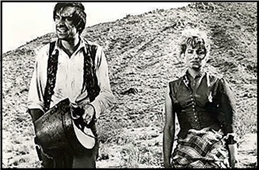
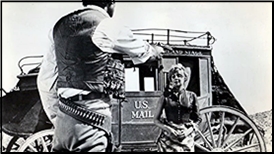
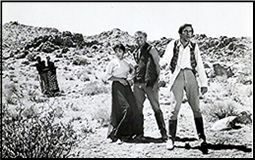
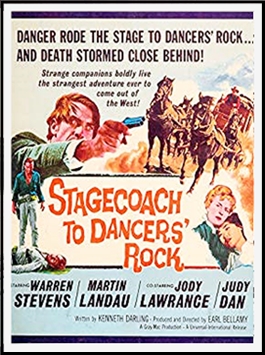
STAGECOACH TO DANCERS’ ROCK. Universal Pictures. 1962. Warren Stevens, Martin Landau, Jody Lawrance, Don Wilbanks, Del Moore, Bob Anderson. Screenplay: Kenneth Darling , based on his own story (his only film credit). Director: Earl Bellamy.
Truth be told, I wasn’t expecting much from Stagecoach to Dancers’ Rock. Especially once the opening credits began rolling, along with a ridiculously outdated (even for 1962) theme song that basically explains the whole plot. Also, the movie starts off like any other somewhat lower budget Western of the time period. There’s a ragtag group of travelers heading into Apache territory. And among them, there’s Dade Coleman (Martin Landau), an outlaw recently released from jail.
The first twenty minutes or so are nothing you haven’t seen time and again. But things begin to get interesting when it turns out that one of the passengers – a Chinese woman on her way to San Francisco – may have smallpox. The myriad ways in which the characters react to that development could have carried the whole film, had the screenwriter wanted it to.
But instead, the film shifts into a half-baked subplot in which one of the stagecoach’s passengers named Jess Dollard (Warren Stevens) teams up with a gunman to rob the very coach he is riding. Why he does this and what lead him to this decision is never fleshed out. In fact, by the end of the movie, it’s almost all forgotten.
So why did I enjoy the second half of this movie so much? Martin Landau. That’s why. Stagecoach to Dancers’ Rock was one of his earliest screen roles. And he certainly was a much bigger presence in this production than he was in Alfred Hitchcock’s North by Northwest (1959).
Here, he takes on the role of a psychotic Western outlaw with glee and with vigor. He smiles that mad smile he was capable of. His character quotes aphorisms and cackles with fiendish delight as succumbs to madness under the glare of the unforgiving hot desert sun.
You may never have heard of Dade Coleman as an infamous Western villain. But with Landau’s scenery-chewing performance, his name should be up there in the pantheon of villains who stand out from the pack.