Reviews


REVIEWED BY DAN STUMPF:


BRETT McKINLEY – Just Plain Scum. Cleveland Publishing Co., Australia, digest-sized paperback original, no date stated.

   Okay, I just couldn’t resist a title like that. Even on a saddle stitched booklet of fewer than a hundred pages wrapped in an indifferent cover. Ultimately, I had to read it, and…

   Well for what it is, Just Plan Scum ain’t bad. It ain’t good, mind you, but it recalled to me the Doc Savage books I enjoyed in Junior High, with characters as colorful and flat as the pages in a comic book, and a fast-moving, unlikely story told in plain, functional prose.

   Scum starts well, with

   â€œHey Johnny!”

   â€œWhat?”

   â€œThere’s a feller here wants to fight you.”

   â€œWhy?”

   â€œHe reckons you’re flash.”

   â€œHe’s right.”

   â€œHe still wants to fight you.”

   I like that. It promises imminent action and a bit of humor, and it could go anywhere from there.

   Where it goes is to a band of free-booting veterans of the Civil War—Yanks and Rebs alike — known as The Company, guided by the loose but firm reins of Johnny Lee, a pulp hero in the best tradition: invincible, right-minded and colorfully costumed. He’s also surrounded by a few faithful lieutenants, each with a special trait that recalls the myrmidons of Doc Savage or the Shadow.

   The story that follows serves them well: raiding Apaches, lovely women, brave soldiers, a double-dealing Officer, and action action action action. It left a cloying aftertaste, and the vague suspicion that too much of this would give me brain decay, but that was quickly rinsed by reading a real book.

   And as I put Just Plain Scum on the shelf somewhere between Kiss Tomorrow Goodbye and Hud, it was with a sense of deep down pleasure that my library is big enough for all three.
JAMES MITCHELL – Smear Job. David Callan #4. G. P. Putnams Sons, hardcover, 1977. Berkley, US, paperback, 1978. Previously published in the UK by Hamish Hamilton, hardcover, 1975. Corgi, UK, paperback, 1977. Ostara Publishing, UK, softcover, 2016. Note: Although there were only four books in the series, they were the basis for four British TV series starring Edward Woodward between 1967 and 1972, plus a film in 1974 and a TV movie in 1981.

   No matter how reluctantly he serves, Callan is British Intelligence’s most effective agen, but not even he can see the connection between the paperback edition of Das Kapital he is ordered to steal in Italy and a German girl strung out on LSD and sex in Ls Vegas.

   The answer is an inverted sort of public relations ploy, one that’s expected to be very useful in making an official in another country’s government see things a little differently.

   While all the details tend to make the suspense grow but slowly, a sub-plot involving a poeer-hungry US congressman and his partly alienated daughter does much to liven things up. Equally involved are the manipulations of individuals and governments that can’t help but leave behind the usual sour taste required by this sort of spy fiction.

–Reprinted from The MYSTERY FANcier, Vol. 2, No. 3, May 1978.


Director RICHARD BOLESLAVSKY
by Dan Stumpf


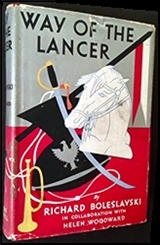
   The highlight of my recent reading has been Way of the Lancer (Bobbs-Merrill, hardcover, 1932) by Richard Boleslavsky and Helen Woodward, an autobiographical novel of Boleslavsky’s experiences (and, I suspect, those of man others that he incorporated and told as his own) for — and against — Russia in the first World War.

   It’s an intriguing account, Boleslavsky was not a Russian but a Pole; his nation had been dominated by Russia since about 1750, and when the Great War got serious, Russia promised Freedom to Poland if her sons would fight for Russia. Austria promised roughly the same thing, so regiments of Poles fought for both sides, against enemies who were often their brothers.

   Boleslavsky describes an interesting vignette off weary, “victorious” Poles escorting even wearier defeated Austrians to POW camps and finding relatives in their midst, tiredly catching up on the news as they slog through the mud to no place in particular.

   Boleslavsky, incidentally, was a Polish soldier, but not a Lancer. He passed the war as a film-make, attached to the Lancers, doing semi-documentary propaganda films. After the War, he gravitated to Hollywood, where he directed some truly remarkable movies, like The Garden of Allah, with Dietrich and Boyer, and the cynical, moving 1936 version of Three Godfathers, and others.

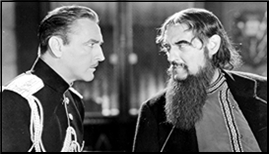
   His Hollywood debut was Rasputin and the Empress (a portrait of the breakdown of Imperial Russia that must have seemed very real to him), the only film to star all three Barrymores. It’s an interesting show, but not a great one. John seems ticked off that he didn’t get to play Rasputin, and sulks through the whole movie with marked disinterest until the scene where he gets to kill Lionel, which is really quite memorable.

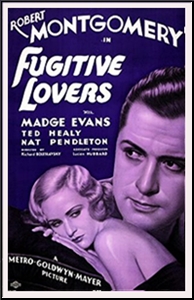
   Boleslavsky also directed one of the two Three Stooges movies you should make an effort to see: Fugitive Lovers (MGM, 1933), a dandy little thing about Robert Montgomery as an Escaped Con being pursued with cold precision by C. Henry Gordon, catching a bus with aspiring chorus girl Madge Evans, who is herself being pursued by dumb, possessive, aspiring gangster Nat Pendleton. Also onn board are Ted Healy and his stooges,whose time onscreen is mercifully brief.

   Boleslavsky fills the film with sudden cuts and jarring camera angles that seem avant-garde even today, and make Citizen Kane look antiquated before its time. And he maintains the pace and drama quite nicely throughout, right up to a howling blizzard that had my teeth chattering despite the fact that it was done entirely inside a studio. You should look for this one.

— Reprinted in shortened form from Shropshire Sleuth #71, May 1995.


WAGON WHEELS. Paramount Pictures, 1934. Randolph Scott, Gail Patrick, Billy Lee, Monte Blue, Raymond Hatton, Jan Dugganq, Leila Bennett, Olin Howland Based on the novel Fighting Caravans by Zane Grey, serialized in Country Gentleman between November 1928 and March 1929. Director: Charles Barton.

   This is a remake of the 1931 film Fighting Caravans starring Gary Cooper, with stock footage taken from the earlier film, or so I’m told. And at a running time of less than 60 minutes, some of it is taken up by the time it takes to sing several songs, “Wagon Wheels” being one of them, there’s not much space left to tell a story.

   Which is that of a wagon train of settlers heading for Oregon Territory to begin new lives, if they can make it. Indians, snow-covered mountain, wide rivers and more all lie ahead of them, complicated by the nefarious plot against them by a fur dealer who would like to delay the settling of the new land for several more years.

   Randolph Scott is the head scout for the party, while Gail Patrick is the love interest, a widow with a small boy (five year old Billy Lee, who in several ways nearly steals the show). Scott repeatedly tries to warn her off from going, but she manages to thwart all his efforts to do so.

   There’s not much more to this movie than this, but Randolph Scott was Randolph Scott, even some 85 years ago at the age of 36.


REVIEWED BY BARRY GARDNER:


MIKE LUPICA – Jump. DiMaggio #1, Villard, hardcover, 1995. Kensington, paperback, 1996. Pinnacle, paperback, 2002.

   I like Lupica’s crime novels, and his sportswriting as well. He’s not bad on ESPN, either. He’s written three novels inn the [investigative TV journalist] Peter Finley series, and this has the feel of a series as well.

   DiMaggio has an illustrious last bane (if he has a first nae I missed it) and had a much less lustrous career in baseball than his namesake. now he’s a lawyer, and specializes in investigations involving sports figures — at which trade he’s de Man.

   He’s got a dandy coming up. The young, black successor to Michael Jordan has just been accused, along wth a white teammate, of raping a white woman. The accuser waited a year to come forward, and the team’s owners want Dimaggio to find out the truth, preferably that she’s lying.

   As he starts sorting through everyone’s dirty laundry, he finds that no one is clean and pure, and that to some there are secrets worth killing for.

   Lupica is a smooth, facile writer. A pro. He has the good sense to write what he knows, sports, and his knowledge and insight deepen the book considerably. The story is told from multiple viewpoints — DiMaggio, the accused, the accuser, a sleazy tabloid journalist — and told very effectively.

   The book paints a telling portrait of big-time athletics and athletes, and is far from one-sided in its depictions. It’s an easy read but a good one, and I hope he does more DiMaggios.

— Reprinted from Ah Sweet Mysteries #19, May 1995.


Editorial Update:   It is not easy to say for sure, but I do not believe that Mike Lupica wrote another DiMaggio novel. He’s written several dozen books, almost all involving sports, including a series of YA mysteries, but Jump appears to have been a one-and-done for DiMaggio as a series character.

THE ROCKFORD FILES “Caledonia – It’s Worth a Fortune!” NBC, 06 December 1974 (Season 1, Episode 11). James Garner (Jim Rockford), Shelley Fabares, Ramon Bieri, Richard Schaal, Sid Haig. Teleplay: Juanita Bartlett, based on a story by John Thomas James (Roy Huggins). Director: Stuart Margolin.

   Rockford is hired by Shelley Fabares as the wife of a critically ill penitentiary prisoner who whispers to her the location of a hidden fortune in collectible stamps, but she needs help in actually digging them up. For a percentage of the find, Rockford readily agrees.

   But also on their trail are the convicted man’s former partner, who is also the man the woman was having an affair with, as well as two hoodlums who turn out to have been in the same cell block as the imprisoned man. The big stumling block as far as Rockford and his client are concerned is that they only know the town to start their hunt in (Caledonia). The ex-partner has the only set of directions.

   And why is local sheriff so intent in running them all out of town?

   If this all sounds very complicated, it is, but there’s still plenty of time to be spent on watching cars drive up an down the local highways, including at least one reckless chase or two.

   The overall tone is light and breezy, though, with good rapport between James Garner and his lady co-star, making it very easy for the viewer (me) to safely sit back and enjoy watching this first season episode with no effort at all.

C. L. GRANT – The Hour of the Oxrun Dead. Oxrun Station #1. Doubleday, hardcover, 1977. Popular Library, paperback, 1979; To, paperback, 1987.

   According to what you may have read in recent fiction, New England must be full of towns such as this: peacefully serene in the daytime, but once after dark, horribly vulnerable to supernatural forces that can swallow them up overnight, with none of the inhabitants any the wiser.

   In Oxrun Station, only two people are aware that anything is wrong, and both are newcomers, one an assistant librarian recently widowed under strange circumstances.

   This is Gothic horror at its finest. Half of it is unmitigated nonsense, but if you’re the sort of person who believes that there may be unexplained things that inhabit graveyards at midnight, the other half will have you double-checking the locks on your doors before going to bed.

   Guaranteed.

–Reprinted in slightly revised form from The MYSTERY FANcier, Vol. 2, No. 3, May 1978. Previously published in the Hartford Courant.


      The Oxrun Station novels —

The Hour of the Oxrun Dead (1978)
The Last Call of Mourning (1979)
The Sound of Midnight (1979)
The Grave (1981)
The Bloodwind (1982)
The Soft Whisper of the Dead (1982)
The Dark Cry of the Moon (1986)
The Long Night of the Grave (1986)

REVIEWED BY DAN STUMPF:


ERNEST HAYCOX -Sundown Jim [or “Red Harvest Rides the Range”}. Little Brown, hardcover, 1937. Grosset & Dunlap, hardcover reprint, 1938. Pocket Book #573, paperback, 1949. Reprinted many times since. Film: 20th Century Fox, 1942, with John Kimbrough as Sundown Jim Majors.

   Haycox tended to make his heroes working men: miners, ranchers, freighters and such, but here the focus is on Jim Majors, a US Deputy Marshall sent to the town of Reservation, fast becoming a sanctuary for wanted men, to clear out the owlhoots and generally set things straight.

   Turns out, Reservation is the Western equivalent of Hammett’s “Poisonville,” a town so rife with corruption, warring factions and shifting alliances that it’s hard to tell who’s on which side at any given moment and fatal to misjudge. One sure-enough outlaw, Ben Maffit, has his eye on Katie Barr, daughter of the local cattle baron, and keeps his felonious followers allied against the smaller ranchers, but some of these lesser cattlemen are as bad as the Barrs and scarcely better than Maffit’s misfits – in fact, sometimes not as good.

   The situation is ripe for violence and Haycox ladles out plenty, done up in his terse, visceral style, but he also peoples the tale with some well-rounded and even memorable characters, and gives them enough ink to spread their wings and fly about the pages a bit. And this in turn motivates the plot as violence spreads throughout Reservation’s environs.

   There’s a dandy few pages here where, having de-fanged the cattle baron, Majors persuades the smaller ranchers not to take advantage of his weakness. They do it anyway, with decidedly mixed results, and then blame Majors for the ensuing tragedy. And it works on the page because Haycox has given us a few short scenes of each man debating the situation and deciding on violence.

   I have to say that the characters of Majors himself and Katie Barr never break free of the Hero and Heroine mold, but they don’t really need to; Haycox keeps things moving fast enough to cover for it, and the back-up band makes it all ring true.

UNCUT GEMS. A24, 2019. Adam Sandler, Julia Fox, Kevin Garnett, The Weeknd, Idina Menzel, Eric Bogosian, Judd Hirsch, John Amos, Mike Francesa. Written & directed by Benny Safdie and Josh Safdie.

   It is possible for an actor like Adam Sandler to be nominated for an Oscar? There’s talk about it, and if I weren’t totally out of the loop when it comes to Academy Awards (I have not had any interest in any of the films that have been nominated over the past several years, and I mean none), I’d say that the talk is entirely justified.

   He should be nominated, in other words, but whether he will be is another matter altogether. In Uncut Gems he plays Howard Ratner, a sleazy but only semi-shady jewelry store owner in Manhattan’s midtown diamond district. Always sharply dressed with a smile on his face, he’s always in trouble with his bookies, for one thing, and constantly juggling his bets around to pay off another.

   This a life that that not guarantee him a lot of friends. His marriage is crumbling, as much as he tries to save it, but having a mistress on the side does not help matters. His one hope, as the movie begins, is a rock he has managed to import from Ethopia containing what he thinks is a fortune in uncut gems. To this end, he attracts the attention of Boston Celtics basketball player Kevin Garnett (who very effectively plays himself) with whom Howard swaps the stone on a temporary basis for other’s NBA championship ring.

   Things do not go well. Howard’s minor victories always seem to have a catch to them, and as sharp as he outwardly thinks he is, the losses keep piling up. Whether we would ever hang out with such a character — I’m speaking you and I — is doubtful, but if you can watch this movie without empathizing with him, you’re a better person than I, Sandler’s portrayal of him is well-nigh perfect.

   You’ll have to judge the ending for yourself. I don’t think I was well enough prepared for it, and yet in retrospect, it’s also inevitable and fitting. Do be prepared for a non-stop torrent of F-words, and if you’re allergic to hand-held cameras you might want to stay away altogether.

   But if you do, you’ll miss the performance of Adam Sandler’s career. He fits the role of a small grifter of a man whose luck always turns out bad, no matter how hard he tries, as if the part was written for him — and if it was, then all due credit to the Safdie brothers as well.


LADY OF BURLESQUE. MGM, 1943. Barbara Stanwyck, Michael O’Shea Michael O’Shea, J. Edward Bromberg, Iris Adrian, Gloria Dickson, Victoria Faust, Stephanie Bachelor, Charles Dingle, Pinky Lee, Janis Carter, Gerald Mohr. Screenplay: James Gunn, based on the novel The G-String Murders, by Gypsy Rose Lee. Director: William A. Wellman.

   I’ve read somewhere that the murder mystery portion of this movie stays fairly close to the book, but it’s been so long since I’ve read the book, so I can’t confirm that one way or another. Maybe someone reading this can say more for sure.

   One thing’s for sure: no one came to see this movie in 1943 wanting to see a murder mystery movie. No, what they obviously came to see was whatever they could glimpse of what was forbidden grounds for most of them, the world of burlesque, girls, strippers and goofy comics, but mostly strippers. (The trailer above doesn’t even mention the murders.)

   Well, they saw girls, all right, but strippers? In 1943? In the movies? Not from MGM and the Hays Code in full force, they didn’t. Bare legs and midriffs, and a hint of cleavage, but no more. The jokes are borderline risque, but still far north of the border, and of course as corny as you can get. I still laughed at some of them.

   Barbara Stanwyck may seem like a strange choice to play the lead dancer, but she turns to have been a pretty good hoofer, cartwheels and all. (If they used a stunt double for her, they certainly did a good job of it.) She also holds her own with the wisecracks, and of course deep inside, she has a heart of gold.

   Lots of backstage action, far more than what the audiences in their seats saw on stage, including a couple of murders that bring in the police, not quite as dumb as usual, to investigate. The mystery was only frosting on the cake, as far as I was concerned, and the cake was delicious.

« Previous PageNext Page »