Reviews


THE NEW ADVENTURES OF NERO WOLFE “The Case of the Disappearing Diamonds.” NBC, 30 minutes. March 9, 1951. Sydney Greenstreet, Harry Bartell. Story: Mindret Lord.

   As a radio series The New Adventures of Nero Wolfe was heard for one short season on NBC, running from October 20, 1950, to April 27, 1951. There had been two earlier versions: The Adventures of Nero Wolfe, a 1943–44 series on ABC starring Santos Ortega and Luis van Rooten, and The Amazing Nero Wolfe, a 1945 series on Mutual starring Francis X. Bushman, but there’s no denying that Sydney Greenstreet was well nigh perfectly cast for the role.

   For a season of only 26 shows, though, the series went though quite a few people playing Archie. Besides Harry Bartell, they included such well known radio voices as Gerald Mohr, Herb Ellis, Lawrence Dobkin, Lamont Johnson and Wally Maher. It probably didn’t matter to radio audiences all that much who played the part back then, however. The combo of Nero Wolfe and Sydney Greenstreet was, I’m sure, all they needed.

   I’m not so sure about the stories, though, not if this is an example. It begins with a sneak thief named Willie Inch asking Wolfe to help him prove he didn’t kill the lady of the house after he’d burgled it, and quite successfully, too. It’s too bad he left fingerprints behind, as well as the body of the lady.

   And oh, yes, a small fortune in diamonds is also missing, but Willie Inch did not take them. Someone else had larceny on his (or her) mind the very same evening. There is also a beautiful young woman involved. She claims to be a writer and wants to do a story about Wolfe. Archie demurs, saying that a fellow named Rex Stout is already writing up his adventures. After Wolfe proves she’s a fraud, that doesn’t stop Archie for making a play for her — to his regret.

   But the ending is very weak and terribly rushed. Something could have made of the gimmick involved, but as it was, that’s all is was, only a gimmick. The trappings of the Wolfean stories are there, but there’s not solid enough in this episode to make me want to listen to another. I’ll stick to the books, and the Maury Chaykin-Timothy Hutton TV show that was how on A&E a while back. As an adaption of one of my favorite detective series, it was most satisfactory.

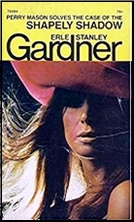
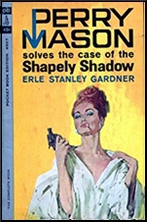
ERLE STANLEY GARDNER – The Case of the Shapely Shadow. Perry Mason #63. William Morrow, hardcover, 1960. Pocket 4507, paperback, 1962. Ballantine, paperback, 1982. Reprinted many times.

   This one begins at Della’s strong suggestion. She notices that the woman who asking for Mason’s advice is deliberately toning down her appearance, making herself as unattractive as possible. Why? She’s the secretary of a successful businessman, and Della assumes (correctly) that she’s in love with him, and she doesn’t want his current wife to have any reason to have her fired.

   What attracts Perry’s attention, though, is the suitcase full of money she has with her. She thinks that her employer is being blackmailed, and this is the money she’s to put into a train locker, with the key to be sent to an address he’s given her.

   When the man ends up dead, however, Perry’s client is the number one suspect, along with the other two women in his life: his wife and his ex-wife, who it is obvious would like nothing nothing better than to win him back.

   The case is so deliciously complicated that Perry figuratively throws up his hands. The evidence points directly to his client, but she is adamant that she didn’t do it. The fireworks in court is really what makes this book really sizzle, though. When the odds are so far against you, maybe the only thing to do, Mason decides, is to take a chance.

   He does, he succeeds, and Hamilton Burger fails again. This one has what every Perry Mason reads Perry Mason books for.

REVIEWED BY DAVID VINEYARD:


BART PAUL – Under Tower Peak. Tommy Smith #1. Arcade, hardcover, April 2013; paperback, November 2014.

   Early in the season we rode up to the forks to fix the trail above the snow cabin. The winter had been good and the aspens had leafed out down in the canyon at the edges of the meadows. Above The Roughs up in the tamarack pines it was shady and cool once the trail got narrow, and the only sounds were the steady scuff of the horses’ hooves as they kicked up little puffs of dust and the clack when an iron shoe struck a rock as they climbed, the rush of the creek off in the timber, and the breeze through the tamarack limbs.

   It isn’t often when reading a mystery, Western, thriller, or combination of the three I find myself thinking in terms of writers like Ernest Hemingway, Tom Lea, Cormac McCarthy, and Jim Harrison, and at the same time hearing echoes of Craig Johnson, Elmore Leonard, James Crumley, and Stephen Hunter, but Bart Paul’s Under Tower Peak evokes all those and in the best way possible, and manages a sense of humor to boot, as hero Tommy Smith and his pal Lester lie under the stars in California’s Sierra Nevadas.

   â€œIn the moonlight the plane looks like some spacecraft crashed on Mars,” he (Lester) said. “You ever think about outer space?”

   â€œNot ever.”

   â€œYou see those movies with guys standing all alone on some distant planet a gazillion miles out in deep space with some weird moon on the horizon. But what if we’re the ones on the distant planet and all this just over our heads is deep space, all cold and huge and empty? You ever think that lying here we’re flying a million miles an hour in outer space right now?”

   â€œOne of us is, that’s a fact.”

   Loosely suggested by the crash of businessman adventurer Steve Fossett’s plane in 2008, the novel finds former sniper Tommy Smith and his friend Lester in the high country where they discover the crashed plane of a missing billionaire adventurer. That’s a seemingly harmless enough fact, but it soon turns complicated when Lester takes an expensive Rolex off the dead man and some of the money carried in a bag on the plane. Once back in civilization his less than ethical sometime girlfriend Callie Dean, local tramp with a not quite heart of gold, contacts the family lawyers about a reward and when she shows up dead after talking to a man in a fancy car the stops are out.

   Lester’s moment of greed has let loose the hell hounds as the dead man’s trophy wife and drug lord son, and their legal and illegal cadre of backers are soon threatening Tommy and Lester, and crawling all over the Sierra Nevada’s willing to kill for something related to the dead man and the crash that Tommy has no clue to. Innocent people are dying and Tommy’s one time friend idiot Sheriff Mitch isn’t up to handling the mess he has on his hands.

   As the wife’s attractive lawyer Nora explains why Gerald, the son needs the father to be alive or he could lose a fortune she warns Tommy:

   â€œ…Gerald’s father is dead,” she said. “You saw the body?”

   â€œHe’s dead, alright. Lester and me were as close to the body as I am to you.”

   â€œThat, Sergeant Smith,” she said, “makes you both very inconvenient people to leave walking around.”

   That’s setup enough for a solid tale of adventure, violence, and the hard won values of uncorrupted but not scrupulously honest men vs corrupt and ruthlessly violent ones, but Paul ups the ante not only by his evocative writing, but in his character of his reluctant but all too proficient hero who turns out to be equal parts John Wayne, Robert Mitchum, and James Bond.

   â€œYou scared me when you pulled out the knife,” she said.

   â€œProbably not much I could have done.”

   She sort of leaned in to me and her heat just poured out. I held the shirt tight around her.

   â€œI doubt that,” she said. “It was like you were on a mission or something.”

   Even the gun-lore here, which in some writers’ hands is little more than gun porn, is part of the plot and the nature of the protagonist, never overdone, or less than vital to the story at hand.

   It doesn’t take much to guess Smith and Lester are going to find themselves out numbered and out gunned against a small army of dangerous and violent people, but the fact that Paul makes that pay off again and again in ways that evoke the best writers of this kind of tale, James Lee Burke is another name that comes to mind, is remarkable.

   After Gerald’s Cuban friends blow up his cabin Tommy lies in wait on a bridge for them.

   When he was almost halfway across, I reached down and felt for the wire and the big plastic switch and thumbed it on. It was a full second before the generator fired up about a hundred yards away and another second until four big halogen spots flared on in a semicircle behind me and lit up that bridge like noon. The Escalade stopped hard, then started to back up, slow at first, the driver halfblind from the spots. I thumbed off the safety then and squeezed off a round into the road on my side of the bridge just so they could hear the shot and see the dirt kick up. The driver hit the gas, and one back wheel started to spin on the iron plate between the planks. In that bright light I could see the two Cubans in the front seat scrambling as the car drifted ass-first to one side. When the spinning rear wheel hit the planks, it bit into the wood and got instant traction. The driver overcorrected, and that wheel slid off the upstream edge of the bridge. I fired a second shot way over their heads and saw the front tires jerk sideways like they thought they could still back themselves out of trouble. The Escalade tilted, and the left front wheel went over the edge too. The whole thing hovered there for a second until it rolled off the bridge and splashed into the creek on its side. With the front windows open it sunk fast. When I could see the headlights under water, I snapped off the switch, and the spotlights dimmed out and the bridge went dark.

   Naturally at some point Tommy and Lester decide the law isn’t going to take its course in time to save their lives or avenge Callie, who was trying her hand at extortion, and decide to take things in their own hands against the advice of Deputy Sarah Cathcart who tries to protect them both.

   This isn’t just an action suspense piece either, there is a decent mystery and noirish plot and some good detective work along the way putting the complicated ends of the story together with billions of dollars at stake, and something else Tommy can’t guess at drawing all the firepower, legal and not.

   One more good rain and it would be as if that old boy had never hit that mountain, had never missed that pass. It would be like he was just flying around over us forever, trying to find his way home. At least that’s how I like to think of it. And except for me, and now Sarah, any folks who would tell otherwise are dead. We kept on riding past The Roughs and disappeared into the trees.

   Paul is a writers’ writer, literate and literary without beating it over the readers head. Reading this book is not only a pleasure as escapist literature, but in watching a capable and gifted writer practice his craft with precision and style. His work invokes not just the obvious names, but writers like Edward Abbey, Oliver Lange, Newton Thornberg, Will Bryant, A. B. Guthrie, and Clair Huffaker, and that is notable company for any writer, in the genre or out.

      The Tommy Smith series —

1. Under Tower Peak (2013)
2. Cheatgrass (2016)
3. See That My Grave is Kept Clean (2019)
REVIEWED BY BARRY GARDNER:


MICHAEL CONNELLY – The Last Coyote. Harry Bosch #4. Little Brown, hardcover, 1995. St. Martin’s, paperback, 1996.

   Connelly is without question one of the most highly regarded crime writers of the nineties. That his 1994’s The Concrete Blonde was not shortlisted for an Edgar tells you all you need to know about the MWA’s awards process.

   He wouldn’t be Harry if he didn’t have troubles. His house has been condemned because of earthquake damage, his lover has left him, he’s drinking too much,and he’s been suspended and forced to see the Department psychiatrist because he shoved a superior officer’s face through a window. A closed one.

   His remedy? To investigate the murder of his mother, unsolved (covered up?) when she was killed over 30 years ago. Old bones, buried secrets, and a road that could lead either to redemption of or the bottom of the long slide.

   Connelly’s strengths are to me a little harder to analyze than those of some. There’s no one facet of his writing that says, “Here’s a Connelly book.” The primary appeal is the character of Harry himself, I guess, but Connelly is the complete package — his prose is excellent, his pacing outstanding, and the characters other than Harry quite go.

   His only weakness for me has been his plotting, but that has improved with each book. And this is a particularly good book, deepening the characterization and conveying a sustained mood of darkness and desperation. But then, Harry and his tales never were rays of sunshine, were they?

   Connelly is one of the better.

— Reprinted from Ah Sweet Mysteries #18, February-March 1995.


REVIEWED BY DAN STUMPF:


I’LL BE SEEING YOU. Selznick/Unired Artists, 1944. Ginger Rogers, Joseph Cotten, Shirley Temple, Spring Byington and Tom Tully. Adapted by Marion Parsonnet from a radio play by Charles Martin. Directed by William Diertele and George Cukor.

   Among the oddest of Christmas films, I’ll Be Seeing You offers a deceptively simple tale and makes it resonate with surprising counter-rhythms and a touch of noir.

   The plot in brief: It’s the Holidays, and Ginger Rogers is visiting relatives in a small town, but after New Year’s Day she has to go back to Prison, where she’s serving a six-year stretch for Manslaughter.

   On the train, she meets Zach Morgan (Joseph Cotten) a soldier who impulsively decides to get off at her stop and get to know her. But after the Holidays, he too must return — to a VA hospital where he’s being treated for what we now call PTSD.

   The romance that follows is built like a fragile house of cards as we see them start to build trust in each other, confidence in themselves and tentative plans for a future that just ain’t gonna happen; he’s got to go back to the Hospital (she doesn’t know it) and she must return to Prison (he doesn’t know it) and even as love grows in the holiday climate, tension builds as we wonder what will happen when they find out….

   Director Diertele heightens the drama by stressing the small town atmosphere and the loving cohesion of Ginger’s family (Tom Tully, Spring Byington and Shirly Temple at that awkward adolescent age.) Her furlough has been hard fought-for, and the depth of feeling when she reunites with her family is.. well it’s one of those moments we watch Movies for. Joseph Cotten is welcomed by her family…

   â€¦.And then it hit me: This is the reverse side of Shadow of a Doubt (Universal, 1944 – just a year earlier!). We have Joseph Cotten once again as a man with a secret coming to a small town and ingratiating himself with an All-American Family. Only this time, Ginger is the killer, and the flashback to her crime has a haunting Woolrichesque quality to it that matches anything in Shadow.

   As I watched both films I saw how Cotten incorporated elements of one character into the other and differentiated them at the same time. Both men are charming, but Zach ‘s charm is a clumsy, off-hand thing, while Uncle Charlie’s is a practiced act. Both men wear masks, but Cotten lets Uncle Charlie’s mask slip to chilling effect, while Zach’s mask crumbles heart-wrenchingly. Watching both films back to back I gained a new appreciation of Joseph Cotten’s talent, all too rarely used and too often wasted.

   But all this is a sidebar at best. I’ll Be Seeing You is a moving if modest triumph of off-beat movie-making. A film of genuine charm and feeling. And perfect for the Christmas Season.


SHOOT TO KILL. Screen Arts Pictures, 1947. Also released as Police Reporter. Russell Wade, Luana Walters [as Susan Walters], Edmond MacDonald, Robert Kent [as Douglas Blackley], Nestor Paiva. Director: William Berke.

   This tough-minded B-programmer from 1947 was included in a box set of Noir films, and in that category, it’s certainly marginal, if not a full-fledged entry. It’s told in flashback form, with at least one flashback within the first one, but not confusingly. I don’t think anyone will any problems following the story.

   It begins with the current acting D. A. (Edmond MacDonald) being found dead in a car, having gone over one of those cliffs that are always on the outskirts of town in B-movies like this one. In this case, though, what makes the headline of the day is that also in the car is Dixie Logan (Douglas Blackley), one of the town’s most notorious gangsters, also dead. Surviving the crash is the D.A.’s recently wedded wife (Susan Walters).

   The flashback begins as the latter tells her story to the sympathetic ear of reporter ‘Mitch’ Mitchell, played by extremely soft-spoken Russell Wade. None of the players in this picture ever made it big in Hollywood, as I’m sure you’ve realized already, but most of them had long careers in movies very much like this one — speaking budget-wise, of course.

   Susan Walters, most often billed in her many movie appearances as Luana Walters — many of them westerns — was making a bit of a comeback in Shoot to Kill , her first film in several years, but to little avail, making only five more after this one (including a short role as Superman’s mother in the 1948 serial). Still very beautiful at the age of 35, she also shows more weariness than the role calls for, caused, one imagines, by tragedy and other problems in her personal life.

   I’m not a big fan of movies told in flashback format, but I have to admit that in this case what it does is to introduce an element of mystery to the entire proceedings, producing a puzzle that would have been harder to create if the tale had to build up to it in purely linear fashion.

   More. There are plenty of dark shadows in this one, along with a dash of dark-edged violence as a double-edged bonus. Add plenty of mysterious goings-on and some better than average plot twists along the way, making the 64 minutes of running time just the right length for more than your money’s worth of entertainment.

Note: This is a slightly revised version of a review first posted on this blog in August 2009.


IT IS PURELY MY OPINION
Reviews by L. J. Roberts


ANNE PERRY – Death in Focus. Elana Stanford #1. Ballantine, hardcover, September 2019. Setting: Europe, 1933.

First Sentence:   Elena narrowed her eyes against the dazzling sunlight reflected off the sea.

   On a vacation in Italy with her sister Margot, Elena Stanford meets Walter Mann and Ian Newton. An immediate attraction causes Elena to go with Ian to Berlin after a message compels him there. A shocking event and a request from Ian sends Elena on to Berlin, and into a danger from which she may not escape.

   Anne Perry masterfully sets the stage, lulling one into a sense of elegance, music and possible romance. How effectively she dispels one of that notion. She describes the emotional environment of the time, –“Fifteen years after the war, everyone still had their griefs: loss of someone, something, a hope or an innocence, if not more. And fear of the future.” –conveying the almost frenetic gaiety and desperation for emotional connection so well.

   Perry is such an evocative writer, and her characters are dimensional and interesting, but it’s her perspective which causes one to pause, consider and want to share what one has read with others. She also understands pacing; taking one seamlessly from tranquility into the threat of danger.

   The story is told from several POVs. One may smile at the timelessness and dismissiveness with which the younger generation considers the older one, and of Elena’s brother’s view of her talent and ambition. Elena’s resourcefulness, strength, and determination; a hallmark of Perry’s female characters, is impressive even though one may question the suddenness of Elena’s decisions.

   There is great lyricism to Perry’s writing, particularly in her descriptions of nature, yet there is also a touch of pathos. In 1933, one is witnessing the rise of Hitler, Mussolini’s move toward fascism. It is somewhat painful to realize how much of the 1930s are reflected in that which is happening today. The book does have a strong historical and political message. While some may object and possibly be offended, others may decide to learn from it –”Hitler is either assuming more power for himself or appointing bloody awful men to do it for him.”

   It is Perry’s description of those who have been in a war and suffer from what we now know as PTSD, and her portrait of the time’s events—”The violence is increasing, and the oppression. They’re building camps to put prisoners in, not people who’ve committed crimes, but people who are born guilty of being …” that truly brings to bear the reminder that the more things change, the more they stay the same.

   When Perry switches gears, it is sudden, surprising, and very effective. She triggers our suspicions and then makes us question them.

   The plot isn’t perfect. There are points of repetitiveness, a lack of focus, and what feels to be plot holes. The female characters are occasionally too trusting, but that’s part of the plot. On the other hand, there is excellent suspense and a very effective sense of danger. One has a real sense of the fear people experienced during this time. Elena’s determination to photograph the events she witnesses, and then to keep the film safe, were a strong element one hope to see continued. One must give Perry credit for making this time in Berlin painfully real and for teaching us details of history we’ve not known.

   Death in Focus is a somewhat painful, but highly relevant read. It does contain a well-done red herring, and a wicked twist leading to a very good ending.

Rating: Good Plus.

   The dictionary definition of “serendipity” describes it as the happy quality of finding desirable objects quite by accident. To give an example, here, reviewed below. are two works of detective fiction which I accidentally read back to back, a chance occurrence which may stretch the definition only a small amount, is as fine a double introduction into the parallel worlds of fine arts and antiques as you could find anywhere.

   As in most endeavors, involved here are levels of expertise and familiarity that those of us on the lower echelons are only vaguely aware of. It always comes with no little satisfaction, not to mention fascination, whenever we’re given the chance like this to pick the brains of even a fictional expert, no matter what field.


EDWIN LEATHER – The Duveen Letter. Robert Conway #3. Doubleday/Crime Club, hardcover, 1980. Pinnacle, paperback, 1981. Originally published in the UK by Macmillan London, hardcover, 1980.

   Take this book. In it the renown Viennese art dealer Robert Conway is flown all the way to New York City to assist in authenticating a priceless collection of Renaissance oils. Minute details, such as a given artist’s technique in painting ears and hands, or the texture of such objects in the background as trees are said to have exposed more forgeries than any ultra-modern laboratory technician has ever done.

   There is another puzzle for Conway to decipher, however, and that is why an apparently genuine painting should come with an entirely phony letter of authentication. The trail leads him back to Paris, where his diligence is responsible for uncovering yet another of those so many tragic tales still the European legacy of World War II.

   Another strand of the plot concerns the attempted defection of an East German SSD officer to the West. On a purely story level, the two halves of the tale run headlong together and are intermeshed only with a noticeably strong dose of coincidence. Too much of too little action seems also to occur offstage. The urbane Mr. Conway, who has appeared in both of Mr. Leather’s previous mysteries, gets his feathers ruffled only just a little this time.


  JONATHAN GASH – The Grail Tree. Lovejoy #3. Harper & Row, US, hardcover, 1980. Dell/Scene of the Crime, paperback, 1982. Originally published in the UK by Collins, hardcover, 1979.

   In absolute contrast, there is Lovejoy, of Lovejoy Antiques, Inc., the scruffy hero of sorts of two previous detective novels written by Jonathan Gash. Here he is again, and somehow still managing to scrape by, both in business and his many and varied love affairs.

   Lovejoy has, nevertheless, an inborn instinct for the authentic antique — a little bell rings somewhere at the merest sniff of one — a handy knack to have, too, since England is apparently awash with myriads of fine imitations being merrily produced every minute of the day by scores of skilled, industrious craftsmen.

   In the guise of guiding a young apprentice-assistant named Lydia into the many intricacies of his profession, Lovejoyy casually tells us in passing all there is to know, and certainly more than we are ever likely appreciate, about Seraton wine tables, Hepplewhite elbow chairs, Regency silverware, and (as the ads would say) much, much more.

   Unfortunately, some endless hugger-mugger about some not-so-splendid Satsuma vases slows the tempo down considerably, and keeping track of our hero’s motley group of fellow dealers is a requirement that gradually becomes more and more of a chore.

   Lovejoy is a character of no great outward appeal, but he knows his business, and his zealous devotion to it is all but enough to make acceptable the rest of his warted personality. It should be noted, however, that it will strictly those of the male chauvinistic persuasion whom the ending, a mildly happy fantasy of sort, will please the most.

–Reprinted from The MYSTERY FANcier, Vol. 4, No. 5, Sept-Oct 1980. Both reviews were previously published in the Hartford Courant.


TOMBSTONE TERRITORY “Gunslinger from Galeville.” ABC, 16 Oct 1957. 30 min. Cast: Pat Conway (Sheriff Clay Hollister), Richard Eastham (Harris Claibourne of the Tombstone Epitaph / Narrator), Thomas B. Henry, Gilman Rankin. Guest Cast: Robert Foulk, Brett King, Carol Kelly. Writer: Andy White. Director: Eddie Davis.

   The first two seasons of Tombstone Territory aired on ABC; the third and final season were shown in syndication only (ZIV). Each episode was supposedly based on a true story published in the Tombstone Epitaph in the 1880s. Only Richard Eastham, the publisher, and Pat Conway as Sheriff Clay Hollister were in all 91 episodes. No one else appeared more than a handful of times.

   Even though the story itself is a rather fanciful one, the first episode, “Gunslinger from Galeville,” is a good one. Determined to collect taxes from everyone in the county, Hollister co-opts the services of outlaw Curly Bill Brocius (Robert Foulk) to help persuade certain recalcitrants to pay up.

   It’s not easy, of course. The members of Curly Bill’s gang don’t know what’s come over their boss. One in particular holds a personal grudge against the sheriff, and lots of gunplay is the result. Curly Bill Brocius returned for a couple more episodes, but this was the only time that Carol Kelly appeared, as the owner of a small store in outlaw territory.

   Pat Conway had a decent career in TV, mostly in westerns, but this series was his only steady job. He’s both tough and steady in this one, and he displays a small sense of humor along with the other two attributes — that plus being a fine hand with a gun. Richard Eastham was solid enough as the editor/publisher/narrator, but mostly he acts a well-established witness who is otherwise only along for the ride.

REVIEWED BY DAN STUMPF:


THE BRIDE AND THE BEAST. Allied Artists, 1958). Charlotte Austin, Lance Fuller, Johnny Roth, William Justine, and Ray “Crash” Corrigan as “Spanky.” Written by Adrian Weiss and Ed Wood Jr. 2nd Unit/Assistant director: Harry Fraser. Photographed by Roland Price. Directed by Adrian Weiss.

   A classic in the annals of bad movies, with screen creds to go with it.

   Readers here recognize Ed Wood’s name at once, but how many can recall Roland C. Price “the Vagabond Cameraman” who made Lash of the Penitentes (1936) at some risk to his life? Likewise, Ray Corrigan made his name in B Westerns and Jungle movies, but Harry Fraser wrote, produced and/or directed scores of them – all terrible.(See my reference to both gentlemen here. And speaking of credits, I just wish I could name the old tiger-hunt movie that died so this film could live.

   Let’s get the plot out of the way first — which is more than the movie does. As the story opens, newlyweds Laura (Charlotte Austin) and Dan (Lance Fuller) indulge in some circular, pointless dialogue (a trademark of Ed Wood’s prose style.) en route to his castle/menagerie where the only animal seems to be a gorilla (Ray “Crash” Corrigan”) kept in a cage in a dungeon-like room — there’s a refrigerator, but it’s lit by torches; architecture for Ed Wood was more about mood than function.

   Anyway, Laura finds herself strangely attracted to the ape, and he to her. So much so that he breaks out of his cage, invades the nuptial chamber (with its twin beds) and is quickly shot dead by Dan.

   The next day, Dan calls in his Psychologist-buddy (named Dr Carl Reiner, and yes, her name is Laura, but the Dick Van Dyke show was still a few years away.) to see why his bride is so upset (!), and the Doc immediately suspects it has something to do with a past life. Before you can say “Bridey Murphy,” he hypnotizes Laura and regresses her to a past life where she was a gorilla running through scenes from old jungle movies.

   Next thing we know, Dan & Laura are on their Honeymoon, on safari in Africa (“Get some rest. Tomorrow we’ll be in Gorilla country.”) and….

   â€¦And then the Gorillas go on sabbatical or something so we can watch another movie. Producer Weiss, an old hand with stock footage, throws in a line about tigers escaping from a shipwreck, the extras start wearing turbans and saris, and we spend the next half hour with Dan hunting tigers and trying to look like the guy in the other movie. Getting back to this movie, the gorillas don’t return till the last ten minutes, when they abduct Laura and carry her off to Bronson Canyon, that elephant’s graveyard of cheap movies, where Dan catches up and….

   â€¦and I don’t want to spoil it for you. But I will say that Charlotte Austin is a much better actress than one should expect in a mess like this. There are times she even convinces me that she’s haunted by her inner ape, just like it says there in the script. I’m not saying she’s another Ethel Barrymore, but I will observe that it’s easier to be convincing amid the splendor at MGM than in the squalor of Bronson Canyon.

   Maybe Ms Austin’s to blame for it, but Bride/Beast just misses slipping easily into the so-bad-it’s-good bracket. Or perhaps I expected too much from a film with this pedigree. At any rate, Bride is firmly in the fun-if-you’re-in-the-mood rankings, and on that level I can recommend it highly.


« Previous PageNext Page »