Reviews


REVIEWED BY DAVID VINEYARD:


TOM MITCHELTREE – Blink of an Eye. Grant Reynolds #1. Intrigue Press, hardcover, 2004. No paperback edition.

   It’s always nice to get in at the top of a new series, especially a promising one, and here Tom Mitcheltree introduces an interesting new sleuth in Grant Reynolds, an American in Paris who investigates crimes involving American tourists before they are referred to the FBI for the Legal Attache at the American Embassy.

   It’s an interesting setup that has considerable leeway for the character as both detective and man.

   Reynolds is a former cop who quit after a tragic incident (nothing new there), a fine arts major, ex-Military Intelligence, and lawyer who has stumbled into a dream job in the City of Lights, albeit one that comes with multiple rules, like never carrying a gun, and working at the sometimes limited patience of the French police. Do something, but don’t actually be seen to have done anything, is the rule of the day.

   His first case, almost before he can get well started, involves the murder of the granddaughter of an American billionaire and the son of a Bolivian diplomat in a Paris alley.

   A simple enough case.

   Or so it seems.

   Reynolds introduces himself to the Maigret-like Inspector Gerard (I hate when Americans and the Brits insist on calling French Commissaires Inspectors, but they will do it) who is investigating the case.

   Granted the Maigret demeanor of Gerard and failing to call him a Commissaire put me a little off, but Mitcheltree soon overcomes that minor faux pas, thanks to Reynolds being a personable character, and a decent understanding of Paris that many fail in conveying. I do wish though American writers would understand not all French policemen are large men with mustaches. You would think they would have read one French mystery writer besides Simenon.

   Reynolds role puts him in an interesting position in that while still being a cop of sorts he has no more power than a private eye and no real legal standing, but still has access to the police and their investigations through Gerard who thankfully is an intelligent and capable policeman and neither comical nor colorful.

   As with any good crime novel, the fairly simple murder Reynolds wets his toes on proves to be far more complex and dangerous than he expected. An international hit man has killed the two young people and as Reynolds looks farther into the crime, he finds himself revisiting an old romance with a well-to-do young lady from his college days, and soon enough the Assassin has targeted Reynolds who has gotten too close, if he’s not quite sure to what.

   The mystery is good, there is a decent amount of suspense and a well done ending where Reynolds gets the upper hand, all adding up to a debut that, if not spectacular, is solid and shows some promise for the character. The writing is clean and literate, takes flight once in a while without being showy or pretentious, and the characters are well drawn and likable.

   I like this one better than you might think from the review. The writing is clean, the protagonist likable and interesting without being overdrawn, his angst believable but not beat over the reader’s head, and the elements are better handled than most debuts, plus Mitcheltree makes none of the mistakes so many American writers make in using a Parisian setting.

   It’s not merely that he understands the geography of the city, he gets the reality and the unreality of the city right, the ordinary day to day Paris as well as the legend. The last American writers to do half so well with Paris were Peter Stone in Charade, Marvin Albert’s Stone Angel series, and David Dodge. That’s pretty good company for any writer.


       The Grant Reynolds series —

1. Blink of an Eye (2004)
2. Death of a Carpenter (2006)
3. Crime of the Heart (2011)
4. The Conspiracy of Silence (2012)
5. Swan Song and Other Lullabies (2016)


A. E. W. MASON – At the Villa Rose. Inspector Gabriel Hanaud #1. Hodder & Stoughton, UK, hardcover, 1910. Scribner’s, US, hardcover, 1910. Serialized in nine parts in The Strand Magazine, beginning December 1909, as “Murder at the Villa Rose.” Reprinted many times, including Scribner’s Crime Classics, US, paperback, 1979, as Murder at the Villa Rose. Filmed four times: At the Villa Rose (silent, 1920), At the Villa Rose (1930), Le mystère de la villa rose [The Mystery of the Villa Rose] (in French, 1930), At the Villa Rose (1940). Also produced as a stage play (London, 1920).

   A classic, as the Scribner’s paperback suggests? Consider the date it was first published, 1910, and here it is, back in print again. How many other books published in 1910 can you think of that you can say that about? And how many people of good taste must have read it by now? If it’s a classic, it will have had to have earned the title.

   It is dated. If it were to be submitted to a publisher as newly written, there’s no doubt a revision would be demanded. Reading the first chapter relieves some fears, however — the symptoms of old age are there, but the book has not yet succumbed to the afflictions of rigor mortis.

   In that first chapter, with precise pictorial writing, Mason described the first meeting of Mr. Ricardo with Mlle. Celie. She is on the verge of melancholy hysteria and despair outside a French casino; nest she is being soothed by the wealthy young English inventor, Mr. Wetherall.

   On the very next night, Celie’s benefactress, whose companion she is, is robbed and murdered. The girl stands accused, at least of complicity. All the evidence, as well as the testimony of the maid, points directly to her. Nor does her background as a stage-variety spiritualist speak well on her behalf.

   Mr. Wetherall asks that the famed M. Hanaud of the Paris Sûreté be called in. Hanaud is not only a gifted detective, but he is also a forerunner of all those other masterminds who know, or guess, and do not tell. Of course I know that Conan Doyle often allowed Holmes to lapse into this poor excuse for a storytelling device, but at least Holmes never insulted Watson, at least not directly, nor did he ever ridicule him for poorly asked questions, as Hanaud so badly treats Ricardo.

   Speaking of whom — on pages 79-80 of the paperback edition Ricardo very nicely summarizes the eight salient features he sees in the mystery. Included in the replies Hanaud later makes to the questions that Ricardo happens to ask is one based on one of those very points. The latter (as a gentleman) accepts the rebuke when Hanaud loudly suggests that Ricardo has foolishly missed a vital point of the case.

   The mystery is solved by page 145. The remainder of the books recounts that final version of the reconstructed crime, and Hanaud’s feeble attempt to explain the guesses in deduction that he made.

   Well, as you can see, I was already biased. This may be too harsh a judgment, and by no account should you take this to mean that Hanaud’s version is impossible. It’s just that the facts, as described, I submit there is no reader who would have come to the same conclusion as Hanaud did by guesswork, pure and simple.

   A classic? From a historical point of view, perhaps so. As a mystery, it’s an outdated one.They just don’t write them like this any more.

–Reprinted in slightly revised form from The MYSTERY FANcier, Vol. 4, No. 5, Sept-Oct 1980.

NO MAN’S WOMAN. Republic Pictures, 1955. Marie Windsor, John Archer, Patric Knowles, Nancy Gate, Jil Jarmyn, Richard Crane, Fern Hall, Louis Jean Heydt, Percy Helton. Screenplay by John K. Butler, based on a story by Don Martin. Director: Franklin Adreon.

   Marie Windsor’s movie-making career was perhaps never destined to climb into the A-film category, but to me and many people I know, she was the Queen of the B’s, no doubt about it. She has top billing in this one, and she deserved it, even though she’s the kind of witch (“no matter how you spell it”) who’s destined to be killed off buy someone she’s crossed, and badly, soon after the halfway point.

   As Carolyn Grant, she’s the wife, for example, of a man (Suspect #1) who’s no longer in love with her, and in fact they live apart, and who would like to have a divorce to marry someone else (Suspect #2). He can’t meet her demands, however: alimony plus a six-figure additional payout. The husband’s father (Suspect #3) offers to meet her demands, but husband refuses to use his money that way.

   Carolyn meanwhile has her eye on the fiancé (Suspect #4) of the girl (Suspect #5) who works for her in her art shop. After insinuating her way into breaking up the engagement, add two more people would would be happy to see her dead.

   And that’s not all. Her lover of sorts is a local art critic/newspaper columnist [Suspect #6] who’s been plugging her art shop, to their mutual advantage, until he’s found out and fired. At which point Carolyn summarily boots him out of her life, laughing happily as she does so.

   All of which makes the first half of the movie a lot of fun to watch and await the inevitable. On the other hand, after Carolyn’s death, all of the built up tension is gone, and the movie turns into a straightforward murder mystery. It’s not a bad one as far as murder mystery movies go, and in fat it’s actually a very good one. The problem is, without Marie Windsor’s memorably brassy man-stealing performance to continue watching, anything that follows would have to have been, in comparison, a ten-story letdown.


THE SHADOW “The Man Who Murdered Time.” Mutual Radio Network. January 1, 1939. William Johnstone, Agnes Moorehead. Sponsor: B. F. Goodrich Tires.

   In this, the first adventure of The Shadow (aka Lamont Cranston) in 1939, the man who can control men’s minds so that they cannot see him, deals with a mad scientist (there is seldom any other kind on the radio) who has invented a time machine. Dying of an incurable disease, he has by the flip of a switch found a way to set the entire world back 24 hours so to relive the day, December 31, over and over again.

   And thus the series delves deeply into science fiction, rather than a pure detective mystery. I always find it interesting to see how writers try to explain their time travel stories to mass audiences; this time the analogy is to a railroad track that time travels down. The scientist in this one simply bends the track into a circle, so the day repeats itself, with no one the wiser.

   Except for Lamont Cranston, whose powers of “invisibility” from the Orient also mean the scientist’s machine does not affect him; or at least he is fully aware that the time has curled back on itself. And because Margot Lane is dancing in his arms at the time, she also is aware of what is happening.

   All this makes for a story that’s pure nonsense,of course, but it’s one that’s still very entertaining to listen to, perfectly timed for a New Year’s Day broadcast.

IT IS PURELY MY OPINION
Reviews by L. J. Roberts


  FRED VARGAS – This Poison Will Remain. Commissaire Adamsberg #7. Harvill Secker, hardcover, August 2019. Penguin, trade paperback, 2019. Translator: Siân Reynolds.

First Sentence: Jean-Baptiste Adamsberg, sitting on a rock at the quayside, watched the Grimsey fishermen return with their daily catch as they moored their boats and hauled up their nets.

   Spider bites can kill. But three elderly men, living in one area, killed by a small reclusive spider seems more than accidental to a member of Inspector Jean-Baptiste Adamsberg’s team. As information is gathered, Adamsberg decides to investigate, a decision that causes a rift within his team. Running an unauthorized investigation and possibly losing his best friend and right-hand man is a risk, but seeking justice is worth it.

   What an interesting opening to have the protagonist, the former commissaire of the Paris Serious Crimes Squad, on a quay in Iceland. Adamsberg’s respite doesn’t last long before he is called back to his team who knows him well— “Lieutenant Veyrenc … knew that when the commissaire was in charge, the squad was like a tall sailing ship, sometimes with a brisk wind behind it, other times becalmed and its sails drooping, rather than a powerful speedboat churning up torrents of spray.”

   For those who have read previous books in the series, there is a feeling of coming home. For those who have not, Vargas conveys the sense of the team members and their loyalty, from the very start. And what a quirky team it is, filled with affection and respect, right down to the cat and Mathias, a character from her “The Three Evangelists” series. It’s interesting seeing Adamsberg go through the case and the evidence with the team, which adds veracity to the story. The verbal exchanges often make one smile— “It’s called Le Curé de Tours, The Priest of Tours.” “Thank you,’ said Estalère warmly…’Still Balzac didn’t bust a gut making up the title, did he?’ ‘Estalère, one doesn’t say of Balzac that “he didn’t bust a gut”.’

   As an historian and an eukaryotic archaeologist Vargas wrote a definitive work on the bubonic plague, and her knowledge certainly contributes to the story’s plot. There is certainly nothing usual or ordinary about this case to which Adamsberg is attracted, as well as the realism of having the squad working more than the one case. There are very good twists and an escalation in the depth of the crimes involved and in the tension within the team. Yet it is all the characters, which are the core of the story, including Louise Chevier and Adamsberg’s brother, a revelation in his own life, and the return of the imagery of a ship, which keeps us immersed in the story. Vargas plays fair with the reader. As Adamsberg begins to put the pieces together, so may we.

   It is very difficult to quantify Vargas’ work. She takes one into the world of the best, most unique police squad one will ever find although some similarities may be made to Christopher Fowler’s “Bryant and May” team.

   With This Poison Will Remain, Vargas has created a story filled with delightful imagery, a unique plot, and a truly touching ending. For those who like the unusual and quirky, reading Vargas can be addictive.

Rating: Excellent.

REVIEWED BY DAN STUMPF:


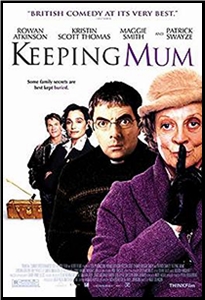
KEEPING MUM. Isle of Man Film – Azure Films – Tusk Productions / Entertainment Film Distributors, UK, 2005. Rowan Atkinson, Kristin Scott Thomas, Maggie Smith, Patrick Swayze, Tamsin Egerton, Toby Parkes, Liz Smith. Screenplay: Richard Russo & Niall Johnson, based on a story by the former. Director: Niall Johnson.

   A couple of months ago I saw a French film from 2000, With a Friend Like Harry, about a psycho who insinuates himself into a family. then “helps them” by killing anyone he perceives as their enemies. Imagine my surprise to find the same plot played for laughs — and played quite well — in Keeping Mum, which I recommend if you ever think back to those old Ealing comedies like Lady Killers and Kind Hearts and Coronets where murder was done with such quiet panache as to seen amusing and even tasteful.

   Mum centers around Kristine Scott-Thomas as the beleaguered wife of bemused country ,minister Rowen Atkinson, mother of a libidinous teenage daughter and a bullied son, and sex-object of sleazy lothario Patrick Swayze. Into her chaotic life housekeeper Maggie Smith descends like a lethal Mary Poppins with a perfectly simple philosophy for happiness: kill anyone who gets on your nerves.

   Writer-director Niall Johnson handles this thing with the necessary light touch — he recycles the cell-phone gag from With a Friend Like Harry to highly amusing effect — and the players are competent and sometimes inspired. Scott-Thomas as the wide-eyed adulteress reminded me touchingly at times of Celia Johnson in Brief Encounter. Give this one a look if you enjoy the gentle irony of British Humour at its best.

— Reprinted from The Hound of Dr. Johnson #51, May 2007.


ROADBLOCK. Pilot episode, 1958. MCA-TV/Revue. Later shown on (Heinz) Studio 57 as “Getaway Car,” 29 March 1958 (Season 4, Episode 19, in first-run syndication). Michael Connors, John McIntyre, Wallace Ford, Olan Soule, Irene James. Teleplay: Fredric Brady, based on the story “The Homesick Buick” by John D. MacDonald (EQMM, September 1950). Director: Earl Bellamy.

   The only clue the California cops have to catch a gang of bank robbers who made their getaway in separate automobiles is by cross-referencing the locations of the stations the radio of one of the cars was preset to. The driver himself is dead, with no ID on him, having been shot while driving away.

   I don’t get it. VIN’s have been around since 1954, and the car didn’t look older than that, but maybe it was. No matter. The rest of the case is based on faulty deductions, luck and pure guesswork. No wonder this pilot episode of a proposed new series, sort of a early precursor to CHiPs, went nowhere fast.

   A young Michael Connors plays a special motorcycle-riding state investigator in this one, young and very earnest. Most of the other roles are played by old-timers who could do short plays like this in their sleep.

      —

Note: Michael Shonk also reviewed this busted pilot a while ago on this blog. You can read his comments here.


JERRY KENNEALY – Polo in the Rough. Nick Polo #4. St. Martin’s Press, hardcover, 1989. Speaking Volumes LLC, paperback, 2013.

   Nick Polo is yet another San Francisco PI. This, his fourth recorded case, takes him to Carmel as a bodyguard for a writer who specializes in uncovering dirt those in political power would rather stay buried. What he’s working on now involves the Shah of Iran.

   And all the millions of dollars that left the country with him. Kennealy is said to be a working PI himself, which may explain why the writing is occasionally straight from the cliché closet, while the detecting is strictly high-tech state-of-the-art: Computer databases, mail-order supply houses, and all.

   Unfortunately Polo is not much help to his client, and the ending is as flat as yesterday’s two-day-old beer.

–Reprinted from Mystery*File #15, September 1989, very slightly revised.


      The Nick Polo series

1. Polo Solo (1987)
2. Polo Anyone? (1988)
3. Polo’s Ponies (1988)
4. Polo in the Rough (1989)
5. Polo’s Wild Card (1990)
6. Green With Envy (1991)
7. Special Delivery (1992)
8. Vintage Polo (1993)
9. Beggar’s Choice (1994)
10. All That Glitters (1997)
11. Polo’s Long Shot (2017)

REVIEWED BY BARRY GARDNER:


G. M. FORD – Who in Hell Is Wanda Fuca? Leo Waterman #1. Walker, hardcover, 1995. Avon, paperback, 1996. Thomas & Mercer, trade paperback, 2012.

   Is that a great title, or what? Okay, so it won’t mean anything to someone not familiar with the Northwest. I still think it’s great. And if “G. M. Ford” isn’t a pseudonym, it ought to be.

   Leo Waterman is a Seattle private eye who father was a long-term City Councilman. Leo’s had a problem with the bottle in the past, but seems to have it under control. He fee;s a thirst coming on, though, when the patriarch of Seattle organized crime, an old union associate of his father’s, asks him to help him.

   The old man’s granddaughter has left the family manse and is associating with a group of environmentalists who have a penchant for violence and ill-considered acts, and he wants Leo to find out what they’re up to. It’s one of those deals you can hardly refuse, so Leo marshals his helpers and starts to work. Oh, I ought to mention that the “helpers” are a group of alcoholics and some homeless who Leo met in his down-and-dirty days.

   If this sounds like a farce, it isn’t. At least mostly it isn’t. I think Ford had a few problems in drawing the line, bur for the most part it’s a straightforward if not overly grim and sometimes humorous PI story. The characters are entertaining and sympathetic, and Ford writes with an assurance and skill beyond most first-timers. (Was that a small homage to Chandler I caught at the beginning?)

   He obviously knows Seattle, and manages to bring the city to life without loading the narrative with the tiresome minutiae that often pass for a “sense of place” these days. If he can learn some sense of restraint with is characterizations — the villains were egregious over the top unless he wanted farce — and quit pulling rabbits out of the hat at the end (or if his editor will do it for him) I think he has the markings of a very good series.

— Reprinted from Ah Sweet Mysteries #18, February-March 1995.


         The Leo Waterman series —

   NOVELS

Who in Hell is Wanda Fuca? (1995)
Cast in Stone (1996)
The Bum’s Rush (1997)
Slow Burn (1998)
Last Ditch (1999)
The Deader the Better (2000)
Thicker Than Water (2012)
Chump Change (2014)
Salvation Lake (2016)
Soul Survivor (2018)
Heavy on the Dead (2019)

   SHORT STORIES

“Clothes Make the Man” (February 1999, EQMM)

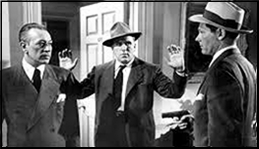
RACE STREET . RKO Radio Pictures, 1948. George Raft, William Bendix, Marilyn Maxwell, Frank Faylen, Harry Morgan, Gale Robbins. Director: Edwin L. Marin.

   Although available on DVD from Warner Archives, Race Street is largely a rather obscure one. even if considered film noir, a popular category now, if ever there was one. It has a decent cast, but I think the reason hardly anyone remembers or talks about it today, is that as a film, it’s mostly a mediocre one. It has its moments, including a few flashes of hard-boiled action, but it’s far too talky to stand out in a field filled with so many other crime films that came out around the same time and had a lot more to offer.

   George Raft plays the kind of bookie whom other bookies lay off their larger bets on, but a new gang is in town (San Francisco), and they’re beginning to push their way in,. What they offer is “protection” and they show no remorse in demonstrating what happens to guys who don’t take them up on it. William Bendix plays a childhood friend who’s also a cop, and who tries to persuade Raft to let the police take care of the problem.

   Raft will have nothing to do with it, of course, not even when one of his friends dies after being pushed around a little too hard. It doesn’t stop Bendix from talking and nudging and trying to persuade him otherwise. A couple of lengthy musical numbers featuring Gale Robbins as the lead vocalist are well done, but move the story along, they don’t.

   Marilyn Maxwell as a sultry brunette this time around plays Raft’s girl friend, a very eye-pleasing girl friend, to be sure, but her role in the story is, well, shall we say not particularly well filled out. If I’d been in charge of production, say, I’d have cut the musical numbers and given her story line the amount of running time it really needed.

   Since it’s far too late for the real director to have taken my advice, alas, he didn’t. While the end result is watchable, especially if you’re a George Raft fan — and to tell you the truth, I think his performance here is one of his better ones — you probably won’t remember it for more than ten minutes or so afterward.

« Previous PageNext Page »