Reviews


REVIEWED BY DAVID VINEYARD:

BRIAN CLEEVE – Vice Isn’t Private. Sean Ryan #3. Random House, hardcover, 1966. Lancer 73-621, paperback, 1967. First published in the UK as The Judas Goat (Hammond, hardcover, 1966).

   Somewhere between the suave James Bond, the tough minded Quiller, and Len Deighton’s nameless (in the books anyway) Chandler-voiced cynical operative there was Brian Cleeve and his creation, former IRA killer turned reluctant British agent, Sean Ryan.

   Like many of his fellow British spy writers, Cleeve was a former intelligence operative, but unlike most, he chose a darker and less glamorous path. You wonder if Ryan ever owned a dinner jacket; in fact, you wonder if he owned a decent suit most of the time.

   This gritty thriller opens with Ryan recently rescued from prison by a cold-blooded major (is there any other kind in spy fiction) to work for counter-intelligence, “You don’t have to know anything, just do what you are told.”

   Kathy O’Hara’s “friend,” Mike Rafferty, is in Garside prison, and a fixer named Harry Marks has arranged for a meeting with Ryan as the man to get him out, but Harry is under the thumb of brutal gangster Guilio Romano, and he sings like a bird that Ryan is “Big Law”.

   Ryan’s job is to get Rafferty out, disguising the fact he has the government behind him, follow him and retrieve the photographs Rafferty is blackmailing a cabinet minister with. Not just any cabinet minister either, Garrett Cameron-Harvey, the Home Secretary.

   To this point, this entry in the series is pretty clearly based on Sean Bourke’s book about breaking traitor George Blake out of prison and smuggling him out of England to Russia. It was a good story as true spy stories go, demonstrated by the fact it was the basis for Desmond Bagley’s Freedom Trap (John Huston’s The MacIntosh Man) and would have been the basis for a Hitchcock film had he lived.

   It made headlines and Bourke’s book was a bestseller, optioned but not filmed itself.

   Of course nothing is ever that simple in any spy novel, much less suspense novel, and the same is true of this one.

   Complicating things farther is the source of the Home Secretary’s blackmail, Irina Mortimer, a discrete dominatrix who has reasons of her own to keep his secrets from destroying her access to a very elite clientele in Europe and England.

   The escape proves the easiest of Ryan’s tasks, which escalate when Romano kidnaps Rafferty in order to get the papers for himself, leaving Ryan to rescue Rafferty, retrieve the photographs, and get Rafferty and Kathy O’Hara out of England and well away from the Home Secretary, all complicated by Ryan’s growing hate of Rafferty and desire for Kathy, and Cameron-Harvey himself on the thin edge threatening to collapse under the threat.

    Vice Isn’t Private is a tight and lean book, under two hundred pages, far from today’s bloated thrillers. There isn’t an extraneous word or missed beat, the violence shocking and sometimes sadistic, the suspense palpable, and Ryan a fascinating protagonist torn between his violent past and glimpses of a world away from it he can never quite reach, all told in tough and sometimes poetic prose by Cleeve, who later went on to write bestselling historical fiction.

REVIEWED BY DAN STUMPF:

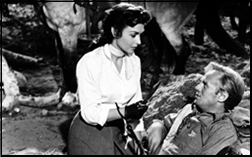
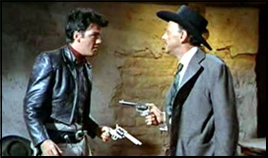
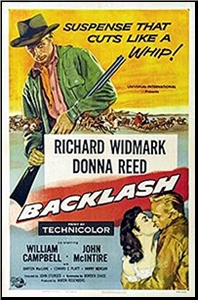
BACKLASH. Universal International, 1956. Richard Widmark, Donna Reed, William Campbell, John McIntire, Barton MacLane, Harry Morgan, Robert J. Wilke, Jack Lambert, Roy Roberts, Edward C. Platt, Robert Foulk. Screenplay: Borden Chase, based on the novel Fort Starvation by Frank Gruber, reviewed here. Director: John Sturges.

   Here’s a gaudy little B-movie which I found enjoyable out of all proportion to its actual merit. Written by Borden (Red River) Chase, directed by John Sturges (Great Escape, Magnificent Seven) and done up in lurid Universal Technicolor, this is in every inch a “B,” never mind the budget, cowboys, Indians, lost treasure and what-all else you need for a Saturday afternoon.

   The plot hangs loosely on the peg of Richard Widmark looking for the man who killed his Pa — or more precisely, the an who let Dad and four others get butchered by Indians instead of going for help, then took the gold they were carrying out of Indian country.

   To this end, Widmark does some exemplary sleuthing, poring over old testimony, double-checking witnesses, exploring the crime scene and wisecracking in the best PI tradition (“There’s something I’ve wanted to tell you since we first met — Goodbye!”) with “tough gal” Donna Reed, who plays the possibly treacherous female lead like Angie Dickinson in Rio Bravo or The Killers.

   There are suggestions here that this could have been a better movie, though perhaps less fun: as the story progresses we find that Widmark is not so much pursuing his dad’s killer as he is trying to live up to a father whose love he never knew. Anthony Mann or Delmar Daves would have pursued the oedipal complexities of this, but Sturges just shrugs it off and brings on the Indians.

   And the gunfights, fistfights, and chases with the lean technical skill typical of him, and even a certain amount of humor. I particularly enjoyed the spirited thesping of third-billed William Campbell: he’s only in the movie for a few minutes, but he plays a black-clad giggling gunfighter just like Richard Widmark’s Tommy Udo of a decade earlier.

— Reprinted from The Hound of Dr. Johnson #51, May 2007.


BOSTON LEGAL “Head Cases.” ABC, 60 min. Season 1, Episode 1. 03 October 2004. James Spader (Alan Shore), William Shatner (Denny Crane), Rhona Mitra, Lake Bell, Mark Valley, Rene Auberjonois, Monica Potter. Created by David E. Kelley. Director: Bill D’Elia.

   William Shatner will be known for now and forever as Captain James Kirk of the starship Enterprise, but I think that totally irreverent hotshot Boston lawyer Denny Crane is the role he was always meant to play. His view of things is that he’s still at the top of his game, but in this first episode of Boston Legal, his underlings and associates are beginning to wonder if he’s still up to the job.

   This series had a large ensemble cast, and since some of the players came over from a preceding series called The Practice, which I never saw (and in fact this is the first time I’ve seen an episode of this series), it took me a while to put together who was who and what connection they may have to each other.

   There are a quite a few cases the firm is working on as well, beginning with the head of the local office coming to a staff meeting sans pants (nor undershorts) and being carried away strapped down in a stretcher. The two major ones are (1) a major client of the firm demanding that a PI be hired to follow his wife. Denny refuses, for good reason. He’s the one who’s sleeping with the wife. And (2) the mother of a young black girl wants to sue a theatrical company for not choosing her to play the part of Annie.

   James Spader is the first name in the cast listing, but it took me until I’d seen the second episode, not otherwise reviewed here, to understand how essential he is to the show’s chemistry. His unflappable refusal to ever be outwitted in a battle of words, in the office as well as in the courtroom, is a wonder to behold.

   By the way, I consider this a comedy, an extremely sophisticated one, but if you were to have been watching me watch this show and listening to me laugh out loud several times, and smile all of the rest of the time, you would know exactly what I mean. I also do not know how true this is in the real world, but not only are all of the women in this series knockout attractive, they’re wonderful actors too.

   It looks like I may be watching this series several nights a week for some time to come.


MICHAEL J. KATZ – Last Dance in Redondo Beach. Andy Sussman & Murray Glick #2. G. P. Putnam’s Sons, hardcover, 1989. Pocket, paperback, 1990.

   Here’s a first. It’s gotta be. A professional wrestler dies, apparently of a heart attack, in a network’s “celebrity sports” competition. It’s really murder, of course, and on the scene, in his second brush with detective work is CBS sportscaster Andy Sussman.

   Doing most of the legwork, however, is his pal, a sleazy Chicago PI named Murray Glick, who works out of a Northbrook Court mall. You may have gotten the idea by now that the tone of this book is not entirely serious, but I surprised myself and enjoyed it anyway. (*)

       —

(*) I’d be remiss in pointing out, however, that I found the ending to be a bit too slick. The final confrontation works out far too easily — and not easily enough to avoid leaving a mess behind. Katz seems to think that justice is done, or at least his characters do, and in a sense they’re right, maybe as well as it ever does in real life, but I still think there’s some guilt not yet accounted for.

–Reprinted from Mystery*File #15, September 1989 (very slightly revised).


      The Andy Sussman & Murray Glick series

Murder Off the Glass. Walker, 1987.
Last Dance in Redondo Beach. Putnam, 1989.
The Big Freeze. Putnam, 1991.

REVIEWED BY DAVID VINEYARD:

ALEXANDRA SOKOLOFF – Book of Shadows. St. Martin’s Press, hardcover, June 2010.

   I admit readily I am a sucker for an evocative opening, and this one does it in spades.

   Caterpillar trucks and front-loaders crouched with metal jaws gaping, like gigantic prehistoric insects on the mountains of trash, an appalling chaos of rotting vegetables, discarded appliances, filthy clothing, rusted cans, mildewed paper: the terribly random refuse of a consumer society gone mad. A lone office chair sat on the top of on one hill, empty and waiting, its black lines stark against the fog.

   And below it, tangled in the trash like a broken doll, was the body of a teenaged girl.

   Boston policemen Adam Garrett and Carl Landauer have caught a messy case, the dismembered body of a murdered teen left in a landfill. The two, different as night and day, are a good team, seasoned and skilled at their jobs, but this time they are about to be in over their heads, beginning with the black wax found on her, the number 333, and three triangles carved on her flawless skin.

   It’s not an ordinary sex murder, not an ordinary serial killer. That much is quickly apparent, and it soon gets worse when they find the victim is the daughter of a wealthy businessman.

   The ME soon confirms the cops worst fears, the not so faint breath of the Satanic is licking at the heels of the case like a hound of hell.

   But this is more than just some drug happy kids playing with blasphemy. Something more serious and more primal is going on, and the stench of sulfur and brimstone is palpable.

   I confess I love this sort of thing when it is done well as it is here. The mix of police procedural and growing horror is kept well in balance with the hero gradually facing despite everything there is more at stake than just a killer, more at hand than only brutal murder.

   Enter the attractive Tannith Cabarrus, who comes to the police to report she has dreamed three murders. Tannith isn’t a psychic, she’s a witch, and something evil is about, and the clencher is hard to deny;

   â€œSo if you ‘dreamed’ this before, why is this the first time we’re hearing about it?”

   â€œIt’s not,” she said. There was ice in her voice. “The first time, I hoped it was just a dream. The second time I knew it wasn’t, and I called here, the police station. I was told no such killings had occurred. This time—when I saw the news, I came in.”

   Of course Garrett and Tannith are going to become involved as the case spirals out of control and edges toward madness. Sokoloff has a sure hand, and keeps all the elements in the air as she juggles them with professional skill building to a suspenseful and dramatic confrontation with evil and madness well beyond the mere human kind.

   By downplaying the melodrama, Sokoloff succeeds in making it all the more effective when it does come, avoiding the too great reliance on eldritch lore and the weird for a solid blend of cop drama and supernatural thriller. It’s always a pleasure to be taken in hand by a gifted pro for a walk on the really wild side.

PETER DUNCAN – Sweet Cheat. Dell First Edition A182, paperback original; 1st printing, 1959. Cover art by Darcy (Ernest Chiriacka).

   The cover artist was worth mentioning, I thought, since it was his work that caught my eye and had me pick this off the shelf to read way ahead of several hundred other books. (What do you think? Wouldn’t you?) It turned out to be a good choice, too. I enjoyed the book as much as I did the fetching young lady on the cover.

   Buck Peters, who tells the story, is both the Chief of Police in his home town and a deacon in the local church, so he has something of a reputation to maintain with his Mama and the other elderly local ladies, which makes solving the town’s latest (and maybe the first in the long time) a task something like juggling three balls in the air blindfolded.

   Dead is a woman known as the town’s tramp, although that’s by reputation only. As much as she teased the menfolk’s healthy libidos, Buck knows that none of them had ever even made it to first base with her. What was the motive, then? Buck has a feeling that it was only frustration.

   What complicates everything — and thus takes up most of the story — is that the chief suspect is Kip Belton, the police commissioner himself, a man whose wife Buck has been diddling with (his word) since high school. Belton’s alibi is that he was with his wife at the time, but he was not. She was with Buck, doing what long-time lovers do whenever they can, and in the Beltons’ own back yard.

    What a predicament! Luckily Buck has similar goods on all the other men in town, and when it’s necessary, he’s not at all leery about making what he knows be known — much to the delight of Delbert, his deputy , who is a little sharper than Barney Fife, but not by a whole lot.

   It all works out in the end, and I was sorry the end came so soon. Highly recommended, if you happen to come across a copy — and if you go looking, it’s not a book that’s very hard to find.

   As for Peter Duncan, whose real name was Butler Markham Atkinson Jr., he has one other mystery novel in Hubin, a Gold Medal original entitled The Telltale Tart (1961). That one I’m going have to go looking for myself.

REVIEWED BY DAN STUMPF:

LET’S GO NATIVE. Paramount, 1930. Jeanette MacDonald, Jack Oakie, “Skeets” Gallagher, Kay Francis, James Hall and William Austin. Written by Percy Heath and George Marion Jr. Directed by Leo McCarey.

   A silly thing, but outrageously enjoyable. Writers Heath and Marion start with a “putting on a show” story: Jeanette McDonald is a Costume Designer in dire straits whose show is about to launch… if she can just make ends meet till then. That’s adequate, but Director McCarey is more interested in using slap-shtick from his old silent days, while Eugene Pallette, charged with repossessing Jeanette’s belongings, drops and breaks whatever he touches, like a one-man Laurel & Hardy routine.

   Suddenly a title card informs us that the star of the show couldn’t make it, so Jeannette stepped in and is now the star! 10 minutes of show tunes ensue, including one with dancing bears that ends with the warbling lovers encased in snow. McCarey does what he can with a stationary camera, but basically this is just photographed dance routines, in the style of the Marx Brothers’ Coconuts (1929.) Still, those guys dancing in bear suits….

   About this time Jack Oakie shows up as a cab driver named Voltaire McGinnis, and the whole show sets off for South America(!) whereupon Native turns into a shipboard romance, with Jeanette up against Kay Francis (also the vamp in Coconuts) for the affections of bland leading man James Hall. With time out for some more L&H routines and a dance number of course.

   Then there’s a shipwreck and the players are stranded on a tropical island ruled by Skeets Gallagher, a band-leader marooned there years ago, who taught the native girls (there are no native men) to play swing music. So they dress up in Jeanette’s costumes and put on a show till the volcano erupts…. and NO, Jeanette does NOT wake up from a dream.

   Jack Oakie gets most of the comedy time, but the big laugh-getter is William Austin, a British comic I never heard of, who does physical & verbal comedy equally well, mixed with an off-hand manner that downplays his expertise and conversely shows it off. Austin had a mostly bit-part career but is remembered thusly in IMDB:

    “William Austin’s being cast as Alfred the Butler in the Columbia Pictures’ Batman Serial (1943) proved to have a profound effect on the character. Prior to the serial, Alfred had been portrayed as being a very portly character. In order to rectify the disparity between Comics Page and Film, the Editors at DC Comics had Alfred put on a diet; which resulted in a slimmer Butler, who mirrored the movie version.”

   So William Austin paved the way for Michael Gough, Alan Napier, Michael Caine and Jeremy Irons. In these posts I strive to be Educational as well as Entertaining.


FIRST YOU READ, THEN YOU WRITE
by Francis M. Nevins


   THE VIRGIN KILLS (1932) was Whitfield’s third and final crime novel under his own byline and a sad comedown after his first two. Our narrator, sports columnist Al Connors, is invited to join a party on the yacht of shady gambler Eric Vennell (the “Virgin” of the title) as it makes its way up the Hudson from Manhattan to Poughkeepsie where the annual inter-university boat races are held.

   Accompanying Connors is Mick O’Rourke, a scar-faced Victor McLaglen type, who’s bodyguarded several top gangsters and has been recruited by Connors to perform the same function for Vennell, who claims he’s been threatened by racketeers after his investment firm lost a pile of their money on the stock market. Also on board the Virgin are a movie star, a bitchy female writer, a Lindberghesque aviator and some others.

   Not much happens until the big race, which the odds-on favorite California crew loses to Columbia thanks to its stroke—“the most important of the oarsmen”—collapsing and dying just before his crew’s “shell” reaches the finish line. An autopsy establishes that, either before or during the race, someone with a hypodermic needle had injected the victim under his left shoulder blade with a fatal dose of morphine.

   Not long afterwards, Vennell is found murdered in his cabin aboard the Virgin. The rest of the book is padded with endless speculations by the narrator, a Poughkeepsie cop and a Philo Vance type hired by the dead oarsman’s family. “He’s suave and very cold and superior….He’s the kind you read about in the books whose writers go in for annotations and such stuff.”

   Luckily for us, this character talks just like all the others in the book, making no attempt to ape that insufferable twit created by S. S. Van Dine. Eventually some movie footage of the race, shot from an airplane, comes to light and the murderer obligingly confesses everything. Since every moment of the action takes place on board the yacht, one might easily believe that the novel was originally intended as a stage play, with interpolated film footage at the climax.

   Whitfield is reported to have helped Hammett construct some of his plots, but I find this rumor hard to swallow considering how in THE VIRGIN KILLS he bungled some crucial physical details. At one point the Poughkeepsie cop asks: “Number Seven [the prime suspect among the California oarsmen] is right ahead of the stroke in a shell, isn’t he?” To which the captain of the Virgin replies: “He sure is.” This is confirmed by our Philo Vance stand-in, who tells us that Number Seven “was directly in front of [the morphine victim]—that is, ahead of him.”

   In that case, Number Seven would have had to reach behind him with one hand to puncture the victim, while rowing at full speed with the other. What an athlete! A page or so later Whitfield seems to have realized his blunder when he has the ersatz Vance character state that Number Seven’s “face was to [the victim’s] back….,” but he doesn’t bother to correct the earlier dialogue. We have to give Whitfield some credit for using “human” when he means “person” only a few times, but we must yank it back when he tells us over and over that the oarsman murdered during the race was “morphined.” If a different poison had been used, would we have been told that the poor guy had been arsenicked or strychnined to death?

   Perhaps the most intriguing aspect of THE VIRGIN KILLS is that the California crew’s physician happens to be named Doc Vollmer, which is also the name of the West 35th Street medico who is called in whenever a body turns up on or near the premises of Nero Wolfe. Either Rex Stout read this misfire of a mystery, and remembered, or we are faced with a full-blown Keeler Koinkydink.

***

   In 1933 Raoul and Prudence Whitfield were divorced. Did her long term affair with Hammett have something to do with the breakup? Hardly had the decree become final when Raoul married again, this time into the Vanderbilt family, and more or less retired from the words game. I have a sneaking suspicion that Hammett was tweaking Whitfield’s nose a bit when, early in THE THIN MAN (1934), he had Nick Charles say that he quit the PI game when his wife Nora inherited a fortune.

   Unlike Nick’s marriage, Raoul’s didn’t last long. Emily Whitfield filed for divorce in February 1935 but shot herself to death a few months later in their New Mexico ranch house, a chain of events on which Walter Satterthwait based his novel DEAD HORSE (2007). Thanks to her will, her estranged husband—who, being in California at the time, had a perfect alibi—morphed into a sudden millionaire.

   From then on he lived the high life and drank whiskey as if it were water. Eventually he married a third and much younger woman, a local barmaid who, in 1943, also killed herself. By this time Raoul had run through Emily’s Vanderbilt money and contracted tuberculosis, which took his life in January 1945.

***

   None of Whitfield’s three crime novels under his own name was reprinted in paperback during his lifetime. GREEN ICE appeared in softcover not long after his death (Avon Murder Mystery Monthly #46, 1947, as THE GREEN ICE MURDERS) and reappeared in the 1980s, along with DEATH IN A BOWL and THE VIRGIN KILLS, in the Quill Mysterious Classics series edited by Otto Penzler. Whitfield’s debut novel was also reprinted in hardcover by Gregg Press (1980) and, more recently, by Mysterious Press (2014).

   Between 1930 and 1933 the Knopf firm published three other Whitfield titles (WWI and aviation books apparently aimed at the juvenile market) and the obscure Penn Publishing Company issued another air adventure, but these have never been revived and are near extinct, as are the two crime novels issued by Farrar & Rinehart under the pseudonym of Temple Field (FIVE, 1931, based on the 5-part Black Mask serial published between June and October 1929, and KILLERS’ CARNIVAL, 1932, taken from the 6-part Black Mask serial published between August 1931 and January 1932).

   Of his 300-odd shorter tales the most easily accessible are the cases of the Filipino sleuth Jo Gar, certainly Whitfield’s most important character and probably the first ethnic detective after Charlie Chan. The eighteen genuine short stories about him were collected in JO GAR’s CASEBOOK (Crippen & Landru, 2002) and are also available, along with the two Black Mask serials in which he stars —one in six installments, the other in two—in WEST OF GUAM (Altus Press, 2002, expanded edition 2013).

   Most of Whitfield’s short stories featuring other series characters like Ben Jardinn or no such character at all are available to you only if your shelves are piled high with issues of Black Mask . Prudence Whitfield, the only one of Raoul’s three wives to survive him, prevailed upon Fred Dannay to reprint that six-part Jo Gar serial in Ellery Queen’s Mystery Magazine (February-July 1949; originally in Black Mask, February-August 1931, with no installment in the June issue) and also three other tales (May 1948, November 1951, June 1953).

   I suspect it was also due to Prudence that editor Hans Stefan Santesson chose two more Whitfield stories for reprint in The Saint Detective Magazine (March and August 1956) and a third (March 1960) featuring Jo Gar. Not much of a showing when stacked up against the novels and stories of Hammett and Chandler, which have been reprinted on a regular basis for generations, but then Whitfield was never in their league.

   Still, a letter from him or a first edition of one of his scarcer books can command more than $3000 in the collectors’ market. Whether or not they’re worth that much, it can’t be denied that Raoul Whitfield remains of interest today to anyone who wants to understand the formative years of the literature we now call noir.


NOTE: Part One of this two-part profile of Raoul Whitfield can be found here.
REVIEWED BY DAVID VINEYARD:

SERGEANNE GOLAN – Angélique and the Sultan. Angelique #3. US edition published as Angélique in Barbary. Film: A Franco-German-Italian-Tunisian film dorected by Bernard Borderie , released in 1968, with Michelle Mericier & Robert Hossein.

   Our story up to now:

   Angelique. Born Angelique de Sanc de Monteloup, of a family of the minor nobility in Poitou, she first married Comte Jeffrey de Peyrac of Toulouse, Prince of Aquitaine, of the Palace of Gay Learning. Jeffrey, a remarkably brilliant and powerful man, was condemned to the stake by Louis XIV on a trumped-up charge of sorcery, and was supposedly executed in February 1661.

   Reduced to extreme poverty, Angelique became a member of the Paris underworld, the rendezvous of which was the Court of Miracles in the Saint-Denis quarter of Paris. Later, under the name of Madame Morens, she opened a chocolate shop with David Chaillou, whereby she made a great deal of money which she invested shrewdly, becoming extremley rich, and a member of the literary society of Paris.

   Having been in love with her cousin Philippe, Marquis du Plessis-Belliere, since they were both adolescents, she more or less blackmailed him into marrying her, thus gaining a position in the high nobility of France. She became a shrewd adviser and trusted confidante of Louis XIV and his Minister of Finance, Colbert, and one of the leading members of Louis’s brilliant Court at Versailles. The King’s attentions to her involved her in a fierce rivalry with his mistress, Madame de Montespan. Louis XIV was deeply in love with Angelique, but she resisted his advances and fled the Court, thus incurring the King’s grave displeasure …

   This international bestseller of doorstop adventures of the seventeenth century cross between Candide, d’Artagnan, Fanny Hill, Little Orphan Annie, Madame DuBarry, and Little Nell picks up as our heroine learns the king has pardoned her scar faced lover Joffrey, who has promptly escaped. Always true to her husband, in her fashion, Angelique sets out to find him and reunite with him, but as nothing comes easily for her the reader can be assured they will not be reunited easily.

   The series was written by Anne and Serge Golon, signing as Sergeanne Golan after the first book, and was an immediate bestseller in Europe and then here. The thick paperbacks were a common sight on newsstands, though they made little room for anything else in a spin rack. Finding one that didn’t have a bent cover from being shoved in too small a space was rare.

   Fairly tame in terms of actual sex despite all of her affairs, the books offered a rich background of palaces, intrigue, Dickensian poverty, rogues, adventurers, pirates, heroes, villains, swords, duels, escapes and hurried journeys that manage to sweep from France to the Middle East and all the way to the New World while inspiring films and television series (the most recent only a decade or so back). They were bodice rippers before the genre was invented and Angelique, no doubt inspired by Kathleen Winsor’s Amber from Forever Amber, a cottage industry unto herself.

   My first wife being a long blonde green-eyed French dancer named Angelique, I probably have a higher tolerance for these books and films than many of you. Old home week.

   Anyway, our heroine is off to find her dear Joffrey, a journey that leads her to Marseilles and the smuggler ridden coast of Southern France onto Candia, center of the slave trade, then to Algiers and onto Morocco and the harem of the Sultan Mulai Ismael, the Moroccan equivalent of Louis XIV. Along the way she is shipwrecked and rescued by the masked pirate known as Rescator who holds her youngest son by Joffrey Cantor as hostage and gives her to the Grand Eunuch, Osman Faraji, who in turn presents her to his Sultan.

   Points if you have figured out why Rescator is masked and holds Cantor, much less why Angelique is turned over to Osman Faraji.

   She also manages to seduce, emotionally if not physically, the Eunuch, the Sultan, a French Admiral, and the slave Colin Paturuel, who will naturally give his freedom and life for her while out maneuvering and winning over the Sultan’s jealous first wife Daisy-Valina. And have no fear Joffrey will show up as well, to steal a treasure from the Sultan’s kingdom, and pick up the pieces, since Angelique is not the sort to sit around and wait for rescue, all told in rich descriptive prose somewhere between Dumas and Maurice Dekobra (bestselling French author of Madonna of the Sleeping Cars and many others) and equally adept at describing luxury, sensuality, horror, hardship, and emotional trauma.

   Granted these are thick dense books filled with actual historical personages, interwoven with Angelique and her friends and lovers adventures, they are certainly not great literature, and lacking Georgette Heyer’s signature wit, but they are also literate, expansive, and more Dumas than Kathleen Winsor.

   The Michelle Mercier films are big productions and perfect companions to the films with Mercier and Robert Hossein ideally cast as Angelique and Joffrey, though thankfully running times are nothing like reading ones.


MICHAEL ALLEGRETTO – The Dead of Winter. Jake Lomax #3. Scribners, hardcover, 1989. Avon, paperback, 1991.

   In this his third case, PI Jake Lomax is hired to find a barber’s missing daughter. The barber’s also a bookie, and the daughter, a sensitive type, has just found out. A good beginning, and the stakes quickly become even higher. The next day a bomb destroys the barber’s car.

   Allegretto has a smooth, even style of writing, but until the kidnapping plot is revealed, not much out of the ordinary actually happens. I’m ambivalent about the kidnapping plot, too. It’s an interesting twist, but overall the story line is a combination of bad coincidence mixed with poor judgment.

–Reprinted from Mystery*File #15, September 1989 (slightly revised).


      The Jake Lomax series —

Death on the Rocks (1987)
Blood Stone (1988)
Dead of Winter (1989)
Blood Relative (1992)
Grave Doubt (1995)

« Previous PageNext Page »