THE CROOKED WAY. United Artists, 1949. John Payne John Payne, Sonny Tufts, Ellen Drew, Rhys Williams, Percy Helton, John Doucette, Don Haggerty. Director: Robert Florey.
Although in many ways a highly impressive film noir, The Crooked Way doesn’t have much in the way of depth. The story is a familiar one to those steeped in the works of writers such as Cornell Woolrich and David Goodis. World War II has ended. A man (John Payne) wakes up in a U.S. Army hospital in San Francisco with a metal fragment in his skull and no memory of his past life. He thinks he’s named Eddie Rice and from Los Angeles.
It therefore makes sense that he’d go to the City of Angels to piece together who he is so he can begin living again. When he gets to LA, though, he soon learns that his real last name isn’t Rice. It’s Riccardi. Eddie Riccardi. And he led a life of crime and was mixed up with some seriously bad dudes.
He also had – or has – a wife named Nina Martin (Ellen Drew), who is now working with his former associate, the nasty and brutish Vince Alexander (Sonny Tufts). Much of the running time is spent on the cat-and-mouse games played by the LAPD and Vince with Eddie (Payne) caught in the middle. And just when things don’t seem as if they could get any worse for him, he finds himself framed for the murder of a LAPD officer.
All standard material in the world of late 1940s crime cinema, topped off with a significant amount of time devoted to the then nascent science of forensics. Payne does more than an admirable job in portraying the film’s doomed protagonist, although he isn’t quite able to capture his character’s inner life. How tormented is Eddie Rice/Riccardi after all he’s been through? To be honest, we don’t really know. Had the producers wanted more of the lead character’s trauma explored, someone like Robert Ryan would have been a more suitable actor for the part.
What The Crooked Way may lack in depth, however, it more than makes up for in flair and style. The movie was lovingly photographed by cinematographer John Alton, who lent his signature touch to numerous films noir in the 1940s and 1950s. From the lighting to the prototypical noirish mood settings, the movie is steeped in the dark and shadowy world of film noir.
I know that sometimes there is a debate about whether a movie can rightly be considered a film noir. Trust me, this one with the neon lights, the nightclubs, the rainy LA street, the shootout in a warehouse, the unique camera angles, is about as visually noir as you can get. Recommended.
JIN ROH, THE WOLF BRIGADE. Japan, 1999. Voices (in the English version): Michael Dobson, Moneca Stori, Colin Murdock, Maggie Blue O’Hara. [From Wikipedia: “The film is the third adaptation of Mamoru Oshii’s ‘Kerberos saga’ manga, Kerberos Panzer Cop, after the two live-action films: The Red Spectacles and StrayDog: Kerberos Panzer Cops released in 1987 and 1991 in Japanese theaters.”] Directed by Hiroyuki Okiyura.
Japanese anime can be as stylized and foreign to Western audiences as Kabuki theater or Chinese Opera in some cases, and tied in with the cultural differences, it can be a hurdle for older viewers in the US who didn’t grow up with it to follow, but it is also a universal storytelling medium that doesn’t always need language to tell its stories, and a well-told story is a well told story regardless of medium.
Jin Roh, the Wolf Brigade is set in an alternate Post-War setting where Japan is beset by native terrorists and protected by Special Units of Police trained as jin roh “human wolves.†There are developing tensions between the special units and the regular police and they are as much at each other’s throats as the terrorists.
When jin roh Kazuki Fuse (pronounced Fu-say) hesitates to kill a young female courier who then triggers a deadly explosion, it gives the police something to use against the special units, and they act quickly to discipline Fuse, sending him back to training under an officer whose son is with the regular police. Then Fuse, still suffering flashbacks to that night and guilt-filled hallucinations, meets and falls for the dead girl’s sister, who bears her an uncanny resemblance.
Done in realistic style animation, the story is a strong mix of noir, action, and Le Carre style intrigue, where nothing and no one is quite telling the truth, and loyalties shift on treacherous moral sands.
This is as grim and dark as any live action film, as morally complex, and as unrelenting. It is also beautifully told, with strong elements visually and easily identifiable characters whose animated faces reveal their character as well as many actors.
Unlike most anime, other than the set-up there is little in the way of science fiction or fantasy elements here, rather a powerful dystopian future, handsomely rendered and deftly told with as many twists as any thriller.
The film was submitted for an Academy Award in animation, but wasn’t qualified because it first played on Japanese television. It is not a story you will easily forget once seen.
THOMAS PERRY – Vanishing Act. Jane Whitefield #1. Random House, hardcover, 1995. Ballantine, paperback, 1996.
The Butcher’s Boy is one of my favorite books, with Metzger’s Dog not far behind. I’m always glad to see a new one by Perry.
Jane Whitefield is a young woman who is part Seneca by blood, all by heritage. She lives in upstate New York, and is a guide. Not the kind of guide you may be thinking of, though; she guides people who need to be lost, people who have other people looking for them. Jane puts them on the road to not being found, and teaches them how to walk it.
And then one day a man named John Felker shows up at her door. He says he’s an ex-cop, that he’s been framed, and that there’s a contract out on him. There are people after him, all right, as Jane finds as they set out on the road to anonymity, but he’s not exactly what he seems. A different road lies ahead, with a different destination.
Two things you can depend on with Perry: he’ll have a strong, somewhat off-beat central character, or characters, and he’ll tell a hell of a good story. Jane Whitefield is one of his more memorable leads, and the story is a fast-moving thriller that will drag you right along.
There’s a good deal of Native American lore and history interspersed in the third person narrative, about the verisimilitude of which I have no idea at all, but which certainly enhances the story and fits in well with it. Perry seldom writes the same book twice, but he always writes a good one, and this one is very good.
— Reprinted from Ah Sweet Mysteries #18, February-March 1995.
THE MAN WHO DIED TWICE. Republic Pictures, 1958. Rod Cameron, Vera Ralston, Mike Mazurki, Gerald Milton, Richard Karlan. Writer: Richard C. Sarafian. Director: Joseph Kane.
Albeit brief in running time, The Man Who Died Twice is a surprisingly stylish film noir from Joseph Kane, a director better known for his work with Gene Autry and Roy Rogers. With a taut screenplay from Richard C. Sarafian, there’s more than a hint of sleaze in this crime thriller. Let’s see. There’s the lead character who may or may not be a Kansas City cop, a nosy old woman who gets more than she bargains for when she snoops on a couple of hitmen, a heroin addict who double crosses her dealer, and a nightclub singer who pretends not to see the obvious sin all around her. All good stuff if you’re into that sort of thing.
Rod Cameron portrays Bill Brennon, the Kansas City cop who shows up in town after he learns that his good for nothing brother T.J. died in an automobile accident. He soon finds out that T.J., a nightclub owner, was mixed up in a heroin smuggling operation and that he got into some disputes with his business associates.
Further complicating matters is Lynn Brennon, his brother’s widow. She professes to know nothing about what her deceased husband was mixed up in. But Bill feels protective toward her. In fact, he may even be falling in love with her. All of this is quite displeasing to Rak (Mike Mazurki), one of bartenders at the nightclub, who obviously is also holding a candle toward Lynn.
There’s not really one second wasted in this Republic Pictures release. It moves at breakneck speed and has some exceptionally well-crafted moments, especially those involving the two hitmen sent from Chicago to recover a payload of heroin from the dead brother’s apartment. In this way and others, this movie reminded me quite a bit of The Lineup (which I reviewed here), also released in 1958. Although the latter film is clearly superior, the two put together would make for a great double feature.
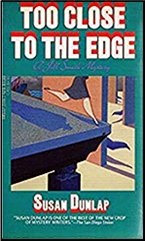
SUSAN DUNLAP – Too Close to the Edge. Jill Smith #5. St. Martin’s, hardcover, 1987. Dell, paperback, July 1989.
Detective Jill Smith works out if the Homicide-Felonious Assault division of the Berkley police department, and in this case she solves the murder of a handicapped woman dumped from her wheelchair and drowned in a few inches of water at the edge of the bay.
What I don’t know about police procedure you could write a book about, but the investigating techniques displayed here seem awfully chaotic and uncoordinated to me. And while Dunlap is a good writer, someone should tell her not to make up clues as she goes along.
SIMON & SIMON “Details at Eleven.” CBS, 24 November 1981. (Season 1, Episode 1.) Jameson Parker (A.J. Simon), Gerald McRaney, (Rick Simon), Jeannie Wilson, Cecilia Simon, Eddie Barth. Guest Cast: Peter Graves, Markie Post, Sharon Acker. Writer: Philip DeGuere Jr. Director: Corey Allen.
Total opposites, even if they are brothers, make good partners, even in the private eye business, or so is the premise of this long-running TV series. A.J. is the laid-back one, wearing blue jeans and cowboy boot,s while Rick wears suits and ties in the bast Wall Street tradition.
As I understand it, this first episode was not the pilot, but while it takes a while, I’d have to say that it serves the purpose, which is to introduce the recurring vast members, letting the viewer get to know them and who they are. The two brothers bicker a lot, mostly about their childhood and how Mom liked the other best.
Of course when they get in a jam, as in “Details at Eleven,” when they get stuck in Mexico without a car, who comes to their rescue? Mom, of course. In this story they’re hired by a woman whose daughter is missing. It turns out that she has documents that will prove that her stepfather, a prominent newscaster in San Diego area, is on the take from gangsters who are hoping to promote him to public office.
What I noticed first of all is how fast paced this episode was. No long scenes of cars driving from one place to another, or planes landing or taking off, a la some episodes of The Rockford Files, among a few others.
I also assume the bickering between the two mismatched brothers had a lot to do with their long-term appeal. The show was on for eight seasons, but for whatever reason this is the first episode I’ve ever seen, and I don’t know why. I enjoyed this one, and as I have the first season on DVD, I will be watching more.
QUEENS OF MYSTERY. Acorn original TV series, available on Acorn streaming, April 2019. Sly Fox Production for Acorn Media Enterprises, produced in association with Ferncroft Media Limited. Cast: Olivia Vinall as Detective Sergeant Matilda Stone, Julie Graham as Cat Stone, Sarah Woodward as Beth Stone, Siobhan Redmond as Jane Stone, Martin Trenaman as Inspector Derek Thorne, Michael Elcock as P.C. Terry Foster, Andrew Leung as Daniel Lynch, and with the Voice of Juliet Stevenson. Created and Executive Produced by Julian Unthank. Produced by Linda James and Tim Vaughan.
It is difficult to watch the opening of new British TV mystery series Queens of Mystery without thinking of one word – whimsical. With visions of Pushing Daisies dancing like sugar plums in my head I settled back and enjoyed this light contemporary murder mystery.
Matilda Stone returns to Wildemarsh, the countryside village she grew up in and a place of many mysteries. Newly promoted to Detective Sergeant, Mattie is eager to reunite with her three mystery writing Aunts who raised her and to finally solve the mystery of her mother Eleanor Stone’s disappearance.
As required in all typical British traditional TV mysteries Wildemarsh is a small village with beautiful scenery, odd characters and more than its share of murders. For whatever reason the citizens of Wildemarsh has a strong interest in Edgar Allan Poe. Perhaps that is why there is a raven that often appears during important moments in the stories. It is certain the raven is not telling all it knows.
What makes Queens of Mystery so much fun is how it uses the tropes of the British TV traditional murder mystery and gives them a dry humorous twist.
The use of the narrator is clever, adding a fairy tale feel to the stories. The series uses the narrator to go beyond just wittily adding exposition but to expose the secrets of the characters and town.
Mattie’s boss is Inspector Thorne, a stereotype boss – rude, impossible to please, cold middle aged man. But whenever he is gruffly assigning Mattie the case, the narrator stops action and has the Inspector express his real sensitive and hidden feelings. In episode “Murder in the Dark” we learn the Inspector has been secretly in love with Aunt Jane and lives in fear he will say the wrong thing and ruin it all, but then we return to the scene where we hear what the Inspector decides to say instead – Mattie is to keep her meddling Aunts away.
The fanciful style of the series works well with the traditional mystery genre that can normally push the limits of believability. Queens of Mystery playfully embraces the cliches of the form of mystery that has entertained readers and viewers for decades.
In Murder in the Dark,” Beth is in jail on suspicion of murder. Her sisters Cat and Jane want to see her. P.C. Foster refuses to let them in. Jane hands him her phone. It is the Aunt’s friend and the Constable’s mother demanding her son let Cat and Jane in to see Beth,
The plots are ancient and tired, something Queens of Mystery uses to its advantage. Scripts by creator and executive producer Julian Unthank as well as Matthew Stone offer a different spin on the expected tropes. While the writers have their fun with in-jokes and literary puns hiding in the background, the writing treats the genre with respect and never falls to parody. The mysteries are as full of clues and challenging mysteries as any episode of Midsomer Murders.
Casting is hit and miss, but most of the regulars do well as their characters. Each of the three middle-aged Aunts is unique. Having spent their lives in the quaint village they know everyone, who to ask when they need help, and all the secrets of the village – including what happened to Mattie’s mother (and before that what happened to her father).
Oddly the three women spend a great amount of effort and will do anything to prevent Mattie from discovering the answers to the mystery that still haunts her. They especially try to hide any mention of a long gone serial cat burglar named The Raven.
Aunt Beth is the best cook, former midwife and most popular author of the three. Beth’s detective is intercity Reverend Iris Freeman. Tough, Aunt (“don’t call me Auntâ€) Cat lives above an auto repair shop and ride a motorcycle. A former rock musician she does graphic novels featuring a kickass music industry femme fatale named Roxanne Parker. Smart, Aunt Jane owns a bookstore named Murder Ink and writes police novels featuring Henry Lambert iDI, an android police detective.
Mattie is a shy single woman of 28, obsessed with mysteries, especially the one of her Mother’s disappearance. She is a good cop, from spotting clues to possessing the plodding determination of every good TV procedural cop.
Another running theme of the series is “Love Hurts.†P.C. Foster has had a crush on Mattie since their school days. Mattie is oblivious to this. The Inspector has loved Aunt Jane secretly for 25 years. Aunt Jane was once left at the altar. Cat has a estrange daughter from a one night drunken fling that cost Cat her true love. Beth’s husband Doctor Robert Doyle died three years ago. Mattie has lost her parents.
Mattie has fallen in love with the local Coroner Dr. Daniel Lynch who has a girlfriend. The Aunts keep setting Mattie up with bachelors while Mattie pines for the unavailable Daniel. This takes a predictable romantically tragic twist at the end of the final first season episode.
This is just the damage love does to the regular cast. Love is just as cruel to the suspects and victims of the mysteries. It is the motive for murder in two cases and a weapon used in a third.
The series featured three episodes each broken up in two parts of 45 minute each.
“Murder in the Dark” – Written by Julian Unthank – Directed by Ian Emes. – Guest Cast: David Bamber, Selina Cadell, Nancy Carroll and Chloe King. *** Murder at a book awards with many of the usual suspects but with a nice twist for the killer’s motive.
Here is a video of director Ian Emes explaining how he used storyboarding to help him direct episode “Mirder in the Dark.”
“Death by Vinyl” – Written by Matthew Thomas – Directed by Jamie Magnus Stone – Guest Cast: Josette Simon, Michelle Collins, Con O’Neill and Bob Goody/ *** Cat’s old rock band Volcanic Youth from the 1980s decide to get back together, but a secret from the past leads to murder.
“Smoke & Mirrors” – Written by Justin Unthank – Directed by Ian Emes – Guest Cast: Ken Bones, Rebecca Scroggs, Carmen Du Sautoy and George Irving. *** One of Jane’s novels has been adapted for the stage and scheduled to debut at the local theatre, but the rehearsals are plagued with problems. However great thespian of the past and in his own mind Sir Lawrence Shaw believes the play “Macbeth Duality” will return him to fame.
Modern British TV drama is getting darker and darker with series such as Luther, London Kills, Blood, Elizabeth Is Missing, and on and on. Reacting to the trend Julian Unthank decided to create a light mystery series. Queens of Mystery was originally to be about the three middle-aged sisters solving crimes but when Mattie was added the series came together.
Some will compare Queens of Mystery to Agatha Raisin as they both belong to a very small group of new TV that is light-hearted mysteries. I found Queens of Mystery one of the best of this genre. Its is more witty and clever than Agatha Raisin. Agatha is more a comedy aiming for laughs (and not always succeeding).
Queens of Mystery is an Acorn original and available only on Acorn’s streaming service. The DVD will be released in September 2019.
There has been no official announcement about a possible second season, but hopefully there will be one.
Layne Littlepage is a singer, performer, voice coach and the author of one mystery novel,Murder-by-the-Sea, which is set in Carmel CA, which (not surprisingly) is also where Ms Littlepage’s voice studio is located.
With that as a background, it is no surprise she set her mystery novel against a backdrop of a stock company theater, an enterprise for which she shows a deep knowledge and affection. The leading protagonist is still glamorous Vivienne Montrose, a former movie star who has found a home for herself in Carmel, but when one of the players in the town’s latest theatrical production is found drowned, she also finds herself playing detective, a role she finds she doesn’t mind at all.
There is a list of all of the speaking characters before the story begins, and this is a detective story that most definitely needs one. Ms Littlepage not only knows the ins and outs of both being on the stage but behind the scenes as well. Even more importantly, perhaps, she also knows the kinds of people who invariably show up for xasting calls and rehearsals.
This is fascinating stuff, but I also have to tell you that the detective end of things is far from the story’s strongest point. The dead woman was unliked, true, but for most of the book, there is no reason she was so unlikable as to be murdered. Some business about poisoned pen letters is finally brought up, but they come into play far too late to be as useful in solving the crime as they might have been.
So read this, if ever you do, for the setting, that of the world of amateur theater and the town itself, the charming town of Carmel-by-the-Sea.
THE PRETENDER. Republic, 1947. Albert Dekker, Catherine Craig, Charles Drake, Alan Carney, Linda Stirling and Tom Kennedy. Written by Don Martin and Doris Miller. Photography by John Alton. Produced & directed by W. Lee Wilder.
I read someplace that film noir was a genre in which even lesser talents could shine, a premise borne out convincingly by this film, because if ever there were a definitive Lesser Talent, it was surely Billy Wilder’s brother: William “W. Lee†Wilder.
In fact, The Pretender isn’t bad at all, and in places it’s surprisingly good, coming from the auteur of Killers from Space and The Man Without a Body.
Albert Dekker’s usual noir persona was as the Criminal Boss a little too intelligent for his own good, to be brought down by his less-mentally-encumbered underlings in films likeSuspense, The Killers, and Kiss Me Deadly. Here he’s an investment broker who’s been pilfering from a client (Catherine Craig) and plots to cover the theft by marrying her.
Here’s where Don Martin’s script gets tricky. Dekker arranges for Carney’s hit man to rub out the rival when his name and picture show up in the Society Column. Whereupon fickle Ms Craig has a change of heart and elopes with Dekker—who finds his name and picture in the papers!
I’ve mentioned Screenwriter Don Martin before, in connection with the movie Arrow in the Dust (which, come to think of it, also deals with mistaken identity) and he does a fine job here of fleshing out the characters, laying the groundwork for plot twists, and papering over the implausibilities.
When it comes to establishing mood, though, I must tip the hat to cinematographer John Alton, whose work includes The Big Combo, Reign of Terror,He Walked by Night, and big-budget things like Elmer Gantry and The Brothers Karamozov. Alton fills the screen with striking compositions, looming shadows and those just-slightly-strange lighting effects that can cast an eerie atmosphere over an otherwise mundane moment.
This off-beat approach extends to the casting, with Dekker going from stodgy to desperate quite convincingly. Charles Drake projects his usual bluff nothingness, and he does it well, Christine Craig is really quite good as the middle-aged socialite bent on marriage, but the big surprise is Alan Carney, as the sleazy middle-man for murder. There’s just something about his performance here that makes you wonder how a fat man like him crawled out from under a rock. Add Serial Queen Linda Stirling in a showy part as a vengeful moll, and you have a colorful ensemble indeed.
It’s a combination even a flat-footed director like Wilder can’t mess up, and The Pretender comes off as an enjoyable and even memorable noir worthy of your attention.
JOHN CREASEY – Sons of Satan. Dr. Palfrey #11 (*). John Long, UK, hardcover, 1947. Arrow, UK, 1963, as Palfrey versus Sons of Satan (on cover). House of Stratus Ltd, UK, softcover, 2015, as The Sons of Satan. No US edition.
Brett’s (the Marquis of Brett) dream had been of a world united and fighting only the battles of want and disease. Into this man’s mind had first sprung the belief that unity could be fashioned out of the holocaust of the Second World War. So, during the war, he had brought together men of most countries all prepared to sacrifice loyalty to their country to loyalty to the world. Among these men, Palfrey, Bruton and Stefan Andromovitch had been prominent.
For nearly a year now Palfrey had devoted himself solely to working for Brett. Moscow had sent Stefan for the same task, and held others in reserve; Bruton was there with authority from Washington, for most of the nations of the world still subscribed to this world-wide Secret Service.
The mission statement for Dr. Septimus Palfrey and Z5, the worldwide secret service he will soon command, as stated in one of Palfrey’s earliest adventures. The Sons of Satan is the eleventh novel in the thirty-four volume series that is notable for expressing Creasey’s Post-War political views and being his deepest venture into science fiction, if only the kind found in thrillers.
This one opens with Bruce Mallen, an expatriate Brit returning from South America encountering the beautiful Lady Veronica Howell, who slips a strange object into his luggage to be smuggled into England. Soon Mallen has encountered the mysterious and wealthy Colonel George Wray who is tied to Lady Veronica and finds himself a suspected agent of something and someone called Abba and is soon confronted by Z5 agent Stefan Andromovich and Dr. “Sap†(Septimus Alexander) Palfrey himself.
As in the earlier Gordon Craigie series, the Palfrey series often introduces an “innocent†protagonist or one of Palfrey’s agents who only appear in the single book. Here, Mallen, who proves a capable protagonist, finds himself over his head caught between Z5 and the dangerous Abba.
Abba had been a code-word first discovered when a little group of reactionaries had been found in Haifa a few months earlier – neither Jews nor Arabs, but fostering unrest among the races. By devious means they had discovered that Abba was a code-word used elsewhere also; in Trieste for a while, in Milan, in Warsaw and in Prague. Agents had sent their reports in, and so Abba had become to them as Brett and Palfrey were to the world at large – a legendary figure. Who he was, exactly what he was trying to do, they did not yet know. They did know that he worked mostly through religious factions, creating fanaticism out of fervour and madness out of piety.
These megalomaniacal madmen willing to kill millions to achieve their goals remain a staple of the Palfrey adventures rather than spies or agents of other nations. In Dark Harvest, the tenth book in the series, Palfrey and his agents had defeated a madman trying to starve the world through famine. That apocalyptic tone would continue and come to dominate the series with Palfrey battling deadly fogs, world wide forest fires, drought, flood, famine again, infertility, and even alien invasion, surely influencing wirters like John Christopher and J.G. Ballard and possibly even Nigel Kneale’s Quatermass.
Read today in light of the current concerns of climate change the series seems more contemporary than when it was written.
This is the last book to feature the Marquis of Brett as Palfrey’s boss, with Sap soon replacing him as head of Z5, an obvious decision, one that it seems curious it took Creasey eleven books to reach.
Palfrey is a ruthless chief, and agents often sacrifice themselves to the greater good, sometimes at Palfrey’s reluctant but certain order.
Palfrey, Mallen, and Lady Veronica track Abba to his lair in San Palino in Spain, in the Monastery of Azzen where Abba and his Golden Friars spread their religion of hate.
“There are rumours that the order is active in other countries, but that this is its centre and its heart. I hear stories of the spread of this new religion and new worship, and I have seen some of the effect upon the people. Señor, they are good people, but something is turning them bad. Here in the city there is no longer real kindliness or goodwill, they are replaced by suspicion and mistrust. And those who will not subscribe to the new faith – what will happen to them I do not know. I am reminded of the days of Rome, of the arena, of sacrifice to the beasts of the Devil…â€
The Palfrey books are formulaic, so you would not want to read many in a row. There is a mystery that gradually grows more horrible in its implications, the embattled agents of Z5 seem outnumbered and powerless, Palfrey doubts himself and almost gives up, and then at the last moment saves himself and the world, but not without consequence to his agents, the world, and his own conscience.
Readers tend to either love or hate the Palfrey series, and admittedly they can show the best and the worst of Creasey as a writer with Palfrey far less attractive than the Baron, the Toff, Roger West, or George Gideon, but I have a soft place for this very pulp-like series and I suppose a taste for apocalypse, at least fictional ones.
Sons of Satan is an early example of Palfrey at his best.
—
(*) Editor’s Note: Different sources count this as either #9 pr #10, as well as #11.