Reviews


REVIEWED BY DAN STUMPF:         


THE GREEN GODDESS. Warner Brothers, 1930. George Arliss, Ralph Forbes, H.B. Warner, Alice Joyce. Director: Alfred E. Green.

   Speaking of surprises, there’s a nifty one at the end of The Green Goddess, a remake of a venerable Silent Film derived from a creaky play by William Archer. Both films starred that shameless old ham George Arliss (whom a critic dubbed “The Man of One Face”) delivering a magnificently fruity performance as the half-mad ruler of some lost city in the remote regions of what C. Aubrey Smith used to call “Injah.”

   This film may be the spiritual progenitor of every “lost city” serial and B-movie ever made. Certainly, all the elements are there, what with the doughty downed flyers (Ralph Forbes and H. B. Warner, back when he had hair) and the woman they both love (Alice Joyce) at the mercy of heathen zealots, playing cat-and-mouse with Arliss amid splendiferous sets and keeping upper lips stiff to the point of Lockjaw. There are hairbreadth escapes, human sacrifices, stylish lust, and everything else kids go to the movies for.

   At Center Stage, though, is the unforgettable Arliss, who — how can I describe it? — manages to ham it up without overacting. He ladles out every line of his drippy dialogue with all the relish of Robert Newton or Tod Slaughter, yet somehow manages to gently kid the whole thing at the same time.

   It’s a performance of enormous gusto and more complexity than you might think, and as a reward for it, Arliss gets to wrap up the film with a Closing Line guaranteed to awaken even the most jaded viewer, Watch it and see.

— Reprinted from A Shropshire Sleuth #44, May 1990.


A 1001 MIDNIGHTS Review
by Bill Pronzini


BRIAN GARFIELD – Death Wish. McKay, hardcover, 1972. Fawcett Crest, paperback, August 1974. Mysterious Press, paperback, 1985. Other reprint editions exist. Film: Paramount Pictures, 1974.
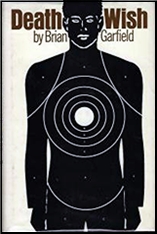
   Brian Garfield is a highly versatile writer at any number of story types and forms. He began his career in the western field,where he published dozens of novels, including at least five of outstanding quality. In 1970 he shifted his sights to the contemporary novels with criminous themes that have earned him wide acclaim in this country ans best0seller status in England.

   These, published under his own name and the pseudonym John Ives, cover most of the criminous spectrum: action/adventure, political intrigue, comic farce, historical suspense, espionage, and urban crime. More recently, he has published a nonfiction book on western films, written screenplays, and formed his own Hollywood production company.

   Death Wish is probably Garfield’s most famous (some might say infamous) novel, not so much by its own virtue but as a result of the 1974 film version with Charles Bronson. It is certainly the work that catapulted him into national prominence, at least in part of his violent reaction to the film.

   The plot is simple and gut-wrenching. Paul Benjamin, a happily married cliff dweller on New York’s Upper West Side, receives a call from his son-in-law one hot, ordinary summer afternoon. Three young hoodlums have broken into his apartment (the building was supposedly secure) and brutally beaten his wife and daughter — attacks of such violence that neither woman survives.
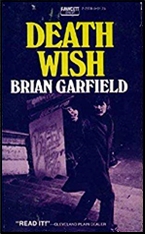
   The police are helpless: they have no clear description of the youths, no way to track them down. Paul’s grief, frustration, and rage finally lead him to take action himself — to buy a gun and go hunting the three kids in their world: the deserted alleys and streets and byways of the city after dark. But his mission of vengeance soon assumes a much larger scope: It becomes a vendetta against all the criminals who prey on helpless victims, a one-man vigilante committee bent on destroying as many of the enemy as possible before he himself is caught.

   As the jacket blurb says, this “is the story of a society having a nervous breakdown. It is about something that causes a a secret uneasiness far back in the conscious minds of many people. What would happen to a man who is unable to keep to the narrow line that stands between being a victim or executioner?”

   Garfield does not glorify or advocate vigilantism: his is the story of Paul Benjamin’s descent into hell. The film version, however, does glorify Paul’s actions. Its makers misinterpreted the novel’s ambiguous ending and produced a paean to violence, an ultra-right-wing fantasy that ends with Bronson winking at the camera and silently promising more carnage to come.

   Garfield was so appalled at the film’s distortion of his novel that he ought — unsuccessfully, foe thr most part — to keep t from being shown on national television.

   In a sequel, Death Sentence (1975), Garfield completes Paul’s story, reaffirms the original intent of Death Wish, and makes a strong anti-violence statement. This novel, however, did not have the commercial success of Death Wish ad unfortunately seems to be one of Garfield’s least-known works. This reviewer, at least, accords it considerable respect.

     ———
   Reprinted with permission from 1001 Midnights, edited by Bill Pronzini & Marcia Muller and published by The Battered Silicon Dispatch Box, 2007.   Copyright © 1986, 2007 by the Pronzini-Muller Family Trust.
REVIEWED BY BARRY GARDNER:


STEPHEN HUMPHREY BOGART – Play It Again. R. J.Brooks #1. Forge, hardcover, 1995; paperback, June 1996.

   R. J. Brooks is a Manhattan PI, and if he isn’t sleazy, it isn’t because he doesn’t do sleazy work. He’s also the son of a couple of movie stars; his father’s dead, but his mother, the glamorous if aging Belle Fontaine, is still around.

   He doesn’t have much to do with her, though, and thinks she was a pretty lousy mother, all things told. But there’s a murder that changes all sorts of things, and R. J. has to face part of a past he turned away from long ago.

   This isn’t quite a two-smiley, but it’s a solid smiley-plus. Bogart has a flair for dialog, and tells a pretty good story. His characters are well done, too, and Brooks comes across as a surprisingly real person for the most part.

   The book isn’t compelling or anything that grand, but it will stand comparison with most of the PI stuff being done these days. There’ll be a lot of speculation as to how much of his real relationship with his parents found its way into the story, as I’m sure he realizes full well; it can’t do anything but sell books.

   It’s blurbed, by the way, by Connie Chung and Liz Smith, if that tells you anything about how Tor/Forge intends to market it.

— Reprinted from Ah Sweet Mysteries #18, February-March 1995.


Bibliographic Note:   There was one follow-up book in a series of only two: As Time Goes By (Forge, hardcover, 1997).

REVIEWED BY JONATHAN LEWIS:


TOMAHAWK TRAIL. United Artists / Bel-Air Productions, 1957. Chuck Connors, John Smith, Susan Cummings, Lisa Montell, George N. Neise, [Harry] Dean Stanton. Director: Lesley Selander.

   Although there’s not much depth in Tomahawk Trail, it’s a rather enjoyable Western programmer that provides a good hour of pure cinematic escapism. With more than a nod to John Ford’s Cavalry Trilogy, the plot follows a U.S. Army troop caught in hostile Apache country. Problem is, Lt. Jonathan Davenport (George N. Niese), an arrogant West Point graduate, has gone mad from a head injury and exposure to the desert sun. This forces Sgt. Wade McCoy (Chuck Connors) into action, taking charge of the troop, knowing all too well that this could lead to his Court-martial.

   Along for the journey is a ragtag group of soldiers, including Private Reynolds (John Smith) and Private Miller (a young Harry Dean Stanton) and two women, the white Ellen Carter (Susan Cummings) and the Apache squaw Tula (Lisa Montell). The dialogue written for the women is bland and unconvincing. That’s putting it mildly. Conversations between the two are in a childish stereotypical Native American patois, with exceedingly simple words and phrases. Although it’s grating to the ears, fortunately the bulk of the film’s dramatic moments revolve not around them, but around McCoy as he tries to convince himself that he is doing the best possible thing in the worst possible situation.

   In many ways, there’s not all that much that’s wrong with Tomahawk Trail. It’s nothing exceptional, either. Just another 1950s Western that is neither particularly compelling, nor particularly off-putting. If you’re a Chuck Connors fan and you haven’t seen it yet, it’s worth a look.


KILLER WOMEN “La Sicaria.” ABC, 07 January 2014. Season 1, Episode 1. 60 minutes. Tricia Helfer (as Molly Parker, a Texas Ranger), Marc Blucas, Alex Fernandez, Michael Trucco, Marta Milans. Guest star: Nadine Velazquez. Written by Hannah Shakespeare. Director: Lawrence Trilling.

   Tricia Helfer, previously seen to good advantage n a regular basis as Number Six, a ultra-sexy humanoid Cylon on Battlestar Galactica, plays newly appointed Texas Ranger Molly Parker in this short-loved series taking place in the San Antonio area. Only six of eight episodes that were filmed for the first season were ever aired. There was no second season.

   The premise for the series was that every week Molly is assigned cases of murder all of which were committed by women. In “La Sicaria” (the feminine form of the word “sicario,” or “hit man”), the killer of an ADA immediately after she says “I do” in church on her wedding day is easily identified. The question is, given that her stated motive doesn’t make sense, why did she do it?

   The series didn’t fare will with the critics and was ignored by TV audiences, but I thought at was well done, and I enjoyed as many of the episodes as I was able to watch at the time. That Tricia Helfer makes a Texas Ranger’s uniform as well filled out as a Texas Ranger’s uniform ever could be might have had something to do with it. Plus she has the swagger of a Texas Ranger down pat. You might even call it a sashay. Poetry in motion.


REVIEWED BY DAN STUMPF:         


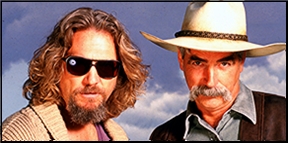
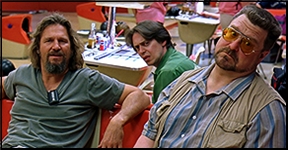
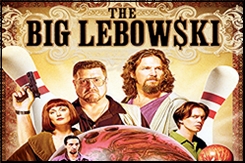
THE BIG LEBOWSKI. Polygram, 1998. Jeff Bridges, John Goodman, Julianne Moore, Steve Buscemi, David Huddleston, Philip Seymour Hoffman, Tara Reid, John Turturro, Sam Elliott, Ben Gazarra, and Jon Polito. Written & directed by Joel & Ethan Coen.

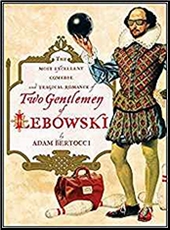
ADAM BERTOCCI – Two Gentlemen of Lebowski: A Most Excellent Comedie and Tragical Romance. Simon & Schuster, trade paperback, 2010.

   Okay, so this time it’s a movie and the book inspired by it – or as Adam Bertocci would have it, the text of the play Shakespeare wrote after seeing it. Got that?

   At this point there’s really no use going into a detailed synopsis or critique of The Big Lebowkski. It’s a cult film, which means you either love it or can’t imagine why anyone would. There’s enough lawlessness, detection and mayhem to qualify it for anyone’s list of crime films, but suffused throughout with so much deliberate quirkiness that the question of Whodunit seems completely irrelevant.

   What strikes me about Lebowski though, is its compelling similarity to Robert Altman’s film of The Long Goodbye (UA/Lions Gate, 1973). Besides the obvious L.A. ambiance, both films feature protagonists seriously out of step with the world they inhabit, cast into convoluted plots which they — and we (and, I suspect, the writers) — only partly comprehend, adrift in an ocean of whackos, weirdoes and certified wing nuts, dancing with sudden death like a monkey on a high wire. Mark Rydell in Goodbye has Ben Gazarra as his counterpart in Lebowski, just as Sterling Hayden in the earlier film is mirrored by David Huiddleston in the later one. It’s as if the Coens saw Altman’s screwy classic when they were impressionable teens and never got over it.

   Like I say, there’s been enough written about this film already, but I want to make note of the pitch-perfect performances of Philip Seymour Hoffman as an unflappable toady and John Turturro doing a dead-on impression of Timothy Carey as a mad bowler. Add Steve Buscemi as the kegler equivalent of Elisha Cook Jr, and you have an able supporting cast indeed — all blown off the screen by John Goodman’s perennial Nam Vet, Walter.

   More than a decade after Lebowksi hit the screens, Adam Bertocci wondered in print what The Big Lebowski would have been like if written by the Bard of Avon. He even went so far as to write an afterword, detailing how Shakespeare might have seen someone else’s Elizabethan play of the story and stolen it (as playwrights of his time were wont to do—leading to flocks of Angry Bards) for his own Two Gentlemen of Lebowski.

   I should say up front that this will appeal mainly to those who have some familiarity with the works we call Shakespeare’s. When Sam Elliott (I forgot to mention him, didn’t I?) says “Sometimes you get the Bear” one doesn’t automatically recall the stage direction from Winter’s Tale, “Exit, pursued by a bear.” But Bertocci does.

   It will be lost on some. As will many (most?) of the other allusions. But no one should miss the author’s seriocomic “footnotes” explaining things like Cracked Cheeks (“Maps of the period depicted wind in the form of clouds blowing over the land and possibly on freshly-painted toes.”) and Haters of Jewry (“Anti-semites. In Elizabethan England, a synonym for ‘everyone’.”)

   Cult items to be sure. Take them for all in all, we most likely shall not look upon their like again. But we can hope.

REVIEWED BY JONATHAN LEWIS:


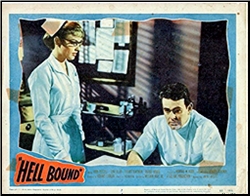
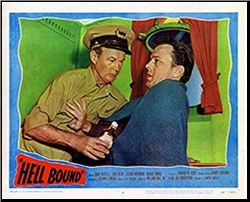
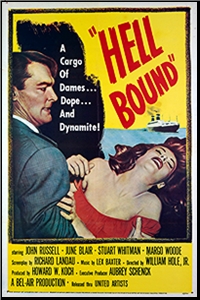
HELL BOUND. United Artists / Bel-Air Productions, 1957. John Russell, June Blair, Stuart Whitman, Margo Woode. Director: William J. Hole Jr.

   Hell Bound opens with voice-over narration that tells the viewer what is going on. It’s technique familiar to all of us who have watched numerous low budget 1950s crime films and police procedurals. Where the narrator instructs us as to what is happening on the screen, as if we needed some additional help. But in this Bel-Air Production, the narration goes on and on. And on. Or so it seems. All of which leads the viewer to wonder what exactly is going on? Is the whole film going to be like this?

   But eventually the narration ends. And as it turns out, what you were watching was a 16mm film within a film. A short movie that was filmed by a thief named Jordan (John Russell) in order to “sell” his vision to a businessman who could finance his latest criminal scheme: to steal narcotics from a ship set to arrive in the Los Angeles harbor. It’s a clever device, one that immediately lets the viewer know that this isn’t going to be one just another stodgy and formulaic police procedural.

   Hell Bound is a lot grittier than what most of those films even hope to offer. It’s soaked in sweat, oozes sexual innuendo, and has its fair share of odd, unsavory characters, including a blind heroin dealer who simply goes by the name Daddy (Dehl Berti). The film has a lot of visual signposts and trademarks of what has become known as film noir. There’s a gin-soaked nightclub with an exotic dancer, neon lights, and a ruthless degree of criminal brutality. There is also a stark, but exquisitely filmed finale in a junk yard filled with old trolley cars, one of the more creative endings I’ve seen in a while.

   Look for former Playboy Playmate June Blair as Jordan’s primary accomplice, and a for youthful Stuart Whitman as an honest hardworking ambulance driver who inadvertently gets mixed up in the whole affair. Les Baxter provides the soundtrack. Recommended.
   

HEADLINE SHOOTER. RKO Radio Pictures, 1933. William Gargan. Frances Dee, Ralph Bellamy, Jack LaRue, Gregory Ratoff, Wallace Ford, Robert Benchley, Betty Furness. Director: Otto Brower.

   William Gargan plays one of those old-fashioned newsreel cameramen whose lives consist 100 percent of their jobs and nothing but their jobs. A chance encounter with an equally scoop-conscious society writer (sob sister) played by Frances Dee (later Mrs. Joel McCrea) causes only sparks at first, but as it turns out, these are only partially nullified by the fact that Jane Mallory already has a fiancé back home in Mississippi. Take a look at the cast. You needn’t need me to tell you that Ralph Bellamy is the guy, and no, he’s not likely to keep Miss Mallory from slipping through his fingers.

   There are some comedy bits in this movie (such as Robert Benchley doing a short bit as the announcer of a beauty contest — over the radio), but what this short 60 minute film really is is nothing more (or less) than an entertaining romantic drama, set against a backdrop of newsreel footage of actual disasters: earthquakes, fires and floods. You might also guess, from seeing Jack Larue’s name in the credits, that there is a gangster subplot involved, one that tells Ralph Bellamy’s character more about his would-be wife’s true character than he wanted to know.

   I don’t think William Gargan had too many leading roles in the movies over the years, unless perhaps as a detective in charge of a murder mystery, and he seems out of place in this one. What Jane Mallory sees in Bill Allen is one those unexplained mysteries of life, I suppose. Otherwise this is a competently done melodrama that moves along quickly in very solid fashion.


BOOMTOWN. “Pilot.” NBC, 29 September 2002. Donnie Wahlberg, Neal McDonough, Mykelti Williamson, Gary Basaraba, Lana Parrilla, Jason Gedrick, Nina Garbiras. Creator-screenwriter: Graham Yost. Director: Jon Avnet.

   The movie Pulp Fiction (1994) showed that film audiences could accept movies that were not shown in linear fashion. That audiences could follow stories that curled back, overlapped itself, and jumped ahead again — if done well, and Pulp Fiction most certainly was.

   But TV audiences, apparently, were a harder sell. Despite the approval of critics, ratings for the first season were low and the cast was considerably reshuffled for a quickly aborted second season, which also lost the basic concept of a single crime per episode being investigated from different perspectives and time frames.

   I’ve only seen this, the first episode of season one, and I found it very well done. I had no trouble following the story, but a second time through made it abundantly clear how well the script was written and directed.

   The story is about the drive-by Los Angeles (Boomtown) shooting of two young schoolgirls. On the scene and tackling the case from a wide array of differing angles are the D.A., a female reporter) also the D.A.’s secret girl friend, a female paramedic, and three police officers, of whom Donnie Wahlberg appears to be the primary lead in the rest of the series as well.

   Each one of the above has their own back story, much of which is shown, albeit sometimes briefly, as the investigation unfolds. It makes for a bit of a clutter in this, the opening episode, but making the characters individuals rather than faceless ciphers also makes for very enjoyable watching.


REVIEWED BY BARRY GARDNER:


CAROL O’CONNELL – The Man Who Cast Two Shadows. Mallory #2. Putnam, hardcover, 1995; paperback, 1996.

   I was really afraid to read this, after liking O’Connell’s debut with Mallory’s Oracle as much as I did.

   TV news reports policewoman Kathy Mallory dead at 6 o’clock, but she’s not. Someone who resembled her and was wearing one of her castoff coats is, however, and Malory naturally takes an interest in who she was and who saw to it that she wasn’t any more.

   Mallory is technically on suspension because of a shooting incident, but she doesn’t fret about technicalities. She quickly determines by computer-aided deduction that the killer must live in a particular building, and shortly thereafter is ensconced in the same building, determined to smoke him out.

   But there are several suspects, and though Mallory wouldn’t agree, there seems to be some question as to who is the hunter, and who the prey.

   This didn’t have the impact on me that Mallory’s Oracle had. Having said that, I should probably say that there’s a real tendency on my part (and I imagine on that of most of us) to judge the follow-up to a highly regarded book by standards that are perhaps set too high. I should judge it on its own merits, and not by how it compares to its predecessors, but I don’t know if I’m able to do so.

   O’Connell is still a superb prose stylist. There were no passages that “grabbed” me as there were in the previous book, but there was a sustained quality of word-crafting that not too many equal. I felt there were some plot problems here, and some character problems, the latter mostly causing the former.

   It’s impossible to discuss them without giving away the plot, which I almost guarantee will have some surprises for you. Too many, maybe; some mental gear-shifting that O couldn’t easily manage.

   This is the kind of book that I hate to review briefly, as its pluses and minuses call for a critique that I’m probably not qualified, certainly not prepared to do. O’Connell is a vastly talented writer, but I think she needs an editor. And I don’t think she had one here. Still—

— Reprinted from Ah Sweet Mysteries #18, February-March 1995.


      The Kathleen Mallory series —

1. Mallory’s Oracle (1994)
2. The Man Who Cast Two Shadows (1995)
3. Killing Critics (1995)
4. Stone Angel (1997)
5. Shell Game (1999)
6. Crime School (2002)
7. Dead Famous (2003)
8. Winter House (2004)
9. Find Me (2006)
10. The Chalk Girl (2012)
11. It Happens in the Dark (2012)
12. Blind Sight (2016)

« Previous PageNext Page »