Reviews


REVIEWED BY DAN STUMPF:         


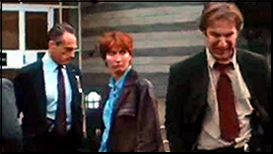
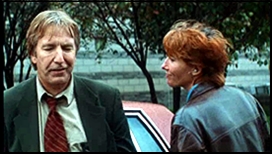
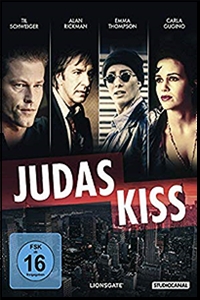
JUDAS KISS Bandeira Entertainment, 1998. Carla Gugino, Simon Baker-Denny, Emma Thompson, Alan Rickman, Gil Bellows, Til Schweiger, Hal Holbrook, Roscoe Lee Browne. Director: Sebastian Gutierrez.

   Any movie that starts with a blue-skinned alien lesbian getting naked is probably worth a look, and when Emma Thompson and Alan Rickman come on as sho ’nuff Looziana cops, replete with corn pone accents and Wal-Mart wardrobes, you know Judas Kiss is headed into undiscovered territory. But that’s only the beginning, folks, only the beginning…

   This movie offers more genuine flakiness than you’d find in a whole case of Post Toasties, and there’s a surprise inside: a twisty-turny kidnapping plot that develops layer on layer of deception and double-dealing, all very intelligently presented.

   I mentioned Rickman and Thompsoon, and they’re both quite good in off-beat parts, along with Roscoe Lee Browne, and Hal Holbrook as a bereaved and betrayed congressmen, but the real acting honors here go to four unknowns playing a quartet of trailer-trash crooks trying to break out of the small-tie with a high-profile kidnapping.

   And honestly, the names of these actors would mean nothing to you, but the parts are written and performed so skillfully I kept wanting to get back to them, even when the camera was on actors I liked better. Okay, the thespians in question are Carla Gugino, Simon Baker, Gil Bellows and Til Schweiger, and I hope mention in these pages rockets all four of them to stardom.

   Chalk it up to adroit writing and directing by Sebastian Gutierrez, another talent who needs to be much better known.

— Reprinted from The Hound of Dr. Johnson, May 2005.


DEVIL IN A BLUE DRESS. TriStar Pictures, 1995. Denzel Washington (Easy Rawlins), Tom Sizemore, Jennifer Beals, Don Cheadle (Mouse), Maury Chaykin, Terry Kinney, Mel Winkler. Based on the book by Walter Mosley (also Associate Producer). Screenplay & director: Carl Franklin.

   When a young black man named Easy Rawlins, an unemployed aircraft worker who owns his own home in 1948 Los Angeles, is offered a job to find Daphne Monet, a white woman who is known to hang out in the juke joints in the city, he jumps at the chance. It turns out that Daphne is/was the girl friend of the man who has just dropped out of the current race for mayor, and when the girl who helps Easy track her down is murdered, it’s Easy whom the cops will pin her death on, unless he can do something about it.

   I’ve read some of the Easy Rawlins books, but not this one, which was the first. I have read that Denzell Washington was not Walter Mosley’s first choice to play Easy Rawlins, but this is not the first time I think an author was wrong as to whom would be best play his own character. Of course, I think Washington can play almost any character and make it work, and to me, he certainly does here.

   I loved the way director Carl Franklin recreated sections of late 1940s L.A. so perfectly, not to mention the lives led by the people who lived there, including their relationship with the police force, deeply infested with racism if not out and out malice. The era may also have been Raymond Chandler territory, but this movie takes us into locales that Chandler never was or could have been.

   As for Easy’s homicidal friend and sidekick Mouse (Don Cheadle), the way he is introduced could have been seriously improved upon. He came on the scene way too quickly (and conveniently) for me.

   In general critics seemed to have liked the movie, but it did not do well at the box office, and chances at a followup film seem awfully slim. I can think of a couple of reasons for this. First of all, it’s a complicated story, and by the two-thirds mark, it’s easy not to remember who all of the characters are. Secondly and honestly, I don’t think that audiences even as recently as 1995 were ready to see a movie in which one of the driving components was racism in 1948 L.A.


SPLIT SECOND. RKO Radio Pictures, 1953. Stephen McNally, Alexis Smith, Jan Sterling, Keith Andes, Arthur Hunnicutt, Paul Kelly, Robert Paige, Richard Egan, Frank de Kova. Director: Dick Powell.

   A large ensemble cast portraying a group of strangers, mostly, being held captive in a Nevada ghost town by am escaped killer (Stephen McNally) and his two confederates, one of whom (Paul Kelly) is seriously wounded. Others include a journalist (Keith Andes) and the female hoofer (Jan Sterling) he had picked up earlier as a hitchhiker. Also trapped are a woman (Alexis Smith) doing in Nevada what women with unwanted husbands did in the 50s, along with her current male companion (Robert Paige).

   Adding considerable stress to the situation is the fact that a nuclear bomb test is scheduled to take place at six the next morning, and they are less than a mile from ground zero.

   The movie has a good many fans, but unfortunately I found it far less intense and suspenseful than I was supposed to, even with the time of the blast moved up an hour. As the crazed murderer in charge of his small gang, Stephen McNally is over the top when it comes to the “crazed” part of his role, while Keith Andes holds back a little too much. Perfect in her role, however, is Jan Sterling, caught between her attraction to Andes and diverting the crude advances of McNally.

   While the camera work is fluid and very effective, the direction itself (Dick Powell’s debut) is often stagey and in effect calls attention to itself more than pleased me. Worse are the holes in the plot. Here’s one of them that puzzled me throughout the movie: How do so many people manage to avoid the roadblocks into the area to begin with?


REVIEWED BY DAN STUMPF:         


SCREAMING MIMI. Columbia Pictures, 1958. Anita Ekberg, Philip Carey, Gypsy Rose Lee, Harry Townes, Linda Cherney. Based on the novel The Screaming Mimi, by Fredric Brown. Director: Gerd Oswald.

THE BIRD WITH THE CRYSTAL PLUMAGE. Seda Spettacoli, Italy-Germany, 1970. CBS, US, 1977 (TV, original airing). 21st Century Film Corporation, US, 1982. (theatrical re-release). Original title: L’uccello dalle piume di cristallo. Tony Musante, Suzy Kendall, Enrico Maria Salerno, Eva Renzi. Screenplay by Dario Argento, based on the novel The Screaming Mimi by Fredric Brown (uncredited). Director: Dario Argento.

   I’ve spoken often and highly of Fredric Brown;s classic mystery novel of strip-clubs and theology, The Screaming Mimi (Dutton, 1949) and recently betook myself to watching both film versions of it, side-by-side and back-to-back, through the miracle of VCRm watching a chunk of one, then the other, than back again…

   The Screaming Mimi (Columbia, 19580 offers some kicking-and-kinky direction from Gerd Oswald, a cult director in the Jim Jones tradition, which is to say he showed a lot of potential in low-budget westerns and thrillers, and managed one classic, A Kiss Before Dying (1956) before drinking the kool-aid of network television.

   Mimi belongs to his Promising period, with a pleasantly straightforward (for the 50s) to homosexuality, bondage, obsession and amour fou, but it’s undone by a screenplay that seems way too limp for a movie about serial killings.

   There’s never a sense of momentum here, no feeling of progressing towards some resolution. Instead, events just seem to come along and happening no particular order, the head off in any direction whatever, just sort of strutting and fretting across the screen till their allotted hour-or-so is over at last.

   A pity, because there are glimmers here and there of what could have been a perverse classic.

   The Bird with the Crystal Plumage (Italy, 1970) on the other hand, is a certified wowser. The directorial debut of Dario Argento, who became something of a Name in Horror films, this is a garish, fast-moving, humorous movie about serial slashing, stalking, knifing and general mayhem set against colorful locations, played and/or dubbed by a cast a cut (sorry!) above the usual run of Italian imports.

   Fredric Brown got no screen credit for this film, and for years critics who knew nothing about Pulp averred that it was based on an Edgar Wallace story, but I defy anyone out there to show me an Edgar Wallace book with this plot. I’ll wrestle anyone in the crowd who thinks he can do it. No takers? I thought not.

   Anyway, getting back to the story, this follows Brown’s novel pretty closely, right down to the minor characters and bits of by-play. Argento tossed away the thematic framework of Brown’s novel, and he turned the hard-drinking loner of the book into a young married couple, ut that’s a fate that befell many of us in the 70s.

   The fact is, this is a fairly faithful translation of The Screaming Mimi into film, and if not all of it could have been (The real meaning of the book isn’t revealed until the last page, and it’s truly harrowing.), it’s at least a fun ride.

— Reprinted from The Hound of Dr. Johnson, May 2005.


A STRANGE ADVENTURE. Republic Pictures, 1956. Joan Evans, Ben Cooper, Marla English, Jan Merlin, Nick Adams, Peter Miller. Director: William Witney.

   We could have a contest with 20 entries to choose a better title than the one A Strange Adventure was saddled with, and I have no doubt that all 20 would be a ten times improvement. My guess is that in 1956 Republic was beginning to cut back, a little at a time, and the first people to go were the ones in charge of choosing titles for the movies they made. (I don’t know what the particular job title for this might be.)

   It turns out that what this is is a heist film, a rather minor one, true, but with an action director such as William Witney at the helm, it does have its moments. There’s something happening on the screen all the time — that is to say until he ending, which I’ll get to in a moment.

   Marla English plays the femme fatale in this one, playing the young tempting sexpot role for all she’s worth, and the focus is almost entirely on her for most of the first half of the movie. First she’s flirting with Harold Norton (Ben Cooper), the hot rod-obsessed son of her landlady; then with the driver of the armored car she and her two confederates (Jan Merlin and Nick Adams) are going to rob; and then with the leader of the small threesome (Merlin), who doesn’t hesitate to slap her down whenever he thinks he should.

   Once the loot is in their hands, though, and the armored car driver dead, they don’t have much of a plan. They borrow Harold’s car (with him as driver) and speed off to the mountains at 100 miles per hour.

   With no one following them, this is not the best way to avoid being spotted by the police, but never fear, the police seem to be off looking somewhere else.

   And somehow they end up in a cabin about to be snowed in for the winter. In the cabin are a brother and sister (Joan Evans and Peter Miller) whose job it is is to monitor the amount of snow that’s fallen all winter long. One problem: the latter have to radio in twice a week, or the folks down below will know something is wrong. Three gang members with three captives, all in close quarters. No wonder things do not go well.

   Factoring in the fact the two male gang members are as dumb as dirt, the movie is still quite watchable, if not totally engaging. The ending is extremely rushed, though, and that’s putting it mildly. The production crew may have run out of money. I have no idea how Harold knew where the money was, or did he? I don’t think he did, nor did the writer of this whole misguided adventure.


SHELLEY SINGER – Spit in the Ocean. Jake Samson #4. St. Martin’s, hardcover, 1987. Worldwide, paperback, June 1989.

   Vandalism — let’s not get into whether you’d call it murder — at a sperm bank, then a fatal accident off the rocky spit into the ocean north of San Francisco suspiciously does look like murder. Luckily unlicensed PI Jake Samson is already on hand to investigate.

   Along with him is his partner, Rosie Vincente. It takes a while to determine their relationship more than that, but in a word: none. This mystery comes as close to the classic detective story as any I’ve read recently, spoiled only by a “gratuitous” sex scene.

–Reprinted from Mystery*File #14, July 1989.


        The Jake Samson series —

Samson’s Deal. St. Martin’s, 1983.
Free Draw. St. Martin’s, 1984.
Full House. St. Martin’s, 1986.]
Spit in the Ocean. St. Martin’s, 1987.
Suicide King. St. Martin’s, 1988.
Royal Flush. Perseverance, 1999.

REVIEWED BY JONATHAN LEWIS:


WEREWOLF. Fox. Pilot for subsequent series, two hours, 11 July 1987. John J. York, Lance LeGault, Chuck Connors. Guest cast: Raphael Sbarge, Michelle Johnson. Writers: Allan Cole, Frank Lupo. Director: David Hemmings.

   Revisiting TV shows from your childhood is always a precarious endeavor. Once you press play, you simply don’t know if your positive memories of a particular show, character or plot is going to hold up. I’ve watched some movies that I absolutely loved as a teenager that now make me cringe. Alternatively, I’ve recently had the chance to revisit some features from that era that, while largely forgotten, still hold up extraordinarily well.

   Case in point: the pilot for Fox’s TV series Werewolf. Aired originally on July 11, 1987, this one I specifically remember watching, commercial breaks and all. Conceived as a hybrid of a supernatural thriller and a fugitive-on-the-run crime drama, Werewolf was absolutely terrifying (in a good way) to me as a child. And it remains scary and suspenseful even today. The soundtrack is eerie. The special effects are top notch. And the writing by Frank Lupo is superb.

   The plot. Eric Cord (John J. York) is an all-American kid living what appears to be the Southern California dream. He’s handsome, rooms with his best friend, and has a beautiful girlfriend who just so happens to be his best friend’s sister. All is well in Eric’s world. Until one fateful night when his best friend/roommate makes a confession to him. That he’s a werewolf and responsible for a local series of grisly murders.

   Eric thinks his best friend is nuts and in need of psychiatric intervention. It doesn’t help matters that his friend asks him to kill him with a gun loaded with silver bullets. Eric, decent man that he is, refuses to partake in this perceived insanity. Until it’s too late. Until his friend turns into a werewolf and attacks him. The end result being that his friend is now dead, but not before he bites Eric and transforms him into a werewolf.

   The rest of the pilot follows Eric as he battles the legal system that holds him responsible for his friend’s death, as he navigates his relationship with his girlfriend, and as he begins his quest to find and to kill the head of the werewolf bloodline. Who is it? Well, it’s none other than a sneering, scenery chewing Chuck Connors who is playing this way over the top. He portrays Janos Skorzeny, the man who transformed Eric’s friend into a werewolf down in Baja California.

   The name Skorzeny will ring a bell for fans of supernatural television. It is the same name as the vampire in The Night Stalker (1972). This time, Skorzeny is cruder and hairier, but he’s still a monster. And what a monster! Look for the scene where he rips off his face and transforms into a gigantic werewolf. Hair raising stuff indeed.

    A discussion of Werewolf would not be complete without an analysis of the show’s third main character. A part Native American bounty hunter by the name of “Alamo,” Joe Rogan (Lance LeGault) who has been assigned to track down Eric once he skips his court date. He’s part Steve McQueen, part Charles Bronson. Equipped with a small arsenal, he’s on an obsessive quest to track down and to kill Eric with a silver bullet. Little does he know that Eric is a “good” werewolf and that the really “bad” werewolf is the one he should be after.

   Now I realize that this show might not sound like everyone’s cup of tea. Not everyone is into supernatural themes. But if you watch it as if it were a crime show, you will find a lot to like. The characters are well developed and there’s the occasional dose of light humor to break the rather bleak and downright tragic feeling that permeates the show.

   Fox had a great thing on its hands back in 1987. Too bad it only lasted one season. If any show deserves a reboot based on the concept alone, it’s this one. But I dare suspect that no one will ever quite be able to recreate the foreboding atmosphere that drenches this show like a Southern California fog.


BELLE STARR. 20th Century Fox, 1941. Randolph Scott, Gene Tierney, Dana Andrews, John Shepperd, Chill Wills, Louise Beavers. Director: Irving Cummings.

   This was the first sound film to pretend to tell the story of the notorious western outlaw named Belle Starr, and by all accounts, they messed it up pretty badly. Some of the names are the same, and an incident or two, perhaps, but that’s about all.

   As I understand it, Belle Starr was not even all that notorious in her lifetime. It was not until the time of her unsolved murder in 1889 that dime novels picked up her story, leading to a novel about her by Richard K. Fox, Bella Starr, the Bandit Queen, or the Female Jesse James, published in 1889. Not too incidentally, Fox was also the publisher of the National Police Gazette, which had also been touting her exploits.

   In any case, the movie is entertaining enough, but from the opening scene, you know the intent was primarily to create a legend, be it based only on Technicolor and imagination. The movie begins with an old black man plowing a rocky field aside a burned out mansion telling his grandson the story of the woman who once lived there, and it ends with one black man telling another that Belle Starr will never die, because she is a legend.

   Belle Shirley is played by a young Gene Tierney, who is very pretty but not as beautiful on screen as she grew to be. Even so she is better looking than the real Belle Starr by a multiplicative factor of 100 or more. The story takes place in Missouri, but Tierney’s southern accent and mansion makes it seem as though the film was set in Georgia. (Cue for “Tara’s Theme.”)

   Miss Belle, as portrayed in the movie at least, is a Southerner through and through, even after the war is over, and when she meets Captain Sam Starr, a rebel turned bandit still fighting the Yankee troops and carpetbaggers busily taking over the state, she gives him shelter, at the cost of her home being burned (Dana Andrews’ character, Union major Thomas Crail, a former sweetheart, comes into play here), and she and her brother end up being declared outlaws.

   Captain Starr is played by Randolph Scott, as upright and soft-spoken then as he was in later films. Eventually he and Belle marry, she taking up his cause as thoroughly as he. Until, that is, she realizes that perhaps he is taking his killing and marauding too far.

   From this point on, though, you’ll have to watch the film yourself. It’s likable enough. You just have to realize that it’s made up of whole cloth only, planting the seeds for the legend that grew from there.


REVIEWED BY DAVID VINEYARD:


LESLIE CHARTERIS – The Saint in New York. The Saint #15. Hodder & Stoughton, UK, hardcover, 1935. Doubleday, US, hardcover, 1935. Avon #44, US, paperback, 1944. Reprinted many times, in both hardcover and paperback. Note: A shorter version appeared in the The American Magazine, September 1934.

THE SAINT IN NEW YORK. RKO, 1938. Louis Hayward, Kay Sutton, Jonathan Hale, Sig Ruman, Jack Carson, Paul Guilfoyle, Frederick Burton, Ben Weldon, Paul Fix, Leon Belasco. Screenplay: Charles Kaufman & Mortimer Offner, based on the novel by Leslie Charteris. Directed by Ben Holmes.

   Inspector John Fernack of the New York Police Department is fed up with the rampant crime plaguing the city when he vents to the Commissioner.

   â€œThere’s times when I wish I knew a guy like this Saint was here in New York—doing things like it says in that dossier,” he said. “There’s times when for two cents I’d resign from the Force and do ’em myself. I’d sleep better nights if I knew there was things like that going on in this city.”

   And as Fernack is going to learn sometimes you should be careful what you wish for.

   The Saint in New York is not my favorite Saint novel, but I will be the first to admit it is likely Charteris’s best novel, and it was certainly the best film adaptation of the character and his work despite his own dislike of the film.

   Not surprisingly Simon Templar’s arrival in New York also ushers in a considerably tougher, even hard-boiled version of the Saint, who had been around almost a decade when the novel was published in 1934. Indeed, the book itself was heavily censored in its early magazine and newspaper serialization, close to emasculated, because the full thing is a wild ride full of bursts of gunfire and violence, breathless escapes from impossible traps, cold blooded killings, the kidnapping of an innocent child, and the kind of retribution the Saint is famous for. There is also a beautiful and sexy femme fatale who is not only a match for the Saint, but possibly even wilder than the adventurer himself.

   The plot is that old favorite about the citizens committee that decides to clean up the city by extra legal means, in this case persuading one of its members, one Valcross, to find and hire Simon Templar to eliminate six of the big time racketeers terrorizing New York. Simon takes the job and arrives in New York with typical Saintly verve notifying his victims they are on his list.

   â€œIt goes back to some grand times—of which you’ve heard,” he said quietly. “The Saint was a law of his own in those days, and that little drawing stood for battle and sudden death and all manner of mayhem. Some of us lived for it—worked for it — fought for it; one of us died for it…There was a time when any man who received a note like I sent to Irboll, with that signature, knew that there was nothing more he could do. And since we’re out on this picnic, I’d like things to be the same—even if it’s only for a little while.”

   Not too long after he polished off Irboll the Saint is captured and taken to the lair of yet another of his victims, and it is there he finds the kidnapped little girl and first meets the beautiful and enigmatic Fay Edwards, who is connected in some mysterious way with all the men on his list.

   Escaping and rescuing the little girl with typical Saintly elan the Saint finds himself entranced by Fay Edwards even as he moves on his next victim.

   Eventually he meets Fay and he discovers that behind the six men he has been sent to kill is the Big Fella, the mastermind who with Fay’s help recruited the six criminals and who meticulously planned all their crimes, He also learns the big payoff is due soon when the Big Fella plans to split the profits — to a much smaller group than originally planned thanks to the Saint.

   I’m not going to pretend this one takes much effort for any mystery reader to figure out. Even in 1934 the villain should have been pretty obvious, which is why Charteris, who must have been well aware of this, never lets the action falter, never give the reader a chance to catch his breath, and piles incident upon incident in one of the most sustained action novels of its type ever penned.

   His trembling hands went up as if to shield himself from the stare of those devilish blue eyes.

   â€œDeath,” said the Saint, in a voice of terrible softness. “Death is my racket.”

   The Saint gets his man, the femme fatale meets the fate of most her kind, and the Saint and Inpector Fernack develop a much different relationship than the one he has back home with Inspector Teal.

   You know how it is, prophets in their own land.

   Charteris was working at Paramount when RKO bought the rights to his novel and the Saint came to the screen for the first time. Despite Charteris’s caveats, Louis Hayward is far and away the most Saintly of film Saints, hard edged but smooth, dangerous, suave, funny, and closer to the actual character in the books than any actor before or since. The scenes between he and Kay Sutton are not only well written, they are damn sexy considering when the film was made.

   There is a first rate cast with Jonathan Hale as Fernack, Kay Sutton as Fay, and a who’s who of bad guys that include Sig Ruman, Jack Carson, Paul Guilfoyle (as a semi comic team of killers Red and Heimie), Paul Fix, and Ben Weldon. The screenplay is fairly close to the book, certainly capturing the tone of the books better than any since, and the action is well staged.

   Granted it looks a little cheap here and there, and it could all be done a bit smoother, but it is the genuine Saint we are seeing in action, not the rather bored George Sanders or the dull Hugh Sinclair, and not the late much more sedate version television gave us (true to the later stories and novels in the series, there being almost as many versions of Simon Templar as there are of Ellery Queen).

   Whatever it’s flaws, you can imagine Hayward in white tie and tails singing to a Bobby beneath a street light or leaping through a window guns blazing — which he does at least twice in this film. Unlike later Saint’s he even makes use of his knife though he doesn’t seem to have named them.

   Some of the Sanders films are fun, and Hayward made an interesting if not entirely successful return to Sainthood in The Saint’s Girl Friday twenty years later. There is at least one French adaptation of a Saint novel done without Charteris’s permission (The Dance of Death (1960) with Felix Marten and based on “Palm Springs”) and available with the hero’s name changed.

   And of course there was the much loved Roger Moore series, a second series with Ian Ogilvy, a failed pilot, a series of made for television films with Simon Dutton, the Val Kilmer film, and a 2013 pilot with Adam Raynor (available on Netflix). That doesn’t include comics, comic strips, and the radio series that starred Vincent Price and later Brian Aherne as the Saint, but this is far and away the closest to Leslie Charteris’s vision of the character, making it ironic that he disliked it and Hayward so much, but I suppose when his ideals were Cary Grant and Rex Harrison anyone would be a letdown.

   Whoever plays the role next, I’m willing to bet it will be with less than half the verve and style Hayward brings to the part in his American debut as a leading man. For one time, and one time only, he was the Saint, the real one, not the rather wan imitation we have gotten since, and that is something Saint fans have every right to treasure.
REVIEWED BY DAN STUMPF:         


WILLIAM O’FARRELL – Gypsy, Go Home. Gold Medal s1175, paperback original, December 1961. Cover art by Barye Phillips

   Nothing to see here, folks. Just a tightly-written and forgettable tale of murder and detection, with a great cover. In other words, a typical Gold Medal of its time. Move along now.

   Author William O’Farrell debuted with Repeat Performance in 1942, and over the next twenty years he turned out about a dozen books, until his death in 1962 (none afterwards) with occasional forays into television writing for Perry Mason and Alfred Hitchcock Presents. It’s perhaps this last that provided background for Gypsy, Go Home and its milieu of small-screen scribes, producers and wanna-bes — and murder.

   The lady on the cover is Gypsy O’Brien: loud, grasping, crudely manipulative and usually drunk. I went out with a girl like that in college, but after a couple of dates she dumped me. And after a couple of chapters, Gypsy puts the squeeze on a no-talent writer trying to lever himself into a job on a TV show, and ends up the subject of a murder investigation.

   O’Farrell does a competent if unremarkable job of setting up two protagonists: Ken Morse, a television writer with a proven track record, lined up for a job on new series, and Alan Procter, the guy on the cover playing “guess what I got for you” with a poker. When Alan kills Gypsy and (mostly) covers his tracks, he decides the best way to get Ken’s job is to frame him for murder – even if the frame slips, it’ll muddy Ken’s reputation, and besides, Ken’s ex-girlfriend happens to be the daughter of the show’s creator, so if he can insinuate himself with her….

   About this time I started seeing similarities between this and the book (not the movie) In a Lonely Place, by Dorothy B. Hughes, which also featured a murderous would-be writer. But where Hughes focused on her deadly dramatist, O’Farrell skips nimbly between his rivals in love and television, with frequent stops in between to sketch out the characters of Gypsy’s complaisant cuckold husband, her confused nine-year-old daughter, and a smart cop who realizes the case goes considerably deeper than Gypsy’s shallow grave.

   If anything lifts Gypsy, Go Home out of the ordinary — and I’m not sure it does — it’s the Police, refusing to act according to type by arresting Ken and needlessly prolonging the action. Instead, O’Farrell keeps the story moving fast and in a straight line to a pat solution. In all, there’s nothing very memorable here, except as a relic of the kind of light, compact and easily-enjoyable book they just don’t make anymore.

« Previous PageNext Page »