Reviews


REVIEWED BY BARRY GARDNER:


DON WINSLOW – A Long Walk Up the Water Slide. Neal Carey #4. St. Martin’s Press, hardcover, 1994; paperback, 1998.\\

   I liked the first, why nor check out the fourth? NO reason I could think of.

   There’s no such thing as a typical job for Friends of the Family, but Carey thinks this one is a bit much. He and his lady-love Karen (evidently acquired in an intervening book) are supposed to make a silk purse out of a sow’s ear.

   A woman who has accused a TV personality/network owner of rape is a bit rough around the edges, and a man who is trying to take over the network wants the edges smoothed for sake of credibility. So off they go to a small town in Nevada to start sanding.

   It’s not that simple, of course; there’s a monster involved, and someone has hired a ht man, and there’s an ex-FBI agent and an alcoholic private detective, and they’re all revolving around Neal, Karen, and the lady with the rough edges.

   This was a different sort of book than the first Winslow I read. I wouldn’t say it’s not serious, at least not exactly, but at times that story did seem almost farcical, with everyone moving around frantically à la Mad, Mad, Mad World.

   The smooth, easy voice was still there, but the dissonance between this book and the earlier one bothered me. I didn’t like it nearly so well, and the problem was definitely in the type of story it was. I was eager to read it after reading the first one, but I don’t think I’ll be nearly so avid for the next.

— Reprinted from Ah Sweet Mysteries #18, February-March 1995.

REVIEWED BY WALTER ALBERT:


WHILE THE PATIENT SLEPT. Warner Brothers, 1935. Aline MacMahon (Sarah Keate), Guy Kibbee (Lance O’Leary), Lyle Talbot, Patricia Ellis, Allen Jenkins, Robert Barrat. Based on the novel by MIgnon G. Eberhart. Director: Ray Enright.

   Nurse Sarah Keate is brought to a gloomy mansion on a stormy nighth to care for a comatose patient while the family gathers vulture-like for the death-bed wait. A murder, accusation, Guy Kibbee as the amiable detective, and a confusing and not very convincing plot.

   Of interest for the pairing of MacMagon and Kibbee on what was probably an attempt to match the chemistry of the successful RKO Edna May Oliver/James Gleason pairing as Hildegarde Withers and Inspector Oscar Piper. MacMahon isn’t given much to do and aside from some arch exchanges between her and Kibbee, the movie doesn’t generate much chemistry.

   They were also probably trying to continue the more successful pairing of the two stars in Big-Hearted Hobart and Babbitt, both released in 1934. I saw these two films, or parts of them, recently. They’re light-weight romantic comedy-dramas worth watching for the expert acting of the cast. And Babbitt is as far from Sinclair Lewis as you can get.)

— Reprinted from Walter’s Place #106, March 1995.


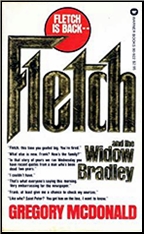
GREGORY MCDONALD – Fletch and the Widow Bradley. Fletch #4. Warner, paperback original, 1981.

   Taking a rather unusual marketing approach for a mystery paperback original, Warner has apparent;y tried to promote the book as a potential bestseller. When it first came out, B. Dalton had copies set up in a huge floor display at the front of the store, for example, and the title is embossed on the front cover with big gold lettering.

   There is a price tag to match. For your money [$2.95 rather than the usual going rate of $2.25 or $2.50], you get nearly 300 pages of big print on cheap paper, and yards and yards of crackling good dialogue, in Mcdonald’s customary laid-back style.

   For those of you who have come in late, Fletch is a reporter by profession, and with his usual casual approach to living come the inevitable jams he keeps finding himself getting into. This time around he ends up getting fired — in working on his latest story he somehow manages to quote a man who’s been dead for quite some time. He also finds a wallet with $25,000 in it. For some reason the owner does not want to be found.

   Fletch is also an idealist of sorts, a world-saver with bare feet. He is also a surprisingly bit naive. Even after he has almost worked out the truth behind the dead man’s strange demise, he still has to have it explained to him. Personally, I knew what was going on (although not necessarily why) from about 200 pages earlier on.

   Incidentally, and this probably doesn’t mean anything, but either Mcdonald or Warner Books seem to have a weird way of spelling certain words. Not once, but consistently.

–Reprinted in slightly revised form from The MYSTERY FANcier, Vol. 6, No. 1, Jan-Feb 1982.
REVIEWED BY DAN STUMPF:         


ROBBERY UNDER ARMS. Rank, British/Australian, 1957. Peter Finch, Ronald Lewis, David McCallum, Maureen Swanson, Jill Ireland, and Laurence Naismith. Screenplay by Alexander Baron, W.P. Lipscomb and Richard Mason, from the novel by Rolf Boldrewood. Directed by Jack Lee.

   From the title, I assumed this was a British crime film, which only flaunts my ignorance. Turns out Robbery Under Arms is a well-known tale of Aussie outlaws (called Bushrangers) set in the 1860s, the basis of four films before this (the first in 1907) and one in 1985.

   This one turned out rather well. I’m not sure why Peter Finch got top billing, since Ronald Lewis and David McCallum carry the weight of the story and the bulk of the screen time, but he does, and they do — quite effectively, as two outback lads who decide to help out their dad (Laurence Naismith) with a spot of cattle rustling in the employ of Captain Starlight (Finch), a sort of down-under Jesse James with a penchant for robbery and a sense of loyalty that doesn’t stop at murder.

   â€œMurder” I sez and Murder is what we see here. Robbery has the look and feel of an American Western, replete with cattle rustling, gold-mining, bank robberies and horseback pursuits. But when it comes down to shooting and folks get shot down, it’s usually from ambush, at a distance, and more like the stark, stupid violence of Bonnie & Clyde than the measured mayhem of Red River and Shane.

   The plot line here is enjoyably pointless. Having committed the greatest cattle-rustle in history, our boys find themselves wanted men, and learn that life on the run is harsh and lonely. They change their names, find honest work and stick to it, only to discover that the World’s smallest continent isn’t big enough to hide in.

   David McCallum is particularly good at this, his slender frame and big blue eyes conveying a haggard longing for the decent life. Ronald Lewis is equally fine as his tougher brother, yearning for the elusive Clean Slate, both men matched up with Maureen Swanson and Jill Ireland as the women they dream of sharing a life with.

   As for Peter Finch, well he’s dashing enough as the legendary bushranger, but frankly he doesn’t have much to do except dash across the Outback and look legendary. Fortunately, Robbery Under Arms has enough going on — and the supporting players carry enough conviction — to do quite nicely without him.


ROBERT CAMPBELL – Red Cent. Jake Hatch #2. Pocket paperback original; 1st printing, January 1989.

   Robert Campbell, in this second mystery solved by railroad detective Jake Hatch, has a nice effortless talking-to-the reader style of writing, but in terms of what he has to say, what can you say about a story in which the first chapter is the most interesting?

   A man is killed in a railroad car nu a gang of drunken Indians riding in pickups along the tracks, and Jake thinks there is more than misadventure involved. There is: Indian agencies, lawyers and mistresses, squabbles over jurisdiction, changes of venue, and so on.

   In Red Cent Campbell begins with a decent premise, and while he seems to have a solution in mind, he really doesn’t have a very solid idea of how to write up the detective part of the mystery and make it interesting, Hatch is beginning to have women trouble in this second book — all of the lonely windows he’s been seeing are starting to talk of marriage, and probably high time too — and you know you’ve got a less than stimulating detective story on your hands when matters like this are more gripping than the mystery.

   I think I’ll talk about the cover, too, while I’m at it. Iy’s strikingly done, too, with a view of the victim slumped in his seat with a bullet in his temple. But besides having the color of his shirt wrong, in the book the man’s head was blown pretty nearly clear away. Blood all over. His widow has to identify him from his hands. They didn’t show this on the cover.

–Reprinted and somewhat revised from Mystery*File #14, July 1989.


Bibliographic Note:   The one earlier book in the series was Plugged Nickel (Pocket, 1988). Red Cent was Jake Hatch’s final appearance.

REVIEWED BY DAVID VINEYARD:         


MENACE. Paramount, 1934. Gladys Michael, Paul Cavanaugh, Berton Churchill, Henrietta Crossman, John Lodge, Raymond Milland, Halliwell Hobbes, Robert Allen, Forester Harvey, Arletta Duncan Screenplay Chandler Sprague, Anthony Veilliers based on the novel R.I.P by Philip MacDonald (Collins, UK, 1933; published in the US as Menace, Doubleday, 1933). Directed by Ralph Murphy.

RYNOX. Ideal, 1932. Stuart Rome, John Londgren, Dorothy Boyd. Screenplay (mostly uncredited) J. Jefferson Farejohn, John Jerome, Philip MacDonald (his novel, Collins, UK, 1930; published in the US as The Rynox Murder Mystery , Doubleday, 1931), and Michael Powell, the latter also director.

   These two adaptations of novels by Philip MacDonald were virtually unknown to me until they showed up on YouTube, and certainly neither of them is in a class with his better known film adaptations such as X Vs Rex, Patrol, The List of Adrian Messenger (which ironically has a screenplay by Anthony Veilliers who co-wrote this one), 23 Paces to Baker Street, or even the earlier version of that book under its British title The Nursemaid Who Disappeared.

    Menace is the somewhat better of the two, working at least as a suspense film to some extent if not as much as a mystery, and moving with some vigor. Gladys Michael, Paul Cavanaugh, and Berton Churchill are wealthy friends in Africa just before the monsoons. Bored, they convince dam supervisor Ray (billed as Raymond) Milland to leave his post to play bridge with them. When the storms break early, Milland tries to fly back through the storm only to arrive in time to see the dam collapse and his mother and sister below killed, as well as hundreds of others.

   In a fit of remorse he flies his plane into the ground taking his own life.

   Back in England his brother Timothy, who is mentally disturbed, swears vengeance on the three he blames for his brother’s death, is put in a mental asylum, escapes, and one year later they are in Malibu in Michael’s beach side villa when he finally catches up with them.

   Soon to be trapped in the villa with them are a new butler (Halliwell Hobbes) hired from an agency, and who proves to be a crack shot when Cavanaugh tests him; Michael’s younger sister, who she raised when their parents died and her fiance (Arletta Duncan and Robert Allen); Cavanaugh’s driver (Forester Harvey); and a nosy eccentric old lady neighbor (Henrietta Crossman) who shows up on their doorstep with her son’s friend in tow (John Lodge).

   Not long after the lights go out, and the phone goes dead and all the autos are sabotaged. Not long after that Churchill is killed by a knife thrown by Timothy. Then Cavanaugh barely survives an attack.

   Now they are waiting for Timothy to strike and unsure who he is, if he is one of them at all. All we know is we have seen the butler attack Michael’s sister and tie her up and gag her.

   Not much real mystery here about who the killer is, even with a bit of misdirection, and there is one decent clue planted early on that does explain one surprise; plus two suspects complain of headaches– which we know Timothy suffers from — as half decent red herrings.

   What is notable here is not the film itself, which is at best a minor success, but just how stiff and unreal everyone else in the film seems after Ray Milland’s few scenes at the start. His perfect ease on screen, even delivering what isn’t much more than ‘tennis anyone’ dialogue, compared to everyone else in the film is striking. The film actually never recovers from his early death because there is no one in the film even remotely as attractive or natural on screen.

   It is about as clear a demonstration of the power of a natural screen presence as you will ever see. It’s as if everyone else is in a different film.

   Rynox, based on the The Rynox Mystery, basically has one thing going for it. It happens to be one of the earliest films directed by Michael Powell, who as one half of the Archers (with Emric Pressberger) would create such films as 49th Parallel, Black Narcissus, A Matter of Life and Death, I Know Where I’m Going, The Life and Death of Colonel Blimp, and more.

   Tycoon and founder of Rynox, F. X, Benedik (Rome) is threatened by the theatrical and larger than life Boswell Marsh. When Benedik is murdered, son Tony Benedik (Longdren, and the closest thing to Anthony Gethryn in the film — ironically Longdren is also television’s first Sherlock Holmes) takes over the business and the investigation.

   Unfortunately the very nature of film means the big reveal that made the novel a success is so obvious even the most naive film goer must have found it crystal clear. The script tries hard — little surprise with that lineup — and Powell shows a few directorial flourishes, but when the chief surprise in any mystery is telegraphed as this one is by bad acting and worse makeup, there isn’t much anyone can do to save it.

   This might have worked better is they had actually filmed the book as a detective story instead of trying to getting into character and showing the viewer far too much. I’ll only say that something similar worked much better when John Huston tried his hand at a MacDonald novel.

   Both films are mostly of interest to MacDonald fans or film historians, the former for an early star turn by Ray Milland and the latter as a footnote in the career of Michael Powell. I won’t warn anyone off them, because both have their moments, but take them for what they are, primitive variations on more familiar formulas.

   Menace at least has the advantage of moving fast and one or two touches of suspense and actual mystery, Rynox — well, it’s an early film by a great director.
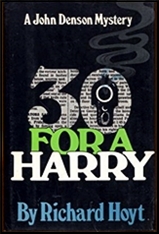
RICHARD HOYT – 30 for a Harry. John Denson #2. M. Evans, hardcover, 1981. Penguin, paperback, 1984.

   Having worked for a newspaper at one time himself, private eye John Denson is a natural to be hired by the Seattle Star to help flush out a Harry, vernacular for a crooked reporter with a habit of shaking down local business establishments.

   Denison has a suspect from the start, but when the man is found murdered, the scope of his investigation is widened dramatically. The local vice industry is strongly interested in the case, and so are certain Japanese gentlemen with a finger in the area’s salmon business.

   Hoyt’s first book and Denson’s case immediately preceding this one was entitled Decoys, and overall, it’s probably the stronger of the two. The approach taken this time around is considerably more direct, for one thing, with fewer layers of misdirection being applied. Hoyt has a winning way in creating well-defined characters, however — in this case those especially of the type usually found hanging around a city room. I’m already looking forward to his next one.

–Reprinted in slightly revised form from The MYSTERY FANcier, Vol. 6, No. 1, Jan-Feb 1982.

        The John Denson series —

1. Decoys (1980)
2. Thirty for a Harry (1981)
3. The Siskiyou Two-Step (1983) aka Siskiyou (1984)
4. Fish Story (1985)
5. Whoo? (1991)
6. Bigfoot (1993)
7. Snake Eyes (1995)
8. The Weatherman’s Daughters (2003)
9. Pony Girls (2004)

AGATHA CHRISTIE – Cat Among the Pigeons. Hercule Poirot #34 (including story collections). Dodd Mead, US, hardcover, 1960. Pocket, US, paperback; March 1961. First published in the UK by Collins, hardcover, 1959. Reprinted many times. TV adaptation: ITV, 2008, with David Suchet as Poirot. (Other versions have also been made.)

   At this mid-to-late stage in her career, Agatha Christie’s skills at concocting outrageously clever detective puzzles were showing signs of decreasing, but even so, as a detective puzzle Cat Among the Pigeons would qualify to be in the top 5% of anything written and marketed as a mystery today.

   The book opens in impressive fashion. It is the first day of the term for the girls arriving at Meadowbank School, some for the first time, including some of the mistresses. It is a day of happiness and confusion. There are any number of matrons, mothers, girls and the new school secretary to be introduced to the reader. While I can’t tell you how Miss Christie does it, what is true is that each and every one of these is described in such a way that you know them almost inside and out within just the few lines set aside for each of them.

   It isn’t going to be a pleasant term, however. Two murders will occur before it has hardly begun, and headmistress Miss Bulstrode, usually calm and collected, has all she can handle as she does her best to keep the scandal from closing the school down. Luckily Hercule Poirot is called in on the case, one that also involves a fortune in diamonds that has somehow been smuggled into the country.

   Unluckily, Poirot doesn’t make his first appearance until page 148 of the Pocket paperback I’ve just read, and yet, on the other hand, Agatha Christie also had the knack of keeping her mysteries from sagging as badly as they do in the ones written by so many other authors.

   Being a novel taking place in academia, it should not be surprising that Miss Christie has something to say about schooling and education in general, and she does. Or at least her main character here, Miss Bulstrode, does. She’s a very progressive woman, especially for the year of 1960.


REVIEWED BY DAN STUMPF:         


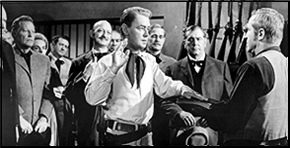
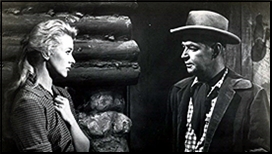
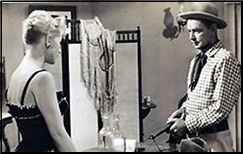
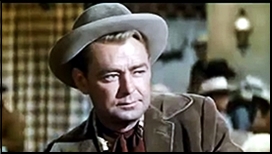
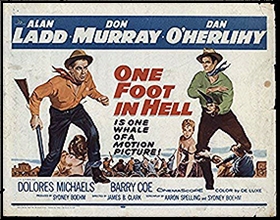
ONE FOOT IN HELL. 20th Century Fox, 1960. Alan Ladd, Don Murray, Dolores Michaels, Dan O’Herlihy and Barry Coe. Written by Aaron Spelling and Sydney Boehm. Directed by James B Clark.

   I hate it when someone has a good idea for a movie and then it gets fumbled.

   In this case it’s a warped quest for vengeance set in the old west, with Alan Ladd as a settler passing through a small town who sees his ailing wife die because of the callousness of its citizens: The hotel clerk won’t fetch a doctor, the local druggist doesn’t fill a prescription promptly, and when Ladd makes a fuss, the sheriff detains him on suspicion long enough for Ladd’s wife to die before he gets back with the medicine that would have saved her life.

   Chastened by her death, the good people of the town try to make up for it by offering him a job, but when Ladd takes a position as Deputy Sheriff, it’s with an eye out to settle the score.

   To this end, he recruits a small band of ne’er-do-wells and owlhoots to help him loot the local bank: Don Murray as a drunk looking to restore his pre-war fortunes; Dolores Michaels as a dance-hall floozie trying to get out of the racket; and Dan O’Herlihy and Barry Coe, who just like stealing & killing — and One Foot takes a step into Caper Movie Territory.

   The supporting cast does quite well in this, particularly when Murray and Michaels (who was memorable in The Fiend Who Walked the West) kindle a spark of decency between them and wrestle with the notion of going straight. Some of Aaron Spellings’ expositions are a bit too pat—like the characterizations in Love Boat — but when we get to the robbery and subsequent posse chase, led by Ladd himself, things get agreeably nasty as writer Sydney (The Big Heat, Violent Saturday, etc.) Boehm rings in some gratuitous murders and wicked double-crosses to liven things up.

   Too bad One Foot is afflicted by the wrong director and a star past his prime.

   Director James B. Clark did some highly successful animal films (Flipper, and A Dog of Flanders come to mind) but he lacks the sense of pace necessary to this sort of thing. As for star Alan Ladd as the bitter widower nursing a deadly grudge and finally turning on his cohorts…

   Well, back in the 40s he could have used his impassive features to suggest wheels within wheels ready to grind up his unwitting prey, but at this stage in his career Alan Ladd was from all accounts fighting a battle with booze & drugs, and not trying very hard to win. Podgy and dull-eyed, he looks about as deadly here as a rubber ball, and he’s not helped by a costume designer who dresses him like a hick.

   With Ladd and Clark at its heart, it’s surprising that One Foot in Hell works as well — or as not-too-badly — as it does. I recommend it to fans of Westerns and Caper Movies with a quick finger on the fast-forward trigger, who will find here a solid half-hour’s entertainment in a 90-minute movie.

REVIEWED BY BARRY GARDNER:


DON WINSLOW – A Cool Breeze on the Underground. Neal Carey #1. St.Martin’s, hardcover. 1991; paperback, 1996. Nominated for an Edgar award for Best First Novel.

   Neal Carey is a young man employed by a firm called Friends of the Family, which exists to solve nagging little problems that might annoy friends, acquaintances, or business associates of an old New England bank. Carey is called away from his studies — the firm is financing his education — to hunt down the daughter of a politician who has run away from home, and has been sighted in London.

   He doesn’t care much for the assignment, or the timing that’s going to cause him to fail a course, but really doesn’t have much choice. And as if finding a runaway in a huge city weren’t chore enough, he’s given a deadline. Off he goes to the Smoke, where he finds that nothing is ever simple. But he already knew that.

   I can see why Winslow is getting a lot of attention. I don’t know whether the series will stand the test of time — or even if the second and third are as good as the first, for that matter — but I liked this considerably. A good bit of the book is devoted to flashbacks that tell us who Carey is, and how he got to where he is today, and these interludes are well integrated with the story proper.

   Winslow has what may be the most important ingredient in making it big in the field — an engaging “voice.” His characters are interesting and believable, his narration smooth. The plot was nothing special, but nothing especially offensive either. Underground is one of the better series debuts I’ve read, and it will be interesting to see if he can maintain the standard he’s set.

— Reprinted from Ah Sweet Mysteries #18, February-March 1995.


      The Neal Carey series —

A Cool Breeze on the Underground (1990)
The Trail to Buddha’s Mirror (1992)
Way Down on the High Lonely (1994)
A Long Walk Up the Waterslide (1995).
While Drowning in the Desert (1996).

« Previous PageNext Page »