Reviews


Reviewed by MIKE TOONEY:


(Give Me That) OLD-TIME DETECTION. Issue #49. Autumn 2018. Editor: Arthur Vidro. 36 pages. On the cover: Jack Ritchie.

   As always, the latest edition of OLD-TIME DETECTION brings to mind fond memories of works of mystery and detection of yesteryear, stories and authors that don’t deserve to be forgotten. Case in point: the few hardboiled private eye novels by Howard Browne that have just seen republication in an omnibus after seventy years, HALO FOR HIRE: THE COMPLETE PAUL PINE MYSTERIES. In his review, Michael Dirda applauds Browne’s style, “quite consciously written in the wise-cracking, tough-guy mode of Chandler’s fiction and 1940s Humphrey Bogart films. Yet even with their faint tongue-in-cheek air (and an astonishing amount of cigarette smoking), they make for heavenly reading.”

   When it comes to obscure detective fiction, Charles Shibuk has turned up titles that you’ve probably never encountered: H. C. Branson’s LAST YEAR’S BLOOD, Moray Dalton’s THE LONGBRIDGE MURDERS, and J. F. Hutton’s TOO GOOD TO BE TRUE, books published more or less at the same time as Howard Browne’s.

   Francis M. Nevins biobibliographically spotlights Jack Ritchie, creator of the unforgettable Detective Sergeant Henry Turnbuckle; Ritchie, says Nevins, “figured out how to have endless fun tweaking the noses of the hoary old whodunit cliches while staying squarely within the great tradition’s confines.” For that reason, Arthur Vidro nominates Ritchie as one of his all-time favorites.

   Then Edgar Wallace gets spotlighted by J. Randolph Cox, as he chronicles in detail the ups and downs in the British author’s life and literary career. “He was not a great writer,” writes Cox, “for all of his flashes of genius and inspiration. He never claimed to be, and he did not need to be.”

   The fiction piece in this issue is Charles Shibuk’s teleplay version of Cornell Woolrich’s 1941 short story, “The Fingernail.” Memorable line: “Robert, are you sure that was all rabbit?”

   Nevins returns with notes on three motion pictures derived from Woolrich’s stories: DEADLINE AT DAWN (1946), which wasn’t received with any great enthusiasm at the time; BLACK ANGEL (1946), which, even though “every frame of this magnificent film noir is permeated with the Woolrich spirit,” the author himself regarded as “a disaster”; and THE CHASE (1946), which, writes Nevins, “is the one most likely to provoke an argument among noir aficionados” of Cornell Woolrich’s movies.

   Dr. John Curran, foremost expert on all things Christie, reports on the good and bad things that have been going on in Christiedom, particularly stage, film, and TV plays as well as upcoming books. Regarding the recent John Malkovich-BBC production of THE A.B.C. MURDERS, he writes, “Once again, I fear, the signs are not good.”

   Then we have in-depth reviews of three books: Jack Ritchie’s collection, THE ADVENTURES OF HENRY TURNBUCKLE, about which Arthur Vidro says, “If you want to laugh aloud while enjoying true detection, read this book”; Ellery Queen, Jr.’s THE BROWN FOX MYSTERY, “far,” writes Trudi Harrov, “from his best entry”; and S. John Preskett’s satirical MURDERS AT TURBOT TOWERS, which, says Amnon Kabatchnik, “pokes outrageous fun at the holy cows of our beloved genre.”

   In “My First Great Detectives,” Jon L. Breen waxes nostalgic about his initial encounters with the world of mystery, crime, and detective fiction; the characters whose exploits he followed from an early age were, not surprisingly, on the radio, but it wasn’t long before he delved into the written word, including Paul French’s Lucky Starr science fiction mysteries. (A trip to Patagonia if you can supply the real name of “Paul French” without looking it up. Of course, you pay for the ticket.)

   Charles Shibuk’s 1970 list of crime and mystery authors whose classic books were enjoying paperback reprintings at the time reads like a WHO’s WHO of detective fiction: Marjorie Allingham, John Dickson Carr, Agatha Christie, Michael Collins, Dick Francis, Andrew Garve, Adam Hall, Ross Macdonald, Ngaio Marsh, Judson Philips (Hugh Pentecost), Maurice Procter, Ellery Queen, Joel Townsley Rogers, C. P. Snow, Rex Stout, Robert van Gulik, and Cornell Woolrich.

   Finally, in addition to a puzzle are the comments from the readers, one of which deals with a much-discussed topic: “What’s wrong with modern mysteries? How about the obvious fact that they contain every aberration known to man . . . and some of the writing is by devout enemies of the English language?”


*** OLD-TIME DETECTION is published three times a year: Spring, Summer, and Autumn. Sample copy: $6.00 in the U.S.; $10.00 anywhere else. For a subscription to Old-Time Detection, contact the editor at: Arthur Vidro, Old-Time Detection, 2 Ellery Street, Claremont, New Hampshire 03743 or oldtimedetection@netzero.net.
REVIEWED BY DAVID VINEYARD:         


RIDE THE MAN DOWN. Republic Pictures, 1952. Brian Donlevy, Rod Cameron, Ella Raines, Forrest Tucker, Barbara Britton, Chill Wills, J. Carroll Naish, James Bell, Taylor Holmes, Jim Davis, Paul Fix, Roy Barcroft, Jack La Rue, Douglas Kennedy, Chris-pin Martin Screenplay by Mary McCall, Jr. based on the book by Luke Short (Doubleday Double D Western, hardcover, 1942; Bantam Books # 82, paperback, February 1947; first published as a Saturday Evening Post serial, April 4 through May 16 1942). Directed by Joseph Kane.

   Maybe it is because it is based on a novel by Luke Short (Frederick Glidden), but this fast moving tale of a range war has enough characters and plot for half a dozen films, and yet somehow never seems crowded or off balance, and that certainly has to do with an all star B cast and the sure hand of veteran Republic oater director Joe Kane at the helm.

   Shot in TruColor, this one boasts a literate script, tough almost hard-boiled characters (not surprising from Short who was one of the leading exponents of the hard-boiled Western and whose books inspired two of the better noir Western films — Blood On the Moon and Stations West), and solid motivation all around, and in this one it feels less like the old West than Capone era Chicago with horses and cowboy hats, as everyone in the countryside is out to steal from or kill the handful of good-guys. Odds against the hero of one of these have seldom been higher.

   This is one of several Rod Cameron and Forrest Tucker worked on at the studio with Cameron usually the hero and Tucker the heavy, though here he is only one of a formidable group surrounding the embattled Cameron and his handful of allies.

   The time is the early thaw of 1892 when Phil Evarts, owner of the Hatchet Ranch has just died, frozen to death in the harsh winter. Evarts was an unpopular man who carved his land out by sweat and bullets and few mourn his passing, particularly not Bide Marriner (Brian Donlevy), a fellow rancher, and neighbors Paul Fix, Roy Barcroft, Jack La Rue, and Douglas Kennedy, who all want the Hatchet grazing land, and Evart’s son-in-law-to-be Sam Danfelser (Forrest Tucker) who has other reasons to want Hatchet broken up. Even Sheriff Joe Kneen (J. Carroll Naish) is no mourner, and likely to be little help.

   Add to that Red Courteen (Jim Davis) as a renegade who sells whiskey and guns to the Indians and wants his piece of the pie, and there is a who’s who of Western bad guys gathered to destroy the Evarts legacy. Even the proprietor of the local general store Mr. Priest (Taylor Holmes) father of Lottie, the girl Hatchet foreman Will Bartlett (Rod Cameron) wants to marry (Barbara Britton), wants to get in on the deal. The Hatchet Ranch is surrounded by venal and violent vultures who want to feed on the body before its dead the characters almost as venal as a revisionist Western from a much later era.

   In fact, the only people who seem to care about Evarts and Hatchet are his weak brother John (James Bell), Phil’s strong daughter Celia (Ella Raines), and foreman Will Bartlett, and it quickly looks as if it will be the latter two against the whole territory as they fight to keep the Hatchet together against impossible odds and enemies inside and out.

   Sub-plots abound. Sam is jealous of Celia Evarts devotion to Bartlett; Lottie is jealous of Bartlett’s devotion to Celia; Sheriff Kneen is in Marriner’s pocket but the fit is increasingly binding; Ray Kavanaugh (Paul Fix) murders John Evarts and is witnessed by weak rancher Joe Kennedy (Jack La Rue) who flees the country pursued by Bartlett; Marriner wants Kavanaugh arrested and tried tying up the Hatchet in court and with it certain the locals who hate the Hatchet Ranch will set him free; Red Courteen (Jim Davis) hates the part Indian Bartlett who humiliated him; Lottie’s father Mr. Priest has bought interest in cattle owned by Courteen and now being held by the Hatchet because they were grazing on Hatchet land and he’s losing money; and, the only help Bartlett can hire is a couple of drifters top hand Ike Adams (Chill Wills) doesn’t trust.

   Meanwhile Sam tries to undermine Bartlett and force Celia to give into Marriner because he is unmanned by her wealth and power and resents her strength.

   That’s quite a bit of plot to work into just over ninety minutes and still get in a satisfying amount of action and gunplay, and granted Donlevy doesn’t really get as much film time as he might need to really make an impression as the bad guy, what with Tucker and Davis taking up so much of the bad air..

   And tough action there is, more brutal than you might expect from a Western of this era, but also room for the redemption of Sheriff Kneen and a shootout between him and Marriner; a couple of well done set pieces — a nice one of Bartlett trapped in the town run by Courteen having to shoot his way out against a small army of enemies — and enough bits here and there for the large cast to keep all the actors happy.

   It’s no lost classic, and frankly the print I saw was at best only serviceable, but it is a good example of what Republic could do with the Western, given a bit more to chew on than the usual oater script. The fact that the crowded plot never seems constrained by the running time and no one in the cast gets slighted shows capable hands at work. Just getting all those plot elements from the Short story into the screenplay without losing track of any of the characters or their arcs was no small achievement.

   It’s not exactly true that Republic never made a bad Western as they used to assert when I was a kid growing up, but they didn’t make many of them, and they hit the bulls-eye for more often than you might expect. This is a surprisingly meaty small A film with a Western fan’s dream cast, and more going for it than any fan has the right to expect. You got a lot for your dime or quarter in those days and no Western fan, kid or adult, was likely disappointed in this one.


J. M. T. MILLER – Weatherby: On a Dead Man’s Chest. Artie Weatherby #2. Ballantine, paperback original; 1st printing, October 1989.

   Billy Bones, a salty sea captain marooned by pirates, buried treasure! I don’t believe I’ve ever read a PI adventure quite like this — a modrn-day murder mystery combined with Robert Louis Stevenson’s Treasure Island, and I enjoyed just about every minute of it.

   The PI is named Artie Weatherby, and from the way he tells his own story, we know that he isn’t the swiftest thinker in the world, but when he gets caught up in the lust for treasure, the story is tells is well nigh irresistible. Lots of bodies. Lots of fun.

–Reprinted from Mystery*File #19, January 1990.


UPDATE. [01-11-19]   The first book in the series was Weatherby (1987), which I reviewed here just about two years ago. The third and final case that Weatherby was involved in was The Big Lie (1994), which I have not read, nor do I have a copy of. And for the record once again, the author’s full name is Janice Marie Tubbs Miller.

REVIEWED BY JONATHAN LEWIS:


  CANON CITY. Eagle-Lion Films, 1948. Scott Brady, Jeff Corey, Whit Bissell, Stanley Clements, Charles Russell, DeForest Kelley, Ralph Byrd, Mabel Paige, (Warden) Roy Best as himself. Narrator: Reed Hadley. Cinematography: John Alton. Screenwriter-Director: Crane Wilbur.

   Film noir aficionados looking for a movie that has previously escaped their attention should look no further than Canon City, a surprisingly effective crime film put out by Eagle-Lion Films. Written and directed by Crane Wilbur, who also penned both the story and script for He Walked By Night, also from 1948 and reviewed here, Canon City notably features stark black and white cinematography by John Alton, who is perhaps best known today for his ongoing collaborations with director Anthony Mann.

   Traversing genres, the semi-documentary film named after the Colorado city where the action takes place is simultaneously a work of social realism in the 1930s Warner Brothers mold, a prison break movie, and a home invasion thriller.

   Scott Brady, in his first leading role, portrays Jim Sherbondy, a doomed protagonist if there ever were one. As teenager who got mixed up with a bad crowd and whose subsequent criminal path led him to a lengthy sentence of incarceration for murdering a cop, Sherbondy is now doing his best to reform himself within the confines of the prison walls. But trouble seems to follow him wherever he goes. Other convicts planning a prison break exploit his good reputation with the guards and snooker him into becoming a key player in a prison break.

   Leading the pack of thieves and murderers is Carl Schwartzmiller. Jeff Corey takes this role and lends it an infectious energy. We know his character is a miscreant, yet in Corey’s more than capable hands, he fascinates us with his sardonic wit and fatalistic worldview as much as repels us. Look for the diabolically tense scene wherein Schwartzmiller takes an elderly couple hostage in their home. The camera follows the old woman, carrying both a hammer and an orange, as she slowly creeps up on the criminal ringleader, hoping to smash his skull. Schwartzmiller turns around and notices her presence, asking what she has with her. She offers him an orange. He gladly accepts and begins to peel it.

   A trifling scene perhaps. But one that only reinforces my belief that Corey remains one of the great character actors of that era.


REVIEWED BY BARRY GARDNER:


LUCRETIA GRINDLE – So Little to Die For. Inspector Ross #2. Pocket, paperback original, 1994.

   Lucretia Grindle has spent much of her time in England, but now lives in Massachusetts. I thought her first pbo, The Killing of Ellis Martin, was a good traditional British mystery. I don’t remember it getting much attention, though.

   Inspector Ross of the Kent CID is having a bit of a holiday in Scotland, but we know how that goes, don’t we? He meets a British group in a restaurant and chats with them, and the next day four of the six are dead, brutally murdered by shotgun blasts on their small cottage.

   A local shepherd is quickly arrested, but for various reasons Ross does not believe him guilty. He speaks to the investigating officer but does not convince him, and might have let the matter lie despite his doubts — until he’s handed evidence that some of the parties involved have lied to the police. Now he’s got the bit in his teeth, and over the fences we go in pursuit of an unknown fox.

   I still think Grindle is worth reading. Her prose is smooth, and she does a nice job of characterizing the widower Ross and his Welsh Sergeant, Owen Davies. Her focus is a bit more on her detective than is the case with the more traditional authors like Burley and Clark, but that’s clearly the tradition in which she works.

   While this isn’t really a village mystery, it has that feel, and her first was. There isn’t a great deal of depth either intended or achieved in her books, but she does furnish a pleasant read.

— Reprinted from Ah Sweet Mysteries #17, January 1995.


Bibliographic Update:   While there were only the two books in Lucretia Grindle’s Inspector Ross series, she continued on as a writer, adding four more mystery novels to her resume, beginning in 2003. For more information about her, you might start by checking out her Wikipedia page here.

WINGS OF DANGER. Hammer Films, UK, 1952. Lippert Pictures, US, 1952 as Dead on Course. Zachary Scott, Robert Beatty, Naomi Chance, Kay Kendall, Colin Tapley, Arthur Lane, Harold Lang, Diane Cilento. Screenwriter: John Gilling, based on the novel Dead on Course by Mansell Black (Elleston Trevor aka Trevor Dudley Smith}. [Note: The movie credits also give Packham Webb as a co-author of the book.] Director: Terence Fisher.

   Zachary Scott, in my opinion, made a better villain in the movies he made than he did a hero. He had a beautiful speaking voice, but he seemed to have a perpetual semi-scowl on his face, the thought being that he had some sort of subtle dislike of what he was doing or who he was dealing with.

   But in Wings of Danger he is the hero, and if it doesn’t work out well, which I don’t think it does, I’d be the first to admit that it wasn’t all his fault. The story doesn’t allow his character much range at all, and you really have to wonder what he might have been able to do with a better script.

   He plays a post-WWII cargo pilot who’s been successfully hiding the blackout spells he’s been having from the firm he’s working for, and when he tries to stop a buddy (Robert Beatty) from taking off into stormy weather, the buddy threatens to tell all and flies off anyway. And his plane is never heard from again.

   Well, the wreckage is, but there’s no body to be found. The police are interested — smuggling is suspected — and Scott’s character (a fellow named Van Ness) is implicated. Van Ness’s other motive for snooping around is keep everything a secret from his friend’s sister and father, who idolize him.

   You might be thinking of The Third Man right about here, and rightly so. There is a lot more to the plot than I’m going to go into, but rather than adding to the story, it makes it all the more muddled. As an example of film noir, the story’s adequate. The photography, within the limitations of a low budget, is even more so.


REVIEWED BY DAN STUMPF:         


LEE LEIGHTON (WAYNE D. OVERHOLSER) – Law Man. Ballentine, hardcover (H51) & paperback (#51), 1953. Ballantine U1040, paperback 1964. Axe, paperback, 1977. Ace/Charter, paperback, 1985. Jove, paperback, 1988. Winner of the first Western Writer’s Assocation Spur Award for Best Novel.

STAR IN THE DUST. Universal, 1956. John Agar, Mamie Van Doren, Richard Boone, Colleen Gray, Leif Erickson, Randy Stuart, Paul Fix, Harry Morgan, Kermit Maynard and Clint Eastwood. Screenplay by Oscar Brodney, from the novel by Lee Leighton. Produced by the redoubtable Albert Zugsmith. Directed by Charles Haas.

   A taut film from a slack novel.

   Leighton/Overholser’s book deals with twenty-four hours in the life of middle-aged Marshal Bill Worden: the last day in the life of convicted killer Ed Lake, scheduled to hang next morning. It also deals with a wide cast of characters, including:

   Worden’s daughter Ellen, who is engaged to marry

   George Ballard, who owns the biggest ranch in the valley and the local bank — and is therefore ipso facto a bad guy.

   Nan Hogan, Ballard’s ex-mistress, now married to

   Lew Hogan, a stubborn rancher who feels duty-bound to keep Lake from hanging

   Rigdon, a fire-and-brimstone preacher who feels duty-bound to hang Lake himself

   Mike MacNamara, Worden’s Deputy

   Orval Jones, janitor and would-be deputy

   Jeannie Mason, a fallen woman because of Ed Lake

plus assorted farmers, ranchers, cowhands, townsfolk and attendants to the court.

   Leighton does a skillful job of setting all these folks at odds with each other: the ranchers out to save Lake, Ballard anxious to see that Lake doesn’t incriminate him, farmers egged on to lynching by Rigdon, Lake with his own plans for the future – and thankfully Leighton takes care to remind the reader who everyone is from time to time. He also works things to a convincing resolution, one that seems to grow from the characters themselves.

   The problem is that Leighton tends to tell us how they feel—repeatedly and at length — when he should just show us — and when things should be getting tense, they just get wordy. Worthy concept, weak execution.

   Oscar Brodney’s script for Star in the Dust tightens things up considerably. For one thing, it starts at dawn on the day Lake (here named “Sam Hall”) is scheduled to die at sunset. And since this is a film, the internal monologues of the book get replaced by a few lines of dialogue.

   That’s not all that gets replaced. Preacher Rigdon of the book is here a power-mad schoolteacher (I think I had him for English 101 in College) and middle-aged Marshal Bill Worden is now youngish Bill Jordan (John Agar) engaged to marry Ballard’s sister (Mamie Van Doren.)

   Best of all, nasty Ed Lake in the book is now Sam Hall, played with savage sensitivity by Richard Boone, a year before Have Gun, Will Travel and in those days a character actor to be reckoned with. I suspect Brodney knew he was writing for Boone, and wrote the part to fit him. His Sam Hall is educated, self-aware, and dangerous to know, a character at once sympathetic and frightening.

   With Boone as the lynch pin, Star in the Dust could have stopped right there, but producer Albert Zugsmith fills the movie with fine actors in choice parts. Leif Erickson radiates bluff duplicity as the scheming bad guy, slimy Robert Osterloh projects petty tyranny as the schoolmaster, while Paul Fix and James Gleason do a fine double-act as Agar’s deputy and the wanna-be janitor.

   Star in the DustEven better, Colleen Gray and Randy Stuart play off each other perfectly as the women who loved well but unwisely. Stuart in particular carries a moving rueful aspect as Erickson’s cast-off mistress, now married to Henry Morgan, as the loyal-but-not-bright Lew Hogan (Years later, Stuart also played Morgan’s wife in the 1960s Dragnet teleseries.)

   Best of all, Star in the Dust moves in a way the novel never did, filling eighty minutes with action under the fast-paced direction of Charles Haas.

   And by the way, in his one scene, a skinny young contract player named Clint Eastwood is what is usually and charitably termed adequate.


DELANO AMES – She Shall Have Murder. Jane & Dagobert Brown #1. Hodder & Stoughton, UK, hardcover, 1948. Rinehart & Co., US, hardcover, 1949. Dell #493, US, paperback, 1951. Perennial Library, US, paperback, 1983. Rue Morgue Press, trade paperback, 2008. Manor Minor Press, US, annotated trade paperback, November 2014. Film: Concanen, UK, 1950 (with Rosamund John as Jane Hamish and Derrick De Marney as Dagobert Brown).

   Jane and Dagobert are not yet married in this, their first case of actual murder. Their relationship is complicated, and it takes a while to sort things out. They are (apparently) lovers, and I am sure Jane calls him her fiancé, but the fact is that Dagobert is already married but is (apparently) going through divorce proceedings.

   This is the first of the series I’ve read, but I am fairly sure that some point along the line — there were twelve books in all — they did get married. Jane is the sensible one with a steady job as a secretary in a law office), and it is a little perplexing at times what she sees in him. His is notoriously unemployed and flits from one interest to another like a moth on a holiday.

   The big conceit in She Shall Have Murder, and an amusing one, is that Jane should write a mystery novel whose characters are her bosses and fellow employees at work. But when one of the firm’s oldest clients dies, fiction becomes truth, and Dagobert has a new interest: that of amateur detective work.

   The telling of the tale that follows is bright and witty, and with Jane narrating the story, she gives Dagobert a few well-deserved jabs. Dead is an old and uncomfortably paranoid old lady whose visits to the law office are sadly barely tolerated by the staff. When she is found dead, everyone but Dagobert is convinced it was suicide, but as it always happens in detective novels, it turns out that he is correct. It was not.

   This was written back in the post-WWII when the British had to insert shillings into a gas meter box to obtain heat, and since a good deal of the plot depends on this, it makes the story rather dated, especially for US readers. Of the many characters, I also found only the main protagonists, Jane and Dagobert, particularly interesting, and of the others, rather than the least likely, it was the least interesting who was the killer.

REVIEWED BY JONATHAN LEWIS:


KENNETH MILLAR – The Dark Tunnel. Dodd Mead, hardcover, 1944. Lion #46, paperback, 1950. Gregg Press, hardcover, 1980. Also published as I Die Slowly. Lion Library LL52, paperback, 1955.

   Ross Macdonald penned his first novel, The Dark Tunnel, in 1944 under his birth name Kenneth Millar. A detective story where the protagonist is a professor rather than a private investigator, the book is best categorized as a work of mystery fiction with strong elements borrowed from the type of thrillers that inspired many a Hitchcock film. Although by no means a flawless work, Millar’s debut novel demonstrates the author’s fluidity with language, particularly the hardboiled vernacular that has become the trademark patois of those writers who have followed in the tradition of Dashiell Hammett and Raymond Chandler.

   Published during the Second World War – and soon before Millar entered service in the U.S. Navy – The Dark Tunnel refers to a physical place detailed in one of the more action oriented portions of the novel. It likewise serves as an apt metaphor for Germany’s descent into Nazism. After all, Germany was not some backwater, uncivilized country; it was a country with a rich cultural and literary tradition that nonetheless chose a dark path.

   The novel follows the path of Dr. Robert Branch, a literature professor at an unnamed Midwest university set in the fictional town of Arbana (a clear stand-in for Ann Arbor, Michigan). After Branch’s colleague, Alec Judd, informs him of a Nazi spy ring operating in Michigan, Branch is plunged into a nightmarish world of murder and subterfuge wherein he both witnesses one murder and is falsely accused of another. Millar’s academic background – he went on to receive a doctorate in literature after the Second World War – influences his prose, lending the work a frenetic Kafkaesque quality that is more refined than some of his lesser known contemporaries.

   Then there’s the girl. A beautiful redheaded German actress named Ruth Esch with whom Branch had a whirlwind romance when he was in Munich in 1937, well before the United States was at war but after the Nazi jackboots had taken power. When Ruth Esch reappears in Arbana, years after being interned in a concentration camp, Branch’s past and present collide in a maelstrom of brutal political violence.

   Critics may bristle someone at Millar’s treatment of the dual subjects of homosexuality and transvestitism, both of which play pivotal roles in the unraveling of the mystery and which (Plot Alert) are linked, at least implicitly, with Nazi decadence. These topics, while not overtly exploited for sensational purposes, do lend the work a pulpy, sordid feel that likely shocked some readers when the book first appeared on bookshelves. Some may feel the emphasis on the villains’ sexuality to be a distraction from what is otherwise an impressive tale of an ordinary American man thrust into a world he doesn’t fully comprehend.

   More distracting for me, however, was the suspension of disbelief constantly required to accept that a professor of literature would speak in such a hardboiled manner, let alone mouth off to authority figures such as the police and the feds. Robert Branch comes across as a working class PI masquerading as a professor, a product more of the school of hard knocks than of the mandarin university system.

   Millar was clearly finding his voice at this point in his career. Academia was the world he knew. So it made perfect sense for him to create a character set in the milieu he best understood. But it’s clear that inside Robert Branch, there was a cynical Lew Archer waiting to get out and make his presence to the world known.

REVIEWED BY JONATHAN LEWIS:


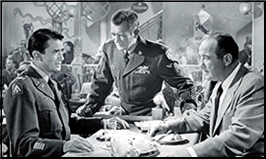
NIGHT PEOPLE. 20th Century Fox, 1954. Gregory Peck, Broderick Crawford, Anita Björk, Rita Gam, Walter Abel, Buddy Ebsen. Screenwriter-Director: Nunnally Johnson.

   The labyrinthine plot is a feature, not a bug. It’s the murkiness of the whole rotten deal that’s on display in Night People, a Twentieth-Century Fox production starring Gregory Peck and Broderick Crawford as two men attempting to navigate the return of a kidnapped American enlisted man in Cold War Berlin.

   Peck stars as Col. Van Dyke, a hard-nosed cynic who has learned that diplomacy means not only patience, but also making deals with the devil.

   Crawford is perfectly cast as Charles Leatherby, the kidnapped GI’s father. A car parts industrialist from Toledo, he believes that his fast-talking and his vast wealth will certainly expedite the release of his son. After all, money talks. His influence with elected officials back home is well known.

   But what starts off as a semi-straightforward case soon reveals itself to be a far more complicated and morally dubious scenario. It turns out that the communists want an elderly German couple, both known anti-Nazis in their day, as the price to pay.

   Initially, Leatherby is inclined to trade the couple if it means getting his boy back. He starts to get cold feet, however, when he ends up spending time in the hospital with the couple, both of whom chose to poison themselves rather than end up back in a Soviet prison. Things get even more shadowy when it comes out that the German woman isn’t German at all and that the GI’s captors may not be Soviets after all.

   [WARNING: Plot Alert]   There’s one aspect to the film that continues to frustrate me, and that has to do with a character that presents herself to Van Dyke as a go-between who works both the American and Soviet sides. “Hoffy” Hoffmeir (Anita Björk) is an ex-lover of Van Dyke’s who says she’ll be able to set up the nighttime exchange between the two enemy forces staring each other down across Checkpoint Charlie.

   It’s a spy film whose main theme is deception, so it comes as no surprise that she too isn’t exactly honest about her true identity. But the way the screenplay is written, it’s never clear whether she’s been an imposter all the time or whether she’s been part of an elaborate plot to gain the confidence of Van Dyke from the very beginning.

   But perhaps that was the whole point. Maybe you can’t even trust a beautiful woman whose life you’ve spent hours researching. Maybe nobody anybody in Cold War Berlin was fully honest about their true identities, let alone what they may or may not have done during the Nazi regime. If Van Dyke is the hardnosed cynic, Leatherby represents the optimistic, can-do American whose illusions are shattered in the chilly Berlin night.


« Previous PageNext Page »