Reviews


REVIEWED BY DAN STUMPF:         


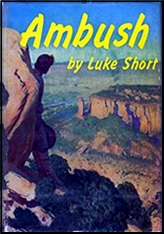
LUKE SHORT – Ambush. Houghton Mifflin, hardcover, 1949. Bantam #853, paperback, December 1950. Many other reprint paperback editions.

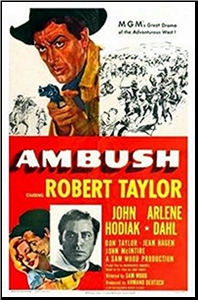
AMBUSH. MGM, 1950. Robert Taylor, Arlene Dahl, John Hodiak, Don Taylor, John McIntire, Jean Hagen, Leon Ames, Chief Thundercloud and Charles Stevens. Screenplay by Marguerite Roberts, from the novel by Luke Short. Directed by Sam Wood.

   Reading Luke Short’s Ambush, it’s easy to see why so many of his books were translated into noir Westerns: The terse, tough dialogue; fast, bloody action, and most of all Short’s view of the World as nasty, brutish and vast. Short’s heroes seem to be shaped by the terrain they travel, from snow-bound mining camps, to wide open cattle ranges and harsh deserts, pitiless as Chandler’s Mean Streets. Thus they beget films like Ramrod, Station West, Blood on the Moon … and Ambush.
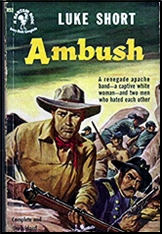
   As the novel opens, ex-army scout Ward Kinsman has been mining gold for months in Apache country, keeping his presence a secret until old friend and fellow-scout Frank Holly noses him out and brings the Apaches down on them both. We get a long, tense scene of the two men making their way down an escarpment in the dark to escape, then back up again to throw their pursuers off the trail. Finally they reach the Army outpost whence Holly was sent to summon him, he’s asked to scout for an expedition to find a war chief known as Diabolito and rescue a captive from him — a mission he flatly refuses, in the tradition of hard-boiled heroes everywhere.

   Of course, Kinsman does eventually take on the job, and while he’s working his way around to it, we get background on the soldiers and soldiers’ wives who make their homes at the outpost, and the little dramas that fill their lives. This could have been a dull stretch, but Short keeps it moving with clever dialogue (“What comes after a Billion?” “I don’t know. Fifteen, I think.”) and bursts of action.

   Best of all, when the expedition gets underway the action is plentiful and shaped by the relationships we watched simmering back at the fort. Short has a gift for letting the rough-hewn characters shape their own ends, and best of all he knows how to keep it exciting.

   Screenwriter Marguerite Roberts and director Sam Wood were smart enough to stick close to the book when they filmed this, and they do a fairly good job of getting through the personal drama quickly and on to the injun fightin’. Robert Taylor uses his type-cast sharpness to good effect; his piercing glance seems to take in each rabbit and lizard scuttling across the rocky terrain and file it away for future use. John McIntire, made up to look like Buffalo Bill, is fine as Frank Holly, and Jean Hagen puts in a quietly moving performance as a battered wife that steals the show from ostensible leading lady Arlene Dahl.
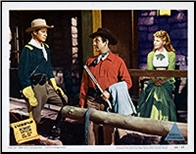
   There’s also some movie shorthand here that works well: In the book, Luke short limns the characters of Diabolito, crazed war chief, and Tana, a warrior who has switched sides (or has he?) to scout for the Army. The movie doesn’t have time to do this, so director Wood simply uses actors Charles Stevens (who made a career of crazy Indians) and Chief Thundercloud, whose inexpressive face seems to hint at all sorts of possibilities.

   There are a couple of awkward spots where the screenplay departs from the book and Roberts patches it over with awkward dialogue, but Ambush brings off a memorable finale, as the Cavalry rushes to catch up with fleeing foes… and we suddenly see they are charging into the canyon where the film opened – with an ambush.

   Nice touch, that.
PARNELL HALL – Murder. Stanley Hastings #2. Donald J. Fine, hardcover, 1987. Onyx, paperback, January 1989.

   PI Stanley Hastings first appearance was in Detective, read and reviewed be me in M*F10 [but not yet online], and as I said then, Hastings is not really a PI. More of an ambulance chaser, a self-admitted coward. The scrapes he gets into are invariably amusing, compulsively readable, and not to be missed.

   In this case a housewife in his son’s kindergarten’s car pool is also a daytime hooker, unwillingly, and Hastings is asked yo help retrieve an incriminating video tape from her pimp, whom he finds dead. Is he up to the challenge? Read this. It’s the real thing.

[FOOTNOTE.]   No, I’m not going to tell you anything about the ending. It’s not quite up to the suspense-building climax of the first book, but it wil do. What I thought I’d mention instead is that when Hastings watches the tape, he tells us exactly what is on it/ He has a problem facing his client after that, which is probably the same reaction I would have.

   Pamela Berringer’s character also changes at this point, ever so subtly, from an innocent victim to someone who has something of an upper hand. Most curious.

— Reprinted and slightly revised from Mystery*File #17, November 1989.


      The Stanley Hastings series —

Detective (1987)
Murder (1987)
Favor (1988)
Strangler (1989)
Client (1990)
Juror (1990)
Shot (1991)
Actor (1993)
Blackmail (1994)
Movie (1995)
Trial (1996)
Scam (1997)
Suspense (1998)
Cozy (2001)
Manslaughter (2003)
Hitman (2007)
Caper (2010)
Stakeout (2013)
A Fool for a Client (2016)

    Short stories —

“The Petty-Cash Killing” (November 1999, EQMM)
“The Missing Heir” (2000, The Shamus Game)
“Faking It” (2002, Most Wanted)
“Oh, What a Tangled Lanyard We Weave” (2005, Murder Most Crafty)
“Death of a Vampire” (2010, Crimes By Moonlight)
“Times Square Shuffle” (2013, Crime Square)
“The Naked and the Dead” (2015, Fifty Shades of Grey Fedora)
“The Dead Client” (2015, Dark City Lights: New York Stories)

THE DESPERADOES. Columbia Pictures, 1943. Randolph Scott, Claire Trevor, Glenn Ford, Evelyn Keyes, Edgar Buchanan, Guinn ‘Big Boy’ Williams. Screenplay: Robert Carson, based on an original story by Max Brand. Director: Charles Vidor. Assistant director: Oscar ‘Budd’ Boetticher Jr.

   Let’s go with a list of the characters for this one: A sheriff and his former partner, a wanted outlaw trying to go straight; a girl and her father, the slightly shifty Uncle Willie; plus a crooked banker and the “Countess” who runs Red River’s only hotel of note.

   Once all the players have been sorted out, the story begins. Randolph Scott is his usual straight as an arrow self, but a very young Glenn Ford seems too awkward and wet behind the ears to be playing a notorious gunman. As for Edgar Buchanan, his overplayed role (guess who?) might be the worst of his career.

— Very slightly revised from Movie.File.8, January 1990.


CARTER DICKSON – Seeing Is Believing. William Morrow, US, hardcover, 1941. Heinemann, UK, hardcover, 1942. Paperback reprints include: Pocket #386, 1946; Berkley F1282, 1966; Zebra, 1990.

   A small gem from the Golden Age of Detection, no doubt about it, even though the setup involves hypnotism and whether or not a person can be commanded to kill someone while under the spell. More specifically, though, this is the case of someone switching a knife with a rubber blade with a real one, one that does the job very nicely — but in a room full of observers watching intently but who never saw the switch being made.

   Sir Henry is in fine form with this one, full of mysterious hints of what he knows but without ever quite telling until the end. There is the usual bit of grand buffoonery as well, as he spends his spare moments dictating his memoirs to a poor fellow who soon wishes ne never signed up for the job.

   Unfortunately while the solution to the mystery sounds possible, if you think about it more than once, the killer really had to have been quite lucky to have pulled it off. John Dickson Carr / Carter Dickson was also a master of using exactly the right word in his stories, often just managing for them to qualify as “fair play” puzzles.

   Take this line, for example, which comes early on. [WARNING: Plot Alert Ahead]. When he uses the sentence “That was the admitted fact,” which is precisely correct, but not in the way the reader reads it the way Carr/Dickson wants him to. Clever? It’s the key to unraveling the whole case.

   And if you think this is a complaint, you’d be wrong. It’s like a wicked clue in a crossword puzzle, one if you see it the right way, it’s easy. Otherwise, not. Misdirection? It’s the name of the game.

BODYGUARD. RKO Radio Pictures, 1948. Lawrence Tierney, Priscilla Lane, Phillip Reed, June Clayworth, Elisabeth Risdon, Steve Brodie, Frank Fenton. Director: Richard Fleischer.

   Lawrence Tierney plays an ex-cop who’s hired as a bodyguard for the wealthy lady owner of a meat-packing company, but his usual tough-guy performance is toned down a bit by the fact that he has a girl friend who sticks by him when a case of murder develops.

   And she is Priscilla Lane, a blonde with the juiciest lips this side of a 1950s paperback cover. Apparently this was her last movie, which was a terrible injustice to all B-movie detective fans around the world — and at the age of only 31. Other than talking about the two stars, however, there’s not much else to say. As a detective story, strictly minor league.

— Somewhat revised from Movie.File.8, January 1990.


REVIEWED BY DAN STUMPF:         


THE SLOWEST GUN IN THE WEST. Made for TV, CBS, 7 May 1960. Phil Silvers, Jack Benny, Bruce Cabot, Jean Willes, Marion Ross and Jack Albertson. Written & produced by Nat Hiken. Directed by Herschel Daugherty.

   In 1950s, films like THE GUNFIGHTER, SHANE, and THE FASTEST GUN ALIVE codified the myth of the Gunfighter and etched it in stone for other films to trace. And in 1960, Phil Silvers smashed it to bits.

   I saw THE SLOWEST GUN IN THE WEST as a boy of 10, more than 20 years ago now, and I don’t think it ever aired again since that initial release. I thought it was pretty funny then, and seeing it recently it seems to have stood the test of time and changing tastes. But it has acquired a B-Movie luster over the years – or perhaps it always did have, and no one ever mentioned it.

   SLOWEST runs a brisk 55 minutes: about the length of a typical “B” Western from Monogram or Republic. The story is the familiar tale of a wandering stranger who rides into town and stays to clean out the outlaws, in this case led by Bruce Cabot in the same part he owned in DODGE CITY (1939). We get the Saloon Gal, the Prim-and-Proper leading lady, concerned citizens, and iconic character actors like Ed Brophy, Byron Foulger and George Chandler as Bartender, Hotel Clerk and Old-Timer, respectively.

   And riding into this classic milieu, we get Phil Silvers. Phil Silvers at his comic best, as Fletcher Bissell III, aka The Silver Dollar Kid, the most cowardly non-combatant ever to ride the range. So cowardly is he that the worst outlaws of the west won’t stoop to crossing pistols with him, lest they become laughingstocks of the prairie—and hence Fletcher is the only man who can run them out of town.

   Seeing this so soon after THE FASTEST GUN ALIVE, I had to admire how deftly it plays on, with, and against the familiar themes of prowess, personal code of honor, and most of all, Reputation. It’s also a hoot, as one owlhoot after another shies away from Silvers’ manifest incompetence until Dress-Heavy Cabot finds the one man whose renown is worse than Fletch’s: Chicken Finsterwald, played to pulp-novel perfection by Jack Benny.

   Comic talents like these could have gotten by with anything, but writer-producer Hiken handed them a good script and they make the most of it, delivering a steady stream of chuckles and belly-laughs.

   For lovers of the old-time Bs however, there’s something more here. An affectionate parody of those formulaic, cheap-ass oaters we love so much. SLOWEST GUN IN THE WEST gives us the hackneyed plot, cheap sets, and a once-in-a-cinematic-lifetime array of Western Bad Guys: Bruce Cabot, Ted de Corsia, Jack Elam, Robert Wilke, John Dierkes, and Lee Van Cleef, all at their nasty worst. With a cast like that and two fine comedians, this is a shiny little gem to treasure.

REVIEWED BY BARRY GARDNER:


LES ROBERTS – The Lake Effect. Milan Jacovich #5. St. Martin’s, hardcover, 1994; paperback, 2000.

   I’m continually bemused by the fact that everyone doesn’t share my opinion that Les Roberts is in the top rank of currently practicing PI writers. Over the last two or three years I don’t think that anyone in that group other than Larry Block has written as consistently well as he has.

   Cleveland PI Milan Jacovich owes someone a favor. He doesn’t like owing favors in general, and he really doesn’t like this one, because it’s to the heir of Cleveland’s reigning capo. The payback seems harmess enough: Jacovich is to act as security consultant to a mayoral political campaign in one of Cleveland’s affluent suburbs. Milan can’t figure out why this mobster wants him there, but it doesn’t take him long to put his talents to good use.

   Jacovich is one of the best-characterized of today’s PI’s to me. He’s bright, and he’s tough, and he has a stern, somewhat inflexible moral code that gives him — and others — problems at times. Personal morality is a theme that pervades all of Roberts’ fiction, and to his credit it is never dealt with in a simplistic fashion.

   The philosophical underpinnings are never obtrusive, though, and Roberts tells a well-paced story in excellent prose. He handles all aspects of the novelist’s craft well, but his strengths are his characters, his prose, and the fine sense of place that permeates his books, particularly in the case of Jacovich’s Cleveland, which he obviously loves.

   This another good one from a very good writer.

— Reprinted from Ah Sweet Mysteries #16, November 1994.


      The Milan Jacovich series —

Pepper Pike (1988)
Full Cleveland (1989)
Deep Shaker (1991)
The Cleveland Connection (1993)
The Lake Effect (1994)
The Duke Of Cleveland (1995)
Collision Bend (1996).
Cleveland Local (1997).
A Shoot in Cleveland (1998).
The Best Kept Secret (1999).
The Indian Sign (2000).
The Dutch (2001)
The Irish Sports Pages (2002)
King of the Holly Hop (2008)
The Cleveland Creep (2011) !
Whiskey Island (2012)
Win, Place or Die (2013; written with Dan S. Kennedy).
The Ashtabula Hat Trick (2015)

REVIEWED BY DAVID VINEYARD:


KRAFT SUSPENSE THEATRE. NBC, 1963-1965, 60 minutes:

      â€œOne Tiger to a Hill.” Season 2, Episode 8. 03 Dec 1964. Barry Nelson, Diane McBain, James Gregory, Peter Brown, Warren Stevens. Teleplay: Robert Hamner. Directed by Jack Arnold.

      â€œFour Into Zero.” Season 2, Episode 15. 18 Feb 1965. Jack Kelly, Martha Hyer, Robert Conrad, Sue Randall, Joe Mantell, Jessie White, Bill Quinn. Teleplay: Don Brinkley. Story: Milt Rosen. Directed by Don Weiss.

   What these two episodes of Kraft Suspense Theatre (syndicated under the title Crisis) have in common is the fact that both are caper stories, and in both cases ones with happy endings. Not that the anthology series didn’t have its fair share of crime does not pay tales like any other series from the sixties, but at least these two episodes are different.

   â€œOne Tiger to a Hill” opens with a jewel thief breaking into a safe and relieving it of close to half a million in goodies. That draws the attention of the head of the Burglary division. James Gregory who is enjoying a bit of fine dining and a good cognac when he receives the call — only to find that sharing the restaurant with him is jewel thief extraordinare Colin Neal (Barry Nelson) and his girl Diane McBain, making Gregory Neal’s alibi.

   Neal and Gregory are friendly adversaries, Gregory the only cop to ever catch Neal and Neal the only thief to ever elude Gregory. Not so much Gregory’s subordinate Lt. Hadley (Warren Stevens) who wants nothing so much as to put away all thieves — in any condition he can catch them in.

   The secret to Neal’s latest success is bartender Peter Brown who is his apprentice and pulled the latest caper in Neal’s style. There are complications though. Aside from Hadley and the much smarter and more dangerous Gregory, Brown is ambitious. He not only wants Neal’s career, he wants his woman, and he isn’t above framing Neal for a crime he never committed. Even worse he shoots a policeman while committing it.

   Now Neal has to stop Brown, recover the stolen gems, and get the increasingly driven Hadley off his neck while not getting caught by Gregory.

   This could all be done darkly and in a noirish mood, but it is much more a low budget TO CATCH A THIEF, and thanks largely to good players and a light script, it doesn’t pause long enough to let you question the obvious gaps in the story, and it works for what it is.

   Next up is a somewhat more serious caper. “Four Into Zero.” Jack Kelly is the husband of wealthy Martha Hyer, tired of feeling as if he has been bought by his beautiful wife and determined to do something on his own. The something is a heist, and on a moving train across country from Chicago to Los Angles.

   The train will be carrying the currency plates for a new banana republic in South America, and the plot is lift the plates being shipped from Chicago from the baggage car, use a printing press built by failed artist and engraver Jessie White to print a million dollars in the new currency, and return the plates unsuspected for delivery. Also mixed in the job is Robert Conrad, whose fiance has been working for the South American dictator and unwittingly providing all the details needed for the job.

   Joe Mantell is the final part of the scheme, an alcoholic circus performer Kelly rescued from the gutter and dried out for a vital part of the caper, crossing the top of the train while it is moving with the plates.

   And complications ensue as you might expect. Kelly’s wife and Conrad’s girl (Sue Randell) are suspicious, and when they meet decide to fly to Los Angles to meet the boys. Meanwhile railroad cop Bill Quinn is taking the same train on vacation, and there is this annoying little boy who keeps seeing men climbing outside on the train …

   For once the caper goes fairly smoothly, until Mantell breaks his wrist, ironically on a crate of whiskey, and Kelly has to replace him on the final leg of the heist. It ends fairly happily with Kelly and Conrad rejecting their part of the spoils for love, and a nice ironic touch (actually foreshadowed in the script for once) ends the episode.

   Everyone gets at least one good scene, and what more could television actors ask?

   Neither the best or the worst of the series, this is your parents comfortable sixties television done with professionalism and style. Both episodes could easily have been expanded to features and both make for a tightly packed forty-eight minutes.

   I can’t say either generates much actual suspense, but both are fairly handsomely done and the dialogue is intelligent and revealing in both, making you wish they had been more interested in the suspense end of the thing.

   Of the two “One Tiger to a Hill” is the standout, but I recall seeing “Four Into Zero” when it first aired and surprisingly remembered almost every detail when I watched it again for the first time, so there is more here than may meet the eye

SUNSET IN THE WEST. Republic Pictures, 1950. Roy Rogers, Trigger, Estelita Rodriguez, Penny Edwards, Gordon Jones, Will Wright. Director: William Witney.

   The story line doesn’t make a lot of sense, but it’s one that’s strong and powerful enough to stand out in the minds of its intended audience. Which is to say, mostly 6 to 14 year olds watching the movie at a Saturday afternoon matinee — with solid enough production values to appeal to adults as well.

   For some mysterious unknown reason, a gang of outlaws are hijacking trains, killing the members of the crew and dumping all of the goods on board on the ground, then disappearing with the empty trains. The local sheriff, having no clues, is roundly castigated by a mob of townspeople outside his office until one of his former deputies, Roy Rogers, shows up to offer him a helping hand.

   What follows is a typical William Witney action-packed extravaganza, with songs and music inserted in every once in a while, some naturally, others more or less at random. The story isn’t much, as I’ve previously suggested, but it’s good to see one of these old series westerns in the bright shiny colors such as displayed in this one. By any standard, they’re quite spectacular.


DAVID EVERSON – Rebound. Robert Miles #2. Ivy, paperback original; 1st printing, September 1988.

   While Robert Miles is a PI (Mid-Continental Op and Associates), his specialty is political intelligence. Of course you realize that this is as much a contradiction in terms as “student athlete.” which is what this story is all about: an impending basketball scandal.

   Lincoln Heritage University is also where Miles’s wife (separated but amicably so) happens to work. All this background is interesting, but except on occasions mow and then, this is merely adequate PI fare. What Everson has to do is to make it both leaner and meaner.

— Slightly revised from Mystery*File #20, March 1990.


      The Robert Miles series —

Recount (1987)
Rebound (1988)
Instant Replay (1989)
Rematch (1989)
A Capital Killing (1990)
Suicide Squeeze (1991)
False Profits (1992)

    Short stories:

“Catnap” (1991, Cat Crimes)
“Operation: Trojan Horse” (1991, Solved)

« Previous PageNext Page »